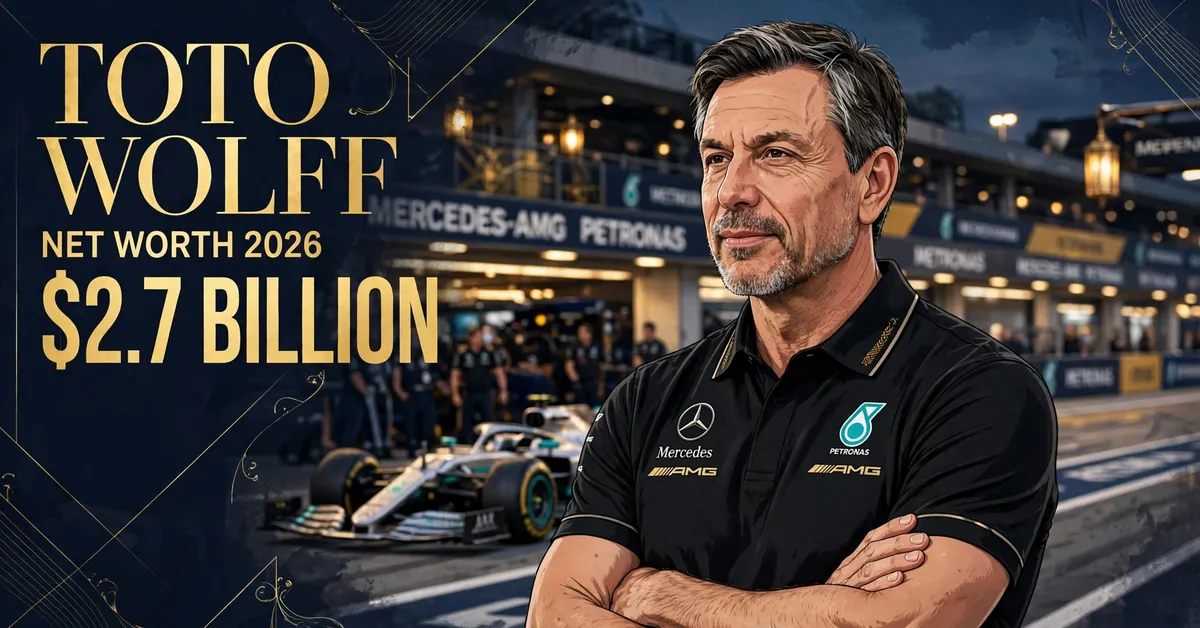
Toto Wolff’s net worth is $2.7 billion in 2026, per Forbes. The Mercedes boss turned a £38M buy-in into a $6B team — and banked $300M selling a slice.
Last updated: November 6, 2026 · By Nathan Cole
Toto Wolff is worth $2.7 billion in 2026, according to Forbes’ real-time billionaires tracker. The Mercedes team principal and CEO is the richest team boss in Formula 1, and his fortune jumped by about $900 million in a single year — not because of his salary, but because of a single deal. In November 2025 he sold a slice of his Mercedes stake to CrowdStrike founder George Kurtz for a reported $300 million, a transaction that valued the team at a record $6 billion.
Wolff is the only team principal on the grid who is also a major owner of his team. He bought in when Mercedes was a midfield outfit worth under €250 million. Thirteen years later he runs the most successful team of the modern era — eight straight Constructors’ Championships from 2014 to 2021 — and the stake he once paid £38 million for is worth close to $1.7 billion on its own. This article gives the number first, then the full story: the racing career that ended before Formula 1, the investment firms that made him rich before he ever ran a team, the Williams years, the Mercedes buy-in, the Kurtz deal in full, the salary, the Aston Martin holding, and the family life in Monaco.
The headline figure needs one honest note up front. Some 2026 listicles still show $2.5 billion. That is the older Forbes figure, from before the Kurtz deal repriced the team. Forbes’ live tracker moved to $2.7 billion after the sale, and ranked Wolff No. 1,534 in the world as of October 2026. The gap between the two numbers is the story of this article.
Quick Facts
| Full Name | Torger Christian “Toto” Wolff |
| Born | January 12, 1972, Vienna, Austria |
| Age in 2026 | 54 years old |
| Height | 6 ft 5 in (1.96 m) |
| Nationality | Austrian |
| Residence | Monaco |
| Net Worth | $2.7 billion (Forbes real-time, 2026; range $2.5–2.7B) |
| Forbes Rank | No. 1,534 (October 2026) |
| Occupation | Team Principal and CEO, Mercedes-AMG Petronas Formula One Team; co-owner |
| Mercedes Stake | ~28.33% after the November 2025 Kurtz deal (was 33.33%) |
| Salary | Reported ~$26 million a year including performance bonuses |
| Other Holdings | ~1% of Aston Martin Lagonda; Marchfifteen / Marchsixteen investments; BBR Rallye Racing |
| Wife | Susie Wolff (married October 2011), managing director of F1 Academy |
| Children | Son Jack (born April 10, 2017); two older children, Benedict and Rosa, from his first marriage |
| Known For | 8 consecutive Constructors’ Championships (2014–2021); 7 drivers’ titles with Mercedes |
How This Estimate Was Made
The anchor is Forbes’ real-time billionaires tracker, which put Wolff at $2.7 billion in 2026 and ranked him No. 1,534 as of October 2026, as reported by Athlon Sports and Yardbarker on November 1, 2026. Celebrity Net Worth agrees at $2.7 billion in its March 2026 update. The figure is an estimate built on one dominant asset: Wolff’s stake in the Mercedes Formula 1 team, priced by a real transaction — the November 2025 sale of part of that stake to George Kurtz at a $6 billion team valuation.
The range in this article is $2.5–2.7 billion. The lower figure is the older Forbes number, still repeated by listicles published before the Kurtz deal repriced the team. It is not a different opinion about the same facts; it is the same fortune measured before and after a valuation event. This article uses $2.7 billion as the headline because it reflects the most recent market-priced valuation of the main asset.
The maths in the valuation section is labeled illustrative wherever it multiplies a reported stake by a reported valuation — that arithmetic is ours, not a published figure. Salary, holdings and deal prices are attributed to the outlet that reported them. Figures no outlet has confirmed are labeled as reported or illustrative.
+
How Much Is Toto Wolff Worth in 2026?
Toto Wolff’s net worth is $2.7 billion in 2026, according to Forbes. The publication’s real-time tracker ranked him No. 1,534 among the world’s richest people as of October 2026, and lists sports as the source of his wealth and Monaco as his residence. Celebrity Net Worth gives the same $2.7 billion figure in its 2026 profile, updated in March 2026.
The jump is what makes the 2026 number different from every earlier one. The Daily Express reported in March 2026 that Wolff’s fortune had risen by £670 million — about $900 million — from the previous year. A year earlier, Forbes had him closer to $1.8 billion. The driver of the rise was not a pay raise. It was the November 2025 transaction that put a hard market price on the Mercedes team for the first time: $6 billion, a record valuation for a Formula 1 team.
That transaction is also why some outlets still show $2.5 billion. Profiles published in late 2025 and early 2026 — before the Kurtz deal closed and before Forbes updated its tracker — carried the older figure, and it has been copied from site to site ever since. InterestingFootball’s January 2026 ranking of F1 team owners still lists Wolff at $2.5 billion. The honest way to read the two numbers is as a before-and-after: $2.5 billion was the fortune at the old valuation; $2.7 billion is the fortune at the new one.
Wolff’s wealth sits almost entirely in one asset. His remaining Mercedes stake, about 28.33% of a team valued at $6 billion, is worth roughly $1.7 billion on the arithmetic alone — and that is before his salary, his Aston Martin shares, his investment portfolio and the $300 million of cash the Kurtz sale put in his hands. The rest of this article breaks down each piece, and shows how a man who started as a driving instructor at the Red Bull Ring ended up the richest team principal in the sport.
The £38 Million Bet: How a 5M Team Became B
When Wolff bought into Mercedes in January 2013, the team was valued at under €250 million — about $165 million, according to reports at the time. He paid a reported £38 million, roughly $58 million at 2013 exchange rates, for a 30% stake. Mercedes had offered him 40%; he took 30%, and Niki Lauda took 10%. The team had won a single race in three seasons as a works outfit. It looked, to most observers, like a midfield project with a famous badge.
Twelve years later the same team was valued at $6 billion. The multiple is the cleanest way to see what happened to Wolff’s money. The table below is illustrative maths — reported stake multiplied by reported valuation — not a published figure.
| Date | Team valuation | Wolff’s stake | Stake value (illustrative) |
|---|---|---|---|
| January 2013 | ~$165 million | 30% | ~$50 million (cost: £38M) |
| December 2020 | Not publicly priced | 33.33% | — |
| November 2025 | $6 billion | 33.33% before sale | ~$2 billion |
| After Kurtz deal | $6 billion | ~28.33% | ~$1.7 billion + ~$300M cash |
The stake grew by roughly 34 times in value between 2013 and 2025. Three forces did the work. The first was winning: eight consecutive Constructors’ Championships turned a midfield team into the sport’s benchmark. The second was the cost cap, introduced in 2021, which turned Formula 1 teams from loss-making marketing arms into profitable businesses — Wolff himself has credited the cap and Liberty Media’s commercial structure for the surge in valuations. The third was the sport’s wider boom: the Netflix effect, new American races, and a young audience pushed every team’s price up, with McLaren and Ferrari valued near $4.7 billion in recent deals before Mercedes set the $6 billion mark.
Wolff’s timing helped at every step. He bought when the team was cheap, raised his stake to a full third in December 2020 when INEOS bought in at the same level, and sold a slice only when the market was willing to pay a record price for it. The £38 million cheque from 2013 is the single best investment ever made by a Formula 1 team principal — and it is the reason the $2.7 billion figure exists at all.
The Kurtz Deal: 0 Million for 5% of Mercedes
In November 2025, Wolff sold a 15% minority interest in his personal ownership entity to George Kurtz, the founder and chief executive of the cybersecurity firm CrowdStrike. Because Wolff’s entity holds one third of the Mercedes team, the 15% slice equalled 5% of the team itself. The deal was announced on November 20–21, 2025, during the Las Vegas Grand Prix weekend, and reported by the Sports Business Journal, the BBC and Forbes.
The financial terms were not officially disclosed. The BBC estimated the price at roughly $300 million, and several outlets put it at €258 million — the same figure in different currencies. What was disclosed was the valuation it implied: $6 billion for the whole team, or £4.6 billion, a record for a Formula 1 team. It passed the previous high-water marks — McLaren at about $5 billion after its 2024 ownership changes, and Ferrari at about $4.7 billion.
Kurtz is not a stranger to the team. CrowdStrike has been a Mercedes partner since 2019, and Kurtz is an endurance racing driver himself, with a win at Le Mans on his record. Under the deal he joined the team’s strategic steering committee as a technology adviser, alongside Mercedes chairman Ola Källenius, INEOS founder Sir Jim Ratcliffe and Wolff. He did not join the main board, and the governance of the team did not change: the three partners remain Mercedes-Benz, INEOS and Wolff’s entity, each holding a third at team level.
Wolff has been blunt that the sale was not the start of an exit. “I have no plan to sell the team and no plan to leave my role,” he said after the Las Vegas race, according to PlanetF1. He described the deal as bringing in a partner who could help the team in the United States market — Kurtz is American, a racer, and a tech entrepreneur — and nothing else. Kurtz has said the same from his side: his focus is CrowdStrike, and he is not positioning himself as Wolff’s successor.
The cash matters to the net-worth figure in a specific way. Before the deal, Wolff’s wealth was almost entirely paper — a stake in a private team with no public market price. The Kurtz sale did two things at once: it turned $300 million of that paper into cash, and it gave the remaining 28.33% a market-tested price. That is why Forbes’ tracker moved. The $900 million jump in a year is not new money appearing from nowhere. It is the market finally putting a number on an asset Wolff already owned.
Who Owns Mercedes F1? The Three-Way Split
The Mercedes-AMG Petronas Formula One Team is owned in thirds. Mercedes-Benz holds one third, the chemicals group INEOS holds one third, and Wolff’s holding company holds one third. That structure dates to December 2020, when INEOS bought in and Wolff raised his own holding from 30% to 33.33% to match.
The Kurtz deal changed the picture inside Wolff’s third without changing the team-level split. Kurtz bought 15% of Wolff’s entity, which is 5% of the team. Wolff’s personal economic interest is now about 28.33% of the team, while his entity still controls its third for governance purposes. Forbes still lists Wolff as controlling 33% in some displays — a reminder that the public rich lists lag the deal paperwork by months, and one more reason the $2.5 billion and $2.7 billion figures circulated side by side.
The structure is unusual in Formula 1. Most team principals are employees. Wolff is an owner-operator: he runs the team, sits on its board, and holds a large equity stake in it. That is also why his pay and his wealth are so hard to separate — and why his fortune moves with the team’s valuation rather than with his salary. When the team is worth $6 billion, the boss is a billionaire. When it was worth $165 million, he was a wealthy investor with a racing habit.
INEOS’s own stake tells the same story from the other side. The Telegraph reported in November 2025 that the INEOS holding, bought three years earlier for $271 million, could now be worth as much as $2 billion at the $6 billion valuation. Every owner in the three-way split has watched the same asset multiply. Wolff is simply the one who also runs it.
Salary: What Mercedes Pays Its Team Principal
Wolff’s salary is the smallest part of his fortune, and the hardest to pin down exactly. Celebrity Net Worth reports his annual compensation at between $20 million and $26 million, including bonuses tied to the team’s commercial performance and championship standings. Other outlets converge on the top of that range: TWSN and Boss Hunting both report about $26 million a year, plus performance bonuses, making him the highest-paid team principal on the grid.
Some reports put the base lower. Several European profiles cite around €20 million a year — roughly $23 million — as his Mercedes pay. The gap between the figures is the gap between base salary and total compensation: bonuses for podiums, wins and championships sit on top of the base, and the exact split is not public. This article uses $26 million as the reported all-in figure and names the €20 million base figure alongside it, because the honest answer is a range, not a single number.
For scale, the salary is about 1% of his net worth per year. A full year of Wolff’s pay would buy roughly half of one percent of the team he co-owns. That is the point the salary section of most profiles misses: for Wolff, the job is not the income. The income is the equity. His three-year contract extension, signed in January 2024, keeps him as team principal and chief executive through the end of the 2026 season — and the deal was reported at the time as a formality, not a negotiation. Nobody in the paddock expected him to go anywhere.
The salary also explains why Wolff can afford to be relaxed about the Kurtz cash. At $26 million a year, the $300 million from the sale is more than a decade of pay in a single transaction. But the sale was never about the cash. It was about pricing the asset — and the price it set made him nearly a billion dollars richer on paper in twelve months.
Early Life in Vienna: A Racer Who Lost His Father at 15
Torger Christian Wolff was born on January 12, 1972, in Vienna, Austria. His father was Austrian with Romanian heritage; his mother is Polish. He did not grow up wealthy. The family lived in the city, and the young Wolff’s first contact with motorsport came the way it comes for most teenagers who end up in racing — a friend, a track day, a borrowed car.
His father died when Wolff was 15. He has spoken rarely about it, but the loss sits at the start of every serious profile of him, including a Forbes feature that frames his career as a climb out of a difficult adolescence. At 17 he was racing. He started in the Austrian Formula Ford Championship in 1992, driving in the Austrian and German series through 1993 and 1994, and he was working as a driving instructor at the Red Bull Ring — then the Österreichring — to pay for it.
The instructor job is the detail that makes the later fortune feel earned rather than inherited. Wolff was teaching other people to drive fast on the same circuit where, decades later, he would watch his own team win. He studied at the Vienna University of Economics and Business while he raced, and the combination — a driver who understood balance sheets — shaped everything that followed. Most team principals come from engineering or from money. Wolff came from the cockpit and the classroom at the same time.
The Racing Career: Formula Ford to the Nürburgring
Wolff never raced in Formula 1, and the fact is worth stating plainly because the question comes up in almost every search about him. His career ran through the junior and endurance ranks, and it was respectable without ever threatening the top. The highlight came early: in 1994, at 22, he won his class at the 24 Hours of Nürburgring, one of the toughest endurance races in the world.
He kept racing after he moved into business. In 2002 he returned to the track in the FIA GT Championship, finishing sixth in the N-GT category and winning a race. Between 2004 and 2006 he raced in Red Bull colours — the forgotten chapter of his career, and a strange piece of foreshadowing given the rivalry that would later define his Mercedes years. With Karl Wendlinger, Dieter Quester and Stefano Zonca he took a class win at the 1000 Miles of Interlagos in 2004; with Quester and Philipp Peter he won the Misano 6 Hours in 2005; and with Quester, Peter and Hans-Joachim Stuck he won the inaugural Dubai 24 Hour race in 2006.
The most vivid episode came in April 2009, when Wolff set out to break the Nürburgring Nordschleife lap record for GT cars in a Porsche 911 RSR. He did it — 7 minutes 3.28 seconds, four seconds inside the record held by Sabine Schmitz, the driver known as the Queen of the Nürburgring. Then, on the same lap, the right rear tyre exploded at 189 mph at Fuchsröhre, pitching the car into a violent spin into the guardrail. He walked away. The lap record stood. The crash is the closest Wolff has come to the kind of accident that ends racing careers, and it arrived the same year he bought into Williams — the year his life tilted from driver to owner.
He also holds a lesser-known distinction from that period: in 2009 he became a lap-record holder on the Nordschleife, and he had already been a winner at Dubai. None of it made him a star. What the racing years gave him was different: a driver’s understanding of what a team needs, a paddock full of contacts, and a reputation as a man who understood both sides of the garage wall. When he started buying teams, people in the sport took his calls.
The Investor: Marchfifteen, Marchsixteen and the HWA Bet
Wolff stopped racing full-time in the late 1990s and turned to the other skill he had been building: investing. In 1998 he founded Marchfifteen, an investment company focused at first on internet and technology firms. In 2004 he founded a second vehicle, Marchsixteen Investments, and widened the brief to mid-sized and listed companies. The two firms are the engine of the fortune outside Formula 1, and they explain why Wolff arrived at Mercedes in 2013 as an investor first and a team boss second.
The early bets were in technology, the sector he knew from the first internet boom. From 2003 he moved into industrial holdings, and in 2006 he invested in HWA AG, the company that runs Mercedes’ DTM programme and builds its GT3 racing engines. HWA was the bridge between the investment world and the motorsport world: a company Wolff understood as a businessman and as a former driver, and one that put him inside Mercedes’ orbit years before the Formula 1 job existed.
Other holdings followed the same pattern — businesses adjacent to racing, where his knowledge was worth more than his money. He invested in BBR Rallye Racing, one of Europe’s largest rally parts dealers, and he co-owns a sports management company with Mika Häkkinen, the two-time Formula 1 world champion. The portfolio is private, and its value is not public, which is why Forbes’ $2.7 billion is built almost entirely on the Mercedes stake. The investment firms are the part of the fortune that cannot be priced from the outside — and the part that made the Mercedes buy-in possible in the first place.
Williams: The First Formula 1 Investment
Wolff’s first Formula 1 investment came in November 2009, when he bought a reported 16% stake in the Williams team and joined its board of directors. Williams was a proud independent team in decline — a former champion living on past glory — and Wolff’s money and judgement arrived at a useful moment. In July 2012 he became the team’s executive director, and that season Williams won the Spanish Grand Prix with Pastor Maldonado, its first victory in eight years.
The Williams years taught Wolff the job he would later do at Mercedes. He learned the boardroom side of a Formula 1 team — sponsors, budgets, engine deals — and he learned it at a team that had to count every pound. He also kept a personal link to the place: his wife Susie was a Williams development driver at the time, and the couple’s connection to Grove survived his departure.
The move to Mercedes, in January 2013, surprised the paddock. Mercedes’ top management had asked Wolff to analyse why their team was not progressing, and he gave them an honest assessment. Then they offered him a job — and a stake. He left Williams, kept a shareholding there for a time, and took control of Mercedes’ motorsport operation as executive director, team principal and co-owner. Williams got a good executive for three years. Mercedes got the man who would run it for the next decade.
The Mercedes Move: January 2013
Mercedes-Benz Grand Prix was not a prize when Wolff arrived. The team had returned as a works outfit in 2010, won a single race in three seasons, and finished fifth in the 2012 Constructors’ Championship. The budget was large and the results were not. The team principal was Ross Brawn, the man who had won titles with Benetton, Ferrari and his own Brawn GP team. Wolff arrived as his eventual replacement, and the handover took a year: Brawn left at the end of 2013, and Wolff took full control.
What followed is the most dominant run in the sport’s history. Mercedes won the Constructors’ Championship in 2014, the first year of the hybrid engine era, and kept winning it every year through 2021 — eight in a row, a record no team had ever set. Lewis Hamilton won six drivers’ titles with the team in that span (2014, 2015, 2017, 2018, 2019, 2020) and Nico Rosberg won one, in 2016, beating his own team-mate in a season-long fight that ended with Rosberg’s immediate retirement.
Wolff’s contribution is hard to separate from the machinery — the hybrid engine was the best on the grid, and the car was usually the fastest — but the paddock credits him with two things the machinery could not supply. The first is the culture: a team that kept winning without splitting apart, through the Hamilton-Rosberg rivalry, through rule changes, through the pressure of being the team everyone else was chasing. The second is the people: Wolff hired and kept the engineers, strategists and pit crew who made the dominance repeatable, and he gave them room to work. The record books show eight titles. The garages show a team that did not fall apart while winning them.

The run ended in 2022, when new ground-effect regulations reset the order and Red Bull took over. Mercedes has spent the seasons since trying to get back to the front, and the 2026 season — the first under a new set of technical regulations — is the team’s next real chance to reset the balance. Wolff’s contract, extended in January 2024, runs through the end of 2026. The timing is not an accident: the regulations, the contract and the team’s rebuild all come due in the same year.
Eight Straight Titles: What the Dominance Was Worth
The eight Constructors’ Championships are the sporting achievement. Their financial value is a separate story, and it runs through the cost cap. Before 2021, Formula 1 teams spent what their owners would fund, and most of them lost money. The cost cap, introduced in 2021, limited spending and forced teams to live within their means. Revenue kept rising — broadcast deals, sponsors, new races — while costs were capped. Teams became profitable. Profitable businesses with scarce entry slots get valued like businesses, not like hobbies.
Wolff has said as much himself. After the Kurtz deal he credited the cost cap and Liberty Media’s commercial structure for the leap in valuations, saying the cap “fundamentally changed our business case” — revenue up, free cash flow up, valuations up. The quote is the closest thing to a public explanation of the $6 billion figure, and it comes from the man who sold the stake.
The dominance years also built the brand that the valuation rests on. Mercedes won 111 of the 160 races between 2014 and 2021, and the team’s silver cars became the visual shorthand for the hybrid era. Sponsors paid for that association, and the team’s commercial income grew with it. The titles were the marketing. The cost cap was the business model. Together they turned a racing team into a $6 billion asset — and turned its boss into a billionaire.
The Horner Rivalry: Mercedes vs Red Bull
No profile of Wolff is complete without Christian Horner, the Red Bull team principal who was his great rival for a decade. The two men ran the two teams that split the modern era between them — Mercedes from 2014 to 2021, Red Bull from 2022 onward — and their public exchanges became a fixture of the sport. The rivalry peaked in 2021, when Hamilton and Max Verstappen fought for the drivers’ title down to the final lap of the final race in Abu Dhabi, and the two team principals spent the season arguing in press conferences, in stewards’ hearings and, on occasion, through the media.
The contrast between them is also a financial one. Horner’s net worth is reported at around $50 million, with a salary of about $10 million a year — substantial money, and roughly one fifty-fourth of Wolff’s fortune. The difference is ownership: Horner was an employee who ran a team; Wolff is an owner who runs one. When Red Bull won, Horner got a bonus. When Mercedes won, Wolff’s equity went up.
Horner left Red Bull in mid-2025, midway through the season, with a reported settlement of between £50 million and £80 million, according to the Daily Mirror in January 2026. By early 2026 he was reported to be part of a consortium in talks to buy the 24% stake in Alpine held by the investment firm Otro Capital — a move that would, if it happened, make him an owner for the first time. Wolff’s old rival may yet follow his model. The irony is not lost on the paddock: the man who spent a decade arguing with the owner-operator is now trying to become one.
Beyond the Pit Wall: Aston Martin, BBR and the Rest
Wolff’s money does not all sit in Brackley. In April 2020 he bought a 4.95% stake in Aston Martin Lagonda, the British carmaker, at a moment when its shares were cheap and its Formula 1 future was uncertain. Later rights issues diluted the holding to about 0.95% — still a meaningful slice of a listed company, and a useful hedge: if Aston Martin’s road-car business recovers, the stake is worth more than he paid for it, and he holds it alongside the man who runs the rival team, Lawrence Stroll.
The rest of the portfolio is private and harder to price. BBR Rallye Racing, one of Europe’s largest rally parts dealers, sits in the Marchsixteen stable. The sports management company he co-owns with Mika Häkkinen manages drivers and commercial deals. Marchfifteen and Marchsixteen continue to invest, and Wolff has kept the habit of a working investor: he reads deals, he takes meetings, and he has said more than once that the investment side of his life is the part he would keep if the racing stopped.
None of these holdings is individually large next to the Mercedes stake. Together they matter for a different reason: they are the proof that the fortune was not a single lucky bet. Wolff was a successful investor before he bought into Mercedes — the Williams stake, the HWA investment, the technology portfolio — and the Mercedes buy-in was the biggest application of a skill he had spent fifteen years building, not a first throw of the dice.
Life in Monaco: Susie Wolff, Jack and the Family
Wolff lives in Monaco with his wife Susie and their son Jack. The move is practical as much as it is luxurious: Monaco is where the Formula 1 paddock lives, where the tax treatment suits a man whose income is mostly capital, and where the commute to the races is short. Forbes lists Monaco as his residence, and the family home is the base from which both Wolffs run their parallel careers in the sport.
Susie Wolff is a public figure in her own right. Born in Oban, Scotland, on December 6, 1982, she raced in DTM, served as a Williams development driver, ran the Venturi Formula E team, and since 2023 has been the managing director of F1 Academy, the development series for women drivers. She and Toto met in the DTM paddock around 2010, he proposed in Venice in 2011, and they married in Capri in October 2011. Their son Jack was born on April 10, 2017, in Zurich. In January 2026 Susie said Jack had taken up karting — the family business, starting a generation early.
Wolff has two older children, Benedict and Rosa, from his first marriage to Stephanie Wolff, which lasted about a decade. Susie is their stepmother, and by every public account the blended family is close. The children are kept out of the spotlight: no public profiles, no social media presence, no paddock appearances beyond the occasional family photograph. Wolff is protective of that line, and this article respects it.

The Monaco life is visible in glimpses rather than in detail. Wolff is 6 ft 5 in, usually in a team polo or a dark suit, usually on the pit wall with a headset. He is known for the intensity of his radio messages during races and for a management style that is direct to the point of bluntness — a style that has produced both loyal lieutenants and public rows. The lifestyle reporting around him tends to focus on the wrong things: the cars, the watch, the apartment. The money that matters is the equity, and the equity sits in Brackley, not in the harbour.
Wolff vs the Other F1 Billionaires
Wolff is the richest team principal in Formula 1, but he is not the richest person in the paddock. That distinction belongs to the owners, and the gap between the two groups is the clearest illustration of what equity does that salary cannot.
| Person | Role | Net worth (2026) | Source of wealth |
|---|---|---|---|
| Toto Wolff | Mercedes team principal, CEO, co-owner | $2.7 billion (Forbes) | ~28% of Mercedes F1 + salary |
| Lawrence Stroll | Aston Martin F1 owner | ~$3.8 billion (Forbes) | Fashion (Michael Kors sale) + Aston Martin |
| Lewis Hamilton | Ferrari driver (ex-Mercedes) | ~$450 million (The Scotsman) | Salary, endorsements, investments |
| Christian Horner | Ex-Red Bull team principal | ~$50 million (reported) | Salary + 2025 exit settlement |
Stroll is the nearest comparison, and the contrast is instructive. Stroll built his fortune outside racing — the Michael Kors share sale is the core of it — and then bought into Formula 1. Wolff built his fortune inside racing, starting with a £38 million stake in a single team. Stroll is richer by about $1.1 billion, but Wolff’s fortune grew faster: Stroll’s wealth has held broadly steady in 2026, according to Motorsport Magazine, while Wolff’s jumped $900 million in a year.
Hamilton’s figure shows the ceiling for a driver. At about $450 million he is the richest driver on the grid, and his fortune is roughly a sixth of his old boss’s. Verstappen, the sport’s biggest earner as a driver, sits near £168 million by the Daily Mirror’s count — less than a tenth of Wolff’s. The lesson of the table is simple, and it is the lesson of this whole article: in modern Formula 1, owning the team pays more than driving for it, and more than running it for a salary. Wolff is the only person on the grid who does all three at once.
What 2026 Holds for Wolff and Mercedes
The 2026 season is a hinge year for Mercedes and for Wolff. New technical regulations have reset the competitive order, with eleven teams on the grid including the new Audi and Cadillac entries, and Lando Norris defending a first drivers’ title won with McLaren in 2025. Mercedes has spent four seasons chasing Red Bull and then McLaren, and the regulation change is the team’s best chance in years to get back to the front on merit rather than by development race.
Wolff’s own position is secure either way. His contract runs through the end of 2026, and there is no public sign that either side wants it to end there. The Kurtz deal removed the one question that used to hang over him — whether he would cash out — by answering it in the smallest possible way: he sold 5% of the team, kept the rest, kept the job, and kept the board seat. The structure that made him a billionaire is intact.
The longer question is succession. Wolff is 54. He has run Mercedes for thirteen years, longer than any team principal has run a single top team in the modern era. He has said he has no plan to leave, and the Kurtz deal was structured so that it did not need a successor. But the stake itself is the succession plan in one sense: a 28% holding in a $6 billion team is an asset his family will hold long after he stops standing on the pit wall. The $2.7 billion figure is a snapshot of a fortune that was built in thirteen years. The next thirteen will decide whether it was a peak or a plateau.
Sources & Reporting
This profile was reported from named sources, all checked in November 2026. The $2.7 billion net worth, the No. 1,534 Forbes rank, the Monaco residence and the sports source of wealth come from Forbes’ real-time tracker as reported by Athlon Sports and Yardbarker on November 1, 2026; Celebrity Net Worth agrees at $2.7 billion in its March 2026 update. The $900 million / £670 million one-year rise comes from the Daily Express, March 12, 2026. The older $2.5 billion figure is carried by InterestingFootball’s January 2026 ranking and by Forbes’ own December 2025 profile, and is treated in this article as the pre-deal figure.
The Kurtz deal — the 15% sale of Wolff’s holding entity, the 5% of the team, the $6 billion (£4.6 billion) valuation, the ~$300 million price, Kurtz’s steering-committee role and the unchanged governance — is reported from the Sports Business Journal (November 21, 2025), the BBC via Grandprix.com, PlanetF1 and the Financial Times via Newsible Asia. The 28.33% post-deal stake comes from Celebrity Net Worth and BizofSpeed (March 2026). The 2013 buy-in price of £38 million comes from F1 Oversteer; the sub-€250 million / ~$165 million team valuation at the time comes from Tournaments.com and BizofSpeed. The valuation-maths table is illustrative arithmetic from those reported figures, not a published number.
The salary range ($20–26 million including bonuses) comes from Celebrity Net Worth, with the ~$26 million figure also reported by TWSN and Boss Hunting, and the ~€20 million base figure from Tournaments.com and the Forbes profile republished by Arizona Sports Fans. The three-year contract extension of January 2024 is reported by Boss Hunting and Paddock & Percent. The racing record — Formula Ford from 1992, the 1994 Nürburgring 24 Hours class win, the 2002 FIA GT season, the Red Bull-colours wins at Interlagos, Misano and Dubai, and the 2009 Nordschleife lap record of 7:03.28 and the tyre failure at 189 mph — follows the Mercedes/SAL Racing profile, Crash.net and Skill Nation. The investment history (Marchfifteen 1998, Marchsixteen 2004, HWA AG 2006, BBR Rallye Racing, the Häkkinen management company) follows the same sources. The Williams investment (November 2009, executive director July 2012) and the January 2013 Mercedes move follow Athlon Sports, Skill Nation and the Forbes-derived account republished by Arizona Sports Fans.
The family details — Susie Wolff’s birth and career, the October 2011 Capri wedding, Jack’s birth on April 10, 2017 in Zurich, the two older children from the first marriage, the Monaco home, and Jack’s karting in January 2026 — come from Athlon Sports (November 1, 2026), PlayersBio, BuzzNigeria and VisionF1. The peer figures are Forbes via Motorsport Magazine (Lawrence Stroll, ~$3.8 billion), The Scotsman via Unifresher (Lewis Hamilton, ~$450 million), and reported figures for Christian Horner (~$50 million net worth, ~$10 million salary, £50–80 million settlement, Alpine consortium talks) from Crix11 and the Daily Mirror (January 31, 2026). The 2026 season context — new regulations, Norris as defending champion, eleven teams including Audi and Cadillac — comes from Unifresher. Where sources disagreed, the article names the disagreement and gives the reason for the figure chosen. Figures that no outlet has confirmed are labeled as reported or illustrative. Corrections: see our corrections policy on the About Us page; if a figure in this article changes, it will be updated with a dated note.
Toto Wolff Net Worth — Frequently Asked Questions
What is Toto Wolff’s net worth in 2026?
Toto Wolff’s net worth is $2.7 billion in 2026, according to Forbes’ real-time billionaires tracker, which ranked him No. 1,534 in the world as of October 2026. Celebrity Net Worth agrees at $2.7 billion. Some listicles still show $2.5 billion — that is the older Forbes figure from before the November 2025 Kurtz deal repriced the Mercedes team at $6 billion.
Is Toto Wolff a billionaire?
Yes. Toto Wolff is a billionaire, and the richest team principal in Formula 1. Forbes puts his fortune at $2.7 billion in 2026, built almost entirely on his ownership stake in the Mercedes-AMG Petronas Formula One Team. He is the only team principal on the grid who is also a major owner of his team.
How much of Mercedes does Toto Wolff own?
Wolff owns about 28.33% of the Mercedes Formula 1 team after the November 2025 deal in which he sold 15% of his personal holding company to CrowdStrike founder George Kurtz. Before the deal he owned a full third (33.33%). His holding company still controls its third of the team for governance purposes, alongside Mercedes-Benz and INEOS, which each hold a third.
Why did Toto Wolff sell part of Mercedes to George Kurtz?
Wolff sold 15% of his holding entity — 5% of the team — to Kurtz in November 2025 for a reported $300 million, valuing Mercedes at a record $6 billion. He has said the sale was not an exit: he has no plan to sell the team or leave his role. Kurtz, a racer and tech entrepreneur whose CrowdStrike has sponsored Mercedes since 2019, joined the team’s strategic steering committee as a technology adviser, bringing help in the US market.
What is Toto Wolff’s salary?
Wolff’s Mercedes salary is reported at around $26 million a year including performance bonuses, according to Celebrity Net Worth, which gives a $20–26 million range. Some European reports put his base pay closer to €20 million (about $23 million), with bonuses on top. Either way he is the highest-paid team principal in Formula 1 — though the salary is only about 1% of his net worth per year; the fortune comes from his equity, not his pay.
How did Toto Wolff make his money?
Wolff made his money in three stages. First, as an investor: he founded the investment firms Marchfifteen (1998) and Marchsixteen (2004) and invested in companies including HWA AG. Second, in Formula 1 ownership: he bought into Williams in 2009. Third, at Mercedes: he bought a 30% stake for a reported £38 million in January 2013, raised it to a third in 2020, and watched the team grow from a ~$165 million valuation to $6 billion after eight straight Constructors’ Championships.
Who is Toto Wolff’s wife?
Toto Wolff’s wife is Susie Wolff, a Scottish former racing driver and the managing director of F1 Academy. They met in the DTM paddock around 2010, married in Capri in October 2011, and live in Monaco with their son Jack, born on April 10, 2017. Susie previously raced in DTM, was a Williams development driver and ran the Venturi Formula E team. Wolff also has two older children, Benedict and Rosa, from his first marriage.
Did Toto Wolff race in Formula 1?
No — Toto Wolff never raced in Formula 1. He raced in Austrian and German Formula Ford from 1992, won his class at the 1994 24 Hours of Nürburgring, competed in the FIA GT Championship in 2002, and won the inaugural Dubai 24 Hour race in 2006. In 2009 he set a Nürburgring Nordschleife lap record of 7:03.28 in a Porsche 911 RSR — on the same lap his rear tyre exploded at 189 mph. He moved into investing and team ownership instead of chasing an F1 seat.
About the author: Nathan Cole covers celebrity wealth, sport, and the business of fame for Guide Net Worth. He reports net-worth figures only from named outlets, gives ranges where sources disagree, and updates every profile when new reporting lands.
References & Sources
This article has been fact-checked and verified against multiple public sources, financial disclosures, SEC filings, Forbes reports, Celebrity Net Worth databases, and official records. All net worth estimates are based on publicly available information and financial analysis.