Anthony Joshua biography 2026: the Watford bricklayer who won Olympic gold in 2012, unified the heavyweight division twice, and built a £240M fortune.
Last updated: 6 November 2026 | By Nathan Cole
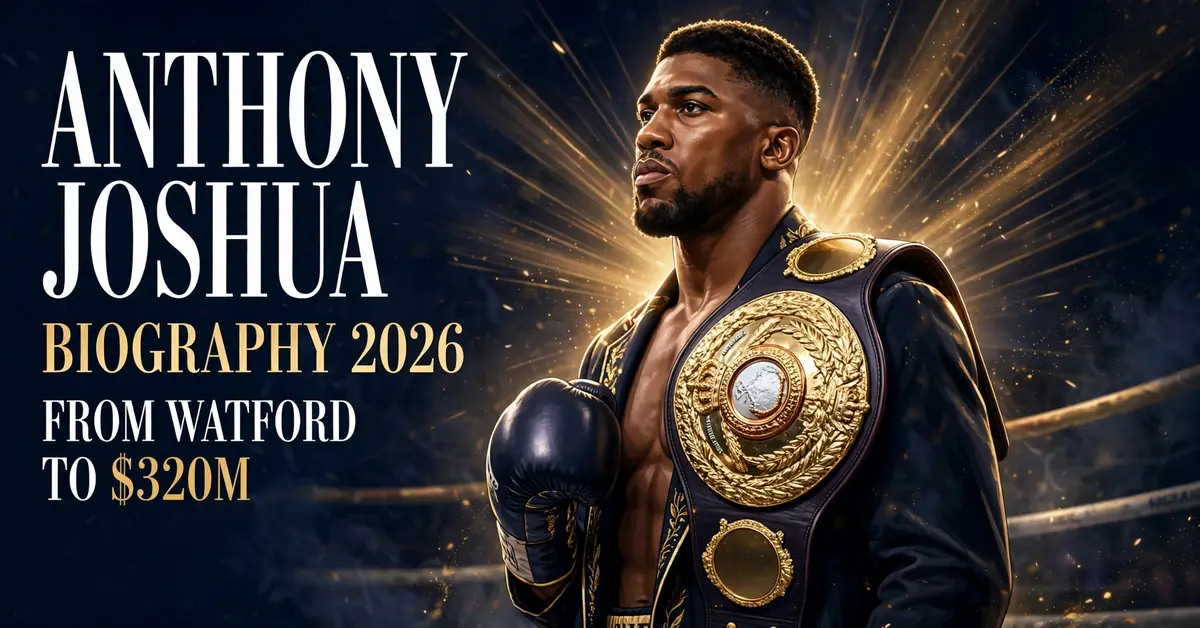
Anthony Joshua is 37 years old, a two-time unified heavyweight world champion, an Olympic gold medallist, and — according to the Sunday Times Rich List published in 2026 — the eighth-richest sports figure in Britain, with a fortune of £240 million (about $320 million). He was born Anthony Oluwafemi Olaseni Joshua on 15 October 1989 in Watford, Hertfordshire, and he did not throw his first punch in a boxing gym until he was 18. Nineteen years later his professional record stands at 30 wins and four defeats, with 27 knockouts, and he is weeks away from the fight British boxing has waited a decade for: Tyson Fury, reported for 11 December 2026 in Cardiff.
The story is not a straight line. Joshua won Olympic gold at London 2012, unified three world titles by the age of 28, lost them all to Andy Ruiz Jr. in one of the biggest shocks in heavyweight history, won them back six months later, then lost twice to Oleksandr Usyk and was knocked out by Daniel Dubois at Wembley in September 2024. Each defeat was supposed to end him. Each time he came back — most recently in July 2026, when he was knocked down twice in the first round by the little-known Albanian Kristian Prenga in Jeddah and still stopped him in the second.
This biography covers the whole arc: the Watford childhood split between England and Nigeria, the late start at Finchley Amateur Boxing Club, the amateur run to Olympic gold, the title reigns and the defeats, the money — purses, endorsements and the businesses behind the £240 million figure — and the family life he keeps out of the cameras. Every figure below is tied to the outlet that reported it, and where sources disagree, the range is shown rather than hidden.
Quick Facts: Anthony Joshua at a Glance
| Full name | Anthony Oluwafemi Olaseni Joshua |
| Born | 15 October 1989, Watford, Hertfordshire, England (age 37) |
| Nationality | British (Nigerian heritage, Yoruba) |
| Height / reach | 6 ft 6 in (198 cm) / 82 in (208 cm) |
| Division / stance | Heavyweight / orthodox |
| Professional record | 30 wins, 4 losses, 27 knockouts (as of 25 July 2026) |
| Biggest wins | Olympic gold London 2012; Wladimir Klitschko (TKO R11, 2017); Joseph Parker (UD, 2018); Jake Paul (KO R6, 2025) |
| Defeats | Andy Ruiz Jr. (2019), Oleksandr Usyk (2021, 2022), Daniel Dubois (2024) |
| Net worth 2026 | $150 million to $320 million; Sunday Times: £240 million |
| Honours | MBE (2013), OBE (2018) |
| Family | Son Joseph, born October 2015; not married |
| Next fight | Tyson Fury, reported for 11 December 2026, Cardiff (Netflix) |
How This Estimate Was Made
Joshua has never disclosed his finances, and no public filing shows his full wealth. This profile therefore publishes a range, not a single figure. The top of the range is the Sunday Times Rich List 2026, which put him at £240 million (about $320 million) and ranked him the eighth-richest sports figure in Britain — a figure ESPN cited on 22 October 2026. The bottom is CelebrityNetWorth’s long-standing estimate of about $150 million. Between the two sit reported career purses of more than $275 million gross, endorsement income estimated at $8 million to $15 million a year, and the value of his companies, 258 Management and Sparta Promotions Ltd. Stale figures still circulating — a £107 million number from a 2020 young-athletes list — are out of date and are not used here.
+
Early Life: Watford, Nigeria and Two Worlds
Anthony Oluwafemi Olaseni Joshua was born on 15 October 1989 in Watford, Hertfordshire, to Nigerian parents who had both grown up in Sagamu, in Ogun State. His mother is Yeta Odusanya; his father, Robert Joshua, is of Nigerian and Irish descent. The family background runs deep: Joshua is Yoruba, and through his great-grandfather he holds aristocratic rank among the Yoruba people — his great-grandfather was one of the earliest Nigerians to trade with Europeans through the United Africa Company. His grandmother was Irish. That mix — Watford and Sagamu, English and Yoruba — has shaped how Joshua talks about himself ever since, and he has worn it literally: one of his three tattoos is an outline of Africa with Nigeria highlighted, on his right shoulder.
Some of his earliest years were spent in Nigeria, where he attended boarding school at Mayflower School in Ikenne. He was still a boy when his parents divorced — he was 12, in Year 7 — and he moved back to England with his mother. The family settled in Garston, Hertfordshire, on the Meriden Estate, an area British Boxing News describes as known for persistent problems with crime and drugs. Joshua went to Kings Langley Secondary School, about a mile from Junction 20 of the M25, and he was a natural athlete before he was a boxer: he broke the school’s Year 9 100 metres record with a time of 11.6 seconds, and he played football with real promise.
School did not hold him. He left with few qualifications and went to work on construction sites as a bricklayer — the job he still names when people ask where he came from. It was not a romantic origin story at the time. It was a young man from a rough estate with no plan, earning a wage with his hands. The turn came in 2007, when he was 18 and a cousin suggested he try boxing. He walked into Finchley Amateur Boxing Club in North London, and the club’s coach, Sean Murphy, saw something worth working with. Murphy remains a close friend today.
Finchley ABC: Starting Boxing at 18
Eighteen is late to start boxing. Most Olympic champions have been in a gym since they were eight or nine. Joshua had three years to make up a decade, and the Finchley gym gave him the structure his life outside it lacked. Training was discipline, routine and an outlet for the energy that had been building up since his teens. Under Murphy’s coaching, the raw material — 6 ft 6 in, fast hands, a sprinter’s legs — started to look like a heavyweight.
The progress was startling. Within two years he was winning national titles. He won the ABA heavyweight championship in 2010 and again in 2011, and in 2011 he was named Amateur Boxer of the Year by the British Boxing Writers’ Club. The speed of the rise is the first thing to understand about Joshua: he did not climb boxing’s ladder rung by rung. He sprinted up it, because he had started so late that there was no time to do anything else.

Amateur Career and Olympic Gold at London 2012
Joshua’s amateur peak came fast. At the 2011 World Championships in Baku he won the super-heavyweight silver medal, losing the final to Azerbaijan’s Magomedrasul Majidov. A year later, at the London Olympics, he fought in front of a home crowd at ExCeL and won gold in the super-heavyweight division, beating Italy’s Roberto Cammarelle in the final. He was the first British boxer to win Olympic gold in the division, and the medal made him a national figure overnight.
The amateur record is usually given as around 40 wins against three defeats, though British Boxing News notes the often-quoted 48-3 figure is likely inflated by walkovers, and 40-3 is the more realistic count. Either way, the numbers tell the same story: a fighter who reached the top of the amateur sport in about five years, from his first gym session to an Olympic gold medal. He turned professional within a year of the Games, signing with Eddie Hearn’s Matchroom Boxing.
Turning Professional: The Matchroom Rise
Joshua made his professional debut on 5 October 2013 at the O2 Arena in London, stopping Emanuele Leo inside two rounds. The pattern of the next two years was the same almost every time out: an opponent, a short night, a knockout. He won the British heavyweight title in May 2015 against Kevin Johnson, then added the Commonwealth title against Gary Cornish that September. By the end of 2015 he had fought 15 times and stopped all 15 opponents.
The first real test came on 12 December 2015, against Dillian Whyte — a man Joshua had lost to as an amateur in 2009. Whyte hurt him in the second round, the first time a professional opponent had done so, and Joshua answered by stopping him in the seventh. The fight did two things: it proved Joshua could take a punch and come back, and it set up a rivalry that would run for the next decade. Four months later, on 9 April 2016, he fought Charles Martin for the IBF world heavyweight title at the O2 and won it with a second-round knockout. He was 26, a world champion, and barely three years into his professional career.
The Klitschko Night: Wembley, April 2017
The fight that made Joshua a star was the one he nearly lost. On 29 April 2017, in front of a post-war British record crowd of about 90,000 at Wembley Stadium, he faced Wladimir Klitschko — the long-reigning former champion, a man who had held the heavyweight division for a decade. Joshua knocked Klitschko down in the fifth round. Klitschko knocked Joshua down in the sixth, the first time Joshua had been floored as a professional. Then, in the eleventh, Joshua came back with a right uppercut and a flurry that stopped the Ukrainian.
The win gave Joshua the vacant WBA (Super) and IBO heavyweight titles to go with his IBF belt, and it did something no purse figure can measure: it proved he could survive a crisis in the ring and still find a finish. The fight was named Fight of the Year by several outlets, and it turned Joshua from a British attraction into a global one. He was 27, and he held three of the four major heavyweight belts.
Unification: Parker, Povetkin and the Top of the Division
Joshua’s next step was unification. On 31 March 2018 he fought Joseph Parker at the Principality Stadium in Cardiff and won a unanimous decision, adding the WBO title. It was the first time in his career a fight had gone the distance, and the first time he had fought a full twelve rounds — a detail that mattered, because it answered the question of whether he could box patiently when the knockout did not come early. He now held the WBA (Super), IBF, WBO and IBO titles: three of the four major belts, with only the WBC — held by Deontay Wilder — outside his grasp.
He defended against Alexander Povetkin on 22 September 2018, stopping the Russian in the seventh round at Wembley, and against Kubrat Pulev on 12 December 2020, knocking the Bulgarian out in the ninth. Between those defences, though, came the night that changed everything.
The Ruiz Shock and the Saudi Rematch
On 1 June 2019, Joshua made his American debut at Madison Square Garden against Andy Ruiz Jr., a late replacement for Jarrell Miller. Ruiz was a 25-1 underdog. He knocked Joshua down four times and stopped him in the seventh round. It was one of the biggest upsets in heavyweight history, and it cost Joshua his titles, his unbeaten record and — for a time — his reputation. The reaction in Britain was brutal. The questions were direct: had he been overprotected? Was his chin the problem? Was the whole project a creation of careful matchmaking?
Joshua answered the only way that counts in boxing: he took the rematch immediately, on 7 December 2019 in Diriyah, Saudi Arabia, and boxed a disciplined twelve rounds to win a unanimous decision and take his belts back. He weighed less, moved more, and refused to trade with a man who had already knocked him out once. The rematch win was less spectacular than the Klitschko night and more important: it showed a fighter who could learn, adjust and execute a plan under the heaviest pressure of his career.
Usyk, Dubois and the Hardest Years
The next two defeats came against a better boxer. Oleksandr Usyk, the former undisputed cruiserweight champion, outboxed Joshua over twelve rounds at the Tottenham Hotspur Stadium on 25 September 2021 to take his titles, then beat him again on 20 August 2022 in Jeddah, this time by split decision. Joshua’s behaviour after the second defeat — he threw two of Usyk’s belts out of the ring in frustration before apologising — was the lowest public moment of his career, and he has said since that he was ashamed of it.
He rebuilt under new trainers — Derrick James in 2023, then Ben Davison, who has been in his corner since late 2023. The rebuild produced four straight wins: a points victory over Jermaine Franklin in April 2023, a seventh-round knockout of Robert Helenius that August, a fifth-round stoppage of Otto Wallin in December 2023, and a devastating second-round knockout of former UFC champion Francis Ngannou in Riyadh on 8 March 2024. The Ngannou win, in particular, reminded everyone what Joshua’s power looks like when it lands clean.
Then came Daniel Dubois. On 21 September 2024, back at Wembley in front of 96,000 people, Joshua fought for the IBF title and was knocked down four times before being stopped in the fifth round. It was his third defeat in four fights against elite opposition, and at 34, the obituaries were written again. Joshua did not fight for fifteen months after that night. He had elbow surgery, stepped away from the sport, and let the noise die down.
Jake Paul, Prenga and the 2026 Comeback
The comeback began in the most 2026 way possible: against a YouTuber. On 19 December 2025, Joshua fought Jake Paul at the Kaseya Center in Miami, live on Netflix, over eight three-minute rounds with 10 oz gloves and a 245 lb weight limit for Joshua. Paul had been scheduled to fight Gervonta Davis before that bout was cancelled; Joshua, who had not fought since the Dubois defeat, took the date. He knocked Paul out in the sixth round. Paul broke his jaw in the defeat, needed two operations, and was suspended from boxing indefinitely. The fight was a mismatch on paper, and it played out that way — but it put Joshua back in a ring, back on a winning run, and back in front of a global Netflix audience.
The next fight was stranger still. On 25 July 2026, at the Jeddah Superdome in Saudi Arabia, Joshua faced Kristian Prenga, an Albanian puncher who had won all 20 of his fights by knockout and entered the bout 20-1. Prenga knocked Joshua down twice in the first round — the first knockdown came 19 seconds in, before Joshua had thrown a punch. Joshua got up, steadied himself, and stopped Prenga at 2:43 of the second round with a right hand that sent the Albanian through the ropes. The win moved his record to 30-4 with 27 knockouts, and it kept the Fury fight alive. It also showed, for the second time in his career, that Joshua’s best quality might be the one nobody credits him with: he gets up.
The Fury Fight: December 2026
The fight British boxing has waited a decade for is now signed. Joshua and Tyson Fury are set to meet in the final quarter of 2026 in the United Kingdom, live on Netflix, with the event backed financially by Turki Alalshikh, chairman of Saudi Arabia’s General Entertainment Authority. The date reported by multiple outlets is 11 December in Cardiff, with the WBA super heavyweight title at stake. Promoter Eddie Hearn confirmed at the Prenga post-fight press conference that the bout is signed.
It is the biggest fight of both men’s careers, and it arrives late: Fury is 38, Joshua is 37, and both have lost fights they were expected to win. That is also why it matters. The winner settles the argument about the best British heavyweight of their generation; the loser has nowhere left to go. Joshua’s preparation for it runs through the same team that rebuilt him after Dubois, and the Prenga scare — two knockdowns in a tune-up — is the warning that the Fury fight will not be won on reputation.
Style, Trainers and the Rebuild
Joshua’s style has always been built on physical gifts: a long jab, a heavy right hand, and footwork that owes something to the sprinter he was at school. At his best — against Klitschko, against Povetkin — he boxes behind the jab, controls distance, and finishes with combinations rather than single shots. At his worst, he has looked stiff and hesitant, most obviously in the first Usyk fight, where he tried to outbox a better boxer instead of imposing his size and power. The second Usyk fight was closer, and the Dubois defeat showed the other failure mode: he walked onto punches early and never recovered.
The trainer changes track the rebuild. Robert McCracken coached him from the amateur days through the first title reigns and the Ruiz rematch — the longest partnership of his career. After the Usyk defeats, Joshua moved to Derrick James in Texas for 2023, then to Ben Davison, who has been in his corner since late 2023. Davison’s work showed in the Ngannou fight: Joshua was patient for a round, then finished the job in the second with the kind of composed power that had been missing. The Prenga fight tested the other side of Davison’s coaching — what a fighter does after being knocked down twice — and Joshua passed it by getting up, resetting, and landing the right hand that ended the fight.
One detail from the Prenga camp is worth noting for the Fury fight. Joshua weighed 251 lb for Prenga, his lightest in years, against an opponent who weighed 261.4 lb. The lighter weight was a choice: speed and stamina over bulk, with Fury’s movement in mind. At 37, Joshua is no longer the fighter who could rely on youth to carry him through a bad round. The version fighting Fury in December is a veteran who has learned, expensively, what happens when the plan fails — and who has now survived that failure three times and come back.
Net Worth, Purses and the Business of Being AJ
The money behind Joshua’s career is better documented than most boxers’, because so much of it passed through public companies and reported purses. The table below uses reported figures only; where a purse was never officially confirmed, the range is given.
| Fight | Date | Reported purse / earnings |
|---|---|---|
| vs Wladimir Klitschko | Apr 2017 | About $15 million each, plus pay-per-view upside |
| vs Joseph Parker | Mar 2018 | About $20 million reported |
| vs Andy Ruiz Jr. I & II | Jun & Dec 2019 | About $25 million (I) and $60 million-plus (II, Saudi fee) |
| vs Oleksandr Usyk II | Aug 2022 | Highest reported payday, about $75 million |
| vs Jake Paul | Dec 2025 | Reported $30 million to $50 million range |
| Career purses (gross) | 2013–2026 | More than $275 million |
The purse table explains the top of the net-worth range. The Sunday Times put Joshua at £240 million in its 2026 Rich List, ranking him eighth among British sports figures — ahead of Fury, whose fortune the same list put at £162 million. ESPN cited the £240 million figure on 22 October 2026, noting that sponsorship income had pushed Joshua ahead of his rival despite the defeats. CelebrityNetWorth, which values athletes more conservatively, holds him at about $150 million. The honest figure is the range: $150 million to $320 million, with the Sunday Times number the best-sourced single estimate.
The endorsements are part of the gap between purse money and net worth. Joshua’s endorsement income has been estimated at $8 million to $15 million a year, and it held steady through the defeats — a sign of how carefully his team separated the sporting results from the commercial brand. His deals have included Under Armour, Hugo Boss, Beats and Lucozade. Forbes put his on-field earnings at $75 million in its May 2024 assessment, a figure that covered purses and endorsements together.
The business side runs through two companies. 258 Management is his management and investment vehicle, named for the 258 area code of his old neighbourhood. Sparta Promotions Ltd is the company through which much of his non-boxing commercial activity is run. He also holds a stake in DAZN, the streaming service that has broadcast his recent fights, and an investment in the Alpine Formula 1 team. In 2018 he set up the Anthony Joshua Foundation to support young people through education, skills training and community services, and he founded the AJ Boxing Club to give young people in his area the same start the Finchley gym gave him.
Personal Life, Family and Philanthropy
Joshua guards his private life more tightly than almost any British sports star of his stature. He is not married. He has a son, Joseph, born in October 2015, and he has spoken about fatherhood as the thing that changed his priorities — the reason, he has said, that he trains the way he does and thinks about money the way he does. Joseph’s mother has been reported as Nicole Osbourne, a former partner from Joshua’s youth, though Joshua himself rarely discusses the relationship.
He lives mostly in North London, near the gyms where he trains, and his public appearances outside boxing are usually tied to his foundation or his business interests rather than celebrity events. The honours tell their own story about how Britain sees him: he was appointed MBE in 2013, a year after the Olympic gold, and OBE in 2018, after he had unified the division. He is, by the usual measures, one of the most decorated British sportsmen of his generation — and one of the least interested in talking about himself.
Legacy: Where Joshua Stands in 2026
Joshua’s place in heavyweight history is still being written, and the Fury fight will decide much of it. The case for him is straightforward: Olympic gold, two spells as unified world champion, wins over Klitschko, Parker, Povetkin and Pulev, and a career that rebuilt British heavyweight boxing as a stadium sport — the 90,000 at Wembley in 2017 and the 96,000 at Wembley in 2024 were both, in large part, his crowds. The case against him is the defeats: Ruiz, Usyk twice, Dubois. He has never beaten the best heavyweight of his era, and he has never held the WBC belt.
What is not in doubt is the scale of what he built. Compare him with his peers on this site: Tyson Fury’s biography covers the rival he finally meets in December, and Oleksandr Usyk’s biography covers the man who beat him twice. Joshua’s fortune, at £240 million, sits ahead of Fury’s £162 million on the same Rich List — the commercial crown, at least, is already his. For the full picture of his physical profile, see Anthony Joshua’s height profile.
If he beats Fury in December, the story becomes one of the great comebacks in British sport: a bricklayer who started boxing at 18, won Olympic gold, lost everything twice, and ended his career by beating his generation’s other great heavyweight. If he loses, he retires as a two-time champion who made a fortune and filled stadiums — and the debate about his place will run for years. Either way, the biography is already remarkable. He started late, learned fast, and kept getting up.
Frequently Asked Questions
How old is Anthony Joshua in 2026?
Anthony Joshua is 37 years old. He was born on 15 October 1989 in Watford, Hertfordshire, England, and he turned 37 on 15 October 2026.
What is Anthony Joshua’s net worth in 2026?
Anthony Joshua’s net worth is estimated at $150 million to $320 million in 2026. The Sunday Times Rich List 2026 put him at £240 million (about $320 million), ranking him the eighth-richest sports figure in Britain, while CelebrityNetWorth estimates about $150 million. His career fight purses alone exceed $275 million gross.
What is Anthony Joshua’s boxing record?
Anthony Joshua’s professional record is 30 wins and 4 losses, with 27 knockouts, as of his win over Kristian Prenga on 25 July 2026. His four defeats came against Andy Ruiz Jr. (2019), Oleksandr Usyk (2021 and 2022) and Daniel Dubois (2024).
When did Anthony Joshua win Olympic gold?
Anthony Joshua won Olympic gold at the London 2012 Games, beating Italy’s Roberto Cammarelle in the super-heavyweight final at ExCeL. He was the first British boxer to win gold in the division. He had also won silver at the 2011 World Championships in Baku.
Who has beaten Anthony Joshua?
Four men have beaten Anthony Joshua: Andy Ruiz Jr., who stopped him in seven rounds at Madison Square Garden in June 2019; Oleksandr Usyk, who beat him on points in September 2021 and again by split decision in August 2022; and Daniel Dubois, who knocked him out in five rounds at Wembley in September 2024.
Is Anthony Joshua fighting Tyson Fury in 2026?
Yes. Joshua vs Tyson Fury is signed for the final quarter of 2026 in the United Kingdom, live on Netflix, and multiple outlets report the date as 11 December in Cardiff, with the WBA super heavyweight title at stake. Promoter Eddie Hearn confirmed the bout is signed after Joshua’s win over Kristian Prenga in July 2026.
Does Anthony Joshua have a wife or children?
Anthony Joshua is not married. He has a son, Joseph, born in October 2015. He keeps his private life out of the public eye and rarely discusses his relationships.
How tall is Anthony Joshua?
Anthony Joshua is 6 ft 6 in (198 cm) tall, with a reach of 82 in (208 cm). He fights in the heavyweight division in an orthodox stance. Our full breakdown is on the Anthony Joshua height profile.
Sources & Reporting
This profile was researched in November 2026 from live reporting and reference sources: Wikipedia (Anthony Joshua; Kristian Prenga) for the birth record, family background, amateur career, title history and the Prenga result; ESPN (Nick Parkinson, 22 October 2026) for the Sunday Times Rich List £240 million figure and the Fury comparison; Big Fight Weekend (March 2024) for the rise from Finchley to the O2; British Boxing News for the early-life detail, the Meriden Estate, the 100 metres record and the amateur record; All American Speakers for the 29-4 pre-Prenga record and the Fury link; furyjoshua.com (updated 11 October 2026) for the full 34-fight record and the 30-4 tally; Sports Illustrated (KO on SI) and MixedMartialArts.com (26 July 2026) for the Prenga knockdowns, the 2:43 second-round finish and the signed Fury bout; ClutchPoints (30 October 2026) and Yardbarker (28 October 2026) for the Jake Paul knockout, the broken jaw and the 11 December Cardiff date; the Guardian via BritBrief (July 2026) for the Paul fight announcement and terms; Billionaires.Africa (16 June 2026) for the $275 million career purses, the $8-15 million annual endorsements and the 258 Group detail; Yoda London for the $75 million Usyk II payday; and this site’s own Tyson Fury biography, Oleksandr Usyk biography and Anthony Joshua height profile for the peer figures. Net worth figures are estimates: Joshua has never disclosed his finances, and no public filing reveals his full wealth. Where sources disagree, this article publishes the range and names the outlet behind each figure. Corrections: figures are updated when new reporting emerges — contact us via the About page if you spot an error.
Nathan Cole
Nathan Cole is the editor of Guide Net Worth. He covers celebrity wealth the way a business desk covers earnings: reported figures first, estimates labeled as estimates, and no invented numbers. Every profile on this site passes through his desk before it publishes. About Guide Net Worth · Corrections: figures are updated when new reporting emerges — contact us via the About page if you spot an error.
References & Sources
This article has been fact-checked and verified against multiple public sources, financial disclosures, SEC filings, Forbes reports, Celebrity Net Worth databases, and official records. All net worth estimates are based on publicly available information and financial analysis.