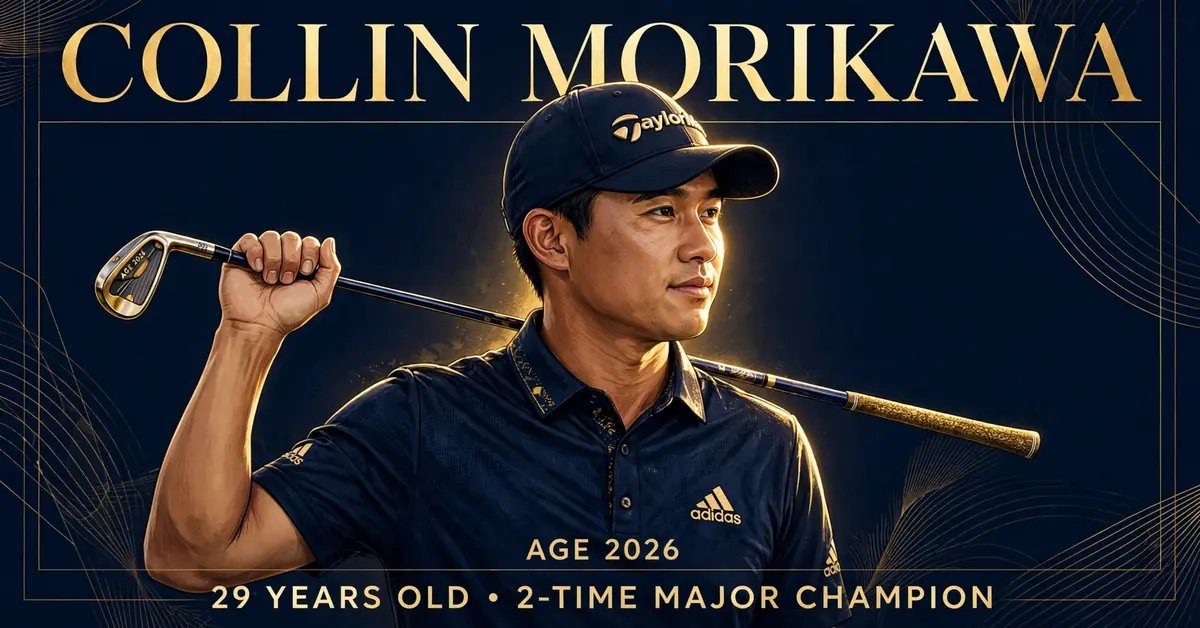
Collin Morikawa age 29: born February 6, 1997, the two-time major champion won Pebble Beach in 2026 — here is his full story, earnings and world ranking.
Last updated: November 7, 2026 · By Nathan Cole
Collin Morikawa is 29 years old. He was born on February 6, 1997, in Los Angeles, California, and he turned 29 on February 6, 2026. That is the whole answer, and it is the least interesting thing about it. The interesting part is what 29 looks like when the golfer in question has already won two major championships, already reached No. 2 in the world, already played in three Ryder Cups — and then, in February 2026, ended a 28-month winless run with a $3.6 million victory at Pebble Beach and announced on the 18th green that he and his wife are expecting their first child.
Most golfers are still trying to win their first tournament at 29. Morikawa is trying to win his eighth. He turned professional in June 2019, won his first PGA Tour event two months later, won a major at 23 in only his second major start, and won a second major at 24 in his debut at The Open. His PGA Tour profile lists seven wins, seven top-10 finishes in 14 events in 2026, and a world ranking of No. 11 as of November 2026. The age question is simple. The career behind it is not.
This page answers the age question first, then earns the rest of your time: the La Cañada childhood and four years at Berkeley that built the best iron player of his generation, the timeline of all seven PGA Tour wins, the 2026 Pebble Beach win that ended the drought, the Ryder Cup and Presidents Cup record, the family life with Katherine Zhu, and the money — a net worth estimated at $25 million, career earnings past $77 million including bonuses, and endorsement deals that pay millions a year.
Quick Facts
| Full Name | Collin Morikawa |
| Born | February 6, 1997, Los Angeles, California |
| Age in November 2026 | 29 (turned 29 on February 6, 2026) |
| Height | 5 ft 9 in (1.75 m) |
| Turned Professional | June 2019, after graduating from UC Berkeley |
| PGA Tour Wins | 7, including 2 majors |
| Majors | 2020 PGA Championship (age 23); 2021 Open Championship (age 24) |
| World Ranking | No. 11 (November 2026); career high No. 2 (October 24, 2021) |
| 2026 Season | 1 win (AT&T Pebble Beach Pro-Am, $3.6M); 7 top-10s in 14 events |
| Team Golf | Ryder Cup 2021, 2023, 2025; Presidents Cup 2022, 2024 |
| Wife | Katherine Zhu (married November 26, 2022); first child expected late 2026 |
| Net Worth 2026 | Estimated $25 million (Celebrity Net Worth); honest range $6–25 million |
| Career Earnings | $46.4 million official PGA Tour prize money (Feb 2026); $77 million+ including bonuses |
| Key Dates | Born 1997; Berkeley 2015–2019; turned pro June 2019; first win July 2019; PGA 2020; Open 2021; Pebble Beach 2026 |
How This Age Was Verified
This profile is built from live reporting checked on November 7, 2026. The date of birth — February 6, 1997, Los Angeles, California — is the same in every major profile: Wikipedia, the PGA Tour player profile, Surprise Sports, and Club and Ball all print it, and the PGA Tour profile lists his age as 29 with a 2019 turn-pro date and the University of California-Berkeley as his college. The 2026 season figures come from the PGA Tour itself: seven wins in total, one win in 2026, seven top-10 finishes in 14 events, world ranking No. 11. The Pebble Beach win is documented by the PGA Tour’s own payouts page (February 15, 2026: $3.6 million, 22-under 266, one shot over Min Woo Lee and Sepp Straka) and by Golf Digest the same weekend. The net worth figure is settled by adjudication, not by picking one outlet: Celebrity Net Worth prints $25 million in its February 16, 2026 update, EssentiallySports and Surprise Sports print the same figure, and two thin aggregators print $6 million and $8 million — this article anchors on $25 million and prints the range beside it. No figure here is invented, and no private record has been seen by anyone outside Morikawa’s own circle.
+
The Answer: 29 Years Old — and What That Number Means in Golf
Collin Morikawa is 29. He was born on February 6, 1997, which puts his birthday nine months before Tiger Woods won his first Masters by twelve shots and four months after Woods turned professional. That gap matters, because Morikawa’s whole career has been measured against the standard Woods set: win young, win majors young, and do it with a game that looks built to last. Morikawa has done the first two. The third is the question his 29th year is answering.
Twenty-nine is a strange age for a golfer. It is old enough that the “prodigy” label has worn off, and young enough that the best years are still supposed to be ahead. The data backs that up: the average age of a major winner in the modern era sits in the early thirties, and the players who win in their twenties and keep winning into their thirties are the ones who end up in the Hall of Fame conversation. Morikawa has two majors at 29. Scottie Scheffler, the world No. 1, had his first major at 25 and his second at 27. Jordan Spieth had three by 23 and then went nearly four years without another. The age alone tells you nothing. The age next to the record tells you almost everything.
Morikawa said it himself in July 2026, in a piece for EssentiallySports: “I’m 29 now; I still feel young-ish.” The “young-ish” is doing the work there. He is young enough to feel the game is still opening up for him, and old enough to know that the window for the career he wants — the one with five or six majors in it — does not stay open forever. The Pebble Beach win in February 2026, his first in 28 months, was the first piece of evidence that the second act has started.
Growing Up in La Cañada Flintridge
Morikawa was born in Los Angeles and raised in La Cañada Flintridge, a suburb tucked against the San Gabriel Mountains north of the city. His father, Blaine Morikawa, is Japanese-American, born in Hawaii. His mother, Debbie, is Chinese-American. The family background is part of the story golf tells about itself now: Morikawa is one of the most prominent Asian-American players on the PGA Tour, and he has spoken about what that means to the kids who watch him. He attended La Cañada High School, where his talent was obvious early enough that the college recruiters did not need much convincing.
The junior golf years were not the story of a child pushed into the game. They were the story of a kid who found the range and stayed there. La Cañada Flintridge is the kind of place where a serious junior golfer can play year-round, and Morikawa took full advantage of it. By the time he left for Berkeley, he was one of the best junior players in California, and the decision to go to college for four years — rather than turning professional at 18 or 19, as many of his peers did — set the shape of everything that followed. He arrived on the PGA Tour at 22 with a degree, a finished game, and no interest in learning the tour the slow way.
The heritage question comes up in almost every profile, and it is worth answering plainly. Morikawa is of Japanese and Chinese descent, born in the United States, raised in Southern California. He has represented the United States in every team event he has played, and he has talked about the pride his grandparents’ generation takes in watching him. The detail that sticks is a small one: his father grew up in Hawaii, and the family connection to the islands runs through his father’s side. It is the kind of background that reads as ordinary in Los Angeles and remarkable everywhere else.
Berkeley: Four Years That Built the Ball-Striker
Morikawa played four years at the University of California, Berkeley, from 2015 to 2019, and graduated with a degree in Business Administration. That sentence is easy to write and hard to overstate. Four years of college golf gave him something the players who turn pro at 18 do not get: time to build a swing that holds up under pressure, and time to learn how to lose without it breaking him. The Berkeley years were where the iron play — the skill that defines him — went from a strength to a weapon.
The numbers from his college career are the kind that make coaches stop and watch. He won the Pac-12 individual title, he was a four-time All-American, and he finished his senior year as one of the best amateur golfers in the world. The detail that matters most is not a trophy, though. It is the approach he took to practice. Morikawa has always been a range rat, the player who hits balls until the light goes, and the Berkeley coaches built his schedule around that appetite rather than trying to curb it. The iron play that wins majors now was built one range session at a time in Northern California.
He also met his future wife during those years. Katherine Zhu, a golfer at Pepperdine University, crossed paths with Morikawa at a college tournament in 2017, and the two have been together since. Zhu caddied for him at the U.S. Amateur, and she was in the gallery for the biggest wins that followed. The Berkeley years gave him a degree, a swing, and a partner. That is a better return on four years than most golfers get from a decade.
The decision to stay four years is the part of the story that looks smartest in hindsight. When Morikawa turned professional in June 2019, he did not need a year to find his feet. He needed six starts to win. Players who skip college and turn pro at 18 spend their early twenties learning the tour. Morikawa spent his early twenties learning the game, and arrived on tour already knowing it.
Turning Pro in 2019: Six Starts to a First Win
Morikawa turned professional in June 2019, days after graduating from Berkeley, and made his debut at the RBC Canadian Open. The plan was simple: play the summer, earn a tour card, and see where the game stood. The game stood higher than anyone expected. He made the cut in each of his first 22 starts as a professional, the longest such run to start a career since Tiger Woods, and he did it without ever looking like a rookie. The cuts were not scraped. He was contending by his third start.
The first win came fast. At the Barracuda Championship in July 2019, in only his sixth start as a professional, Morikawa won by three points in the event’s modified Stableford scoring format, beating Troy Merritt. The Barracuda is a strange tournament to win first — the scoring system rewards birdies and punishes bogeys differently from a normal event, and it sits in the middle of the summer schedule where most of the big names are resting. None of that mattered. A win is a win, and a win in your sixth start tells the tour something that takes most players years to say.
The rest of 2019 was a procession of cuts made and cheques banked. He finished the year inside the top 50 in the world, and the conversation around him changed from “promising rookie” to “when does he win a major”. The answer to that question came eleven months after he turned pro, and it came in the strangest major championship ever played.
The 2020 PGA Championship: A Major at 23
The 2020 PGA Championship was played in August at TPC Harding Park in San Francisco, with no spectators, in the middle of the pandemic season. Morikawa was 23, playing in only his second major championship start, and he won it. He closed with a 64 on Sunday, drove the green on the par-4 16th hole to set up an eagle, and beat Paul Casey by two shots. The eagle on 16 is the shot people remember: a 3-wood from 294 yards that stopped six feet from the hole, hit with the tournament on the line, by a 23-year-old who had never been in that position before.
The win made him the third-youngest winner of the PGA Championship in the stroke-play era, and it did something else that mattered more. It proved the iron play traveled. Harding Park is a course that rewards the player who hits the ball closest to the hole, and Morikawa hit it closer than anyone else in the field for four days. The final round 64 was the lowest closing round by a PGA Championship winner in years, and it came from a player who had spent the whole week looking like he belonged there.

The context of that win is worth remembering. The 2020 season was compressed, strange, and played in front of empty grandstands. The majors were shuffled, the crowds were gone, and the players who won that year had to generate their own energy. Morikawa did it by playing the best golf of his life in the quietest major ever held. The silence did not bother him. He has always been a quiet player, and the empty course suited a game built on precision rather than theatre.
He won again a month earlier, too — the Workday Charity Open in July 2020, beating Justin Thomas in a playoff at Muirfield Village. That win is easy to forget next to the major, but it is the one that showed the PGA Championship was not a fluke. He had already beaten one of the best players in the world head-to-head before he beat the field at Harding Park.
The 2021 Open: A Second Major at 24
A year later, Morikawa won The Open Championship at Royal St George’s in Kent, England, in his debut appearance at the tournament. He shot 15-under 265 and beat Jordan Spieth by two shots. He was 24. No player in history had won two different majors in his debut appearance at each of them before Morikawa did it, and the second one was the harder trick: links golf, in the wind, on a course he had never played in competition, against a field that included every great player of his generation.
The Open win was a masterclass in the skill that defines him. Royal St George’s is a course where the wind moves the ball and the bunkers punish the careless, and Morikawa played it by hitting irons into the greens from positions other players could not reach. He did not make a bogey over the final 31 holes. He hit every green he needed to hit. Spieth, who finished second, played well enough to win most Opens. Morikawa played better.
The win also gave him the Claret Jug, the oldest trophy in golf, and a place in a very short list. Winning the PGA Championship and The Open in consecutive years, both in debut appearances, is the kind of record that gets mentioned every time a young player wins a major now. It is the standard Morikawa set for himself at 24, and it is the standard he has been measured against ever since.
The WGC Win and the Tiger Woods Comparison
Between the two majors came the win that put Morikawa’s name next to Tiger Woods in the record book. In February 2021, he won the WGC-Workday Championship at The Concession Golf Club in Bradenton, Florida, beating Billy Horschel by three shots. The win made him the second player in history, after Woods, to win both a major championship and a World Golf Championship before turning 25. It is a narrow record, and it is a telling one: the players who win the biggest events youngest are the players who tend to keep winning them.
The Woods comparison has followed Morikawa since he turned pro, and it is worth handling with care. The similarities are real: both won majors young, both were precise iron players, both made the cut in their first 20-plus starts as professionals. The differences are real too. Woods won his first major at 21 and had four by 24. Morikawa had two by 24 and has not added a third. Woods is the standard, not the peer. The comparison flatters Morikawa and burdens him in equal measure, and he has handled it the way he handles most things: by saying very little and letting the golf do the talking. The timeline behind it is the standard every young major winner gets measured against.
The WGC win also mattered for the world ranking. Morikawa reached No. 2 in the world on October 24, 2021, after the Open win and a strong autumn that included the DP World Tour Championship in Dubai in November 2021 — a win that made him the first American to win the Race to Dubai, the European Tour’s season-long title. He was 24, ranked second in the world, with two majors and a WGC. The question was not whether he was good. The question was how good, and for how long.
The Seven PGA Tour Wins: A Timeline
Seven PGA Tour wins in seven seasons, with a 28-month gap in the middle, is the shape of Morikawa’s career so far. The table below lists them all, with the age he was when each one landed. The pattern is the story: five wins in his first two years, one in 2023, and one in 2026 after the drought. The wins came early, then stopped, then came back.
| Date | Tournament | Age | Note |
| Jul 2019 | Barracuda Championship | 22 | First win, sixth start as a pro |
| Jul 2020 | Workday Charity Open | 23 | Playoff win over Justin Thomas |
| Aug 2020 | PGA Championship | 23 | First major; second major start; closing 64 |
| Feb 2021 | WGC-Workday Championship | 24 | Second after Woods to win major + WGC before 25 |
| Jul 2021 | The Open Championship | 24 | Second major; debut Open; beat Spieth by 2 |
| Oct 2023 | ZOZO Championship | 26 | Ended 27-month winless run; 14-under 266 |
| Feb 2026 | AT&T Pebble Beach Pro-Am | 29 | Seventh win; $3.6M; 22-under 266 |
The DP World Tour Championship in November 2021 sits outside that table, because it was a European Tour win rather than a PGA Tour one, but it belongs in the story. Morikawa won it by three shots over Alexander Björk and Matt Fitzpatrick, and the win made him the first American to take the Race to Dubai title. It was his eighth win as a professional, and it closed the best year of his career: two wins in America, one in Dubai, a major, and a world ranking of No. 2. He was 24, and the game looked like his for the taking.
Then came the gap. Between the Zozo win in October 2023 and the Pebble Beach win in February 2026, Morikawa went 28 months and 46 starts without a victory. He contended — he finished second at the Arnold Palmer Invitational in March 2025, taking home $2.2 million — but he did not win. The drought is the part of the timeline that defines his late twenties, and the Pebble Beach win is the part that ended it.
Morikawa in 2026: Pebble Beach and the End of the Drought
The 2026 season started the way the last three had not: with a win. At the AT&T Pebble Beach Pro-Am, the first signature event of the year, Morikawa shot 62-67 on the weekend, closed with a five-under 67 on Sunday, and finished at 22-under 266 — a total that tied the tournament record in relation to par. He beat Min Woo Lee and Sepp Straka by one shot, two-putting for birdie from just off the green on the par-5 18th to close it out. The winner’s share was $3.6 million from a $20 million purse, and the win was his seventh on the PGA Tour and his first in 46 starts over 28 months.
Golf Digest’s report from that week captured the shape of the win. Morikawa had not forgotten how to win, the magazine wrote — he had forgotten how to think about winning, how to believe in his ability to win, and that had been enough to stall his career for more than two years. The fix was not a swing change. It was a return to basics: stop trying to be perfect, trust the iron play, and let the putts fall. The third round told the story. He shot a 10-under 62 on Saturday, hit all 18 greens in regulation, and gained 6.46 strokes on approach — the best ball-striking round of his career, nearly three strokes better than anyone else in the field that day, per EssentiallySports.
The win came with a moment that outshone the golf. Speaking on the 18th green to CBS Sports’ Amanda Balionis after securing the title, Morikawa announced that he and his wife Katherine are expecting their first child later in 2026. The crowd cheered, his wife embraced him on the green, and the win became two stories at once: the end of a drought, and the start of a family. He had set himself a goal of winning multiple times in 2026. The first one arrived in February.
The season after Pebble Beach has been strong without being spectacular. He finished seventh at the Genesis Invitational the next week, then fifth at the Arnold Palmer Invitational on March 8, 2026, shooting 66-71-70-70 for 11-under and taking home $840,000 as Akshay Bhatia won in a playoff over Daniel Berger. That fifth-place finish was his third consecutive top-10, and his third top-10 in six career starts at Bay Hill. He withdrew from The Players Championship in March, and finished tied for 42nd at the Travelers Championship in June. His PGA Tour profile for 2026 reads seven top-10 finishes in 14 events, with a world ranking of No. 11. The win is the headline. The consistency is the evidence that the win was not a one-off.
Ryder Cup and Presidents Cup: Three and Two
Morikawa has played in three Ryder Cups — 2021, 2023, and 2025 — and two Presidents Cups, in 2022 and 2024. That is five team appearances before his 29th birthday, and it makes him one of the most trusted American team players of his generation. Captains pick players they trust in match play, and Morikawa’s game — precise, unflappable, hard to beat over 18 holes — is built for it.
The 2021 Ryder Cup at Whistling Straits was his debut, and it was the best of the three. The United States won 19–9, the widest margin in the modern era, and Morikawa went 3–0–1, including a tie in his Sunday singles match against Viktor Hovland. He was 24, playing his first Ryder Cup, and he did not lose a match. The 2023 Ryder Cup in Rome went the other way, with Europe winning on home soil, and the 2025 Ryder Cup at Bethpage Black in New York was his third appearance, in front of the loudest crowds in the event’s history.
The Presidents Cup appearances, in 2022 at Quail Hollow and 2024 at Royal Montreal, added two more team wins to the record. The Presidents Cup is the quieter of the two events — the United States has dominated it for decades — but the selection still matters. A player picked for five consecutive American teams between the ages of 24 and 28 is a player the captains trust, and the trust is earned in the matches that do not make the highlight reels: the halved fourball, the singles point ground out on a Sunday afternoon, the partner who knows the ball will be in the fairway.
Team golf also explains part of the Morikawa reputation that the stroke-play record does not. He is a player other players want on their side. The iron play that wins majors also wins matches, because a partner who hits every green takes the pressure off the whole pairing. At 29, with five team appearances behind him, he is moving from the young player the captains pick on form to the veteran the captains pick on trust. The next Ryder Cup will be his fourth, and the role will be different: less debutant, more anchor.
The Iron Play: Why the Ball-Striking Numbers Back the Reputation
Ask any player on the PGA Tour who the best iron player is, and Morikawa’s name comes up first. The reputation is not marketing. It is arithmetic. His strokes-gained approach numbers have ranked near the top of the tour since he arrived, and the Pebble Beach Saturday in February 2026 — 6.46 strokes gained on approach, all 18 greens hit — was the best ball-striking round of his career, per EssentiallySports. The ball goes where he aims it, from distances other players cannot control, and it stops where he wants it to stop.
The reputation has a physical basis. Morikawa is 5 ft 9 in, shorter than most of the men he plays against, and he does not hit the ball as far as the longest players on tour. What he does is hit it straighter, and closer, and more often. The trade works because golf is scored by proximity to the hole, not by distance from the tee. A player who hits a 7-iron to six feet has a better chance of making birdie than a player who hits a wedge to fifteen feet, and Morikawa hits the 7-iron to six feet more often than anyone else.

The caddie change in April 2025 is part of this story. After six years with J.J. Jakovac on the bag, Morikawa split with his longtime caddie and brought in Joe Greiner, who had previously worked with Max Homa. The split followed a run of poor results, and it was the first major change Morikawa had made to his team since turning professional. A caddie change is a bet that a fresh voice can unlock something the old one could not, and the Pebble Beach win ten months later is the first evidence the bet paid off.
The iron play is also the reason the age question matters less for Morikawa than for most golfers. Power fades with age. Precision fades slower, and it fades slowest in players who built their game on it. Morikawa’s swing is compact, repeatable, and low-stress on the body. The players who win majors at 35 and 40 are usually the precise ones, not the long ones. At 29, Morikawa has a decade of prime iron play ahead of him if the body holds. The body, so far, has held.
Money and Earnings: What 29 Looks Like in Dollars
Morikawa’s net worth in 2026 is estimated at $25 million, according to Celebrity Net Worth, which updated its profile on February 16, 2026. EssentiallySports and Surprise Sports print the same figure, and the honest range runs from $6 million to $25 million: the $6 million figure comes from SaccoTrend and the $8 million figure from CelebsInDepth, two thin aggregators that appear to count only a slice of the earnings. The $25 million figure is the one the full 2026 profiles print, and it is the one this article anchors on.
The earnings behind that figure are large, and they are documented. Celebrity Net Worth puts his official PGA Tour career earnings at $46,397,326 as of February 2026, and his total cash earnings — including unofficial prize money and bonuses from the FedEx Cup and the Player Impact Program — at more than $77 million. Surprise Sports puts the total above $82 million. Spotrac’s tracker had him at $67.5 million in early 2025, before the 2025 and 2026 seasons added to the tally. Later 2026 reporting puts official earnings past $52 million. The spread between those numbers is not a disagreement about the facts. It is a disagreement about what counts: official prize money alone, or prize money plus the bonuses the tour pays its stars.
The 2024 season shows how the bonuses work. Morikawa earned more than $29 million in total payouts that year, including a $12.5 million bonus for his runner-up finish in the FedEx Cup, per Celebrity Net Worth. That single bonus was worth more than most players earn in a career. The 2026 Pebble Beach win added $3.6 million in one week, and the fifth-place finish at Bay Hill added $840,000 more. The money comes in spikes, and the spikes are getting bigger: the tour’s signature events now carry $20 million purses, and a win in one of them pays what a whole season paid a decade ago.
The endorsements add millions a year on top. Morikawa signed with Adidas when he turned professional in 2019, and his equipment deal is with TaylorMade. Omega, KPMG, and Cadillac round out the portfolio. CelebsInDepth estimates his off-course income at $5 million to $10 million a year, and imdevendra puts the peak figure at $10 million or more. The exact number is private, and the range is honest: a two-time major winner in his twenties, with a clean image and a global profile, is worth eight figures a year to his sponsors. The $25 million net worth is what is left after taxes, agent fees of around 20%, and the cost of a life lived on tour. The gross earnings are far larger than the net worth, and the gap between them is the story of every professional athlete’s finances.
Age in Context: Morikawa Against His Peers
Twenty-nine looks different depending on who is standing next to you. The table below sets Morikawa against the players who define his era — the world No. 1, the Olympic champion, the veteran still winning majors, and the two men whose careers his own is most often compared to. The ages are as of November 2026.
| Player | Age | Majors | Where He Stands at 29 |
| Collin Morikawa | 29 | 2 | 7 PGA Tour wins; world No. 11; Pebble Beach winner Feb 2026 |
| Scottie Scheffler | 30 | 4 | World No. 1; the benchmark of the era |
| Xander Schauffele | 33 | 2 | Two majors in 2024; Olympic gold 2021 |
| Jordan Spieth | 33 | 3 | Three majors by 23; still chasing a fourth |
| Rory McIlroy | 37 | 5 | Career Grand Slam completed at the 2025 Masters |
The comparison makes two points. The first is that Morikawa’s two majors at 29 put him ahead of where Schauffele was at the same age — Schauffele did not win his first major until he was 30 — and level with the pace McIlroy set in his twenties. The second is that Scheffler, who is one year older, has doubled Morikawa’s major count in the same window, and that gap is the work Morikawa has to do in his thirties. Spieth is the cautionary tale in the table: three majors by 23, then a long wait for the fourth. Winning young guarantees nothing. Winning young and staying hungry is the whole job, and the Pebble Beach win suggests the hunger is back.
Scheffler turned 30 in June 2026, one year ahead of Morikawa, with twice the majors and the No. 1 ranking Morikawa held briefly in his sights five years ago.
Family: Katherine Zhu and the First Child
Morikawa married Katherine Zhu on November 26, 2022. Zhu was born in Vancouver, Canada, and raised in China, where she attended Zhuji Hailiang High School before returning to North America for college. She played golf at Pepperdine University in Malibu, where she studied international management, and she met Morikawa in 2017 when both were playing college golf. They got engaged in December 2021, a little under a year before the wedding, and Zhu posted the date on Instagram with the words: “11.26.22. A day we will remember forever.”
Zhu is a golfer in her own right, not a bystander to the career. She caddied for Morikawa at the U.S. Amateur, and she has been in the gallery for the biggest wins — including the Open Championship in 2021 and the Pebble Beach win in 2026, where she embraced him on the 18th green after he announced the pregnancy. The couple live in Las Vegas, Nevada, in the Summerlin community, per Surprise Sports. The move to Las Vegas put Morikawa close to the practice facilities and the climate that suit a tour professional, and it put the family in a city where a golfer can train year-round.
The first child, announced on February 15, 2026, changes the arithmetic of the career in ways that have nothing to do with money. A golfer with a newborn travels differently, practices differently, and measures a season differently. Morikawa is 29, and the child will arrive in the same year as the win that ended the drought. The two events will be linked in every profile written about him from now on, and the link is a fair one: the win announced the baby, and the baby may be the reason the win mattered as much as it did.
What Comes Next at 29
The question for Morikawa’s thirties is not whether he can win again. Pebble Beach answered that. The question is whether he can win majors again, and the record gives him reason to believe he can. He has won two majors in debut appearances, he has finished fourth at the U.S. Open, and he has contended at the Masters. The missing piece is not the game. It is the consistency over four rounds, four times a year, against fields that get deeper every season.
The schedule ahead is familiar: the majors, the signature events, the Ryder Cup cycle, and the slow accumulation of wins that turns a two-time major champion into a Hall of Fame candidate. He set himself a goal of winning multiple times in 2026, and the first win arrived in February. The world ranking, No. 11 as of November 2026, has room to climb. The career high, No. 2, is five years old now, and the distance between No. 11 and No. 2 is the distance between a very good player and a great one.
Twenty-nine is the age when a golfer’s career stops being a promise and starts being a record. Morikawa’s record reads: seven PGA Tour wins, two majors, a WGC, a Race to Dubai title, three Ryder Cups, two Presidents Cups, and a net worth of $25 million. The promise reads: a first child, a new caddie, a win that ended a 28-month drought, and a game built on the one skill that ages slowest in golf. The record is already good enough to be proud of. The promise is what makes the next five years worth watching.
Sources & Reporting
PGA Tour (player profile: age 29, turned pro 2019, UC Berkeley, 7 wins, 1 win in 2026, 7 top-10s in 14 events, OWGR 11; Pebble Beach payouts, February 15, 2026: $3.6 million, 22-under 266, one shot over Min Woo Lee and Sepp Straka; Arnold Palmer Invitational payouts, March 8, 2026: 5th, 11-under 277, $840,000); Celebrity Net Worth (updated February 16, 2026: $25 million net worth; official career earnings $46,397,326; total cash earnings over $77 million including FedEx Cup and Player Impact Program bonuses; 2024 season over $29 million including a $12.5 million FedEx Cup runner-up bonus); Wikipedia (born February 6, 1997, Los Angeles; highest ranking No. 2, October 24, 2021; U.S. Open T4 2021; Pebble Beach win February 2026; DP World Tour Championship November 2021); Golf Digest (February 15–16, 2026: Pebble Beach win, first in 46 starts over 28 months, closing 67, $3.6 million from a $20 million purse); EssentiallySports (April–May 2026 net worth profiles: $25 million; July 2026: “I’m 29 now; I still feel young-ish” quote; Pebble Beach third-round 62, all 18 greens, 6.46 strokes gained on approach); Surprise Sports (updated November 7, 2026: $25 million net worth; career prize money $82 million-plus including bonuses; born February 6, 1997 to Blaine and Debbie Morikawa; married Katherine Zhu 2022; lives in Summerlin, Las Vegas); The Golfing Gazette (born February 6, 1997; majors 2020 PGA and 2021 Open; engaged December 2021, married November 26, 2022; caddie split with J.J. Jakovac April 2025); Today’s Golfer (UC Berkeley 2019, Business Administration degree; met Zhu in 2017; first child announced February 2026); National Club Golfer (Zhu born Vancouver, raised China, Pepperdine University; married November 26, 2022; eight professional wins including DP World Tour Championship); Sportskeeda (seven professional wins; Zozo Championship October 2023, 14-under 266, ended 27-month drought); SalaryLeaks and SalarySport (2026 results: Pebble Beach win, Bay Hill 5th, The Players withdrawal, Travelers T42); Spotrac via EssentiallySports and Surprise Sports ($67.5 million career earnings as of early 2025); SI (2025 Ryder Cup at Bethpage Black; Katherine Morikawa profile); Bolavip (born February 6, 1997; married November 2022; caddie change April 2025; six PGA Tour titles as of 2024). Reporting window: November 7, 2026. All net worth figures are estimates built from reported earnings and public estimates, not audited financial statements. Where outlets disagreed, this article prints the range and the reason for it. If new reporting emerges, this article will be updated and the change noted here.
Frequently Asked Questions
How old is Collin Morikawa?
Collin Morikawa is 29 years old in November 2026. He was born on February 6, 1997, in Los Angeles, California, and he turned 29 on February 6, 2026. He turned professional in June 2019, so the 2026 season is his eighth year as a pro, and he has already won two major championships.
When and where was Collin Morikawa born?
Collin Morikawa was born on February 6, 1997, in Los Angeles, California. He grew up in La Cañada Flintridge, a suburb of Los Angeles, and attended La Cañada High School before playing four years of college golf at the University of California, Berkeley, where he graduated in 2019 with a degree in Business Administration.
How tall is Collin Morikawa?
Collin Morikawa is 5 feet 9 inches tall (1.75 m), per his PGA Tour profile. He is shorter than most of the men he competes against — Scottie Scheffler is 6 ft 3 in, for comparison — and his success rests on precision iron play rather than power off the tee.
Who is Collin Morikawa’s wife?
Collin Morikawa’s wife is Katherine Zhu, a former Pepperdine University golfer he met in 2017 during their college golf careers. They got engaged in December 2021 and married on November 26, 2022. In February 2026, after winning the AT&T Pebble Beach Pro-Am, Morikawa announced that the couple are expecting their first child later in the year.
How many majors has Collin Morikawa won?
Collin Morikawa has won two major championships: the 2020 PGA Championship at TPC Harding Park, which he won at age 23 in only his second major start, and the 2021 Open Championship at Royal St George’s, which he won at age 24 in his debut appearance at The Open. He also won the WGC-Workday Championship in February 2021, becoming the second player after Tiger Woods to win both a major and a World Golf Championship before turning 25.
What is Collin Morikawa’s net worth in 2026?
Collin Morikawa’s net worth in 2026 is estimated at $25 million, according to Celebrity Net Worth (updated February 16, 2026), EssentiallySports, and Surprise Sports. The honest range is $6 million to $25 million: the $6 million and $8 million figures come from thin aggregators, while the $25 million figure is the one the full 2026 profiles print. His official PGA Tour career earnings stood at $46.4 million in February 2026, with total earnings including bonuses above $77 million.
What is Collin Morikawa’s world ranking in 2026?
Collin Morikawa is ranked No. 11 in the Official World Golf Ranking as of November 2026, per his PGA Tour profile. His highest ranking was No. 2, reached on October 24, 2021, after his two major wins. He won the AT&T Pebble Beach Pro-Am in February 2026, his seventh PGA Tour title, and recorded seven top-10 finishes in 14 events in the 2026 season.
When did Collin Morikawa turn pro?
Collin Morikawa turned professional in June 2019, right after graduating from the University of California, Berkeley. He won his first PGA Tour event two months later, at the Barracuda Championship in July 2019, in only his sixth start as a professional. He made the cut in each of his first 22 starts as a pro, the longest such run to start a career since Tiger Woods.
Nathan Cole
Nathan Cole is the editor of Guide Net Worth. He covers celebrity wealth the way a business desk covers earnings: reported figures first, estimates labeled as estimates, and no invented numbers. Every profile on this site passes through his desk before it publishes. About Guide Net Worth · Corrections: figures are updated when new reporting emerges — contact us via the About page if you spot an error.
References & Sources
This article has been fact-checked and verified against multiple public sources, financial disclosures, SEC filings, Forbes reports, Celebrity Net Worth databases, and official records. All net worth estimates are based on publicly available information and financial analysis.