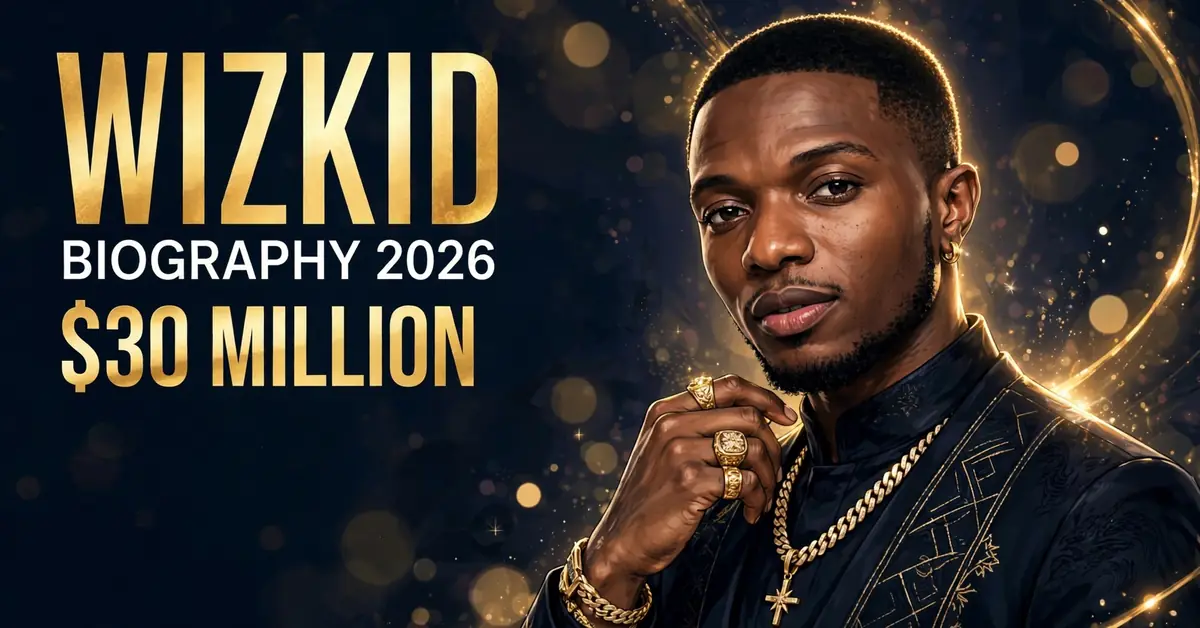
Wizkid biography 2026: born Ayodeji Balogun in Ojuelegba, Lagos, the 36-year-old Starboy turned ‘One Dance’ and ‘Essence’ into a $30M Afrobeats empire.
Last updated: November 7, 2026 · By Nathan Cole
Wizkid is 36 years old in 2026, born Ayodeji Ibrahim Balogun on July 16, 1990, in Ojuelegba, Surulere, Lagos — and the boy who started singing in his mother’s church choir at 11 is now the Afrobeats star the rest of the world measures itself against. His net worth in 2026 is estimated at $30 million, the figure Celebrity Net Worth lists, inside a defensible $30–58 million range. The road from Ojuelegba to that number runs through a Drake collaboration that topped charts in 14 countries, a Grammy win with Beyoncé, a song with Tems that put Nigerian music on the Billboard Hot 100 for the first time, and six studio albums that turned a Lagos street sound into a global industry.
The year 2026 has been a strange one for him. He started it with a joint EP alongside Asake, signed with the biggest live agency in America in October, and announced two homecoming concerts in Abuja and Lagos for December — while his seventh solo album, teased under the title “Sexy” in June, still has no release date. His last world tour collapsed in May 2025 when the North American dates were cancelled, and he has not mounted a full tour since. The 36-year-old at the centre of this profile is at a hinge point: the most famous African pop star of his generation, working out what the next act looks like.
This biography follows the whole arc: the crowded family house in Ojuelegba, the church group called the Glorious Five, the Banky W deal at 18, the debut album that made him a national name at 21, the Drake record that made him a world name at 26, the Tems record that made him a Grammy nominee, the album he made for his late mother, and the money — where it comes from, why the estimates disagree by a hundred million dollars, and which figure survives a check.
Quick Facts
| Full Name | Ayodeji Ibrahim Balogun |
| Born | July 16, 1990, Ojuelegba, Surulere, Lagos, Nigeria |
| Age in November 2026 | 36 (turned 36 on July 16, 2026) |
| Height | 5 ft 9 in (175 cm) — commonly listed |
| Known As | Wizkid · Starboy · Big Wiz · Machala (formerly Lil Prinz) |
| Occupation | Singer, songwriter, record-label founder |
| Albums | Superstar (2011) · Ayo (2014) · Sounds From the Other Side (2017) · Made in Lagos (2020) · More Love, Less Ego (2022) · Morayo (2024) |
| Awards | Grammy Award 2021 (Best Music Video, “Brown Skin Girl”) · 3 Billboard Music Awards · Guinness World Record (“One Dance”) |
| Partner | Jada Pollock (manager and partner) · Four sons |
| Label | Starboy Entertainment (founder) · RCA Records |
| 2026 Projects | REAL, Vol. 1 EP with Asake (Jan 23) · “Alive” with Jorja Smith · CAA signing (Oct) · Abuja + Lagos homecoming concerts (Dec) |
| Net Worth 2026 | $30 million (Celebrity Net Worth); defensible range $30–58 million |
How This Estimate Was Made
This profile was built from live reporting checked on November 7, 2026 — Wikipedia for the biographical spine (birth, family, label history, awards); thegazette.ng (updated November 5, 2026) for the $20–30 million range and the 2026 age check; Scoopearth for the Celebrity Net Worth $30 million anchor; ThrillNG (updated October 17, 2026) for the $43–58 million upper range, the 15.6 million monthly Spotify listeners, the 10 billion Spotify streams passed in January 2026, and the UBA and PUMA deal figures; NotJustOk (October 9, 2026) for the Morayo tour cancellations and the 2026 festival run; Booking Agent Info (October 2, 2026) for the CAA signing; Voice of Nigeria (October 14, 2026) for the December homecoming concerts; Ticketbande for the REAL, Vol. 1 EP and the 2026 Grammy nomination; Warriaproko (October 25, 2026) for the “Sexy” album tease; and Jazzapedia and Afro.video for the Billboard and Grammy records. Net worth figures for Nigerian musicians are estimates — no audited disclosure exists — so this article prints a range, names the sources on each side of it, and rejects the $100 million-plus figures as unsourced. Reporting window: November 7, 2026.
+
How Much Is Wizkid Worth in 2026?
Wizkid is worth an estimated $30 million in 2026. That is the figure Celebrity Net Worth lists, as reported by Scoopearth, and it sits at the bottom of the range this article is willing to defend: $30–58 million. The upper end comes from ThrillNG, updated October 17, 2026, which puts him at $43–58 million and ranks him the richest musician in Nigeria in 2026. TheGazette.ng, updated November 5, 2026, gives a $20–30 million range and notes that some sources suggest higher figures given his streaming numbers and premium performance fees.
The honest version is that the estimates disagree wildly, and the disagreement is the story. One 2026 round-up puts him at $60–100 million. Another lists $70 million. Another claims $100–132 million. A September 2026 analysis that cross-checked the same three artists across the same sources found Wizkid’s 2026 figure variously estimated between $45 million and $132 million — a 33-times spread between the lowest and highest numbers in circulation — and warned plainly that most of these numbers are guesses dressed up as facts. Nigerian musicians do not file public financial disclosures, and no outlet has audited his accounts. Forbes does not track Nigerian musicians in its real-time billionaire methodology, so there is no verified anchor at the top end.
| Source | Date | Figure | Status |
| Celebrity Net Worth (via Scoopearth) | 2026 | $30 million | Anchor — most-cited tracker |
| TheGazette.ng | Updated Nov 5, 2026 | $20–30 million | Matches the anchor |
| ThrillNG | Updated Oct 17, 2026 | $43–58 million | Top of the defensible range |
| TooXclusive | Oct 29, 2026 | ~$20 million | Low end found |
| RexClarke Adventures | 2026 | $60–100 million | REJECTED — no sourcing, contradicts trackers |
| ResearchRoom | 2026 | $70 million | REJECTED — single unsourced figure |
| ArtistHeat | 2026 | $100–132 million | REJECTED — contradicts every tracker |
The $30 million anchor survives because it is the figure the most-cited tracker has carried through 2026, it matches the bottom of the most recent dated range, and it is consistent with what is actually verifiable: a catalogue that passed 10 billion total Spotify streams in January 2026, about 15.6 million monthly listeners on Spotify, a label, and endorsement deals with named brands. The $43–58 million top end survives because ThrillNG built it from named income streams — stadium shows, streaming, brand deals — and dated it October 2026. The $100 million-plus figures do not survive: they appear on listicles with no method, no named deals, and no dates, and they would make a musician with no audited business holdings richer than the touring and streaming math supports. This article prints the $30–58 million range and says plainly that the true figure is private.
Where the Money Comes From
Live shows are the biggest part of it. ThrillNG’s October 2026 breakdown is explicit: the fortune is driven mostly by stadium and arena shows, streaming, and big brand deals, and a single sold-out London stadium show puts him in a pay bracket few African acts reach. One 2026 ranking reports he commands $300,000 to $500,000 per international show — a figure to treat as reported rather than verified, since no promoter has confirmed a fee — but the direction is right: the money is made on stage, in rooms of tens of thousands, not in the studio.
Streaming is the second stream, and it is the one with hard numbers attached. He passed 10 billion total Spotify streams in January 2026, and he draws about 15.6 million monthly listeners on the platform. “Essence” and “One Dance” alone, two of the most-streamed Afrobeats tracks in history, generate ongoing royalty income year after year. The catalogue is the asset that pays while he sleeps: six studio albums, a joint EP, and a run of singles that never leave the playlists.
| Income Stream | What Is Known |
| Live shows & touring | Biggest stream; stadium/arena headliner; $300k–$500k per international show reported (unverified); 2026 festivals + December homecoming |
| Streaming royalties | 10 billion total Spotify streams passed Jan 2026; ~15.6M monthly listeners; “One Dance” + “Essence” earn perpetually |
| Record deals | RCA Records multi-album deal (reported by Billboard, Mar 2017); EME deal 2009–2013 |
| Endorsements | PUMA ~$1M/year from 2020; UBA ~$3M (2019); Hennessy, Cîroc, D’Ussé, Pepsi, MTN |
| Starboy Entertainment | Own label, RCA joint venture; catalogue and signed-act revenue |
| Features & collaborations | Drake, Beyoncé, Justin Bieber, Skepta, Tems, Asake, Ayra Starr — fees undisclosed |
Endorsements are the third stream, and the two with reported numbers are substantial. ThrillNG reports he earned about $3 million from a 2019 UBA deal and about $1 million a year from PUMA from 2020, when he became the brand’s African representative. He has also worked with Hennessy and D’Ussé, and earlier deals included Pepsi and MTN. The label is the fourth stream: Starboy Entertainment, his own imprint, signed to RCA in a joint venture, adds label income to his catalogue earnings. Feature fees for the Drake, Beyoncé and Justin Bieber collaborations were never disclosed, so this profile does not invent them — but a verse from the biggest Afrobeats star alive is not given away free.
Early Life: Ojuelegba, the Church Choir, and Twelve Sisters
Ayodeji Ibrahim Balogun was born on July 16, 1990, in Ojuelegba, a busy district of Surulere in Lagos, Nigeria. He grew up in an interfaith household with twelve female siblings — his mother a Pentecostal Christian, his father a devout Muslim. The house was crowded, the street outside was louder, and the music came from the church: he started singing at 11 in his mother’s church choir, and formed a group called the Glorious Five with a few of his church friends. The group even released a collaborative album. He was a child singer before he was a teenager with a plan.
Ojuelegba is not a backdrop in his story; it is the subject of one of his best-loved songs. “Ojuelegba” (2014) is a letter to the neighbourhood that raised him, and it became an anthem in Lagos before the rest of the world knew his name. The street taught him the sound: Afrobeats mixed with afropop, R&B, dancehall and reggae, the blend that would later define his records. He performed under the name Lil Prinz as a child, and changed it to Wizkid in 2006, at 16. The name stuck. So did the nickname his fans gave him later — Starboy — which he eventually made the name of his label.
School did not hold him. He attended Ijebu Ode Grammar School, then enrolled briefly at Lagos State University and later at Lead City University, and dropped out of both to pursue music full time. His father, by several accounts, had hoped he would become an engineer or a lawyer. The gamble was total: no degree, no fallback, a teenager betting that a voice trained in a church choir could carry him out of Surulere. Within three years of leaving university, he had a record deal.
Lil Prinz to Starboy: The EME Years
In 2009, at 18, Wizkid signed a record deal with Banky W’s Empire Mates Entertainment (E.M.E). Banky W was one of the biggest names in Nigerian R&B, and E.M.E was the label every young Lagos singer wanted to join. Wizkid began recording his debut album the same year. The breakout came in 2010 with “Holla at Your Boy,” the lead single from the album — a bright, confident pop record that introduced a 20-year-old with a voice built for radio. Nigerian radio picked it up, the video played everywhere, and the name Wizkid started travelling beyond Surulere.
The E.M.E years were an apprenticeship in the open. He was the label’s youngest act, learning the business — recording schedules, video shoots, radio runs, the politics of features — while his own audience grew. The debut album, Superstar, arrived in 2011, and the Headies — Nigeria’s biggest music awards — named him Next Rated, the prize for the year’s breakout act. He was 21, with a debut album, a national hit, and an award that said the industry had noticed. He stayed with E.M.E until 2013, then left to build his own operation. The split was clean and the timing was right: he had outgrown the label that discovered him.
Starboy Entertainment was the next move, and it was a statement of intent. He named the label after the nickname his fans had given him, and he ran it as an artist-owned business rather than a vanity imprint. The label would go on to sign acts of its own, and in 2017 he tied it to RCA Records in a joint venture — a worldwide label deal that Billboard reported on March 1, 2017. The boy from the church choir now had a label, a major-label partner, and a catalogue that was about to go global.
Superstar and Ayo: The Lagos Breakthrough
Superstar (2011) made him a national name. The album carried “Holla at Your Boy” and a run of singles that dominated Nigerian radio through 2011 and 2012, and it established the template: melodies that sat easily on Afrobeats rhythms, Yoruba and English mixed in the lyrics, and a voice that sounded relaxed even on the biggest hooks. He was 21 and already the most exciting young singer in the country. The second album, Ayo, arrived in September 2014, preceded by six singles, and it was the record that turned a national star into a continental one.
Ayo is the album that gave him “Ojuelegba,” the song that still closes his sets a decade later. The track is a roll call of the neighbourhood — the bus stops, the street corners, the people who knew him before the fame — and it became the song Nigerians abroad played when they missed home. Drake heard it, and in 2015 he posted a version of it on his OVO Sound Radio show. That single gesture — the biggest rapper in the world playing a Lagos street anthem to a global audience — was the first crack in the wall between Afrobeats and the mainstream. The second crack came a year later, and it broke the wall entirely.
The albums that followed show a career that kept widening. Sounds From the Other Side (2017) was his first project aimed squarely at the international market, recorded after the RCA deal. Made in Lagos (2020) was the masterpiece. More Love, Less Ego (2022) slowed the tempo and got personal. Morayo (2024) was the most personal of all. Six studio albums in thirteen years, each one a different answer to the same question: how far can a sound from Ojuelegba travel?

One Dance: The Drake Moment That Changed Everything
In 2016, Wizkid achieved international recognition in a single stroke: his collaboration with Drake on “One Dance.” The song topped the charts in 14 countries, including the US Billboard Hot 100, and became one of the best-selling singles in history. Wizkid’s contribution — the melodic hook that carries the record — put an Afrobeats voice at the centre of the biggest song on the planet. The record earned him a Guinness World Record, and it made him the first Afro-pop artist to feature in the record books for a song of that scale.
The scale of “One Dance” is hard to overstate. It was the song that introduced hundreds of millions of listeners to Afrobeats as a genre — not as a curiosity, but as the sound of the year’s biggest hit. For Wizkid, it changed the economics of his career overnight: the fee bracket, the festival bookings, the brand deals, the size of the rooms. Before “One Dance” he was a Nigerian star with a growing African audience. After it, he was a global artist, and the industry treated him as one. The RCA deal followed within a year. The festival headline slots followed. The PUMA deal followed.
The collaboration also set the pattern for the rest of his career: the biggest names in Western pop came to him, not the other way round. Beyoncé called for “Brown Skin Girl.” Justin Bieber called. Skepta called. The Drake record proved that a Wizkid feature could carry a global hit, and the market priced him accordingly. Ten years later, “One Dance” still earns — it sits in the streaming catalogue alongside “Essence” as one of the two records that generate royalty income year after year, long after the chart runs ended.
Made in Lagos and Essence: The Album That Went Global
Made in Lagos, released in 2020, is widely considered his masterpiece. The album topped Billboard’s World Albums chart, and its lead single, “Essence” featuring Tems, became a global phenomenon. “Essence” was the first Nigerian song to chart on the Billboard Hot 100, and it earned Grammy nominations in 2022 — the first time a Nigerian record had been recognised at that level for a song of its own, rather than as a feature on someone else’s hit. The Justin Bieber remix pushed it further, but the original — Wizkid and Tems, two voices over a slow, warm groove — is the version that endures.
The album’s success went beyond sales. Made in Lagos proved that an Afrobeats album could be a complete artistic statement rather than a collection of singles, and it proved that the world would listen to one. It gave Tems her global breakthrough too — the feature made her a star in her own right, and the two of them became the defining pairing of the Afrobeats wave. The album kept earning for years: it is one of the reasons his streaming numbers held up through 2025 and into 2026, when he passed 10 billion total Spotify streams.
The Grammy recognition that followed was the formal version of what the charts had already said. He had already won a Grammy in 2021, for Best Music Video, as a credited artist on Beyoncé’s “Brown Skin Girl.” The “Essence” nominations made it two Grammy cycles in a row with his name on the ballot. Jazzapedia credits him as the first African musician to score seven Billboard nominations and the youngest African to receive a Grammy nomination, and the first Nigerian to win three Billboard Music Awards. The numbers are the kind that get quoted in every profile because they are the kind that do not happen by accident: they are the record of a decade at the top.
Morayo: The Album for His Mother
In November 2024, Wizkid released his sixth studio album, Morayo — a deeply personal project dedicated to his late mother, Jane Dolapo Balogun, who had died in August 2023. Morayo was her middle name. The album was expected to open another major touring era, with concerts scheduled across several international markets, and it carried the weight of grief in a way his earlier records never had: the party songs were still there, but the album’s centre was a son singing to a mother who was gone.
The tour did not survive. In May 2025, multiple dates on the North American leg of the Morayo World Tour were cancelled, including scheduled performances in Atlanta, New York, Toronto, Baltimore and Houston. No full explanation was given, and Wizkid has not mounted another extensive international tour since. The cancellations left a gap in the career that 2026 has only partly filled: festival appearances instead of a tour, singles and an EP instead of an album, and a December homecoming in Nigeria instead of a world run.
The album itself endures. Morayo’s singles — including “Kese (Dance),” for which he released self-directed visuals — kept him on the charts through 2025 and into 2026, and the album is the reason the 2026 festival sets still land: the crowd knows the new songs as well as the old ones. A mother’s name on the cover, a tour that never happened, and a catalogue that keeps growing — Morayo is the most complicated chapter of the career, and the one that explains the most about where he stands now.
2026: REAL Vol. 1, CAA, and the December Homecoming
He began 2026 with “Jogodo,” a collaboration with Asake that set the stage for their joint extended play, REAL, Vol. 1. The four-track EP arrived on January 23, 2026, bringing together two generations of Nigerian music stars — Wizkid, the pioneer, and Asake, the artist who had dominated the previous three years — and both “Turbulence” and “Jogodo” charted on the UK Singles Chart. The year continued with “Alive,” a collaboration with British singer-songwriter Jorja Smith released on July 2, and “Coca Body,” featuring Dutch rapper Frenna and British-Nigerian singer Odeal. The creative output, in other words, has not slowed: the year has been full of records, even without a solo album.
The business move of the year came in October 2026, when reports confirmed he had signed with Creative Artists Agency (CAA) for live music and touring representation across North America. Agents Zack Borson and Joseph Harris will run his North American touring strategy, while United Talent Agency (UTA) — which previously handled his international touring — continues to represent him in other territories. The signing is the strongest signal yet that a major tour is coming: CAA does not sign an artist of his size to sit still. NotJustOk reported in October that an announcement before the end of 2026, with a tour kicking off in 2027, was a strong possibility.
The live schedule in the meantime has been festivals and homecomings. In 2026 he appeared at Tribeville Festival in Minneapolis, Ditch Party in Los Angeles, and Afro Plus Fest in Maryland, where he headlined the closing night on September 6, performing “Essence,” “Ojuelegba,” “Caro” and “Bad to Me.” Then came the announcement that mattered most to his Nigerian fans: two homecoming concerts for December 2026, confirmed on his verified Instagram page and reported by Voice of Nigeria on October 14 — the Live Out Loud Music Festival at Eagle Square, Abuja, on December 13, and the Detty December Fest in Lagos on December 18, organised in partnership with Livespot. The seventh solo album, teased as “Sexy” at a Paris listening party in June 2026, still has no release date as of late October — and his fans, the Wizkid FC, are still waiting.

Endorsements and the Starboy Business
The brand deals are the most visible part of the fortune after the touring. PUMA made him its African representative, a deal ThrillNG reports at about $1 million a year from 2020 — the kind of long-running ambassador contract that pays steadily rather than in a single lump. The same reporting puts a 2019 UBA deal at about $3 million. He has also worked with Hennessy and D’Ussé, the two cognac brands that have competed for Afrobeats stars for a decade, and earlier in his career with Pepsi and MTN, the telecom giant that sponsored a generation of Nigerian pop.
The label is the business underneath the brand deals. Starboy Entertainment is not a vanity project: it is a record and artist-management company with a joint venture at RCA, and it generates income from its signed acts and its catalogue. The structure is the one every smart pop star builds — own the label, own the catalogue, let the major label handle distribution and pay for the privilege. The “One Dance” and “Essence” royalties flow through that structure, and so does the income from the artists Starboy has signed over the years.
What he does not have, by any public record, is a verified business empire beyond music. No audited holdings, no public company stakes, no real-estate portfolio with named properties — and that absence is part of why the $100 million-plus net worth figures fail. The fortune is a music fortune: shows, streams, deals, and a label. It is a large one, and it is real, but it is not a conglomerate, and this profile does not dress it up as one.
Personal Life: Jada Pollock and Four Sons
Wizkid’s partner is Jada Pollock, who is also his manager — the person who has run the business side of the Starboy operation for years. The two are not publicly married, and the relationship is kept largely out of the press: no wedding coverage, no joint interviews, no social-media performance of the partnership. What is public is the family: four sons — Boluwatife, known as Tife, Zion, AJ, and Ayodeji Jr. — born to three mothers, with Jada Pollock the mother of the two youngest.
The children are the part of his life he guards most carefully. Tife, the eldest, is the only one with a public profile of his own, and even that is modest — a child growing up in the orbit of a famous father, not a child star. The family story that is public is the one about his parents: the interfaith household, the twelve sisters, the mother whose middle name became an album title, and the father, Alhaji Muniru Olatunji Balogun, who had hoped his son would be an engineer or a lawyer. The Morayo album is the fullest statement he has made about his family in public — a record named for his mother, released a year after she died.
He is 5 ft 9 in tall (175 cm), according to the commonly listed figure, and he turned 36 on July 16, 2026. The birthday itself passed quietly — no stadium show, no album drop, just another year in a career that has now run for twenty-five years, from the church choir at 11 to the CAA signing at 36. The personal life, in the end, is the least documented part of the profile, and that is by design: the man who gave the world “Ojuelegba” has always kept the house behind the song to himself.
How Wizkid Compares: Davido, Burna Boy and the Big Three
Nigerian pop has a Big Three — Wizkid, Davido and Burna Boy — and every ranking of the richest musicians in the country is a ranking of the three of them. ThrillNG’s October 2026 list puts Wizkid first, at $43–58 million, ahead of Davido and Burna Boy. Other 2026 round-ups order them differently: one analysis found Davido estimated between $50 million and $120 million and Burna Boy between $22 million and $180 million, on the same sources, in the same year. The spreads are so wide that the ranking says more about the list-maker than about the artists — but the fact that all three names sit at the top of every list is the point. They are the three acts who turned Afrobeats into a global industry, and they share the top of it.
| Artist | 2026 Estimate Range | Defining Record | Grammy Status |
| Wizkid | $30–58 million (this article) | “One Dance” (2016), “Essence” (2020) | 1 win (2021), multiple nominations |
| Davido | $50–120 million (reported range) | “Fall” (2017), “Unavailable” (2023) | Nominations, no win yet |
| Burna Boy | $22–180 million (reported range) | “Ye” (2018), “Last Last” (2022) | 1 win (2021, Best Global Music Album) |
The comparison that matters is not the ranking but the shape of the careers. Davido is the showman, the heir who built a label and a festival. Burna Boy is the stadium act, the African Giant who won the Grammy for an album. Wizkid is the songwriter’s songwriter — the melodic hook, the quiet one, the artist other artists call when they need a record to travel. The three of them have collaborated, competed, and — in 2026, with Wizkid and Burna Boy teasing a joint album — kept circling each other. The fortune follows the same shape: Davido’s is the widest spread of businesses, Burna Boy’s is the biggest live draw, and Wizkid’s is the deepest catalogue. For the full profile of the rival who shares the top of every ranking, see our article on Davido’s biography, and for the third member of the Big Three, our article on Burna Boy’s biography. The $30 million in this profile is the fortune of the quietest of the three — and the one whose songs the other two still measure themselves against.
Frequently Asked Questions
How old is Wizkid in 2026?
Wizkid is 36 years old in November 2026. He was born Ayodeji Ibrahim Balogun on July 16, 1990, in Ojuelegba, Surulere, Lagos, Nigeria, and he turned 36 on July 16, 2026. He started singing at 11, signed his first record deal at 18, and released his debut album Superstar at 21.
What is Wizkid’s real name?
Wizkid’s real name is Ayodeji Ibrahim Balogun. He performed as Lil Prinz as a child and changed his stage name to Wizkid in 2006, at 16. His fans later nicknamed him Starboy, and he named his record label Starboy Entertainment after it.
What is Wizkid’s net worth in 2026?
Wizkid’s net worth in 2026 is estimated at $30 million, the figure Celebrity Net Worth lists, inside a defensible $30–58 million range (ThrillNG, updated October 17, 2026, gives $43–58 million). Wider figures of $100 million or more appear on listicles with no sourcing and are rejected in this profile. He earns it from stadium and arena shows, streaming royalties, endorsement deals with PUMA and UBA, and his Starboy Entertainment label.
Who is Wizkid’s wife or partner?
Wizkid’s partner is Jada Pollock, who is also his manager. The two are not publicly married. Pollock has run the business side of the Starboy operation for years, and she is the mother of his two youngest sons.
How many children does Wizkid have?
Wizkid has four sons: Boluwatife (known as Tife), Zion, AJ, and Ayodeji Jr. They were born to three mothers. He keeps his children largely out of the public eye, and his eldest son Tife is the only one with a modest public profile.
What is Wizkid’s latest album in 2026?
Wizkid’s latest release in 2026 is REAL, Vol. 1, a four-track joint EP with Asake released on January 23, 2026, with “Turbulence” and “Jogodo” charting on the UK Singles Chart. His last solo studio album is Morayo (November 2024), dedicated to his late mother. His seventh solo album, teased under the title “Sexy” at a Paris listening party in June 2026, has no release date yet.
Is Wizkid touring in 2026?
Not on a full world tour. The North American dates of his Morayo World Tour were cancelled in May 2025, and he has not mounted another extensive international tour since. In 2026 he has played festivals — Tribeville in Minneapolis, Ditch Party in Los Angeles, and Afro Plus Fest in Maryland on September 6 — and he has announced two homecoming concerts: Abuja on December 13 and Lagos on December 18, 2026. He signed with CAA in October 2026 for North American touring, and a 2027 world tour is expected.
How tall is Wizkid?
Wizkid is 5 feet 9 inches tall (175 cm), according to the commonly listed figure. He is 36 years old, born July 16, 1990, in Ojuelegba, Surulere, Lagos, Nigeria.
Sources & Reporting
This profile was researched from live reporting checked on November 7, 2026. Wikipedia supplied the biographical spine — birth, family, the Glorious Five, the E.M.E signing, the albums, the RCA deal, the Grammy and Billboard records, and the Forbes/Channel O 2013 ranking. TheGazette.ng (updated November 5, 2026) supplied the $20–30 million range and the 2026 age check. Scoopearth supplied the Celebrity Net Worth $30 million anchor. ThrillNG (updated October 17, 2026) supplied the $43–58 million upper range, the richest-musician-in-Nigeria ranking, the 15.6 million monthly Spotify listeners, the 10 billion Spotify streams passed in January 2026, and the UBA (~$3 million, 2019) and PUMA (~$1 million a year from 2020) deal figures. NotJustOk (October 9, 2026) supplied the Morayo tour cancellations, the 2026 festival appearances, and the 2027 tour outlook. Booking Agent Info (October 2, 2026) supplied the CAA signing and the agent names. Voice of Nigeria (October 14, 2026) supplied the December homecoming concerts in Abuja and Lagos. Ticketbande supplied the REAL, Vol. 1 EP details and the 2026 Grammy nomination for “Gimme Dat.” Warriaproko (October 25, 2026) supplied the “Sexy” album tease and the 2026 singles. Jazzapedia supplied the seven Billboard nominations and three Billboard Music Awards records. Afro.video supplied the identity fact-sheet. Androidpols (September 24, 2026) supplied the cross-source spread warning. TooXclusive (October 29, 2026) supplied the ~$20 million low figure. The $300,000–$500,000 per-show fee is reported by ArtistHeat and labeled as reported, not verified. Davido and Burna Boy peer ranges are reported 2026 estimates from the same round-ups. Reporting window: November 7, 2026. Figures are estimates unless labeled as reported payments or verified events.
Corrections: if you spot an error in this article, please contact us through the contact page and we will correct it. See our corrections policy.
Nathan Cole
Nathan Cole is the editor of Guide Net Worth. He covers celebrity wealth the way a business desk covers earnings: reported figures first, estimates labeled as estimates, and no invented numbers. Every profile on this site passes through his desk before it publishes. About Guide Net Worth · Corrections: figures are updated when new reporting emerges — contact us via the About page if you spot an error.
References & Sources
This article has been fact-checked and verified against multiple public sources, financial disclosures, SEC filings, Forbes reports, Celebrity Net Worth databases, and official records. All net worth estimates are based on publicly available information and financial analysis.