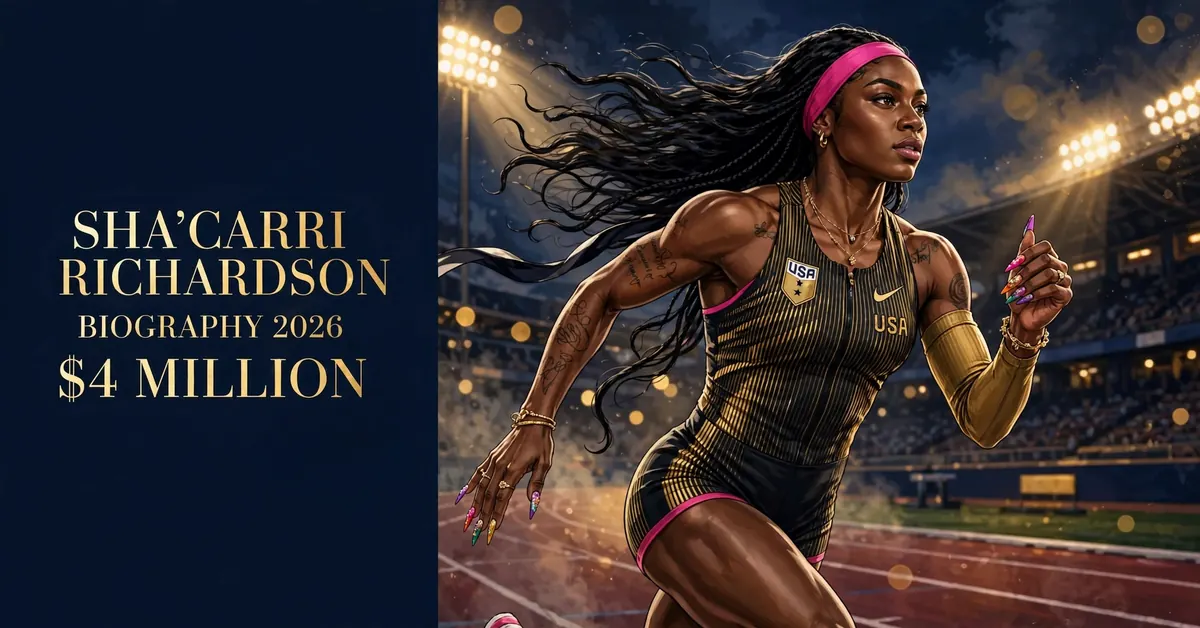
Sha’Carri Richardson biography 2026: age 26, the Dallas sprinter who went from a 2021 Olympic heartbreak to world 100m gold, Paris silver and a $4M fortune.
Last updated: November 10, 2026 · By Nathan Cole
Sha’Carri Richardson is 26 years old in 2026, and her fortune is estimated at $4 million. The American sprinter was born Sha’Carri LaNay Richardson on March 25, 2000, in Dallas, Texas, and she is the fastest woman in the world over 100 metres when she is at her best — a world champion, an Olympic silver medallist in the 100m and an Olympic gold medallist in the 4x100m relay. She got there the hard way. At 19 she broke the collegiate 100m record at LSU. At 21 she won the US Olympic Trials, lost her biological mother days later, tested positive for cannabis, and watched the Tokyo Olympics from home. At 23 she came back and won the world 100m title in a championship record of 10.65 seconds.
2026 has kept the story moving. On Easter Monday, April 6, she opened her season by winning the Stawell Gift in Australia — a 120-metre handicap race on grass — from scratch, the third woman ever to do it, for A$40,000 in prize money. The same year brought a court agreement that closed the 2025 airport assault case and, weeks later, a speeding arrest in Florida. She is 26, unmarried, in a relationship with fellow sprinter Christian Coleman, and still the most recognisable face in American sprinting — the long hair, the coloured nails, the confidence that made her famous before she had won a global title.
This biography works through the whole story behind the number: the Dallas childhood raised by her grandmother, the high-school titles, the LSU season that made her a star, the Nike deal, the 2021 suspension and what actually happened, the Budapest comeback, the Paris medals, the 2026 Stawell Gift win, and the money — how a sprinter whose track salary is reported at $45,000 to $55,000 a year ends up worth an estimated $4 million. The net-worth figure is an estimate, and this article says exactly how it was reached and why other sites give different numbers.
Quick Facts
| Full Name | Sha’Carri LaNay Richardson |
| Age in 2026 | 26 years old (born March 25, 2000; turns 27 on March 25, 2027) |
| Born | March 25, 2000, Dallas, Texas, USA |
| Height | 5 ft 1 in (155 cm) |
| Occupation | Professional track and field sprinter (100m, 200m, 4x100m relay) |
| Known For | 2023 world 100m champion (10.65); Paris 2024 Olympic 100m silver and 4x100m gold |
| Education | David W. Carter High School, Dallas; Louisiana State University (2018–2019) |
| Raised By | Grandmother Betty Harp and aunt Shayaria |
| Partner | Christian Coleman (sprinter; relationship reported since 2023) |
| Coach | Dennis Mitchell |
| Net Worth | Estimated $4 million (2026); range $3–5 million |
| Personal Bests | 100m 10.65 (Budapest 2023); 200m 21.92 (Budapest 2023) |
| Current Base | Clermont, Florida |
How This Estimate Was Made
Sha’Carri Richardson has never disclosed her earnings, and no filing or contract has ever made her income public. Every number attached to her name is a third-party estimate, so this article treats the figure the way a reporter treats any unverified claim: it collects the recent estimates, checks which ones agree, and names the ones that do not. The anchor is $4 million. Celebrity Net Worth lists $4 million, as reported by Parade in a profile published January 1, 2026 and updated February 1, 2026. Two other 2026 sources agree: Trendcelebs gives $4 million, and Bharat Horizon gives $4 million for Richardson individually in early 2026. That agreement across outlets that otherwise disagree with each other is the reason this article anchors on $4 million.
The honest range is $3–5 million. TheCityCeleb lists $3 million, and Paperblog gives a $1–5 million range. At the top end, TheMost10 lists $5 million in its 2026 pages. This article reports the range as $3–5 million, with $4 million as the figure the most recent reporting converges on. The range reflects a real fact about her money: almost none of it comes from running. Parade reports her track salary at $45,000 to $55,000 a year; the fortune comes from endorsements, appearance fees and prize money, none of which is itemised in public, so any single number is a best guess built from the same public pieces.
One figure was rejected outright. A separate TheMost10 page lists “$15 million in 2026” — three times the same site’s own $5 million figure, far above every other 2026 source, and supported by nothing. It is not used anywhere in this article. The widely repeated claim that her Nike deal is worth $20 million over five years is also handled with care: Parade reports it as a report, not a confirmed fact, and Nike has never confirmed the figure. This article names it as reported, not as money in the bank.
+
Who Is Sha’Carri Richardson?
Sha’Carri Richardson is an American sprinter and the 2023 world champion in the women’s 100 metres. She is also the most famous track athlete in the United States who is not named Usain Bolt — and Bolt retired in 2017. Richardson’s fame rests on two things at once: the speed, which is real and measured, and the style, which is impossible to miss. Long flowing hair, often in bright colours. Long decorated nails. A confidence on the start line that reads as arrogance to some people and as joy to others. She has been called the face of American sprinting since she was 19 years old, and the sport has not produced another one since.
The speed is the part that can be checked. Her personal best in the 100m is 10.65 seconds, set when she won the 2023 World Championships in Budapest. Only four women in history had ever run faster at the time. Her 200m best is 21.92, also from Budapest. She won Olympic silver in the 100m at Paris 2024 and anchored the United States to gold in the 4x100m relay. She won another world relay gold in Tokyo in September 2025. At 5 ft 1 in, she is one of the shortest elite sprinters in the world, and the contrast between her size and her speed is part of the story — she does not look like the sprinters she beats.
The other part of the story is the one people search for when they type her name into Google. In June 2021 she won the US Olympic Trials, learned her biological mother had died, tested positive for cannabis, and missed the Tokyo Olympics. It was the most public fall from grace in American track in a generation, and it happened in the space of a week. Two years later she was world champion. The biography that follows is the story of that arc — and of what came after the comeback, including a 2026 season that started with a win on grass in Australia and a court case back home.
Early Life in Dallas: Raised by Her Grandmother
Sha’Carri LaNay Richardson was born on March 25, 2000, in Dallas, Texas. She was raised by her grandmother, Betty Harp, and her aunt Shayaria, who took on the job of bringing her up. Her biological mother, Shayari Richardson, was not the person who raised her, and Richardson has spoken about her grandmother as the central figure of her childhood — the person who got her to practice, who kept her in school, who built the discipline that sprinting demands. She started running competitively around the age of nine, and the talent was obvious early: she was winning before she was a teenager.
Dallas in the 2000s was a hard place to grow up fast, and Richardson has never hidden that her childhood was not easy. Her parents were separated from her early life, and the family she lived with was the one that showed up. What the record does show is that the structure around her held. She stayed in school, she stayed in sport, and by the time she reached high school she was the best sprinter in her class in the country. The grandmother who raised her is still the person Richardson credits first in interviews — the through-line of every profile of her is that Betty Harp’s house in Dallas is where the fastest woman in America was made.
The detail that matters for the rest of the story is the relationship with her biological mother. Richardson did not grow up with her, and the two were not close. That distance is the context for what happened in June 2021, when Richardson learned of her mother’s death from a stranger — a fact she has described as triggering, nerve-shocking, and the cause of a state of emotional panic. It is not an excuse. It is the fact that explains the week that followed.
Carter High School: Five State Titles
Richardson attended David W. Carter High School in Dallas, and by the time she left she was the most decorated high-school sprinter in Texas. She won five individual Texas state championships — three in the 100 metres and two in the 200 metres — plus relay golds and team titles. In 2016, as a high-school athlete, she won the Texas UIL state championship in the 100 metres in 11.58 seconds. The same year she won the 100m at the AAU Junior Olympics. In 2017 she won bronze in the 200m at the USATF Junior Olympics and team gold in the 4x100m relay at the Pan American U20 Championships.
The Dallas Morning News named her its Girls Track Athlete of the Year in 2017. By then she was already the number-one sprint recruit in the country, and the recruiting race was a formality: she chose Louisiana State University, one of the great sprint programmes in American college track, and enrolled in 2018. The high-school numbers are worth listing because they show how long the talent had been visible. She did not come out of nowhere at 19. She had been the fastest girl in Texas for three years, and everyone in the sport knew her name before she ran a college race.
Carter High School is also where the style started. The hair, the nails, the colours — Richardson has said she grew up watching the great American sprinters and wanted to look like a star before she was one. The look is sometimes treated as a distraction from the running. It is the opposite: it is the brand she built herself, years before a sponsor paid her for it, and it is the reason her endorsement value is far higher than her track salary. The image came first. The money followed it.
LSU: The 10.75 That Broke the Collegiate Record
Richardson spent one season at Louisiana State University, and it was enough. As a freshman in 2019 she exploded onto the national scene at the NCAA Division I Outdoor Championships in Austin, Texas. In the 100 metres she ran 10.75 seconds — breaking a 42-year-old collegiate record, setting a world under-20 record, and becoming one of the ten fastest women in history at the age of 19. In the same meet she ran 22.17 in the 200 metres, breaking the under-20 world record that had belonged to Allyson Felix. Two under-20 world records in one day, in her first NCAA championships.
The NCAA recognised the season by awarding her The Bowerman, the prize given to the most outstanding track-and-field athlete in American college sport. It was the first time the scale of what she had done was clear to people outside the sport: a 19-year-old freshman had run times that put her among the fastest women who had ever lived, and she had done it in a single afternoon. The 10.75 still stands as one of the great collegiate performances in the history of the sport, and it is the number that made her a professional prospect before she had finished her freshman year.
She left LSU after that one season and turned professional in June 2019. The decision was not controversial — a sprinter who has run 10.75 as a freshman has nothing left to prove in college, and the money on offer was real. She signed with Nike, took on the agent Renaldo Nehemiah — himself a former world-record hurdler — and began training under Dennis Mitchell, the former Olympic sprinter who had won gold in the 4x100m relay at Barcelona 1992 and bronze in the 100m. Mitchell is still her coach in 2026, and the partnership has now lasted seven years, through the suspension, the comeback and the world title.
Turning Pro: The Nike Deal
Turning professional in June 2019 meant one thing above all: a Nike contract. Richardson signed with the brand that has sponsored nearly every great American sprinter of the last forty years, and the deal has been the foundation of her income ever since. The exact terms have never been disclosed, and the figure most often repeated — $20 million over five years — comes from reporting that Parade itself describes as unconfirmed. Nike has never confirmed it, and this article does not present it as fact. What is certain is that the deal exists, that it is her largest single income stream, and that it survived the 2021 suspension when many sponsors would have walked away.
The Nike relationship goes beyond a shoe contract. Richardson became the face of the brand’s collaboration with the French fashion designer Simon Porte Jacquemus, fronting the Nike x Jacquemus Spring 2024 collection — a fashion campaign, not a track campaign, and a sign of how Nike sees her value. She is not just a sprinter to the brand. She is a style figure with a track career attached, and the Jacquemus work is the clearest proof of that. Parade’s 2026 profile lists her other endorsements as Android, Beats by Dre, Oikos, Olay and Sprite — a portfolio that spans technology, audio, food and beauty, and that pays far more than the sport itself.
The economics are the point of the net-worth story, and they are worth stating plainly. Parade reports that a sprinter’s salary — the money paid for running — is typically $45,000 to $55,000 a year. Richardson’s $4 million fortune was not built on that. It was built on the Nike deal, on the other endorsements, on appearance fees for racing, and on prize money. The Stawell Gift win in April 2026 paid A$40,000, about $27,680 — more than half a year’s track salary for one afternoon’s work on grass in Australia. That is the arithmetic of modern sprinting: the running is the advertisement, and the money is in the brand.

Tokyo 2021: The Trials Win, the Loss, the Suspension
The week that defined Sha’Carri Richardson’s public life began on June 19, 2021. She won the 100 metres at the US Olympic Trials in Eugene, Oregon, in 10.86 seconds, becoming the youngest woman to win the event at the Trials since 1980. She was 21, she was going to the Tokyo Olympics, and she was the favourite for the gold medal. Days later she learned that her biological mother had died — from a stranger, by her own account — and in the grief that followed she used cannabis. A urine sample submitted after the Trials final tested positive for THC metabolites. The United States Anti-Doping Agency imposed a one-month suspension. She was out of the 100m in Tokyo, and she was not selected for the 4x100m relay team either. Her Olympic debut was postponed, and the story was everywhere.
The facts of the suspension are not in dispute, and this article does not relitigate them. Cannabis is a prohibited substance under the World Anti-Doping Agency code, and Richardson accepted the suspension without appeal. What is worth saying is what the coverage at the time often missed: the suspension was thirty days, the minimum the rules allowed, and it was served in full. She did not cheat to run faster — cannabis is not a performance enhancer in sprinting, and no one in the sport has ever claimed it is. She broke a rule in the worst week of her life, and she paid for it with an Olympic Games.
The aftermath was harder than the suspension. Richardson returned to racing in the autumn of 2021 and lost — badly, publicly, to the Jamaican sprinters who had swept the Olympic medals. The criticism was loud, and some of it was cruel. She was 21, she had been humiliated on television, and the sport’s establishment was not kind. The next two years were a slow climb back: new training, new discipline, fewer headlines. The comeback did not happen in a single race. It happened in the two seasons nobody was watching, and it arrived all at once in Budapest in August 2023.
The Comeback: World Gold in Budapest 2023
Richardson won the US national title in the 100 metres in July 2023, running 10.82, and arrived at the World Championships in Budapest as a contender rather than a favourite. The final, on August 21, 2023, is the race her career will be remembered for. She won the gold medal in 10.65 seconds — a championship record, a personal best, and the fifth-fastest time in the history of the women’s 100 metres at the time. She beat Shericka Jackson and Shelly-Ann Fraser-Pryce, the two Jamaicans who had dominated the event for a decade, from lane nine, the outside lane, the one nobody wants. It was the first global title of her career, and it came two years and two months after the suspension that was supposed to have ended it.
Budapest gave her two more medals. She anchored the United States to gold in the women’s 4x100m relay in 41.03 seconds — another championship record — with an anchor leg split of 9.65 seconds, reported as the fastest anchor leg in history. And she took bronze in the 200 metres in 21.92 seconds, another personal best. Three medals, two championship records, two personal bests, one week. The comeback was not a story about redemption any more. It was a story about a sprinter who was now, by the numbers, the best in the world.
The city of Dallas noticed. The track at John Kincaide Stadium in South Dallas was renamed the Sha’Carri Richardson Track, and November 10 was declared Sha’Carri Richardson Day. The honours are the kind that usually come at the end of a career, and they came in the middle of hers — a sign of how much the city had invested in the girl from Carter High School, and how much her return had meant to the people who had watched her grow up. The 2023 season also settled the commercial question: the Nike deal, which had looked fragile in 2021, was now attached to a world champion, and the endorsement portfolio grew around it.
Paris 2024: Silver in the 100m, Gold in the Relay
The Paris Olympics in August 2024 were Richardson’s first Games, three years late. She won silver in the 100 metres behind Julien Alfred of Saint Lucia, and then anchored the United States to gold in the 4x100m relay in 41.78 seconds. The silver was a disappointment only in the sense that she had gone to Paris to win — she was the world champion, and the 100m was her race. Alfred ran the race of her life, and Richardson, who had waited three years for the moment, had to settle for second. The relay gold, a day later, was the medal that mattered most to her team: she ran the anchor leg, brought the baton home, and became an Olympic champion at last.
Paris also confirmed her place in the sport’s hierarchy. She is not the fastest woman who ever lived — that is Florence Griffith Joyner, whose 10.49 from 1988 still stands, and the Jamaicans who have run 10.54 and 10.60. She is the fastest American woman of her generation, the world champion, and an Olympic gold medallist, and at 24 she had time to add to all of it. The 2024 season ended with her as the most marketable track athlete in the United States, and the most searched: her name trends every time she races, and her races are the ones casual fans watch.
A year later, at the World Championships in Tokyo in September 2025, she added another world title in the 4x100m relay, anchoring the American team to gold again. The relay has become her most reliable medal — she has now anchored the United States to world gold in 2023 and 2025 and Olympic gold in 2024, and the 41.03 from Budapest remains the fastest time a women’s relay team has ever run at a World Championships. The individual 100m title from 2023 is still the one that defines her. The relays are the ones that keep coming.

2026: The Stawell Gift Win From Scratch
Richardson opened her 2026 season in the most unlikely place imaginable: a grass track in a small town in Victoria, Australia, 200 kilometres north-west of Melbourne. The Stawell Gift is Australia’s oldest and richest footrace, run since 1878 over 120 metres on grass, and it is a handicap race — slower runners get a head start, and the fastest runners start from scratch, chasing the whole field. Richardson and Coleman both entered the 144th edition, both from scratch, and both raced for the first time in 2026 on Easter Monday, April 6.
She won. After a heat in 13.815 seconds and a semi-final she survived by 0.007 seconds — easing up before the line and nearly paying for it — she powered through the final in 13.15 seconds, a record, catching Australia’s Charlotte Nielsen in the closing stages. She became only the third woman in the history of the event to win from scratch, after Melissa Breen in 2012 and Bree Rizzo in 2025, and she took home A$40,000 in prize money. Coleman, also from scratch, finished fifth in his semi-final and did not reach the men’s final, won by the 21-year-old medical student Olufemi Komolafe in 11.93 seconds. Richardson’s own verdict was simple: chasing everyone on grass, she said, “woke my body up” and made her activate her race pattern. It was, she said, like being a kid again, playing tag.
The Stawell win matters for two reasons. The first is the money: A$40,000 for one race is more than most sprinters earn in a season of Diamond League meetings, and it is the kind of appearance that shows how much her name is worth outside the sport’s usual circuits. The second is the signal: at 26, in her eighth year as a professional, she is still opening seasons by winning races she has never run before, in formats she has never tried, on surfaces she has never raced on. A fortnight later, at the Tom Jones Memorial in Gainesville on April 17–18, she withdrew from the 200m to run only the 4x100m relay, telling fans she was still recovering from the Australia trip and looking forward to opening up in China. The season, as of November 2026, is still unfolding.
How Tall Is Sha’Carri Richardson? 5 Feet 1 Inch
Richardson is 5 feet 1 inch tall (155 cm), according to Wikipedia’s infobox, which is the most widely cited source for her measurements. There is no official measurement on record, and the figure should be treated as reported rather than verified, but it is consistent across the biography sites that list her height, and it matches what anyone can see on the start line: she is one of the shortest elite sprinters in the world, giving away several inches to most of the women she races. For the full breakdown of her height, see Sha’Carri Richardson’s height on our sister site CelebAmerica.
The height is part of the athletic story, not just a trivia answer. Sprinting rewards long levers and long strides — the great sprinters are usually tall, and the fastest man in history, Usain Bolt, is 6 ft 5 in. Richardson is 5 ft 1 in and runs 10.65. She does it with a stride rate that compensates for the stride length she does not have, and with a start that gets her out of the blocks ahead of taller women who need longer to unfold. Her size is the reason her speed looks surprising, and the surprise is the reason people remember her. A 6 ft sprinter running fast is expected. A 5 ft 1 in sprinter running 10.65 is a story.
The comparison with her peers makes the point. Noah Lyles, the American men’s sprint star, is 5 ft 11 in. Allyson Felix, whose under-20 200m record Richardson broke at LSU, is 5 ft 6 in. Richardson is shorter than both, and faster over 100m than Felix ever was. The height does not hold her back. It is the detail that makes the 10.65 more impressive, not less.
Sha’Carri Richardson Net Worth in 2026: Million
Sha’Carri Richardson’s net worth is estimated at $4 million in 2026. That is the figure Celebrity Net Worth lists, as reported by Parade in January 2026, and the figure two other 2026 sources — Trendcelebs and Bharat Horizon — also give. The range around it runs from $3 million at the low end (TheCityCeleb) to $5 million at the top (TheMost10), with Paperblog giving a $1–5 million range. This article anchors on $4 million because it is the figure the most recent reporting converges on, and it gives the spread because the spread is the honest answer.
The money comes from four streams, and the balance between them explains why her fortune is smaller than her fame. Endorsements are the first and the largest: the Nike deal, reported at $20 million over five years but never confirmed, plus Android, Beats by Dre, Oikos, Olay and Sprite, plus the Nike x Jacquemus fashion work. Appearance fees are the second: promoters pay her to show up, because her name sells tickets, and the Stawell Gift appearance in April 2026 — with its A$40,000 prize — is the clearest recent example of what a single appearance is worth. Prize money is the third: World Athletics pays a $50,000 bonus for a world-championship gold, and she has won three of those, plus Diamond League winnings. Track salary is the fourth, and the smallest: Parade reports it at $45,000 to $55,000 a year.
| Income stream | What it is | Status in 2026 |
|---|---|---|
| Endorsements | Nike (reported $20M/5 yrs, unconfirmed), Android, Beats by Dre, Oikos, Olay, Sprite, Nike x Jacquemus | Largest stream; Nike deal intact since 2019 |
| Appearance fees | Paid to race at meetings and invitationals | Stawell Gift 2026 appearance + A$40,000 prize |
| Prize money | World Athletics gold bonus $50,000; Diamond League winnings | Three world golds (2023 x2, 2025 relay) |
| Track salary | Base pay for sprinting (Parade) | $45,000–$55,000 per year — the smallest stream |
What she does not have is a business empire. There is no Richardson clothing line, no restaurant chain, no media company — the fortune is an athlete’s fortune, built on a shoe deal and a name, not on equity. That is also why it is modest by celebrity standards: $4 million is a great deal of money for a 26-year-old, and a small fortune next to the $90 million or so that Usain Bolt built over a longer career with bigger deals. The difference is time and scale, not talent. Bolt ran for a decade at the top of the sport. Richardson has been a professional for seven years, and her biggest earning years are still ahead of her — if she stays healthy and keeps winning.
Endorsements and the Money Behind the Fame
The endorsement portfolio is where Richardson’s fortune actually lives, and it is worth looking at in detail because it explains the gap between her fame and her net worth. Nike is the anchor, and it has been since June 2019. The brand signed her as a 19-year-old freshman with one great college season behind her, and it stayed with her through the 2021 suspension — a decision that looks obvious now and did not look obvious then. Sponsors drop athletes for failed drug tests as a matter of routine. Nike did not, and the loyalty has paid off: the brand now has a world champion and an Olympic gold medallist under a contract signed before either medal existed.
The rest of the portfolio shows how wide her appeal runs. Android, Beats by Dre, Oikos, Olay and Sprite are not track brands. They are technology, audio, food, beauty and soft-drink brands, and they buy the same thing Nike buys: a young Black American woman with a huge social-media following, a distinctive look, and a story that people know. The Nike x Jacquemus Spring 2024 collection — a fashion campaign with the French designer Simon Porte Jacquemus — is the furthest the portfolio has gone from the track, and it is the clearest sign of where her value lies. She is marketable as a fashion figure, not just as an athlete, and fashion pays better than sprinting.
Her home is the one asset the public record can price. MansionsRadar reported in September 2026 that she lives in Clermont, Florida, in a house worth about $605,000 in 2026 — a $580,000 purchase that has appreciated. It is a comfortable house, not a mansion, and it is consistent with the $4 million estimate: a fortune of that size buys a $600,000 house, not a $6 million one. The absence of a property empire is itself a data point. Richardson’s money is in endorsements and appearance fees, not in real estate, and the $4 million figure is best read as the value of a career that is still in its middle, not as a finished fortune.
Personal Life: Christian Coleman and the 2025 Airport Case
Richardson is not married, and she has no children. She is in a relationship with the sprinter Christian Coleman, the 2019 world 100m champion and the world-record holder over 60 metres indoors. The two have been linked since 2023, they train in the same circles, and they opened their 2026 seasons together at the Stawell Gift in Australia — Coleman racing from scratch in the men’s event, Richardson winning the women’s. Coleman is the only partner Richardson has publicly been linked to, and the relationship is the one readers ask about most after her net worth.
The relationship has also produced the most difficult episode of her public life since 2021. In July 2025, Richardson was arrested at Seattle-Tacoma International Airport and charged with misdemeanor fourth-degree assault (domestic violence). Video footage showed her shoving Coleman and throwing headphones at him. The case did not go to trial. On December 23, 2025, Richardson and the City of SeaTac agreed a two-year stipulated order of continuance: the charge will be dropped if she meets the conditions over the two-year period, including having no hostile contact with Coleman. The Associated Press reported in April 2026 that the two appeared to have continued their relationship despite the charge.
There was a second arrest, in January 2026. On January 29, Richardson was arrested in Florida and charged with dangerous excessive speeding — 100 miles per hour or more. She pleaded not guilty, with a pre-trial hearing scheduled for April 16, 2026, in Orlando. The speeding case is still open as of November 2026, and this article will be updated when it is resolved. Both cases are reported here because readers search for them, and because leaving them out would make this biography less honest than the record. They are reported in proportion: two arrests, one resolved by agreement, one pending, neither resulting in a conviction as of November 2026. Richardson has not spoken publicly about either case in detail, and this article does not speculate about what happened beyond the public record.
How Sha’Carri Compares to Other Sprinters
Richardson’s $4 million fortune sits at the lower end of the sprinting range, and the comparison shows what kind of career builds what kind of money. Usain Bolt, the fastest man who ever lived, is worth an estimated $90 million — a fortune built on eight Olympic golds, three world records that still stand (9.58 in the 100m, 19.19 in the 200m, 36.84 in the relay), and a decade as the most famous athlete on the planet. Noah Lyles, the American men’s star of Richardson’s own generation, is worth an estimated $4–7 million — a fortune built on the same model as hers, endorsements and appearance fees, with an Olympic 100m gold from Paris 2024 at its centre.
The women’s comparison is Allyson Felix, whose under-20 200m record Richardson broke at LSU in 2019. Felix won 11 Olympic medals — more than any American track athlete in history — across five Games from 2004 to 2021, and built a career on longevity and consistency rather than a single peak. Richardson, at 26, has two Olympic medals and three world golds, and her 10.65 is faster than anything Felix ever ran. The difference is time: Felix competed at the top for seventeen years. Richardson has been a professional for seven. The peer table is a snapshot, not a verdict — and the numbers will move.
| Sprinter | 100m best | Olympic medals | Estimated net worth (2026) |
|---|---|---|---|
| Sha’Carri Richardson | 10.65 | 2 (1 gold, 1 silver) | $4 million |
| Usain Bolt | 9.58 (world record) | 8 golds | ~$90 million |
| Noah Lyles | 9.79 | 2 (1 gold, 1 bronze) | $4–7 million |
| Allyson Felix | 10.89 | 11 (7 golds) | Not publicly estimated |
The table also shows the other side of the comparison. Richardson’s 10.65 is the fastest time on it after Bolt’s world record, and she ran it at 23. Lyles’ 9.79 won him the Olympic title in Paris; Richardson’s 10.65 would have won the women’s Olympic 100m in every Games except the last two. The fortune is small because the career is young, not because the talent is. A sprinter who runs 10.65 at 23 and wins a world title at the same age has a decade of earning ahead of her — and the endorsement market pays for the next title, not the last one.
Sha’Carri Richardson: Age and Career Timeline
| Year | Age | What happened |
|---|---|---|
| 2000 | 0 | Born March 25 in Dallas, Texas |
| 2009 | 9 | Starts running competitively |
| 2016 | 16 | Texas UIL state 100m title (11.58); AAU Junior Olympics 100m win |
| 2017 | 17 | Dallas Morning News Girls Track Athlete of the Year; Pan Am U20 relay gold |
| 2018 | 18 | Enrols at LSU |
| 2019 | 19 | NCAA 100m 10.75 (collegiate + U20 world records); The Bowerman; turns pro; signs with Nike |
| 2021 | 21 | Wins US Olympic Trials (10.86); mother dies; THC positive; one-month suspension; misses Tokyo |
| 2023 | 23 | US 100m champion (10.82); world 100m gold (10.65, championship record); world 4x100m gold (41.03); 200m bronze (21.92) |
| 2024 | 24 | Paris Olympics: 100m silver, 4x100m relay gold (41.78) |
| 2025 | 25 | World 4x100m relay gold, Tokyo; airport arrest (July); SOC agreed (December 23) |
| 2026 | 26 | Wins Stawell Gift from scratch (13.15, A$40,000); Florida speeding arrest (January 29) |
Twenty-six years old, a world title, an Olympic gold, a personal best of 10.65, and a fortune estimated at $4 million. The timeline is the biography in miniature: a girl from Dallas who was the fastest in Texas at 16, the fastest in college at 19, the fastest in the world at 23 — and who lost two years to a suspension and came back better. The next chapter is the one that decides the fortune: another world title, another Olympic gold, and the endorsements that follow them.
Sha’Carri Richardson Biography — Frequently Asked Questions
How old is Sha’Carri Richardson in 2026?
Sha’Carri Richardson is 26 years old in 2026. She was born on March 25, 2000, in Dallas, Texas, and she turns 27 on March 25, 2027. Many older pages still list her as 25 because they were written before her March birthday.
What is Sha’Carri Richardson’s net worth in 2026?
Sha’Carri Richardson’s net worth is estimated at $4 million in 2026, according to Celebrity Net Worth, as reported by Parade in January 2026, with Trendcelebs and Bharat Horizon also giving $4 million. The honest range runs from $3 million to $5 million, with TheCityCeleb listing $3 million and TheMost10 listing $5 million. No official disclosure exists; all figures are third-party estimates.
How tall is Sha’Carri Richardson?
Sha’Carri Richardson is 5 feet 1 inch tall (155 cm), according to Wikipedia’s infobox. There is no official measurement on record, so the number should be treated as reported rather than verified, but it is consistent across the biography sites that list her height.
What happened to Sha’Carri Richardson at the 2021 Olympics?
Richardson won the 100m at the US Olympic Trials in June 2021 in 10.86 seconds, then learned her biological mother had died. She tested positive for THC after the Trials final and accepted a one-month suspension from the United States Anti-Doping Agency, which kept her out of the Tokyo Olympics. She was also not selected for the 4x100m relay team.
What is Sha’Carri Richardson’s fastest time?
Her fastest 100m time is 10.65 seconds, run when she won the 2023 World Championships in Budapest — a championship record and the fifth-fastest time in history at the time. Her fastest 200m time is 21.92 seconds, also from Budapest 2023, where she won bronze.
Who is Sha’Carri Richardson’s boyfriend?
Sha’Carri Richardson is in a relationship with fellow sprinter Christian Coleman, the 2019 world 100m champion and 60m world-record holder. The two have been linked since 2023 and opened their 2026 seasons together at the Stawell Gift in Australia. She is not married.
Did Sha’Carri Richardson win the Stawell Gift?
Yes. On Easter Monday, April 6, 2026, Richardson won the women’s 120m at the Stawell Gift in Australia in 13.15 seconds, from scratch — meaning she started with no head start. She became only the third woman ever to win the race from scratch, after Melissa Breen in 2012 and Bree Rizzo in 2025, and took home A$40,000 in prize money.
What happened in Sha’Carri Richardson’s 2025 airport case?
In July 2025 Richardson was arrested at Seattle-Tacoma International Airport and charged with misdemeanor fourth-degree assault (domestic violence) after an incident involving Christian Coleman. On December 23, 2025, she agreed a two-year stipulated order of continuance with the City of SeaTac; the charge will be dropped if she meets the conditions, including no hostile contact with Coleman. In January 2026 she was separately arrested in Florida for dangerous excessive speeding and pleaded not guilty.
Sources & Reporting
This article was reported on November 10, 2026, from live sources checked the same day. The biography facts — birth date, family, education, LSU season, professional career and medals — are sourced to Wikipedia’s Sha’Carri Richardson entry, Encyclopaedia Britannica (published March 21, 2026), All American Speakers’ biography, and the Qoshe/International Business Times 2026 season report. The 2026 Stawell Gift win is sourced to the Associated Press report carried by Glance, Pulse Kenya’s race report, and the Victorian Government’s Sport Victoria report of April 9, 2026. The 2025 airport case, the December 2025 stipulated order of continuance and the January 2026 Florida speeding arrest are sourced to Pulse Kenya’s October 2026 reports citing LetsRun and the court order. The net-worth anchor of $4 million is sourced to Celebrity Net Worth as reported by Parade (published January 1, 2026, updated February 1, 2026), Trendcelebs and Bharat Horizon; the $3–5 million range is sourced to TheCityCeleb ($3 million), TheMost10 ($5 million) and Paperblog ($1–5 million). The Nike $20 million figure is sourced to Parade, which reports it as unconfirmed, and is labeled as such. The Clermont house value of about $605,000 is sourced to MansionsRadar (September 2026). The height of 5 ft 1 in (155 cm) is sourced to Wikipedia’s infobox. The peer figures are sourced to Guide Net Worth’s own profiles of Usain Bolt, Noah Lyles and Allyson Felix. Where sources disagreed — on the net-worth range and the Nike deal — this article gives the range and names the outlet behind each number rather than picking one. Figures that no outlet has confirmed are labeled as reported or estimated. Corrections: see our corrections policy on the About Us page; if a figure in this article changes, it will be updated with a dated note.
About the author: Nathan Cole covers celebrity wealth, track and field, and the business of fame for Guide Net Worth. He reports net-worth figures only from named outlets, gives ranges where sources disagree, and updates every profile when new reporting lands.
References & Sources
This article has been fact-checked and verified against multiple public sources, financial disclosures, SEC filings, Forbes reports, Celebrity Net Worth databases, and official records. All net worth estimates are based on publicly available information and financial analysis.