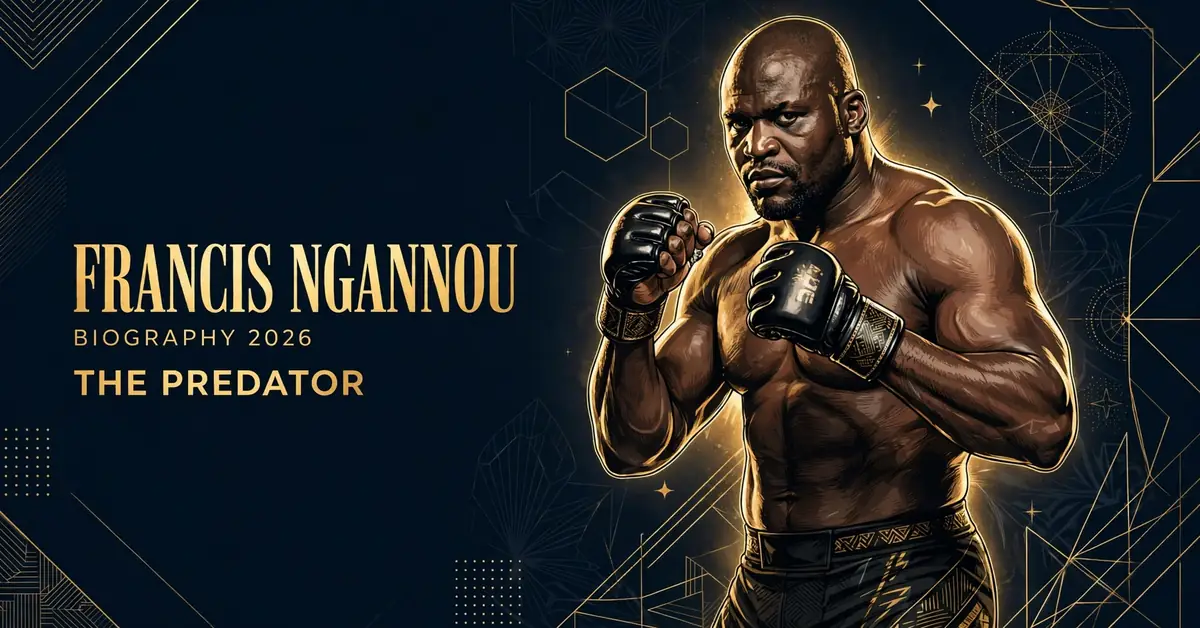
Francis Ngannou’s biography: from Cameroon’s sand quarries to UFC heavyweight champion, boxing Tyson Fury and a $15M fortune built on the hardest punch in MMA.
Last updated: November 12, 2026 · By Nathan Cole
Francis Ngannou is 40 years old in 2026, a former UFC heavyweight champion with a professional MMA record of 19-3, and one of the most improbable success stories in combat sports. Born in a village in Cameroon with no running water, he worked in sand quarries as a child, crossed a continent on foot and by boat, slept rough in Paris, and discovered mixed martial arts at 26 — an age when most fighters are already a decade into their careers. Within eight years he held the UFC heavyweight title, and within ten he had boxed the two biggest names in heavyweight boxing.
His net worth sits at an estimated $15 million in 2026, according to Surprise Sports’ October 2026 update, with credible outlets ranging up to $25 million. The fortune was built in an unusual order: modest UFC purses first, then two boxing paydays reported at roughly $10 million and $20 million, then a PFL deal that paid him like a partner rather than an employee. This biography follows the whole arc — the quarries of Batié, the 14-month journey to Paris, the UFC title, the contract fight that made him walk away as champion, the PFL years, the two boxing nights in Riyadh, the loss of his infant son, and the May 2026 knockout that put him back in the cage at 39 and extended his winning streak to eight.
The record needs one correction before anything else. Several profiles still list Ngannou at 18-3. That figure went out of date on May 16, 2026, when he knocked out Philipe Lins in the first round of Most Valuable Promotions’ first MMA card in Los Angeles. Sherdog and Wikipedia both record the win, taking his professional record to 19-3 with 14 knockouts. Every figure in this article is dated to its source, and where sources disagree, the article says so.
Quick Facts
| Full Name | Francis Zavier Ngannou |
| Born | September 5, 1986, Batié, Cameroon (age 40 in 2026) |
| Nationality | Cameroonian-French |
| Height / Reach | 6 ft 4 in (1.93 m) / 83 in (211 cm) |
| MMA Record | 19-3 (14 KO/TKO, 4 submissions, 1 decision); UFC record 12-2; boxing 0-2 |
| Net Worth (2026) | $15 million anchored (Surprise Sports, October 2026); credible range $15M–$25M |
| Titles | UFC Heavyweight Champion (2021–2023); inaugural PFL Super Fights Heavyweight Champion (2024) |
| Biggest Paydays | Reported ~$20M vs Anthony Joshua (2024); reported ~$10M vs Tyson Fury (2023); $10M PFL debut purse reported (2024) |
| Current Status | MMA free agent as of September 2026; last fight May 16, 2026 — first-round KO of Philipe Lins |
| Family | Unmarried; son Kobe died April 2024, aged 15 months; runs the Francis Ngannou Foundation in Cameroon |
| Known For | The hardest punch ever measured at the UFC Performance Institute (129,161 units, 2018) |
How These Figures Were Verified
This is a biography, not a bank statement, so every number in it is either a dated public record or a labeled estimate. The fight record (19-3) comes from Sherdog and Wikipedia, both updated after the May 16, 2026 win over Philipe Lins; the article names the fight that changed the record from 18-3 so readers can check it. The net worth anchor is Surprise Sports’ $15 million, updated October 8, 2026, tested against Celebrity Net Worth’s $25 million, EssentiallySports’ $15 million from early 2026, and Wealthy Gorilla’s $15 million from November 2026. Fight purses are reported figures, never confirmed salaries: the $10 million Fury purse and $20 million Joshua purse are labeled as reported throughout, because neither promoter nor fighter has confirmed them. The one hard purse figure is the $1.5 million disclosed by the California State Athletic Commission for the May 2026 Lins fight, reported by Celebrity Net Worth. Where the public record is silent — endorsement income, property values, private investments — the article says so instead of filling the gap with a guess.
+
Francis Ngannou’s Net Worth in 2026
Francis Ngannou’s net worth is estimated at $15 million in 2026. Surprise Sports, which updated its Ngannou profile on October 8, 2026, puts the figure at $15 million, and EssentiallySports reached the same number in early 2026. Wealthy Gorilla, updated November 9, 2026, also lists $15 million. That three-way agreement makes $15 million the anchor for this article.
The range around it is wide. Celebrity Net Worth now lists Ngannou at $25 million, and our sister site NetWorthCraft puts Francis Ngannou’s net worth at $20 million. One outlier, GiveMeSports via The Hot Jem, goes as high as $35 million. The honest answer is a range of $15 million to $25 million, with $15 million as the figure the most recent dated reporting supports.
The spread has a clear cause. Ngannou’s two biggest paydays — the boxing matches against Tyson Fury and Anthony Joshua — were reported at roughly $10 million and $20 million, but neither figure was ever confirmed by a promoter, a commission, or Ngannou himself. An outlet that counts both purses in full, after tax, lands near $25 million. An outlet that treats them as reported rather than confirmed, and deducts the taxes, training costs and management fees that eat into any fighter’s purse, lands at $15 million. The truth, as far as the public record allows, sits between the two, and this article uses $15 million because that is where the freshest dated source sits.
What is not in dispute is the shape of the fortune. Ngannou earned relatively little in the UFC — his early purses were five figures, and even his title fights paid a fraction of what boxing’s heavyweights earn. The money arrived late and fast: two boxing nights in Riyadh, a PFL contract that paid a reported $10 million for a single fight in October 2024, and a $1.5 million disclosed purse for his May 2026 return. He went from sand-quarry wages to eight-figure paydays in thirteen years, and the second half of this article follows that climb fight by fight.
Why the Estimates Disagree: Million to Million
Three reputable outlets can look at the same fighter and produce three different fortunes, and in Ngannou’s case the reason is specific. It is not that anyone is guessing wildly. It is that the two largest inputs to his wealth are reported numbers with no paper trail behind them.
The first input is the Fury purse. Reports at the time put Ngannou’s pay for the October 28, 2023 fight at roughly $10 million. The figure circulated widely, but it traces to reporting rather than a disclosure — Saudi boxing cards do not publish purses the way American commissions do. An outlet that banks the $10 million in full gets a bigger fortune. An outlet that discounts it for tax and costs gets a smaller one.
The second input is the Joshua purse. Reports put it near $20 million, double the Fury figure, and it is the single largest number in Ngannou’s financial story. The same problem applies: reported, not confirmed. Count it in full and the fortune pushes toward $25 million. Treat it cautiously and the number drops toward $15 million.
The third input is the PFL money. EssentiallySports’ earnings table lists a $10 million purse for the October 2024 Renan Ferreira fight, and Ngannou’s PFL deal was reported to guarantee him a high seven-figure amount for every MMA appearance. His UFC earnings, by contrast, are small enough to count precisely — his debut purse was reported at $22,500 by The Sports Daily — and they barely move the total either way.
| Source (dated) | Net worth figure | Basis |
|---|---|---|
| Surprise Sports (updated Oct 8, 2026) | $15 million | Anchor figure; freshest dated listing |
| EssentiallySports (early 2026) | $15 million | Estimate; fight earnings + endorsements |
| Wealthy Gorilla (updated Nov 9, 2026) | $15 million | Estimate; $30M from two boxing bouts cited |
| Celebrity Net Worth (2026) | $25 million | Ceiling; counts reported boxing purses in full |
| NetWorthCraft (2026) | $20 million | Midpoint; sister-site profile |
Early Life in Cameroon: The Sand Quarries of Batié
Francis Zavier Ngannou was born on September 5, 1986, in Batié, a village in the West Region of Cameroon. The family had little money and no running water. His parents separated when he was young, and he was raised largely by his grandmother and an aunt. School was irregular. Work was not.
By the age of 10 he was working in the sand quarries around Batié, shovelling sand into sacks for a few coins a day. The quarries are open pits where labourers dig, haul and load sand by hand under a hard sun, and Ngannou has described the work as the hardest thing he has ever done — harder, in his own telling, than any training camp. The strength that later flattened heavyweights in the UFC was built there first, carrying loads that grown men struggled with.
His father was a street fighter, known in the village for settling disputes with his fists, and the young Ngannou wanted to follow him. His mother talked him out of it. She wanted him to stay away from fighting, and for years he did — the boy who would become the most feared puncher in MMA spent his childhood trying to avoid the path that made him famous. The irony is not lost on him: he has said in interviews that he ran from fighting until there was nothing else left to run to.

There was no gym in Batié, no coach, no boxing club. Ngannou’s first exposure to combat sports came from watching Mike Tyson fights, and Tyson became the hero he measured himself against. He has said he wanted to box from the time he was a teenager, but there was no route from a Cameroonian village to a boxing ring. The route he eventually found was longer, harder and almost entirely on foot.
The poverty stayed with him. Years later, after he had won a UFC title and banked millions, he built a gym in Batié through the Francis Ngannou Foundation — the first proper training facility the village had ever had. The foundation’s work, building gyms and giving children in Cameroon a place to train, is the part of his story he talks about most now, and it is the clearest sign of what the quarries taught him: that the way out of Batié was never going to be handed to anyone.
The 14-Month Journey to Paris
Ngannou left Cameroon at 26. He had no visa, no money to speak of, and no plan beyond reaching Europe. The journey took fourteen months. He crossed Nigeria, Niger and Algeria, then Morocco, travelling by bus, by truck and on foot, sleeping where he could. He was detained in Spain for two months after being caught crossing by boat. He arrived in Paris in 2013 with nothing — no home, no job, no papers, and no French beyond a few words.
For a time he slept in a car park in Paris. He ate at food banks and trained when he could, holding on to the idea that had carried him across a continent: that he could fight. A chance meeting changed the course of the story. He was introduced to Fernand Lopez, a coach who ran the MMA Factory gym in Paris, and Lopez saw something in the homeless 26-year-old who had walked into his gym. Lopez gave him a place to train, and later a place to stay, and Ngannou began learning mixed martial arts from zero.
The timeline is the remarkable part. Most UFC champions start training as teenagers and reach the top after a decade of competition. Ngannou started at 26, had his first professional fight within months, and was in the UFC two years later. He has said he chose MMA because boxing’s route was closed to him — there were no amateur bouts to build a record, no promoter waiting — while MMA in France, still finding its feet, would take a raw heavyweight with power and teach him the rest.
Lopez became more than a coach. He was the first person in Paris to treat Ngannou as a fighter rather than a problem, and their relationship — which later broke down publicly over money and credit — began with Lopez feeding and housing a man who had nothing. The story of Ngannou’s rise is often told as a solo journey. It was not. It was a journey that depended, at the decisive moment, on one coach opening a door.
MMA Beginnings: Pro Debut to UFC Contract
Ngannou’s professional debut came in November 2013, in Paris, against Rachid Benz. He won by submission — an armbar, of all things, from a man who would become famous for knocking people unconscious. The early record was built in small French promotions: wins over Bilal Tahtahi and Nicolas Specq, a first loss to Zoumana Cisse in December 2013, then a run of finishes that caught the UFC’s attention.
The UFC signed him in 2015. His debut came on December 19, 2015, at UFC on Fox 17 in Orlando, against Luis Henrique. Ngannou knocked him out in the second round. The Sports Daily later reported his purse for that debut at $22,500 — a figure that looks almost comical against the purses he would earn eight years later, and a useful measure of how far the money travelled.
What the UFC had bought was obvious from the first fight: a heavyweight who moved like a middleweight and hit harder than anyone in the division. His next five fights all ended inside the distance. Curtis Blaydes was stopped in the second round in April 2016. Bojan Mihajlovic was stopped in the first in July 2016. Anthony Hamilton fell in the first in December 2016. Andrei Arlovski, a former champion, was finished in 92 seconds in January 2017. By then the division knew his name, and the UFC knew it had a problem of the good kind: a contender who finished everyone, fast.
The Rise: Overeem, Miocic, and the First Setbacks
The fight that made Ngannou a star was also one of the most violent knockouts in UFC history. On December 2, 2017, at UFC 218 in Detroit, he faced Alistair Overeem, a former champion and one of the most experienced heavyweights alive. Fifty-nine seconds into the first round, Ngannou landed an uppercut that lifted Overeem off his feet and left him unconscious before he hit the canvas. The image of Overeem flat on his back, arms outstretched, became the defining picture of Ngannou’s power — and the clip still circulates today as proof of what a single punch from him can do.
The uppercut earned him a title shot against Stipe Miocic, the champion, on January 20, 2018, at UFC 220 in Boston. It was a lesson in what power alone cannot do. Miocic, the most accomplished heavyweight in UFC history to that point, weathered the first round, took Ngannou down repeatedly, and won a clear unanimous decision over five rounds. Ngannou gassed badly after the opening minutes, and the fight exposed the gaps in his game: no wrestling defence, no plan B, no gas tank for a championship distance.
The next fight made it worse. On July 7, 2018, at UFC 226 in Las Vegas, he faced Derrick Lewis in a bout billed as a guaranteed knockout. It became one of the dullest heavyweight fights ever staged — three rounds of two men refusing to engage, decided by Lewis on the scorecards. Ngannou threw 46 strikes in fifteen minutes. The loss dropped him to two defeats in a row, and the talk around him changed overnight: from future champion to a cautionary tale about a puncher with no depth.
The rebuild was ruthless and fast. On November 24, 2018, he stopped Curtis Blaydes in 45 seconds. On February 17, 2019, he knocked out Cain Velasquez — a former champion returning after two and a half years out — in 26 seconds. On June 29, 2019, he stopped Junior dos Santos in the first round. On May 9, 2020, he flattened Jairzinho Rozenstruik in 20 seconds. Four fights, four first-round finishes, a combined fight time of under three minutes. The man who had looked lost against Miocic and Lewis was gone. The rematch with Miocic was the only fight that made sense.
UFC Heavyweight Champion: Miocic, Gane, and a Torn Knee
The rematch came on March 27, 2021, at UFC 260 in Las Vegas. This time Ngannou fought like a man who had studied the first defeat. He defended the takedowns, stayed patient, and in the second round landed the right hand that ended Miocic’s reign. Miocic fell, Ngannou followed with hammerfists, and the referee stopped it. Ngannou was the UFC heavyweight champion, eight years after sleeping in a Paris car park, and the first African-born fighter to hold the UFC’s heaviest title.
His first defence was meant to be a unification bout against Jon Jones, the light-heavyweight great moving up to heavyweight. It never happened. Jones and the UFC could not agree on pay, and the fight — the biggest the division could have made — stayed on the drawing board. Jon Jones’ biography tells the other half of that story: a champion who spent years in a pay dispute of his own, and whose heavyweight debut eventually came against Ciryl Gane in March 2023, months after Ngannou had left.
Instead, Ngannou defended against Gane, the interim champion, on January 22, 2022, at UFC 270 in Anaheim. The fight revealed a fighter nobody had seen before. Ngannou had torn his ACL and damaged his MCL in training, an injury he kept secret until after the fight, and he could barely move on the knee. So he did the last thing anyone expected: he wrestled. He took Gane down repeatedly over five rounds and won a unanimous decision on control and top position. It was the least spectacular win of his career and, in the eyes of many analysts, the most impressive — a knockout artist winning a title fight with wrestling, on one good leg.
He had surgery on the knee in March 2022 and spent the rest of the year recovering. While he healed, the UFC’s contract clock ran down. What happened next had nothing to do with fighting and everything to do with money.
Leaving the UFC: The Contract Fight
Ngannou’s UFC contract expired with the Gane fight, and the promotion’s matching rights kept him tied up through 2022 while the two sides negotiated. The talks failed on three points that Ngannou has named publicly ever since: health insurance for fighters, the freedom to take sponsorships outside the UFC’s deals, and a say in how his opponents were paid. He wanted a contract that treated fighters as partners. The UFC, which has never given a fighter those terms, would not bend.
On January 14, 2023, the UFC released him from his contract and stripped him of the heavyweight title. He walked away as the reigning champion — the first UFC heavyweight champion to leave the promotion while holding the belt since the title’s early days. Dana White, the UFC president, said publicly that Ngannou had turned down a deal that would have made him the highest-paid heavyweight in UFC history, and that the promotion had moved on. Ngannou said the money was never the whole issue, and that no figure would have fixed a contract he believed was wrong.
The gamble was enormous. He had no promoter, no fight lined up, and a knee that had only just healed. The only precedent for a champion walking away and getting richer was Conor McGregor’s biography, whose 2017 boxing match against Floyd Mayweather had shown that a UFC star could earn boxing money without the UFC’s permission. Ngannou’s plan was the same shape: box first, get paid like a boxer, then return to MMA on his own terms.
He was not the only fighter to test the UFC’s pay structure, and his stand sits in a longer argument about fighter pay that has followed the promotion for years. Khabib Nurmagomedov’s biography tells a different version of the same argument: a champion who retired undefeated at 29-0 rather than fight on terms he did not like, and who walked away from millions rather than compromise. Ngannou chose the opposite route — out the door, into the open market, and toward the biggest paydays of his life.
The PFL Deal: Chairman, Partner, and One Fight
On May 16, 2023, Ngannou signed with the Professional Fighters League. The deal was unlike any MMA contract before it: a strategic partnership rather than a standard fighting agreement. Ngannou became chairman of PFL Africa, the promotion’s new African division, and a minority equity owner in it. The contract let him box professionally — the freedom the UFC had refused — and it reportedly guaranteed his opponents a minimum of $1 million, a term Ngannou had pushed for as part of his argument that fighters below the top of the card were underpaid.
The PFL years were slow to start. Ngannou’s boxing detour took priority, and his PFL debut did not come until October 19, 2024, at the PFL Super Fights event in Riyadh, against Renan Ferreira, the 2023 PFL heavyweight tournament winner. Ngannou knocked him out in the first round, in 3 minutes and 32 seconds, and won the inaugural PFL Super Fights Heavyweight Championship. EssentiallySports’ earnings table lists a $10 million purse for the fight — a figure that, like the boxing purses, is reported rather than confirmed, but which fits the scale of the deal he had signed.
It was his only PFL fight. On March 6, 2026, the PFL announced it was parting ways with Ngannou, ending a partnership that had produced one appearance in almost three years. ESPN’s Brett Okamoto reported the split the same day, and the promotion’s statement wished him well in the next chapter of his career. Celebrity Net Worth notes that Ngannou stayed on as chairman and minority owner of PFL Africa even after the fighting contract ended — the business half of the deal outliving the fighting half.
The PFL chapter looks thin on paper: one fight, one knockout, one title, then a parting of the ways. Its real value to Ngannou was structural. It proved a fighter could leave the UFC, keep his name, box for eight-figure purses, and return to MMA on a deal he had shaped himself. The $10 million reported for the Ferreira fight was more than he had earned in any single UFC bout, and it arrived without the UFC taking its cut. That was the point of the whole exercise, and it worked.
Boxing Tyson Fury: The Knockdown Nobody Expected
Ngannou’s boxing debut came on October 28, 2023, in Riyadh, against Tyson Fury — the undefeated WBC heavyweight champion, the lineal champion, and a man most observers expected to toy with a debutant. Fury stood 6 ft 9 in, three inches taller than Ngannou’s 6 ft 4 in and with a reach advantage to match. Tyson Fury’s biography covers the champion’s side of the night; this is the challenger’s.
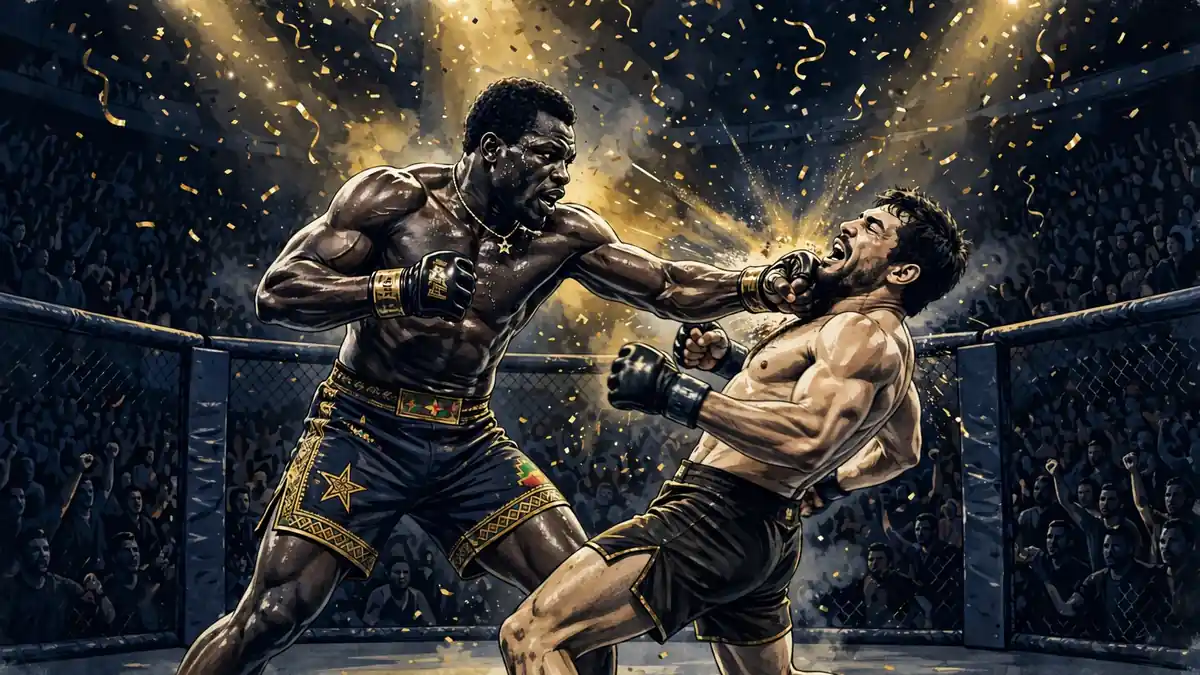
In the third round, Ngannou dropped him. A left hook caught Fury on the temple and sent the champion to the canvas, and for a moment the boxing world stopped. A man who had never boxed professionally had knocked down the heavyweight champion of the world. Fury got up, steadied himself, and won the remaining rounds on activity and ring craft. The judges scored it a split decision: 95-94 for Ngannou on one card, 96-93 and 95-94 for Fury on the other two.
The result was disputed the moment it was announced. Many ringside observers scored the fight for Ngannou, or at least a draw, and the debate still runs today. What was not disputed was the scale of the shock. Fury, who had been expected to win comfortably and move on to an undisputed title fight with Oleksandr Usyk, had been dropped by a debutant and pushed to a split decision. Ngannou, who had been a 14-1 underdog in some books, had shown he belonged in a boxing ring with the best in the world.
The reported purse was roughly $10 million — more than Ngannou had earned in his entire UFC career combined, for one night’s work. The figure is reported, not confirmed, and this article does not present it as a fact. But the direction of travel is clear: one boxing match paid him like a decade of MMA had not. Tyson Fury’s height — 6 ft 9 in against Ngannou’s 6 ft 4 in — was supposed to be the story of the fight. The knockdown was the story instead.
Boxing Anthony Joshua: The Second-Round Lesson
The second boxing match was a different story. On March 8, 2024, again in Riyadh, Ngannou faced Anthony Joshua, a two-time heavyweight champion rebuilding after his losses to Oleksandr Usyk. Joshua had studied the Fury fight and fought nothing like Fury had. He stayed patient, used his jab, and in the second round landed a right hand that dropped Ngannou hard. Ngannou got up. Joshua dropped him again. The referee waved it off at 2 minutes and 38 seconds of the second round.
It was the first time Ngannou had ever been knocked out, in either sport. He had never been stopped in 22 professional MMA fights — all three of his MMA losses came by decision. Joshua’s right hand did what no mixed martial artist had managed in eleven years: it put him down and kept him there. Anthony Joshua’s biography tells the story from the winner’s side — a champion who rebuilt himself into a finisher again — but for Ngannou the night was a hard reminder that boxing is a different trade, and that two fights in it did not make him a boxer.
The reported purse was roughly $20 million, double the Fury figure, and the largest single payday of his career. Again: reported, not confirmed. The money, whatever its exact size, did not soften the result. Ngannou said afterwards that he had not been hurt the way people assumed, that he had simply been caught clean by a great puncher, and that he would box again if the right fight came. As of November 2026, it has not. His boxing record stands at 0-2, with one of the great upsets-that-wasn’t and one of the most conclusive knockouts of the year.
The two fights, taken together, changed how the sport values crossover stars. McGregor’s 2017 bout with Mayweather had opened the door; Ngannou walked through it and showed that an MMA champion could survive in a boxing ring with the best in the world — and drop the champion. The Joshua loss showed the limit of that idea just as clearly. Between them, the two nights reportedly earned him around $30 million — more than his entire UFC career, his PFL deal and his endorsements combined.
The 2026 Return: MVP, Philipe Lins, and Free Agency
After the PFL split in March 2026, Ngannou was a free agent with no promoter and no fight scheduled. The return came from an unexpected direction: Jake Paul’s Most Valuable Promotions, which staged its first MMA card on May 16, 2026, at the Intuit Dome in Los Angeles, headlined by Ronda Rousey against Gina Carano and broadcast on Netflix. Ngannou fought on the card against Philipe Lins, a former PFL champion.
It lasted one round. Ngannou dropped Lins with a right uppercut followed by a left hook and finished him at 4 minutes and 31 seconds of the first, winning by knockout and taking his professional record to 19-3. It was his eighth consecutive MMA win, a streak stretching back to the Blaydes rematch in November 2018. The California State Athletic Commission disclosed a purse of $1.5 million for the fight, per Celebrity Net Worth — the only hard, disclosed purse figure in Ngannou’s entire career, and a useful anchor against the reported eight-figure boxing paydays.
The win put him back in the rankings. Sherdog’s October 26, 2026 update kept him at No. 3 in its heavyweight rankings, behind Ciryl Gane and Tom Aspinall, and noted that he had not lost an MMA fight in more than eight years. As of September 2026, no next fight had been announced. He is 40, a free agent, and holding the one thing no promoter can manufacture: an eight-fight winning streak and the hardest punch in the sport.
What comes next is open. A return to boxing would pay the most. A new MMA deal would need to match the freedom and money of the PFL arrangement, and few promotions can. A fight against Gane or Aspinall would settle the argument about who the best heavyweight in MMA really is. For now, the record speaks for itself: 19-3, eight straight wins, and a man who has never been stopped in mixed martial arts.
Fighting Style: The Hardest Punch Ever Measured
Ngannou’s fighting style is built on one asset and refined around it. The asset is power. In 2018 the UFC Performance Institute measured his punch at 129,161 units on its PowerKube device — the hardest punch ever recorded there, equivalent to 96 horsepower, and widely described at the time as being hit by a small car at full speed. The number has been repeated so often it risks sounding like a slogan. It is a measurement, taken in a laboratory, and no heavyweight since has beaten it.
The refinement came late. Early in his UFC career, Ngannou was a puncher with no wrestling, no cardio and no plan beyond the first minute. The Miocic loss in 2018 exposed all three gaps at once. The Gane win in 2022 showed what he had done about them: he wrestled a superior technician for five rounds on a torn knee and won on control. He is not a complete fighter in the sense that a Jon Jones or a Georges St-Pierre was complete. He is a finisher who learned enough wrestling and enough patience to let the finish arrive, and the numbers show it: 14 of his 19 wins by knockout, four by submission, one by decision, and an average fight time of under two rounds per bout across 38 professional rounds.
His physical measurements frame the style. At 6 ft 4 in and around 257 lb, with an 83-inch reach, he is a large heavyweight but not the largest — Fury is taller, Miocic is heavier on fight night, and plenty of heavyweights outweigh him. The advantage is not size. It is the combination of size with speed: he moves and throws like a man fifty pounds lighter, and the punch that ends fights is usually the one the opponent never sees. Israel Adesanya’s height is the same 6 ft 4 in, and the comparison is instructive — Adesanya uses the frame for range and precision at middleweight, while Ngannou uses the same height to put more force behind punches that have ended fourteen professional fights.
The weakness, when it shows, is the same as it was in 2018: cardio over five rounds, and wrestling defence against elite grapplers. Gane exposed neither, because Ngannou out-wrestled him. Miocic exposed both, and the rematch showed Ngannou had fixed the wrestling defence first. No opponent since has taken him down and held him there. At 40, the question is not whether the power is still there — the Lins knockout in May 2026 answered that — but how many more times he will get to use it.
Personal Life: Loss, Family, and the Foundation
Ngannou is unmarried and keeps his private life out of the public eye. The one fact the public knows, and the one that changed his life more than any fight, is the death of his son. In April 2024, his 15-month-old son Kobe died. Ngannou announced the loss on April 29, 2024, and has spoken about it only rarely since. This article records the fact and leaves the rest to him.
The loss came weeks after the Joshua fight, and it framed the year that followed. He fought once in 2024, the Ferreira knockout in October, and then went quiet for more than a year before the PFL split and the MVP return. He has said that the foundation work and his family in Cameroon are what kept him going through it, and the people around him have said the same in fewer words.
The Francis Ngannou Foundation is the centre of his life outside fighting. It builds gyms in Cameroon — the first opened in Batié in 2019 — and gives children in the country a place to train that Ngannou himself never had. He has described the foundation as the reason he fights now: the money pays for the gyms, and the gyms give children in Batié the route out that he had to carve for himself. He also serves as a brand ambassador for Premier Bet, the betting company active across Africa, a deal that fits the foundation’s work on the continent.
His life in 2026 is split between Las Vegas, where he trains, and Cameroon, where the foundation operates. Reports in March 2026 said he had bought a home in Dubai, at the Armani Beach Residences on Palm Jumeirah, for AED 92.5 million — roughly $25 million — a figure EssentiallySports reported at the time. The purchase, if accurate, would be the largest single asset he owns, and it fits the pattern of his wealth: earned late, spent on property and on the foundation, and kept largely out of the public eye.
Career Earnings and Endorsements
Ngannou’s career earnings are unusually hard to pin down for a fighter of his profile, because the biggest numbers are reported rather than disclosed. The table below gives the figures that can be sourced, and labels each one honestly. The one hard number is the $1.5 million disclosed purse for the Lins fight. Everything else is reported, and the article says so.
| Fight / deal | Date | Reported pay | Status |
|---|---|---|---|
| UFC debut vs Luis Henrique | Dec 19, 2015 | $22,500 | Reported (The Sports Daily) |
| UFC title win vs Stipe Miocic | Mar 27, 2021 | Not disclosed | UFC purses not published |
| Boxing vs Tyson Fury | Oct 28, 2023 | ~$10 million | Reported, not confirmed |
| Boxing vs Anthony Joshua | Mar 8, 2024 | ~$20 million | Reported, not confirmed |
| PFL debut vs Renan Ferreira | Oct 19, 2024 | $10 million | Reported (EssentiallySports) |
| MVP debut vs Philipe Lins | May 16, 2026 | $1.5 million | Disclosed (CSAC, via CNW) |
Endorsement income is the gap in the record. Ngannou has carried sponsorships through his career, and his Premier Bet ambassadorship is on the record, but no named source publishes an annual endorsement figure for him, and this article does not invent one. The UFC’s Reebok-era uniform deal paid him a flat rate like every other fighter on the roster, and the PFL deal’s equity stake in PFL Africa — a chairman’s holding, not a salary — is the most valuable commercial asset he holds, though its value is not public. The honest summary is that fight purses, not endorsements, built the fortune, and that the two boxing nights account for the majority of it.
Taxes and costs take a real share. A fighter’s purse is gross: management, training camp, travel and tax come out of it before anything is saved, and a boxer fighting in Saudi Arabia pays tax on the purse in ways that vary by residence and structure. None of that is public for Ngannou, which is one more reason the $15 million to $25 million range is the honest answer. The $15 million anchor assumes the reported purses were taxed and costed like a normal fighter’s. The $25 million ceiling assumes they were banked in full. Reality sits between them.
Francis Ngannou’s Fight Record
Ngannou’s professional MMA record is 19-3: 14 wins by knockout or technical knockout, four by submission, one by decision, and three losses, all by decision. He has never been knocked out or submitted in MMA. His boxing record is 0-2, with one loss by split decision and one by knockout. The table below lists the fights that define the record.
| Date | Opponent | Result | Event |
|---|---|---|---|
| Nov 2013 | Rachid Benz | Win — submission | Pro debut, Paris |
| Dec 19, 2015 | Luis Henrique | Win — KO, round 2 | UFC debut |
| Dec 2, 2017 | Alistair Overeem | Win — KO, round 1 | UFC 218 |
| Jan 20, 2018 | Stipe Miocic | Loss — decision | UFC 220, title fight |
| Jul 7, 2018 | Derrick Lewis | Loss — decision | UFC 226 |
| Nov 24, 2018 | Curtis Blaydes | Win — TKO, round 1 (0:45) | UFC Fight Night 141 |
| Feb 17, 2019 | Cain Velasquez | Win — KO, round 1 (0:26) | UFC on ESPN 1 |
| May 9, 2020 | Jairzinho Rozenstruik | Win — KO, round 1 (0:20) | UFC 249 |
| Mar 27, 2021 | Stipe Miocic | Win — KO, round 2 | UFC 260, won title |
| Jan 22, 2022 | Ciryl Gane | Win — decision | UFC 270, title defence |
| Oct 28, 2023 | Tyson Fury (boxing) | Loss — split decision | Riyadh; Fury knocked down |
| Mar 8, 2024 | Anthony Joshua (boxing) | Loss — KO, round 2 | Riyadh |
| Oct 19, 2024 | Renan Ferreira | Win — KO, round 1 (3:32) | PFL Super Fights; won title |
| May 16, 2026 | Philipe Lins | Win — KO, round 1 (4:31) | MVP, Intuit Dome |
Francis Ngannou Biography: Frequently Asked Questions
How old is Francis Ngannou in 2026?
Francis Ngannou is 40 years old in 2026. He was born on September 5, 1986, in Batié, Cameroon, and turned 40 on September 5, 2026. He discovered MMA at 26, won the UFC heavyweight title at 34, and knocked out Philipe Lins at 39.
What is Francis Ngannou’s MMA record?
Francis Ngannou’s professional MMA record is 19-3: 14 wins by knockout or technical knockout, four by submission, and one by decision, with all three losses by decision. His UFC record is 12-2 across 14 fights. The 19th win came on May 16, 2026, a first-round knockout of Philipe Lins at Most Valuable Promotions’ first MMA card in Los Angeles. Some profiles still list 18-3 because they have not been updated since that fight. His boxing record is 0-2.
What is Francis Ngannou’s net worth in 2026?
Francis Ngannou’s net worth is estimated at $15 million in 2026, according to Surprise Sports’ October 2026 update, with EssentiallySports and Wealthy Gorilla agreeing at $15 million. The credible range is $15 million to $25 million: Celebrity Net Worth lists $25 million and NetWorthCraft lists $20 million. The spread comes from his two reported boxing purses — roughly $10 million against Tyson Fury and $20 million against Anthony Joshua — which were reported but never confirmed.
How tall is Francis Ngannou?
Francis Ngannou is 6 ft 4 in (1.93 m) tall, with an 83-inch (211 cm) reach and a fighting weight of around 257 lb. He gave away five inches in height to Tyson Fury, who stands 6 ft 9 in, and still knocked Fury down in the third round of their October 2023 fight.
Why did Francis Ngannou leave the UFC?
Ngannou left the UFC in January 2023 after a contract dispute. He wanted health insurance for fighters, the freedom to take sponsorships outside the UFC’s deals, and a say in how his opponents were paid. The UFC would not agree to those terms, so he was released from his contract on January 14, 2023, and stripped of the heavyweight title while still the reigning champion. He then signed with the PFL in May 2023 and boxed Tyson Fury and Anthony Joshua.
Did Francis Ngannou beat Tyson Fury?
No — Fury won by split decision on October 28, 2023, in Riyadh, with scores of 95-94 for Ngannou, 96-93 for Fury and 95-94 for Fury. But Ngannou knocked Fury down in the third round, and many ringside observers scored the fight for Ngannou or as a draw. It was Ngannou’s professional boxing debut, and he entered the fight as a heavy underdog.
What happened to Francis Ngannou’s son?
Francis Ngannou’s 15-month-old son Kobe died in April 2024. Ngannou announced the loss on April 29, 2024. He has spoken about it only rarely since, and this article records the fact without further detail out of respect for his privacy.
Is Francis Ngannou still fighting in 2026?
Yes. Ngannou returned to MMA on May 16, 2026, knocking out Philipe Lins in the first round at Most Valuable Promotions’ debut MMA card at the Intuit Dome in Los Angeles, broadcast on Netflix. The PFL had announced in March 2026 that it was parting ways with him, and as of September 2026 he was an MMA free agent with no next fight scheduled. He remains ranked No. 3 among heavyweights by Sherdog and has won eight MMA fights in a row.
Sources & Reporting
This biography was researched from live reporting in November 2026. The fight record and career dates come from Sherdog’s fighter profile and Wikipedia’s Francis Ngannou page, both updated after the May 16, 2026 win over Philipe Lins; MartialBot, Cagewalks and Champinon were used to cross-check the 19-3 record. The net worth anchor is Surprise Sports, updated October 8, 2026, tested against Celebrity Net Worth, EssentiallySports (May 16, 2026), Wealthy Gorilla (updated November 9, 2026) and NetWorthCraft. The PFL split is reported by ESPN’s Brett Okamoto (March 6, 2026) and MiddleEasy (March 6, 2026). The $1.5 million disclosed purse for the Lins fight and the PFL Africa chairmanship come from Celebrity Net Worth’s 2026 profile. The $22,500 UFC debut purse is reported by The Sports Daily via The Hot Jem (updated August 6, 2026). The Dubai home report (AED 92.5 million, Armani Beach Residences) comes from EssentiallySports (March 2026). Where sources disagreed — above all the net worth figure and the reported boxing purses — the article names the disagreement and dates each figure. Where the public record is silent — the exact value of his endorsement deals, his private investments, the confirmed value of the Fury and Joshua purses — the article says so. Corrections are welcome via the About page.
Nathan Cole
Nathan Cole is the editor of Guide Net Worth. He covers celebrity wealth the way a business desk covers earnings: reported figures first, estimates labeled as estimates, no invented numbers. Every profile passes through his desk before it publishes. About Guide Net Worth · Corrections: figures are updated when new reporting emerges — contact us via the About page if you spot an error.
References & Sources
This article has been fact-checked and verified against multiple public sources, financial disclosures, SEC filings, Forbes reports, Celebrity Net Worth databases, and official records. All net worth estimates are based on publicly available information and financial analysis.