Rafael Nadal is 6 ft 1 in (1.85 m) tall — the same height as Federer, an inch shorter than Djokovic. At 40, the King of Clay is back for a Las Vegas exhibition.
Last updated: November 12, 2026 · By Nathan Cole
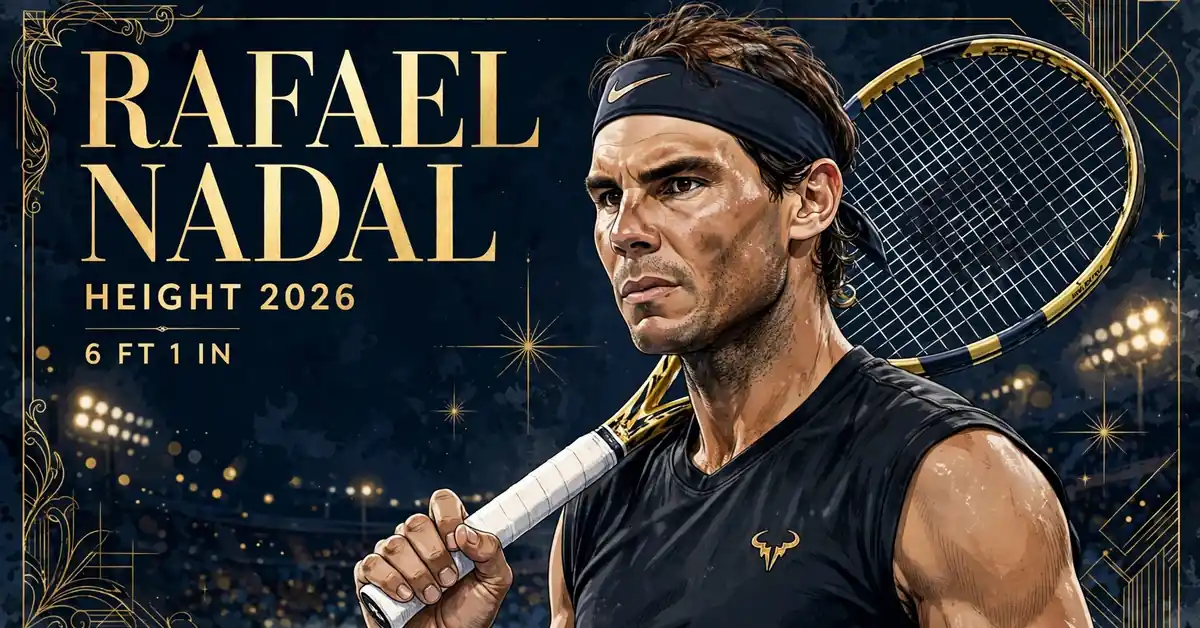
Rafael Nadal is 6 ft 1 in (1.85 m) tall. That is the figure on his ATP Tour profile, on Wikipedia, and in every official tournament programme from Paris to Melbourne, and it has not changed in two decades. He weighs 85 kg (187 lbs), which puts him at the sturdy end of the modern game: a powerful, muscular player who built a career on outlasting opponents rather than towering over them. At 40 years old in 2026 — he turned 40 on June 3 — he is two years into retirement, running an academy in Mallorca, raising two small sons, and preparing to pick up a racket again for an exhibition in Las Vegas in February 2027.
The height question has a second answer, and it is worth stating plainly. The 6 ft 1 in figure is a listed height, measured the way tennis lists heights: in shoes, once, early in a career. Barefoot, Nadal is probably closer to 6 ft 0 in (183 cm), a difference of an inch that matters to nobody except the people who argue about it online. This article gives you the official number first, the honest caveat second, and then the part the height pages usually skip: what 6 ft 1 in actually did for the greatest clay-court player who ever lived, how it stacked up against Federer, Djokovic and the giants who followed, and why it never held him back.
The career behind the number is the largest in the sport’s history on one surface and among the largest on any: 22 Grand Slam singles titles, including a record 14 French Opens, 92 ATP titles, 209 weeks at world No. 1, and $134,946,100 in official prize money. His fortune in 2026 is estimated at $220 million to $400 million, anchored at $400 million after Celebrity Net Worth updated its figure in November 2026. What follows is the full picture — the number, the measurement, the rivals, the injuries, and the second act that started when he walked off the court in Málaga in November 2024.
Quick Facts
| Full Name | Rafael Nadal Parera |
| Born | June 3, 1986, Manacor, Mallorca, Spain (age 40 in 2026) |
| Height | 6 ft 1 in (1.85 m) listed; ~6 ft 0 in (183 cm) barefoot estimate |
| Weight | 85 kg (187 lbs) |
| Plays | Left-handed, two-handed backhand |
| Status | Retired November 19, 2024 (Davis Cup, Málaga) |
| Grand Slams | 22 singles titles, including a record 14 French Opens |
| ATP Titles | 92; 209 weeks at world No. 1; 5 year-end No. 1 finishes |
| Olympics | Gold, singles Beijing 2008; gold, doubles Rio 2016 |
| Prize Money | $134,946,100 (official ATP figure, November 2026) |
| Net Worth (2026) | $220–400 million estimated, anchored at $400 million (Celebrity Net Worth, November 5, 2026) |
| Family | Married María Francisca Perelló (2019); two sons |
How This Article Was Put Together
The height is the one figure in this article with no dispute attached: 1.85 m (6 ft 1 in), 85 kg, listed on the ATP Tour’s official player profile and on Wikipedia, which cites the ATP, and repeated by NBC Olympics, Tennis Majors and the height-reference sites that cross-check official listings. The only disagreement is the barefoot estimate of about 183 cm, which comes from a single analysis piece and is presented here as an estimate, not a measurement. The career numbers — 22 Grand Slams, 14 French Opens, 92 titles, 209 weeks at No. 1, $134,946,100 in prize money — come from the ATP’s own records as of November 2026. The 2026 reporting — the academy museum, the Las Vegas exhibition, the hand surgery, the family — comes from the ATP Tour’s June 2026 features and from the Associated Press and Reuters interviews of November 4, 2026, all named in the text. The net-worth range of $220 million to $400 million, anchored at $400 million, reflects Celebrity Net Worth’s November 5, 2026 update and the Spanish corporate filings for his holding company Aspemir, with the older $220 million figure identified as stale. Where the public record is silent — the exact barefoot measurement, his private business accounts, his plans beyond February 2027 — the article says so.
+
How Tall Is Rafael Nadal?
Rafael Nadal is 6 ft 1 in (1.85 m) tall. That is the number on his ATP profile, and it is the number every other serious source prints: Wikipedia lists 1.85 m (6 ft 1 in), Sportradar lists 185 cm, NBC Olympics calls him 6-foot-1, and Tennis Majors, working from the ATP profile, gives 6 ft 1 in (1.85 m) alongside his weight of 187 lbs (85 kg). There is no rival figure. No outlet lists him at 6 ft 0 in or 6 ft 2 in. The height sites that exist to settle arguments — HowHeight, HeightsBySide — both land on 185 cm, and HeightsBySide notes that its figure was last reviewed on September 30, 2026, against the ATP listing.
For a tennis player, 6 ft 1 in sits in a useful middle. It is tall enough to serve with power and reach the high balls that clay-court tennis produces, and short enough to move the way Nadal moved: low, fast, balanced, sliding into shots that taller men have to bend for. The modern men’s game has drifted taller — the generation behind him is full of 6 ft 5 in and 6 ft 6 in players — and Nadal, at 6 ft 1 in, was never the biggest man on the court. He was the strongest, the fittest, and the most relentless. The height was a tool. The engine was everything else.
One comparison puts the number in everyday terms. HowHeight notes that Nadal is about 8.9 cm taller than the average Spanish man, which puts that average at roughly 176 cm (5 ft 9 in). He is also about 93.6 cm taller than a tennis net at its centre, which stands 91.4 cm (3 ft) high. The net comparison is the one that matters on court: a 6 ft 1 in player hitting a heavy topspin forehand clears the net by a margin that a shorter player has to work for, and Nadal’s forehand — the heaviest topspin shot the sport has seen — was built on that margin.
The Listed Height vs the Barefoot Height
Here is the honest caveat, stated before anyone else raises it. Tennis heights are listed heights, and they are almost always measured in shoes, once, early in a player’s career. The ATP does not run medical-grade height checks every week, and most of these numbers are self-reported or taken when the player first turns professional. A player measured in high-performance tennis shoes gains two or three centimetres over his barefoot height, and the shoes Nadal wore — built for stability and lateral movement on clay — were not thin.
One analysis, published by Amway’s Achievers site, puts the point directly: if Nadal is 185 cm in shoes, he might be closer to 183 cm (6 ft 0 in) barefoot. That is an estimate, not a measurement, and no official source has ever published a barefoot figure for him. This article reports the listed 6 ft 1 in as the answer, because it is the figure the sport uses, the figure the ATP prints, and the figure every tournament programme has carried for twenty years. The barefoot estimate is worth knowing because it explains why some fans who have stood next to him swear he looks shorter than 6 ft 1 in. They are probably right, by an inch, and it changes nothing about the career.
The same logic applies to everyone on tour. Djokovic’s listed 6 ft 2 in is probably 6 ft 1 in barefoot. Federer’s 6 ft 1 in is probably 6 ft 0 in. The listings are consistent with each other, which is what makes them useful: when this article says Nadal is the same height as Federer and an inch shorter than Djokovic, the comparison holds, because all three numbers were measured the same way. Treat the listings as relative, not absolute, and they tell the truth.
Early Life: Growing Up Tall in Manacor
Rafael Nadal Parera was born on June 3, 1986, in Manacor, a town on the island of Mallorca, Spain, to Sebastián Nadal Homar and Ana María Parera Femenías. He was a sporting child in a sporting family: his uncle Miguel Ángel Nadal was a professional footballer who played for Barcelona and Spain, and his other uncle, Toni Nadal, became his tennis coach and the defining influence of his career. The full story of his rise is told in Rafael Nadal’s biography on this site; this article follows the height through it.
He turned professional in 2001, at 15, and played his first ATP match in 2002. By then he was already close to his adult height — tennis players mostly reach their full height by 16 or 17 — and the game he built was the game of a 6 ft 1 in left-hander: a heavy topspin forehand that kicked high off the clay, a two-handed backhand that could absorb pace, and legs strong enough to chase every ball. The left-handedness mattered as much as the height. A lefty’s forehand goes to a right-hander’s backhand, and Nadal’s forehand, spinning at rates no one had measured before, went to the backhand of every right-handed player he faced, including Federer, whose one-handed backhand it tormented for a decade.
The first title came in Sopot, Poland, in 2004, when he was 18. The first French Open came in 2005, when he was 19, on his debut at Roland Garros. He won it as a teenager, in a sleeveless shirt, with long hair and pirate trousers, and the image stuck: a kid who played like a man, hitting the ball harder and running further than anyone else on the court. The height was already the height it would stay. The body around it was still filling out, and by his early twenties he had the physique that defined him — broad shoulders, huge biceps, the most physical frame in tennis.
King of Clay: Fourteen French Opens at 6 ft 1 in
Nadal won the French Open 14 times between 2005 and 2022, a record no one in tennis is likely to touch. He won 81 consecutive matches on clay between 2005 and 2007, another record, and finished his career at Roland Garros with 112 wins against 4 defeats. The numbers are absurd, and they are the reason the height question has a real answer rather than a trivia answer: 6 ft 1 in was the height of the greatest clay-court player in history, and the height shaped the way he played the surface.
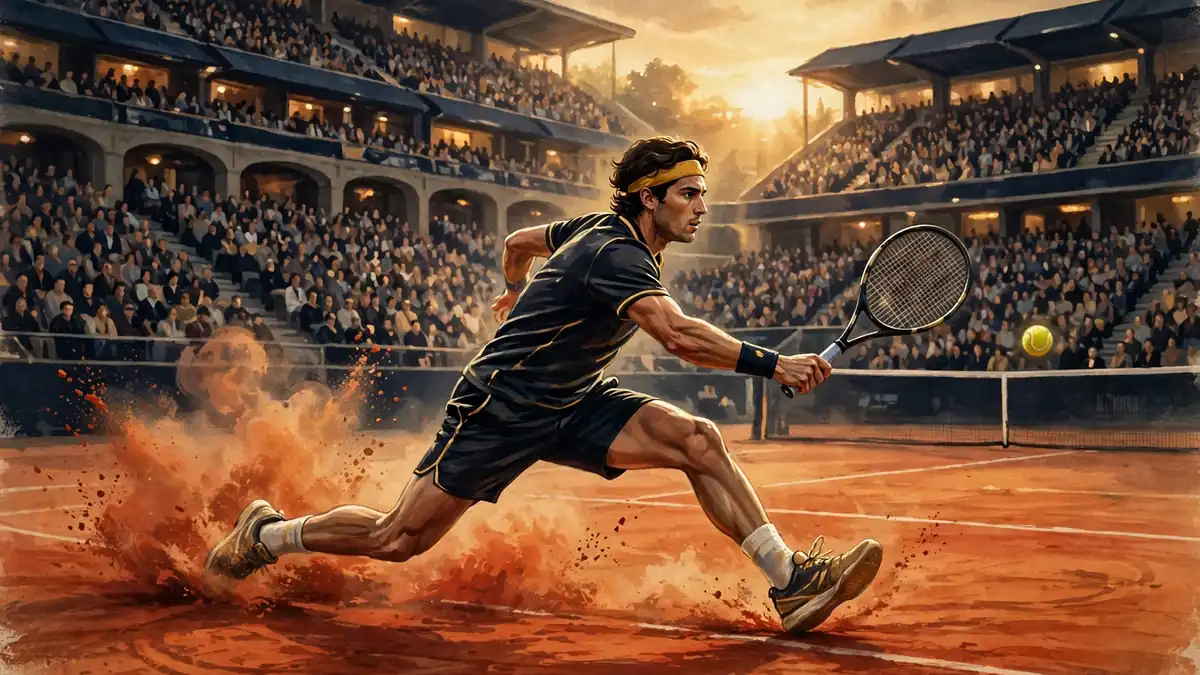
Clay rewards the player who can get low, slide into the shot, and recover in time for the next one. A taller player has further to go down and further to come back up. At 6 ft 1 in, Nadal could crouch into the low balls, slide with his weight over the shot, and spring back to the middle of the court. The 6 ft 6 in players who followed him — Medvedev, Zverev — can hit harder from the baseline, but they cannot move on clay the way a 6 ft 1 in player can, and their French Open records show it. Height is not a straight advantage in tennis. On clay, it is a trade-off, and Nadal’s height was the right side of the trade.
The serve tells the same story in reverse. A 6 ft 1 in player does not get the free points a 6 ft 6 in player gets — the angle over the net is lower, the bounce is lower, the ace count is lower. Nadal compensated by making his serve a rally starter rather than a weapon, and by winning the point after it with the forehand. It worked 14 times in Paris. It worked 22 times in Grand Slams. The height was never the reason he won. It was never the reason he lost, either.
Nadal vs Federer, Djokovic and the Next Generation
The height question is usually asked about one man, but it is answered by comparison. Nadal’s 6 ft 1 in puts him in the middle of his generation: the same height as Federer, an inch shorter than Djokovic, two inches shorter than Murray, and five inches shorter than the giants who came after him. The table below lines them up.
| Player | Height | Vs Nadal | Grand Slams |
|---|---|---|---|
| Roger Federer | 6 ft 1 in (1.85 m) | Same height | 20 |
| Rafael Nadal | 6 ft 1 in (1.85 m) | — | 22 |
| Carlos Alcaraz | 6 ft 0 in (1.83 m) | 1 in shorter | 7 |
| Novak Djokovic | 6 ft 2 in (1.88 m) | 1 in taller | 24 |
| Jannik Sinner | 6 ft 2 in (1.88 m) | 1 in taller | 5 |
| Andy Murray | 6 ft 3 in (1.91 m) | 2 in taller | 3 |
| Daniil Medvedev | 6 ft 6 in (1.98 m) | 5 in taller | 1 |
| Alexander Zverev | 6 ft 6 in (1.98 m) | 5 in taller | 0 |
The table makes the point better than any paragraph could: the two tallest men on it have one Grand Slam between them, and the shortest man on it, Alcaraz at 6 ft 0 in, is the one winning them now — he took his seventh Slam at the 2026 Australian Open in February, completing the Career Grand Slam at 22, the youngest man ever to do it, while Sinner won his fifth at Wimbledon in July 2026. Height helps in tennis, up to a point, and then it starts to cost. The cost is movement, and movement is the currency of the sport. Federer, at the same 6 ft 1 in as Nadal, won 20 Slams with a game built on grace and timing. Djokovic, an inch taller, won 24 with a game built on flexibility and return. Nadal won 22 with a game built on physical force. Three men, three builds, 66 Grand Slams between them, and the heights differ by an inch.
The rivalry numbers carry the same message. Nadal played Federer 40 times and won 24 of them, most of them on clay, where his high-bouncing forehand attacked Federer’s one-handed backhand at shoulder height — a shot that only works because the ball kicks up to a tall man’s shoulder, and because Nadal, at 6 ft 1 in, could generate the spin to get it there. Against Djokovic he played 60 times, the most-played rivalry in men’s tennis, and lost 31 of them. The inch between them never decided a match. The knees, the feet and the mileage did.
What 6 ft 1 in Gave Him on Court
Height in tennis is a package deal: reach, serve, movement, balance, and the wear on the joints. Nadal’s 6 ft 1 in, at 85 kg, gave him a rare combination — the reach of a tall player and the balance of a shorter one. His wingspan let him cover the court in fewer steps than a 6 ft 0 in player, and his low centre of gravity let him change direction faster than a 6 ft 6 in player. The slide was the signature move: the left leg driving into the clay, the body low, the racket whipping through the ball, and then the recovery, back to the middle, ready for the next one. It is a young man’s shot, and it is a 6 ft 1 in man’s shot. Taller men cannot get that low without losing their balance. Shorter men cannot cover the same ground.
The weight matters as much as the height. At 85 kg, Nadal was one of the heaviest top players of his era — heavier, pound for pound, than Federer, who played at around 85 kg on a taller frame, and heavier than Djokovic, who played at around 77 kg. The muscle was the point: the forehand’s pace came from the legs and the core, not the arm, and the body that generated it was built in the gym, not born. The cost was the joints. A heavy, physical game on hard courts punishes the knees and the feet, and Nadal’s left foot — the Müller-Weiss syndrome, a chronic condition that left him in pain for years — was the bill coming due.
There is a number that captures the trade-off. Nadal played 1,527 matches in 23 years, won 92 tournaments, and earned $134,946,100 in prize money. The matches are the mileage, and the mileage is what ended the career. A lighter player, or a taller player who served his way through matches, might have lasted longer. Nadal played every point as if it were the last one, and the body kept the score.
The Body Breaks Down: Injuries and Retirement
The final years of Nadal’s career were defined by injury, surgery and recovery, in his own words to the ATP Tour in June 2026. The left foot was the long problem — Müller-Weiss syndrome, a degenerative condition that caused chronic pain and required special shoes, injections and, eventually, a procedure that numbed the nerves in the foot so he could play the 2022 French Open, which he won, in pain, at 36. The hip was the next problem, and then the abdominal muscle, which he tore in the quarter-finals at Wimbledon in 2022 and which ended that tournament.
He kept coming back, and the comebacks got shorter. A year of pain to try to recover, as he put it in June 2026, after an operation and many months of rehabilitation. The last match came on November 19, 2024, in the Davis Cup Finals in Málaga, against the Netherlands. Spain lost. Nadal lost his singles match. He was 38 years old, and he had known for months that it was the end. “I reached the limit of my abilities,” he told the ATP in June 2026. “I don’t think mentally, but physically, yes.” The mind was willing. The body had reached its limit — a body that had played 1,527 matches at 6 ft 1 in and 85 kg, on the hardest surfaces in the sport.
The retirement was not a surprise, and it was not a tragedy. He had won everything there was to win, twice over in most cases, and he left with his health mostly intact, which is more than most players manage. The farewell in Málaga was emotional — the Spanish crowd, the tears, the tributes from Federer and Djokovic — but the man himself was calm about it. “That chapter is well and truly closed,” he said in June 2026, at the opening of the new museum at his academy. “I don’t miss it because I know that’s no longer my place.”
Life at 40: The Academy, the Museum, the Family
Nadal turned 40 on June 3, 2026, and the year has been the busiest of his retirement. The centre of it is the Rafa Nadal Academy in Manacor, which opened a new museum in June 2026 — the occasion for the ATP Tour’s two long features that month, in which Nadal spoke more openly about retirement than he had since Málaga. The academy, which began as a training project, is now a large operation: in the summer it employs 700 people, and Nadal talks about global expansion after ten years in Mallorca. The full picture of Rafael Nadal’s age and life at 40 is covered by our sister site CelebAmerica; the height story and the academy story meet here, because the academy is where the 6 ft 1 in frame now does its work — not on court, but in the gym, the office and the classroom.
Alongside the academy, the other pillar of this stage of his life is the foundation, which works with children and families in Spain and India. Since retiring, Nadal has increased his presence at foundation events, and he told the ATP in June 2026 that he sees the events as a way to generate resources so the foundation can keep growing. “The centre of my world is the little ones,” he said, when asked what excites him now — and he meant it literally. He has two young sons, and when he is at home in Mallorca, he takes them to school at 8:30 in the morning, at the school attached to the academy.
The personal details are deliberately quiet. He married María Francisca Perelló, known as Xisca, in October 2019, after fourteen years together. Their first son, Rafael, was born in October 2022. A second son followed, and in November 2026 Nadal told the Associated Press that he had been eight minutes late to a video interview because he was tucking in his two sons. “Sorry,” he said. “That’s the world of being a dad.” He was made Marquess of Llevant de Mallorca in 2025 by King Felipe VI — a hereditary title, and a sign of how Spain regards him. The Netflix documentary “Rafa”, released in 2026, tells the retirement story in his own words.
The Las Vegas Return: MGM Slam, February 28, 2027
Two years after retiring, Nadal is picking up a racket again. He will play the MGM Slam at the T-Mobile Arena in Las Vegas on February 28, 2027, an exhibition that marks his first time playing in the United States since retirement. He played the same event in 2024, against Carlos Alcaraz, in his final season on tour. This time the opponent has not been announced, and the format is still to be confirmed.
The decision, he told the Associated Press in November 2026, was about enjoyment rather than competition. “I’m going to play because I want to enjoy the preparation it demands and then the feeling of playing tennis again in front of a big crowd,” he said. “I’m doing this for myself, because I want to enjoy this sport again.” He had hardly touched a racket since retiring — “practically not played tennis until a month ago,” he said — when he picked it up again for an exhibition at his academy, playing alongside Andy Murray to mark the academy’s tenth anniversary. The Las Vegas commitment, he admitted, was what forced him to start training again.
The body is the question. Nadal had surgery on his right hand almost a year ago, in late 2025, to treat pain and regain mobility, and for four months he could not do much. “I’m hitting the ball pretty well, to be honest,” he said in November 2026. “Mobility is another story.” He was also, Reuters reported the same week, largely free of the daily pain that marked the final years of his career — “most of the time I am in good shape,” he said, “something that for me is very important because I suffered enough for so many years.” The exhibition, he said, will be a test: “For me it will be a test that will tell me things.” A possible exhibition with Federer — the two speak almost weekly, and Nadal says he is open to it — is the match everyone wants next.
The Fortune at 6 ft 1 in: Net Worth in 2026
The money behind the height is large, and it moved in 2026. For years, most pages on the internet said Rafael Nadal was worth $220 million. That figure was the long-standing Celebrity Net Worth estimate, repeated so widely that it became the default answer. The freshest reporting says it is out of date. Celebrity Net Worth updated its Nadal page in 2026 and now puts his net worth at $400 million, in a snapshot dated November 5, 2026. The reason is unusually solid for a celebrity fortune: Spanish corporate filings for Aspemir, Nadal’s investment holding company, show the company ended 2024 with €375.4 million in net equity — roughly $428 million — up from about $389 million a year earlier, and with a €14.5 million profit in 2024 after an extraordinary €94.1 million profit in 2023.

Forbes Spain’s rich list, published November 3, 2026, points the same way: it estimates Nadal’s fortune at €400 million, even while noting he does not make Spain’s top 100. Forbes has also reported more than $550 million in pretax career earnings from prize money, appearances, endorsements and business activity. The official prize money alone — $134,946,100, confirmed by the ATP on November 9, 2026 — is the second-highest in men’s tennis history, behind Djokovic. The rest came from endorsements with Nike, Kia, Babolat, Richard Mille and Infosys, and from the academy, the hotels and the investments held through Aspemir. This article publishes the range as $220 million to $400 million, anchored at $400 million. The $220 million figure is stale; $400 million is the current estimate. The full breakdown is covered in Rafael Nadal’s net worth profile on our sister site NetWorthCraft, and the life behind the number is told in Rafael Nadal’s biography on this site.
There is a useful way to read the fortune against the height. Nadal earned his money the way he won his matches: not by being the biggest, but by being the most durable, the most consistent, and the hardest to beat over twenty years. A 6 ft 1 in player who wins 22 Grand Slams earns more than a 6 ft 6 in player who wins one, because the money in tennis follows the winning, not the measuring. The height got him on the court. The rest did the earning.
Frequently Asked Questions
How tall is Rafael Nadal?
Rafael Nadal is 6 ft 1 in (1.85 m) tall, according to his ATP Tour profile, Wikipedia and NBC Olympics. He weighs 85 kg (187 lbs). The figure is a listed height, measured in shoes; barefoot he is probably closer to 6 ft 0 in (183 cm).
How tall is Nadal in cm?
Nadal is 185 cm tall. That is the figure on his ATP profile and on Wikipedia, and it is the number the height-reference sites HowHeight and HeightsBySide both use, with HeightsBySide last reviewing it against the ATP listing on September 30, 2026. In feet and inches, 185 cm is 6 ft 1 in.
Is Nadal taller than Federer?
No. Nadal and Roger Federer are the same height: both are listed at 6 ft 1 in (1.85 m). Novak Djokovic is an inch taller than both at 6 ft 2 in (1.88 m), and Andy Murray is two inches taller at 6 ft 3 in (1.91 m). Nadal won 24 of his 40 matches against Federer, most of them on clay.
How tall is Nadal compared to Djokovic?
Djokovic is one inch taller than Nadal: 6 ft 2 in (1.88 m) against Nadal’s 6 ft 1 in (1.85 m). The two played 60 times, the most-played rivalry in men’s tennis, with Djokovic winning 31 of them. The inch between them never decided a match.
How old is Rafael Nadal in 2026?
Rafael Nadal is 40 years old in 2026. He was born on June 3, 1986, in Manacor, Mallorca, Spain, and he turned 40 on June 3, 2026. He retired from professional tennis on November 19, 2024, at 38, after the Davis Cup Finals in Málaga.
What is Rafael Nadal’s net worth in 2026?
Rafael Nadal’s net worth in 2026 is estimated at $220 million to $400 million, anchored at $400 million. Celebrity Net Worth updated its figure to $400 million on November 5, 2026, supported by Spanish corporate filings showing his holding company Aspemir ended 2024 with about $428 million in net equity, and Forbes Spain estimated his fortune at €400 million the same month. His official career prize money alone was $134,946,100.
Is Nadal playing tennis again in 2026?
Not professionally. Nadal retired in November 2024 and says that chapter is closed. He is playing exhibitions: he returned to the court in October 2026 alongside Andy Murray for the tenth anniversary of the Rafa Nadal Academy, and he will play the MGM Slam at the T-Mobile Arena in Las Vegas on February 28, 2027, his first appearance in the United States since retiring. He says he is open to an exhibition with Roger Federer.
How many Grand Slams did Nadal win?
Nadal won 22 Grand Slam singles titles, including a record 14 French Opens between 2005 and 2022. He also won 92 ATP titles, spent 209 weeks at world No. 1, won Olympic gold in singles at Beijing 2008 and in doubles at Rio 2016, and finished his career at Roland Garros with 112 wins against 4 defeats.
Sources & Reporting
This article was researched on 12 November 2026 from live reporting and dated listings: the ATP Tour for the official height (1.85 m) and weight (85 kg), the 209 weeks at No. 1, the $134,946,100 career prize money (ATP Prize Money Leaders, November 9, 2026), and the June 1 and June 6, 2026 features on the academy museum opening, the 700 summer employees, the global expansion, the foundation, and Nadal’s own words on retirement (“That chapter is well and truly closed”, “I reached the limit of my abilities”); Wikipedia for the birth date (June 3, 1986), the height and weight, the retirement date (November 19, 2024), the 22 Grand Slams, 14 French Opens, 92 titles and the 2025 marquessate; NBC Olympics and Tennis Majors for the 6 ft 1 in figure; Sportradar (185 cm) and HeightsBySide (1.85 m, reviewed September 30, 2026) for the cross-checked listings; HowHeight for the Spain-average and tennis-net comparisons; Amway Achievers for the barefoot estimate of about 183 cm; the Associated Press via TSN and Reuters (November 4, 2026) for the Las Vegas MGM Slam on February 28, 2027, the right-hand surgery, the academy exhibition with Andy Murray, the two sons, the weekly calls with Federer, and the Netflix documentary “Rafa”; Tennis World USA (November 5, 2026) for the Federer exhibition talks; Celebrity Net Worth (snapshot November 5, 2026) for the $400 million net-worth figure and the Aspemir filings (€375.4 million net equity, €14.5 million 2024 profit, €94.1 million 2023 profit); Forbes Spain (November 3, 2026) for the €400 million estimate; Tennis Prize Money (updated November 9, 2026) for the prize-money and net-worth cross-check; and the ATP Tour (February 1, 2026) for Alcaraz’s seventh Slam and Career Grand Slam, and the 2026 Wimbledon reporting for Sinner’s fifth Slam. Where sources disagreed — above all the stale $220 million net-worth figure against the current $400 million, and the listed height against the barefoot estimate — the article names the disagreement and dates each figure. Where the public record is silent — the exact barefoot measurement, his private business accounts, his plans beyond February 2027 — the article says so. Corrections are welcome via the About page.
Nathan Cole
Nathan Cole is the editor of Guide Net Worth. He covers celebrity wealth the way a business desk covers earnings: reported figures first, estimates labeled as estimates, no invented numbers. Every profile passes through his desk before it publishes. About Guide Net Worth · Corrections: figures are updated when new reporting emerges — contact us via the About page if you spot an error.
References & Sources
This article has been fact-checked and verified against multiple public sources, financial disclosures, SEC filings, Forbes reports, Celebrity Net Worth databases, and official records. All net worth estimates are based on publicly available information and financial analysis.