Jasprit Bumrah biography 2026: born 6 December 1993 in Ahmedabad, the Yorker King rose from a single-parent home to No. 1 in all formats with 234 Test wickets.
Last updated: November 12, 2026 · By Nathan Cole
Jasprit Bumrah was born on 6 December 1993 in Ahmedabad, Gujarat, and at 32 he is the bowler every batting side in world cricket plans around first. The numbers explain why: 234 Test wickets at 19.79, the first bowler in history ranked No. 1 in all three formats at the same time, and a 2024 season that ended with the ICC Men’s Cricketer of the Year award. He did it with an action coaches told him to change, a run-up shorter than a school corridor, and a yorker that has ended more innings than most bowlers’ entire careers.
The story behind those numbers starts in a middle-class home in Ahmedabad, where a five-year-old boy lost his father and a schoolteacher mother held the family together. It runs through a parking lot where he copied Brett Lee’s action, a domestic trophy final where he bowled Gujarat to a title, and a Mumbai Indians dressing room where Lasith Malinga taught him the yorker. This biography covers the whole arc — the childhood, the action, the records, the 2024 World Cup, the workload rows of 2025, the family, and the money — with every major figure dated and sourced, and with an honest warning where the published net worth figure does not add up.
Quick Facts
| Full Name | Jasprit Jasbir Singh Bumrah |
| Born | 6 December 1993, Ahmedabad, Gujarat, India (age 32; turns 33 on 6 December 2026) |
| Nickname | Yorker King |
| Role | Right-arm fast bowler, India (all formats) |
| Height | 5 ft 10 in (178 cm, as commonly listed) |
| Teams | India (2016–present), Mumbai Indians (2013–present), Gujarat (2012–present) |
| Test Wickets | 234 at 19.79 (November 2026) |
| Wife | Sanjana Ganesan (married 15 March 2021) |
| Children | Son Angad (born September 2023) |
| Estimated Net Worth (2026) | ₹55–70 crore, roughly $7–8 million (reported estimates; see the money section for the caveat) |
| Last Updated | November 12, 2026 |
How This Biography Was Put Together
Dates, debuts, and career numbers here come from standard cricket references (Wikipedia and Cricinfo data) cross-checked against 2026 reporting from Cricbuzz, the IPL’s own site, CricToday, and the Indian press. Where outlets disagree — most visibly on net worth, where published figures run from ₹45 crore to $15 million — the article publishes the range, names the outlets, and says which figure it trusts and why. One figure gets special treatment: the commonly quoted ₹60 crore net worth is lower than what his documented IPL contracts alone would leave after tax, and the article says so plainly. Nothing in this profile is based on a private source or an unnamed claim.

+
Who Is Jasprit Bumrah?
Jasprit Jasbir Singh Bumrah is an Indian international cricketer and the spearhead of India’s bowling attack in all three formats. He plays for Gujarat in domestic cricket and for Mumbai Indians in the Indian Premier League, the franchise he joined in 2013 and has never left. Wikipedia calls him widely considered the best all-format bowler in the history of cricket, and the ranking record backs the claim: he became the first bowler ever to hold the No. 1 spot in the ICC rankings in Tests, ODIs, and T20Is at the same time, and the first Indian bowler to take 100 wickets in each format.
What makes him unusual is not pace alone. Bumrah bowls in the high 140s kph, fast but not the fastest in the world. His edge is deception: a short, stuttering run-up, a stiff front arm, a hyperextended elbow that releases the ball a fraction later than a batter expects, and a yorker he lands at will in the death overs. Coaches tried to rebuild the action when he was young. He refused, and the action that was supposed to break him became the most feared delivery in white-ball cricket.
By November 2026 the record reads like this: 234 Test wickets at 19.79, a T20 World Cup winners’ medal from 2024 with the Player of the Tournament award, the Sir Garfield Sobers Trophy as ICC Men’s Cricketer of the Year for 2024, and a Mumbai Indians retention of ₹18 crore a season — the richest deal ever given to a bowler in the IPL. He is 32, married to sports presenter Sanjana Ganesan, father to a two-year-old son, and the central figure in Indian cricket’s most argued-about question: how many matches can one fast bowler’s back take?
Early Life: Ahmedabad, Loss, and a Mother Who Held the Line
Bumrah was born on 6 December 1993 into a Punjabi Ramgarhia Sikh family in Ahmedabad, Gujarat. His father, Jasbir Singh, ran a chemical distribution business. His mother, Daljit Bumrah, worked as a school teacher. The family lived a middle-class life in the city, and for the first five years of Bumrah’s life it was an ordinary one.
Then his father died of hepatitis B. Bumrah was five years old. His mother raised him and his sister Juhika alone, working her way up to vice-principal at Nirman High School in Vastrapur, Ahmedabad — the same school Bumrah attended. The detail matters because it shaped everything that followed: the boy who became India’s richest bowler grew up in a house where money was counted carefully, and where his mother’s job at his own school meant there was no hiding from discipline.
Cricket entered his life the way it enters most Indian childhoods — in the street, with a tennis ball, in the parking area of the family’s housing colony. The young Bumrah spent hours imitating the actions of the bowlers he watched on television, Makhaya Ntini and Brett Lee chief among them. He was not coached into a textbook action. He built his own, piece by piece, in a parking lot, and the jerky, whip-like delivery that resulted looked wrong to every coach who saw it — and unplayable to every batter who faced it.
The Parking-Lot Bowler: How the Action Was Built
At some point a neighbour or a teacher suggested formal coaching, and Bumrah was enrolled at the academy run by Kishore Trivedi in Ahmedabad. Trivedi did what good coaches do with a strange talent: he worked on the repeatable parts — the wrist position, the seam, the follow-through — and left the strange parts alone. Bumrah also spent time at the MRF Pace Foundation, the Chennai academy that has shaped a generation of Indian fast bowlers.
The action that emerged has three parts a batter has to solve in about half a second. First, the run-up: short, stuttering, and slow enough that a batter’s timing is set before Bumrah is even at the crease. Second, the gather: arms close to the body, front arm stiff and high, giving almost nothing away about length or line. Third, the release: a hyperextended right elbow that snaps the ball out a fraction later than a conventional action, with the wrist cocked so the seam stays upright. The result is a bowler who looks like he is bowling within himself and is actually generating serious pace with late swing and a yorker that arrives at the base of the stumps.
His listed height is 5 ft 10 in (178 cm) in Jasprit Bumrah’s height profile — tall enough to extract bounce, short enough that the low, skiddy trajectory surprises batters expecting a taller fast bowler’s lift. The height figure is one of the least contested facts about him, and it explains part of the deception: the ball stays lower than a batter’s eye expects from a man of his build.
Domestic Breakthrough: Gujarat, the Syed Mushtaq Ali Trophy, and John Wright
Bumrah made his domestic debut in the 2012–13 Syed Mushtaq Ali Trophy, India’s domestic T20 competition, and helped Gujarat win their maiden title in the tournament. It was the first time a wide audience saw the action, and it was enough. Former India coach John Wright, then scouting for Mumbai Indians, was watching that tournament. He flagged the unknown Gujarat quick to the franchise, and Mumbai Indians signed Bumrah in 2013.
The domestic rise continued on schedule. He made his Ranji Trophy debut for Gujarat in 2013–14, and his breakthrough season came in the 2015–16 Vijay Hazare Trophy, where he played a central role in Gujarat’s title win — including a five-wicket haul in the final against Delhi. By then the pattern was set: Bumrah’s best bowling arrived in finals and knockout games, a habit that would follow him into international cricket and define his reputation as a big-match bowler.
Domestic cricket also taught him the workload lesson early. Gujarat used him sparingly across formats, and the Mumbai Indians management, once they had him, treated him as a long-term asset rather than a short-term weapon. That patience is part of why a bowler with his action is still bowling at 32 — and part of why the workload arguments of 2025 and 2026 feel so familiar to the people who have managed him longest.
Mumbai Indians: Thirteen Seasons in Blue
Bumrah has played for exactly one IPL franchise. Mumbai Indians signed him in 2013, and he has been with them ever since — through five title wins in 2013, 2015, 2017, 2019, and 2020, through the lean years that followed, and through the mega-auction retention that made him the highest-paid bowler in IPL history at ₹18 crore a season for 2025 and 2026.
The most important relationship of his early IPL years was with Lasith Malinga. The Sri Lankan was Mumbai’s death-overs master and the finest yorker bowler of his generation, and he took Bumrah under his wing. The two men spent net sessions working on the blockhole — the six inches of pitch at the base of the stumps where a yorker becomes unplayable — and on the slower ball that looks identical to the yorker until it arrives a beat late. Malinga’s influence shows in Bumrah’s record in the final overs: for a decade, Mumbai’s plan at the death has been to give Bumrah the ball and let the batter solve a problem with no good answer.
His IPL numbers carry the weight of that longevity. As of November 2026 he has taken 187 IPL wickets in 158 innings for Mumbai Indians (cricstats.in), at an average of 23.75 and an economy rate of 7.36 — figures that hold up across thirteen seasons of flat pitches and small boundaries. The retention math tells its own story: his documented IPL contracts since 2013 total ₹104.9 crore in gross value, a figure that matters far beyond the IPL, because it is the key to understanding why the published net worth estimates for Bumrah do not add up. The money section below works through that arithmetic in full.
International Debut: Australia, January 2016
Bumrah’s international career began on the white-ball tour of Australia in January 2016. His ODI debut came on 23 January 2016 against Australia at Sydney; his T20I debut followed three days later, on 26 January at Adelaide. He finished that T20I series as its highest wicket-taker, an immediate statement that the domestic numbers were not a fluke. The debut series also set his role: he was picked to bowl the hard overs — the powerplay and the death — and he was trusted with them from his first week in international cricket.
The captain who handed him that trust was MS Dhoni, whose own biography traces a career built on exactly that kind of backing for young players. Dhoni captained India through Bumrah’s first two years, and the bowler’s early white-ball success came in a side where Dhoni’s calm behind the stumps matched Bumrah’s calm at the top of his mark. It is a small connection, but it is where the Bumrah story and the Dhoni story cross — the veteran keeper-captain and the rookie with the strange action, on a tour where India were rebuilding their limited-overs attack.
Two years passed before the Test call came. India picked him for the 2018 tour of South Africa on the strength of his white-ball record, a selection that surprised plenty of watchers — he had not played a first-class match in over a year at that point — and his Test debut arrived on 5 January 2018 against South Africa at Cape Town. His maiden Test five-wicket haul followed in the third Test at Johannesburg, on a pitch where the ball was doing plenty and Bumrah’s skiddy pace made him the most dangerous bowler in the match.
The Yorker, the Slower Ball, and the Action Nobody Could Copy
Every great fast bowler has a signature delivery. Bumrah has three, and they all look the same until the last possible moment. The yorker is the famous one — a ball that lands at the base of the stumps at 140-plus kph, swinging late, leaving the batter with nowhere to put the bat. The slower ball is its twin: same arm speed, same release point, a ball that arrives a fraction later and turns a big swing into a mistimed chip to mid-off. The third is the short ball, bowled sparingly and used as a surprise, which is why it works — a batter set for the yorker is in no position to handle a ball at the ribs.
The action itself is the reason the three deliveries are so hard to pick. Because the arm comes through late and the wrist stays cocked until release, the batter gets less visual information than against a conventional bowler. Add the short run-up, which gives the batter less time to settle, and the result is a bowler whose average speed understates his difficulty. Batters facing Bumrah talk about feeling rushed even when the speed gun reads 142 kph — the ball is on them before their feet have finished moving.

Coaches have argued for a decade about whether the action is sustainable. The hyperextended elbow puts unusual stress on the joint, and the short run-up means the body generates pace through the shoulder and back rather than through momentum. Bumrah’s answer has been to manage the load ruthlessly — missing series, skipping formats, and accepting the criticism that follows. The 2025 England tour made that argument public in a way it had never been before, and the section below covers it in full. For now, the record speaks: a bowler whose action was supposed to break him has taken more than 470 wickets across formats and is still the first name on India’s team sheet.
Test Cricket: Cape Town Debut to the Best Average in History
Test cricket was supposed to be the format where Bumrah’s white-ball skills did not translate. The opposite happened. From the Cape Town debut in January 2018, he became India’s most reliable Test bowler, and the numbers grew into something no Indian fast bowler had ever produced. He was the fastest Indian fast bowler to 200 Test wickets, reaching the mark in 44 Tests — and he did it at a sub-20 bowling average, the best in Test history for any bowler to 200 wickets.
The overseas record is where the claim to greatness rests. Bumrah took wickets in South Africa, England, New Zealand, and Australia — the four countries where Asian fast bowlers historically struggle — at an average that stayed under 20. Before the 2025 England tour he had 145 Test wickets in those SENA countries, two short of Wasim Akram’s 146, the record for an Asian bowler. He passed Akram’s mark and became the first Asian bowler to 150 SENA Test wickets during that tour. In England alone he passed 50 Test wickets, the second Indian after Ishant Sharma to reach the mark (ESPNcricinfo).
The signature Test moments stack up fast. At Edgbaston in July 2022 he took 35 runs off a single Stuart Broad over — the most runs ever scored in one over in Test history, a batting record from a man picked for his bowling. In Australia in 2024–25 he took 32 wickets in five Tests, the most by any India bowler on an away bilateral tour. And at Lord’s in July 2025 he took 5 for 74 and put his name on the honours board, his 13th five-wicket haul away from home — passing Kapil Dev’s record of 12. The Test tally as of November 2026 stands at 234 wickets at 19.79, an average no bowler in the modern era has matched across such a long career.
The 2024 T20 World Cup: Fifteen Wickets and Player of the Tournament
The 2024 T20 World Cup in the West Indies and the USA was Bumrah’s finest tournament, and one of the finest bowling performances in World Cup history. He took 15 wickets at an average of 8.26 and an economy rate of 4.17 across the tournament — figures that look like a misprint until you watch the games. In a format where an economy rate under 7 is excellent, Bumrah went at barely over four runs an over for eight matches. He was named Player of the Tournament, and the award was not close.
The final, against South Africa at Bridgetown on 29 June 2024, was his masterpiece in miniature. India defended 176, and Bumrah’s four overs cost 18 runs for two wickets — including the 18th over of the chase, bowled when South Africa needed 30 from 30 balls with six wickets in hand. His two wickets in the final were Reeza Hendricks and Marco Jansen, and his spell broke the chase open for Hardik Pandya to finish. India won by seven runs, their first T20 World Cup title since 2007 and their first ICC trophy in eleven years.
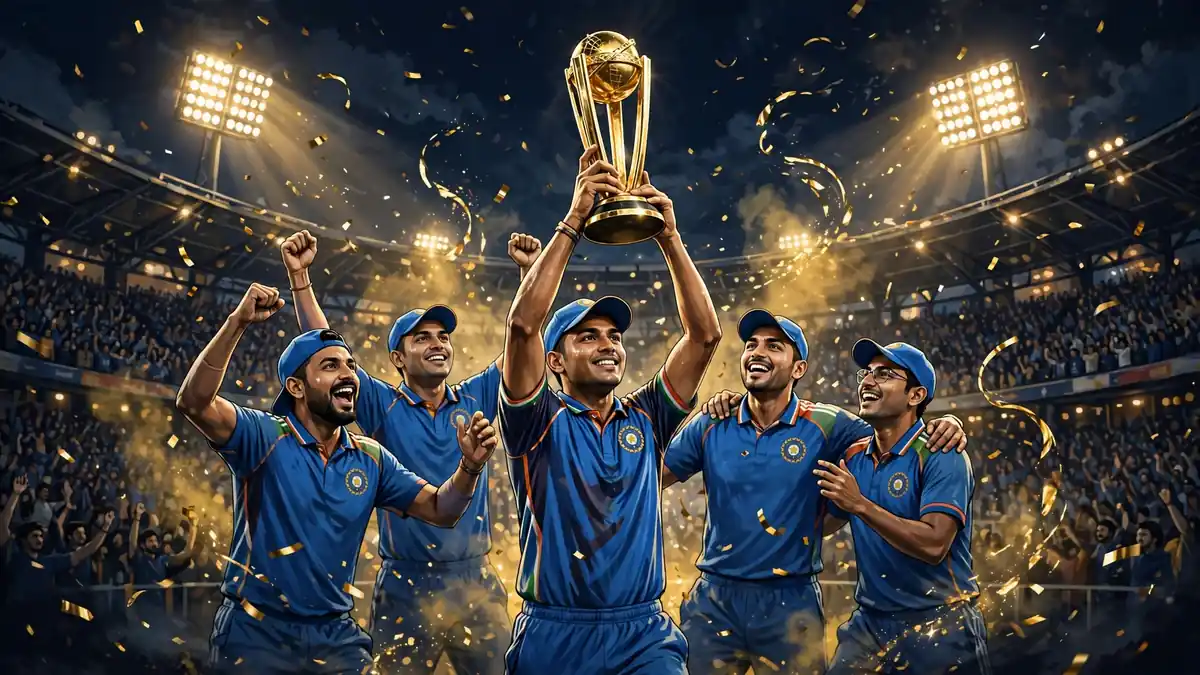
The win also closed a chapter for the team around him. Rohit Sharma, whose biography covers the same night from the captain’s side, retired from T20 internationals hours after the final, and Virat Kohli, whose biography traces his own long road to that trophy, did the same. Bumrah, at 30, was the bridge between the generation that won and the generation that would follow — the one bowler both captains built their plans around, and the one player whose place in the side was never in doubt.
The 2024 Season That Won Every Award
The World Cup was the middle of a calendar year that stands among the greatest ever produced by a fast bowler. In Tests in 2024, Bumrah took 71 wickets in 13 matches at 14.92 — the most by any bowler in the world that year, 19 clear of the next best, England’s Gus Atkinson with 52. Across all formats he took 86 wickets in 21 matches at 13.76 (Wisden). His ICC Test bowling rating crossed 900 points and ended the year at 907, the highest ever recorded by an Indian bowler.
The awards followed in January 2025. On 27 January he was named ICC Men’s Test Cricketer of the Year for 2024; the next day he won the Sir Garfield Sobers Trophy as ICC Men’s Cricketer of the Year, the overall award. He became only the fifth Indian to win it, after Rahul Dravid (2004), Sachin Tendulkar (2010), Ravichandran Ashwin (2016), and Virat Kohli (2017 and 2018). He was also named in the ICC Men’s Test Team of the Year for 2024, his second selection after 2018.
The Border-Gavaskar Trophy that straddled the end of 2024 and the start of 2025 added the final piece. Bumrah took 32 wickets in five Tests in Australia, the most by an India bowler on an away bilateral tour, and captained India to a 295-run win in the Perth opener while Rohit Sharma was absent, taking eight wickets in the match and the Player of the Match award. Then, in the Sydney Test, his back gave way. He left the field midway through the match, did not bowl again in the series, and missed the Champions Trophy that followed. The injury set up the two arguments that have followed him since: how much can one bowler carry, and who decides when he stops?
The Back Injury, the England Tour, and the Workload Debate
The back injury from Sydney kept Bumrah out for months. He missed the Champions Trophy in February 2025, returned for the IPL, and then faced the biggest scheduling question of his career: the five-Test tour of England in the summer of 2025, the first series of India’s new era after the Test retirements of Rohit Sharma and Virat Kohli. Before the tour, chief selector Ajit Agarkar announced the plan in public — Bumrah would play three of the five Tests, on the advice of the team’s physiotherapists, and would not play back-to-back games.
He played the first, third, and fourth Tests — Headingley, Lord’s, and Old Trafford — and took 14 wickets at 26, with two five-wicket hauls: 5 for 83 at Headingley and 5 for 74 at Lord’s. India drew the series 2–2, winning the final Test at The Oval by six runs without him, after losing two and drawing one of the three Tests he played. The results gave both sides of the argument ammunition, and the argument itself became one of the loudest of the year. Former captain Dilip Vengsarkar called the rest policy unacceptable, pointing to the eight- and nine-day gaps between Tests. Sanjay Manjrekar made a similar case in the Hindustan Times. Former opener Aakash Chopra defended Bumrah, arguing that a bowler with his injury history cannot be treated like any other player. Irfan Pathan rated the tour 6 out of 10 — the wickets and the Lord’s honours board on one side, the three Tests India failed to win with him in the side on the other.
Agarkar’s explanation, given in May 2025, was blunt: the physios had told the selectors Bumrah could not be risked in all five Tests, because another serious back injury might end his Test career. The management’s position is that a fit Bumrah for three Tests is worth more than a broken Bumrah for five. The critics’ position is that a series decider at The Oval, with the series level, is exactly the match a great bowler exists to play. Both positions have evidence on their side, and neither side has won the argument — which is why it will return every time India announce a squad with Bumrah’s name in it.
The 2026 season has followed the same pattern. Bumrah was retained by Mumbai Indians at ₹18 crore for the IPL 2026 season, and the BCCI rested him from the July 2026 T20I tours as part of the same workload plan (CricToday). The management of a 32-year-old fast bowler with a repaired back is now a permanent part of Indian cricket’s planning, not a one-off decision — and Bumrah, who has never complained in public about the rests or the criticism, has let the wickets do the answering.
Captaincy: Perth, and Why the Job Went to Gill
Bumrah has captained India in Tests and T20Is, and the Perth Test of November 2024 showed what he could do with the job: a 295-run win in Australia, eight wickets in the match, and the Player of the Match award. It was a complete captain’s performance, and it put him in the frame for the full-time Test captaincy when Rohit Sharma retired from the format in May 2025.
The selectors chose differently. Agarkar explained in May 2025 that Bumrah had been removed from vice-captaincy consideration because workload management and captaincy do not mix — in his words, “Bumrah is more important to us as a player. Once you’re managing people, there’s a lot that takes out of you.” The job went to Shubman Gill, whose biography covers his rise to the Test captaincy at 25, and Bumrah led the attack under Gill on the England tour that followed. The decision was presented as protection, not rejection: India would rather have Bumrah bowling in three Tests than captaining in five and breaking down.
It is a fair reading of his career. Bumrah’s value to India has always been as a bowler, not as a tactician — and the Perth win showed he can do both when asked, but the cost of asking is measured in overs bowled and Tests missed. The captaincy question will return if Gill’s tenure ends early. For now, Bumrah’s leadership is exercised the way it always has been: with the ball, in the spells that decide matches.
Family: Sanjana Ganesan and Angad
Bumrah married Sanjana Ganesan, a sports presenter and former Miss India finalist, on 15 March 2021 in a private ceremony in Goa. Ganesan is a familiar face to Indian cricket fans in her own right — a Star Sports anchor who has covered the IPL and international cricket for years, and one of the most recognisable broadcasters in the sport. The wedding was small and private, in keeping with a couple who have kept their personal life out of the headlines throughout their marriage.
Their son, Angad, was born in September 2023. Bumrah took time away from cricket around the birth, and the couple have shared only occasional glimpses of family life since — a photo here, a mention there, nothing staged. It is a deliberate choice, and it fits the rest of Bumrah’s public life: he is a private man whose fame comes entirely from what he does on a cricket field, and he has never tried to build a public persona beyond it.
His mother remains a central figure in the story. Daljit Bumrah, the schoolteacher who raised two children alone after her husband’s death, watched her son become the world’s best bowler from the same Ahmedabad home where the family lived on a teacher’s salary. Bumrah has spoken rarely about his father, but the facts of his childhood — the loss at five, the single-parent household, the parking-lot practice — are the first thing every profile of him reaches for, because they explain the discipline that shows up in his bowling: a man who does the hard, boring, repeatable work and lets the results speak.
Money: What the Numbers Really Say
Most published estimates put Jasprit Bumrah’s net worth in 2026 at ₹55–70 crore, roughly $7–8 million. Sportsdunia gives about ₹60 crore ($7 million) in a profile last updated in September 2025. CricToday’s tabulated estimate is ₹55–65 crore ($6.5–7.59 million). Waykup’s range is ₹45–65 crore, and GlimmerSports lands at ₹55–60 crore. Higher figures exist — CricketWinner says ₹80 crore, CurrentIndia says ₹70 crore, and one profile claims $15 million, about ₹125 crore — but the cluster of 2026 reporting sits firmly in the ₹55–70 crore band, and that is the range this profile publishes.
That headline figure needs a health warning, though, and this profile gives it in full — because a close look at his documented contracts suggests the commonly quoted ₹60 crore figure may be on the low side. Bumrah’s IPL contracts alone total ₹104.9 crore in gross value from 2013 to 2026, including ₹18 crore a season for 2025 and 2026 (imdevendra, October 2026). Income at his level is taxed at close to 40 percent once surcharge and cess are added, which would leave roughly ₹60–65 crore from the IPL by itself — before a rupee of his BCCI retainer, his international match fees, or his endorsement income. A ₹60 crore net worth would mean he had kept almost nothing from any of those.
The honest position is that no published net worth figure for Bumrah holds up under scrutiny, and the range should be read as a floor rather than a fact. The documented income streams are: the BCCI central contract — Grade A+ at ₹7 crore a year through 2024–25, then Grade A for the 2025–26 cycle after Grade A+ was abolished, with the retainer figure not published by the BCCI (some outlets report ₹5 crore); match fees of ₹15 lakh per Test, ₹6–7 lakh per ODI, and ₹3 lakh per T20I; the ₹18 crore IPL salary; and endorsements across 13 or more brands, including Skechers, Dream11, OnePlus, Tata, and Uniqlo, which named him a brand endorser in March 2026 (Storyboard18, Fibre2Fashion). One outlet claims he charges ₹1.5–2 crore for a single day of shooting — a claimed rate, not a confirmed one.
| Income source | Figure | Source / date |
|---|---|---|
| IPL contracts, 2013–2026 (gross) | ₹104.9 crore | imdevendra, Oct 2026 |
| IPL salary, 2025 and 2026 | ₹18 crore per season | CricToday; multiple outlets |
| BCCI central contract | Grade A+ ₹7 crore/yr to 2024–25; Grade A 2025–26, retainer unpublished | BCCI announcements; imdevendra |
| Match fees | ₹15 lakh/Test, ₹6–7 lakh/ODI, ₹3 lakh/T20I | GlimmerSports, 2026 |
| Annual income estimate | ₹32–42 crore | CricToday ₹32–35cr; GlimmerSports ₹38–42cr |
| Published net worth range | ₹55–70 crore (~$7–8M) | Sportsdunia, CricToday, Waykup, GlimmerSports |
Two other figures in circulation deserve a line each. The ₹80 crore estimate from CricketWinner (August 2026) is a single-outlet figure with thin workings, and the $15 million figure from TheCelebWiki (about ₹125 crore) has no workings at all — both are treated here as outliers, not as part of the range. And the combined household figure sometimes quoted — about ₹68 crore with his wife Sanjana’s earnings included (GlimmerSports) — is a household number, not Bumrah’s own wealth, and is not used in this profile’s headline range.
Career Numbers in One Table
| Format | Matches | Wickets | Average | Notes |
|---|---|---|---|---|
| Test | — | 234 | 19.79 | November 2026; 200 wickets in 44 Tests, fastest Indian pacer |
| ODI | — | 149 | — | June 2026 snapshot (CricBites) |
| T20I | — | 96 | — | June 2026 snapshot (CricBites) |
| IPL (Mumbai Indians) | 158 innings | 187 | 23.75 | Economy 7.36; 5 titles (cricstats.in, Nov 2026) |
| All formats (international) | — | 479 | — | 234 + 149 + 96, using the June 2026 white-ball snapshot |
One caution on the table: ODI and T20I wicket counts move with every series, and different references snapshot them on different dates. The Test figures are the headline numbers and are current to November 2026. The white-ball counts are from a June 2026 snapshot and will have moved by the time the next series ends.
The Criticism, the Comebacks, and What Comes Next
Every long career collects a counter-argument, and Bumrah’s has two. The first is the workload question: whether a bowler of his value should ever be rested from a Test match, and whether the selectors’ caution is protecting him or wasting him. The second is the action itself: whether a hyperextended elbow and a short run-up can carry a fast bowler into his mid-thirties without another serious injury. The Sydney back injury of January 2025 gave both arguments fresh force, and neither has been settled.
What survives those arguments is the bowling itself. Bumrah’s best spells share a quality that does not show up in a scorecard: the sense, visible in the batter’s feet, that the ball is arriving sooner than expected and lower than expected, and that the yorker is coming even when the batter knows it is coming. That quality, plus a Test average under 20 across more than 230 wickets, is why a boy from a parking lot in Ahmedabad is, at 32, the bowler every batting side in the world plans around first. The biography is not finished — the back will decide how many chapters are left — but the chapters already written put him alongside the greatest fast bowlers India has ever produced.
Sources & Reporting
Figures in this profile reflect reporting through November 2026. Key sources: Wikipedia / Cricinfo data (birth, family, debuts, career statistics, No. 1 rankings, 200 Test wickets); IPL.com (28 January 2025, ICC Cricketer of the Year 2024, 71 Test wickets at 14.92, 200 wickets in 44 Tests); Cricbuzz (28 January 2025, Sobers Trophy, fifth Indian winner, 907 rating points); Wisden (28 January 2025, 86 wickets at 13.76 in 2024, 32 wickets in the Border-Gavaskar Trophy); Circle of Cricket (workload debate, Manjrekar/Chopra/Pathan positions, 14 wickets in England); CricketAddictor (June 2025, SENA record, Agarkar on captaincy and workload, 64 wickets in nine Tests in England before the tour); USFI Times / ESPNcricinfo (50 Test wickets in England, Lord’s honours board, Kapil Dev record); CricToday (2026, net worth ₹55–65 crore, Grade A contract, IPL 2026 salary, July 2026 T20I rest); imdevendra (10 October 2026, ₹104.9 crore IPL contracts, Grade A 2025–26, Uniqlo March 2026); Sportsdunia, Waykup, GlimmerSports, CricketWinner, CurrentIndia (2026 net-worth ranges and endorsement reporting); CricBites and AllCric (biography, debuts, family, June 2026 white-ball wicket counts); StarsUnfolded (height, family details, marriage date); cricstats.in (November 2026, 187 IPL wickets). Where outlets disagree, the article explains why and publishes a range rather than picking a side.
Frequently Asked Questions
When was Jasprit Bumrah born and how old is he in 2026?
Jasprit Bumrah was born on 6 December 1993 in Ahmedabad, Gujarat, India. He is 32 years old in November 2026 and turns 33 on 6 December 2026.
Who is Jasprit Bumrah’s wife and does he have children?
Jasprit Bumrah is married to Sanjana Ganesan, a sports presenter and former Miss India finalist, since 15 March 2021. They have one child, son Angad, born in September 2023.
What is Jasprit Bumrah’s net worth in 2026?
Most published estimates put Jasprit Bumrah’s net worth in 2026 at ₹55–70 crore, roughly $7–8 million. The range reflects 2026 reporting from Sportsdunia (₹60 crore), CricToday (₹55–65 crore), Waykup (₹45–65 crore) and GlimmerSports (₹55–60 crore). The figure carries a caveat: his documented IPL contracts alone total ₹104.9 crore gross since 2013, which would leave roughly ₹60–65 crore after tax — so the commonly quoted ₹60 crore figure may be on the low side.
How much does Jasprit Bumrah earn in the IPL?
Jasprit Bumrah earns ₹18 crore per season from Mumbai Indians, retained at that figure for IPL 2025 and 2026 — the richest deal ever given to a bowler in the IPL. His documented IPL contracts since joining Mumbai Indians in 2013 total ₹104.9 crore in gross value.
How many Test wickets has Jasprit Bumrah taken?
Jasprit Bumrah has taken 234 Test wickets at an average of 19.79 as of November 2026. He was the fastest Indian fast bowler to 200 Test wickets, reaching the mark in 44 Tests at a sub-20 average — the best in Test history for any bowler to 200 wickets.
Why is Jasprit Bumrah’s bowling action so unusual?
Bumrah bowls with a short, stuttering run-up, a stiff front arm and a hyperextended elbow that releases the ball a fraction later than a batter expects. The action, built by imitating Brett Lee and Makhaya Ntini in a parking lot as a boy, makes his yorker, slower ball and bouncer look identical until the last moment. Coaches tried to change it when he was young; he kept it, and it became the most feared delivery in white-ball cricket.
Why does Jasprit Bumrah miss Test matches?
India manage Bumrah’s workload because of his history of back trouble, most seriously the injury in the Sydney Test of January 2025 that kept him out for months and cost him the Champions Trophy. Before the 2025 England tour, chief selector Ajit Agarkar announced on physio advice that Bumrah would play three of the five Tests. He took 14 wickets in those three Tests, but the rests remain contested — former players including Dilip Vengsarkar and Sanjay Manjrekar have criticised them, while Aakash Chopra has defended the policy.
How tall is Jasprit Bumrah?
Jasprit Bumrah is listed at 5 ft 10 in (178 cm). His height is covered in detail in our dedicated profile of Jasprit Bumrah’s height, which also compares him with other Indian fast bowlers.
WRITTEN BY
Nathan Cole
Nathan Cole is the editor of Guide Net Worth. He covers celebrity wealth the way a business desk covers earnings: reported figures first, estimates labeled as estimates, and no invented numbers. Every profile on this site passes through his desk before it publishes. About Guide Net Worth · Corrections: figures are updated when new reporting emerges — contact us via the About page if you spot an error.
References & Sources
This article has been fact-checked and verified against multiple public sources, financial disclosures, SEC filings, Forbes reports, Celebrity Net Worth databases, and official records. All net worth estimates are based on publicly available information and financial analysis.