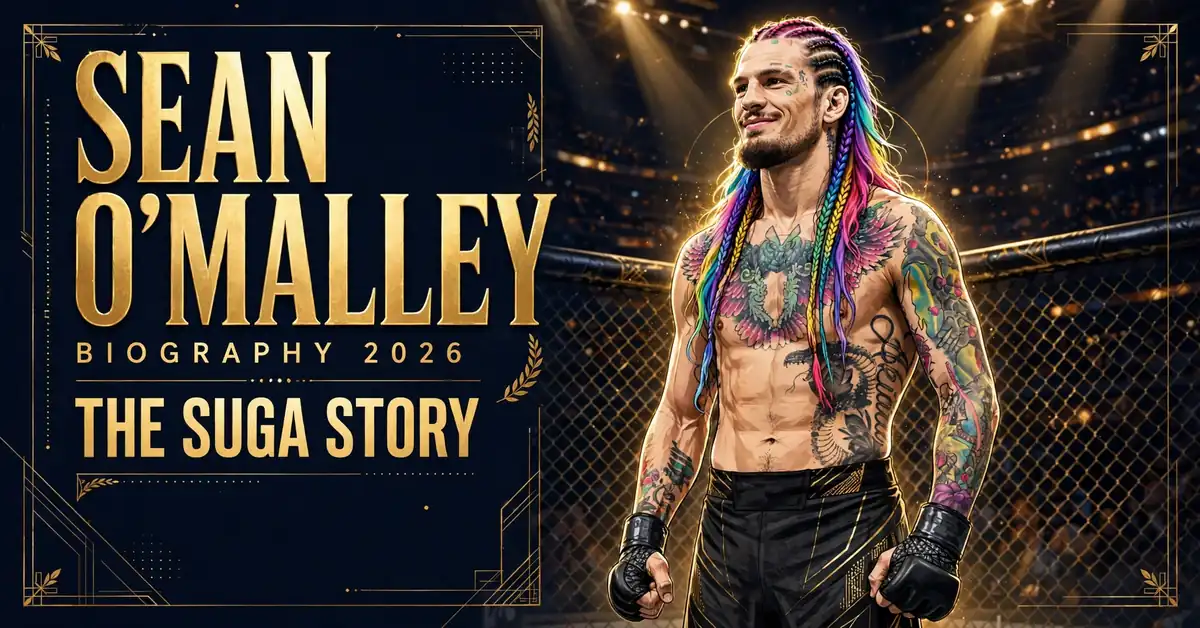
Sean O’Malley biography 2026: the Montana kid who became UFC bantamweight champion at 28, lost the belt twice to Merab Dvalishvili, and roared back in 2026.
Last updated: November 13, 2026 · By Nathan Cole
Sean O’Malley is 32 years old in 2026. He was born Sean Daniel O’Malley on October 24, 1994, in Helena, Montana, and he turns 33 on October 24, 2027. The age is the smallest part of the story. In the last three years he has won a UFC title with a second-round knockout, defended it, lost it twice to the same man, and then rebuilt himself with two wins in 2026 — a unanimous decision over Song Yadong in January and a second-round stoppage of Aiemann Zahabi on the White House lawn in June.
His professional record stands at 20 wins, 3 losses, and 1 no contest. The three losses tell the story in miniature: one to Marlon Vera in 2020, when a leg injury left him unable to stand, and two to Merab Dvalishvili, the Georgian pressure fighter who took his belt at UFC 306 in September 2024 and then submitted him in the rematch at UFC 316 in June 2025. Everything else on the record is a win, and most of them are finishes — knockouts built on distance, timing, and a right hand that has ended nights in Boston, Las Vegas, and Abu Dhabi.
This profile traces the full arc: the Helena childhood spent fishing and camping, the amateur run that earned him an invitation to Arizona, the one-round Contender Series audition that won him a UFC contract, the climb from $12,000 show purses to a reported $4.14 million payday, the businesses he built outside the cage, and the family life in Arizona with his wife Danya and their two children. Every figure is tied to the outlet that reported it. Where the outlets disagree — most of all on his net worth — this profile prints the range and says why.
Quick Facts: Sean O’Malley
| Full name | Sean Daniel O’Malley |
| Born | October 24, 1994, Helena, Montana, USA (age 32) |
| Turns 33 | October 24, 2027 |
| Nickname | “Suga” |
| Height | 5 ft 11 in (180 cm) |
| Reach | 72 in (183 cm) |
| Division | Bantamweight (135 lb), UFC |
| Team | The MMA Lab, Glendale, Arizona (John Crouch, Tim Welch) |
| Pro record | 20-3-0 (1 NC) |
| UFC title | Bantamweight champion, August 2023 – September 2024; one successful defence |
| Pro debut | March 6, 2015, vs. Josh Reyes (first-round TKO) |
| Net worth (2026) | $4M–$6M range, anchored at $4M |
| Biggest payday | About $4.14M, UFC 306 vs. Dvalishvili |
| Wife | Danya Gonzalez, married; daughter born 2020, son born May 2025 |
| Businesses | Co-founder, Doing Well; co-owner, W personal care; The TimboSugarShow podcast |
How This Biography Was Verified
Sean O’Malley’s age, birthplace, and fight record are matters of public record, not estimates. His birthdate of October 24, 1994 and his Helena, Montana birthplace come from his standard fighter profile, and his professional record of 20-3-0 with one no contest is carried by the UFC’s own listings and the independent record-keepers. The 2026 comeback wins — Song Yadong at UFC 324 on January 24, 2026 and Aiemann Zahabi at UFC Freedom 250 in June 2026 — are reported by VAVEL and Nairobi News, and the UFC 316 rematch result, a third-round submission at 4:42 on June 7, 2025, comes from UFC.com and Sportradar. The net worth figure is different: no public filing lists a fighter’s bank balance, so the honest figure is a range. Celebrity Net Worth prints $4 million, cited by Nairobi News in September 2026, and Glimmersports prints a $4 million to $6 million range in August 2026, with most outlets settling on $4 million to $5 million. This profile anchors on $4 million and prints the full range so the reader can see the disagreement. The purse figures — the $1.18 million UFC 292 total, the $4.14 million UFC 306 payday, and the $9.72 million recorded career total — come from Surprise Sports and UFCalendar, which label their own numbers as reported and modelled, not disclosed. Where a figure is reported rather than confirmed, this profile says so.
+
32 Years Old — a Former Champion Rebuilding
The short answer is simple: Sean O’Malley is 32. He was born on October 24, 1994, which puts his 33rd birthday on October 24, 2027. The longer answer is why 32 matters for him. He won the UFC bantamweight title at 28, lost it at 29, lost the rematch at 30, and spent 2026 — his 31st and 32nd years — climbing back. Fighters who lose two straight title fights to the same champion rarely get a third crack. O’Malley’s two wins in 2026 are the reason the conversation about him is still a title conversation.
His frame is part of the story. At 5 ft 11 in (180 cm) with a 72-inch reach, O’Malley is one of the tallest, longest fighters the bantamweight division has ever seen. Most of his opponents give up three or four inches of height and reach, and his whole style is built on that gap: a long jab, a switch stance that hides the right hand, spinning attacks from distance, and a habit of making opponents walk into shots they cannot see coming. Sean O’Malley’s height is covered in full on our sister site CelebAmerica, including how it compares with the rest of the division. On this page, the number matters because it explains the knockouts — thirteen of his twenty wins have come inside the distance, and most of them started with a punch thrown from a range his opponent could not match.
Age works differently for a bantamweight than for a heavyweight. The division is built on speed, and speed is the first thing to fade. But O’Malley’s game was never built on raw athleticism alone. It is built on timing, distance, and reads — skills that hold up into the early thirties, and in some cases sharpen as the fighter sees more looks. His two 2026 wins are the evidence: a clean decision over Song Yadong, a durable top-ten bantamweight, and a second-round finish of Zahabi on the biggest stage the sport has ever staged, the White House lawn. He is 32, he is back in the top three of the division, and the belt is held by the one man he has not been able to solve.
Early Life: Helena, Montana, and a Late Start in Fighting
Sean Daniel O’Malley was born in Helena, Montana, on October 24, 1994, and grew up there in the kind of childhood the state is known for: fishing, camping, and boating with his family. He did not grow up in a fight gym. He did not wrestle in school. He was barely out of high school when he took an interest in mixed martial arts, and his first amateur fight came in March 2013, when he was 18. Most UFC champions start their combat-sport education as children. O’Malley started his as a teenager who had just finished school.
That late start shaped everything about his style. He did not come up through wrestling rooms or boxing gyms, so he built his game from scratch as an adult: long-range striking, movement, feints, and spinning attacks, the tools of a fighter who learned to hit without getting hit because he had no grappling base to fall back on. His grandmother is Irish, and the family background is part of the story he tells about himself, but the fighting education was American and self-made — a kid from Montana who walked into a gym at 18 and decided to see how far it would take him.
The nickname came early. An early coach gave him “Sugar” — shortened to “Suga” — and it stuck because it fit: a flashy, sweet-striking kid with dyed hair and a highlight-reel instinct. The hair became the trademark later, cycling through rainbow colours that made him instantly recognisable on a poster. The nickname was there first, and it was there before the money, before the UFC, and before anyone outside Montana knew his name.
His family stayed in Montana while his career moved to Arizona, and the Helena connection has never left his public story. Local Montana outlets still cover his fights as hometown news, and the Montana Sports report on the UFC 316 loss framed it the way a hometown paper frames a local kid’s defeat: “Helena’s Sean O’Malley falls to Merab Dvalishvili again.” He left the state to become a fighter. He never stopped being its most famous export in the sport.
The Amateur Years: 9-2 and a Ticket to Arizona
O’Malley’s amateur career ran from March 2013 to early 2015, and it was busy by any standard: six fights in his first year alone, a 4-2 start, and then a five-bout winning streak that carried him to a final amateur record of 9-2, with three amateur titles along the way. He fought in Montana and North Dakota, small regional shows where the pay was nothing and the experience was everything. By the end of it he had fought eleven times as an amateur and learned the two things that matter most for a young fighter: how to win, and how to come back from a loss.
The break came from a coach watching in the crowd. Tim Welch, who would become his lifelong coach and podcast co-host, saw one of O’Malley’s amateur fights and personally invited him to move to Arizona and train at The MMA Lab in Glendale, the gym run by head coach John Crouch. O’Malley took the invitation. He left Montana for the desert, moved into the orbit of a serious professional gym, and started training full-time under Crouch and Welch — the partnership that has run his entire professional career.
The move is the hinge of the biography. Fighters from small regional scenes usually stall at the point where the local competition runs out. O’Malley got out at exactly the right moment, at 20 years old, with a 9-2 amateur record and a coach who had already decided he was worth investing in. The MMA Lab gave him sparring partners he could not find in Montana, a strength programme, and a team that understood how to build a striker. He has trained there ever since, and he still fights out of Glendale today.
He turned professional on March 6, 2015, stopping Josh Reyes in the first round. The debut was in the regional circuit, and it set the pattern for the early pro years: quick finishes, a growing highlight reel, and a fighter who looked like he belonged on a bigger stage than the one he was fighting on. He won his first five professional fights, and the fifth of them earned him the call that changed his life.
Dana White’s Contender Series: One Round, One Contract
On July 18, 2017, O’Malley fought Alfred Khashakyan on Dana White’s Contender Series, the UFC’s televised audition show. He knocked Khashakyan out in the opening round — a clean, violent finish that did exactly what the show is designed to do. Dana White offered him a UFC contract on the spot. He was 22, with a 9-2 amateur record and five professional wins behind him, and he had just earned his way into the biggest promotion in the sport in under three minutes of work.
The Contender Series knockout matters because of what it promised. O’Malley did not grind out a decision. He finished a credible opponent in the first round, on television, in front of the man who decides who gets hired. The UFC signed him because he looked like a finisher and a draw at the same time — the rainbow hair, the striking, the confidence. The promotion has built stars on less. It signed O’Malley on the strength of one punch and one look, and both of them have held up.
His UFC debut followed on December 1, 2017, at The Ultimate Fighter 26 Finale, against Terrion Ware. O’Malley won by unanimous decision. It was not a finish, and it was not a spectacular performance — Ware was durable and the fight went the distance — but it was a win in his first UFC appearance, and it put him on the roster to stay. He was 23. The climb from there would take six years, two suspensions, one loss, and a dozen wins.
The Climb: Suspensions, a First Loss, and the Yan Breakthrough
The early UFC years were stop-start. O’Malley beat Andre Soukhamthath by unanimous decision at UFC 222 in March 2018, hurting his foot in the fight and winning anyway. Then the USADA flags arrived: trace amounts of ostarine, a banned substance, showed up in his tests in 2018 and again in 2019, and the two flags together kept him out of the cage for most of 2018 and 2019. The suspensions were short — six months each, with the amounts described as trace and consistent with a tainted supplement — but the absence was long. He went from March 2018 to February 2020 without a fight, 23 months, at the exact age when a young fighter needs rounds.
He returned at UFC 247 on February 8, 2020, stopping Jose Quinonez in the first round, and followed it with a first-round knockout of Eddie Wineland at UFC 250 in June 2020 that won Performance of the Night. Two fights, two first-round finishes, and the hype was back. Then came Marlon “Chito” Vera at UFC 252 on August 15, 2020. Vera attacked his lead leg with calf kicks, the leg went numb, and O’Malley could not stand on it. Vera finished him in the first round. It was his first professional loss, and it was a strange one — a fight he was winning on the feet until his leg stopped working.
The response to that loss is the best measure of the fighter. O’Malley did not change camps, did not change coaches, and did not rush back. He rebuilt the leg, returned in March 2021, and knocked out Thomas Almeida in the third round at UFC 260. Then came Kris Moutinho at UFC 264 in July 2021 — a third-round stoppage in a fight where Moutinho absorbed an enormous amount of punishment — and Raulian Paiva at UFC 269 in December 2021, finished in the first round. The Paiva win closed a 3-0 year, and the next one opened with the fight that made him a contender.
Petr Yan was the test. Yan, the former bantamweight champion, met O’Malley at UFC 280 in Abu Dhabi on October 22, 2022, and most observers expected Yan to win comfortably. O’Malley won by split decision, in a fight many scored for Yan and many scored for O’Malley, and the argument about the scorecards ran for weeks. The result itself is what mattered: a 27-year-old who had never fought a top-five opponent had just beaten a former champion, and the UFC had its next title challenger. The Pedro Munhoz fight in between — a no contest at UFC 276 in July 2022, stopped after an accidental eye poke — was a footnote. Yan was the breakthrough.
There is a money detail in this stretch that explains how far he had come. His early UFC purses were $12,000 to show and $12,000 to win. By the Yan fight he was a pay-per-view name, and by the title fight that followed he was earning seven figures a night. The climb took five years and one loss. The pay rose with every step.
UFC 292: The Night He Took the Belt
On August 19, 2023, at UFC 292 in Boston, Sean O’Malley fought Aljamain Sterling for the UFC bantamweight championship. Sterling was the champion, a grappler with a long reign and a reputation for smothering strikers. O’Malley was 28, the challenger, and the betting had him as the underdog. The fight lasted into the second round. O’Malley caught Sterling with a right hand early in the round, followed him to the canvas, and finished him with ground strikes. The knockout won Performance of the Night and made him the UFC bantamweight champion.
The win was a tactical one as much as a physical one. O’Malley spent the first round at range, refusing to let Sterling close the distance and take him down, and the right hand that ended the fight came off the same switch-stance feinting he had used all night. Sterling walked into it. It was the kind of finish that looks simple on a replay and takes years to set up in a gym: a champion who had prepared for a wrestler and got knocked out by a striker who never let him wrestle.
The payday matched the moment. O’Malley earned about $1,182,000 for the Sterling fight, according to Surprise Sports: a $500,000 base purse, a $600,000 pay-per-view bonus, a $50,000 Performance of the Night bonus, and $32,000 in sponsorship pay. It was the first seven-figure night of his career, and it was the number that changed his financial story. He had gone from $12,000 to show to more than a million dollars in a single fight in six years.
He was 28 years old, a champion, and the UFC’s most marketable bantamweight. The rainbow hair, the knockouts, the podcast, and the social media following had all been building toward a title, and the title made them pay. What came next was the defence, the loss, and the long road back — but UFC 292 is the night this biography keeps returning to, because it is the night the Montana kid became a world champion.

UFC 299: The Vera Rematch and the Only Defence
Seven months after winning the belt, O’Malley defended it against the one man who had beaten him. Marlon Vera got the rematch at UFC 299 on March 9, 2024, in Miami, and the storyline wrote itself: the only loss on the champion’s record, the leg kicks, the unfinished business. O’Malley won the fight clearly, taking a unanimous decision with scores of 50-45, 50-45, and 50-44 reported — every round on every card. He hurt Vera with a knee in the second round that nearly finished the fight, and he controlled the rest of it from distance, landing the cleaner shots and never letting Vera’s leg kicks accumulate the way they had in 2020.
The win did two things. It avenged the only loss of his career, and it proved the first Vera fight was a product of the injury rather than the matchup. A champion who beats the man who beat him, and beats him in every round, has answered the only real question about his reign. It was also a big payday: estimates put his total earnings for the night at up to $3 million including his share of pay-per-view sales, on a seven-figure guarantee. He had not earned less than a million dollars per fight since winning the title, according to EssentiallySports’ reporting in January 2026.
It was his only successful title defence. Six months later he would lose the belt. But the Vera rematch stands as the cleanest performance of his championship run — five rounds, no controversy, no injury, and a decision so wide that nobody argued with it. For a fighter whose career has been defined by finishes and arguments, a shutout decision over the man who beat him was the most complete win he has ever recorded.
Losing the Belt Twice: UFC 306 and UFC 316
Merab Dvalishvili is the problem O’Malley has not solved. The Georgian took the title from him at UFC 306 on September 14, 2024, at the Sphere in Las Vegas, winning a unanimous decision by outworking him for five rounds — takedowns, clinch control, and a pace O’Malley could not match. It was a clear loss, and it ended a title reign that had lasted thirteen months. O’Malley’s biggest payday came on that losing night: about $4.14 million, according to UFCalendar, the largest single purse of his career — a reminder that in the UFC, the money follows the event, not the result.
The rematch came nine months later, at UFC 316 on June 7, 2025, at the Prudential Center in Newark, New Jersey. Dvalishvili was better the second time. He took O’Malley down early in the third round, smothered him, took his back, and locked on a choke that forced the tap at 4:42 of the round. It was Dvalishvili’s second straight win over O’Malley, and his thirteenth consecutive victory overall. Montana Sports, the hometown outlet, put it plainly: “Helena’s Sean O’Malley falls to Merab Dvalishvili again.”
Two losses to the same champion change a career. Another title shot is unlikely while Dvalishvili holds the belt, and O’Malley knows it — the reporting after UFC 316 was unanimous that his route back runs through other contenders, not through a third immediate rematch. The two fights also exposed the gap in his game that every opponent now studies: the wrestling. O’Malley is a brilliant striker. Dvalishvili is a relentless grappler, and over ten rounds he took O’Malley down, held him down, and never let the striking decide the fight.
That is the honest context for the 2026 comeback. O’Malley did not get an immediate third fight with Dvalishvili. He got the long way back: beat the contenders, stay ranked, and wait for the belt to change hands or for the division to demand the trilogy. His two wins in 2026 are the first steps on that road, and they are the reason this biography is a story about a former champion rebuilding rather than a former champion fading.
The 2026 Comeback: Song Yadong and the White House Card
O’Malley returned in 2026 with a point to prove and a division to climb. On January 24, 2026, at UFC 324, he faced Song Yadong, a durable Chinese bantamweight ranked in the top ten, and won by unanimous decision. It was not a finish, and it was not supposed to be one — Song is hard to stop, and O’Malley outpointed him over three rounds with the same long-range striking that won him the title. The win put him back in the win column for the first time since March 2024, and it put him back in the title conversation.
The second win of the year was the stranger one. On June 14, 2026, O’Malley fought Aiemann Zahabi at UFC Freedom 250, the UFC’s event on the South Lawn of the White House, and stopped him by technical knockout in the second round. The setting was historic — a UFC card on the White House grounds, the first of its kind — and O’Malley’s finish was one of the night’s highlights. Two fights, two wins, one decision and one stoppage, and a record that now reads 20-3-0 with one no contest.
The comeback matters because of who he beat and how he beat them. Song Yadong was a top-ten test, and O’Malley passed it cleanly. Zahabi was a veteran on a winning run, and O’Malley finished him. Neither win earned him a title shot on its own, but together they did something more important: they proved the two Dvalishvili losses had not broken him. Fighters who lose twice to the same champion sometimes come back tentative. O’Malley came back and won twice, and the second win came on the biggest stage the sport has ever staged.
Where he goes next depends on the belt. Dvalishvili still holds it, and the division’s other contenders — Petr Yan, Cory Sandhagen, Umar Nurmagomedov — are all in the same queue. O’Malley is ranked among the top three bantamweights in the world through 2026, and his name still sells pay-per-views in a way few bantamweights’ names do. The trilogy with Dvalishvili is the fight the sport wants, and the two wins in 2026 are what keep it alive. He is 32. The clock is not his enemy yet. The champion is.
The Record in Full: 20-3-0
O’Malley’s professional record is 20 wins, 3 losses, and 1 no contest across 24 fights, with thirteen wins by knockout or technical knockout. The table below lists the fights that define it — the debut, the audition, the title win, the defences and the losses, and the 2026 comeback.
| Date | Opponent | Event | Result |
|---|---|---|---|
| Mar 6, 2015 | Josh Reyes | Regional debut | Win, TKO R1 (pro debut) |
| Jul 18, 2017 | Alfred Khashakyan | Contender Series | Win, KO R1 (UFC contract) |
| Dec 1, 2017 | Terrion Ware | TUF 26 Finale | Win, UD (UFC debut) |
| Mar 3, 2018 | Andre Soukhamthath | UFC 222 | Win, UD |
| Feb 8, 2020 | Jose Quinonez | UFC 247 | Win, TKO R1 (return) |
| Jun 6, 2020 | Eddie Wineland | UFC 250 | Win, KO R1 (POTN) |
| Aug 15, 2020 | Marlon Vera | UFC 252 | Loss, TKO R1 (leg injury) |
| Mar 27, 2021 | Thomas Almeida | UFC 260 | Win, KO R3 |
| Jul 10, 2021 | Kris Moutinho | UFC 264 | Win, TKO R3 |
| Dec 11, 2021 | Raulian Paiva | UFC 269 | Win, TKO R1 |
| Jul 2, 2022 | Pedro Munhoz | UFC 276 | No contest (eye poke) |
| Oct 22, 2022 | Petr Yan | UFC 280 | Win, split decision |
| Aug 19, 2023 | Aljamain Sterling | UFC 292 | Win, TKO R2 (won title) |
| Mar 9, 2024 | Marlon Vera | UFC 299 | Win, UD (title defence) |
| Sep 14, 2024 | Merab Dvalishvili | UFC 306 | Loss, UD (lost title) |
| Jun 7, 2025 | Merab Dvalishvili | UFC 316 | Loss, sub R3 4:42 |
| Jan 24, 2026 | Song Yadong | UFC 324 | Win, UD |
| Jun 2026 | Aiemann Zahabi | UFC Freedom 250 | Win, TKO R2 |
Read the table from top to bottom and the shape of the career is plain: a fast start, a two-year gap, a run of finishes, one strange loss, a title, and then the Dvalishvili wall. Thirteen finishes in twenty wins is a finisher’s ratio, and the three losses all have explanations that make sense — an injury, and the same elite grappler twice. The record does not flatter him. It does not need to.
The Money: A 4 Million Dollar Fortune Built on Purses and Pay-Per-View
Sean O’Malley’s net worth in 2026 is estimated at $4 million to $6 million, anchored at $4 million. Celebrity Net Worth prints $4 million, cited by Nairobi News in September 2026. Glimmersports prints the $4 million to $6 million range in August 2026 and notes that most outlets settle on $4 million to $5 million. A $5 million figure circulates from Net Worth Breakdown, and a $6.5 million figure from Velontia. A $2.2 million figure from Net Worth Spot sits well below the rest and looks stale against the purses he has banked since winning the title. This profile anchors on the $4 million Celebrity Net Worth figure and prints the range, because the disagreement is real and the reader deserves to see it.
The purses are the firmest part of the money story, and they are large. UFCalendar records $9.72 million in disclosed career fight purses across twelve fights, and about $11.48 million once modelled estimates for four undisclosed fights are included. The single biggest night was the loss at UFC 306: about $4.14 million, the largest recorded payday of his career. The Sterling title win paid about $1.18 million in total, and the Vera rematch at UFC 299 paid up to $3 million including pay-per-view. He has not earned less than a million dollars per fight since winning the title. The early days — $12,000 to show, $12,000 to win — belong to a different lifetime.
Pay-per-view is where the real money sits for a champion, and O’Malley is one of the few bantamweights who moves the needle. His title fights carried his name at the top of the card, and the pay-per-view bonuses — $600,000 on the Sterling fight alone — are the reason his disclosed purses understate his income. The UFC does not publish pay-per-view points, so every estimate of that income is a model, not a fact. UFCalendar says so plainly on its own pages. This profile does the same: the purse numbers are recorded, the pay-per-view money is estimated, and the gap between them is where the uncertainty lives.
Endorsements fill the rest of the picture. O’Malley has carried deals with Venum, Crypto.com, RYSE Fuel, Sanabul, MyBookie MMA, PrizePicks, YoungLA, Happy Dad, and Reebok in the early UFC years — a sponsor list that reads like a map of the UFC’s commercial world. The crypto deals have been reported as worth more than $500,000 a year. The YouTube channel, with more than 900,000 subscribers, adds advertising and sponsorship revenue on top. None of these figures is disclosed, so none of them is printed here as a fact. What is certain is the shape: a fighter whose income stopped being just purses the moment he won the belt.
There is a comparison worth making. Conor McGregor’s net worth profile covers the fighter O’Malley has been measured against since his Contender Series debut — the Irishman who turned a UFC title into a nine-figure fortune through whiskey, fashion, and pay-per-view. O’Malley is not McGregor, and his $4 million is a fraction of McGregor’s $200 million. But the model is the same: win the belt, build the brand, and let the business pay more than the fighting. O’Malley’s version of that model is smaller and younger, and it is still running.
Beyond the Cage: Doing Well, W, and the TimboSugarShow
O’Malley’s business life starts with a drink. He co-founded Doing Well, an electrolyte drink mix brand, and the brand has reportedly landed an eight-figure sponsorship arrangement, according to Glimmersports. That figure — eight figures for a sponsorship tied to a fighter’s own product — is the largest single business number attached to his name, and it is reported rather than confirmed. What is confirmed is that the brand exists, that he co-founded it, and that it sits at the centre of his post-fighting income alongside the purses.
He is also a co-owner of W, a men’s personal care brand, according to Nairobi News. The two businesses fit the same pattern: products aimed at the audience he already has — young men who watch fights, train, and buy what fighters sell. It is the same playbook McGregor ran with whiskey and that Islam Makhachev’s biography shows from the other side of the sport, where the Dagestani champion’s brand is built on dominance rather than personality. O’Malley’s brand is built on personality, and the businesses are the way he turns it into money that does not depend on winning fights.
The podcast is the third leg. The TimboSugarShow, co-hosted with his coach Tim Welch, has run for years and gives him a direct line to his audience between fights — fight breakdowns, training footage, and the kind of unfiltered conversation that builds a following the UFC cannot give him. The YouTube channel around it has more than 900,000 subscribers. In a sport where most fighters disappear between camps, O’Malley stays visible every week, and that visibility is what makes the sponsors and the businesses work.
Real estate is the quieter part of the portfolio. O’Malley has said he bought five houses in Arizona, telling EssentiallySports in January 2026: “I spent $500,000 on houses, just to make sure I’m set up, you know.” Five houses for half a million dollars is a modest property play by celebrity standards, and that is the point — it reads like a fighter buying security rather than a star buying status. The houses sit in the same state as his gym, his team, and his family, and they are the part of his money story that has nothing to do with fame.

Personal Life: Danya, Two Children, and Life in Arizona
Sean O’Malley’s wife is Danya Gonzalez. They met in 2017 at an MMA gym, introduced by his coach Tim Welch — the same man who had invited him to Arizona two years earlier. The relationship started in the gym and stayed there in the sense that matters: Danya has been beside him for the whole championship run, from the Contender Series contract to the title win to the two losses to Dvalishvili and the 2026 comeback.
They have two children. A daughter was born in 2020, in the middle of the pandemic year when O’Malley fought twice and lost once. A son was born in May 2025, a month before the UFC 316 rematch — which means O’Malley walked into the biggest fight of his life as a new father for the second time. He is married, a father of two, and based in Arizona, where he trains at the MMA Lab and owns the five houses he bought as security for the family.
He keeps the family mostly out of the spotlight. Danya is not a public figure, the children are not named in the reporting, and the personal life in this profile is the part that stays short because the public record is short. What is public is enough: a marriage that started in the gym in 2017, two children born in 2020 and 2025, and a household in Arizona built around a training camp that never really ends. At 32, with a title run behind him and a comeback under way, the family is the part of his life that does not depend on who holds the belt.
Suga in Context: Peers and the Bantamweight Map
O’Malley at 32 sits in a division full of fighters who took different roads to the same place. The table below puts him next to the names that frame his story — the champion who beat him twice, the former champion he beat, and the stars of the wider UFC whose careers set the scale for his own.
| Fighter | Age in 2026 | Where he fits next to O’Malley |
|---|---|---|
| Sean O’Malley | 32 | Former bantamweight champion; 20-3-0; two wins in 2026 |
| Merab Dvalishvili | 35 | Bantamweight champion; beat O’Malley twice (UFC 306, UFC 316) |
| Petr Yan | 33 | Former champion; lost split decision to O’Malley at UFC 280 |
| Aljamain Sterling | 37 | Former champion; lost title to O’Malley at UFC 292 |
| Alex Pereira’s biography | 39 | Two-division champion of the same era; the UFC’s other 2023 breakout star |
| Jon Jones’s biography | 39 | The UFC’s consensus greatest fighter; the longevity template at the top of the sport |
Alex Pereira’s biography covers the other breakout star of O’Malley’s era. Pereira, 39 in 2026, won titles in two divisions and became a pay-per-view headliner in the same years O’Malley was climbing the bantamweight ranks. The two of them are the UFC’s case study in how the promotion builds stars now: not through wrestling pedigrees or long amateur careers, but through knockouts, personality, and a look the cameras love. Pereira did it as a former kickboxer from Brazil. O’Malley did it as a kid from Montana with rainbow hair.
Jon Jones’s biography is the longevity template. Jones, 39 in 2026, has been at the top of the sport for a decade and a half, through suspensions and comebacks of his own, and his career is the model for what a champion’s second act can look like. O’Malley is not Jones — nobody is — but the parallel is real: both men lost time to USADA flags early in their careers, both came back, and both had to rebuild after losing the belt. Jones rebuilt into the heavyweight title. O’Malley is still writing his version of that chapter.
The bantamweight map is what it is: Dvalishvili holds the belt, Yan and the other contenders wait in line, and O’Malley waits with them, two wins into a comeback at 32. The division is the deepest in the UFC, and the road back to the title runs through fighters who have all watched the Dvalishvili tapes. O’Malley’s advantage is the one he has always had: nobody in the division sells a fight like he does, and nobody in the division finishes fights from distance the way he does. At 32, the question is not whether he can still fight. It is whether he can solve the one man who has beaten him twice.
The Career Timeline: Age by Age
O’Malley’s career is a short one by the standards of the sport — thirteen years from his first amateur fight to his 2026 comeback — and the ages are the story. He started at 18, turned pro at 20, reached the UFC at 22, won the title at 28, lost it at 29, and rebuilt at 31 and 32. The table below is that story in order.
| Year | Age | Milestone |
|---|---|---|
| 1994 | 0 | Born October 24, Helena, Montana |
| 2013 | 18 | First amateur fight (March); six amateur fights in the first year |
| 2014 | 19–20 | Invited to The MMA Lab in Glendale, Arizona, by Tim Welch |
| 2015 | 20 | Pro debut March 6 vs. Josh Reyes (first-round TKO); amateur record 9-2 |
| 2017 | 22 | Knocks out Alfred Khashakyan on Contender Series (July 18); UFC contract; UFC debut vs. Terrion Ware (Dec 1) |
| 2018 | 23 | Beats Andre Soukhamthath at UFC 222; first USADA flag for trace ostarine |
| 2019 | 24–25 | Second USADA flag; sidelined for most of the year |
| 2020 | 25 | Returns at UFC 247 (TKO Quinonez); KOs Wineland at UFC 250; loses to Vera at UFC 252; daughter born |
| 2021 | 26 | Three wins: Almeida, Moutinho, Paiva — all by stoppage |
| 2022 | 27 | No contest vs. Munhoz (UFC 276); beats Petr Yan by split decision (UFC 280) |
| 2023 | 28 | Knocks out Aljamain Sterling at UFC 292 (Aug 19); wins UFC bantamweight title |
| 2024 | 29 | Defends vs. Vera at UFC 299 (Mar 9); loses title to Dvalishvili at UFC 306 (Sep 14) |
| 2025 | 30 | Loses rematch to Dvalishvili by submission at UFC 316 (Jun 7); son born in May |
| 2026 | 31–32 | Beats Song Yadong at UFC 324 (Jan 24); stops Aiemann Zahabi at UFC Freedom 250 (June) |
Read the table from top to bottom and the pattern is plain: a late start, a fast rise, two years lost to suspensions, a title won in one round, a title lost in ten rounds to the same man, and a comeback built one win at a time. The fortune was not made in one night. It was made in thirteen years, and the next entries in the table will be written at 32 and 33, against a division that is still waiting to see whether the kid from Montana can solve the champion from Georgia. The only question left is whether the third fight happens — and what it looks like if it does.
Frequently Asked Questions About Sean O’Malley
How old is Sean O’Malley?
Sean O’Malley is 32 years old. He was born on October 24, 1994, in Helena, Montana, and he turns 33 on October 24, 2027. He won the UFC bantamweight title at 28 and lost it at 29.
What is Sean O’Malley’s net worth in 2026?
Sean O’Malley’s net worth in 2026 is estimated at $4 million to $6 million, anchored at $4 million. Celebrity Net Worth prints $4 million, cited by Nairobi News in September 2026, and Glimmersports prints the $4 million to $6 million range in August 2026. His recorded career fight purses total $9.72 million, with his biggest single payday about $4.14 million at UFC 306.
What is Sean O’Malley’s fight record?
Sean O’Malley’s professional MMA record is 20 wins, 3 losses, and 1 no contest. Thirteen of his twenty wins have come by knockout or technical knockout. His losses are to Marlon Vera (TKO, UFC 252, August 2020) and twice to Merab Dvalishvili (decision at UFC 306, submission at UFC 316). The no contest was against Pedro Munhoz at UFC 276 in July 2022, stopped after an accidental eye poke.
How tall is Sean O’Malley?
Sean O’Malley is 5 ft 11 in tall (180 cm), with a 72-inch reach. He is one of the tallest and longest fighters in UFC bantamweight history, and his whole striking style is built on that height and reach advantage. His height is covered in full on our sister site CelebAmerica.
Who is Sean O’Malley’s wife?
Sean O’Malley’s wife is Danya Gonzalez. They met in 2017 at an MMA gym, introduced by his coach Tim Welch. They have two children: a daughter born in 2020 and a son born in May 2025.
When did Sean O’Malley win the UFC title?
Sean O’Malley won the UFC bantamweight title on August 19, 2023, at UFC 292 in Boston, knocking out Aljamain Sterling early in the second round. He defended the title once, beating Marlon Vera by unanimous decision at UFC 299 on March 9, 2024, then lost it to Merab Dvalishvili at UFC 306 on September 14, 2024.
What happened in the Sean O’Malley vs. Merab Dvalishvili rematch?
Merab Dvalishvili beat Sean O’Malley for the second time at UFC 316 on June 7, 2025, at the Prudential Center in Newark, New Jersey, submitting him with a choke at 4:42 of the third round. Dvalishvili had first taken the title from O’Malley at UFC 306 in September 2024 by unanimous decision.
What is Sean O’Malley’s nickname and why is he called Suga?
Sean O’Malley is nicknamed “Suga” — short for “Sugar” — a name given to him by an early coach. It stuck because it fit his flashy, sweet-striking style, and it became his brand alongside the rainbow-dyed hair that makes him instantly recognisable on a UFC poster.
Sources and Reporting
This profile was reported from the sources named in the text in November 2026. The birthdate of October 24, 1994, the Helena, Montana birthplace, the 5 ft 11 in height, the 72-inch reach, the 20-3-0 record, and the family details — wife Danya Gonzalez, daughter born 2020, son born May 2025 — come from his standard fighter profile, Wikipedia, and Waged War’s bio and record pages. The amateur record of 9-2, the Contender Series knockout of Alfred Khashakyan on July 18, 2017, the UFC debut against Terrion Ware on December 1, 2017, and the title win over Aljamain Sterling at UFC 292 on August 19, 2023 come from VAVEL’s biography, MMASucka’s career retrospective (updated April 21, 2026), and Glimmersports (updated August 18, 2026). The UFC 316 rematch result — Dvalishvili by submission at 4:42 of round three on June 7, 2025, at the Prudential Center in Newark — comes from UFC.com, Sportradar, and Montana Sports (June 7, 2025). The 2026 comeback wins over Song Yadong at UFC 324 and Aiemann Zahabi at UFC Freedom 250 come from VAVEL and Nairobi News (September 10, 2026). The net worth anchor of $4 million comes from Celebrity Net Worth, cited by Nairobi News in September 2026; the $4 million to $6 million range comes from Glimmersports (August 2026), with the $5 million and $6.5 million figures from Net Worth Breakdown and Velontia, and the $2.2 million figure from Net Worth Spot treated as stale. The purse figures — the $1,182,000 UFC 292 total, the $4.14 million UFC 306 payday, the $9.72 million recorded career total, and the $11.48 million figure including modelled estimates — come from Surprise Sports (updated October 7, 2026) and UFCalendar, which label their own numbers as reported and modelled. The endorsement list, the Doing Well eight-figure sponsorship report, and the five Arizona houses come from Glimmersports, Nairobi News, and EssentiallySports (January 2026). The linked Guide Net Worth profiles and the CelebAmerica height profile were verified live on November 13, 2026 with real article titles. Reporting window: November 2026. Figures are estimates where labelled as such.
About the Author
Nathan Cole covers celebrity net worth and biography for Guide Net Worth, reporting from public records, league data, and named outlets. Read more about the site’s methods on the About Us page.
Corrections: spot an error in a figure or a date? Email the newsroom and we will check it against the source and correct it, with a note on the page.
References & Sources
This article has been fact-checked and verified against multiple public sources, financial disclosures, SEC filings, Forbes reports, Celebrity Net Worth databases, and official records. All net worth estimates are based on publicly available information and financial analysis.