Omah Lay biography 2026: age 29, born 19 May 1997 in Port Harcourt — from Get Layd to Boy Alone and Clarity of Mind, plus a Grammy nod and a $2–$5M fortune.
Last updated: November 14, 2026 · By Nathan Cole
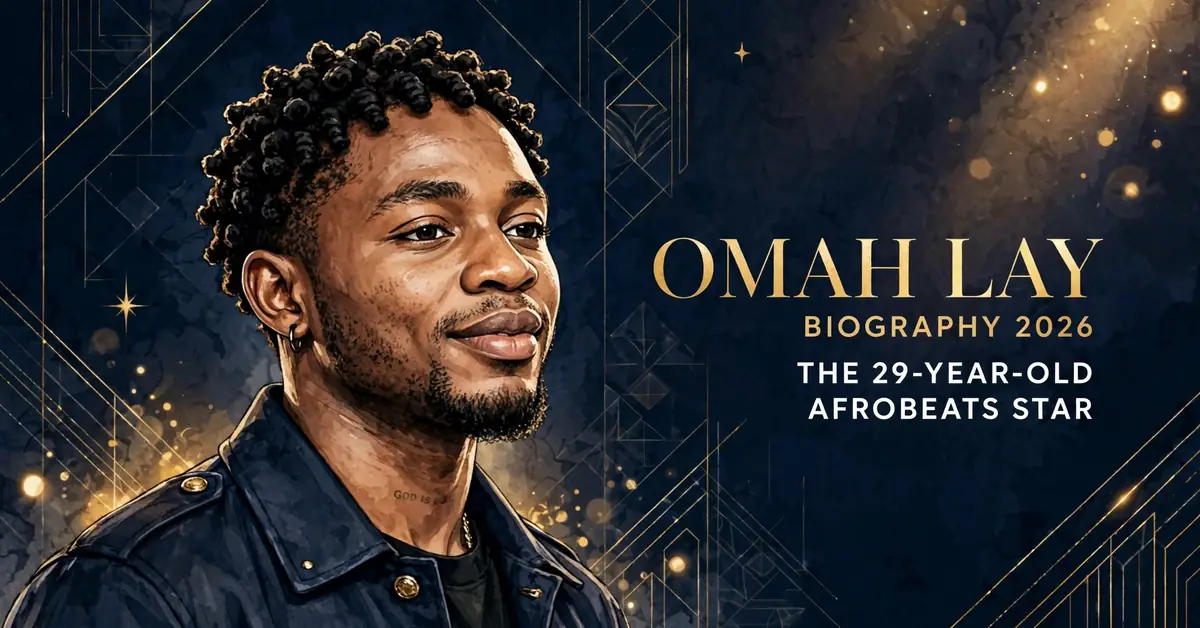
Omah Lay is 29 years old. He was born Stanley Omah Didia on 19 May 1997 in Port Harcourt, Rivers State, Nigeria, and by November 2026 he had gone from a self-produced singer in a rap group to a Grammy-nominated Afrobeats star with two studio albums, a Billboard Top 10 debut, and nearly three billion streams worldwide, according to Warner Records. His estimated net worth in 2026 sits in the $2 million to $5 million range, with the most recent dated estimate putting it at $2 million.
The arc is short and steep. In February 2020 he was releasing self-produced singles. By May 2020 his debut EP Get Layd was number one on the Nigerian Apple Music chart. By 2022 he had a debut album, Boy Alone, a collaboration with Justin Bieber, and more than a billion Spotify streams. In April 2026 his second album, Clarity of Mind, debuted at number eight on the Billboard World Albums chart, and by October 2026 he had expanded it into a deluxe edition with Gunna. This profile follows the whole rise — the Marine Base childhood, the rap-group years, the two EPs of 2020, the Uganda arrest, the albums, the Grammy nomination, and the money — with every figure tied to the outlet that reported it.
One thing this profile does not do is invent the missing pieces. No reliable outlet has published Omah Lay’s height, and he has not publicly confirmed a partner, so neither appears here as a fact. Where the sources disagree — above all on the net worth — the disagreement is printed in full, with the names attached.
Quick Facts
| Full Name | Stanley Omah Didia (Wikipedia lists the name order as “Omah Stanley Didia”) |
| Born | 19 May 1997, Port Harcourt, Rivers State, Nigeria (age 29 in 2026) |
| Net Worth (2026) | Estimated $2 million to $5 million (anchor $2 million, NetWorthAfrica 2026) |
| Profession | Singer, songwriter, record producer |
| Genre | Afro-fusion, Afrobeats, R&B, highlife |
| Labels | KeyQaad, Warner Records (Sire Records on Clarity of Mind) |
| Breakthrough | Get Layd EP, 22 May 2020 — “Bad Influence” and “You” |
| Albums | Boy Alone (2022), Clarity of Mind (April 2026), Clarity of Mind Extended (29 October 2026) |
| Awards | Headies Next Rated (2020 edition, won February 2021); Headies Album of the Year 2023 (Boy Alone); Grammy nomination 2026, Best African Music Performance (“With You” with Davido) |
| Streams | 1 billion+ Spotify streams by 2022; nearly 3 billion worldwide per Warner Records |
| Education | Comprehensive High School, Port Harcourt; University of Port Harcourt |
| Best-known Songs | “Bad Influence”, “You”, “Godly”, “Understand”, “Soso”, “Attention”, “Holy Ghost”, “reason”, “Moving” |
How This Estimate Was Made
This profile was researched on November 14, 2026, from live search results and the outlets named throughout: Wikipedia and Pulse Nigeria for the birth and early-life facts; KeyQaad, the artist’s own label, for the career timeline; Warner Records press releases from October 2026 for the Clarity of Mind chart positions and stream totals; the Recording Academy’s artist record for the Grammy nomination; The Guardian’s Headies winners report for the Next Rated win; and NetWorthAfrica, DJMondo, ResearchRoom, NetWorthSpot, and NetWorthBreakdown for the net-worth figures. All facts were checked on November 14, 2026.
Where the sources disagree — above all on the net worth, where published figures run from $500,000 to $6 million — this profile names the disagreement, dates each figure, and attributes it to its outlet rather than picking a winner silently. The $2 million anchor is used because NetWorthAfrica’s 2026 figure is the most recent dated estimate, and it sits at the bottom of the $2–$5 million range that the two most detailed Nigerian profiles agree on. No audited accounts exist for Omah Lay, so every net-worth figure here is an estimate, and the article says so wherever it appears.
+
The Short Answer: 29, From Port Harcourt, Worth an Estimated 2 to 5 Million
Omah Lay was born Stanley Omah Didia on 19 May 1997 in Port Harcourt, and he turned 29 in May 2026. He is a Nigerian singer, songwriter, and record producer who works in Afro-fusion — a blend of Afrobeats, R&B, and highlife — and he is signed to KeyQaad and Warner Records. His net worth in 2026 is estimated at $2 million to $5 million, with the most recent dated estimate, from NetWorthAfrica in 2026, at $2 million.
The career, in one paragraph: he started in a rap group under the name Lil King, released his first self-produced singles in 2019, broke through with the Get Layd EP in May 2020, followed it with a second EP the same year, released his debut album Boy Alone in July 2022, and returned in April 2026 with his second album, Clarity of Mind, which debuted at number eight on the Billboard World Albums chart and has passed half a billion streams. Along the way he won Next Rated at the Headies, won Album of the Year for Boy Alone in 2023, and earned a Grammy nomination for “With You” with Davido.
The money follows the music. Streaming is the base — more than a billion Spotify streams by 2022 and nearly three billion worldwide per Warner Records — with touring, label deals, and brand work on top. The rest of this profile takes the career piece by piece, because the number only makes sense once you see how fast it was built: six years from first single to a Billboard Top 10 album.
Early Life in Port Harcourt: Music in the Blood
Omah Lay grew up in Marine Base, a neighbourhood of Port Harcourt in Rivers State, and music was in the house before he could choose it. His grandfather played percussion for Celestine Ukwu, one of the great highlife singers of Nigeria, and his father played drums. That is not a decorative detail. Highlife is the root of the sound Omah Lay makes now — the melodic, guitar-led Nigerian music that Afrobeats grew out of — and he heard it from the people who played it, not from a record collection.
Port Harcourt matters to the story in a second way. Lagos gets the attention in Nigerian music, and most of the stars in the peer table at the end of this profile are Lagos artists. Port Harcourt, the oil city in the south, has its own scene — rougher, smaller, and further from the labels — and Omah Lay is its most successful export of the streaming era. He attended Comprehensive High School in the city and went on to the University of Port Harcourt. The schooling is part of the public record; what he studied is not, and this profile does not guess.
One more name-order note, because readers will trip over it. Most Nigerian profiles give his full name as Stanley Omah Didia. Wikipedia gives it as Omah Stanley Didia. Both refer to the same person, born on the same day in the same city, and the difference is the order of the names, not the identity. This profile uses Stanley Omah Didia, the form his label KeyQaad uses, and flags the other form so the reader is not confused when they see it elsewhere.
School, University, and the First Steps in Music
Before the fame, Omah Lay was a producer first. He learned to make beats, recorded himself, and released his first singles in 2019 — “Do Not Disturb” and “Hello Brother” — which he produced himself. The self-production is a thread that runs through his whole career: he writes, sings, and produces, which means he owns more of the publishing on his songs than a singer who only performs. That ownership is part of why the streaming money reaches him in a way it does not reach every artist with the same stream count.
The 2019 singles did not make him famous. They did something more useful: they taught him his sound. The songs were quiet, melodic, and emotionally direct — a young man singing about love and uncertainty over soft, spare production — and that sound, refined rather than replaced, is what broke through a year later. The gap between the 2019 singles and the 2020 EP is the whole story of his development: same voice, same instincts, better songs, better timing.

He was 22 when the first singles came out, and 23 when the breakthrough arrived. That is young, but it is not unusually young for Afrobeats, where stars routinely break in their early twenties. What was unusual was the speed: from first single to a number-one EP in about fifteen months, with no major-label push at the start. KeyQaad, the Nigerian label he signed to in 2019, backed the rise, and Warner Records came in as the international partner.
Lil King: The Rap-Group Years Before the Fame
Before Omah Lay, there was Lil King. He started out in a rap group, performing under the names Lil King and Lil Street King, and the group years are the least documented part of his career — no hit records, no chart positions, just a young artist learning to write and perform in a crew. Most biographies skip this period. It deserves a paragraph, because it explains the writing.
Rappers learn to write bars. Omah Lay’s songs are built like rap verses that learned to sing: short lines, plain language, a hook that lands on the first listen. “Bad Influence”, the song that made him, is a rap writer’s song — a confession delivered in a melody, with the kind of direct line (“I want to be a bad influence on you”) that a pop writer would have softened. The rap-group years also explain his comfort as a producer: he came up making his own beats, so he never had to wait for a producer to understand what he heard in his head.
The name change marked the break. Lil King was a rap name for a rap group. Omah Lay — “Omah” from his middle name — was a singer’s name, and the music changed with it: less bravado, more feeling, and a voice that sits in the middle of the production instead of shouting over it. The group ended. The solo career started. Within a year, the solo career had a number-one EP.
Get Layd: The EP That Changed Everything in 2020
On 22 May 2020, Omah Lay released his debut EP, Get Layd, and Nigerian music changed shape around him. The project had five tracks — “Damn”, “Lo Lo”, “You”, “Bad Influence”, and “Ye Ye Ye” — and it went to number one on the Nigerian Apple Music chart. “Bad Influence”, released as a single in February 2020, became the most streamed Nigerian song on Apple Music by the end of the year, and the EP passed 120 million streams worldwide, according to NotJustOk.
The timing helped and the songs did the rest. May 2020 was the middle of the pandemic, when the whole world was indoors and streaming. A five-track EP of quiet, intimate songs was exactly what locked-down listeners wanted, and “You” and “Bad Influence” spread through playlists and social media without a tour, without a video campaign, and without radio. The EP’s sound — soft drums, warm guitar lines, a voice that sounds like it is singing to one person — became the template for a wave of Nigerian artists who followed him.
“Bad Influence” is the song to understand first. It is a love song that admits the singer is bad for the person he loves, and the honesty of that line is what made it stick. The song’s success also set up the first of his career patterns: a slow, personal song outperforming louder, more obvious hits. He has repeated that trick on every project since, and it is the reason his catalogue has lasted longer than most breakthrough EPs.
What Have We Done: The Second EP of 2020
Six months later, on 20 November 2020, he released a second EP, What Have We Done, also five tracks: “Godly”, “My Bebe”, “Can’t Relate”, “Confession”, and a “Damn” remix. Two EPs in one year is a fast pace for a new artist, and it was a deliberate one — the first EP had made him a name, and the second proved the first was not a fluke. “Godly” became the standout, and the EP confirmed his place among Nigeria’s rising stars with both critics and listeners.
The second EP also widened the sound. Where Get Layd was almost entirely intimate, What Have We Done let in more rhythm and more confidence — the songs of a young man who had spent six months being told he was the next big thing and had decided to believe it. The two EPs together, ten songs in six months, are the foundation of the whole career: everything he has released since is a development of the ideas in those ten tracks.
By the end of 2020 he had also been nominated for four awards at the Headies, Nigeria’s biggest music awards, and won Next Rated — the prize for the most promising new act — at the 14th Headies ceremony, held on 21 February 2021 after the 2020 edition was postponed. The year is sometimes given as 2020 and sometimes as 2021, and both are right: the award was for 2020, and the ceremony happened in 2021. The win put him on the same list as the previous generation of Nigerian stars, and it set the expectation that the debut album would be a major event.
The Uganda Arrest: Two Days That Tested Him
In December 2020, at the peak of his breakthrough year, Omah Lay was arrested in Uganda alongside Tems, the Lagos singer whose own rise from Lagos to two Grammys at 31 is one of the great Afrobeats stories. The two had performed at a show in Kampala on 12 December, and Ugandan police arrested them for allegedly breaking COVID-19 lockdown rules. They were charged under Section 171 of Uganda’s Penal Code Act, which covers acts likely to spread infectious disease, and their manager Muyiwa Awoniyi was charged too.
They spent two days in custody, appeared in court, and were released on 15 December 2020 after the charges were withdrawn. The Ugandan government apologised for the arrests and cleared both artists of wrongdoing. The artists said they felt they had been set up — the promoters had assured them the paperwork was in order — and the Nigerian government had called for their release. Omah Lay later said the ordeal was one of the toughest times of his life, and also that it gave him something lasting: his relationship with Tems and with her manager Muyiwa, who shared the cell with him.
The arrest is part of the record, and it is worth stating plainly what it was and what it was not. It was a two-day detention over an alleged lockdown breach, ended by a dropped charge and a government apology. It was not a conviction, and it left no criminal record. What it did leave was a bond with Tems that has shaped both careers since — they have supported each other’s work publicly ever since — and a story that follows Omah Lay in every profile written about him, including this one.
Boy Alone: The Debut Album and the Bieber Collaboration
On 15 July 2022, Omah Lay released his debut studio album, Boy Alone. The title was honest: the record is about fame, loneliness, grief, and mental health, and it sounds like a young man working through the shock of becoming famous in a pandemic year. The album’s best-known tracks are “Soso”, which went viral around the world, “Understand”, “Woman”, “I’m a Mess”, and “Attention”, the collaboration with Justin Bieber.
“Attention” deserves its own sentence, because it was the moment Omah Lay went from a Nigerian star to a global one. A Justin Bieber feature on a debut album is a statement of intent from a label, and the song delivered: it put Omah Lay on pop playlists in the United States and Europe, and it introduced his voice to listeners who had never heard an Afrobeats record. The album also featured Tay Iwar, and it carried the same intimate sound as the EPs, stretched across a full-length record without losing its nerve.
The numbers followed. By 2022 Omah Lay had passed a billion Spotify streams, and Warner Records puts his worldwide total at nearly three billion. The album’s themes — the ones about depression and the pressure of fame — also became part of his public image: an artist who writes about what he feels rather than what sells, and whose audience trusts him for it. Boy Alone won Album of the Year at the Headies in 2023, and it remains the record his fans measure everything else against.
The Deluxe, the Tours, and the Quiet Years
In June 2023, Omah Lay released a deluxe edition of Boy Alone, adding fresh songs and collaborations and keeping the album alive for another year. The deluxe was a holding move, and a smart one: it gave the touring business new material without the risk of a whole new record, and it kept his name on the playlists while he worked on the follow-up. The years between Boy Alone and Clarity of Mind were quieter than the breakthrough years, and deliberately so.
He stepped back from touring and social media during that period to take care of himself — a fact noted in a 2026 interview, in which he said he needed to “fall in love again” with making music. The pause is part of the story of Clarity of Mind: the second album is, by his own framing, a record about rebirth, made by an artist who had stopped enjoying the work and had to find his way back to it. That is a more honest explanation for a four-year gap between albums than any label statement, and it matches the sound of the record that followed.

Touring filled the gap. He played the international circuit that Afrobeats built in the early 2020s — festivals and headline shows in Europe and North America — and the live audience grew even while the release schedule slowed. That is the economics of the modern Afrobeats career: the streams pay, but the shows pay more, and a singer with a billion streams can fill rooms on three continents. The quiet years were quiet on the release calendar, not on the road.
Clarity of Mind: The 2026 Comeback Album
In April 2026 — 3 April, per the release record — Omah Lay released his second studio album, Clarity of Mind, his first full-length project since Boy Alone in 2022. The album debuted at number eight on the Billboard World Albums chart in the week of 18 April 2026, his first Top 10 debut in the United States on that chart, and it placed twelve songs simultaneously on Billboard’s U.S. Afrobeats Songs chart, a personal best. It also reached number one on Spotify’s Global Top Albums debut chart, and Warner Records reports that it has passed half a billion streams since its spring release. The New York Times, NPR, and Billboard all praised it.
The sound moved forward. Warner Records describes the record as an expansion of his Afro-fusion into alternative and electronic territory, keeping the melodic instincts and emotional honesty that shaped the rise. The standout tracks include “Holy Ghost”, “Waist” — which Billboard called “versatile, creative, and unexpected” — “I Am”, and “Don’t Love Me”. The album arrived on the heels of his Grammy nomination alongside Davido for “With You”, and it reads as the work of an artist who had taken four years to make a record he believed in, rather than one he owed.
The comeback kept building through the autumn. On 8 October 2026 he released a cinematic video for “Artificial Happiness”, directed by NWSPK, and on 12 October a video for the fan favourite “Canada Breeze”, with Omah Lay himself as creative director. Then on 29 October 2026 he released Clarity of Mind Extended, a deluxe edition adding four previously unreleased tracks, including “Back to Lagos”, a collaboration with the American rapper Gunna. The deluxe’s message was plain: the comeback was not a single release, it was a campaign, and it was still running as 2026 closed.
The Net Worth Question: What the Sources Say
Omah Lay’s net worth in 2026 is estimated at $2 million to $5 million. That is the working range this profile prints, and it is built from the sources below — not from a single number, because no single number survives a look at the evidence. The most recent dated estimate comes from NetWorthAfrica, which lists $2.0 million for 2026 with “valuation confidence: MEDIUM”. DJMondo, in an April 2026 profile, puts the range at $2 million to $5 million. ResearchRoom, also writing in 2026, gives $3 million to $5 million. For the detail on how that figure breaks down, CelebAmerica’s Omah Lay net worth profile puts the 2026 fortune at $2 million.
The wider published spread runs from $500,000 to $6 million. NetWorthSpot lists $2.4 million in its headline and then $500,000 in its own body text — a contradiction on the same page, which tells you how much to trust either number. NetWorth202 lists $600,000. Socialmate lists $500,000 to $900,000. NetWorthBreakdown lists $6 million, but the same page calls him “24-year-old” and dates his debut album to 2021, both of which are wrong — he turned 29 in 2026 and Boy Alone came out in 2022 — so its $6 million carries little weight. The low figures come from sites that count streaming and social income only; the high figure comes from a site with visible factual errors. The $2–$5 million range is where the sources that count the whole career agree.
One figure does not belong in the range at all. Schoolings.org, updated 30 September 2026, lists his net worth at $100 million. That number is not credible: it is fifteen times the highest figure any other source reports, it appears in a sentence that calls him “one of the most successful upcoming artists”, and no reporting anywhere supports it. It reads like a decimal-point error, and this profile excludes it for that reason. A reader who sees $100 million attached to Omah Lay’s name has found a mistake, not a scoop.
| Source | 2026 Estimate | How to Read It |
|---|---|---|
| NetWorthAfrica | $2.0 million | Most recent dated 2026 figure; confidence “MEDIUM” |
| DJMondo (Apr 2026) | $2–$5 million | Range from streaming, tours, collaborations |
| ResearchRoom (2026) | $3–$5 million | Top of the range; music sales, streaming, shows, endorsements |
| NetWorthSpot (Oct 2026) | $2.4M / $500K | Contradicts itself on the same page; low weight |
| NetWorthBreakdown | $6 million | Calls him 24 and dates Boy Alone to 2021; low weight |
| NetWorth202 / Socialmate | $500K–$900K | Streaming-only methods; undercount touring |
| Schoolings.org | $100 million | Rejected — 15x any other source, no support |
The honest summary: Omah Lay is a multi-millionaire in his twenties who made his money from music, not from a business empire or a family fortune. He is not on any major rich list, and no outlet with access to audited accounts has published a figure. The $2–$5 million range is the best available answer, and the $2 million anchor is the figure a reader should quote.
How the Money Works: Streams, Tours, and Deals
Streaming is the base of the fortune. Nearly three billion streams worldwide, per Warner Records, is a large catalogue, and the per-stream rate on Spotify and Apple Music — fractions of a cent, but multiplied by billions — is the steadiest income an artist of his size has. The catalogue also keeps earning: “Bad Influence” still streams years after its release, and every new project lifts the old ones. As a songwriter and producer on his own records, he also earns publishing income on top of the recording royalties, which is a larger share than a singer who only performs.
Touring is the second pillar, and it is the one the low estimates miss. The streaming-only sites that price him at $500,000 or $600,000 are measuring the wrong thing: they see the Spotify numbers and ignore the rooms. Omah Lay has toured internationally since Boy Alone, playing festivals and headline shows in Europe and North America, and live fees for an Afrobeats headliner with a billion streams are the largest single cheques in his year. Brand deals and endorsements add a third stream, and the label deals — KeyQaad at home, Warner Records internationally — provide the advances and the marketing that make the other two possible.
What the money is not: property speculation, a fashion line, or a business empire. Unlike some of his peers, Omah Lay has no public record of major outside investments or endorsement portfolios with named brands and reported fees. That absence is part of why the range is wide — the fortune is a music fortune, and music fortunes are harder to audit than a listed company. The profile states that plainly rather than filling the gap with invented deals.
The Sound: Afro-Fusion, R&B, and Highlife Roots
Omah Lay calls his music Afro-fusion, and the label fits: Afrobeats rhythms, R&B melodies, and highlife in the blood. The highlife comes from his grandfather, who played percussion for Celestine Ukwu, and from his father, who played drums — the melodic, guitar-led Nigerian sound that predates Afrobeats by decades. The R&B comes from the voice: soft, close, and confessional, the sound of a singer who trusts a quiet line more than a loud one.
The writing is the signature. His best songs are first-person and unsparing — “Soso” is about drowning in feeling, “I’m a Mess” is about exactly what the title says, “reason” and “Moving” are about the push and pull of a relationship. He writes about love, anxiety, and fame in plain language, and the plainness is the point: the listener hears their own thoughts in the lyrics, not a star’s. That emotional directness is what the Nigerian press calls his “Afro-fusion” and what his fans call the reason they stay.
The production is spare by design. Where his peers layer drums and hooks, Omah Lay leaves space — a guitar line, a soft kick, a voice. That spareness is also a commercial choice: a quiet song stands out on a playlist full of loud ones, and a quiet song ages better. Six years after Get Layd, its songs still sound current, and that is not an accident of taste. It is the sound of a producer who knew what to leave out.
Omah Lay vs His Afrobeats Peers
Among Afrobeats stars, Omah Lay sits in the middle of the money table and near the top of the critical one. The table below puts him against the peers Guide Net Worth has profiled, and the pattern is clear: the older stars have the bigger fortunes, because they have had more years to build them, and the younger ones have the fresher sounds. Omah Lay, at 29, is between the two groups — old enough to have a catalogue, young enough to have a decade of growth ahead of him.
| Artist | Age in 2026 | Net Worth (2026) | What Sets Them Apart |
|---|---|---|---|
| Davido | 33 | $100 million | The biggest Afrobeats fortune; “With You” collaborator |
| Wizkid | 36 | $30 million | Starboy; the elder statesman of the scene |
| Burna Boy | 35 | $30 million | African Giant; Grammy winner; stadium tours |
| Omah Lay | 29 | $2–$5 million | Afro-fusion’s most intimate voice; Grammy nominee |
| Rema | 26 | $5 million | “Calm Down” global hit; the youngest star here |
| Tems | 31 | $10 million | Two Grammys; the Uganda cellmate who became a peer |
| Ayra Starr | 24 | $3 million | Gen-Z Afrobeats star; the closest in age to Omah Lay |
The gap between Omah Lay’s $2–$5 million and Davido’s $100 million is the gap between a six-year career and a fifteen-year one, and between a singer-songwriter’s catalogue and an empire with business interests beyond music. The more useful comparison is with Rema and Ayra Starr, the two stars nearest his age: all three are worth single-digit millions, all three built it from streaming and touring, and all three have their biggest earning years ahead of them. Clarity of Mind is the record that starts closing the gap.
Personal Life: Private by Choice
Omah Lay keeps his personal life out of the public eye, and the public record respects that — or, more accurately, it has very little to work with. He has not publicly confirmed a partner, and as of 2026 there is no reliable confirmation that he is married or in a serious relationship. The Nigerian blogs that list a girlfriend do so without a named source, and this profile does not repeat an unconfirmed claim as a fact. What is known is that he is private about romance, and that his songs — which are full of love, heartbreak, and longing — are the closest thing to a public statement he makes on the subject.
What he has spoken about, in interviews around Clarity of Mind, is his mental health. The four-year gap between albums was, by his own account, a period of stepping back from touring and social media to take care of himself and to fall back in love with making music. That honesty is consistent with the albums: Boy Alone is a record about loneliness and depression, and Clarity of Mind is a record about finding a way through it. The private life stays private. The inner life is in the songs.
He lives between Lagos and the international circuit, and Port Harcourt remains home in the sense that matters: it is where he is from, where his family is, and where the sound started. The Marine Base childhood, the grandfather’s highlife percussion, the father’s drums — those are the facts the profile can state, and they are the facts that explain the music better than any rumour about a partner ever could.
What Comes Next in 2026 and Beyond
As 2026 closes, Omah Lay is in the middle of a campaign, not at the end of one. Clarity of Mind Extended arrived on 29 October 2026 with four new tracks and the Gunna collaboration “Back to Lagos”, the videos for “Artificial Happiness” and “Canada Breeze” are out, and the album has passed half a billion streams with twelve songs charting at once on Billboard’s U.S. Afrobeats Songs chart. The next step is the one the numbers point to: a tour built around the new record, and a Grammy result to wait for — the nomination for “With You” with Davido, for Best African Music Performance at the 2026 Grammys, is the first of his career, and a win would change the shape of the next album’s rollout.
The longer view is about the catalogue. Six years in, he has two EPs, two albums, a deluxe, and a string of singles that still stream. The artists in the peer table who are worth $30 million and $100 million got there by keeping the catalogue growing for a decade and a half. Omah Lay is 29, with a Billboard Top 10 album behind him and a Grammy nomination on the record. If the next four years look anything like the last six, the $2–$5 million range will look small in hindsight — and the next profile of him will have a bigger number to explain.
Frequently Asked Questions
What is Omah Lay’s real name?
Omah Lay’s real name is Stanley Omah Didia. Wikipedia lists the name order as “Omah Stanley Didia”, but both forms refer to the same person, born on 19 May 1997 in Port Harcourt, Nigeria. His label KeyQaad uses the form Stanley Omah Didia.
How old is Omah Lay?
Omah Lay is 29 years old. He was born on 19 May 1997 in Port Harcourt, Rivers State, Nigeria, and turned 29 in May 2026.
What is Omah Lay’s net worth in 2026?
Omah Lay’s net worth in 2026 is estimated at $2 million to $5 million, with the most recent dated estimate, from NetWorthAfrica, at $2 million. The money comes from streaming (nearly 3 billion streams worldwide per Warner Records), touring, label deals, and brand work. A $100 million figure seen on one site is not credible and is rejected in this profile.
What are Omah Lay’s best songs?
Omah Lay’s best-known songs are “Bad Influence”, “You”, “Godly”, “Understand”, “Soso”, “Attention” (with Justin Bieber), “Holy Ghost”, “reason”, and “Moving”. “Bad Influence” was the most streamed Nigerian song on Apple Music in 2020, and “Soso” from Boy Alone went viral around the world.
Did Omah Lay win a Grammy?
No. Omah Lay has one Grammy nomination and no wins, according to the Recording Academy’s artist record. The nomination is for Best African Music Performance at the 2026 Grammys, for “With You” with Davido.
What happened to Omah Lay in Uganda?
In December 2020 Omah Lay and Tems were arrested in Kampala, Uganda, after performing a show, for allegedly breaking COVID-19 lockdown rules. They spent two days in custody and were released on 15 December 2020 after the charges were withdrawn; the Ugandan government apologised and cleared them of wrongdoing.
Is Omah Lay married or does he have a girlfriend?
Omah Lay has not publicly confirmed a partner, and as of 2026 there is no reliable confirmation that he is married or in a serious relationship. He keeps his personal life private, and the blogs that name a girlfriend do so without a named source.
What is Omah Lay’s new album in 2026?
Omah Lay’s new album is Clarity of Mind, released on 3 April 2026. It debuted at number eight on the Billboard World Albums chart, placed twelve songs at once on Billboard’s U.S. Afrobeats Songs chart, and has passed half a billion streams. A deluxe edition, Clarity of Mind Extended, followed on 29 October 2026 with four new tracks including “Back to Lagos” with Gunna.
Sources & Reporting
Birth, early life, and career timeline: Wikipedia — Omah Lay (birth 19 May 1997, Port Harcourt; Get Layd 22 May 2020; What Have We Done 20 November 2020; Boy Alone 15 July 2022; Headies awards table; Uganda arrest 14 December 2020, release 15 December, apology and clearance); KeyQaad artist page — career timeline, labels, EP and album dates; Pulse Nigeria via XtraAfrica — birth, early 2019 singles, age 29 as of October 2026. 2026 album: Warner Records press releases, 8/12/29 October 2026 — Clarity of Mind release, 500M+ streams, No. 8 Billboard World Albums (week of 18 April 2026), 12 simultaneous Billboard U.S. Afrobeats Songs entries, No. 1 Spotify Global Top Albums debut, praise from The New York Times, NPR, and Billboard; Clarity of Mind Extended with Gunna’s “Back to Lagos”. Awards: The Guardian Headies winners report (Next Rated, ceremony 21 February 2021) via XtraAfrica; Recording Academy artist record — one Grammy nomination, zero wins, Best African Music Performance 2026 (“With You” with Davido). Net worth: NetWorthAfrica ($2.0 million, 2026, confidence MEDIUM); DJMondo ($2–$5 million, April 2026); ResearchRoom ($3–$5 million, 2026); NetWorthSpot ($2.4 million / $500,000, self-contradictory); NetWorthBreakdown ($6 million, with factual errors noted); NetWorth202 ($600,000); Socialmate ($500,000–$900,000); Schoolings.org ($100 million, rejected as unsupported). This profile was researched and checked on November 14, 2026. Where sources disagreed on the net worth, the full range is printed with the sources, and the $2 million figure is used as the anchor because NetWorthAfrica’s 2026 estimate is the most recent dated figure and sits at the bottom of the range the detailed Nigerian profiles agree on. No reliable published height or confirmed partner exists for Omah Lay, and neither is stated as a fact in this profile.
About Nathan Cole
Nathan Cole is the editor of Guide Net Worth. He covers celebrity wealth the way a business desk covers earnings: reported figures first, estimates labeled as estimates, and no invented numbers. Every profile on this site passes through his desk before it publishes. About Guide Net Worth · Corrections: figures are updated when new reporting emerges — contact us via the About page if you spot an error.
References & Sources
This article has been fact-checked and verified against multiple public sources, financial disclosures, SEC filings, Forbes reports, Celebrity Net Worth databases, and official records. All net worth estimates are based on publicly available information and financial analysis.