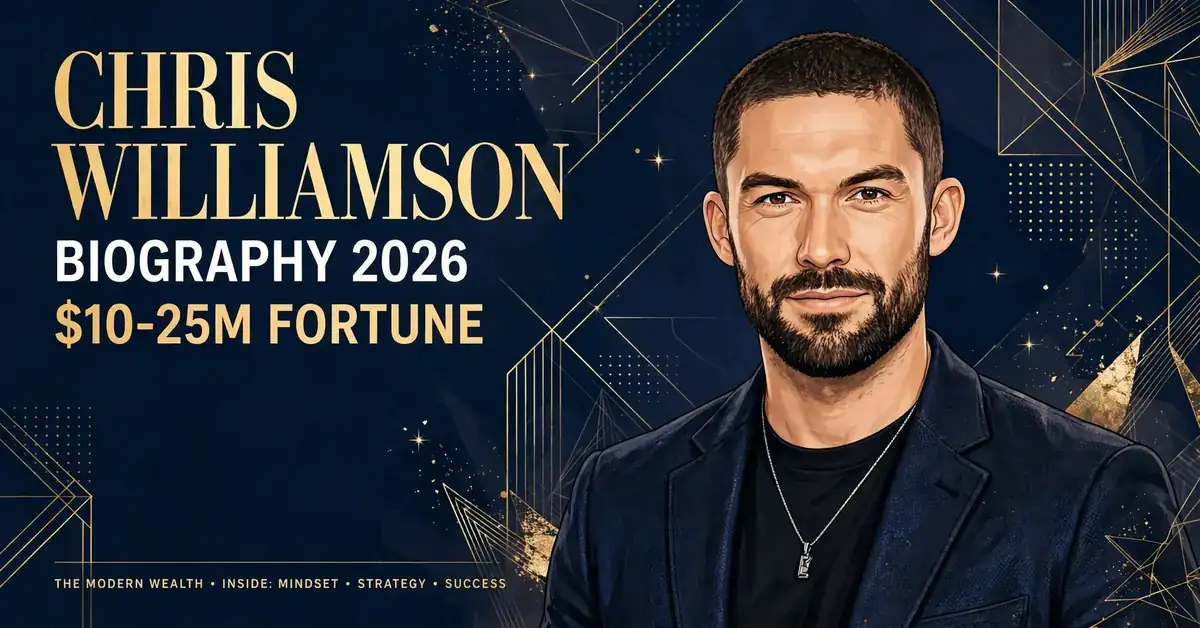
Chris Williamson biography 2026: the Modern Wisdom host, 38, went from Love Island and Newcastle nightclubs to a billion-download podcast and Neutonic.
Last updated: November 14, 2026 · By Nathan Cole
Chris Williamson is 38 years old. The British podcaster behind Modern Wisdom was born on February 23, 1988, in Stockton-on-Tees, England, and he has built one of the most unlikely second acts in modern media: a former Newcastle nightclub promoter and Love Island contestant who now hosts a podcast with more than a billion downloads and co-owns a drinks brand valued at $60 million. His estimated net worth in 2026 sits at $10 million to $25 million.
The arc is the story. Williamson spent his twenties running the party — promoting clubs, directing one of the largest events companies in the UK, appearing on reality television — and then, in his late twenties, decided the life he had built was not the one he wanted. He started Modern Wisdom in 2018 as an attempt to learn from the smartest people he could get on a microphone. Eight years later the show has passed 1,000 episodes, draws more than four million YouTube subscribers, and sits among the top podcasts on the planet. This biography covers the whole run: the Stockton childhood, the Newcastle nightlife years, the three weeks on Love Island, the quarter-life crisis that changed everything, the move to Austin, the guests who made the show, the Neutonic business, and the fortune the podcast built.
Quick Facts
| Full Name | Christopher Williamson |
| Born | February 23, 1988, Stockton-on-Tees, England |
| Age | 38 years old (turns 39 on February 23, 2027) |
| Occupation | Podcaster, YouTuber, entrepreneur |
| Known For | Host of the Modern Wisdom podcast (since 2018) |
| Education | Newcastle University — BA Business Management, MA International Marketing |
| Reality TV | Love Island UK, series 1 (2015) |
| Business | Co-founder, Neutonic (nootropic energy drink, 2023) |
| Based In | Austin, Texas (moved from Newcastle, UK in late 2021) |
| Podcast Scale | 1,000+ episodes; 1 billion+ downloads; 4M+ YouTube subscribers |
| Net Worth | $10–$25 million (2026 estimate) |
| Social | @ChrisWillx |
How This Biography Was Verified
The birth date of February 23, 1988 comes from Wikipedia, and Axios called Williamson 38 in May 2026, which fits it. A few profiles list 1987 instead, and Grazia notes the disagreement — this article names it rather than hiding it, and uses 1988 as the anchor because it is the date on the most complete record. The Austin move is dated to late 2021 from Williamson’s own account of relocating in November 2021 once COVID travel restrictions lifted; some 2026 profiles list 2023, and the article flags that too. The Neutonic figures — $6 million raised at a $60 million valuation, 10,000+ retail locations — come from FoodBev Media reporting cited in a May 2026 Axios-linked fact check. The net worth range of $10–$25 million is People & Media’s 2026 estimate; Grazia’s older £3–4 million figure is named alongside it. Podcast scale figures come from Wikipedia (1 billion+ downloads, 4M+ YouTube subscribers as of December 2025), Castmagic (800+ episodes and 500M+ downloads by August 2024) and the show’s own episode count passing 1,000. Career dates come from Grazia, Podwise and the Impactful Ideas profile of his self-discovery years.
+
Who Is Chris Williamson?
Chris Williamson is a British podcaster, YouTuber and entrepreneur best known as the host of Modern Wisdom, the long-form interview show he started in 2018. The show’s premise is simple and it has never changed: Williamson sits down with the sharpest thinkers he can book — psychologists, authors, athletes, founders, scientists — and tries to learn from them in public. The show’s own description calls it an attempt to learn from “the greatest thinkers on the planet,” and the guest list backs that up: Jordan Peterson, David Goggins, Sam Harris, Andrew Huberman, Ryan Holiday, James Clear.
What makes the biography worth telling is the distance he travelled to get there. Williamson did not come up through journalism or academia. He came up through nightclubs. He spent his early adult years promoting parties in Newcastle, building an events business, modelling, and appearing on the first series of Love Island in 2015. By his own account he was good at the nightlife life and miserable inside it. The podcast was his way out — a project he built around the questions he was actually asking himself at 27 and 28, about meaning, discipline, money and what a good life looks like when the party stops being enough.
The numbers now speak for themselves. Modern Wisdom has passed 1,000 episodes and a billion downloads, per Wikipedia, and as of December 2025 it had more than four million subscribers on YouTube. Axios, profiling him in May 2026, called the show a top-10 global podcast. People & Media places it among the top 30 podcasts globally on Spotify. Williamson also co-founded Neutonic, a nootropic energy drink, with fellow creator James Smith in 2023. The brand raised $6 million at a $60 million valuation and now sells in more than 10,000 retail locations. That is the second act: the podcaster became a founder, and the founder’s equity is now a large part of the fortune.
Early Life in Stockton-on-Tees
Williamson was born in Stockton-on-Tees, a market town in County Durham in north-east England, on February 23, 1988. He grew up as an only child in what he has described as a working-class town, and the detail matters because it runs through everything he built later: the chip on the shoulder, the hunger for status, and eventually the realisation that status was not the same thing as a life. As a boy he played cricket and was good enough to play for the Durham Academy, the youth setup of one of England’s first-class counties. Sport gave him his first taste of discipline and competition, and it also gave him his first identity — the kid from Stockton who could hold his own.
School led to Newcastle University, where he took a BA in Business Management and then a master’s in International Marketing. The degrees are easy to miss in the story, but they explain a lot about the second half of it. Williamson was not a dropout who stumbled into media. He studied how businesses work and how products reach people, and he spent his twenties applying those lessons in the hardest possible classroom: selling nights out to students in a northern English city. The marketing degree shows up in the podcast, too — in the titles, the thumbnails, the clip strategy, the relentless consistency. Modern Wisdom is a content business run by someone who understands distribution.
The Newcastle Nightclub Years
The nightlife career started the way a lot of student stories start: Williamson spent all his money in his first week at university. What happened next was less typical. Instead of getting a bar job, he started promoting nights himself — and discovered he was good at it. He built a club promotion business with a partner he met in his first seminar, and over the following years it grew into something serious. By his late twenties he was the director of one of the largest events companies in the UK, running nights that drew thousands of people and learning, in the process, the unglamorous mechanics of a real business: marketing, hiring, customer service, cash flow, and the grind of filling a room every single week.
He has talked openly about what the work gave him and what it cost. The skills were real — he learned how to sell, how to read a crowd, how to build a brand people wanted to be seen with. The life was real too: late nights, drinking, validation that arrived fast and faded faster. Grazia’s profile of him calls him a “self-declared ex-professional party boy,” and the label fits. He was, by every outside measure, winning at the game he was playing. The problem was the game. As he approached his late twenties, the question that had been sitting quietly in the background got louder: was being known for partying all he had to offer?
That question is the hinge of the whole biography. Most people in his position would have kept promoting. The money was good, the status was real, and the alternative was starting over from nothing. Williamson chose the restart. He has described the years that followed as a slow, deliberate reinvention — reading, training, going sober for a thousand days, and building a show around the ideas that were pulling him out of the life he had built. The nightclub years were not wasted. They taught him how to run a business and how to hold a room. Both skills now pay his bills in a different room, in front of a microphone.
Love Island 2015: Three Weeks on Reality TV
Before the podcast, there was Love Island. Williamson appeared on the first series of the UK show in the summer of 2015, aged 27, entering as a model and nightclub promoter. He lasted three weeks before being dumped from the villa in a tearful exit that Grazia still describes in its profile of him. The show was a relaunch — ITV had revived the format after a decade away — and nobody involved could have known it would become the cultural machine it is today. Williamson was there at the start, one of the original islanders, and the appearance gave him his first taste of national attention.
The Love Island chapter is often told as a footnote, but it matters for two reasons. First, it put a face and a name in front of millions of people who would later find the podcast — and in the attention economy, that head start is worth something. Second, it sharpened the crisis that followed. Reality television is a machine for turning a person into a character, and the character Williamson played was the party boy. He has said since that the experience forced him to look at who he had become, and that the answer was not flattering. The show ended, the attention faded, and he was left with the same question, louder than before: what next?
One detail from the period is worth recording because it shows how seriously he took the reinvention. After Love Island, Williamson did not chase more reality television. He did not try to stretch fifteen minutes of fame into a career of appearances. He went quiet, went back to the books, and started building something that had nothing to do with being seen. Three years would pass between the villa and the first episode of Modern Wisdom. That gap — the years nobody was watching — is where the biography actually happens.
The Quarter-Life Crisis That Changed Everything
Williamson has described his late twenties as a quarter-life crisis, and the phrase is doing real work in his story rather than serving as a soundbite. He was successful by every measure his old world valued — money, attention, a business, a public profile — and he was, by his own account, lost. The fix he found was not a new job or a new city. It was reading. He worked his way through Jordan Peterson, Sam Harris, Naval Ravikant and Alain de Botton, and he started listening to long-form podcasts, including Joe Rogan’s show, which showed him what a conversation could be when nobody was performing for a camera.
The reading did something specific: it gave him a new set of questions. Instead of asking how to get more attention, he started asking what attention was for. Instead of asking how to sell more tickets, he asked what a meaningful life looked like and whether the one he was living qualified. The answers were uncomfortable, and that was the point. He has said the works of Peterson and Harris in particular pulled him toward a different way of thinking about responsibility, truth and the habits that build a person over decades rather than weekends.
The practical changes followed the intellectual ones. He stopped drinking for a thousand days — a stretch he has discussed on the podcast with ultrarunner Cam Haynes — and rebuilt his daily life around training, reading and work that felt honest. The thousand days matter as a fact and as a symbol: it is the kind of extreme, measurable commitment that would later become the show’s house style. Modern Wisdom is, in a real sense, the public version of that private project. Williamson built the university programme he wished he had attended, taught by experts on the internet, one conversation at a time.
Modern Wisdom Is Born (2018)
Modern Wisdom launched in 2018. The format was simple: Williamson invited people he admired — academics, authors, athletes, founders — and asked them the questions he genuinely wanted answered. The show’s tagline, learning from “the greatest thinkers on the planet,” was a mission statement as much as a slogan. He was not an expert interviewing experts. He was a curious amateur learning in public, and the honesty of that position is a large part of why the show worked. Listeners were not being lectured. They were sitting in on a conversation between a man trying to rebuild his life and the people who could help him do it.
The growth was slow at first and then compounding. He posted one episode a week in the first year, two a week in the second, and three a week in the third — a cadence that turned a side project into a library. By 2022, the show was doing four to five million listens a month, according to Eric Jorgenson’s profile of him, and the guest list had become a roll call of the self-improvement world: Peterson, Goggins, Huberman, Harris, Ryan Holiday, James Clear. Each episode did two jobs at once. It taught the audience something, and it taught Williamson something — and the audience could hear the difference between a host reading questions and a host who actually needed the answers.
The production values rose with the audience. Williamson has said he wanted Modern Wisdom to be the best podcast in the world in two ways: ideas and beauty. The ideas came from the guests. The beauty came from treating the show like a craft — good lighting, good sound, careful editing, clips cut for the platforms where new listeners actually discover shows. The clips network matters: People & Media counts more than five million YouTube subscribers across his main channel and the Modern Wisdom Clips network. The long interviews build the reputation. The clips build the audience.
The Growth Engine: A Billion Downloads
The scale Modern Wisdom reached by 2026 is hard to overstate for a show that started as one man in Newcastle with a microphone. Wikipedia records more than a billion downloads. Castmagic counted 800-plus episodes and 500 million-plus downloads by August 2024, and the show has since passed 1,000 episodes. As of December 2025 it had more than four million subscribers on YouTube. Axios, in May 2026, called it a top-10 global podcast, and People & Media places it among the top 30 podcasts globally on Spotify. For a solo-hosted interview show in the crowded self-improvement space, those are elite numbers.
The engine behind them is consistency, and Williamson’s own history proves it. Three episodes a week, every week, for years, is a volume almost no other interview host sustains. The maths of podcasting rewards exactly that: each episode is a new chance to be discovered, a new clip, a new guest’s audience finding the show. The back catalogue does the rest. A listener who discovers Modern Wisdom through a David Goggins clip can spend months working through a thousand episodes — and the advertising, sponsorship and YouTube revenue compounds with every one of them. The show is not a viral moment. It is a library, and libraries pay rent forever.
That library is also the reason the biggest names in the space keep saying yes. A guest who sits down with Williamson knows the episode will be heard by millions, clipped across platforms, and still discovered years later. Andrew Huberman’s appearances are a good example: the Stanford neuroscientist’s conversations about sleep, dopamine and discipline are among the most shared episodes the show has produced, and they pulled in an audience that stayed for the rest of the catalogue. The same dynamic applies to Lex Fridman, the MIT researcher whose own interview show sits in the same long-form world, and to the authors and founders who treat a Modern Wisdom appearance as a stop on every book tour. The guests bring the audience. The audience brings the next guest. The wheel has been turning since 2018.
The Move to Austin, Texas
In November 2021, Williamson moved from Newcastle to Austin, Texas. The timing followed the lifting of COVID travel restrictions, and by his own account the decision had been building for years: a long-standing interest in American culture, a podcasting scene that was concentrating in Austin around Joe Rogan’s move there, and the practical reality that his biggest guests were increasingly American. He weighed Miami, New York, Nashville and Los Angeles before choosing Austin, and the pandemic made New York and Los Angeles less appealing at the time. The day after he arrived, he filmed what has been described as the first cinema-produced podcast — a conversation with Jordan Peterson, shot in a cinema. It was a statement of intent: he had not moved to Texas to slow down.
The move changed the show’s economics as well as its guest list. Texas has no state income tax, which matters when a podcast business starts earning real money, and Austin put Williamson inside the densest long-form podcast ecosystem in the world — Rogan’s Comedy Mothership, a stream of touring comedians, authors and thinkers passing through the city every week. The network effects were immediate. Within months he was recording with people he could never have booked from Newcastle, in rooms he could never have rented there, with production values that kept climbing. Some 2026 profiles date the move to 2023; the earlier date is the one Williamson himself has given, and this article uses it.
Austin also changed the man. The Newcastle promoter who had built his identity on nightlife was now a Texan podcaster whose daily life ran on training, recording and business meetings. The thousand days sober, the discipline, the morning routines the show endlessly discusses — Austin is where they became a permanent structure rather than a phase. The city gave him the guests, the tax bill he wanted, and the distance from the old life. The old life had been fun. The new one was the point.
The Guests Who Built the Show
Every great interview show is really a guest list, and Williamson’s is unusually strong. Jordan Peterson, the psychologist whose lectures first pulled Williamson out of his quarter-life crisis, became a recurring guest and, in Austin, the subject of that cinema-shot episode. David Goggins, the former Navy SEAL and ultrarunner, brought the show its hardest-edged conversations about suffering and discipline. Sam Harris brought the philosophy and the neuroscience. Andrew Huberman brought the lab: sleep, light, dopamine, the protocols that the show’s audience now repeats back in the comments. Ryan Holiday brought Stoicism. James Clear brought habits. Each of them gave the audience a tool, and each of them gave Williamson a lesson he was visibly using in his own life.
The peer group matters too. Modern Wisdom sits in a loose network of shows that cross-pollinate constantly — Rogan’s, Huberman’s, Fridman’s, Jay Shetty’s, Steven Bartlett’s Diary of a CEO. Bartlett is the closest parallel: another Brit who built a media business from nothing, moved fast, and turned a podcast into a company. Alex Cooper is the other side of the same coin — proof, from the Call Her Daddy deals, that a solo-hosted show can become a nine-figure business. Williamson watches those numbers. The difference between his show and theirs is mostly a matter of time and scale, and he has been closing the gap every year since 2018.
What the guests keep saying about him, in their own appearances and in profiles, is that he prepares. The questions are specific, the follow-ups are sharp, and the host has clearly read the book. That preparation is the show’s real product. Anyone can book a famous guest. Few hosts make the guest think. Williamson does, and the audience can hear it — which is why the guests keep coming back, and why the show’s archive is now one of the most valuable interview libraries on the internet.
Neutonic: The Second Business
In 2023, Williamson co-founded Neutonic, a nootropic energy drink brand, with fellow creator James Smith. The idea was simple: the audience that listened to Modern Wisdom — ambitious, health-conscious, suspicious of sugar and cheap stimulants — was the exact audience for a cleaner energy drink, and Williamson was the exact person to sell it to them. He was not a celebrity endorsing a product he did not use. He was a founder building a product for his own listeners, with his own name and reputation attached to it.
The business moved fast. Neutonic raised $6 million at a $60 million valuation, according to FoodBev Media reporting cited in a May 2026 Axios-linked fact check, and its products are now sold in more than 10,000 retail locations worldwide. Those are serious numbers for a drinks brand that is barely three years old, and they explain a large part of the net worth range in this profile. Podcast advertising pays well. Equity in a fast-growing consumer brand pays better, because it compounds. A $60 million valuation on a brand Williamson co-founded is the kind of asset that turns a successful podcaster into a wealthy founder.
The Neutonic story also shows how the two halves of Williamson’s career now feed each other. The podcast is the marketing engine: every episode is a reminder to millions of listeners that the host drinks the product and believes in it. The brand is the monetisation engine: it turns attention into equity rather than just advertising revenue. The model is the one every creator in 2026 is chasing — audience first, product second, ownership always — and Williamson got there earlier than most, because he had spent his twenties learning how to sell things to rooms full of people.
The 1,000 Days Sober
One of the most revealing facts in Williamson’s biography is also one of the least publicised: he went sober for a thousand days. He has discussed the stretch in conversation with ultrarunner Cam Haynes, framing it as a deliberate experiment in self-discovery rather than a reaction to a crisis. The thousand days were not about willpower as a performance. They were about finding out who he was when the social lubricant of his old life was gone — and about proving to himself that the discipline he preached on the podcast was something he could actually live.
The sobriety connects directly to the show’s themes. Modern Wisdom returns, episode after episode, to the same cluster of ideas: discipline, delayed gratification, the gap between who you are and who you want to be, and the daily practices that close it. Those are not abstract topics for Williamson. They are the record of his own rebuild, from the nightclub promoter who drank for a living to the podcaster who treats his body and his calendar like assets. The audience trusts the show because the host is visibly running the experiment on himself, in public, and reporting the results.
It also explains the tone. Williamson’s show is not a hype machine. It is a long, patient conversation about getting better at being a person, hosted by someone who spent his twenties being very good at being the wrong person. The thousand days sober is the proof of concept. Everything else — the billion downloads, the Austin studio, the Neutonic valuation — is what happened after he decided to take himself seriously.
Chris Williamson’s Net Worth in 2026
Chris Williamson’s net worth in 2026 is estimated at $10 million to $25 million, the range published by People & Media. The breadth of the range is honest: most of his wealth sits in two assets that are not publicly valued — his share of the Modern Wisdom business and his equity in Neutonic — so any single number would be a guess dressed up as a fact. What the range does capture is the order of magnitude. He is not a podcaster living episode to episode. He is a founder with a media business and a consumer brand, and the two together are worth eight figures.
The older figure still floating around the internet is Grazia’s £3–4 million, from a profile written when the podcast was a fraction of its current size. That number is now badly out of date: it predates the billion-download milestone, the four-million-subscriber YouTube channel, and the Neutonic raise at a $60 million valuation. The income streams behind the current range are straightforward. Podcast advertising and sponsorship across a thousand-episode catalogue. YouTube revenue from the main channel and the clips network. Speaking fees — he is listed with major speaking agencies as a podcast and business speaker. Brand partnerships. And, biggest of all, the equity: Neutonic at a $60 million valuation and a Modern Wisdom business that, on the revenue multiples other creator businesses command, is worth many millions on its own.
| Income Stream | What We Know (2026) |
|---|---|
| Modern Wisdom podcast | 1,000+ episodes, 1B+ downloads, advertising + sponsorship |
| YouTube (main + clips) | 4M+ subscribers on main channel (Dec 2025); 5M+ across the network |
| Neutonic equity | Co-founded 2023; $6M raised at a $60M valuation; 10,000+ stores |
| Speaking & brand deals | Listed with major speaking agencies; brand partnerships |
| Older estimate (Grazia) | £3–4M — predates the current scale, now out of date |
The honest version is that only Williamson and his accountant know the exact figure. What is public is enough to say this: the nightclub promoter from Stockton who went on Love Island at 27 is, at 38, a multi-millionaire several times over, and the fortune is still compounding — because the podcast keeps growing and the drinks brand keeps expanding into new shelves.
Chris Williamson Career Timeline
| Year | Milestone |
|---|---|
| 1988 | Born February 23 in Stockton-on-Tees, England |
| 2006–2010 | Newcastle University — BA Business Management, then MA International Marketing; starts nightclub promotion |
| 2015 | Appears on Love Island UK series 1, aged 27; dumped after three weeks |
| 2015–2018 | Quarter-life crisis; reading Peterson, Harris, Rogan, Naval, de Botton; 1,000 days sober; directs a large UK events company |
| 2018 | Launches Modern Wisdom podcast |
| 2021 | Moves from Newcastle to Austin, Texas (November); films cinema podcast with Jordan Peterson |
| 2023 | Co-founds Neutonic with James Smith |
| 2024 | 800+ episodes; 500M+ downloads by August; Neutonic raises $6M at a $60M valuation |
| 2025 | 1 billion+ downloads; 4M+ YouTube subscribers (December) |
| 2026 | 1,000+ episodes; top-10 global podcast (Axios); net worth estimated $10–25M |
Personal Life: What He Shares and What He Keeps Private
Williamson is, by the standards of a man with millions of followers, private. He posts as @ChrisWillx, and the feed is mostly the work: episode clips, guest announcements, training, books. He has never built his public image around a relationship, and no verified partner, wife or girlfriend is named in any reliable profile — so this article names none. The silence is deliberate. The show is about ideas, not about the host’s private life, and he has kept it that way for eight years.
What he does share is the discipline. Training, reading, early mornings, the routines the show’s guests recommend and the host actually follows. He has talked about the thousand days sober, about the books that changed him, about the move to Austin and why it mattered. The personal life that is public is the one that serves the work: a man rebuilding himself in public, one habit at a time, and inviting the audience to do the same. At 38, with a billion-download podcast and a drinks brand on ten thousand shelves, the rebuild looks complete. The show suggests he would disagree — the project, as he tells it, never ends.
What Comes Next for Chris Williamson
The trajectory points in one direction. Modern Wisdom keeps adding episodes at a pace almost no interview show sustains, and each one adds to a catalogue that earns while he sleeps. Neutonic keeps adding shelves — 10,000 and counting — and every new store is a small increase in the value of the equity he holds. The podcast and the brand now sell each other, and the audience that trusts the host trusts the product. That loop is the business, and it has years left to run.
The bigger question is what a third act looks like for a man who has already had two. The first act was the party. The second was the podcast and the brand. A third could be anything: a book, a fund, a media company that owns more than one show, a bigger role in the Austin scene he helped build. Williamson has never announced a plan for it, and he does not need one. At 38, with the numbers he has and the audience he holds, the next move is his to choose. The biography so far suggests he will choose the one that asks the most of him — and then spend a thousand days getting good at it.
Sources & Reporting
Figures in this profile reflect reporting through November 14, 2026. Key sources: Wikipedia (Chris Williamson, TV personality — born February 23, 1988, Stockton-on-Tees; Durham Academy cricket; Newcastle University degrees; Love Island series 1, 2015; Modern Wisdom since 2018; 1 billion+ downloads; 4M+ YouTube subscribers as of December 2025; Neutonic co-founder); Grazia (Who Is Chris Williamson — Love Island series 1, three weeks, dumped; Newcastle degrees; 735 episodes; net worth £3–4M; birth-year variation 1987 vs 1988; @ChrisWillx); People & Media (Chris Williamson Net Worth 2026 — $10–$25M estimate; top 30 Spotify; 5M+ YouTube subscribers across main + clips; Neutonic co-founded 2023); Axios (May 4, 2026 — 38-year-old; top-10 global podcast; Neutonic co-founded with James Smith); eFinder / FoodBev Media (May 2026 fact check — Neutonic co-founded 2023, $6M raised at $60M valuation, 10,000+ retail locations); Castmagic (Chris Williamson creator page — 800+ episodes, 500M+ downloads by August 2024); Impactful Ideas (Substack) (How Chris Williamson Used Self Discovery — director of a large UK events company; influences Peterson, Harris, Rogan, Naval, de Botton; 1,000+ episodes; 1/2/3 episodes-per-week cadence; Austin move early 2022; cinema podcast with Peterson); VideoHighlight (Chris Williamson interview summary — moved Newcastle to Austin November 2021; spent all his money in first university week; nightlife partnership); Podwise / The Boss Code (July 2023 — only child, working-class north-east town; quarter-life crisis; nightlife business skills); Gist.ly (Modern Wisdom journey — 1,000 days sober; Cam Haynes conversation); Eric Jorgenson (Building leverage in podcasts — 4–5M listens per month; guests Peterson, Holiday, Clear). Where outlets disagree — the birth year (1988 vs 1987) and the Austin move (2021 vs 2023) — the article publishes the range and names the sources on each side rather than picking one. More profiles in the Celebrity Net Worth archive.
Frequently Asked Questions
How old is Chris Williamson in 2026?
Chris Williamson is 38 years old in 2026. He was born on February 23, 1988, in Stockton-on-Tees, England, and will turn 39 on February 23, 2027. Wikipedia lists February 23, 1988, and Axios also called him 38 in May 2026. A few profiles list 1987 instead, but 1988 is the date on the most complete record.
When is Chris Williamson’s birthday?
Chris Williamson’s birthday is February 23. He was born on February 23, 1988, in Stockton-on-Tees, England. He turned 38 in February 2026 and will turn 39 on February 23, 2027.
Was Chris Williamson on Love Island?
Yes. Chris Williamson appeared on the first series of Love Island UK in the summer of 2015, aged 27. He entered as a model and nightclub promoter and was dumped from the villa after three weeks. He later said the experience forced him to look hard at who he had become, and it was part of what pushed him toward the reinvention that led to Modern Wisdom.
What is Chris Williamson’s net worth in 2026?
Chris Williamson’s net worth in 2026 is estimated at $10 million to $25 million, according to People & Media. The range reflects that most of his wealth sits in two privately held assets — the Modern Wisdom podcast business and his equity in Neutonic, the drinks brand he co-founded in 2023, which raised $6 million at a $60 million valuation. An older Grazia estimate of £3–4 million predates the podcast’s current scale.
When did Chris Williamson start Modern Wisdom?
Chris Williamson launched Modern Wisdom in 2018. He posted one episode a week in the first year, two a week in the second, and three a week in the third. The show has since passed 1,000 episodes and a billion downloads, with more than four million YouTube subscribers as of December 2025.
What is Neutonic?
Neutonic is a nootropic energy drink brand Chris Williamson co-founded in 2023 with fellow creator James Smith. It raised $6 million at a $60 million valuation and its products are sold in more than 10,000 retail locations worldwide. Williamson built it for the same audience that listens to Modern Wisdom — health-conscious, ambitious listeners looking for a cleaner energy drink.
How tall is Chris Williamson?
No verified height is published for Chris Williamson in any reliable profile — Wikipedia, Grazia, Axios and the podcast profiles do not list one. Any height figure circulating online is unverified, so this profile does not publish one rather than repeat a guess.
Is Chris Williamson married or does he have a girlfriend?
Chris Williamson keeps his private life out of public view, and no verified partner, wife or girlfriend is named in any reliable profile. He posts as @ChrisWillx, and his public feed is almost entirely about the podcast, his guests and his work. This profile names no partner rather than repeat an unverified claim.
WRITTEN BY
Nathan Cole
Nathan Cole is the editor of Guide Net Worth. He covers celebrity wealth the way a business desk covers earnings: reported figures first, estimates labeled as estimates, and no invented numbers. Every profile on this site passes through his desk before it publishes. About Guide Net Worth · Corrections: figures are updated when new reporting emerges — contact us via the About page if you spot an error.
References & Sources
This article has been fact-checked and verified against multiple public sources, financial disclosures, SEC filings, Forbes reports, Celebrity Net Worth databases, and official records. All net worth estimates are based on publicly available information and financial analysis.