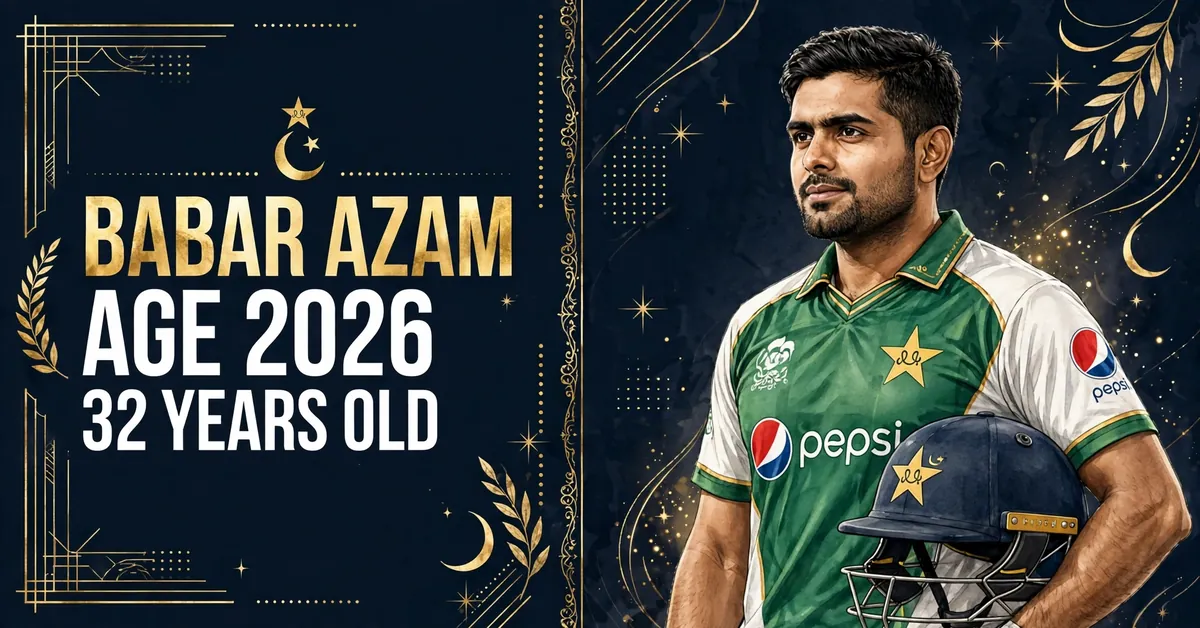
Babar Azam is 32 years old in November 2026 — born 15 October 1994 in Lahore. His age at every milestone, career runs, captaincy and net worth, all sourced.
Last updated: November 17, 2026 · By Nathan Cole
Babar Azam is 32 years old in November 2026. The Pakistan batter was born Mohammad Babar Azam on 15 October 1994 in Lahore, and he turned 32 on 15 October 2026 — a birthday he celebrated three days after passing 16,000 international runs and a month before leading Pakistan into a home Test series against Sri Lanka as captain for the second time. His birth date is one of the most settled facts in Pakistan cricket: ESPNcricinfo, the Pakistan Cricket Board, Cricket Australia and Wikipedia all list 15 October 1994, and every age attached to his name flows from that single date.
Thirty-two is a specific kind of age for a batter. Babar has played international cricket for eleven and a half years, scored more than 16,000 runs across three formats, captained his country in all three of them, and collected the ICC Cricketer of the Year award. He has also gone 42 Test innings without a century — a drought that now defines his second stint as Test captain as much as any milestone does. This profile answers the age question in full, then uses it as the frame for the whole career: his age at every milestone, how his numbers stack up against players of the same generation, and what 32 means for the years still ahead of him.
Every figure here carries a date and a source. Career totals are dated to 12 September 2026, the last full ESPNcricinfo Statsguru snapshot before the October tri-series, with the 16,000-run milestone and the November Test series updated from same-week reporting. Where outlets disagree — on his height, on his net worth — the article says so and prints the range.
Quick Facts
| Age (2026) | 32 years old — turned 32 on 15 October 2026; turns 33 on 15 October 2027 |
| Full Name | Mohammad Babar Azam |
| Born | 15 October 1994, Lahore, Punjab, Pakistan |
| Height | 5 ft 11 in (180 cm) per most profiles; Wikipedia lists 1.83 m (6 ft 0 in) — sources split |
| Role | Right-hand top-order batter; Pakistan Test captain (second stint, from 5 July 2026) |
| International Debuts | ODI 31 May 2015 v Zimbabwe; T20I 7 Sep 2016 v England; Test 13 Oct 2016 v West Indies |
| Career Runs | 16,000+ international runs (passed 16,000 on 18 Oct 2026); 32 centuries, 111 fifties (as of 12 Sep 2026: 15,993 runs in 354 matches) |
| Format Split | Tests 4,771 runs (66 matches, avg 42.98); ODIs 6,626 runs (143 matches, avg 53.43); T20Is 4,596 runs (145 matches, avg 38.94) |
| Highest Scores | Test 196 v Australia (Karachi, 2022); ODI 158; T20I 122 |
| Top Honours | ICC Cricketer of the Year 2022 (Sir Garfield Sobers Trophy); ICC ODI Cricketer of the Year 2021 & 2022; 2017 Champions Trophy winner |
| Franchise Teams | Peshawar Zalmi captain (PSL); Sydney Sixers (BBL 2025-26); Desert Vipers (ILT20) |
| Net Worth (2026) | $5–7 million (media estimates; wider roundups go to $5–12M — no official figure exists) |
| Family | Eldest of three siblings; first cousin of Kamran, Umar and Adnan Akmal; unmarried as of November 2026 |
| 2026 Milestones | Reappointed Test captain 5 July 2026; passed 16,000 international runs 18 Oct 2026; 50 & 34 in the drawn Rawalpindi Test v Sri Lanka, 9–13 Nov 2026 |
How We Verified His Age
The birth date in this profile — 15 October 1994 — was checked against five independent records that all agree: ESPNcricinfo’s player profile (sourced 18 October 2026), the Pakistan Cricket Board’s player profile, Cricket Australia’s profile, Wikipedia’s infobox and lead (source: Cricinfo, 18 October 2026), and the live age calculators on myKhel and CricNepal, which both show 32 in November 2026. No credible source lists a different date, and no age controversy has ever attached to Babar’s name — the figure is stable rather than time-sensitive, so the only maths the reader needs is 2026 minus 1994, adjusted for the October birthday. Every career total in the article is dated to its source snapshot (12 September 2026 for the full Statsguru totals; 18 October 2026 for the 16,000-run milestone; 13 November 2026 for the Rawalpindi Test), so the numbers stay honest as he keeps playing. Where outlets disagree — his height, his net worth — the article prints both sides instead of picking one.
+
How Old Is Babar Azam in 2026?
Babar Azam is 32 years old. He was born on 15 October 1994, which means he spent the first nine and a half months of 2026 as a 31-year-old and turned 32 in the middle of October — three days after a career landmark, and a month before a home Test series in which he led Pakistan as captain for the second time in his career. He will turn 33 on 15 October 2027.
The timing of that birthday matters more than it looks. The 16,000-run milestone came on 18 October 2026, in the opening match of a home ODI tri-series against Sri Lanka at Rawalpindi. Babar walked in needing seven runs, got them off the sixth ball of the fifth over, and finished the day on 16,038 international runs from 355 matches. He was 32 years and three days old. The 399 innings it took him to reach the mark made him the third-fastest Pakistani to 16,000, behind Mohammad Yousuf (388 innings) and Javed Miandad (398), and only the fifth Pakistani ever to get there, after Inzamam-ul-Haq (20,541), Younis Khan (17,790), Yousuf (17,134) and Miandad (16,213). A birthday three days before a milestone is a coincidence. A 32-year-old reaching a mark only four countrymen have ever reached is not — it is the shape of a career that has been accumulating at a steady rate for eleven years.
There is a second reason the age question keeps getting asked. Babar has been famous for so long that people lose track of how young he still is. He debuted in 2015, captained Pakistan before he turned 26, and won the ICC Cricketer of the Year award at 28. Fans who watched him as a 21-year-old scoring three hundreds in a row against West Indies in 2016 now find him a 32-year-old captain leading a rebuild side with four debutants in it. The career feels longer than the age suggests, because it started early and moved fast. The number itself — 32 — is plain. The career behind it is the part that needs explaining, and that is what the rest of this profile does.
Early Life in Lahore: The Walled City and the Akmal Cousins
Babar Azam was born on 15 October 1994 into a Punjabi Kamboh family in the Walled City of Lahore, the old, dense heart of Pakistan’s second city. His father, Mohammad Azam Siddiqui, ran a small watch-repair shop. His mother is a housewife. Babar is the eldest of three siblings — Safeer Azam, Faisal Azam and Fariya Azam — and he grew up in streets where cricket was played with a tennis ball between houses, not on manicured outfields. He has described those years as playing cricket and roaming the streets like a free bird, and the image has stuck because it fits the player he became: a batter whose game looks unhurried, as if the ball is never rushing him.
The family connection shaped everything. His older first cousins — through his elder paternal uncle — were Kamran Akmal, Umar Akmal and Adnan Akmal, all three Pakistan internationals. Kamran kept wicket for Pakistan for more than a decade; Umar was the gifted, combustible middle-order batter of the 2010s; Adnan kept wicket in Tests. Babar has said plainly that his cousins were the reason he was drawn to cricket, and their stories and success gave him the push to take it up as a profession. Growing up around three international cricketers is a rare start. It meant the game was not a distant dream but a job his own family did, and it meant the standard in his own house was set by men who had played Test cricket.

Before the academies, there was the Gaddafi Stadium. As a boy, Babar worked as a ball boy at the ground — fetching balls hit into the stands during international matches, watching the players he would later join from a few yards away. It is the kind of detail that gets repeated because it is true and because it compresses a whole journey into one image: the kid chasing balls at Gaddafi became the man captaining Pakistan at the same ground’s sister venues. He came through the age-group system the long way — Under-15s in 2008, then the Under-19 World Cups in 2010 and 2012, where he finished as Pakistan’s top scorer both times. He was 15 at the first of those World Cups and 17 at the second. The slow climb through domestic cricket followed, and it was slow for a reason: Pakistan spent those years largely isolated as an international venue, so a young batter had to earn his place through domestic runs rather than exposure.
Lahore stays in the story long after he left its streets. The Gaddafi Stadium is where he made his ODI debut in 2015, and it is where the tri-series final was played on 31 October 2026. The city gave him his first ground, his first cousins to copy, and his first audience. It also gave him his nickname among fans — “Bobby”, the short form his teammates and supporters use — and his reputation as the most technically correct batter Pakistan has produced in a generation.
Babar Azam’s Age at Every Career Milestone
A birth date is only useful when it is laid against a career. The table below puts Babar’s age next to every major step, from a 15-year-old at a World Cup to a 32-year-old captain in Rawalpindi. Read down the age column and the pattern is clear: he was young for almost everything he did, and he stayed young for a long time. The debuts came at 20 and 21. The captaincy came at 25. The biggest individual award in the sport came at 28. The 16,000-run mark came at 32, with years still in front of him.
| Milestone | Date | Age |
|---|---|---|
| Under-19 World Cup (Pakistan’s top scorer) | January 2010 | 15 |
| Second Under-19 World Cup (top scorer again) | August 2012 | 17 |
| ODI debut v Zimbabwe, Lahore (54 off 60) | 31 May 2015 | 20 |
| T20I debut v England, Manchester | 7 Sep 2016 | 21 |
| Three consecutive ODI hundreds v West Indies | Sep–Oct 2016 | 21 |
| Test debut v West Indies, Dubai (69 in first innings) | 13 Oct 2016 | 21 |
| Champions Trophy winner with Pakistan | June 2017 | 22 |
| First Test hundred v New Zealand, Dubai | November 2018 | 24 |
| Appointed T20I captain | October 2019 | 25 |
| Appointed ODI captain; Test captain follows | 2020 | 25–26 |
| World No. 1 ODI batter | April 2021 | 26 |
| ICC ODI Cricketer of the Year (first of two) | 2021 | 27 |
| 196 v Australia, Karachi (match-saving) | March 2022 | 27 |
| ICC Cricketer of the Year (Sir Garfield Sobers Trophy) | 2022 | 28 |
| Steps down as captain after the World Cup | November 2023 | 29 |
| Resigns as white-ball captain after brief return | October 2024 | 29 |
| 20th ODI hundred (102* v Sri Lanka, Rawalpindi) | 14 Nov 2025 | 31 |
| Reappointed Test captain | 5 July 2026 | 31 |
| Passes 16,000 international runs | 18 Oct 2026 | 32 |
| 50 & 34 as captain v Sri Lanka, Rawalpindi | 9–13 Nov 2026 | 32 |
Two rows in that table deserve a second look. The first is the 20-year-old debut. Babar’s ODI debut came on 31 May 2015, in the third ODI against Zimbabwe at Lahore, during the series that brought international cricket back to Pakistan after years away. He scored 54 off 60 balls. A debut fifty is a good start; a debut fifty in a series that mattered to the whole country is a better one. The second is the 25-year-old captain. Babar was handed the T20I captaincy in October 2019, the ODI captaincy in 2020, and the Test captaincy later the same year. He was 25 when the job started and 26 when he held all three formats at once. Few batters in the modern game have carried that load that young, and the load is part of why his career reads the way it does — the captaincy years produced his best individual seasons and, later, his most scrutinised ones.
Three Debuts in 17 Months: ODI, T20I and Test
Babar’s three international debuts arrived inside seventeen months, and each one landed in a different setting. The ODI debut came first, at home in Lahore against Zimbabwe in May 2015, in front of a crowd that had waited years to see international cricket return. He made 54 off 60 balls, a calm, correct innings that looked like the player he would become. The T20I debut followed in September 2016, against England at Manchester. The Test debut came a month after that, against West Indies in Dubai on 13 October 2016 — a day-night Test, the first of its kind in which a player scored a fifty on debut. He made 69 in his first innings, two days before his 22nd birthday.
That sequence — white-ball first, red-ball second — is the modern route, and Babar walked it faster than most. The selectors had seen enough in the age-group sides and in domestic cricket to trust a 20-year-old in the ODI team, and enough in his first sixteen months of ODI cricket to hand him a Test cap. The bridge between the two was the West Indies ODI series of September–October 2016, which is where his career stopped being a promise and became a fact.
The debuts also show why the age lens matters for Babar more than for most players. A batter who debuts at 20 and plays 354 internationals by 32 has a different career shape from one who debuts at 25. Babar’s numbers were built over eleven years of near-constant selection. He has been a fixture since his early twenties, which is why his totals look like a veteran’s while his age still reads like a player in his prime.
The 2016 Breakthrough: Three Hundreds in a Row
If one series made Babar Azam, it was the home ODI series against West Indies in the United Arab Emirates in September and October 2016. He was 21. He scored three consecutive centuries — 120, 123 and 117 — and finished the series with 360 runs at an average of 120. Three hundreds in three games is rare at any age. At 21, in your second year of international cricket, it is the kind of start that changes how a whole country talks about you.
The hundreds mattered for a second reason: they were not slogs. Babar’s game has always been built on timing and placement rather than power, and the West Indies series showed it in its cleanest form. The cover drive — the shot he is known for — was already the centrepiece. Coaches and commentators started comparing his technique to the greats of the previous generation, and the comparisons stuck because the numbers kept pace. By April 2021, at 26, he was the world’s No. 1 ODI batter, ending a long run at the top held by the Indian captain of the time.
His first Test hundred took longer. It came in November 2018, against New Zealand in Dubai, when he was 24 — a 127 not out that showed the white-ball player could build a long innings. The highest score of his Test career followed in March 2022: 196 against Australia in Karachi, a match-saving innings that lasted more than ten hours at the crease and is still the defining Test knock of his career. He was 27. Between those two innings sits the whole of his Test story so far — a batter who can bat long and bat beautifully, whose Test average of 42.98 (as of September 2026) sits below his ODI average of 53.43, and whose last Test hundred came in December 2022, against New Zealand in Karachi. That gap is the subject of its own section below.
Career Numbers at 32: 16,000 Runs and 32 Centuries
As of 12 September 2026, Babar Azam’s international record stood at 354 matches, 15,993 runs and 32 centuries, with 111 fifties, at an average of 45.30 across all three formats. The figures come from ESPNcricinfo’s Statsguru, as compiled by SportsAdda and Khelo Pakistan in September 2026. A month later, on 18 October 2026, he passed 16,000 runs in the tri-series opener against Sri Lanka at Rawalpindi, finishing that match on 16,038 runs from 355 appearances. The totals below are the September snapshot, with the October milestone noted alongside.
| Format | Matches | Runs | Average | 100s / 50s | Highest |
|---|---|---|---|---|---|
| Tests | 66 | 4,771 | 42.98 | 9 / 34 | 196 |
| ODIs | 143 | 6,626 | 53.43 | 20 / 38 | 158 |
| T20Is | 145 | 4,596 | 38.94 | 3 / 39 | 122 |
| All international | 354 | 15,993 | 45.30 | 32 / 111 | 196 |
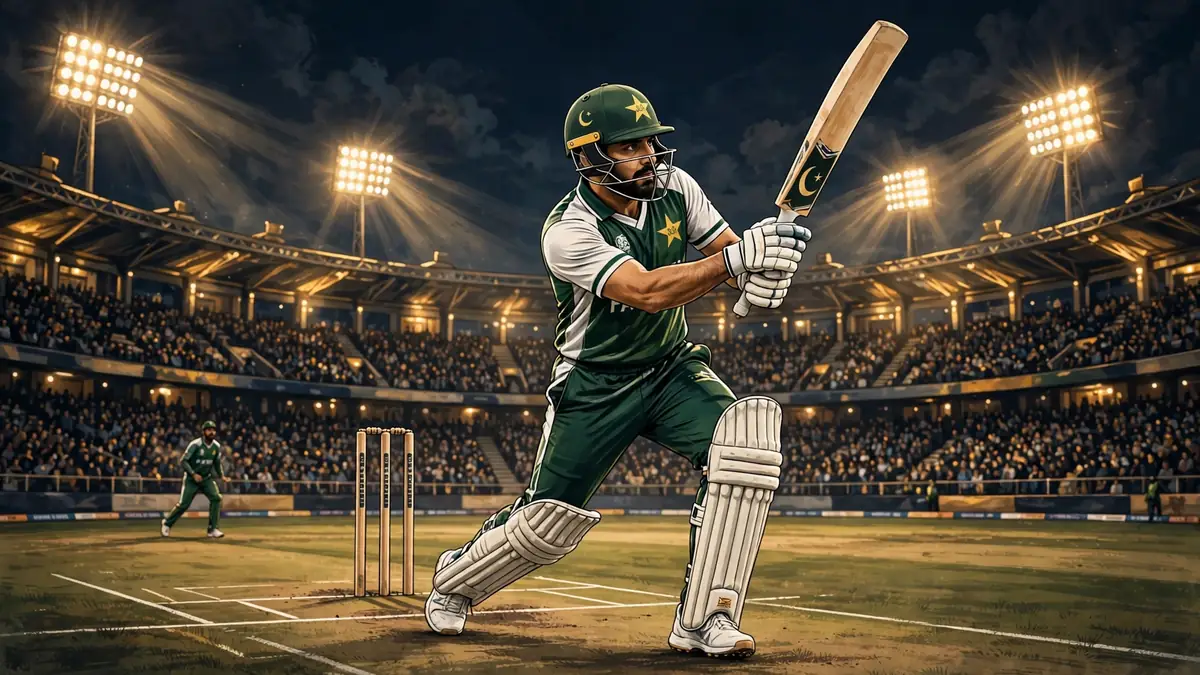
The ODI column is the strongest of the three, and it is not close. An average of 53.43 across 143 matches, with 20 hundreds, makes Babar one of the best one-day batters of his generation. His 20 ODI hundreds are the joint-most by any Pakistan batter, a record he shares with Saeed Anwar after equalling it with 102 not out against Sri Lanka at Rawalpindi on 14 November 2025. He was the fastest to 5,000 ODI runs in 97 innings, and the fastest to 19 ODI hundreds. In T20Is he holds a different record: on 31 October 2025, against South Africa, he passed Rohit Sharma’s 4,231 runs to become the leading run-scorer in men’s T20 internationals. The Test column is the one his critics point to, and they are not wrong to point at it — 42.98 is a good average, not a great one, and the nine hundreds in 66 Tests sit well below the ODI return.
The 2026 season, up to the October milestone, told the same mixed story. Babar scored 742 runs in 18 matches across formats in 2026, at an average of 41.22, with six half-centuries and a highest score of 88 — and no international hundred in the calendar year. In ODIs in 2026 he had 170 runs from four innings at 42.50. Those are solid numbers for a 32-year-old in a rebuilding side. They are not the numbers of a batter at his peak. The question the rest of this profile tries to answer is whether 32 is the age at which the peak returns, or the age at which the totals start to slow.
Captain Again at 32: The Second Test Stint
On 5 July 2026, Babar Azam was reappointed as Pakistan’s Test captain after Shan Masood was relieved of the role. It was his second stint in the job, and it came at 31, three months before his 32nd birthday. The first assignment was a home two-Test series against Sri Lanka in November 2026, and it arrived after a 3-0 whitewash in England that AFP described as disastrous — a series in which seven players were sent home after the second Test, and after which Pakistan sat ninth and last in the World Test Championship 2025-27 table.
Babar’s own preparation for the series was unusual for a Test captain. He went back to domestic first-class cricket, playing for Lahore Whites in the Quaid-e-Azam Trophy 2026-27, and made 28 and 42 against FATA before the Tests began. A month earlier, in the President’s Trophy, he had managed 12 against Khan Research Laboratories. At the pre-series press conference in Rawalpindi on 8 November, he said he had played a few domestic matches and thought the more he played, the more he would improve. “I am ready to fight with these young players,” he told reporters, speaking about a squad that had been overhauled after the England defeat. The selection, he added, was not in his hands — he simply gave his inputs.
The first Test, at Rawalpindi from 9 to 13 November 2026, ended in a draw shaped by rain and bad light, with more than 100 overs lost. Babar made 50 off 58 balls in the first innings — his 35th Test fifty — caught behind off Dilshan Madushanka after striking seven fours, and 34 off 48 in the second innings before flicking a leg-side ball to short square leg off Milan Rathnayake. Pakistan declared on 434 for 9 and made 284 for 8; Sri Lanka replied with 446, Dhananjaya de Silva making 167 and Saud Shakeel 97 across the match. Three debutants scored fifties in Pakistan’s first innings — Tayyab Arif with 57, Mohammad Taha with 51 and Arafat Minhas with 52 — and Taha credited Babar’s guidance during his half-century in an ICC interview after the day’s play.
The two innings extended a statistic that now follows Babar everywhere: 42 Test innings without a century. His last Test hundred was the 161 against New Zealand in Karachi in December 2022, when he was 28. The drought is real, and it is fair to call it the central tension of his second captaincy. But the same reporting that counts the 42 innings also carries a counterweight: one 13 November 2026 report put his Test batting average in 2026 at 50.55, the highest of any player with at least ten innings that year, with five fifties including the Rawalpindi half-century. A captain at 32 who averages over 50 in a calendar year and still cannot reach three figures is a puzzle, not a decline — and puzzles are what the second Test, starting 17 November, was set up to answer. That match was scheduled for Lahore’s Gaddafi Stadium but was moved to Rawalpindi after smog pushed Lahore’s air quality index to 421, a hazardous reading, according to the PCB.
The First Captaincy: All Three Formats Before 30
Babar’s first run as captain began in October 2019, when he was handed the T20I side at 25. The ODI captaincy followed in 2020, and the Test captaincy later the same year, making him captain in all three formats before his 26th birthday. It was a heavy appointment for a young batter, and it came with the two jobs that define a Pakistan captain: winning games and carrying the batting at the same time. For a while, both jobs went well. Pakistan reached the semi-final of the 2021 T20 World Cup and the final of the 2022 edition. Babar won the ICC ODI Cricketer of the Year award in 2021 and again in 2022, and in 2022 he took the sport’s biggest individual prize, the Sir Garfield Sobers Trophy as ICC Cricketer of the Year — the first Pakistani to win the ODI award twice, and one of the few batters of his generation to hold the Sobers Trophy at all.
The turn came at the 2023 World Cup in India, where Pakistan failed to reach the semi-finals. Babar stepped down from the captaincy in November 2023, at 29, saying the role had become too heavy alongside the batting. He returned briefly as white-ball captain in 2024, then resigned that October, again at 29, after the T20 World Cup in the United States and the West Indies. The two exits were different in tone — the first a reset after a poor tournament, the second a quieter admission that the dual role was not working — but they shared a cause. Captaincy had stopped helping his batting, and his batting is the reason he is in the team.
That history is why the July 2026 reappointment reads differently from the first one. This time the job is narrower: Tests only, not all three formats. This time the captain is 32, not 25, with a decade of international cricket behind him and a clear-eyed view of what the role costs. And this time the squad is younger — four debutants in the Rawalpindi XI, a side rebuilding after a whitewash, with the captain as the one senior batter in it. The first captaincy was about a young star being given the team. The second is about a 32-year-old being asked to steady it.
What 32 Means for a Batter: The Prime Years
Cricket has a saying that batters peak late, and the numbers behind it are straightforward: the best Test batters of the modern era did much of their finest work between 30 and 35, when technique, temperament and experience finally lined up. Younis Khan, the man ahead of Babar on Pakistan’s all-time run list, scored heavily into his late thirties. Misbah-ul-Haq made his Test debut at 27 and captained Pakistan past 40. Kumar Sangakkara’s best years came after 30. The reason is simple — Test batting rewards judgement more than reflexes, and judgement is the one thing that keeps improving with age.
Babar’s own 2026 numbers fit that pattern better than his critics allow. His Test average for the calendar year, 50.55, is the highest of any player with ten or more innings in 2026, according to the 13 November 2026 report. He has passed fifty five times in Tests this year. What he has not done is convert — and conversion, not scoring, is the gap. A 32-year-old who keeps reaching fifty and keeps getting out is a batter whose game is intact and whose finishing is not. The Rawalpindi Test showed both halves in one match: a fluent 50 in the first innings, a fluent 34 in the second, and no hundred at the end of either.
The years ahead give him room to fix it. A batter who debuted at 20 and is 32 now has, on the modern pattern, three to five prime years left — the same window in which many greats added the bulk of their hundreds. Babar needs 175 runs to pass Javed Miandad’s 16,213 and move to fourth on Pakistan’s all-time international run list. He needs one ODI hundred to stand alone as Pakistan’s most prolific century-maker in the format, ahead of Saeed Anwar. And he needs one Test hundred to end a drought that has lasted since he was 28. None of those targets is far away. All of them are the kind of target a 32-year-old in his prime years is expected to reach, and the next two years — with a home-heavy schedule and a World Cup in 2027 in South Africa, Zimbabwe and Namibia to build toward — are the years in which he will reach them or not.
There is a caution in the picture too, and honesty requires printing it. Babar’s difficulty against the short ball has been noted in recent reporting — his dismissal in the 16,000-run innings at Rawalpindi came against a rising delivery, and the same weakness was flagged after the England tour, from which he was sent home early. At 32, reflexes do not improve. What improves is preparation: knowing the weakness, planning for it, and picking the balls to attack. The prime-years argument is not a promise. It is a window, and windows close.
Babar Azam vs His Generation: An Age Comparison
Babar’s age makes more sense next to the players he is always measured against. He is the youngest of the great batting group of his era, and the gap matters: the men ahead of him on the run lists are all three to seven years older, which means Babar’s totals were built with fewer years behind him and more years ahead of him.
| Player | Born | Age (Nov 2026) | International runs |
|---|---|---|---|
| Babar Azam | 15 Oct 1994 | 32 | 16,038 (Oct 2026) |
| Virat Kohli | 5 Nov 1988 | 38 | 28,359 (Sep 2026) |
| Rohit Sharma | 30 Apr 1987 | 39 | 4,231 T20I runs (passed by Babar, Oct 2025) |
| Joe Root | 30 Dec 1990 | 35 | England’s record Test run-scorer |
| Kane Williamson | 8 Aug 1990 | 36 | New Zealand’s leading Test run-scorer |
The comparison with Virat Kohli, whose age and career are covered in our Virat Kohli age profile, is the one readers ask for most, and the numbers explain why. Kohli, born 5 November 1988, is 38 in November 2026, and his 28,359 international runs and 85 centuries — SportsAdda’s September 2026 figures, drawn from ESPNcricinfo — sit far ahead of Babar’s 16,038 and 32. But Kohli debuted in 2008, seven years before Babar, and has retired from Tests and T20Is, leaving only ODIs open. Babar is still playing all three formats. The gap between them is a gap of years, not of rate: Babar reached 16,000 runs in 399 innings, and his ODI average of 53.43 is higher than Kohli’s career ODI average ever was at the same stage of his career. The comparison is not a contest Babar wins. It is a measure of how much runway a 32-year-old still has when the man ahead of him is 38 and slowing down.
Rohit Sharma, whose age is covered in our Rohit Sharma age profile, is 39 — the oldest of the group — and the T20I record shows the generational turn in plain numbers: Babar passed Rohit’s 4,231 T20I runs on 31 October 2025, becoming the format’s leading scorer. Joe Root’s biography shows how England’s record run-scorer built his totals over a career that started in 2012, and at 35 he is the closest in age to Babar among the Fab Four of his generation. Kane Williamson’s biography covers New Zealand’s leading Test run-scorer, who is 36 and has spent his thirties the way Babar’s supporters hope Babar will spend his — accumulating steadily, captaining calmly, and letting the totals grow.
The point of the table is not to rank them. It is to show where 32 sits. Babar is younger than every player he is compared with, still active in every format, and already fifth on his own country’s all-time list. The men ahead of him are all older and mostly finished. The men beside him are all older too. At 32, Babar is the youngest of his generation’s greats — and the one with the most cricket still to play.
PSL and Franchise Cricket: Zalmi, Sixers and Vipers
Babar’s franchise career began in the first Pakistan Super League season in 2016, with Islamabad United, and it has tracked his rise ever since. He moved to Karachi Kings, won the 2020 title with them, and was named Player of the Tournament that season. In 2023 he moved to Peshawar Zalmi, whom he captains in 2026. He is the PSL’s all-time leading run-scorer and the first batter to reach 4,000 PSL runs — a record that sits naturally beside his international numbers, since the same qualities build both: consistency, availability, and an average that stays high across seasons rather than spiking in one.
The PSL pays him well by Pakistan standards. His salary as Peshawar Zalmi captain is reported at around $220,000 a season, according to Kyro Sports and Cricket Winner, making him one of the league’s top-paid players. That figure has grown steadily from the $25,000 he earned as a junior in the first PSL season — a rise that mirrors his rise from squad player to franchise captain. The PCB central contract sits underneath it: he was on a Category A deal paying around PKR 4.5 million a month before moving to Category B for 2025-26, which cut the monthly figure to about PKR 3 million, per Kyro Sports’ reporting on the contract lists. Match fees add roughly PKR 1.25 million per Test, with smaller fees for ODIs and T20Is.
Abroad, the 2025-26 season took him to two new leagues. He signed as a marquee player for Sydney Sixers in Australia’s Big Bash League, a platinum deal reported at up to AUD 420,000, and he joined Desert Vipers for ILT20 Season 5 on a reported fee of $80,000. Both moves matter for a 32-year-old: franchise leagues are where a batter’s market value is tested in the open, and two marquee deals in one winter say the market still rates him highly. They also matter for the age question, because franchise cricket is where careers are extended. A batter who can still command a platinum deal at 32 is a batter whose best years are not assumed to be behind him.
Net Worth at 32: – Million, and Why the Range Is Wide
Babar Azam’s net worth in 2026 is an estimated $5–7 million, the band most 2026 outlets cluster in. Surprise Sports puts it at $5 million, Cricket Winner at around $5.4 million, Kyro Sports at $5–7 million, and TheCelebWiki at $6 million. Wider roundups stretch the range to $5–12 million, with Possible11 landing on $10–12 million in July 2026. The honest answer is the range, not a single number: no official figure exists, because neither Babar nor the PCB publishes his wealth, and every figure in circulation is an estimate built from his contracts, match fees and endorsements. One outlier — a $35 million figure from NetWorthBreakdown — rests on supposed IPL earnings, but Babar has never played in the IPL, so this profile rejects it outright.
Readers who want the full workings — the contract history, the PSL salary growth, the franchise deals and the endorsement roster — can read Babar Azam’s net worth profile on our sister site Celebamerica, which breaks down the same sources in detail. The short version is that his money comes from four streams: the PCB central contract and match fees, the PSL salary as Peshawar Zalmi captain, franchise deals abroad with Sydney Sixers and Desert Vipers, and brand endorsements — Pepsi, Gray-Nicolls, Head & Shoulders and Oppo among the names that appear in the reporting. No per-deal endorsement fee has ever been published, so none is printed here.
The number is modest next to the greats of his generation, and the reason is structural rather than personal. Pakistan’s players do not play in the IPL, the richest league in the sport, and the PCB’s central contracts pay far less than the Board of Control for Cricket in India’s. Babar is the most marketable active cricketer in Pakistan — the Medium ranking of the richest Pakistani cricketers in 2026 puts him at $5–10 million and notes that his exclusion from the IPL caps his earning power next to global peers — but his fortune is built on contracts and fees, not on the kind of broadcast money that flows to Indian stars. At 32, with franchise deals now adding to his income, the number has room to grow. It will never catch the Indian totals, because the leagues do not allow it.
Readers comparing him with other stars in the same wealth band can browse the Celebrity Net Worth profiles on Guide Net Worth, where the same sourcing standard — named outlets, ranges on conflict, no invented fees — applies to every figure.
Personal Life: Height, Family and the Private Line
Babar Azam is unmarried as of November 2026. Reports of an engagement to his paternal cousin Nadia have circulated for years — one outlet dates the announcement to June 2021, another to June 2023 — and this profile states the engagement as reported, without asserting a date the sources cannot agree on. He keeps his private life small, and the reporting respects that: there are no confirmed public relationships beyond the engagement reports, and no family detail in this profile goes beyond what Wikipedia and the profile sites print.
His height is one of the few facts about him that sources genuinely split on. Most profile sites list him at 5 feet 11 inches (180 cm). Wikipedia’s infobox lists 1.83 metres — 6 feet 0 inches. This profile prints both, because pretending the half-inch is settled would be dishonest. Either way, he is tall for a subcontinent batter — Wikipedia itself notes that at six feet he is tall enough for a player from the region — and his height is part of why his cover drive looks the way it does: a tall man reaching forward, meeting the ball on the full, with the bat coming down straight. Shaheen Afridi, his Pakistan teammate, has his own height profile on this site, and the two of them — the tall batter and the taller left-arm quick — have anchored Pakistan’s side together for most of the last decade.
His family is cricket, in the literal sense. His father ran a watch-repair shop. His mother kept the house. His younger brother and sister stayed out of the game. His cousins played it for Pakistan. That is the whole of his private life as the public record tells it: a Lahore family, a small shop, three international cousins, and a boy who fetched balls at Gaddafi Stadium before he played on it. The rest is his, and he has kept it that way for eleven years in the public eye.
Sources & Reporting
Figures in this profile reflect reporting through 17 November 2026, including the drawn first Test against Sri Lanka at Rawalpindi (9–13 November 2026) and the 16,000-run milestone of 18 October 2026. Key sources: Wikipedia — “Babar Azam” (birth, family, debuts, captaincy dates, awards, T20I record; source: Cricinfo, 18 October 2026); ESPNcricinfo (player profile and Statsguru totals as of 12 September 2026, via SportsAdda, Khelo Pakistan and TheCricScope); Pakistan Cricket Board (player profile; squad announcement 24 October 2026; second-Test venue move from Lahore to Rawalpindi); Cricket Australia (profile, birth date); AFP via CricTracker and Islamabad Post (8 November 2026 — Rawalpindi preview, 3-0 England whitewash, reappointment in July); ICC (10 November 2026 — Mohammad Taha’s debut half-century and Babar’s guidance); Cricbuzz and Sportradar (Rawalpindi scorecard: 50 off 58, 34 off 48); Najam Sports (13 November 2026 match report — 42-innings drought; 18 October 2026 milestone report); Asia Daily and News18 (18 October 2026 — 16,000 runs, 399 innings, 5th Pakistani); narr.pk (9 November 2026 — Quaid-e-Azam Trophy 28 and 42 v FATA); Kyro Sports (May 2026 — net worth $5–7M, PCB contract, PSL salary); Surprise Sports (March 2026 — net worth $5M, height 5’11”); Cricket Winner (August 2026 — net worth $5.4M); IL T20 (PSL record, Desert Vipers fee, net-worth range); SportsCafe (three consecutive hundreds, 2016); myKhel and CricNepal (live age, 32 in November 2026). Where outlets disagree, the article explains why and publishes a range rather than picking a side.
Frequently Asked Questions
How old is Babar Azam in 2026?
Babar Azam is 32 years old in November 2026. He was born on 15 October 1994 in Lahore, Pakistan, and he turned 32 on 15 October 2026. He turns 33 on 15 October 2027. ESPNcricinfo, the Pakistan Cricket Board, Cricket Australia and Wikipedia all list the same birth date.
When was Babar Azam born?
Babar Azam was born on 15 October 1994 in Lahore, Punjab, Pakistan. His full name is Mohammad Babar Azam. He was born into a Punjabi Kamboh family in the Walled City of Lahore, and he is the eldest of three siblings.
How many runs has Babar Azam scored in international cricket?
Babar Azam has scored more than 16,000 international runs. He passed 16,000 on 18 October 2026, in the tri-series opener against Sri Lanka at Rawalpindi, finishing that match on 16,038 runs from 355 appearances. As of 12 September 2026 his totals were 15,993 runs in 354 matches: 6,626 in ODIs, 4,771 in Tests and 4,596 in T20Is, with 32 centuries and 111 fifties.
When did Babar Azam make his international debut?
Babar Azam made his ODI debut on 31 May 2015 against Zimbabwe at Lahore, scoring 54 off 60 balls. His T20I debut came on 7 September 2016 against England at Manchester, and his Test debut followed on 13 October 2016 against West Indies in Dubai, where he scored 69 in his first innings.
Is Babar Azam the captain of Pakistan?
Yes — Babar Azam is Pakistan’s Test captain, reappointed on 5 July 2026 for a second stint after Shan Masood was relieved of the role. He previously captained Pakistan in all three formats between 2019 and 2023, stepped down after the 2023 World Cup, and resigned as white-ball captain in October 2024. His second stint began with the home Test series against Sri Lanka in November 2026.
What is Babar Azam’s net worth in 2026?
Babar Azam’s net worth in 2026 is an estimated $5–7 million, the band most outlets cluster in — Surprise Sports puts it at $5 million, Cricket Winner at around $5.4 million and Kyro Sports at $5–7 million. Wider roundups stretch the range to $5–12 million. No official figure exists, and the $35 million outlier is rejected because it rests on IPL earnings he has never had.
How tall is Babar Azam?
Sources split on Babar Azam’s height. Most profile sites list him at 5 feet 11 inches (180 cm), while Wikipedia’s infobox lists 1.83 metres (6 feet 0 inches). This profile prints both figures rather than picking one.
Is Babar Azam married?
No, Babar Azam is unmarried as of November 2026. Reports of an engagement to his paternal cousin Nadia have circulated for years, but the reports disagree on the date, so this profile states the engagement as reported without asserting a firm date. He is the eldest of three siblings, and his first cousins Kamran, Umar and Adnan Akmal all played international cricket for Pakistan.
WRITTEN BY
Nathan Cole
Nathan Cole is the editor of Guide Net Worth. He covers celebrity wealth the way a business desk covers earnings: reported figures first, estimates labeled as estimates, and no invented numbers. Every profile on this site passes through his desk before it publishes. About Guide Net Worth · Corrections: figures are updated when new reporting emerges — contact us via the About page if you spot an error.
References & Sources
This article has been fact-checked and verified against multiple public sources, financial disclosures, SEC filings, Forbes reports, Celebrity Net Worth databases, and official records. All net worth estimates are based on publicly available information and financial analysis.