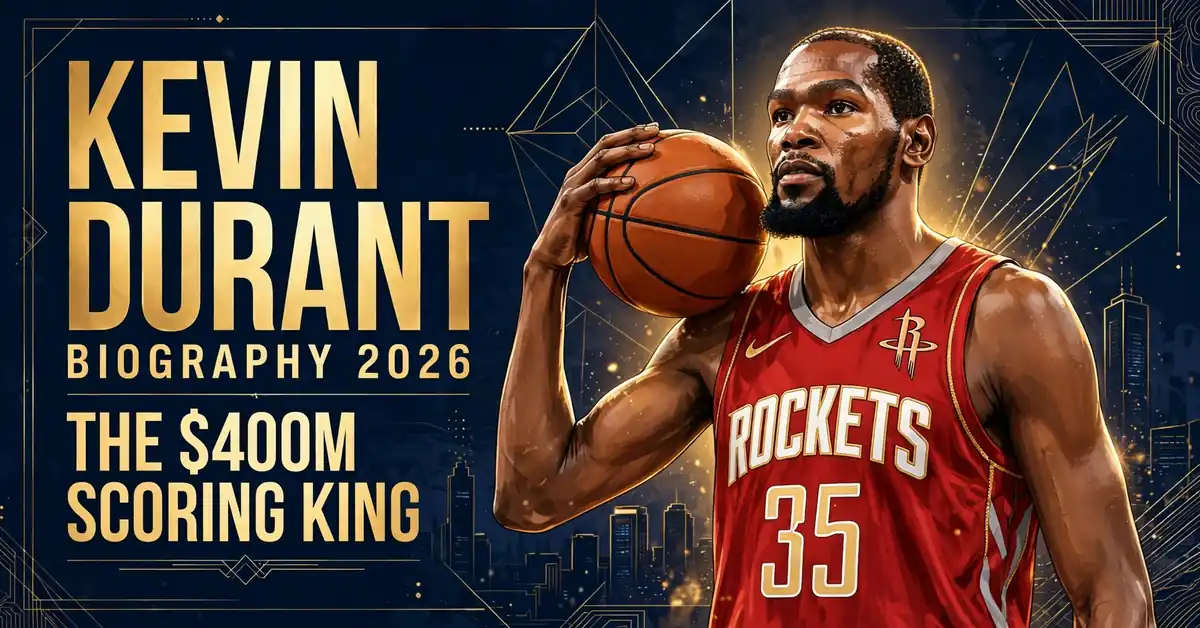
Kevin Durant biography 2026: born September 29, 1988, the 6 ft 11 in Rockets star is a 2x champion, 2014 MVP and 4x Olympic gold medallist with a $400M fortune.
Last updated: November 17, 2026 · By Nathan Cole
Kevin Durant is 38 years old in 2026. Born Kevin Wayne Durant on September 29, 1988, in Washington, D.C., he is the 6 ft 11 in forward for the Houston Rockets who has spent nineteen NBA seasons turning the hardest shot in basketball — a pull-up jumper over a taller defender — into the most reliable one. Two championships, two Finals MVPs, a league MVP, four scoring titles, sixteen All-Star selections, and four Olympic gold medals sit on the record. No other man in Olympic history has won four basketball golds.
The career reads like a map of the modern NBA. Drafted second overall by the Seattle SuperSonics in 2007, he became the face of the Oklahoma City Thunder, lost a Finals to Miami, won an MVP, blew a 3–1 conference finals lead to Golden State, then joined the Warriors and won back-to-back titles. An Achilles rupture in the 2019 Finals cost him a full season. Brooklyn’s superteam collapsed around him. Phoenix’s two seasons produced no playoff series win. In July 2025, at 36, he was traded to Houston — his fifth franchise — and in the 2025–26 season he passed 32,000 career points and climbed to fifth on the NBA’s all-time scoring list.
His net worth in 2026 is estimated at $300 million to $400 million, anchored at $400 million on Celebrity Net Worth’s November 5, 2026 snapshot — a figure that moved up sharply in 2026 as one of his earliest venture bets, the fitness tracker Whoop, reached a $10.1 billion valuation. This biography is current through November 17, 2026. It covers the Washington childhood, the one season at Texas, every franchise in order, the Olympic record, the money in full, and the business portfolio that may one day be worth more than the basketball.
Quick Facts
| Full Name | Kevin Wayne Durant |
| Born | September 29, 1988, Washington, D.C. (age 38 in 2026) |
| Also Known As | KD, The Slim Reaper, Easy Money Sniper |
| Height | 6 ft 11 in (2.11 m); wingspan 7 ft 5 in |
| Parents | Wanda Durant and Wayne Pratt; raised largely by his mother and grandmother Barbara Davis |
| Siblings | Older brother Tony Durant; sisters Brianna and Jasmine |
| Education | National Christian Academy, Oak Hill Academy, Montrose Christian School; University of Texas (2006–07, one season) |
| Occupation | Professional basketball player, small forward / power forward; investor; co-founder of Thirty Five Ventures |
| Current Team | Houston Rockets (No. 7) — traded July 2025 |
| NBA Draft | 2007, 2nd overall pick by the Seattle SuperSonics |
| Career Highlights | 2× NBA champion (2017, 2018); 2× Finals MVP; 2014 NBA MVP; 4× scoring champion; 16× All-Star; 4× Olympic gold (2012, 2016, 2020, 2024) |
| Net Worth (2026) | Estimated $300 million–$400 million; anchor figure $400 million (Celebrity Net Worth, Nov 5, 2026) — see the money section |
| Partner | Never married; engaged to WNBA player Monica Wright in 2013, engagement ended in 2014; no publicly confirmed children |
How This Biography Was Checked
Dates, family details, draft and trade history, and the honours list in this profile come from the public record as reported by Wikipedia, ESPN, and the NBA, cross-checked against each other where they overlap. Season statistics come from StatMuse, FantasyPros, and the Houston Rockets’ own reporting, current through November 16, 2026. Where outlets disagree — most visibly on net worth — this profile names the disagreement and attributes each version to its outlet instead of picking one silently.
Three cautions apply throughout. First, Kevin Durant has never published a balance sheet, so every net-worth figure here is an estimate built from contracts, endorsements, and investments, and the honest answer is a range ($300 million–$400 million), not a point figure. Second, career earnings totals are gross contract values before taxes, agent fees, and living costs; they are not the same thing as net worth. Third, relationship reporting is treated as reported, not confirmed, where Durant himself has not confirmed it publicly.
Figures are updated when new reporting emerges — contact us via the About page if you spot an error.
+
The Short Version: Who Kevin Durant Is
Kevin Wayne Durant is an American professional basketball player for the Houston Rockets, and the purest scorer of his generation. The case for that label is statistical, not rhetorical: he has averaged at least 25 points per game in each of his past seventeen seasons played, a run no active player matches, and he owns four scoring titles, a 50–40–90 season, and a career true-shooting percentage above 60 percent. At 6 ft 11 in with a 7 ft 5 in wingspan, he shoots over defenders who are supposed to be too tall to shoot over, and he handles the ball like a guard who is supposed to be a foot shorter.
The résumé has two halves that rarely sit in the same career. The first is the individual record: 2014 MVP, sixteen All-Star selections, six All-NBA First Team honours, Rookie of the Year in 2008, and a place — fifth, as of the 2025–26 season — on the NBA’s all-time scoring list, behind only LeBron James, Kareem Abdul-Jabbar, Karl Malone, and Kobe Bryant. The second is the team record: two championships with Golden State in 2017 and 2018, both with Finals MVP awards, and four Olympic gold medals with Team USA, a men’s basketball record.
The argument about Durant has never been about whether he can score. It has been about the choices between the scoring. Leaving Oklahoma City for Golden State in 2016 remains the most argued-about free-agency decision of the decade. The Brooklyn superteam that was supposed to define his thirties fell apart in eighteen months. The Phoenix trade cost the Suns four first-round picks and produced no playoff series win. Houston, his fifth franchise, is the latest answer to the question of what a 38-year-old all-time great looks like when the game slows down around him: in 2025–26 he averaged 26.0 points on 52 percent shooting and made All-NBA Second Team at 37, the oldest player ever to score 2,000 points in a season.
Early Life in Washington, D.C.: Wanda, Wayne, and Grandma Barbara
Durant was born on September 29, 1988, in Washington, D.C., and raised in Prince George’s County, Maryland, on the eastern edge of the capital. His mother, Wanda Durant, and his father, Wayne Pratt, separated when Kevin was young, and Wayne was largely absent from his early childhood before reuniting with the family when Kevin was a teenager. Wanda raised Kevin and his siblings — older brother Tony, and sisters Brianna and Jasmine — largely on her own, working multiple jobs, and the family moved often within the county as she chased affordable housing and better schools.
The figure who shaped him most, by his own account, was his grandmother, Barbara Davis. She lived nearby, fed the kids, watched the games, and supplied the steady presence in a household that ran on Wanda’s long hours. When Durant won the MVP award in 2014, the speech that made the ceremony famous was addressed to his mother — “You the real MVP” — but the first person he thanked in the room, and the one whose name he said first, was his grandmother. Barbara Davis died in 2023, and Durant has spoken since about how much of his discipline came from her house rules: homework first, church on Sundays, basketball as a privilege to be earned, not a right.
Wanda’s role in the story is not sentimental decoration. She was the one who drove him to AAU tournaments across the Mid-Atlantic, who negotiated with coaches, and who kept him in school when the recruiting attention started arriving before he could legally drive. The MVP speech is often quoted as a single line, but the passage that matters for this biography is the one before it: Durant describing a mother who woke him up in the middle of the night to do push-ups in the hallway when he came home late, and who told him, at thirteen, that basketball would be his way out only if school came first. The work ethic that later produced seventeen straight 25-point seasons was built in that hallway, not in an NBA weight room.
Prince George’s County in the 1990s and 2000s was one of the most productive basketball nurseries in America — Michael Beasley, Ty Lawson, and Victor Oladipo all came through the same AAU circuits Durant played on — and the competition was the point. Durant was not the biggest kid on those courts at first. He was skinny, quiet, and unusually coordinated for his height, and the coaches who saw him early remember the shooting touch before they remember the size. He grew seven inches during high school, and the frame that arrived late is part of why his game looks the way it does: a guard’s skills stretched onto a center’s body.
High School: Three Schools, Seven Inches, and the AAU Circuit
Durant attended three high schools, and the moves tell you how aggressively he was recruited before he turned eighteen. He started at National Christian Academy in Fort Washington, Maryland, transferred to Oak Hill Academy in Mouth of Wilson, Virginia — the most famous basketball prep school in the country — and finished at Montrose Christian School in Rockville, Maryland. Each move was about competition: better teammates, better opponents, more scouts in the gym. By his senior year at Montrose, he was the consensus second-best prospect in the country, behind only Greg Oden, and the only question in recruiting was which college would get him for the single season the rules would allow.
The AAU years are where the friendships that shaped his career were formed. He played alongside Michael Beasley, a close friend from the Washington youth leagues, and Ty Lawson, the point guard who would later star at North Carolina. The AAU circuit in the Washington area was, in those years, a rolling audition for every major college program in the country, and Durant’s performances there did more for his reputation than any high-school season. Coaches who watched him at fifteen describe the same thing: a kid who could already shoot over anyone, who passed willingly, and who never seemed to be in a hurry.
The height is worth pausing on, because it is the most searched fact about him after his age. Durant is listed at 6 ft 11 in (2.11 m), with a wingspan measured at 7 ft 5 in, and he spent years insisting in interviews that he was 6 ft 9 in — a joke that became a minor media saga before the NBA’s 2019 measurement rules settled it. The full picture of how that height shaped his game, and why the listings disagreed for so long, is covered in our profile of Kevin Durant’s height, and in the CelebAmerica profile of how tall Kevin Durant is. What matters here is the basketball consequence: a player that tall, with that wingspan, who shoots 40 percent from three and 88 percent from the line, has no defensive answer. You cannot block his shot without fouling him, and you cannot leave him open without conceding three points.
He committed to the University of Texas before his senior year, choosing the Longhorns over North Carolina and Connecticut. The decision surprised some recruiters — Texas was a football school with a good basketball program, not a blue blood — but the reasoning was practical. Texas coach Rick Barnes promised him the ball, the freedom to play his game, and a roster built around a single season. Durant took him at his word, and the season that followed is still the standard against which one-and-done freshmen are measured.
One Season at Texas: The Freshman Who Won Everything
Durant played one season at Texas, 2006–07, and it was enough. He averaged 25.8 points and 11.1 rebounds per game, numbers no freshman in a major conference had posted in decades, and he did it while carrying a team that had lost its entire starting five from the year before. Texas finished 25–10 and reached the second round of the NCAA tournament, losing to USC, but the record was beside the point. Every individual award in college basketball went to the same nineteen-year-old: Naismith College Player of the Year, Associated Press Player of the Year, Big 12 Player of the Year, and consensus first-team All-American. He was the first freshman ever to win the Naismith.
The Texas season matters for two reasons beyond the trophies. First, it proved the scoring translated against grown men — Big 12 defenders were older, stronger, and coached to stop him specifically, and he still averaged nearly 26 a game. Second, it established the template for his entire professional career: a team built around one scorer who does everything, surrounded by role players who defend and space the floor. Texas was a Durant team in the same way Oklahoma City would later be a Durant team, and the strengths and the limits of that construction followed him into the NBA.
He declared for the 2007 NBA draft after the season, as everyone expected. The draft had a clear top two: Greg Oden, the 7-foot center from Ohio State, went first to Portland; Durant went second to the Seattle SuperSonics. Portland’s decision is now one of the great what-ifs in draft history — Oden’s knees ended his career within a few seasons, while Durant became a generational scorer — but at the time it was uncontroversial. Centers went first. That was the rule. Durant spent the next nineteen years making the rule look foolish.
Seattle and Oklahoma City: Rookie of the Year to Scoring King
Durant’s rookie season, 2007–08, was played in Seattle for a franchise that already knew it was leaving. The SuperSonics won twenty games, the worst record in franchise history, and Durant averaged 20.3 points a game and won Rookie of the Year on a team with nothing to play for after January. The season is forgotten for good reason — it was a lame-duck year in a lame-duck city — but the number matters: twenty points a game as a nineteen-year-old on a twenty-win team is a foundation, not a fluke, and the front office that moved the team to Oklahoma City that summer knew exactly what it had.
Oklahoma City changed everything. In his second season, 2008–09, Durant raised his average to 25.3 points a game and made his first All-Star team the following year. In 2009–10, at twenty-one, he won his first scoring title at 30.1 points per game, the youngest scoring champion in NBA history at the time, and led the Thunder to fifty wins and a first-round playoff series against the eventual champion Lakers that went six games. He won the scoring title again in 2011 and 2012, and in 2012 he carried Oklahoma City to the NBA Finals, beating Dallas, the Lakers, and San Antonio on the way, before losing to LeBron James and the Miami Heat in five games.
The Thunder years built the core that defined the decade: Durant, Russell Westbrook, and James Harden, three future MVPs on the same roster, all under twenty-five. The front office traded Harden to Houston in October 2012, weeks after the Finals loss, in a cost-saving move that is still argued about in Oklahoma City — Harden won the MVP in Houston six years later. With Harden gone, the Thunder’s ceiling dropped, and the next four years became a story of injuries and near-misses: a foot fracture that cost Durant most of the 2014–15 season, and a 2016 conference finals against Golden State that Oklahoma City led 3–1 before losing three straight games.
The 3–1 collapse is the hinge of Durant’s career. The Thunder were one win from the Finals, at home, against a 73-win Warriors team, and they lost Game 6 in Oklahoma City and Game 7 in Oakland. Durant shot poorly in both games and took the blame publicly. What happened next — his decision, six weeks later, to sign with the very team that had just beaten him — is the subject of the next section, and it is impossible to understand without the collapse. He did not leave a bad team. He left a team that had come within one game of the Finals, because he had decided the gap between that team and a championship was wider than one game.
The Thunder Years: Finals, MVP, and the 3–1 Collapse
The 2013–14 season was Durant’s individual peak in Oklahoma City. He averaged 32.0 points per game and won the scoring title for the fourth time in five years, and in April 2014 he was named NBA Most Valuable Player, beating LeBron James. The MVP speech is the most famous of his career, and the line everyone remembers — “You the real MVP,” addressed to his mother in the front row — has been replayed so often that the rest of the speech is forgotten. The part worth recovering is the opening: Durant thanking his grandmother Barbara Davis first, then his mother, then his teammates, in that order, and describing a childhood in which his mother woke him at night to run drills in the hallway. The speech was not a performance. It was a family history, delivered in public, by a twenty-five-year-old who had just been named the best player in the world.
The season before the MVP, 2012–13, deserves its own line in any careful biography. Durant joined the 50–40–90 club — shooting 50 percent from the field, 40 percent from three, and 90 percent from the free-throw line — one of only a handful of players in history to do it while averaging more than 28 points a game. The club is a shooting-efficiency benchmark, and Durant’s membership in it at twenty-four, as the league’s highest-volume scorer, is the cleanest single statistic for what made him different. Most volume scorers sacrifice efficiency. Durant never did.
The Thunder never got back to the Finals. Westbrook’s knee injuries, Durant’s own foot fracture in 2014–15, and Serge Ibaka’s decline narrowed the window year by year, and the 2016 conference finals against Golden State closed it. Oklahoma City led the series 3–1, won Game 4 at home by twenty-four points, and then lost three straight: Game 5 in Oakland by nine, Game 6 at home by seven after leading by eight in the fourth quarter, and Game 7 in Oakland by eight. Durant shot 10-of-31 in Game 6 and took the blame publicly. In Game 7 he scored 27 points on 10-of-19 shooting — respectable numbers that hid a quiet fourth quarter, in which the Thunder’s offense stalled and the season ended. What happened next — his decision, six weeks later, to sign with the very team that had just beaten him — is the subject of the next section, and it is impossible to understand without the collapse. He did not leave a bad team. He left a team that had come within one game of the Finals, because he had decided the gap between that team and a championship was wider than one game.
He became a free agent that summer. The meeting schedule was public: Oklahoma City first, then Golden State, San Antonio, Boston, the Clippers, and Miami. The decision, announced on July 4, 2016, in a Players’ Tribune essay titled “My Next Chapter,” was Golden State. The reaction was immediate and harsh — “cupcake” became the insult of the year, coined by a fan on social media and adopted by everyone who thought a superstar joining a 73-win team was a betrayal of competition. Durant has never apologized for the move, and he has said more than once that he would make it again. The next section is about what the move produced, because the basketball answer to the criticism is two championships and two Finals MVPs.
Golden State: Two Rings, Two Finals MVPs, and the Decision That Divided the League
Durant signed with the Warriors on July 7, 2016, a two-year deal worth $54.3 million with a player option, and the fit was immediate. Golden State had won 73 games the season before and lost the Finals to Cleveland; adding the league’s most efficient high-volume scorer to a roster that already had Stephen Curry, Klay Thompson, and Draymond Green produced the most talented team of the decade. The Warriors went 67–15 in 2016–17, swept through the Western Conference playoffs 12–0, and beat Cleveland in the Finals in five games. Durant averaged 35.2 points, 8.2 rebounds, and 5.4 assists in the Finals and was named Finals MVP, hitting the go-ahead three over LeBron James in Game 3 that effectively ended the series.
The second title, in 2018, was harder and more revealing. The Warriors trailed Houston 3–2 in the conference finals before winning Games 6 and 7 on the road, then swept Cleveland in the Finals. Durant averaged 28.8 points in the series and won Finals MVP again, becoming one of only a handful of players to win the award in consecutive years. The numbers in those two Finals runs — 35.2 and 28.8 points a game on true-shooting percentages above 65 percent — are the best Finals scoring of any player of his era, and they are the reason the “he needed a superteam” argument has never quite landed. He did not ride the Warriors to titles. He was the best player on the floor in both Finals series.
The third season in Golden State, 2018–19, is where the story turns. The relationship with Draymond Green fractured publicly — a sideline argument in November 2018 that was reported in detail and never fully repaired — and Durant’s free agency hung over the entire season. The Warriors reached the Finals again, against Toronto, and in Game 5, with the series at 3–1 and Golden State’s season on the line, Durant returned from a calf injury he had carried for a month. Eleven minutes into the game, he ruptured his right Achilles tendon. He left the arena on crutches. The Warriors lost the series in six games, and Durant’s Golden State career ended on a hospital table.
The Achilles injury is the single most consequential moment of his career after the 2016 decision. He was thirty years old, at the peak of his powers, and the injury cost him the entire 2019–20 season. Players who rupture an Achilles at thirty do not usually come back the same. Durant did, mostly — he averaged 26.9 points a game in his first season back — but the explosiveness never fully returned, and the injury is the dividing line between the Durant who could beat anyone off the dribble and the Durant who wins with length, touch, and footwork instead. He has said the recovery taught him patience. The record since suggests it taught him something else too: that a career is short, and that the next contract matters more than the last argument.
Brooklyn: The Superteam That Never Was
Durant signed with the Brooklyn Nets on July 7, 2019 — the same day his Golden State exit became official — on a four-year, $164 million contract, and he did it knowing he would miss the entire first season recovering from the Achilles rupture. The plan was announced alongside the signing: he would arrive with Kyrie Irving, and a year later James Harden would join them from Houston, forming a trio that, on paper, was the most talented offensive core ever assembled. The paper version never happened.
The 2020–21 season was the closest the trio came to working. Durant returned in December 2020 and averaged 26.9 points a game, and Harden arrived in January 2021 in a four-team trade. The three played just sixteen games together all season — injuries and Irving’s absences kept them apart — but the playoff run showed what the team could have been. In the Eastern Conference semifinals against Milwaukee, with Harden injured and Irving out, Durant carried Brooklyn to a Game 7 at home. He scored 48 points in 53 minutes, hit a turnaround jumper at the end of regulation that would have won the series, and watched it ruled a two-pointer because his toe was on the three-point line. Brooklyn lost in overtime. The toe-on-the-line shot is now one of the most replayed moments of his career, and the margin — a single inch of shoe leather — is the margin between a championship run and a footnote.
What followed was eighteen months of collapse. Harden asked out in January 2022 and was traded to Philadelphia. Irving’s refusal to comply with New York City’s vaccine mandate kept him off the home court for most of the 2021–22 season. Durant requested a trade in the summer of 2022, then withdrew it after a meeting with ownership, then watched the team start the 2022–23 season badly enough that the front office decided to start over. In February 2023, Brooklyn traded him to Phoenix for Mikal Bridges, Cam Johnson, Jae Crowder, four first-round picks, and a pick swap — one of the largest trade packages ever paid for a single player, and a price that said everything about how the league still valued a thirty-four-year-old Durant. The Brooklyn years produced no conference finals appearance, and the trio of Durant, Irving, and Harden played sixteen games together in total. The full story of the guard who shared that locker room is covered in our profile of James Harden’s net worth and Kyrie Irving’s net worth.
Phoenix: Two Seasons, No Series Win
Phoenix paid the largest price in franchise history for Durant because the Suns believed a scorer of his calibre closed the gap between a good team and a champion. It did not. In his first full season, 2023–24, Durant averaged 27.1 points a game and the Suns won forty-nine games, then were swept in the first round by the Minnesota Timberwolves — four games, no answers, a season over in ten days. The 2024–25 season was worse: Phoenix missed the playoffs entirely despite the league’s most expensive roster, and the head coach, Frank Vogel, was fired after one season.
The Phoenix failure has a specific shape worth naming. Durant played with Devin Booker, one of the league’s best shooting guards, and Bradley Beal, a three-time All-Star, and the three combined for one of the highest-paid trios in NBA history. The problem was everything around them: no point guard, no depth, no defense, and a second apron payroll that made fixing any of it nearly impossible under the new collective bargaining agreement. Durant’s individual numbers held — he shot over 50 percent from the field in both Phoenix seasons — but the team never found a structure that turned three scorers into a contender.
By the spring of 2025, both sides knew the partnership was over. Phoenix shopped him at the trade deadline and again in the summer, and in July 2025 he was traded to Houston as part of a seven-team deal — the largest trade in NBA history by number of teams involved — for Jalen Green, Dillon Brooks, the No. 10 pick in the 2025 draft, and five second-round picks. He left Phoenix having played two and a half seasons, won zero playoff series, and watched the franchise that had mortgaged its future for him start rebuilding the day he left. The Suns kept the bill. Durant kept the scoring average.
Houston: The 2025 Trade and the 2026–27 Season
Houston is Durant’s fifth franchise, and the fit is different from the previous four in a way that matters. The Rockets are young — Amen Thompson, Alperen Şengün, and Jabari Smith Jr. are all under twenty-five — and they traded for Durant not as a final piece but as a finishing school: a veteran scorer who could teach a young core how to close games and, in the meantime, score twenty-six a night himself. The first season, 2025–26, worked better than the Phoenix years. Durant played 78 games and averaged 26.0 points, 5.5 rebounds, and 4.8 assists while shooting 52.0 percent from the field, 41.3 percent from three, and 87.4 percent from the line. On May 24, 2026, he was named to the All-NBA Second Team, and in the course of the season he became the oldest player in NBA history to score 2,000 points in a season, at thirty-seven.
The milestones piled up in 2025–26. Durant moved from eighth to fifth on the NBA’s all-time scoring list, passing Wilt Chamberlain, Dirk Nowitzki, and Michael Jordan in a single season, and he passed career totals of 32,000 points, 8,000 rebounds, and 5,000 assists. He has now averaged at least 25 points a game in each of his past seventeen seasons played — a streak of scoring consistency that no other active player holds, and one that puts the longevity argument to rest. The question about Durant at thirty-eight was never whether he could still score. It was whether his body would let him play enough games to matter, and seventy-eight games in 2025–26 answered it.
The 2026–27 season, his twentieth, is under way as this biography publishes. Through November 16, 2026, Durant has played fifteen games and averaged 21.3 points, 5.5 rebounds, and 3.8 assists, with 320 points scored in total, and the Rockets sit at 11–4 in the Western Conference. On November 12, Houston beat Golden State 115–108, ending the Warriors’ eight-game winning streak — a result that carried its own symbolism, with Durant scoring against the franchise where he won his rings. The scoring average is down from 26.0, as it should be at thirty-eight on a team with younger options, but the efficiency has held: 48.5 percent from the field and a true-shooting percentage above 63 percent through the first month.
His contract runs through the 2027–28 season. The extension he signed with Houston pays him $43,902,439 for 2026–27, with a player option worth $46,097,561 for 2027–28. If he plays through the option year, his projected career NBA earnings reach approximately $598.2 million, according to Celebrity Net Worth — a total that would put him ahead of LeBron James in cumulative on-court salary. The full contract math, and the year-by-year table, is in the money section below.
Team USA: Four Golds and the All-Time Scoring Record
Durant’s international career is the one part of his résumé nobody argues about. He won gold with Team USA at the 2010 FIBA World Championship in Turkey — where he was named tournament MVP at twenty-one — and then won Olympic gold in London 2012, Rio 2016, Tokyo 2020, and Paris 2024. Four Olympic gold medals, the most ever won by a male basketball player, and he did it as the team’s leading scorer in three of the four tournaments.
The record that matters most is the scoring one. At the Tokyo Olympics in 2021, Durant passed Carmelo Anthony to become Team USA’s all-time leading scorer in Olympic play, and he has extended the record at every tournament since. In Paris, at thirty-five, he came off the bench in the opening game against Serbia and scored 23 points in seventeen minutes, shooting 8-for-9 from the field, then scored 15 points in the gold-medal game as the United States beat France 98–87.

The Olympic record reframes the club-career argument. Durant’s critics point to the Golden State move and the Brooklyn collapse; his defenders point to Team USA, where he has never lost a game that mattered, never missed a tournament he was healthy for, and delivered in every gold-medal game he played. The international game, with its shorter three-point line and its emphasis on shooting over athleticism, is built for a 6 ft 11 in shooter, and Durant has exploited that for fourteen years. He is thirty-eight now, and the 2028 Los Angeles Olympics would make him forty. He has not said whether he will try for a fifth gold. The record he already holds — four golds, all-time leading scorer — does not need a fifth to stand.
For readers tracking the numbers across his career, the year-by-year picture of Kevin Durant’s age at each milestone — nineteen at the draft, twenty-one at his first scoring title, twenty-five at the MVP, thirty-five at his fourth Olympic gold — is the fastest way to see how long this run has lasted.
Money: The 300 Million to 400 Million Dollar Estimate, Tested
Kevin Durant’s net worth in 2026 is best stated as a range: $300 million to $400 million, anchored at $400 million. The anchor comes from Celebrity Net Worth’s snapshot of November 5, 2026, which puts him at $400 million. The floor comes from the same publisher’s earlier figure — $300 million, cited by Athlon Sports in January 2026 and EssentiallySports in February 2026 — and the gap between the two is the story of 2026 itself. The full breakdown of the estimate, the salary table, and the investment math behind the move is covered in our profile of Kevin Durant’s net worth. What follows is the short version of why the number moved, and why the range is the honest answer.
The $100 million jump has a name: Whoop. Durant’s investment firm, Thirty Five Ventures, bought into the fitness tracker company early, when it was valued at roughly $125 million. In 2026, Whoop closed a $575 million Series G funding round at a $10.1 billion valuation — an eighty-fold increase on the valuation at which Durant’s firm first invested. Celebrity Net Worth’s April 2026 analysis of the deal estimated Durant’s personal gain from Whoop alone at $85 million to $100 million, after allowing for dilution, his partner’s share, and firm overhead. That single position explains most of the move from $300 million to $400 million, and it is why the older $300 million figure should be read as stale rather than wrong: it was accurate before the Whoop revaluation, and it stopped being accurate the week the Series G closed.
The salary side of the fortune is easier to count, because NBA contracts are public. Durant’s deal history, year by year, is in the table below. The figures are gross contract values from Spotrac and Celebrity Net Worth reporting, and they are the backbone of the estimate — not the whole of it, since endorsements and investments supply the rest, but the part that can be verified to the dollar.
| Season | Team | Salary |
|---|---|---|
| 2016–17 | Golden State Warriors | $26,540,000 |
| 2017–18 | Golden State Warriors | $25,000,000 |
| 2018–19 | Golden State Warriors | $30,000,000 |
| 2019–20 | Brooklyn Nets (injured) | $38,199,000 |
| 2020–21 | Brooklyn Nets | $39,058,950 |
| 2021–22 | Brooklyn Nets | $40,918,900 |
| 2022–23 | Brooklyn / Phoenix | $42,969,841 |
| 2023–24 | Phoenix Suns | $47,649,433 |
| 2024–25 | Phoenix Suns | $51,179,019 |
| 2025–26 | Houston Rockets | $53,282,608 |
| 2026–27 | Houston Rockets | $43,902,439 |
| 2027–28 | Houston Rockets (player option) | $46,097,561 |
The totals tell their own story. Durant’s career NBA earnings through the 2025–26 season stand at roughly $501 million, per EssentiallySports, and his projected career earnings reach approximately $598.2 million if he plays through the 2027–28 player option — a figure Celebrity Net Worth notes would put him ahead of LeBron James in projected cumulative NBA salary. Off the court, Forbes reported in October 2026 that Durant earned $104.9 million in total for the 2026–27 season — $43.9 million in salary plus $61 million off the court — making him the second-highest-paid player in the NBA that season, behind only Stephen Curry. Forbes separately estimated his off-court earnings at roughly $49 million in the twelve months ending in May 2026.
The endorsements behind the off-court number start with Nike. Durant signed a lifetime deal with the brand in 2023 — one of only three active NBA players with a lifetime Nike contract, alongside LeBron James and Michael Jordan — and Athlon Sports reported the deal pays him roughly $26 million a year. The KD signature shoe line, now past its eighteenth model, has been a steady earner since 2008. The rest of the off-court income comes from the investment portfolio, covered in the next section, and from media work through Boardroom. Two cautions belong here. First, the $598.2 million career-earnings projection assumes he exercises the player option and plays the 2027–28 season; if he retires first, the total stops lower. Second, gross salary is not net worth: taxes, agent fees, and two decades of living costs all come out before the remainder becomes wealth. The $400 million anchor already allows for that — it is an estimate of what remains, not a sum of the contracts.
Business: Thirty Five Ventures, Boardroom, and the Whoop Bet
Durant co-founded Thirty Five Ventures — 35V — in 2016 with his business partner and agent Rich Kleiman, and the firm has become the second half of his public identity. The name comes from his jersey number in Oklahoma City and Golden State, and the premise was simple: an athlete’s peak earning years are short, and the money should be put to work while the cheques are still arriving. 35V invests in early-stage technology and consumer companies, produces media through its Boardroom arm, and manages Durant’s endorsement portfolio as a business rather than a series of one-off deals.
Boardroom, launched in 2019, is the media company inside the firm — a sports business outlet that covers contracts, investments, and the economics of athletes with the same seriousness a trade paper covers its industry. Durant is not a silent partner in it. He appears on its shows, writes for it, and uses it to explain his own decisions, including the Golden State move, in long-form interviews that run an hour rather than a soundbite. The company has become a credential in its own right: when Durant talks about money now, he is quoted as a media owner and investor, not just as a player with opinions.
The investment portfolio is where the fortune’s next chapter sits. Whoop is the headline: 35V invested when the fitness tracker company was valued at about $125 million, and the 2026 Series G round valued it at $10.1 billion. The firm’s early positions in Coinbase and Robinhood, both bought before either company went public, are the other two names that recur in reporting on 35V, and the pattern across all three is the same — early, small cheques into companies whose valuations multiplied by orders of magnitude. Celebrity Net Worth’s April 2026 analysis of the Whoop position concluded that Durant’s personal gain from that one company sits at roughly $85 million to $100 million, and added that his net worth “may soon prove to be extremely conservative” as more of the portfolio’s valuations become public. The same analysis raised the possibility that he is on pace to become a billionaire — a claim this profile records as a projection, not a fact, because the underlying holdings are private and their values are estimates.
What the business record proves, even without a billionaire headline, is a different kind of discipline from the one on the court. Durant’s first big contract paid him $4 million a year as a rookie. He did not start a venture firm until his tenth season, and he did it with a partner he had worked with for years rather than a rotating cast of advisers. The Whoop return took nine years to arrive. The through-line is patience — the same quality his grandmother’s household rules were designed to teach, applied to money instead of basketball.
Personal Life: Family, Monica Wright, and Privacy
Durant has never married, and he has no publicly confirmed children. The one relationship he has confirmed at length is with Monica Wright, the WNBA guard. The two were engaged in 2013, and the engagement ended in 2014; Durant has spoken about it once, briefly, in interviews since, and has said the split came down to timing and the demands of two professional basketball careers. Since then, he has kept his romantic life private, and the reporting that does exist is speculative rather than confirmed. This profile records the engagement because it is a matter of public record, and it leaves the rest alone because there is nothing confirmed to record.
The family that matters publicly is the one he grew up in. His mother, Wanda Durant — “Mama Durant” to the basketball world — remains his closest adviser and most visible family member, appearing at his games and in his business announcements. His father, Wayne Pratt, who returned to the family when Kevin was a teenager, has kept a lower profile. His older brother Tony played college basketball and has worked in player development. His grandmother Barbara Davis, who died in 2023, is the person he credits most often for the discipline that carried him through nineteen NBA seasons.
Off the court, Durant is known for two things that rarely appear in the highlight reels. The first is his philanthropy, most of it quiet: he donated $1 million to the Red Cross for tornado relief in Oklahoma in 2013, funded a basketball court renovation in his hometown area of Seat Pleasant, Maryland, and gave $3 million to the University of Texas in 2017 for its basketball facilities and academic programs. The second is his online presence, which is the opposite of quiet — he is famously active on social media under his own name and under burner accounts, arguing with fans and critics directly, and he has never shown any interest in the polished, media-trained persona most stars adopt. The candour is part of the appeal and part of the risk: the same directness that produced the “You the real MVP” speech also produced the Golden State announcement, and Durant has never shown regret for either.
He lives in Houston now, in the city where his fifth franchise plays, and at thirty-eight he is closer to the end of his career than the beginning. What comes after basketball is already partly built: the venture firm, the media company, the Nike lifetime deal, and a portfolio that may be worth more than the contracts that funded it. The biography, for now, ends where the career does — on a court, in a Rockets jersey, averaging twenty-one points a game in his twentieth season, still the purest shooter of his generation.
Frequently Asked Questions
How old is Kevin Durant in 2026?
Kevin Durant is 38 years old in 2026. He was born Kevin Wayne Durant on September 29, 1988, in Washington, D.C., and he turned 38 on September 29, 2026, during his twentieth NBA season with the Houston Rockets.
What is Kevin Durant’s real name?
Kevin Durant’s real name is Kevin Wayne Durant. He is known by his initials KD, and by the nicknames “The Slim Reaper” and “Easy Money Sniper.” He was born in Washington, D.C., and raised in Prince George’s County, Maryland, by his mother Wanda Durant and his grandmother Barbara Davis.
How tall is Kevin Durant?
Kevin Durant is 6 ft 11 in (2.11 m) tall, with a wingspan measured at 7 ft 5 in. He spent years saying he was 6 ft 9 in in interviews before the NBA’s 2019 measurement rules settled the listing at 6 ft 11 in.
What is Kevin Durant’s net worth in 2026?
Kevin Durant’s net worth in 2026 is estimated at $300 million to $400 million, anchored at $400 million on Celebrity Net Worth’s November 5, 2026 snapshot. The older $300 million figure reflects the estimate before his early investment in Whoop was revalued at $10.1 billion in 2026. His projected career NBA earnings reach about $598.2 million if he plays through his 2027–28 player option.
How many championships does Kevin Durant have?
Kevin Durant has two NBA championships, both with the Golden State Warriors in 2017 and 2018. He was named Finals MVP in both series, averaging 35.2 points per game in the 2017 Finals against Cleveland.
What team does Kevin Durant play for in 2026?
Kevin Durant plays for the Houston Rockets in 2026. He was traded from the Phoenix Suns to Houston in July 2025 as part of a seven-team deal, and he signed a two-year, $90 million extension with the Rockets covering the 2026–27 and 2027–28 seasons.
Is Kevin Durant married?
No, Kevin Durant has never married. He was engaged to WNBA player Monica Wright in 2013, and the engagement ended in 2014. He has no publicly confirmed children and keeps his romantic life private.
How many Olympic gold medals does Kevin Durant have?
Kevin Durant has four Olympic gold medals — London 2012, Rio 2016, Tokyo 2020, and Paris 2024 — the most ever won by a male basketball player. He is also Team USA’s all-time leading scorer in Olympic play, a record he set at the Tokyo Games in 2021.
Sources & Reporting
This profile was researched on November 17, 2026, from live search results and the outlets named throughout: Wikipedia and ESPN for the birth date (September 29, 1988, Washington, D.C.), family details, draft and trade history, and the honours list; RetroSeasons and TheAthleteWiki for the career timeline and the 7 ft 5 in wingspan; MrNussbaum and Fandango for the high-school years and the AAU circuit; StatMuse, FantasyPros, and the Houston Rockets’ reporting (via thehrr.com, May 24, 2026) for the 2025–26 season (78 games, 26.0 points per game, All-NBA Second Team, oldest player to score 2,000 points in a season, eighth to fifth on the all-time scoring list) and the 2026–27 season through November 16, 2026 (15 games, 21.3 points per game, 320 points, Rockets 11–4); Celebrity Net Worth for the $400 million estimate (snapshot November 5, 2026) and the Whoop analysis (April 9, 2026); Athlon Sports (January 17, 2026) and EssentiallySports (February 22, 2026) for the earlier $300 million figure and the contract table; and Forbes (October 2026) for the $104.9 million total earnings figure and the $49 million off-court estimate.
Where outlets disagree — on net worth, on the $300 million versus $400 million figures, and on the status of reported relationships — this profile names the disagreement and attributes each figure to its outlet rather than picking a winner silently. No figure in this article comes from an anonymous “sources say” claim, and no fact has been added that the cited reporting does not support. Corrections policy: figures are updated when new reporting emerges — contact us via the About page if you spot an error.
WRITTEN BY
Nathan Cole
Nathan Cole is the editor of Guide Net Worth. He covers celebrity wealth the way a business desk covers earnings: reported figures first, estimates labeled as estimates, and no invented numbers. Every profile on this site passes through his desk before it publishes. About Guide Net Worth · Corrections: figures are updated when new reporting emerges — contact us via the About page if you spot an error.
References & Sources
This article has been fact-checked and verified against multiple public sources, financial disclosures, SEC filings, Forbes reports, Celebrity Net Worth databases, and official records. All net worth estimates are based on publicly available information and financial analysis.