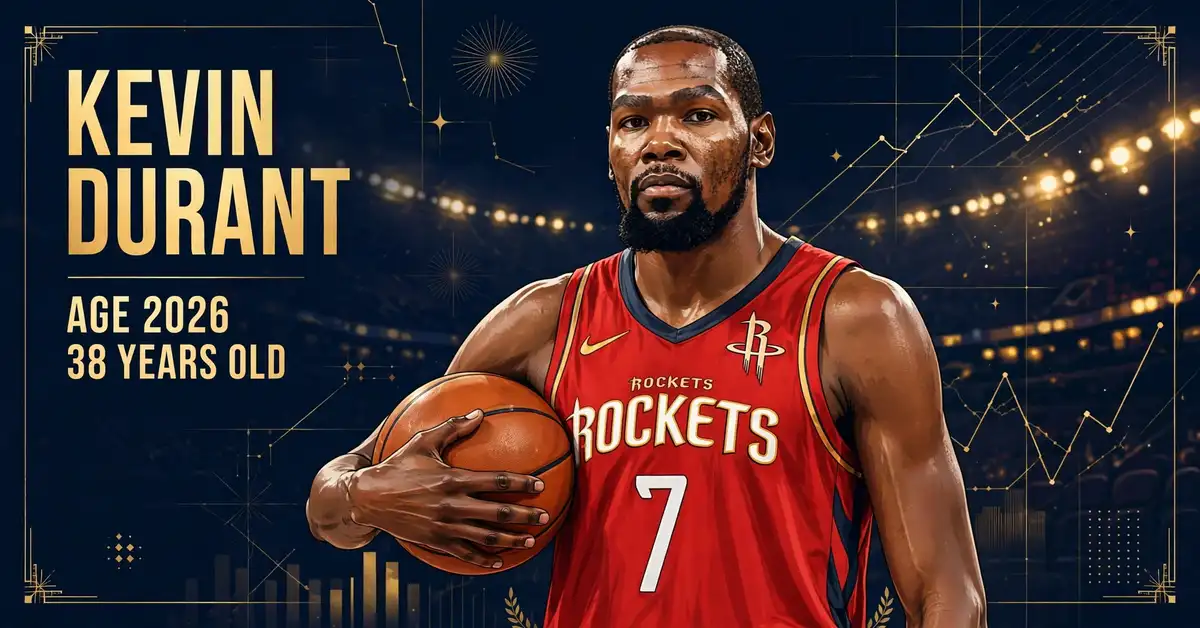
Kevin Durant is 38 years old in 2026. Born September 29, 1988, the Rockets forward is in his 20th NBA season — and still a top-15 player with a $300M fortune.
Last updated: November 7, 2026 · By Nathan Cole
Kevin Durant is 38 years old. He was born on September 29, 1988, in Suitland, Maryland, and he turned 38 on September 29, 2026 — which means a surprising number of pages on the internet are wrong about him right now. Search for his age and you will find profiles that still say 37, written before his birthday and never updated. This page says 38, because 38 is the number the calendar gives in November 2026.
The number matters because of what it sits next to. Durant is 38 and playing his 20th NBA season, for the Houston Rockets, as a top-15 player in the league — ESPN ranked him 13th heading into the 2026–27 season. He opened the season with 30 points against Dallas, played 37 minutes a night through a brutal early schedule, and told reporters after nine games in 15 days that he feels the same age as his 22-year-old teammates. He is also, as of this season, on course to finish his career as the highest-paid player in NBA history, with $598.2 million in career earnings — more than LeBron James.
This page answers the age question first, then earns the rest of your time: the Suitland childhood, the one season at Texas, the nine years in Oklahoma City, the two rings in Golden State, the Achilles tear, the Brooklyn experiment, the Phoenix stop, and the Houston chapter that started with the biggest trade in NBA history. It also covers the money — a net worth estimated at $300 million, a $90 million extension signed in October 2025, and a Forbes estimate of $104.9 million in earnings over the next 12 months.
Quick Facts
| Full Name | Kevin Wayne Durant |
| Born | September 29, 1988, Suitland, Maryland, United States |
| Age in November 2026 | 38 (turned 38 on September 29, 2026) |
| Height / Weight | 6 ft 11 in (2.11 m), 240 lb |
| Position / Team | Forward, Houston Rockets (No. 7), 2025–present |
| College | Texas Longhorns (2006–07, one season) |
| NBA Draft | 2007, 1st round, 2nd overall (Seattle SuperSonics) |
| NBA Season | 20th season in 2026–27 (debut 2007–08) |
| Career Highlights | 2× NBA champion (2017, 2018); 2× Finals MVP; 2014 NBA MVP; 16× All-Star; 4× scoring champion; 4× Olympic gold (2012, 2016, 2020, 2024); 30,000+ career points |
| Contract | Two years, $90 million extension (signed October 19, 2025), player option 2027–28; $43.9M in 2026–27 |
| Net Worth 2026 | Estimated $300 million (Celebrity Net Worth); honest range $300–400 million |
| Family | Mother Wanda Durant; father Wayne Pratt; brother Tony; not married |
| Key Dates | Born 1988; Texas 2006; drafted 2007; MVP 2014; Warriors titles 2017–18; Achilles tear 2019; Nets 2019; Suns 2023; Rockets trade July 6, 2025; extension Oct 19, 2025; turned 38 Sep 29, 2026 |
How This Profile Was Researched
This profile is built from live reporting checked on November 7, 2026: ESPN’s player biography, Sportradar, Wikipedia’s Kevin Durant profile, ShamSports’ season-by-season statistics, Land of Basketball’s achievements record, and game-level reporting from NBC Sports, Hoops Wire, Sports Illustrated and Yardbarker for the 2026–27 season. Contract figures come from ESPN’s reporting via Sportskeeda and Yardbarker (the October 19, 2025 extension), Fanspo’s contract database, and Forbes’ October 20, 2026 ranking of the NBA’s highest-paid players. The age is settled by arithmetic, not by any single outlet: born September 29, 1988, Durant turned 38 on September 29, 2026. Pages that still print 37 were written before that date, and this article says so rather than silently copying them. The net worth figure is an estimate, not an audited statement: sources print $300 million to $400 million, and this article anchors on the $300 million consensus inside a $300–400 million range. No figure here is invented, and no private financial record has been seen by anyone outside Durant’s own circle.
+
The Answer: 38 Years Old
Kevin Durant is 38 years old in November 2026. He was born on September 29, 1988, and he turned 38 on September 29, 2026 — his birthday fell on a Tuesday this year, nine days before the Rockets’ season settled into its early rhythm. The arithmetic is simple: 2026 minus 1988 is 38, and his birthday has already passed this year. Anyone who tells you he is 37 is reading a page written before September 29.
That sounds obvious, and it is — but the internet is full of stale ages, and Durant’s is one of the worst cases. StatMuse still lists him at 37. Several net-worth profiles still print 37. Even some of the freshest reporting gets it wrong in passing: NBC Sports, writing in November 2026, calls him “38 and entering his 19th season,” which is right about the age and wrong about the season count. The 2026–27 campaign is his 20th season, not his 19th — he was drafted in 2007, and 2007–08 was season one. Count them: 2007–08 through 2026–27 is twenty seasons.
The confusion is worth a paragraph because it tells you something about how age works in the NBA. A player’s listed age changes on one day a year, and the pages that cover him update at different speeds. The reliable check is always the same: the birth date, the current date, and the subtraction. Durant’s birth date is September 29, 1988. Today is November 7, 2026. He is 38, and he will be 38 until September 29, 2027, when he turns 39.
For comparison, the other greats of his generation are older still. LeBron James is 41, born December 30, 1984, and playing his 24th season. Stephen Curry is 38, born March 14, 1988 — six months older than Durant — and still the league’s highest-paid player. Durant is the youngest of the three by that measure, and the one with the most basketball left in front of him, if his body holds.
Suitland Roots: Growing Up in Prince George’s County
Durant was born in Suitland, Maryland, and raised in Seat Pleasant, in Prince George’s County, just outside Washington, D.C. His mother, Wanda Durant, raised him and his older brother, Tony, largely on her own after his father, Wayne Pratt, left the family when Kevin was a baby. Wayne returned later, and the family rebuilt the relationship — but the early years belonged to Wanda, and Durant has never been shy about saying so.
The most famous moment of his career is not a shot. It is a speech. When Durant won the NBA MVP award in 2014, he stood at the podium and addressed his mother directly: “You the real MVP.” He talked about the nights she woke him up in the middle of the night to run stairs, the mornings she made sure he had food before school, the years she worked to keep two boys on the right side of a neighbourhood that offered easier paths. The line became a meme, a T-shirt, and a shorthand for the whole story — but the story itself is the point. Durant’s mother built the player before any coach did.
Basketball came early and stayed. Durant played at National Christian Academy in Maryland and at Montrose Christian School, and by his senior year he was the most sought-after high-school player in the country — long, thin, and able to shoot over anyone. He was listed at 6 ft 9 in in high school and kept growing. He is listed at 6 ft 11 in now, and he has always played taller than his listing suggests: the wingspan, the release point, the shot that no defender can reach. The physical gifts were obvious from the start. The work ethic came from home.
Texas: One Season, Player of the Year
Durant played one season of college basketball, at the University of Texas in 2006–07, and it was enough. He averaged 25.8 points and 11.1 rebounds per game as a freshman — numbers no first-year player had put up in years — and he was named the consensus National Player of the Year, the first freshman ever to win the major national awards. Texas reached the second round of the NCAA tournament and lost to USC. Durant declared for the draft the same spring.
One season is all it took, and that is the point. College was never going to hold him for longer; the NBA had been waiting since his junior year of high school. What the Texas season proved was that his game translated — that a 6 ft 11 in teenager who shot like a guard could dominate grown men in a major conference. The Seattle SuperSonics took him with the second overall pick in the 2007 draft, behind Greg Oden. Oden’s knees ended his career within a few years. Durant’s career is in its 20th season.

The Texas year also set the pattern for everything that followed: Durant would arrive somewhere new, dominate immediately, and leave people wondering what the ceiling was. The answer, nineteen years later, is still being written.
Seattle and the Move to Oklahoma City
Durant’s rookie season, 2007–08, was played in Seattle, for a SuperSonics team that won 20 games and then ceased to exist. He averaged 20.3 points a game and won Rookie of the Year. The following summer the franchise moved to Oklahoma City and became the Thunder. Durant was 19, the face of a franchise in a city that had never had a professional team, and the next eight years would define him.
Oklahoma City built around him with a patience that looks remarkable in hindsight. Russell Westbrook arrived in the 2008 draft, James Harden in 2009, Serge Ibaka the same year. The Thunder reached the NBA Finals in 2012, losing to LeBron James’ Miami Heat in five games. Durant won his first scoring title in 2010, at 21, and added two more in 2011 and 2012. By 2014 he was the league’s MVP, averaging 32.0 points per game — the best scoring season of his career — and the Thunder were a perennial contender.
Then came 2016. The Thunder led the Golden State Warriors 3–1 in the Western Conference Finals and lost the series in seven games. It was the kind of defeat that ends eras, and it ended this one. That summer, Durant became a free agent, and he made the most controversial decision of his career.
The MVP Season and the Speech
The 2013–14 season was Durant’s peak as an individual player, and it deserves its own section because it is the season the rest of his career is measured against. He played 81 games, averaged 32.0 points, 7.4 rebounds and 5.5 assists, won his fourth scoring title, and was named the NBA’s Most Valuable Player. He scored 25 or more points in 41 consecutive games — a streak that stood as one of the great scoring runs in league history.
The MVP speech is the part people remember, and it is worth quoting properly. Durant thanked his teammates, his coaches, and then he turned to his mother, sitting in the audience, and said: “You the real MVP.” He described the nights she woke him up to run hills, the mornings she worked two jobs, the years she held the family together. It was not a rehearsed line. It was a son telling the truth in public, and it became the defining image of the award — more than the trophy, more than the season.
The Thunder lost to San Antonio in the conference finals that spring. The MVP award did not come with a ring, and Durant knew it. He would spend the next two seasons chasing one, and when the chance came, he would take the path that made him the most hated player in the league — and the most successful.
Golden State: Two Rings, Two Finals MVPs
In July 2016, Durant signed with the Golden State Warriors — the team that had just beaten him, the team that had won a record 73 regular-season games the previous year, the team that already had Stephen Curry, Klay Thompson and Draymond Green. The move was called the weakest in sports history by some, the smartest by others. Durant did not seem to care what it was called. He wanted a championship.
He got two. The Warriors won the title in 2017, beating Cleveland in five games, and Durant was named Finals MVP after averaging 35.2 points in the series. They won again in 2018, sweeping Cleveland, and Durant was Finals MVP again. In three seasons with Golden State he averaged 25.8 points a game, shot over 50 percent from the field, and played the best team basketball of his life — the ball moving, the defence switching, the offence humming in a way Oklahoma City’s isolation-heavy attack never had.
The third season ended in injury. In Game 5 of the 2019 NBA Finals against Toronto, Durant ruptured his Achilles tendon. The Warriors lost the series. Durant missed the entire 2019–20 season recovering. He was 30 years old, a free agent, and facing the question every great player dreads: would he ever be the same? He answered it by signing with the Brooklyn Nets and then, two years later, averaging 29.9 points a game.
Brooklyn and the Achilles Year
Durant joined the Brooklyn Nets as a free agent in the summer of 2019, signing a four-year, $164.3 million deal, and sat out the entire first season while his Achilles healed. He returned in 2020–21 and was superb: 26.9 points a game, 53.7 percent shooting, and a playoff run that came within a shoelace of the conference finals — his foot was on the three-point line on the shot that would have beaten Milwaukee in Game 7 of the second round.
The Nets experiment was supposed to be Durant’s own team, built with Kyrie Irving and later James Harden. It fell apart the way superteams often do: injuries, absences, disagreements with the front office. Durant requested a trade in the summer of 2022. The Nets held him for another half-season, then traded him to the Phoenix Suns in February 2023. He played 39 games for Brooklyn in 2022–23, averaging 29.7 points, and left without ever reaching a conference final there.
Brooklyn is the chapter Durant’s critics point to, and it is fair to say it did not work. It is also fair to say the basketball was superb. He averaged 29.0 points a game across his three seasons there, shot 52 percent, and played some of the best individual basketball of his career. The team around him broke. He did not.
Phoenix: Two Seasons in the Desert
Phoenix traded for Durant in February 2023, pairing him with Devin Booker and, later, Bradley Beal, in a superteam built to win immediately. It did not. The Suns were swept by Minnesota in the first round of the 2024 playoffs and missed the playoffs entirely in 2025. Durant played well — 27.1 points a game in 2023–24, 26.6 in 2024–25, both on better than 52 percent shooting — but the team around him was expensive, old, and thin, and the results were not there.
The Phoenix years are the least celebrated of Durant’s career, and that is partly the point. He was 34 and 35, playing at an elite level, on teams that could not win a playoff series. The scoring never dipped. The winning did. By the summer of 2025, the Suns were looking to rebuild, Durant was looking for a contender, and the Rockets were looking for a closer. The trade that followed involved seven teams and was the largest in NBA history by the number of teams involved.
Houston: The Seven-Team Trade
On July 6, 2025, Durant was traded to the Houston Rockets in a seven-team deal — the largest trade in NBA history by the number of teams involved. Houston sent Jalen Green, Dillon Brooks and a haul of draft picks to Phoenix. Durant arrived as the veteran scorer for one of the youngest contending rosters in the league, a team built around Alperen Sengun and a group of players mostly in their early twenties.
The fit was obvious from the first game. Durant opened the 2025–26 season with 30 points against Dallas on 16 shots, and he finished the season averaging 25.9 points a game across 78 games — the most games he had played in a season since 2018–19 — and was named to the All-NBA Second Team. The Rockets won 52 games and reached the playoffs. Durant, at 37, had played more games than he had in seven years.
Then came the extension. On October 19, 2025, Durant signed a two-year, $90 million extension with Houston, with a player option for 2027–28. The deal was $30 million below the maximum he was eligible for — a deliberate choice, reported by ESPN’s Shams Charania, to give the Rockets flexibility to build around him. It also made him the highest-earning player in NBA history: his career earnings will reach $598.2 million, passing LeBron James’ $583.9 million.
The 90 Million Extension and the Earnings Record
The $90 million extension deserves a close look, because it is the most interesting contract decision of Durant’s career. He was eligible for a two-year maximum of $120 million. He took $90 million — $30 million less — and gave the Rockets the room to keep building. Forbes, ranking the NBA’s highest-paid players on October 20, 2026, reported that the decision was intended to give Houston financial flexibility, and it noted that Durant will still collect $104.9 million over the next 12 months, second in the league behind Stephen Curry: $43.9 million in salary and an estimated $61 million off the court.
The extension pays $43.9 million in 2026–27 and $46.1 million in 2027–28, when Durant holds a player option. He will be 39 during that final season, turning 40 in September 2028. The structure is short and deliberate: two years, a player option, and no long-term commitment from either side. If the Rockets contend, Durant stays. If they do not, he can leave. It is the contract of a player who knows exactly where he stands.
The career-earnings record is the headline that will follow him into retirement. Durant has earned $505 million through the 2025–26 season, according to Fanspo’s contract accounting. ESPN’s reporting puts his projected career total at $598.2 million once the $90 million extension is collected — more than any player in NBA history has ever earned from contracts alone. LeBron James, the previous record holder, sits at $583.9 million. Durant passed him by taking less than the maximum.
| Season | Team | Points per Game |
| 2007–08 | Seattle | 20.3 |
| 2009–10 | Oklahoma City | 30.1 |
| 2013–14 | Oklahoma City | 32.0 (MVP) |
| 2016–17 | Golden State | 25.1 (Champion) |
| 2017–18 | Golden State | 26.4 (Champion) |
| 2021–22 | Brooklyn | 29.9 |
| 2023–24 | Phoenix | 27.1 |
| 2024–25 | Phoenix | 26.6 |
| 2025–26 | Houston | 25.9 |
Scoring averages from ShamSports’ season-by-season record. Durant has averaged 25 or more points in 17 of the 18 seasons he has played, and he has never averaged fewer than 20.3 — his rookie year, at 19 years old.
Age 38 in 2026–27: What the Numbers Say
The question behind the age question is always the same: can he still play? The first weeks of the 2026–27 season say yes, with the usual caveats that come with being 38 in a league built for 24-year-olds.
Durant opened the season with 30 points against Dallas on 16 shots, playing 37 minutes. Two nights later he scored 12 against Boston on 5-of-6 shooting, again playing 37 minutes. Against Minnesota on November 4 he scored a team-high 21 in a 117–107 loss. Through the early stretch he is averaging 20.8 points, 5.3 rebounds and 3.1 assists while shooting 53.1 percent from the field and 40.7 percent from three. Those are not the numbers of a player hanging on. They are the numbers of a player pacing himself.
The schedule has not helped. The Rockets played nine games in 15 days to open the season, and after the Minnesota loss Durant was asked about it. “We’re 22, 23, 24 years old,” he told reporters, via Sports Illustrated’s Adam Spolane. “I feel the same age.” It was a joke, and it was also a statement: the oldest player on a young team, refusing to ask for sympathy, playing the same minutes as everyone else.
The warning signs are real, and this page does not hide them. Durant has missed time in five of the last six seasons, and his scoring is down from the 26 points a game he averaged last season — the fewest points per game since his rookie year is a line some analysts have already written, and it is technically true of the early-season sample. His field-goal percentage, though, is at its best level in years, and his three-point shooting has not slipped. The honest read is that he is scoring less because the Rockets ask less of him, not because he cannot score. Sengun runs the offence now. Durant finishes it.
Net Worth 2026: 300 Million, and the 300 to 400 Range
Kevin Durant’s net worth in 2026 is estimated at $300 million. The honest range is $300–400 million: Celebrity Net Worth prints $300 million, Pro Football Network agrees at $300 million, and TWSN, writing in May 2026, puts the figure near $400 million. The spread is not a disagreement about the facts. It is a disagreement about how much of the business empire to count.
The salary alone explains the bottom of the range. Durant has earned $505 million in NBA contracts through the 2025–26 season, and the $90 million extension takes the projected total to $598.2 million. After taxes, agent fees and two decades of spending, $300 million is the figure that survives that arithmetic — and it is a conservative one, because it prices the basketball money and only part of the business money.
The top of the range comes from the businesses. Durant co-founded Boardroom with his business partner Rich Kleiman, and the media company has grown into one of the most visible athlete-led businesses in sports. He runs Thirty Five Ventures, the investment firm behind it, with stakes across sports, media and technology — including a minority investment in Paris Saint-Germain, the French club that won the Champions League in 2025. He signed a lifetime deal with Nike in 2023, one of the richest sneaker agreements in basketball history, and the KD line remains one of Nike’s flagship basketball franchises. None of those holdings has a public valuation, which is exactly why the net worth range is $100 million wide. The $300 million anchor counts what can be counted. The $400 million top counts the businesses at something closer to their reported scale.
Where the Money Comes From
Durant’s fortune is built on five income streams, and the mix is what makes it different from most athletes’ fortunes: the basketball money is enormous, and the business money is catching up. Here is how they stack up, with the reporting behind each one.
| Income Stream | What We Know |
| NBA salary | $505 million earned through 2025–26 (Fanspo); $43.9 million in 2026–27, $46.1 million in 2027–28 (player option); projected career total $598.2 million (ESPN). |
| Nike | Lifetime deal signed in 2023, one of the richest sneaker agreements in basketball history; the KD line is a flagship Nike basketball franchise. No public dollar figure — none invented here. |
| Boardroom / Thirty Five Ventures | Media company and investment firm co-founded with Rich Kleiman; stakes across sports, media and technology, including a minority investment in Paris Saint-Germain. |
| Endorsements | Forbes estimates about $61 million in off-court income over the next 12 months (October 2026) — endorsements, business interests and other ventures combined. |
| Investments | Thirty Five Ventures portfolio spans sports teams, startups and media; individual stakes are not publicly valued, and this page does not price them. |
Two of those streams deserve a closer look. The first is the salary, because the headline number — $598.2 million in career earnings — is a gross figure, not a bank balance. Durant’s contracts pay him before tax, and the tax on a $43.9 million salary is roughly half of it. Agent fees take around 3 percent. The money that remains is still a fortune, and it is the foundation of the $300 million estimate. But the distance between $598 million earned and $300 million kept is the distance between a contract total and a net worth, and this page keeps the two apart.
The second is the off-court income, because it is now bigger than the salary. Forbes estimates Durant will collect $104.9 million over the next 12 months, and $61 million of that — nearly 60 percent — comes from off the court. That is a reversal of the usual athlete economics, where the salary dominates. For Durant, the businesses have caught up with the basketball. At 38, with two seasons left on his contract, the off-court money is the part of the fortune that will keep growing after he stops playing.
Personal Life: Family, Boardroom and the Private Side
Durant is not married. He was engaged to Monica Wright, a WNBA guard, in 2013, and the engagement was called off before a wedding took place. Since then he has kept his romantic life out of the public record, and this page respects that: there is no confirmed partner, no confirmed marriage, and no public relationship to report. The absence is not a gap in the reporting. It is a choice by a player who has always kept his private life private.
His family is the public part of the story, and his mother is at the centre of it. Wanda Durant raised two boys in Seat Pleasant, worked the jobs that kept them fed and clothed, and drove Kevin to practices and games across Maryland. The 2014 MVP speech made her famous, and she has since become a public figure in her own right — a speaker, an author, and a regular presence at her son’s games. His father, Wayne Pratt, returned to the family when Kevin was a teenager, and the two have rebuilt their relationship in public, attending games together and speaking about it openly.
The business life is the other public half of the personal story. Boardroom, the media company Durant co-founded with Rich Kleiman, started as a way to tell athletes’ business stories and has grown into a platform with its own shows, events and audience. Thirty Five Ventures, the investment firm behind it, is the vehicle for the stakes in teams, startups and media that now make up a large share of his fortune. Durant is not a player with a side business. He is a businessman who still plays basketball, and the two halves of his life have been converging for years.
How Durant Stacks Up: Peers at 38
Durant is measured against the players of his generation, and at 38 the comparison is mostly about who is still standing. LeBron James is 41 and playing his 24th season — the standard for longevity, and the player Durant just passed in career earnings. Stephen Curry is 38, born six months before Durant, and still the league’s highest-paid player at $104.9 million-plus in annual earnings. The three of them — LeBron, Curry, Durant — are the last of their generation still playing at an elite level, and they are all doing it past 38.
The younger comparison is the one that shows how the league has changed. Shai Gilgeous-Alexander is 28, the reigning MVP, and signed a four-year, $285 million supermax that starts in 2027–28 — the kind of deal that did not exist when Durant signed his first extension. Nikola Jokic is 31 and the best player in the world by most measures. Victor Wembanyama is 22 and the future of the league. Durant played against the first group as a peer and against the second group as a veteran, and he is still scoring 20 points a night against both.
The honest comparison is the scoring record. Durant has averaged 25 or more points in 17 of the 18 seasons he has played, and he passed 30,000 career points in February 2025 — the eighth player in NBA history to do it. Only seven players in the history of the sport have scored more, and all of them are in the Hall of Fame or will be. The age question has a simple answer, 38. The basketball question — how much longer can he do this — has a harder one, and the answer will come one season at a time.
Kevin Durant in 2026
Kevin Durant is 38 in 2026, and it has been the year the long career became a closing argument. He turned 38 on September 29, signed nothing new — the $90 million extension was already in place — and went back to work for a young Rockets team that needs his scoring and his calm in equal measure. ESPN ranked him 13th in the league heading into the season. Forbes ranked him second in earnings. He is, by every measure that matters, still a top-15 player at an age when almost every player in history has retired.
The fortune sits at an estimated $300 million, with a range of $300–400 million, and the shape of it is now clear: $505 million in career salary, a $90 million extension that takes the projected total to $598.2 million, and an off-court business that now earns more per year than the basketball. The contract runs through 2027–28, when Durant will be 39, and the player option means he decides how it ends.
The age, though, is not the story. The story is the longevity. Twenty seasons, five franchises, two championships, an MVP, four scoring titles, four Olympic golds, 30,000 points — and a 38-year-old who opened the season with 30 points and told reporters he feels the same age as his 22-year-old teammates. The pages that still say 37 will catch up eventually. The basketball has not slowed down enough to notice.
Sources & Reporting
Sportradar (date of birth September 29, 1988; age 38; Houston Rockets). ESPN player biography (height 2.11 m, weight 108 kg; birthdate 29/9/1988, age 38; birthplace Suitland, MD; drafted 2007, Rd 1, Pk 2, Seattle). Hoops Wire (November 5, 2026: age 38; nine games in 15 days; “We’re 22, 23, 24 years old… I feel the same age”). NBC Sports (November 2–5, 2026: 30 points on 16 attempts in the opener at Dallas, 37 minutes; 12 points vs Celtics, 5-of-6 FG, 37 minutes; 21 points vs Timberwolves; age 38; All-NBA Second Team last season). Sports Illustrated (ESPN rank No. 13 heading into 2026–27; “Durant is 37 years old now and will be 38 soon” — pre-birthday; 26.0 points, 5.5 rebounds, 4.8 assists last season; All-NBA Second Team). The Dream Shake (October 10, 2026: “turned 38 on September 29th”; 20th season in the NBA). Yardbarker (November 4, 2026: averaging 20.8 points, 5.3 rebounds, 3.1 assists, 53.1% FG, 40.7% 3PT; 12 points vs Celtics). StatMuse (6 ft 11 in, 240 lb, National Christian Academy, Texas, 9/29/1988 — lists age 37, stale). Wikipedia (career history: Seattle/OKC 2007–2016, Golden State 2016–2019, Brooklyn 2019–2023, Phoenix 2023–2025, Houston 2025–present; seven-team trade July 6, 2025; two-year, $90 million extension October 19, 2025, player option). ShamSports (season-by-season statistics: 2007–08 20.3 ppg; 2025–26 25.9 ppg, 78 GP). Land of Basketball (16 All-Star selections, 2010–2026; 18 seasons through 2025–26). NBC Insider (drafted 2007, five franchises, 18 seasons). TWSN (May 29, 2026: net worth ~$400 million; $54.7 million salary 2025–26; $90 million extension; lifetime Nike deal). EssentiallySports (February 22, 2026: Celebrity Net Worth $300 million; four-year $194.2 million deal; $90 million extension, $43.9 million 2026–27, $46.1 million 2027–28). Fanspo (contract 2 yr $90M from 2026–27; $505M earned through 2025–26; $90M still to come; 2025–26: 78 GP, 25.9 ppg). CelebrityFees / Forbes (October 20, 2026: $104.9 million over 12 months, No. 2 in NBA behind Curry; $43.9 million on-court, ~$61 million off-court). Pro Football Network ($300 million net worth; PSG investment). Sportskeeda / Glance / Yardbarker (October 19, 2025 extension; $598.2 million career earnings passing LeBron James’ $583.9 million; $30 million below the $120 million maximum). Guide Net Worth internal: LeBron James age, Stephen Curry age, Shai Gilgeous-Alexander net worth, Nikola Jokic net worth, Victor Wembanyama age. Reporting window: November 7, 2026. All net worth figures are estimates built from reported earnings and public estimates, not audited financial statements. Where outlets disagreed, this article prints the range and the reason for it. If new reporting emerges, this article will be updated and the change noted here.
Nathan Cole
Nathan Cole is the editor of Guide Net Worth. He covers celebrity wealth the way a business desk covers earnings: reported figures first, estimates labeled as estimates, and no invented numbers. Every profile on this site passes through his desk before it publishes. About Guide Net Worth · Corrections: figures are updated when new reporting emerges — contact us via the About page if you spot an error.
Frequently Asked Questions
How old is Kevin Durant?
Kevin Durant is 38 years old in 2026. He was born on September 29, 1988, in Suitland, Maryland, and he turned 38 on September 29, 2026. Many pages still print 37 because they were written before his birthday and never updated.
When is Kevin Durant’s birthday?
Kevin Durant’s birthday is September 29, 1988. He turned 38 on September 29, 2026, and he will turn 39 on September 29, 2027. He was 18 when he started his one season at Texas, 19 when the Seattle SuperSonics drafted him in 2007, and 25 when he won the NBA MVP award in 2014.
How tall is Kevin Durant?
Kevin Durant is 6 feet 11 inches tall (2.11 metres) and weighs 240 pounds (108 kg), according to ESPN’s player biography. He was listed at 6 feet 9 inches in high school and kept growing; his height, wingspan and high release point are the reason his jump shot is famously hard to block.
What team does Kevin Durant play for?
Kevin Durant plays for the Houston Rockets, wearing No. 7. He was traded to Houston on July 6, 2025, in a seven-team deal — the largest trade in NBA history by the number of teams involved. It is his fifth franchise, after Seattle/Oklahoma City, Golden State, Brooklyn and Phoenix.
How many championships has Kevin Durant won?
Kevin Durant has won two NBA championships, both with the Golden State Warriors, in 2017 and 2018, and he was named Finals MVP both times. He reached the Finals once before that, with Oklahoma City in 2012, losing to Miami, and he has been chasing a third ring ever since — through Brooklyn, Phoenix and now Houston.
What is Kevin Durant’s net worth in 2026?
Kevin Durant’s net worth in 2026 is estimated at $300 million, inside an honest range of $300–400 million. Celebrity Net Worth prints $300 million, and TWSN puts the figure near $400 million. He has earned $505 million in NBA contracts through the 2025–26 season, with a projected career total of $598.2 million — the highest in NBA history.
How much does Kevin Durant make?
Forbes estimates Kevin Durant will collect $104.9 million over the 12 months from October 2026, the second-highest total in the NBA behind Stephen Curry: $43.9 million in salary from the Houston Rockets and about $61 million off the court from endorsements, business interests and other ventures. His two-year, $90 million extension runs through 2027–28, with a player option in the final year.
Is Kevin Durant married?
No. Kevin Durant is not married. He was engaged to Monica Wright, a WNBA guard, in 2013, and the engagement was called off before a wedding took place. He has kept his romantic life out of the public record since then, and there is no confirmed partner or marriage to report.
References & Sources
This article has been fact-checked and verified against multiple public sources, financial disclosures, SEC filings, Forbes reports, Celebrity Net Worth databases, and official records. All net worth estimates are based on publicly available information and financial analysis.