Gordon Ramsay’s net worth is $220 million in 2026, per Celebrity Net Worth. His 80+ restaurants, $45M–$60M TV pay, Lion Capital deal, 2026 filings, explained.
Last updated: November 19, 2026 · By Nathan Cole
Gordon Ramsay’s net worth is estimated at $220 million in 2026. That figure comes from Celebrity Net Worth, which updated its Ramsay estimate in February 2026, and it is the same number reported by Parade and Biography.com during 2026. It makes him the richest celebrity chef in the world, ahead of Jamie Oliver and Wolfgang Puck, both usually placed near $200 million.
The number has held steady for years, and that steadiness is part of the story. Ramsay earns somewhere between $45 million and $60 million a year from television alone, according to the most repeated reporting, and Forbes once measured his annual earnings at $70 million. The fortune rests on three legs that most celebrity chefs only ever manage one of: a restaurant group with more than 80 locations, a television career that has run for over twenty years, and a licensing business that turns his name into cookware, books, and frozen food. In 2026 he added a 100th restaurant, a Netflix series, and the first set of published group accounts for his restaurant company — the first hard numbers the public has ever seen.
This profile is current through November 19, 2026. It breaks down the $220 million figure source by source, reads the October 2026 Companies House filings line by line, tracks the 2026 restaurant openings from 22 Bishopsgate to Marble Arch to the South Bank, and covers the football career that ended at 19, the three Michelin stars, the family of eight, and the health scare of August 2025. Every figure carries its outlet and its date, and where outlets disagree, the disagreement is printed instead of hidden.
Quick Facts
| Full Name | Gordon James Ramsay |
| Born | November 8, 1966, Johnstone, Renfrewshire, Scotland (age 60 in November 2026) |
| Net Worth | $220 million in 2026 (Celebrity Net Worth, Feb 2026; range $200M–$220M) |
| Annual Earnings | $45–$60 million from television; Forbes measured $70 million in the year to May 2020 |
| Restaurants | 80+ worldwide (94 by a 2026 count: 29 UK, 65 international); 7 Michelin stars |
| Known For | Hell’s Kitchen, Kitchen Nightmares, MasterChef, Next Level Chef; Restaurant Gordon Ramsay (3 Michelin stars since 2001) |
| Spouse | Tana Ramsay (married 1996); six children |
| Based In | London, England (also Cornwall and Los Angeles) |
| Height | 6 ft 2 in (188 cm) |
How This Estimate Was Made
The $220 million anchor comes from Celebrity Net Worth (updated February 2026) and is corroborated by Parade, Biography.com, Alux (November 2026), InvestorMint, NetWorthPress, Social Life Magazine and InfoCelebs, all of which print the same figure. The $200 million print, carried by some outlets, is printed alongside it as the low end of the range. The television earnings range of $45 million to $60 million a year comes from the most repeated reporting, and the $70 million Forbes figure is from the year to May 2020, when Ramsay ranked No. 19 on the Forbes Celebrity 100. The hard numbers in this profile — the restaurant group’s £151.8 million in sales, the £16.3 million loss, the £12.4 million director’s loan, and the 50/50 ownership split — come from the first group accounts of Gordon Ramsay Restaurants (Global) Ltd, filed at Companies House on October 13, 2026, as reported by WealthFuture. Those accounts cover the restaurant group only; they do not disclose Ramsay’s personal wealth, and this profile does not pretend otherwise. No figure here comes from an anonymous claim, and nothing has been rounded into a false precision.
+
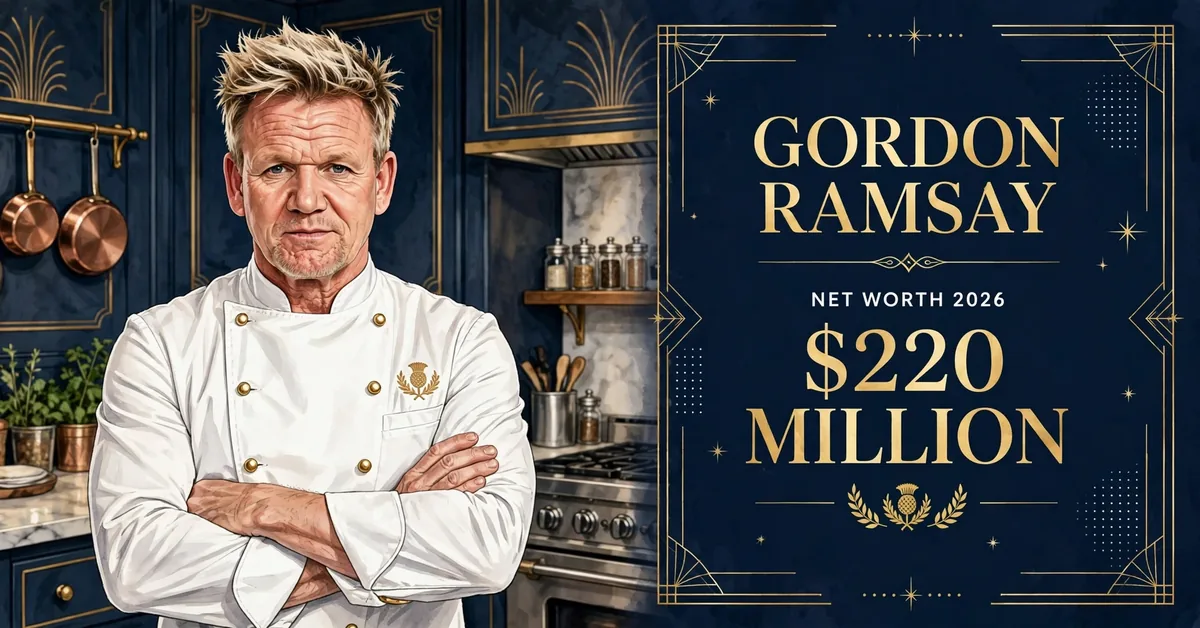
The Short Answer: Gordon Ramsay Is Worth 0 Million
Gordon Ramsay’s net worth is estimated at $220 million in 2026. The figure comes from Celebrity Net Worth, updated in February 2026, and it is the number that Parade, Biography.com, Alux, InvestorMint, NetWorthPress, Social Life Magazine and InfoCelebs all print. It has barely moved in years — not because Ramsay stopped earning, but because the estimate is a rough marker for a privately held fortune, and the estimators have settled on $220 million as the most defensible reading of the public evidence.
He is 60 years old, having turned 60 on November 8, 2026, eleven days before this profile was updated. He runs more than 80 restaurants, holds seven Michelin stars across his group, and fronts four television franchises on two continents. The money comes from all three at once: the restaurants, the television contracts worth $45 million to $60 million a year, and the licensing deals that put his name on cookware and frozen food. Gordon Ramsay’s biography tracks the full arc — from a broke young chef in Glasgow to the $220 million figure — and Gordon Ramsay’s age covers the 60th birthday and the six decades behind it.
The 2026 twist is that for the first time, the public can check part of the story against real accounts. On October 13, 2026, the first group accounts for the company that now holds his restaurants were filed at Companies House in London, and they show a business that is much bigger, and much less profitable, than the $220 million headline suggests: £151.8 million in sales, a £16.3 million loss, and £12.4 million the group owes Ramsay himself. The accounts do not disprove the net-worth estimate — they cover one company, not one man — but they are the most honest numbers ever published about his empire, and they deserve a section of their own.
Gordon Ramsay’s Net Worth Over Time
The $220 million figure did not appear overnight. It is the end of a thirty-year climb from a chef with no money to the richest chef on the planet, and the milestones along the way are all dated and documented.
| Year | Milestone | Wealth Marker |
| 1992 | National Chef of the Year; first head-chef job at Aubergine | Working chef’s salary |
| 1998 | Opens Restaurant Gordon Ramsay, Chelsea | First owned asset |
| 2001 | Three Michelin stars at the flagship — held ever since | Brand value takes off |
| 2004–2005 | Hell’s Kitchen UK, then the US version on Fox | Television income begins |
| 2009 | Dropped from the Sunday Times Rich List (last valued £50M) | ~£50 million |
| 2019 | $100M Lion Capital partnership to expand the group | ~$160–$200 million |
| 2020 | Forbes measures $70M earnings in a year; No. 19 on Celebrity 100 | ~$200 million |
| 2026 | 100th restaurant; Netflix series; first group accounts filed | $220 million |
The table carries a warning that applies to every row before 2026: the historical figures are reconstructed estimates, not claims that Ramsay reported these amounts. His companies are privately held and do not publish a personal balance sheet. The 2009 Sunday Times figure of £50 million is the only one that comes from an independent rich list, and even that was a snapshot that the list itself stopped updating when it dropped him. The honest reading is the direction, not the decimals: from £50 million in 2009 to $220 million in 2026, a fourfold rise driven by television and by the Lion Capital money.
Why 0 Million — and Why Some Outlets Say 0 Million
The $220 million figure should be read as shorthand for “likely worth in the low hundreds of millions,” as InvestorMint puts it — not as proof that Ramsay controls exactly that amount in cash and investments. The estimate is plausible given the long-running television career, the international restaurant portfolio, the publishing history, and the licensing income, but it is not independently confirmed, and Ramsay does not publish an audited personal financial statement.
The $200 million print, carried by some outlets, is the low end of the same range rather than a competing fact. ConcordP2C’s March 2026 comparison notes that Celebrity Net Worth places the fortune at approximately $200 million in one place and $220 million in another — the same source, two snapshots, a $20 million wobble that tells you how soft the underlying data is. This profile anchors at $220 million because it is the figure Celebrity Net Worth printed in its February 2026 update and the figure that Parade, Biography.com, Alux and the rest of the 2026 coverage repeats. The range is $200 million to $220 million, and the truth is somewhere inside it.
What would move the number is not another television season. It is the restaurant group. If the group ever turned its £151.8 million of sales into sustained profit, the equity value of Ramsay’s 50% stake would rise sharply. If it keeps losing £16 million a year, the stake is worth less than the headline assumes. That is why the October 2026 filings matter more than any new show announcement: they are the first evidence about the one asset that decides whether $220 million is too high or too low.
The Restaurant Group: 80-Plus Locations, 7 Michelin Stars
Gordon Ramsay Restaurants is one of the largest restaurant groups in the world run by a single chef. The widely cited count is more than 80 restaurants; a 2026 count by Artvoice puts it at 94 — 29 in the UK and 65 internationally, spanning the United States, South Korea, Malaysia, Dubai, Singapore, France and Hong Kong. The group holds seven Michelin stars across its fine-dining rooms, and the flagship, Restaurant Gordon Ramsay in Chelsea, has held three stars since 2001 — twenty-five years without a break.

The group is built in layers. At the top sits the fine dining: Restaurant Gordon Ramsay, Pétrus, and the three-star rooms that carry the reputation. Below that sit the casual brands — Street Burger, Street Pizza, Ramsay’s Kitchen — that carry the volume. And below that sits the experience layer: the Hell’s Kitchen restaurants, built around the set design and energy of the television show, which turn a TV format into a dinner reservation. The first Hell’s Kitchen restaurant opened in Las Vegas at Caesars Palace in January 2018; there are now eight, in Las Vegas, Lake Tahoe, Southern California, Atlantic City, Washington DC, Connecticut, Miami and Ibiza — and a ninth, in London, opened in April 2026.
The money behind the expansion is not Ramsay’s alone. In 2019 he struck a $100 million partnership with Lion Capital, the private-equity firm, to expand the group in the United States and Asia. The October 2026 filings show the ownership split that resulted: 50% Gordon and Tana Ramsay, 50% a Lion Capital vehicle. Ramsay owns half of his own empire. The other half belongs to the investors who funded its growth — which is why the group’s losses show up on his balance sheet only in part, and why the $220 million estimate depends on what that half is worth.
The 2026 Filings: £151.8 Million in Sales, a £16.3 Million Loss
On October 13, 2026, the first set of group accounts for Gordon Ramsay Restaurants (Global) Ltd was filed at Companies House, and WealthFuture read them the same month. The headline numbers, for the 52 weeks to December 28, 2025: £151.8 million in sales, a £16.3 million loss, and £12.4 million that the group owes Ramsay himself on a director’s loan.
Three things about those numbers matter for the net-worth question. First, the scale: £151.8 million in sales is a serious business, roughly $200 million at the October 2026 exchange rate, and it is the first time the public has seen a group-wide revenue figure rather than a guess. Second, the loss: the group is still loss-making after tax, which means the restaurants, for all their fame, are not currently generating the profit that would justify a high equity valuation. Third, the loan: £12.4 million owed to Ramsay himself means he has been funding the group out of his own pocket — television money going into restaurants, not the other way around.
The filings also carry a warning about comparisons. The 2024 figures covered 70 weeks of the UK business only, while the 2025 figures cover a full year in the UK plus about eleven months of the US business, so the two years cannot be lined up directly. And the accounts cover the restaurant group only — they do not cover Ramsay’s personal assets, his television income, or any business outside the group. A reader who treats the £16.3 million loss as proof that Ramsay is losing money would be making the same mistake as a reader who treats the $220 million estimate as a bank balance. Both numbers are real. Neither is the whole story.
2026: The 100th Restaurant at 22 Bishopsgate
In May 2026, Ramsay hit a career milestone: the opening of his 100th restaurant. The new Bread Street Kitchen & Bar sits on the 59th floor of 22 Bishopsgate, London’s second-tallest building, and it is the crown jewel of a five-concept takeover of the tower that also includes an Asian-inspired Lucky Cat, a high-end Gordon Ramsay Steak, and the Gordon Ramsay Academy — the highest cookery school in Europe.

The tower is the largest single culinary venture of his career, and Netflix is filming it. Being Gordon Ramsay, which premiered in 2026, follows him over a six-month window as he balances the opening of the five Bishopsgate concepts — the kind of access that turns a restaurant launch into a streaming event and a streaming event into a restaurant launch. It is the same loop that built the empire in the first place: television feeds the restaurants, the restaurants feed the television, and the licensing feeds on both.
The 100th-restaurant milestone is worth pausing on, because it shows how far the business has travelled from the single Chelsea dining room of 1998. One hundred restaurants is not a chef’s portfolio. It is a chain, run with private-equity money, spread across three continents, and held together by a brand that is now worth more than any single kitchen in it. The question the 2026 filings raise is whether the chain makes money. The question the Bishopsgate opening answers is whether it can keep growing. Both questions are open.
Hell’s Kitchen Comes Home: London, April 2026
The UK’s first Hell’s Kitchen restaurant opened on April 2, 2026, at The Cumberland Hotel in Marble Arch, central London — a 7,500-square-foot space that seats more than 200 diners, with four chef’s tables and its own dedicated bar. The launch, announced by Gordon Ramsay Restaurants Global and The Clermont Hotel Group, marks the beginning of a multi-site partnership between the two hospitality groups, and Ramsay called it “an incredible full circle moment” — “London is where it all began in 1998, so this feels like a real homecoming.”
The London opening is the ninth Hell’s Kitchen restaurant worldwide and the first in the UK. Every other location is in the United States or Ibiza. The menu mixes signature favourites from the show with new dishes developed for London diners, and the restaurant is built around the same theatre as the television format: fire, drama, and bold flavours, served in a room designed to look like the set.
The timing matters. Ramsay is also in talks with ITV about reviving the original UK Hell’s Kitchen television format, which aired for one series in 2004, with a return expected in 2027. If the revival lands, the London restaurant and the London show will promote each other in the same loop that made the Las Vegas restaurant and the American show into a single business. It is the oldest trick in his book, and it still works.
Sea Containers: The Opening That Did Not Go to Plan
Not every 2026 opening went smoothly. Gordon Ramsay at Sea Containers opened on September 1, 2026, inside the Sea Containers London hotel on the South Bank, offering all-day dining alongside views of the River Thames. The setting is one of the strongest in the group — a dining room overlooking the river, an outdoor terrace, an open kitchen, and a menu built around seafood, steaks and recognisable Ramsay signatures.
The early reviews were mixed. Some guests praised the room and the view; others raised concerns about slow service, value for money, and dishes that did not meet expectations. A review in The Times was particularly critical, questioning whether the execution justified the ambitious setting and the famous name. The coverage is worth noting because it shows the risk at the heart of the 2026 expansion: extending a famous culinary identity across a growing collection of restaurants is hard, and a bad review at a flagship address travels further than a good one at a Street Burger.
There is no confirmed evidence that Ramsay has personally intervened in response to the early reviews, and it would be misleading to suggest he is preparing a dramatic overhaul without an announcement. The early response does not establish that the restaurant is a failure, and it would be unfair to judge its long-term prospects from a limited number of reviews. But the episode is a useful counterweight to the Bishopsgate celebration: at 60, with 100 restaurants, the hardest part of the job is no longer opening rooms. It is keeping them good.
Television: Million to Million a Year
Television is the engine that pays for everything else. The most repeated reporting puts Ramsay’s television earnings at $45 million to $60 million a year, and Forbes measured $70 million in the year to May 2020, when he ranked No. 19 on the Forbes Celebrity 100. Social Life Magazine puts his per-episode pay at about $225,000. InfoCelebs estimates $70 million to $80 million a year from his combined business interests. The exact number is unconfirmed, but the order of magnitude is not: television is the biggest single source of his income, and it has been for two decades.
The portfolio in 2026 is the widest it has ever been. Hell’s Kitchen US season 24, subtitled Battle of the States, wrapped up in early 2026 at the Foxwoods Resort Casino, pitting 20 chefs representing different American states against each other. Next Level Chef season 5 premiered in January 2026 and concluded in May, with a “Mini Gordon” twist and a special episode tied to the FIFA World Cup; season 6 is already greenlit. Gordon Ramsay: Food Stars USA season 3 has shifted its focus toward food-tech and sustainable startups. And Being Gordon Ramsay on Netflix follows the Bishopsgate build-out. The US shows — Hell’s Kitchen, MasterChef, MasterChef Junior and Next Level Chef — air across more than 200 territories worldwide.
The television money is also the most reliable money. Restaurants lose £16 million in a year; a Fox contract does not. That is why the £12.4 million director’s loan in the 2026 filings reads the way it does: television earnings, lent back into the restaurant group, keeping the expansion going while the restaurants find their way to profit. It is a sensible way to run an empire, and it is the reason the $220 million estimate survives a loss-making restaurant group — the television income is real, annual, and largely independent of whether any single dining room makes money.
Early Life: From Rangers to the Kitchen
Gordon Ramsay was born on November 8, 1966, in Johnstone, Renfrewshire, Scotland, and raised in Stratford-upon-Avon, England. His first ambition was not cooking. It was football. He played in the Rangers youth system as a teenager, and a serious knee injury at 19 ended the career before it started. The injury is the hinge of his whole story: a boy who wanted to be a professional footballer, told at 19 that he would never be one, who walked into a kitchen instead and found a second arena with the same discipline, the same hierarchy, and the same intolerance for weakness.
He trained the hard way. After culinary college he worked under Marco Pierre White at Harveys in London — the most feared kitchen in Britain — then in Paris under Guy Savoy and Joël Robuchon, two of the greatest French chefs alive. He won the Craft Guild of Chefs National Chef of the Year competition in 1992, and by 1993 he was head chef at Aubergine in London, where he won two Michelin stars within three years. Gordon Ramsay’s height — 6 feet 2 inches — is a footnote in that story, but it is the kind of footnote readers search for, and it is covered in detail on this site alongside the biography.
The apprenticeship matters because it explains the television persona. Ramsay did not invent the shouting chef. He learned it in kitchens where shouting was the management style, from men who had earned the right to shout by cooking better than anyone else in the room. When he opened his own restaurant in 1998, at 31, he brought the discipline with him — and the discipline is what won the three Michelin stars three years later. The shouting came later, on television, and it paid for the restaurants. The cooking came first, and it is still the only part of the act that cannot be faked.
The Michelin Stars: Three Since 2001, Seven Today
Restaurant Gordon Ramsay, on Royal Hospital Road in Chelsea, opened in 1998 and won three Michelin stars in 2001. It has held them ever since — twenty-five years at the top of the guide, through recessions, a pandemic, and the expansion of the group to 100 restaurants. The room seats a small number of diners, the menu is a tasting menu, and the standards are the ones Ramsay learned in Paris: classical French technique, relentless consistency, and no shortcuts.
The group holds seven Michelin stars in total across its fine-dining rooms. That number is the credential that makes everything else possible. A chef with seven stars can open a burger chain and be taken seriously; a chef with none cannot. The stars are also the reason the licensing works: a HexClad pan with Ramsay’s name on it sells because the name belongs to a man with three stars at his flagship, not because he shouts on television. The television made him famous. The stars made him credible. The order matters, and Ramsay has never mixed it up.
For comparison, Thomas Keller’s biography on this site covers the other great fine-dining empire of the same era — The French Laundry, Per Se, and a chef who took the opposite route to the same destination, building a fortune on cooking alone without ever shouting on television. Keller and Ramsay are the two poles of modern fine dining: one quiet, one loud, both rich, both holding three stars at their flagships. The difference is that only one of them has a television empire, and that is why only one of them is worth $220 million.
Licensing, Books, and the Brand Machine
The third leg of the fortune is the one that scales without kitchens or cameras: licensing. The HexClad cookware partnership puts Ramsay’s name on pans sold around the world. The cookbooks — more than 25 of them, from Gordon Ramsay’s Passion for Flavour to the Ultimate series — have sold for three decades. The frozen food lines, the Gordon Ramsay Academy cookery school, and a YouTube channel with tens of millions of subscribers turn the same content into revenue in a dozen formats at once.
The brand machine works because the underlying product is real. A cookbook by a chef with seven Michelin stars is a different object from a cookbook by a television personality, and the market knows it. The same logic applies to the cookware: HexClad sells because Ramsay actually cooks with it on camera, in kitchens he actually runs. The licensing income is the least reported part of his fortune and the most profitable — no food costs, no staff, no rent, just a name on a product that sells itself.
It is also the part of the business that will outlast him. Restaurants close. Television formats end. A name on a pan keeps selling. At 60, with six children and a 100-restaurant group that loses money, the licensing business is the quiet insurance policy underneath the $220 million — the part of the fortune that does not depend on whether the next opening gets a good review in The Times.
Family and Personal Life at 60
Ramsay married Tana Ramsay in 1996, and the marriage is the longest-running partnership in his life — longer than any restaurant, any show, or any business deal. They have six children: Megan, twins Holly and Jack, Matilda (known as Tilly, herself now a television presenter and cookbook author), Oscar, and Jesse, born in November 2023, when Ramsay was 57. The family lives between London, Cornwall and Los Angeles, and the children have grown up inside the business: Tilly has her own cooking shows, and the older children have all worked in the restaurants.
The family is also a business asset. The 50% of the restaurant group owned by “Gordon and Tana Ramsay” is a joint holding, and Tana has been a partner in the enterprise since the beginning — running the household that made the career possible, and later running her own cookbooks and television work. Gordon Ramsay’s age is covered on our sister site CelebAmerica, which tracks the same November 8, 1966 birthdate to 60 years old in November 2026.
In August 2025, Ramsay revealed he had undergone surgery to remove a basal cell carcinoma, a form of skin cancer that had developed below his ear. He disclosed it himself, on social media, with the same bluntness he brings to everything else — a reminder to wear sunscreen, and a rare public admission of vulnerability from a man whose brand is built on invulnerability. He recovered and was back at work within weeks, opening restaurants and filming the Netflix series. At 60, the schedule has not slowed. If anything, 2026 has been his busiest year yet.
The Richest Chef in the World — By How Much?
Alux’s November 2026 ranking of the richest celebrity chefs puts Ramsay first at $220 million, ahead of Jamie Oliver and Nobu Matsuhisa at about $200 million each. The gap is $20 million — small in absolute terms, but decisive in a ranking where the top three are separated by a rounding error. Jamie Oliver’s net worth, estimated at $200 million on this site, is the closest comparison: Oliver built his fortune the same way, with restaurants, television and books, but without the Michelin stars and without the American television franchises that pay Ramsay $45 million to $60 million a year.
The rest of the field is far behind. Bobby Flay’s net worth is estimated at $60 million — a fortune built on the Food Network and a smaller restaurant group, but less than a third of Ramsay’s. Wolfgang Puck, the third member of the $200 million club, built his fortune on Spago and a licensing empire of his own, but without a television career on Ramsay’s scale. The pattern is consistent: the chefs who are worth the most are the ones who own television formats, not just restaurants.
That is the real answer to the question of how Ramsay got to $220 million. He did not get there by cooking better than everyone else, though he does. He got there by being the first great chef to understand that a restaurant is a television set, a television show is a restaurant advertisement, and a name is a product. The cooking made him credible. The television made him rich. The licensing made him permanent. At 60, with 100 restaurants and a Netflix series, he is still running the same loop — and it is still working.
Gordon Ramsay by the Numbers
| Measure | Figure (2026) |
| Net worth | $220 million (range $200M–$220M) |
| Annual earnings | $45–$60M from TV; Forbes $70M (year to May 2020) |
| Restaurants | 80+ (94 by a 2026 count); 100th opened May 2026 |
| Michelin stars | 7 across the group; 3 at the Chelsea flagship since 2001 |
| Group sales (2025) | £151.8M; loss £16.3M (Companies House, filed Oct 13, 2026) |
| Group ownership | 50% Gordon & Tana Ramsay, 50% Lion Capital vehicle |
| Per-episode pay | ~$225,000 (reported) |
| Age | 60 (born November 8, 1966) |
| Height | 6 ft 2 in (188 cm) |
| Children | 6 (with wife Tana, married 1996) |
The table is the article in miniature: a 60-year-old chef, worth $220 million, running 100 restaurants that lose money and television shows that make it back. The fortune is real, the restaurants are real, and the loss is real too. All three belong in the same profile, because a reader who only sees the $220 million has been told half the story.
Gordon Ramsay Net Worth: Frequently Asked Questions
What is Gordon Ramsay’s net worth in 2026?
Gordon Ramsay’s net worth is estimated at $220 million in 2026, according to Celebrity Net Worth (updated February 2026), with Parade, Biography.com, Alux, InvestorMint, NetWorthPress, Social Life Magazine and InfoCelebs printing the same figure. Some outlets print $200 million, making the honest range $200 million to $220 million. He is the richest celebrity chef in the world.
How does Gordon Ramsay make his money?
Three ways: television, restaurants, and licensing. Television pays $45 million to $60 million a year (Hell’s Kitchen, MasterChef, Next Level Chef, Kitchen Nightmares). The restaurant group has 80-plus locations worldwide. Licensing — HexClad cookware, more than 25 cookbooks, frozen food lines, the Gordon Ramsay Academy — turns his name into products that sell without kitchens or cameras.
How many restaurants does Gordon Ramsay own?
More than 80 restaurants worldwide, with a 2026 count putting the total at 94 (29 in the UK, 65 international). His 100th restaurant, a Bread Street Kitchen & Bar on the 59th floor of 22 Bishopsgate in London, opened in May 2026. He owns 50% of the restaurant group; the other 50% belongs to a Lion Capital investment vehicle.
How many Michelin stars does Gordon Ramsay have?
Seven Michelin stars across his restaurant group. His flagship, Restaurant Gordon Ramsay in Chelsea, has held three Michelin stars since 2001 — twenty-five years without a break.
What is Gordon Ramsay’s salary per episode?
About $225,000 per episode, according to Social Life Magazine’s 2026 reporting. His annual television earnings are most often reported at $45 million to $60 million, and Forbes measured $70 million in the year to May 2020, when he ranked No. 19 on the Forbes Celebrity 100.
How old is Gordon Ramsay in 2026?
Gordon Ramsay is 60 years old in November 2026. He was born November 8, 1966, in Johnstone, Renfrewshire, Scotland, and turned 60 on November 8, 2026.
Is Gordon Ramsay a billionaire?
No. Gordon Ramsay’s net worth is estimated at $220 million, roughly a fifth of a billion dollars. Some projections suggest he could approach $900 million by the late 2020s if current trends continue, but no credible outlet places him among billionaires, and his restaurant group reported a £16.3 million loss in its first published group accounts in October 2026.
What did Gordon Ramsay Restaurants’ 2026 accounts show?
The first group accounts for Gordon Ramsay Restaurants (Global) Ltd, filed at Companies House on October 13, 2026, showed £151.8 million in sales for the 52 weeks to December 28, 2025, a £16.3 million loss, and £12.4 million owed to Ramsay himself on a director’s loan. The accounts cover the restaurant group only, not Ramsay’s personal wealth or television income.
Sources & Reporting
This profile was researched from live reporting current through November 19, 2026. Celebrity Net Worth (updated February 2026) for the $220 million net-worth anchor; Parade and Biography.com for the same figure in 2026; Alux (November 2026) for the richest-chefs ranking, the $220 million figure, and the $200 million figures for Jamie Oliver and Nobu Matsuhisa; InvestorMint for the $220 million estimate and the $3.8 million to $5.1 million social-media income modelling; NetWorthPress for the $220 million figure and the February 2026 update; Social Life Magazine for the $220 million figure, the $45 million to $60 million television range, the $225,000 per-episode figure, the 80-plus restaurant count, the seven Michelin stars, and the August 2025 basal cell carcinoma surgery; InfoCelebs for the $220 million figure, the 80–90 restaurant count, and the $70 million to $80 million annual income estimate; ConcordP2C (March 2026) for the $200 million low-end print and the Forbes $70 million 2020 earnings; WealthFuture (October 2026) for the Companies House filing of October 13, 2026 — £151.8 million in sales, a £16.3 million loss, £12.4 million owed to Ramsay on a director’s loan, the 50/50 ownership split with Lion Capital, the £50 million Sunday Times Rich List figure from 2009, and the Forbes $70 million 2020 figure; MoviesNewsToday (May–June 2026) for the 100th restaurant in May 2026, the five Bishopsgate concepts, the Gordon Ramsay Academy, the Netflix series Being Gordon Ramsay, Next Level Chef season 5 and 6, Hell’s Kitchen season 24, Food Stars season 3, the Sea Containers opening of September 1, 2026 and its mixed early reviews, and the ITV talks on a Hell’s Kitchen UK revival for 2027; the Craft Guild of Chefs for the Hell’s Kitchen London opening in spring 2026 at the Cumberland Hotel, Marble Arch, and Ramsay’s 1992 National Chef of the Year win; The Staff Canteen for the London opening details and the eight existing Hell’s Kitchen locations; Artvoice for the April 2, 2026 opening date, the 7,500-square-foot space, the 200-plus seats, the ninth-location count, and the 29 UK plus 65 international restaurant count. Guide Net Worth’s own Gordon Ramsay biography, age and height profiles, plus the Jamie Oliver, Bobby Flay and Thomas Keller profiles, for the same-person and peer figures cited in the links.
Where outlets disagree — on the net worth ($200M vs $220M), on the restaurant count (80-plus vs 94), and on the annual earnings ($45M–$60M vs $70M–$80M) — this profile names the disagreement and attributes each figure to its outlet rather than picking a winner silently. Two prints are named and set aside as context rather than used as facts: the $900 million late-2020s projection, which no outlet supports with evidence, and the Sunday Times £50 million figure from 2009, which the list itself stopped updating. No figure in this article comes from an anonymous “sources say” claim, and no fact has been added that the cited reporting does not support. Corrections policy: figures are updated when new reporting emerges — contact us via the About page if you spot an error.
WRITTEN BY
Nathan Cole
Nathan Cole is the editor of Guide Net Worth. He covers celebrity wealth the way a business desk covers earnings: reported figures first, estimates labeled as estimates, and no invented numbers. Every profile on this site passes through his desk before it publishes. About Guide Net Worth · Corrections: figures are updated when new reporting emerges — contact us via the About page if you spot an error.
References & Sources
This article has been fact-checked and verified against multiple public sources, financial disclosures, SEC filings, Forbes reports, Celebrity Net Worth databases, and official records. All net worth estimates are based on publicly available information and financial analysis.