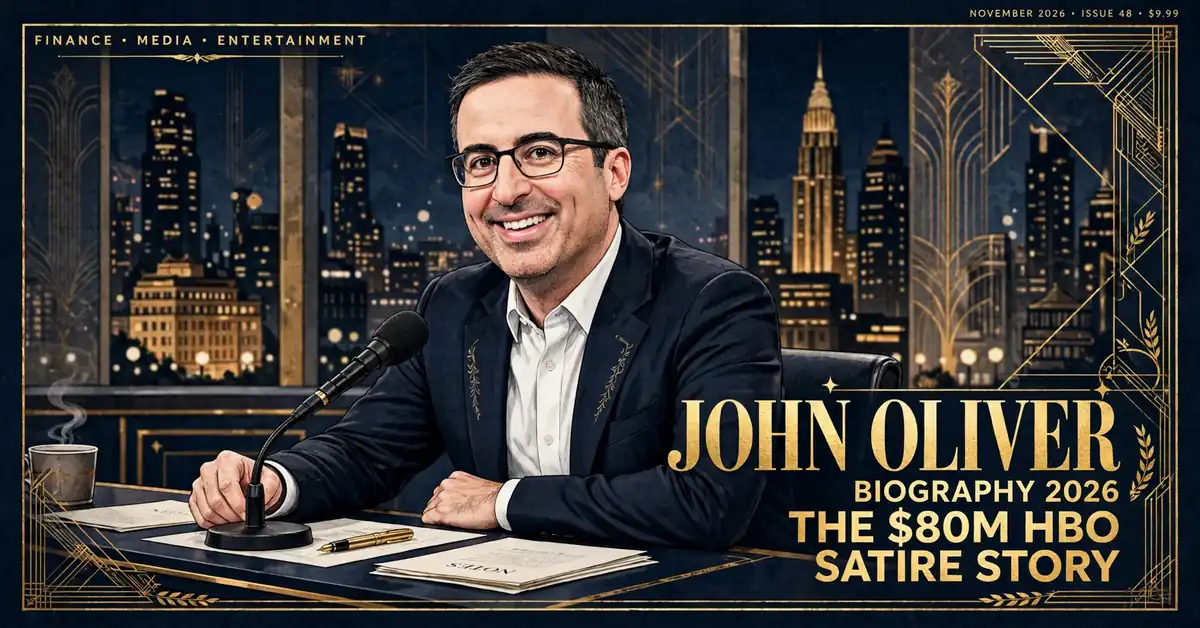
John Oliver biography 2026: born April 23, 1977 in Birmingham, Cambridge comic became HBO’s $80M satire star — Daily Show, wife Kate Norley, Last Week Tonight.
Last updated: November 20, 2026 · By Nathan Cole
John William Oliver was born on April 23, 1977, in Erdington, Birmingham, England, and he is 49 years old in 2026. He turns 50 on April 23, 2027. The Birmingham kid who played viola, studied English at Cambridge and learned stand-up in small British clubs now hosts Last Week Tonight with John Oliver on HBO, the weekly show that turned a 30-minute comedy slot into one of the most consequential news programmes on American television — and built him an estimated $80 million fortune along the way.
Oliver’s path runs through three distinct careers. First came a decade of British stand-up, the Edinburgh Fringe and a satirical podcast. Then came seven years on The Daily Show with Jon Stewart, where he arrived in July 2006 as the Senior British Correspondent and left in 2013 having won three Emmys for writing and having guest-hosted the show for eight weeks. Then came HBO: Last Week Tonight premiered on April 27, 2014, and has now run for 13 seasons, collecting 32 Primetime Emmy wins and three Peabody Awards while Oliver himself has banked 23 personal Emmys. In July 2026 he signed a one-year extension keeping the show on HBO through the end of 2027 — a short deal, by his standards, signed while the network’s ownership hangs in the balance.
This biography covers the whole arc: the Birmingham childhood, the Cambridge Footlights years, the long climb through British comedy, the Daily Show break, the segments that changed policy, the $30-million-a-season HBO deal, and the family life in New York with his wife Kate Norley, the Army combat medic he met at a Republican convention in 2008. Every date and figure below comes from a named source, and where sources disagree, the article says so.
Quick Facts
| Full Name | John William Oliver |
| Born | April 23, 1977, Erdington, Birmingham, England |
| Age | 49 years old (turns 50 on April 23, 2027) |
| Nationality | British-American (naturalised US citizen, December 13, 2019) |
| Height | 6 ft (1.83 m) |
| Education | BA English, Christ’s College, Cambridge (1998); Footlights vice-president 1997 |
| Known For | Last Week Tonight with John Oliver (HBO, 2014–present); The Daily Show (2006–2013) |
| Net Worth (2026) | Estimated $80 million (range $50M–$80M) |
| HBO Salary (reported) | $30 million per 30-episode season |
| Awards | 23 personal Primetime Emmys; show has 32 Emmys + 3 Peabody Awards |
| Wife | Kate Norley (married October 2011) |
| Children | Two sons (born 2015 and 2018) |
| Home | New York City |
How This Biography Was Reported
The biographical facts — birth, schooling, career dates, awards — come from Wikipedia’s John Oliver profile (updated within a day of writing) and Britannica’s profile (updated November 2, 2026), cross-checked against TVOverMind’s April 2026 biography and the show’s own episode record. The $80 million net-worth figure is Celebrity Net Worth’s estimate, updated July 18, 2025, inside a published range of $50 million to $80 million; the salary ladder ($8 million in 2014, $15 million in 2017, $30 million a season from 2020) is documented by the same outlet and repeated by Streamdiag’s January 2026 ranking. The July 31, 2026 contract extension was first reported by The Hollywood Reporter and confirmed by Variety, Deadline and TheWrap. Where trackers disagree — the net-worth range, the stale “48 years old” pages, the second John Oliver born in Vancouver in 1959 who appears on weak tracker sites — this article names the spread rather than filling it in. No figure here comes from an unnamed source, and no private financial record has ever been published.
+
Early Life in Erdington: A Birmingham Childhood
John William Oliver was born on April 23, 1977, in Erdington, a suburb on the north-east edge of Birmingham, England. He was the eldest of four children. His mother, Carole, taught music. His father, Jim Oliver, was a school headmaster and a social worker. The family later moved to Bedford, where Oliver went to Mark Rutherford School, and the house ran on two things that would shape his career: education and music. Oliver played the viola as a child, an instrument that demands patience and a willingness to sit inside an ensemble rather than in front of it.
Birmingham in the late 1970s and 1980s was an industrial city in decline, and Erdington was ordinary suburbia — semis, commuters, a long way from the London media world Oliver would eventually join. Nothing in his childhood pointed at television. His father ran schools; his mother taught children to read music. The comedy came later, and it came through school and university rather than through any family connection to show business. Oliver has said little in public about his parents beyond the basics, and this article sticks to what is on the record: two teachers, four children, a viola, and a boy who liked making people laugh.
One detail from the record matters for everything that follows. Oliver grew up a Liverpool Football Club supporter, a loyalty he still brings up on air, and he spent his teens in Bedford cultivating the habit that became his professional signature: paying close attention to things other people skim past. The viola lessons, the school plays, the household where both parents worked in education — the raw material was diligence, not showmanship.
Bedford, Cambridge and the Footlights
Oliver went up to Christ’s College, Cambridge, to read English, and graduated in 1998. Cambridge gave him two things that mattered more than the degree. The first was the Footlights, the university’s famous comedy club, where he became vice-president in 1997. The Footlights had produced John Cleese, Eric Idle and Stephen Fry; Oliver’s contemporaries there included David Mitchell and Richard Ayoade, both of whom went on to build their own long careers in British comedy. The club was a workshop, not a finishing school — students wrote sketches, performed them, and learned what died in front of a room.
The second thing Cambridge gave him was a network that lasted. Mitchell and Ayoade stayed in his orbit for years, and the Footlights connection ran through the first decade of his career. Oliver left Cambridge in 1998 with an English degree and no clear plan beyond comedy. He did not go to drama school. He did not join the BBC’s trainee schemes. He went back to the clubs and started the slow work of becoming a stand-up.
Stand-Up Years and the Edinburgh Fringe
The decade between Cambridge and America is the part of Oliver’s biography that most profiles compress into a single sentence. It deserves more. He worked the British stand-up circuit through the late 1990s and early 2000s, playing small rooms and learning the trade the hard way: a joke either worked in front of strangers or it did not, and nobody in the room cared about a Cambridge degree. His first major stand-up appearance came at the 2001 Edinburgh Festival Fringe, the month-long comedy marathon where British comics either find an audience or find out they do not have one yet.
Oliver kept at it. He performed in double acts, wrote for radio, and took the unglamorous television jobs that British comics use to pay rent. The work was steady rather than spectacular, and that steadiness is the point. By the time an American audience met him in 2006, he had already spent the better part of a decade doing live comedy — thousands of rooms, thousands of sets, a comic who had been tested in front of people who owed him nothing.

The Bugle: The Podcast That Built His Voice
In 2007 Oliver started The Bugle, a satirical podcast, with fellow comic Andy Zaltzman. The format was simple: two comedians talking about the week’s news, recorded cheaply, distributed free. The Bugle mattered because it was the first place Oliver’s later television voice appeared in full — the long, researched rant about an under-reported story, the joke that lands because the research underneath it is solid, the willingness to spend twenty minutes on a subject most news programmes gave twenty seconds.
The podcast ran for years and built a loyal audience before podcasting was a mainstream medium. It also taught Oliver a skill that Last Week Tonight would later depend on: how to make a dense, policy-heavy story funny without dumbing it down. Zaltzman stayed a collaborator and a friend, and the show’s tone — two smart people who had actually read the documents — became the template for Oliver’s HBO work.
The Daily Show: Senior British Correspondent
In July 2006, Jon Stewart invited Oliver to join The Daily Show with Jon Stewart on Comedy Central as the Senior British Correspondent. Oliver moved to New York, and the job changed his life in two ways. First, it put him in front of an American audience every night, doing field pieces and desk segments that played his outsider’s eye against American politics. Second, it put him inside a writing room that was, by common consent, the best in American comedy — a room where he won three Primetime Emmy Awards for writing, in 2009, 2011 and 2012.
Oliver stayed on The Daily Show for seven years, from 2006 to 2013, and the run gave him something no British club could: a nightly deadline, a research staff, and a host in Stewart who treated the correspondent pieces as real journalism with jokes attached. He also picked up acting work on the side — a recurring role as Professor Ian Duncan on Community, and voice work as Vanity Smurf in The Smurfs films of 2011 and 2013. The Daily Show years were the apprenticeship; HBO was the promotion.
Guest-Hosting The Daily Show in 2013
The summer of 2013 was the audition Oliver never asked for. Stewart took an eight-week leave to direct his film Rosewater, and Oliver guest-hosted The Daily Show for 32 episodes. He ran the desk, delivered the monologues, interviewed the guests, and kept the show’s ratings and tone intact for two months. The run answered the one question HBO needed answered: could this correspondent carry a show of his own?
He could. Within months of the guest-host run ending, HBO signed him to host his own weekly programme. The Daily Show job had done more than make him famous in America — it had given him a live, eight-week demonstration that he could hold a show together. Stewart’s leave was meant to last a summer; it ended up launching Oliver’s career as a host. The timing helped too: Stewart’s return in the autumn of 2013 left Oliver with a choice between staying on as a correspondent or taking the HBO offer, and the eight weeks behind the desk had already answered the question for him. He left The Daily Show at the end of 2013, and the HBO announcement followed within weeks.
Last Week Tonight: The HBO Gamble of 2014
Last Week Tonight with John Oliver premiered on HBO on April 27, 2014. The format was a bet: a weekly, 30-minute show that would spend most of each episode on a single deep-dive segment about a subject the news cycle had ignored — net neutrality, civil forfeiture, the FIFA corruption scandal, the American prison system. The gamble was that an audience would sit still for 20 minutes of policy if the jokes were good enough and the reporting was real.
It worked. The show is now the fifth-longest-running programme in HBO’s history, and it has aired 367 episodes as of June 2026. Season 13 ran from February 15 to November 15, 2026, with 30 episodes. The weekly rhythm matters: one show a week gives Oliver’s team days to research a single topic, call the experts, and read the documents — a luxury no daily show has, and the reason the segments carry a weight that daily monologues do not.
The John Oliver Effect: Segments That Moved Policy
A handful of Last Week Tonight segments did something no comedy show is supposed to do: they changed the thing they were joking about. The first came in 2014, when Oliver’s net-neutrality segment drove so many comments to the Federal Communications Commission that the agency’s website crashed — the moment the press started calling the phenomenon the “John Oliver effect”. The show’s FIFA segment the same year ran through the corruption allegations against world football’s governing body with a thoroughness that embarrassed the sports press.
The hits kept coming. In 2015, Oliver set up a legally registered church, Our Lady of Perpetual Exemption, to show how easy it was to claim tax-exempt status in America — and received thousands of dollars in donations from viewers, which he gave away. In June 2016, the show bought $15 million of medical debt for about $60,000 and forgave it on air, the largest televised giveaway of its kind. The same year, “Make Donald Drumpf Again” — a segment about Donald Trump’s family name — became the most-watched piece of the show’s early run. The Marlon Bundo book, covered in full below, turned a comedy bit into a number-one bestseller the same week it aired.
The pattern is the same every time: pick a subject nobody else is covering, research it harder than the news programmes do, then tell the story with jokes sharp enough to make people watch to the end. The segments work because the research is real. Oliver’s team reads the filings, calls the regulators, and checks the numbers — and the audience can tell.
The Research Machine Behind the Jokes
Behind the desk sits a research operation that looks more like a newsroom than a comedy writers’ room. Each week’s main segment starts with a subject chosen weeks in advance, and the team spends days reading primary documents — court filings, regulatory reports, academic studies — before a single joke is written. The writers then build the segment around the facts, not the other way around. That order of operations is why the show’s segments survive fact-checking by the outlets they cover: the jokes sit on top of reporting, not in place of it.
The approach has a cost. A weekly show that spends a week on one story can only cover 30 stories a year, and the team has to choose carefully. The payoff is authority: when Oliver spends 20 minutes on generic drugs or police body cameras or subscription traps, the segment becomes the reference point for the subject. Rival late-night hosts do monologues; Oliver does investigations with punchlines.
Beyond the Desk: Books, Voice Work and the Marlon Bundo Effect
Oliver’s career outside the desk is easy to miss because the show takes up so much room, but it explains how wide his reach runs. The Marlon Bundo book is the best example. Published in March 2018, A Day in the Life of Marlon Bundo told the story of Vice President Mike Pence’s pet rabbit, reimagined as a gay rabbit who wants to marry another male rabbit. It was a joke aimed at Pence’s public positions on LGBTQ rights, written as a children’s picture book — and it became a number-one bestseller, outselling the real Marlon Bundo book the Pence family had published the same week. The proceeds went to The Trevor Project, which works on suicide prevention for LGBTQ young people, and to AIDS United. A comedy bit had become a charity fundraiser and a publishing event in the same week.
The voice work runs alongside it. Oliver voiced Vanity Smurf in The Smurfs (2011) and its 2013 sequel, and played Zazu in Disney’s 2019 remake of The Lion King — a casting choice that made sense the moment you heard him: precise, slightly exasperated, unmistakably British. He has taken live-action roles too, including the recurring Professor Ian Duncan on Community, where his academic pomposity played against the show’s chaos. None of this work pays anything like the HBO deal, and none of it defines him. What it shows is range: the same voice that reads a 40-page regulatory filing on Sunday can read a children’s book on Monday and voice a cartoon hornbill on Tuesday.
The recognition followed the same widening pattern. Time named Oliver to its Time 100 list in 2015, the year the show’s influence stopped being a comedy-world story and became a news-world one. The 2015 citation praised exactly what the show does — taking subjects other programmes ignore and making them impossible to ignore. A decade later, that description still fits, and the list of subjects has only grown longer.
Season 13 in 2026: Thirty Episodes, One Election Year
Season 13 of Last Week Tonight ran from February 15 to November 15, 2026 — 30 episodes in a midterm-election year, and the season’s subject list reads like a map of the year’s arguments. The premiere took on ICE. Later episodes covered Twitter, police body cameras, USAID, J.D. Vance, police stings, presidential pardons, the subscription model, UnitedHealth Group, Brazil’s presidential election, generic drugs and Republican extremism. The November 1 episode tackled the midterm elections themselves; the November 8 episode took on Pete Hegseth. The finale aired on November 15, 2026.
The season also produced a small, telling footnote. In a November 2025 episode, Oliver launched a limited-edition wine, “Cabernet SauvignJohn”, sold at a loss, with $50,000 donated to 16 California food banks. It was a joke with a cheque attached — the show’s usual pattern, and a reminder that the segments are not only about the subjects they cover. The wine sold out. The food banks got the money.
The 2027 Extension and the Skydance Question
On July 31, 2026, Oliver signed a one-year extension keeping Last Week Tonight on HBO through the end of 2027 — season 14. The Hollywood Reporter broke the news; Variety, Deadline and TheWrap confirmed it. The deal broke a pattern: Oliver’s earlier renewals ran three years at a time, including the December 2023 deal that carried the show through season 13. A single year was a deliberate choice, and the press read it the same way — as a hedge against the uncertainty hanging over HBO’s ownership, with Paramount Skydance’s proposed acquisition of Warner Bros. Discovery in the background.
Oliver’s own comment to The Hollywood Reporter gave the situation its flavour: “We have various prospective business daddies circling.” Compensation under the new deal was not disclosed, and the 2023 deal’s reported $30 million a season remains the last published figure. The short extension keeps the show on air while the ownership question settles — and it keeps Oliver’s options open, which is exactly what a one-year deal is for.
Awards: 23 Emmys and the Counting Problem
Oliver’s trophy count confuses people, because two different numbers get quoted and both are right. Last Week Tonight as a show has won 32 Primetime Emmy Awards from 76 nominations, plus three Peabody Awards, nine Producers Guild Awards and nine Writers Guild Awards. Oliver personally has 23 Primetime Emmy wins from 31 nominations, according to the Television Academy’s records as reported by Variety in September 2026 — and that personal total includes the three writing Emmys he won on The Daily Show in 2009, 2011 and 2012.
The gap exists because shared show wins are credited differently from individual wins, and because Oliver’s personal count spans two programmes. He was also named to the Time 100 in 2015, the year the show’s influence became impossible to ignore. The numbers matter less than what they measure: no other weekly comedy show in American television history has been decorated like this one, and the decoration has arrived steadily, year after year, rather than in a single burst.
| Award body | Last Week Tonight (show) | Oliver (personal) |
|---|---|---|
| Primetime Emmy Awards | 32 wins / 76 nominations | 23 wins / 31 nominations |
| Peabody Awards | 3 wins | — |
| Producers Guild Awards | 9 wins | — |
| Writers Guild Awards | 9 wins | — |
| Daily Show writing Emmys | — | 3 wins (2009, 2011, 2012) |
John Oliver’s Net Worth in 2026
John Oliver’s net worth in 2026 is an estimated $80 million, according to Celebrity Net Worth, which updated its profile on July 18, 2025. The honest range runs $50 million to $80 million: lower trackers print $50 million, but none of them publishes salary reporting to support its number. Alux’s October 2026 estimate of $90 million rests on statistical modelling rather than named reporting, and figures above $80 million have no documented contract behind them at all.
The money comes from one place more than any other: HBO. The salary ladder is documented step by step. The first HBO deal in 2014 paid a reported $8 million a year. A three-year extension in September 2017 lifted that to about $15 million a year. From 2020, the reported figure became $30 million per 30-episode season — about $1 million per episode, by simple division rather than by contract term. The December 2023 renewal carried no raise, and the July 2026 one-year extension disclosed no new compensation figure. The full breakdown, including the book money, the voice work and the wine sold at a loss, is covered in our companion piece on John Oliver’s net worth on CelebAmerica, which reaches the same $80 million figure from the same reporting.
Wife Kate Norley and Family Life in New York
Oliver met his wife, Kate Norley, at the 2008 Republican National Convention in St Paul, Minnesota. He was there reporting for The Daily Show; she was there campaigning with Vets for Freedom, the veterans’ advocacy group. Norley, born May 25, 1978, in Arlington, Virginia, is an Iraq War veteran who served as a US Army combat medic with the 1st Cavalry Division. The meeting was the kind of coincidence that sounds invented until the details are checked: a British comedian covering American politics for a comedy show, and an American soldier campaigning for veterans’ issues, in the same convention hall.
They got engaged in July 2010 in St Thomas and married in October 2011. The couple live in New York City with their two sons: Hudson, born November 12, 2015 — prematurely, a birth Oliver has spoken about on air — and a second son born in 2018, whose name has not been made public. Oliver guards his children’s privacy closely, and this article respects that: the second son’s name stays out of print because the family has never shared it. Norley has kept her own public profile low, working in veterans’ advocacy rather than in her husband’s spotlight. On December 13, 2019, Oliver became a naturalised American citizen, holding British and American citizenship together.
How Old Is John Oliver?
John Oliver is 49 years old in 2026, born April 23, 1977 — which makes him 49 years and about seven months old as this article is published in November 2026. He turns 50 on April 23, 2027. The arithmetic is simple, but the internet gets it wrong constantly: a run of tracker sites still print “48 years old” because they were written before the April 2026 birthday and never updated, and a few pages mix him up with a different John Oliver entirely — a Vancouver composer born in 1959, who is not this man and never hosted a television show.
At 49, Oliver is the same age Jon Stewart was when he handed over The Daily Show desk, and he is now the longest-serving weekly satire host on American television. Season 14, running through the end of 2027, will take him past his 50th birthday — and past 12 years at the same desk.
John Oliver vs the Late-Night Class of 2026
Late-night television in 2026 is a small club, and Oliver sits in it alongside the hosts he came up with. Stephen Colbert’s biography runs on a parallel track: another Daily Show alumnus, another host whose show became a nightly institution, with a reported $75 million fortune and a Late Show that CBS has scheduled to end — a farewell Colbert himself has acknowledged. Trevor Noah’s biography tells the other side of the Daily Show story: the South African comic who took Stewart’s desk in 2015, left in 2022, and built a reported $100 million fortune from touring and a Grammy-hosting sideline.
Jimmy Fallon’s biography covers the Tonight Show host who has held NBC’s 11:35 slot since 2014 with a reported $70 million fortune, and Conan O’Brien’s biography covers the elder statesman of the group — a reported $200 million fortune and a late-night career that ran 28 years before he moved to podcasts and the Oscars stage. Seth Meyers’ net worth sits at a reported $25 million, the smallest of the group, for a host whose Late Night has quietly become the critics’ favourite. Oliver’s $80 million puts him near the top of the class — behind Conan and Noah, ahead of Colbert, Fallon and Meyers — but the money is the least interesting difference. The real difference is the format: everyone else does a nightly show; Oliver does a weekly one, and the week is what makes the deep dives possible.
| Host | Show | Age (2026) | Reported net worth |
|---|---|---|---|
| John Oliver | Last Week Tonight (HBO) | 49 | $80M |
| Stephen Colbert | The Late Show (CBS) | 62 | $75M |
| Jimmy Fallon | The Tonight Show (NBC) | 51 | $70M |
| Trevor Noah | The Daily Show (2015–2022) | 42 | $100M |
| Conan O’Brien | Late Night / Conan (retired) | 63 | $200M |
| Seth Meyers | Late Night (NBC) | 52 | $25M |
Ages and fortunes as reported by Guide Net Worth’s own profiles and the sources named in them; net-worth figures are estimates, not audited disclosures. Browse the full Celebrity Net Worth archive for more profiles.
Sources & Reporting
This biography was reported in November 2026 from live sources. Wikipedia’s John Oliver profile (birth, parents, schooling, Cambridge and Footlights, Daily Show dates, citizenship, awards) was the anchor for biographical facts, cross-checked against Britannica’s profile (updated November 2, 2026) and TVOverMind’s April 2026 biography. The Last Week Tonight episode record and season 13 listing supplied premiere dates, episode counts and 2026 segment topics. The July 31, 2026 contract extension comes from The Hollywood Reporter’s first report, confirmed by Variety, Deadline and TheWrap, with Oliver’s “business daddies” remark from the same reporting. The $80 million net-worth anchor and the HBO salary ladder come from Celebrity Net Worth (updated July 18, 2025) and Streamdiag’s January 2026 late-night ranking; Alux’s October 2026 $90 million figure and the lower trackers’ $50 million figures are noted with their limits. The Television Academy’s records, as reported by Variety in September 2026, supplied the personal Emmy count of 23. Reporting window: November 2026. Where sources disagreed — the net-worth range, the stale “48 years old” pages, the $90 million outlier, the Vancouver namesake — this article names the spread rather than filling it in. Corrections are welcome via the About page.
Frequently Asked Questions
Who is John Oliver?
John Oliver is a British-American comedian, writer and television host, best known as the host of Last Week Tonight with John Oliver on HBO since 2014. He previously spent seven years as the Senior British Correspondent on The Daily Show with Jon Stewart (2006–2013) and has won 23 Primetime Emmy Awards.
How old is John Oliver in 2026?
John Oliver is 49 years old in 2026. He was born on April 23, 1977, in Erdington, Birmingham, England, and he turns 50 on April 23, 2027.
Where was John Oliver born?
John Oliver was born in Erdington, a suburb of Birmingham, England, on April 23, 1977. He is the eldest of four children of Carole Oliver, a music teacher, and Jim Oliver, a school headmaster and social worker. The family later moved to Bedford, where he went to Mark Rutherford School.
Who is John Oliver’s wife?
John Oliver’s wife is Kate Norley, an Iraq War veteran who served as a US Army combat medic with the 1st Cavalry Division. They met at the 2008 Republican National Convention in St Paul, Minnesota — he was reporting for The Daily Show, she was campaigning with Vets for Freedom. They married in October 2011.
How many children does John Oliver have?
John Oliver has two sons. Hudson was born on November 12, 2015, and a second son was born in 2018. The family has not made the second son’s name public, and this article does not print it.
What is John Oliver’s net worth in 2026?
John Oliver’s net worth is estimated at $80 million in 2026, per Celebrity Net Worth (updated July 18, 2025). The honest range is $50 million to $80 million. His reported HBO salary is $30 million per 30-episode season, on a documented ladder from $8 million a year in 2014 to $15 million in 2017.
What show does John Oliver host?
John Oliver hosts Last Week Tonight with John Oliver on HBO, which premiered on April 27, 2014. The weekly show is known for long, researched deep-dive segments on under-reported subjects. Season 13 ran from February to November 2026, and a one-year extension signed in July 2026 keeps the show on HBO through the end of 2027.
Is John Oliver an American citizen?
Yes. John Oliver became a naturalised American citizen on December 13, 2019, and he holds both British and American citizenship. He was born in England and moved to the United States in 2006 to join The Daily Show.
Nathan Cole
Nathan Cole is the editor of Guide Net Worth. He covers celebrity wealth the way a business desk covers earnings: reported figures first, estimates labeled as estimates, and no invented numbers. Every profile on this site passes through his desk before it publishes. About Guide Net Worth · Corrections: figures are updated when new reporting emerges — contact us via the About page if you spot an error.
References & Sources
This article has been fact-checked and verified against multiple public sources, financial disclosures, SEC filings, Forbes reports, Celebrity Net Worth databases, and official records. All net worth estimates are based on publicly available information and financial analysis.