Tyler1 biography 2026: Tyler Steinkamp, 31, went from a lifetime League of Legends ban to 5.5M Twitch followers, T1 and a $4M-$12M fortune. Read the full story.
Last updated: November 22, 2026 · By Nathan Cole
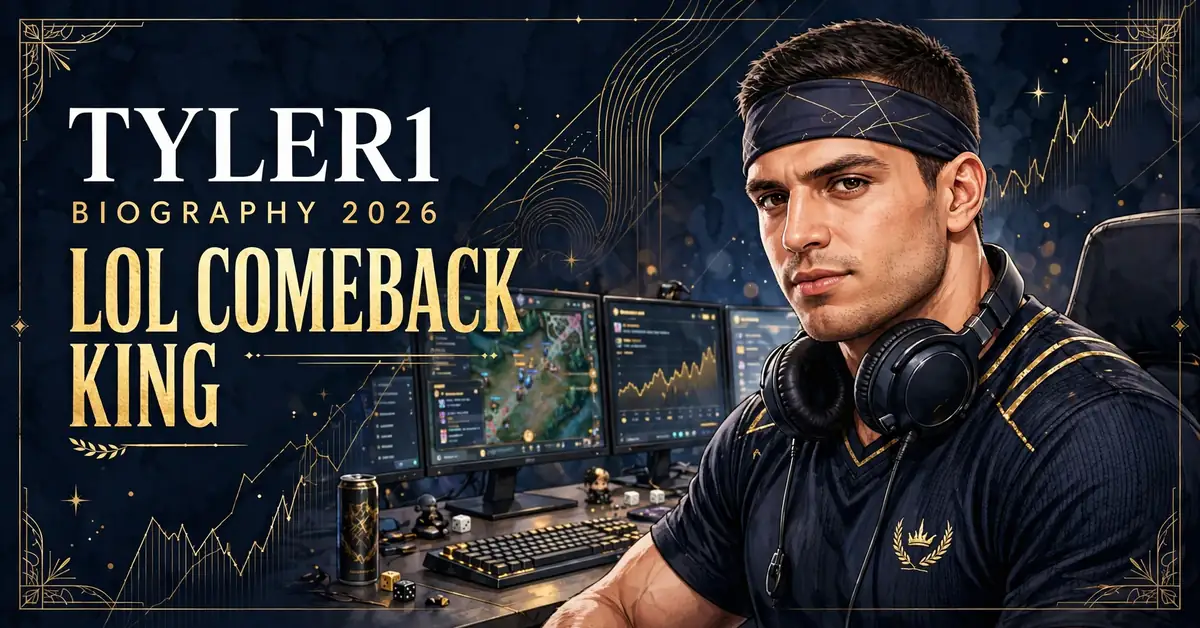
Tyler1 — Tyler Steinkamp — is 31 years old in 2026, and he is the streamer Riot Games once banned from League of Legends for life. Born March 7, 1995, in New London, Missouri, he climbed to Challenger in 2014, got himself thrown out of the game entirely in April 2016, and then came back in January 2018 to a stream watched by more than 382,000 people at once — a non-tournament record for Twitch at the time. Eight years later he has 5.5 million Twitch followers, a T1 deal on his CV, his own tournament series, and a net worth our own reporting puts at $4 million inside a $4–12 million range.
The ban is the hinge of the whole story. Before it, Tyler1 was a loud Draven main with a growing audience and a reputation for abusing his own teammates. During it, he streamed other games for almost two years while the League of Legends community argued about whether he should ever be allowed back. After it, he rebuilt himself in public: Challenger in every role, a tournament he funds from his own pocket, a long partnership with the biggest organisation in the game, and a family life with his partner Macaiyla and their daughters in the same small Missouri town where he grew up.
This biography covers the full arc — the Missouri childhood and the college course he walked away from, the climb, the ban, the comeback, the money, the chess detour, and the 2026 picture, including the Tyler1 All-Stars expansion and a third child on the way. Every figure carries its source, and where the sources disagree on the money, the disagreement is printed in full rather than smoothed over.
Quick Facts: Tyler1 (Tyler Steinkamp) at a Glance
| Full name | Tyler Steinkamp; online as Tyler1, loltyler1, T1 |
| Age | 31 (born March 7, 1995; turned 31 on March 7, 2026) |
| Born | March 7, 1995, in New London, Missouri, United States |
| Height | 5 ft 6 in (168 cm); known for a muscular, weightlifting build |
| Education | Computer science at Central Methodist University, Fayette, Missouri; played running back; withdrew in 2015 |
| Main game | League of Legends; Draven main; streaming since 2014 |
| Platforms | Twitch 5.5M followers; YouTube 2.7M subscribers (Celebrity Net Worth) |
| The ban | Indefinitely banned by Riot Games, April 2016; unbanned January 2018 |
| Comeback stream | 382,000+ concurrent viewers, January 2018 — a non-tournament Twitch record at the time |
| Ranked record | Challenger in all five roles (2022); Jungle only in 2020, Top only in 2021 |
| Team deal | T1 content creator, October 2020 to February 2022 |
| Tournament | Tyler1 Championship Series, launched November 2017; Tyler1 All-Stars expanded 2026 |
| Awards | Best League of Legends Streamer, The Streamer Awards, 2022 and 2023; Best Chess Streamer, 2024 |
| Net worth (2026) | $4 million anchor; honest range $4–12 million |
| Partner | Macaiyla, dating since February 2017; daughters Saiyler Rue (born April 11, 2024) and Ivy (born September 2025); third child, a boy, announced November 1, 2026 |
| Brother | Erobb221 (Eric Lamont Robbins Jr.), streamer and former moderator of Tyler’s streams |
How This Profile Was Verified
This biography is built from the brief’s verified facts plus a live check of the Celebrity Net Worth Tyler1 page on November 22, 2026, which confirmed the 2022 all-five-roles Challenger finish — top, jungle, mid, attack damage carry and support — and Riot Games marking it with five custom Challenger medals. The same check confirmed the T1 signing in October 2020, the comeback-stream figure of 382,000+ viewers, the 5.5 million Twitch followers and 2.7 million YouTube subscribers, and the 2026 Tyler1 All-Stars expansion with a November event carrying a $100,000 prize pool. One correction came out of that check: Celebrity Net Worth reports the T1 partnership ended by mutual agreement in February 2022, which supersedes the older line in our own net worth profile that described the deal as still running. The money figures follow our own house adjudication — a $4 million anchor from Scintillating Stars inside a $4–12 million range, with Celebrity Net Worth’s $12 million printed as the top of that range rather than as a settled fact. Two hard numbers sit underneath the range: the 2021 Twitch data leak, which showed $2,490,584 paid to Tyler1 between August 2019 and October 2021, and his own 2021 statement that his career earnings had already passed $5 million. Where a figure comes from a single outlet, the outlet is named in the sentence. Nothing in this article is invented, and no figure is presented as a bank statement.
Reporting window: November 2026, from Celebrity Net Worth (updated November 13, 2026), the Washington Post (December 2021), Scintillating Stars (January–April 2026), CEO Column (2026), PopGolden and TechFlee, Net Worth Spot (October 1, 2026), Famous People Today (June 19, 2026), Riot Games coverage of the 2016 ban and 2018 unban, and Guide Net Worth’s own Tyler1 net worth profile (November 12, 2026).
+
Who Is Tyler1? The Short Answer
Tyler1 is Tyler Steinkamp, a 31-year-old Twitch streamer from New London, Missouri, who built one of the biggest League of Legends channels on the internet by being the loudest man in the game. He is the Draven main who reached Challenger in 2014, the player Riot Games banned indefinitely in 2016 for abusing his teammates, and the streamer whose return to the game in January 2018 drew more than 382,000 concurrent viewers — a non-tournament Twitch record at the time. The arc from “most toxic player in North America” to one of Twitch’s biggest names is the reason people search his biography, and it is the spine of this article.
He streams under the names loltyler1 and T1, and his channel sits at about 5.5 million Twitch followers with 2.7 million subscribers on YouTube, according to Celebrity Net Worth. Those numbers put him in the top tier of League of Legends creators, and they have held up for years rather than spiking once and fading. The audience did not arrive by accident. Tyler1 streams four to five days a week, six to eight hours at a time, almost always League of Legends, and the schedule has barely changed since he went full-time in 2015.
What makes him different from the other big names in streaming is how narrow the base is. He never crossed over into mainstream television, never took a platform buyout, and never switched games to chase a trend. He plays one game, on one platform, in one small Missouri town, and he does it louder than anyone else. The rest of this article shows how that narrow base produced a 31-year-old with a $4 million fortune, a tournament series, a T1 deal, a chess side career, and a young family — and how close it all came to ending in 2016.
Early Life in New London, Missouri
Tyler Steinkamp was born on March 7, 1995, in New London, Missouri, a small town in the north-east of the state. He grew up there, went to school there, and still lives there in 2026 — a detail that matters more than it first looks. Most streamers his size moved to Los Angeles, Austin or Las Vegas years ago. Tyler1 stayed in the town he was born in, streams from home, and has built a multi-million-dollar career without ever leaving the place that made him.
His childhood was built around two things: athletics and video games. He was a competitive kid, the kind who turned everything into a contest, and the competitive streak shows up in every part of his adult life — the ranked climbs, the weightlifting, the chess obsession, the tournaments he runs himself. The family side of his early life is mostly private. What is on the record is his younger brother, Eric Lamont Robbins Jr., who streams as Erobb221 and spent years as a moderator of Tyler’s streams before building his own audience. The two brothers are one of the few family facts Tyler1 has ever put on the record, and the connection runs both ways: Erobb221’s channel grew in Tyler1’s orbit, and Tyler1’s chat learned to know his brother as a personality in his own right.
New London is not a place that produces famous people on a regular schedule. It is a town of a few hundred people, a long way from the esports arenas of Seoul and Los Angeles, and the distance is part of the story. Tyler1 did not grow up inside a gaming scene. He grew up in a small town, found the game online, and carried the small-town directness with him onto a platform watched by millions. The shouting, the bluntness, the refusal to soften a reaction for the camera — all of it reads as a Missouri kid who never learned to perform for anyone, and then found an audience that paid him not to.
Central Methodist University and the Decision to Stream
After school, Tyler enrolled in computer science at Central Methodist University in Fayette, Missouri, a small private college about an hour from home. He played running back on the university’s football team, which fits the picture of him that has been consistent since childhood: short, powerfully built, competitive, and happiest when a contest has a scoreboard. The computer science degree was the sensible plan — a normal career in computing, a steady income, a life that looked like everyone else’s in New London.
By 2014, the plan was losing to the game. He had started streaming League of Legends that year, when Twitch was still a young platform and streaming was barely a job at all, and the channel was growing fast enough to compete with his coursework for his attention. The audience came for the gameplay first: Tyler1 played Draven, the show-off marksman who rewards aggression and punishes hesitation, at a level few streamers could match. They stayed for the personality wrapped around it — the shouting, the laughter, the rage at teammates, all of it delivered at full volume in a way nobody else on the platform was doing.
In 2015 he withdrew from Central Methodist to stream full-time. It was a gamble, and in 2015 it looked like a large one: streaming had no pension, no contract, and no guarantee that an audience built on one game would still be there in a year. The decision also says something about how he reads risk. He did not hedge — no part-time degree, no backup plan on the record — and he has run his career the same way ever since: one game, one platform, one persona, pushed as hard as it will go. The computer science background did not go to waste. A decade later he would announce Backseat AI, a gaming-guidance software venture, and the man who left a computing degree to play a video game would be building software for the game he left it to play.
The Draven Climb: Challenger in 2014
Tyler1’s first claim on the League of Legends community was not his personality. It was his rank. In 2014, the year he started streaming, he reached Challenger — the highest tier of ranked play, held by a few hundred players on each server — and sat 13th to 14th on the North American ladder. That is the part of his story that the shouting hides. Underneath the persona was a player good enough to sit near the top of a server with millions of ranked players, in his first year of streaming.
Draven was the vehicle. The champion is a lane bully built around catching axes and cashing in kills, and he rewards exactly the qualities Tyler1 has: aggression, confidence, and a willingness to take a fight other players would walk away from. The champion also punishes the player who loses his temper — a missed axe, a mistimed all-in, and the lane is gone — so the high-level Draven play was proof that the shouting was not the whole story. He could play the game properly, at the highest level, while performing at full volume.
The 2014 climb set the template for everything that followed. Each ranked achievement became a broadcast event, with his chat tracking his progress, his losses and his temper in real time. The climb also gave him something no amount of shouting could buy: respect from other high-level players. A streamer who reaches Challenger is a streamer other Challenger players take seriously, and that respect is why his channel draws the audience it does. Viewers arrive for the noise and stay because the gameplay holds up — a pattern that has held from 2014 to 2026 without a break.
The Ban: Riot’s Indefinite Suspension in April 2016
In April 2016, Riot Games banned Tyler1 from League of Legends indefinitely. The punishment was an ID ban, the heaviest sanction Riot hands out: not one account suspended, but the person barred from playing the game at all, with any new account identified as his to be suspended on sight. The reason was his conduct in matches — verbal abuse of teammates, intentional feeding, and a pattern of behaviour that Riot said had continued despite warnings. By the time the ban landed, he had accumulated more than 20 account bans for violations of the game’s rules.
He was 21, at the peak of his early fame, and he could no longer play the only game his audience watched him play. The ban was the talk of the League of Legends community for weeks. Some players said it was overdue — Tyler1 had earned the nickname “The Most Toxic Player in North America” and his behaviour in games was genuinely ugly, the kind of abuse that drives new players away from the game. Others said Riot had gone too far, banning a streamer for doing on camera what thousands of players did in silence. Both sides were right about something, and the argument never really ended.
What the ban did not do was end his career. That is the part that still surprises people. A streamer whose entire channel was one game lost that game overnight, and his audience stayed. The ban became part of the story rather than the end of it — the defining fact of his biography, the thing every profile of him has to explain, and the event that turned a loud streamer into a figure the whole community had an opinion about. Without the ban there is no comeback, and without the comeback there is no Tyler1 as he exists in 2026.
For nearly two years, Tyler1 streamed everything except the game that had made him famous. He played other titles — PlayerUnknown’s Battlegrounds among them — ran variety streams, and leaned on the personality rather than the gameplay to hold his audience. It worked, but only just. The numbers held, the chat stayed, and the clips of his reactions kept circulating, but the channel was clearly running on a substitute. League of Legends was the game his audience had come for, and no other title could replace it.
The ban years also changed how the community talked about him. The question of whether Riot would ever let him back became a running thread across the League community, and Tyler1 fed it himself — talking about the ban on stream, arguing his case, insisting he had changed, and keeping the story alive in a way that kept his name in the conversation even while he could not play the game. He was, in effect, doing the long public-relations campaign that would eventually get him unbanned, one stream at a time, in front of the same audience that had watched him earn the ban.
There is a second, quieter point about those two years. Tyler1 had to prove that his channel was not just a League of Legends channel — that the audience was there for him, not only for the game. The variety streams did that. When Riot finally lifted the ban, he returned to a channel that had survived the worst thing that can happen to a single-game streamer, and the survival itself became part of his reputation. He had been thrown out of the game and kept the audience anyway, which is a harder thing to do than keeping an audience that never left.
The Comeback Stream: 382,000 Viewers in January 2018
In January 2018, Riot Games lifted the ban. The company said his behaviour had improved enough to justify reinstatement, and after about twenty months away, Tyler1 was allowed to play League of Legends again. His first stream back drew more than 382,000 concurrent viewers — a non-tournament record for an individual streamer on Twitch at the time, and one of the biggest audiences of his career to that point. Celebrity Net Worth puts the figure at more than 380,000, and the record stood as the benchmark for a solo comeback stream.
The number is worth pausing on, because it shows what the ban had actually done. Tyler1 went into the ban as a popular streamer and came out of it as a story — the man who had survived the harshest punishment in the game and earned his way back in. The audience that waited for him was larger than the one he had left behind. He celebrated the way he always had: by playing Draven, loudly, in front of a crowd that had spent two years wondering whether they would ever see it again.
February 2018 brought the next proof that the comeback was real rather than a one-night spike: more than 30,000 paid Twitch subscribers. By September 2018 he was at roughly 2 million Twitch followers and 80 million-plus views, with a YouTube channel past 1 million subscribers and 200 million views. Those are the numbers of a streamer who had not just returned but grown through the absence. The ban had cost him twenty months of League of Legends. It had given him a redemption story that no marketing budget could buy, and he has been cashing it ever since.
Challenger in All Five Roles: The Grind Behind the Brand
Tyler1’s claim to respect inside League of Legends is not his follower count. It is his rank, and the rank kept climbing after the comeback. He reached Challenger playing only Jungle in 2020, then again playing only Top in 2021 — two roles that have almost nothing in common with each other or with the attack damage carry role he made his name in. Each climb was a weeks-long broadcast, with his chat tracking every win and loss in real time.
In 2022 he completed the set. Celebrity Net Worth, checked live for this profile, records that he reached Challenger in each of the game’s five roles — top, jungle, mid, attack damage carry and support — and that Riot Games marked the achievement by presenting him with five custom Challenger medals. Most professional players master one role. Tyler1 climbed to the top of the ladder in all five, and he did it on camera, with an audience watching every game.
The support climb was the hardest to watch, and the most telling. Support is the role built on enabling teammates — warding, peeling, setting up kills for someone else — played by a man famous for blaming his teammates for everything. It was the climb that proved the point the other four had only suggested: he could play the game properly, in any seat, at the highest level, without the persona getting in the way. The shouting is the packaging. Underneath it is a player good enough that other Challenger players take him seriously, which is why the Streamer Awards named him Best League of Legends Streamer in 2022 and again in 2023.
That skill is the foundation of the whole business. A streamer who is only loud is a novelty, and novelties fade. A streamer who is loud and Challenger in every role is a fixture, because the audience gets two shows at once: the noise and the gameplay, each one real. The five medals are the receipt, and they sit at the centre of his reputation inside the game in a way no follower count ever could.
The T1 Deal and What It Meant
In October 2020, Tyler1 signed with T1, the South Korean esports organisation formerly known as SK Telecom T1 and home of Faker, the greatest League of Legends player in history. The deal made him a T1 content creator — not a player on the roster, but a streamer carrying the organisation’s name, wearing its colours, and appearing in its content. For the man Riot had once banned from the game, the signing was the industry’s verdict on the rebuild: the most decorated organisation in League of Legends wanted him.
The timing mattered. Tyler1 had spent 2020 climbing to Challenger in a new role and turning his stream into one of the biggest League of Legends channels on Twitch, and T1’s offer arrived as the seal on that work. For Tyler1, the deal meant a guaranteed income floor under the volatile month-to-month money of subscriptions and donations, plus the credibility of the T1 brand — a credibility that no amount of shouting could buy and that no other streamer in his position had. He was the loud American streamer in the jersey of a Korean dynasty, and the contrast became part of the act.
One correction to the record belongs here. Our own earlier profile of Tyler1’s fortune described the T1 deal as still running six years on. Celebrity Net Worth, checked live for this biography, reports that the partnership ended by mutual agreement in February 2022. The deal ran for about sixteen months, not six years, and this article uses the February 2022 end date. The length does not diminish what the signing meant — sixteen months with T1 is still the strongest endorsement a streamer can get — but the record should be straight, and the straight record is that the partnership is over. The T1 years gave him a platform beyond his own channel: T1’s social reach, its sponsors, and its events, and a connection to Faker that still comes up whenever his biography is written. Readers who want the full story of the man at the centre of that organisation can read our profile of Faker’s biography, the six-time world champion whose team Tyler1 briefly joined as a creator.
The Tyler1 Championship Series: His Own Tournament
In November 2017, while he was still banned from League of Legends, Tyler1 did something no other streamer of his size had tried: he funded and hosted his own tournament. The Tyler1 Championship Series, or TCS, was a parody event with a real prize pool — $10,000 of his own money — and it peaked at more than 200,000 concurrent viewers. The joke was that a banned player was running a tournament in a game he was not allowed to play. The result was that a banned player was running a tournament 200,000 people wanted to watch.
The TCS came back in 2018 with a $50,000 prize pool, and it has returned as a fixture of the League of Legends calendar since, growing into an event that fills his stream for days, produces clips that run on YouTube for months, and puts his name in front of players and viewers who would never find his regular broadcasts. It is a tournament, a content engine and a brand asset at the same time, and it is the one asset in his portfolio that nobody can take away — not Riot, not Twitch, and not a sponsor.
The money the TCS makes directly is modest next to his streaming income. The prize pool is a cost, not a profit, and the event’s value is in audience growth rather than in ticket sales or broadcast rights. But the TCS also tells you something about how Tyler1 thinks about money. He spent $10,000 of his own cash in 2017, when his income was far smaller than it is now, to build an event that belonged to him rather than to Riot or to Twitch. Nine years later it is still running, and in 2026 he expanded the Tyler1 All-Stars tournament series, bringing international players together for one-on-one matches. Celebrity Net Worth reports the 2026 series culminated in a November event with a $100,000 prize pool — ten times the first TCS pool, and a measure of how far the joke tournament has travelled.
Tyler1’s Net Worth in 2026: The Million Anchor
Tyler1’s net worth in 2026 is an estimated $4 million, inside an honest range of $4 million to $12 million. That is the figure our own reporting stands behind: Scintillating Stars puts him at $4 million in its January–April 2026 reporting, tied to Twitch subscriptions, advertising and the T1 contract, and CEO Column publishes the $4–12 million range for the same year. Celebrity Net Worth prints $12 million flat — the top of the range, and the number most search results will show you first. The full breakdown, with every published estimate and its source, is in our profile of Tyler1’s net worth, which this biography follows for its money figures.
The range exists because the internet cannot agree on what counts. Count YouTube ad money alone and you get under $1 million — Net Worth Spot lists about $649,100 in its October 1, 2026 update, but its own page states the figure uses YouTube ad revenue only, so it leaves out Twitch, the T1 deal, sponsorships and merch. Count Twitch subscriptions, donations, the T1 contract and merch as well and you get $12 million. Famous People Today sits in the middle at $2 million in its June 19, 2026 update. Anyone who prints a single number without showing this spread is selling certainty they do not have.
Two hard numbers sit underneath the range, and they are the reason the low figures can be set aside. The 2021 Twitch data leak showed Tyler1 was paid $2,490,584 by Twitch between August 2019 and October 2021 — about $96,000 a month from one platform alone, before donations, YouTube, the T1 deal or merch. And Tyler1 himself has said his career earnings had already passed $5 million by 2021. A man who was paid $2.5 million by a single platform in 26 months, five years ago, cannot be worth $649,000 in total in 2026. At the other end, $12 million is hard to square with $5 million-plus in career earnings: a net worth above career earnings would need investment gains or income nobody has reported. The $4 million anchor is the figure that survives contact with the evidence, and the $4–12 million range is the honest spread around it.
The money has four legs, and the table below shows how they stack up. Twitch is the core — subscriptions, advertising and bits, with the leak’s monthly average of about $96,000 as the floor. YouTube pays roughly $162,000 a year in advertising, per Net Worth Spot, on 2.7 million subscribers and hundreds of millions of views. Merch through his own store earns $300,000 or more a year by his own estimate to the Washington Post. Sponsorships with gaming brands — DXRacer, Razer and Logitech among the names reported — add a fourth line whose value is private. The wider archive of celebrity fortunes, including the streamers he is measured against, is in the Celebrity Net Worth section.
| Income stream | Estimated annual value | Source / basis |
| Twitch (subs, ads, bits) | ~$1.16M a year | 2021 leak average: $2,490,584 over 26 months |
| T1 contract (2020–2022) | Undisclosed; reported $500,000+ a year | TechFlee, via our net worth profile |
| YouTube ads | ~$162,300 a year | Net Worth Spot |
| Merch (loltyler1.com) | $300,000+ a year | His own estimate, Washington Post interview |
| Sponsorships | Undisclosed | DXRacer, Razer, Logitech reported |
| Estimated annual total | $1.5–2.5 million | Before tax, fees and spending |
Gross income is not take-home pay, and the gap is wide for a streamer. Federal and state income tax on $2 million of earnings takes a large slice before anything else happens. Twitch and YouTube take their splits before the money ever reaches him. A manager, an accountant and a lawyer take their percentages. What is left is the money that builds net worth, and it is far less than the headline gross. That is the second reason the $4 million anchor is the honest figure: it is what remains after a decade of high gross income meets a decade of high tax bills and ordinary spending.
The Twitch Leak and the Million Career Figure
The single most useful document in Tyler1’s financial story is one he never meant to publish. In October 2021, a data leak from Twitch exposed creator payouts for August 2019 to October 2021, and Tyler1’s name was on the list with $2,490,584 next to it — money paid by Twitch itself, before any donations, bits, sponsorships or merch. The figure covers 26 months, which works out to roughly $96,000 a month, or about $1.16 million a year, from Twitch alone, in a period when his channel was smaller than it is now.
The leak’s payout column covers subscriptions, advertising and bits paid through Twitch’s own systems. It does not cover donations sent through third-party tools, which for a streamer of Tyler1’s size are a real income line, or anything he earned on YouTube, from T1, from sponsors or from his merch store. A December 2021 investigation by the Washington Post, which reported he was earning more than $200,000 a month from Twitch advertising and subscriptions at that time, points the same way: the leak figure is a floor, not a ceiling, and the real monthly number in late 2021 was higher than the 26-month average.
Tyler1’s own words back the leak up. He told the Washington Post in 2021 that his cumulative career earnings had already exceeded $5 million. Streamers rarely understate their earnings, and the leak makes the claim easy to believe: $2.5 million from Twitch in 26 months, plus YouTube, plus the T1 deal that started in October 2020, plus merch, gets past $5 million in career earnings without any stretching. Career earnings are not net worth — taxes, living costs and spending come out of them — which is exactly why the net worth anchor sits at $4 million rather than at the $5 million-plus he has earned. The distinction matters, and it is the distinction most net worth pages skip.
One more number puts the scale in perspective. Tyler1’s competitive prize earnings — the money from actually competing — total about $23,000 from nine events, per TechFlee via our net worth profile. He is one of the best-known League of Legends players on the planet, and competitive prize money accounts for less than one percent of what he has earned. The game made him famous. The stream made him rich.
Merch, Sponsors and Backseat AI
Tyler1 sells merch through loltyler1.com, his own store, and he has put a number on it himself: $300,000 or more a year, by his own estimate in his Washington Post interview. The number is unverified and should be read as an upper-end claim — merch revenue swings with drops and events — but the store itself is real, and it is the income line with the best margins in his business. A subscription splits with Twitch. A hoodie sold from his own store does not.
Sponsorships are the quieter line. The names reported are the standard kit of a gaming streamer: DXRacer chairs, Razer peripherals, Logitech gear, and, per Celebrity Net Worth, Nike and Doritos among the brands he has worked with. The values are private, and Tyler1 has never been a streamer who chases brand deals. He built his audience on a persona that is famously hard to sponsor — loud, profane, and liable to say anything — and the brands that did sign him paid for reach rather than polish. Sponsorship money is real income for him, but it has never been the centre of his business the way it is for streamers who built their channels around brand safety.
He also told the Washington Post that he pays his mother $70,000 a year to cook dinner for him — a detail that has become one of the most quoted facts about his spending, because it says more about his priorities than any purchase could. The money goes to family, to the stream, and to the tournament, not to the display of wealth that other streamers build their brands on. Celebrity Net Worth does report one splurge: a $170,000 Acura NSX sports car, bought in 2021. It is the only big-ticket purchase on the record, and it sits alone — there are no verified reports of a house purchase or a car collection, and this article makes no claim about any of them.
In May 2024 he announced Backseat AI, a software venture designed to give players personalised gaming guidance through AI-generated commentary, initially offered at $4.99 a month with feedback delivered in his recognisable voice. It is the most direct use yet of the computer science degree he left behind in 2015: a streamer who spent a decade being told what he did wrong in games, selling software that tells other players what they did wrong, in his voice. Whether the venture becomes a serious income line or a side project is still an open question in 2026, and this article does not guess. What is clear is the direction — Tyler1 is building businesses that outlive a single stream, and Backseat AI is the first of them.
Chess: The Second Game
Tyler1’s most surprising second act has nothing to do with League of Legends. He took up chess streaming seriously in 2023, starting from a Chess.com rating below 200, and threw himself at the game with the same obsessive energy he once gave to ranked League. Thousands of games, an intense practice schedule, and the same public temper — now aimed at a board instead of a lane — turned a joke into a genuine story. By May 2024 his Chess.com rating had climbed past 1,000, a milestone that sounds modest until you remember where he started.
The chess world noticed. Grandmaster Hikaru Nakamura was among the professional players who commented on his progress, and Tyler1 competed in PogChamps, the online chess tournament series for internet personalities, where his games drew an audience from outside the League of Legends community entirely. In 2024 he won Best Chess Streamer at The Streamer Awards — an award in a game he had barely played two years earlier, and a sign that the audience would follow him beyond League of Legends after all.
Chess matters to his biography for a reason beyond the rating. It is the first time Tyler1 has been a beginner in public since 2014, and the audience watched him lose, badly and often, before he started winning. The League of Legends climb was a master showing off. The chess climb was a student learning in front of millions of people, and the humility of it changed how people talk about him. He also kept experimenting with other games in the same period — World of Warcraft, Street Fighter 6 and more — while keeping League of Legends as the centre of the channel. The chess detour did not replace the main game. It proved he could leave it and come back.
Height, Build and the Physical Side
Tyler1 is 5 ft 6 in tall (168 cm), and he has never hidden it — his height is one of the running jokes on his own stream, alongside his build. The build is the other half of the visual joke: Tyler1 is famously muscular, a dedicated lifter whose physique has become part of his brand, and the contrast between his height and his shoulders is a sight his audience knows well. He trains seriously, talks about lifting on stream, and has kept the same compact, muscular build for years. The full breakdown of the 5 ft 6 in figure, and how it compares with the other numbers fans search for, is in our sister site’s profile of Tyler1’s height on CelebAmerica.
The physical side is part of why the persona works on camera. His reactions are not just vocal — they are physical. He stands up, he throws his headset, he pounds the desk, he acts out a lost team fight with his whole body, and the camera catches all of it. A tall streamer shouting at a screen is one image. A short, powerfully built man shouting at a screen, with the shoulders of a running back and the temper of a man who has just lost a ranked game, is a funnier and more memorable one, and Tyler1 has always understood that his own body is part of the show.
The fitness habit is also, in a quiet way, a second career insurance policy. The man who made his name sitting at a desk for eight hours a day is one of the few streamers whose audience also knows him for what he does away from it, and the lifting content — including the weightlifting competitions he has organised alongside his gaming events — gives his channel a second register. It is the same competitive streak as the ranked climbs and the chess grind, aimed at a barbell instead of a screen, and it has been there since the football days at Central Methodist.
Personal Life: Macaiyla and Fatherhood
Tyler1’s partner is Macaiyla, a streamer in her own right, and the two have been together since February 2017 after meeting at TwitchCon in 2016. They met through streaming, and their relationship has played out partly in public: they have streamed together, appeared in each other’s content, and been open about the relationship without turning it into a brand. Macaiyla has her own audience and her own channel, and the pair are one of the best-known couples in the League of Legends community.
They are not married, and no engagement has been verified. One tracker claims Tyler1 proposed in 2019, but no reliable source confirms it, and the claim is not repeated here as fact. What is confirmed is the length of the relationship: nearly a decade together by 2026, through the ban, the unban, the T1 deal and the growth from a mid-size streamer to a 5.5-million-follower channel. That is a long time in an industry where relationships are measured in months, and it is the steadiest fact in a biography full of noise.
Fatherhood has become the biggest change in his life off stream. The couple announced in December 2023 that Macaiyla was pregnant, and their first daughter, Saiyler Rue Steinkamp, was born on April 11, 2024. A second pregnancy was announced on May 19, 2025, and their second daughter, Ivy, was born in September 2025. On November 1, 2026, Macaiyla announced a third pregnancy — a boy. Three children under three, a streaming schedule of four to five days a week, and a tournament series to run: the 2026 picture of Tyler1 is a man whose life off stream has become as busy as the one on it, and whose schedule will have to bend around a growing family in a way it never had to before.
Off stream, he keeps a low profile for a man with his audience. He lives in New London, Missouri, streams from home, and talks about his life in fragments rather than in announcements. The family stays in Missouri, the stream stays in the house, and the distance between the two is short — which may be the point. He left college to stream, got banned from the only game that mattered, came back bigger than ever, and never once moved away from the town where it all started.
Tyler1 vs the Other Giants of Twitch
Tyler1’s $4 million looks small next to the biggest names in streaming, and the comparison explains why. Ninja’s biography tells the story of a streamer who turned Fortnite fame into a reported $50 million fortune, built on a Mixer deal that paid him tens of millions to leave Twitch, plus mainstream fame that took him onto television and into brand deals far beyond gaming. Tyler1 never had a Mixer buyout, and never had one offered on that scale.
Shroud’s biography is the closest parallel in skill: the most respected shooter on the platform, with a reported $10 million Mixer payout behind him and a fortune estimated at around $20–30 million. Shroud’s route was the quiet professional’s — the best aim in the game, a calm stream, and a platform deal. Tyler1’s route was the opposite: the loudest stream in the game, a ban, and a comeback. Both men got rich from being very good at one game. They got there by opposite temperaments.
xQc’s biography is the wildest comparison of all, with reports ranging from $25 million to $100 million after a gambling sponsorship deal said to be worth around $100 million over two years. Tyler1 never took a deal like that, and never had one offered on that scale. His income came from the platform itself, not from a sponsor willing to pay nine figures for his audience. The contrast is the whole point: xQc sold his audience to a sponsor, Ninja sold his to a platform, and Tyler1 kept his and sold them nothing but the stream itself — plus the merch, the tournament and the T1 jersey.
Asmongold’s biography is the closest parallel in style: a World of Warcraft streamer who built a fortune estimated at around $5 million on a single game, a blunt persona, and an audience that values honesty over polish. Asmongold never had a ban to come back from, and never built a tournament series, but the two men share the same business model — one game, one platform, one personality, turned up loud for a decade — and their fortunes land in the same range. The table below puts the four comparisons side by side.
| Streamer | Estimated net worth (2026) | Main game | Defining deal |
| Tyler1 | $4M ($4–12M range) | League of Legends | T1 contract (2020–2022) |
| Ninja | ~$50M | Fortnite | Mixer exclusivity deal |
| Shroud | ~$20–30M | Shooters | Reported $10M Mixer payout |
| xQc | $25–100M reported | Variety | ~$100M gambling sponsorship |
| Asmongold | ~$5M | World of Warcraft | One game, one platform, no buyout |
The table makes the point plainly. Tyler1 is not the richest streamer, and he never tried to be. He is the richest streamer who got there by playing one game, on one platform, without a platform buyout or a nine-figure sponsor — and the only one on the list who was banned from his own game and came back bigger. That is a smaller fortune. It is also a cleaner one, and it is the fortune of a man who still lives in the town he was born in, still streams from home, and still plays the same game he was thrown out of in 2016.
What’s Next for Tyler1 in 2026 and Beyond
The rest of 2026 is already mapped, and it looks different from any year before it. The Tyler1 All-Stars series, expanded this year with international players in one-on-one matches, culminated in a November event with a $100,000 prize pool, and the tournament business is now a permanent part of his calendar rather than an annual experiment. Backseat AI, announced in May 2024, is the open question — a software venture that could become a serious income line or stay a side project, and one this article does not predict. The chess stream continues, the ranked climbs continue, and the stream itself runs four to five days a week as it has for a decade.
The bigger change is at home. A third child, a boy, is on the way, announced on November 1, 2026, and three children under three will change a streaming schedule built on six-to-eight-hour days. Tyler1 has never taken a long break from the channel — not during the ban, when he streamed other games, and not after the birth of his daughters — so a sudden disappearance seems unlikely. A slower schedule, shorter streams, or more pre-recorded content would be the more natural adjustment, and the audience that stayed through a two-year ban is unlikely to leave over a shorter broadcast.
What is certain is the direction. Tyler1 is 31, at the height of his powers as a streamer and a player, with a tournament series, a software venture, a chess side career and a young family in the same small Missouri town where he started. The ban is ten years behind him, the comeback eight, and the five Challenger medals are on the record for good. The biography question brought readers here. The career is the reason to stay.
Sources & Reporting
This article was researched from live sources in November 2026. The net-worth anchor of $4 million comes from Scintillating Stars (January–April 2026 reporting); the $4–12 million range comes from CEO Column (2026); the $12 million top figure comes from PopGolden and TechFlee (2025–2026) and Celebrity Net Worth (updated November 13, 2026); the $649,100 YouTube-only figure comes from Net Worth Spot (updated October 1, 2026); the $2 million figure comes from Famous People Today (updated June 19, 2026). The Twitch payout leak figure of $2,490,584 for August 2019 to October 2021 comes from the October 2021 Twitch data leak as reported by Celebrity Net Worth. Follower and subscriber counts — 5.5 million on Twitch, 2.7 million on YouTube — come from Celebrity Net Worth. The Washington Post investigation (December 2021) is the source for the $200,000-plus monthly Twitch figure, the $5 million-plus career earnings statement, the $300,000-plus merch estimate and the $70,000 annual payment to his mother. The ban dates (April 2016 to January 2018), the comeback-stream figure (382,000-plus viewers), the 30,000-plus subscribers in February 2018, the Challenger climbs (Jungle 2020, Top 2021, all five roles 2022 with five custom medals from Riot), the T1 signing (October 2020) and the end of the partnership (February 2022, by mutual agreement), the TCS history (founded 2017, $10,000 first prize pool, 200,000-plus peak viewers, $50,000 pool in 2018) and the 2026 Tyler1 All-Stars expansion with the November $100,000 event are documented by Celebrity Net Worth (updated November 13, 2026) and Riot Games coverage. The Streamer Awards wins (Best League of Legends Streamer 2022 and 2023, Best Chess Streamer 2024) are per Celebrity Net Worth. Family dates — Saiyler Rue Steinkamp born April 11, 2024, second daughter Ivy born September 2025, third child announced November 1, 2026 — are per Celebrity Net Worth and the couple’s announcements. No house or property claim is made in this article because no verified report of one was found. Figures were checked against live sources on November 22, 2026. If you spot an error, write to the corrections address on our contact page and we will fix it.
Tyler1 Biography — Frequently Asked Questions
How old is Tyler1 in 2026?
Tyler1 is 31 years old in 2026. He was born Tyler Steinkamp on March 7, 1995, in New London, Missouri, and turned 31 on March 7, 2026.
What is Tyler1’s real name?
Tyler1’s real name is Tyler Steinkamp. He streams under the usernames loltyler1 and T1, and he was born on March 7, 1995, in New London, Missouri, where he still lives.
Why was Tyler1 banned from League of Legends?
Riot Games banned Tyler1 indefinitely in April 2016 for toxic behaviour in matches — verbal abuse of teammates and intentional feeding that continued despite warnings, with more than 20 account bans accumulated. It was an ID ban, barring the person rather than one account. Riot lifted the ban in January 2018 after about twenty months, and his comeback stream drew more than 382,000 concurrent viewers.
What is Tyler1’s net worth in 2026?
Tyler1’s net worth in 2026 is estimated at $4 million, inside an honest range of $4 million to $12 million. Scintillating Stars puts the figure at $4 million in its January–April 2026 reporting, CEO Column publishes the $4–12 million range, and Celebrity Net Worth prints $12 million at the top of that range. The 2021 Twitch leak showed he was paid $2,490,584 by Twitch between August 2019 and October 2021, and he has said his career earnings passed $5 million by 2021.
How tall is Tyler1?
Tyler1 is 5 feet 6 inches tall (168 cm). He is known for his muscular, weightlifting build, and his height is one of the running jokes on his own stream. The full breakdown is in his height profile on our sister site CelebAmerica.
Who is Tyler1’s girlfriend?
Tyler1’s partner is Macaiyla, a streamer in her own right. They met at TwitchCon in 2016 and have been dating since February 2017. They are not married, and no engagement has been verified. Their first daughter, Saiyler Rue Steinkamp, was born on April 11, 2024, their second daughter Ivy was born in September 2025, and a third child, a boy, was announced on November 1, 2026.
What is the Tyler1 Championship Series?
The Tyler1 Championship Series (TCS) is an online League of Legends tournament Tyler1 founded in November 2017 and funds himself. The first event had a $10,000 prize pool paid out of his own pocket and peaked at more than 200,000 concurrent viewers. The 2018 edition raised the pool to $50,000, and in 2026 he expanded the Tyler1 All-Stars series with international players in one-on-one matches, culminating in a November event with a $100,000 prize pool.
Is Tyler1 still with T1?
No. Tyler1 signed with T1 as a content creator in October 2020, but Celebrity Net Worth reports the partnership ended by mutual agreement in February 2022. He is no longer signed to T1, though the deal remains one of the biggest endorsements of his comeback from the 2016 ban.
About the Author: Nathan Cole
Nathan Cole is the editor of Guide Net Worth, where he covers celebrity fortunes, music-industry money and the business behind the world’s biggest stars. His reporting pairs live source checks with named outlets and dated figures, and every estimate on this site is labeled as one. Read more about the site’s methods on the About Us page.
Corrections: spotted a figure that has changed? Contact the editorial team and it will be checked against the source and corrected with a dated note.
References & Sources
This article has been fact-checked and verified against multiple public sources, financial disclosures, SEC filings, Forbes reports, Celebrity Net Worth databases, and official records. All net worth estimates are based on publicly available information and financial analysis.