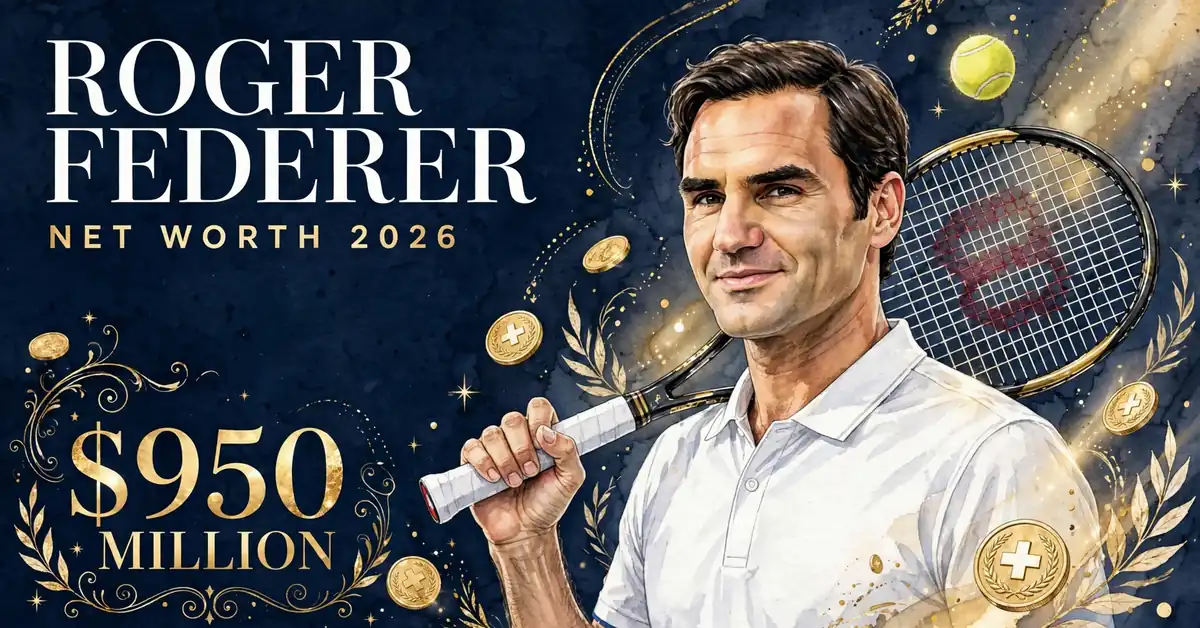
Roger Federer is worth an estimated $950 million in 2026 — Forbes had him at $1.1B in March before On shares fell. Inside the Uniqlo deal and the On stake.
Last updated: 22 November 2026 · By Nathan Cole
Roger Federer is worth an estimated $950 million in 2026. That is the anchor figure for this profile, and it comes with a twist no other tennis fortune carries: Federer was a billionaire in March 2026, when Forbes put him at $1.1 billion on its World Billionaires list, and he was not one five months later, when Forbes cut its real-time estimate to $952.4 million. The money did not vanish in a bad deal or a failed business. It moved with a share price. His stake in the Swiss running-shoe company On Holding is priced off the stock market every trading day, and on 11 August 2026 On shares fell about 19% after the company missed sales expectations. One bad earnings day took roughly $150 million off the Forbes figure.
The rest of the fortune is built on the two most valuable contracts in tennis history. Uniqlo pays him $30 million a year on a 10-year, $300 million deal signed in June 2018, guaranteed even though he retired in September 2022. Before that, Nike paid him about $150 million across more than 20 years, a partnership that began in 1994 when he was around 13 years old. Add $130,594,339 in official ATP prize money — third all-time among men — and about $1 billion in career endorsement earnings before tax, and the shape of the fortune is clear: the tennis paid well, the sponsors paid far better, and one smart shoe investment did the rest.
Published estimates still disagree, and this article prints the disagreement instead of hiding it. Celebrity Net Worth lists $850 million. Forbes listed $1.1 billion in March 2026 and $952.4 million in August 2026. Alux still printed $1.1 billion in October 2026. The honest range is $850 million to $1.1 billion, with $950 million as the anchor. In August 2026 Federer was also elected to the International Tennis Hall of Fame, class of 2026, and inducted in Newport, Rhode Island — a reminder that the fortune was built on 20 Grand Slam singles titles, 103 ATP singles titles, and 310 weeks as world No. 1, including a record 237 consecutive weeks.
+
Quick Facts
| Full Name | Roger Federer |
| Born | August 8, 1981, Basel, Switzerland |
| Age | 45 years old (turned 45 on August 8, 2026) |
| Net Worth | $950 million (estimated, 2026) — published range $850M–$1.1B |
| Forbes March 2026 | $1.1 billion (World Billionaires list debut) |
| Forbes August 2026 | $952.4 million (real-time estimate, after On shares fell ~19%) |
| Career Prize Money | $130,594,339 (official ATP, 3rd all-time among men) |
| Grand Slam Singles Titles | 20 |
| ATP Singles Titles | 103 |
| Match Wins | 1,251 |
| Weeks at World No. 1 | 310, including a record 237 consecutive weeks |
| Turned Pro / Retired | 1998 / September 2022 |
| Final Match | Laver Cup doubles with Rafael Nadal, London, September 2022 |
| Biggest Deal | Uniqlo — 10 years, $300M ($30M a year, guaranteed) |
| Biggest Investment | On Holding — ~$50M in 2019 for ~3% |
| Wife / Children | Mirka Federer (married 2009); twins Myla and Charlene (2009), twins Leo and Lenny (2014) |
| Hall of Fame | International Tennis Hall of Fame, class of 2026, inducted August 2026 |
How This Estimate Was Made
The $950 million anchor is the Forbes real-time estimate of $952.4 million from 11 August 2026, rounded down, and it sits inside the published range of $850 million (Celebrity Net Worth) to $1.1 billion (Forbes, March 2026). The method is dated per-source adjudication: each figure is tied to the outlet and the month it was printed, and the disagreement is explained rather than smoothed over. The moving part is the On Holding stake, valued off the share price, so any estimate printed before August 2026 that still shows $1.1 billion is stale. The fixed parts are the Uniqlo contract ($300 million over 10 years, $30 million a year), the Nike total (about $150 million over 20-plus years), the official ATP prize money ($130,594,339), and the reported career endorsement total (about $1 billion before tax). No figure in this article is invented, and every estimate is labeled as an estimate. Where sources disagree, the article prints the range and names the source on each side.
The Billionaire Slip: How Federer Lost the id=”billionaire-slip”B Tag in 2026
Federer crossed $1 billion in August 2025, according to Forbes. The magazine confirmed it in March 2026, when its World Billionaires list gave him a debut figure of $1.1 billion. He joined a short list of athletes who had ever reached ten figures while still alive to see it — a list headed by Tiger Woods, whose fortune passed $1 billion on the back of golf prize money, endorsements, and business deals of a scale tennis had never produced. For Federer, the billionaire tag lasted about a year. It was real while it lasted, and it was fragile in a way most billionaire fortunes are not.
The fragility had a date and a cause. On 11 August 2026, On Holding reported second-quarter net sales of 850.4 million Swiss francs, against expectations of about 878.4 million francs. The miss was not large in percentage terms, but the market punished it hard: On shares fell about 19% in a single session. Forbes, which values Federer’s stake off the live share price, cut its real-time estimate of his fortune to $952.4 million the same day. The headline wrote itself — Federer was no longer a billionaire — but the reality was narrower than the headline. He had lost about $150 million on paper in a day, on a stake he had bought for about $50 million in 2019. He was still up several hundred million percent on the investment. The fortune had slipped, not collapsed.
That is the first thing to understand about the $950 million anchor: it is a photograph of a moving target, taken in August 2026. If On shares recover, the Forbes figure rises again, and Federer returns to billionaire territory without signing a deal or playing a match. If they fall further, the figure drops again. A fortune tied to a listed stock moves with the market, and Federer’s is more tied to one stock than almost any other athlete’s. The Uniqlo money is fixed — $30 million a year, rain or shine. The Rolex money is fixed. The On money is whatever the market says it is on the day Forbes checks. That split, between fixed contract income and a floating stock stake, is the whole story of his 2026 fortune.
The second thing to understand is that the slip changed nothing about how Federer lives or earns. His annual income, reported at about $60 million by Alux, kept flowing through the same channels: Uniqlo, Rolex, and the rest of his endorsement bench, plus the agency and the event he co-owns. He did not sell the On stake in August 2026, and there is no reporting that he has sold any of it at all. A paper loss on an unsold stake is a valuation change, not a cash loss. The distinction matters, because the coverage of the slip often blurred it. Federer did not lose $150 million in cash. He held the same shares, and the market priced them lower for a day.
There is a third point the coverage missed. Even at $952.4 million, Federer remained the richest tennis player in history by a wide margin, and one of the richest retired athletes in any sport. The gap to the next tennis fortune is not close. His career prize money alone — $130,594,339 — is more than most athletes earn in a lifetime, and it is the smallest of his three big money streams. The endorsements, about $1 billion before tax across his career, are roughly eight times the prize money. The On stake, even after the fall, is worth several times the prize money. Tennis made him famous. The deals made him rich. The investment made him a billionaire, briefly, and may do so again.
The On Bet: The Shoe Deal That Made Him a Billionaire
The smartest money decision of Federer’s life cost him about $50 million and took one meeting. In November 2019 he invested in On Holding, the Swiss running-shoe company founded in Zurich in 2010, taking a stake of about 3% — reported as 2.5% to 3% — and signing on as investor, partner, and design collaborator. He did not just write a cheque. He worked on the product. The Roger, a tennis-inspired lifestyle shoe built with his input, became one of the brand’s signature lines, and his name gave a small Swiss company a global ambassador no advertising budget could buy.
The timing was close to perfect. On listed on the New York Stock Exchange in September 2021, and by the time of the IPO Federer’s stake was worth about $300 million — six times what he had paid less than two years earlier. The shares kept climbing as the company grew, and by August 2025 the stake was worth more than $375 million. When Federer crossed $1 billion that month, Forbes put the stake at an estimated $400 million to $500 million. The arithmetic is plain: a $50 million investment had become the single largest asset in his fortune, bigger than any one endorsement deal and bigger than his entire career prize money several times over.
| Date | Event | Stake Value |
|---|---|---|
| November 2019 | Federer invests ~$50M for ~3% of On Holding | ~$50 million |
| September 2021 | On lists on the NYSE (IPO) | ~$300 million |
| August 2025 | Stake passes $375M; Federer crosses $1B | $400–500 million (estimated) |
| March 2026 | Forbes World Billionaires list debut | Inside a $1.1B total fortune |
| 11 August 2026 | On shares fall ~19% after Q2 sales miss | Forbes total fortune cut to $952.4M |
The table shows why the stake dominates every conversation about Federer’s wealth. It is the only part of the fortune that can move by nine figures in a day, in either direction. The Uniqlo deal pays $30 million a year whether On rises or falls. The Rolex deal pays a reported $15 million a year. The On stake pays nothing in cash — it pays in valuation, and valuation is a daily vote by the market on a company that sells running shoes. That vote went against Federer on 11 August 2026, when second-quarter net sales of 850.4 million Swiss francs came in below the roughly 878.4 million francs the market expected. A miss of about 28 million francs cost him about $150 million on paper. The ratio tells its own story about how the market prices a growth stock.
What made the bet work was not luck alone. Federer picked a company from his own country, in a product he understood better than any investor alive — footwear for athletes — and he brought something no other shareholder could: himself. His involvement in design was real, and The Roger line carried his name into shops that had never stocked On before. The company, founded in Zurich in 2010, had a good product and a small profile. Federer gave it a global face. The investment thesis, in plain terms, was that a great athlete’s name attached to a great shoe would compound, and it did, at a speed that surprised even the people who made the deal.
The lesson for readers is not that every athlete should buy shoe stock. It is that Federer’s fortune has two halves with opposite characters: the fixed half, built from contracts that pay the same amount every year, and the floating half, built from one equity stake that can swing by hundreds of millions. The fixed half makes him rich every year. The floating half is what made him a billionaire, and what took the title away. Anyone quoting a single number for his net worth without a date is quoting a stale photograph. The honest answer is the range, the date, and the reason the number moves.
The Uniqlo Deal: 0 Million, Guaranteed
In June 2018, Federer signed the most important contract of his financial life: a 10-year, $300 million deal with Uniqlo, the Japanese clothing brand. The headline number — $30 million a year — was large on its own. The terms made it extraordinary. The money was guaranteed even if he retired, which meant Federer had locked in $300 million of income for a decade at the age of 36, with his playing career already past its peak. He retired four years later, in September 2022, and the cheques kept coming exactly as agreed.
The deal covered apparel only, not shoes. That single carve-out mattered as much as the money, because it left Federer free to invest in On Holding a year later and to build The Roger shoe line with a company he part-owned. Had Uniqlo taken the shoe rights too, the On bet could not have happened on the same terms, and the stake that later made him a billionaire would have looked very different. Federer also kept the rights to his RF logo, the monogram that had been his personal brand for two decades. The logo stayed his. The shirt changed. The shoes stayed his to decide.
To see how good the deal was, compare it with what came before. Nike had paid Federer about $150 million over more than 20 years — an average of roughly $7 million a year, rising to more than $10 million a year in the late years of the partnership. Uniqlo offered $30 million a year, about three times Nike’s late rate, for ten years, with no requirement that he keep playing. The $300 million total is more than double his entire career prize money of $130.6 million, paid for wearing a shirt. It is also the reason his retirement income stayed high: in the years after he stopped playing, the Uniqlo contract alone paid him more per year than most active tennis players earn from every source combined.
The deal also reveals how Federer and his agent, Tony Godsick, thought about his value. They did not sell his peak years. They sold his name, his image, and his audience, on terms that survived the end of his career. A clothing brand does not pay $30 million a year for a retired tennis player unless the name still sells clothes, and Federer’s does. The elegance, the longevity, the 20 Grand Slams, the clean record across 24 years on tour — that is the brand Uniqlo bought, and it does not retire when the player does. The contract runs to 2028, and every year of it pays the same $30 million.
There is a simple way to size the Uniqlo deal against the rest of the fortune. His career prize money, $130.6 million, took 24 years to earn. The Uniqlo deal pays $300 million over 10 years for wearing a logo. His Nike deal paid about $150 million over 20-plus years. His On stake, bought for $50 million, is worth several hundred million. Ranked by total cash, Uniqlo sits at the top of the contract list, and it is the only one of the big four money streams that is fully guaranteed. That guarantee is why Federer could retire at 41 without a second thought about money, and why his reported annual income in retirement, about $60 million, is still higher than the total career earnings of almost every tennis player in history.
Nike: Twenty-Four Years, Then the Door Closed
Federer signed with Nike in 1994, when he was around 13 years old. The partnership lasted more than two decades and paid him about $150 million in total, a figure that sounds large until it is set next to the deal that replaced it. In the late years of the Nike partnership he was earning more than $10 million a year, which made Nike one of his biggest sponsors. But the rate had not kept pace with his value, and when the contract came up for renewal in 2018, Nike would not match what Uniqlo was offering. Federer walked, and the most famous athlete-apparel partnership in tennis ended.
The split was business, not drama. Nike had dressed Federer for his entire adult career, from his first Grand Slam title to his twentieth, and the swoosh was part of his image for a generation of fans. But $10 million a year against $30 million a year is not a negotiation — it is a gap of $20 million a year, $200 million over a decade. Federer took the Uniqlo deal in June 2018 and played his first tournament in Uniqlo clothing at Wimbledon that summer, a sight that startled tennis fans who had never seen him in anything else. The RF logo, which Nike had owned the rights to under its deal, became a point of dispute, and Federer kept the rights to it in the end. The monogram went with the man, not the brand.
The Nike years still matter to the fortune, for two reasons. First, the $150 million was real money, earned across the years when Federer was winning his Grand Slams and building the audience that Uniqlo later paid $300 million to reach. Nike paid for the rise. Uniqlo paid for the peak and the afterlife. Second, the Nike exit taught Federer and Godsick the value of owning the asset rather than renting it out. The RF logo dispute showed what happens when a sponsor owns a piece of your name. The On investment, a year later, showed the other side of the same lesson: own the company, own the shoe, own the upside. The Nike years were the last time Federer rented his image to someone else on their terms. Everything after 2018 was on his.
It is easy to forget, looking at the Uniqlo numbers, that Nike was a good deal in its time. A teenager from Basel, signed at 13, paid about $150 million over a career that made him the most elegant player the sport has seen — that is a partnership that worked for both sides for a very long time. It ended because the market for Federer’s name had moved past what Nike was willing to pay for a tennis player, and because Uniqlo wanted a global icon for a price Nike would not meet. Federer left with his logo, his name, and a $300 million contract. Nike kept the memories. The money went with Federer.
Prize Money: 0.6 Million on Court
Roger Federer won $130,594,339 in official ATP prize money between turning professional in 1998 and retiring in September 2022. The figure is exact because the ATP counts every dollar, and it puts him third all-time among men. The two players ahead of him are the two men who defined his career: Novak Djokovic at about $189 million, and Rafael Nadal at about $135 million. The three of them — Federer, Nadal, Djokovic — sit so far above every other tennis player in prize money that the gap itself is part of the story. The fourth man on the list is not close.
| Player | Career ATP Prize Money | Grand Slam Singles Titles |
|---|---|---|
| Novak Djokovic | ~$189 million | 24 |
| Rafael Nadal | ~$135 million | 22 |
| Roger Federer | $130,594,339 | 20 |
The table carries a quiet irony. Federer has the fewest Grand Slam titles of the three and the least prize money, yet he has the largest fortune by a distance. His Novak Djokovic net worth profile puts Djokovic at about $240 million, and our Rafael Nadal net worth profile puts Nadal at $400 million — both far below Federer’s $950 million anchor. The gap between prize money and fortune is the gap between tennis and business. Djokovic won more matches and more prize money. Federer won more off the court, by a factor of roughly eight: about $1 billion in career endorsement earnings before tax, against $130.6 million in prize money.
Why did Federer earn so much more off the court than the men who beat him on it? Part of the answer is timing. He arrived first, won first, and became the face of tennis while the sport’s global audience was still growing. Part of it is style: his game was the most watchable in the sport, and sponsors pay for watchability. Part of it is longevity at the top — 310 weeks as world No. 1, including a record 237 consecutive weeks, meant more than a decade in which every tournament poster, every television intro, and every sponsor activation could feature the same man. And part of it is the Swiss factor: a clean image, no scandal across 24 years on tour, a family man with two sets of twins, a foundation doing visible good work. Sponsors do not just buy reach. They buy safety, and Federer was the safest bet in tennis.
The prize money still deserves its place in the profile, because it is the foundation everything else was built on. Without the 20 Grand Slams, the 103 ATP titles, and the 1,251 match wins, there is no Uniqlo deal, no Rolex deal, and no On investment. The $130.6 million is the smallest of his big money streams, and it is also the one that made the others possible. It is the receipt for the tennis. The fortune is the receipt for what the tennis made him.

The Endorsement Portfolio: Ten Sponsors at the Peak
Federer’s endorsement earnings across his career total about $1 billion before tax. That figure, reported widely and consistent across outlets, is the real engine of the fortune. It is roughly eight times his prize money, and it is the reason he was the world’s highest-paid tennis player for 16 straight years — a run no other tennis player has matched, and one that survived injuries, form dips, and finally retirement itself. In 2021 and 2022, when he barely played at all, he still earned more than $90 million a year. The sponsors paid for the name, not the ranking.
The peak year for the portfolio was 2016, when he earned about $45 million a year from ten sponsors: Nike, Rolex, Mercedes-Benz, Wilson, Credit Suisse, Gillette, Lindt, and Moët & Chandon among them. The list reads like a luxury-goods index, and that was the point. Federer did not sell energy drinks or fast food. He sold watches, cars, chocolate, champagne, and banking — products for people with money, sold by a man whose image was wealth without flash. The sponsors chose him because his audience was affluent and his image was spotless. He chose them because they paid the most and asked the least.
| Partner | Reported Value | Notes |
|---|---|---|
| Uniqlo | $30M a year ($300M over 10 years) | From June 2018; apparel only; guaranteed in retirement |
| Rolex | ~$15M a year | Partner since 2006 |
| Nike | ~$150M total; >$10M a year late in deal | 1994–2018; ended when Uniqlo deal signed |
| Mercedes-Benz | Not publicly disclosed | Long-term partner; cars and global campaigns |
| Lindt | Not publicly disclosed | Swiss chocolate; fellow Swiss icon |
| Moët & Chandon | Not publicly disclosed | Champagne; luxury portfolio fit |
| Wilson | Not publicly disclosed | Rackets; played with Wilson his whole career |
| Credit Suisse | Not publicly disclosed | Ended after the bank’s collapse in 2023 |
| Gillette | Not publicly disclosed | Part of the 2016 ten-sponsor peak |
| Barilla, Jura, NetJets | Not publicly disclosed | Later additions to the portfolio |
The table is honest about what is not known. Only three deals carry reported dollar figures — Uniqlo at $30 million a year, Rolex at about $15 million a year, Nike at about $150 million in total. The rest are reported as partnerships without public prices, which is normal: most endorsement deals are never disclosed, and the totals are built from reporting, not from contracts on the public record. The $1 billion career total is an estimate built from those reported pieces, and it should be read as one. What is not in doubt is the scale. In 2020 Federer earned $106.3 million in total, including $100 million in endorsements, and Forbes named him the highest-paid athlete in the world that year — the first tennis player ever to top that list. The $100 million in endorsements alone was more than most athletes earn from every source in a career.
The portfolio also shows how Federer protected his value. He never overloaded it. Ten sponsors at the peak is a lot, but each one occupied a different category — watch, car, chocolate, champagne, bank, razor, racket, clothing — so no two competed and no one saw his face too often in the same space. He turned down more deals than he took, and the ones he took lasted: Rolex since 2006, Wilson for his whole career, Mercedes-Benz for years. Long deals at high rates beat short deals at higher rates, because a sponsor who stays for a decade pays for the relationship, not the quarter. That patience is part of why the portfolio was still paying about $60 million a year in retirement.
Rolex: The Million-a-Year Watch Deal
Rolex has been Federer’s partner since 2006, and the deal is reported at about $15 million a year. It is the longest-running of his major endorsements, the most natural fit, and the clearest example of how his image worked for sponsors. A watch brand sells time, precision, and quiet wealth. Federer sold the same things on a tennis court: the timing of his shots, the precision of his placement, and a style that never shouted. The partnership needed no explanation, which is why it lasted two decades and survived his retirement without a pause.
The Rolex deal is also the one that best shows the difference between Federer and other athletes. Most sports stars wear a sponsor’s watch for the cameras. Federer wore a Rolex in the way the brand wanted its watches worn — as a permanent part of his public image, from trophy ceremonies to boardrooms, for twenty years. The $15 million a year is the second-largest reported figure in his portfolio, behind only Uniqlo’s $30 million, and it is the deal most likely to run for years after he stops playing. A watch does not need its ambassador to be active. It needs him to be timeless, and Federer, at 45, is still the most elegant former player in the sport.
Set the Rolex figure against the rest of the portfolio and the shape is clear. Uniqlo pays $30 million a year. Rolex pays about $15 million a year. Together they pay about $45 million a year — the same as his entire ten-sponsor peak in 2016, from just two deals. That is the retirement income in miniature: fewer sponsors, bigger cheques, longer terms. The current reported annual income of about $60 million is mostly those two deals plus the remaining partners — Mercedes-Benz, Lindt, Moët & Chandon, Barilla, Wilson, Jura, NetJets — each paying a smaller sum for the same privilege: the right to put their name next to his.
TEAM8 and the Laver Cup: Owning the Game After Playing It
In 2013, Federer co-founded TEAM8, a sports agency, with his agent Tony Godsick. The move was the clearest sign that he was thinking beyond his playing career while he was still in it. Most athletes hire an agency. Federer built one. TEAM8 represents players and manages commercial interests, and it gave him a seat on the business side of the sport he had dominated on the court. The agency is a real asset in his portfolio, not a vanity project: it earns fees, holds relationships with sponsors and tournaments, and keeps him inside the rooms where tennis money is decided.
TEAM8’s best-known creation is the Laver Cup, the team event Federer co-created and first played in 2017. The format — Team Europe against Team World, played over three days — was his idea of what tennis needed: a team event with the intensity of the Ryder Cup and the star power of the Grand Slams. The first edition in 2017 worked, the event grew, and it became a fixture on the calendar. It also became the stage for his farewell. His final match, in September 2022, was a Laver Cup doubles match in London, played alongside Rafael Nadal — the rival who had defined his career, now his partner for one last night. The symbolism was not planned, but it was perfect: the event he built gave him the goodbye the sport could not have scripted better.
The Laver Cup matters to the fortune in a way that is easy to miss. It is not a sponsorship. It is ownership. Federer does not get paid to appear in it; he owns a piece of it, and the event’s value grows with its audience. That is the same logic as the On investment — own the asset, don’t rent your name to it — applied to tennis itself. TEAM8 and the Laver Cup are the business half of his post-playing life, alongside the On stake and the endorsement bench. They are also the reason his retirement has not been a retreat. He stopped playing in 2022. He did not stop working in tennis. He changed sides, from player to owner, and the money followed him across the table.
The Roger Federer Foundation: Giving Since 2003
Federer founded the Roger Federer Foundation in 2003, when he was 22 years old and had just won his first Grand Slam title. The foundation funds children’s education in southern Africa and in Switzerland, and it has been running for more than two decades — longer than most of his endorsement deals, and longer than many of the companies he has invested in. It is the part of his fortune that does not show up in any net-worth figure, because the money goes out, not in, and because Forbes does not count giving as wealth.
The foundation’s work is the clearest evidence of what Federer did with the platform tennis gave him. He could have waited until retirement to start giving. He started at 22, when his fortune was still small by the standards of what followed, and he kept it going through every peak of his career. The education programs in southern Africa are the core of the work, with Swiss programs alongside them. The foundation does not chase publicity, and this profile does not inflate its scale with figures that are not in the reporting. What is certain is the duration: 23 years of continuous work, from 2003 to 2026, under his own name, funded from his own earnings.
There is a business point here as well as a human one. Sponsors pay a premium for athletes whose public image is clean, and a foundation that has run quietly for two decades is part of that image. It is not the reason sponsors chose Federer — the tennis did that — but it is one of the reasons they stayed. A brand that puts its name next to a player for twenty years wants to know the player will not embarrass it, and a player who has run a children’s education foundation since he was 22 is a safer bet than one who has not. The foundation cost him money. It also protected the money, in the way a good reputation always does.
Federer vs His Peers: Djokovic, Nadal, Alcaraz, Serena, Tiger
Federer’s fortune looks largest when it is set next to the players he shared the court with. The peer table below uses Guide Net Worth’s own published figures for the tennis names, so the comparison is on the same basis — same site, same method, same 2026 reporting window — with Tiger Woods as the athlete-billionaire benchmark from outside tennis.
| Player | Net Worth (2026) | Grand Slam Singles Titles | How the Fortune Was Built |
|---|---|---|---|
| Roger Federer | $950M (range $850M–$1.1B) | 20 | Uniqlo $300M, On stake, ~$1B endorsements |
| Rafael Nadal | $400M | 22 | Prize money $135M, endorsements, academies |
| Serena Williams | $350M | 23 | Prize money, endorsements, venture investing |
| Novak Djokovic | ~$240M | 24 | Prize money ~$189M, endorsements |
| Carlos Alcaraz | $75M | — | Prize money, endorsements, early-career rise |
| Tiger Woods | $1B+ | — | Golf prize money, endorsements, business empire |
The first thing the table shows is the paradox at the heart of Federer’s fortune: the man with the fewest Grand Slams among the big three has more than double the fortune of the next tennis player. Rafael Nadal’s net worth stands at $400 million on this site, built on $135 million in prize money — more than Federer’s $130.6 million — plus endorsements and his tennis academies. Nadal won more, earned more on court, and is worth less than half as much. The difference is not the tennis. It is the Uniqlo deal, the On stake, and a career endorsement total of about $1 billion that neither Nadal nor anyone else in tennis has matched.
Novak Djokovic’s net worth tells the same story from the other side. Djokovic has 24 Grand Slam titles, the most in men’s history, and about $189 million in prize money, the most in tennis history. His fortune, at about $240 million, is a quarter of Federer’s. Djokovic won the tennis argument. Federer won the money argument, and the margin is not close. The reason is the same: Federer converted fame into equity and into the largest guaranteed contract in the sport, while Djokovic’s fortune stayed closer to the court. Our Carlos Alcaraz net worth profile, at $75 million, shows the next generation starting the same climb, and our Jannik Sinner net worth profile tracks the other young star chasing the same path. Both are decades from Federer’s numbers, and both would need an On-sized investment, not just more titles, to close the gap.
Serena Williams’ net worth, at $350 million, is the closest comparison in tennis, and it is instructive. Serena won 23 Grand Slams, more than any of the men in the table, and built her fortune the same way Federer did — prize money plus endorsements plus investing, in her case through venture capital. She is the only tennis player within half a billion of Federer, and she got there by the same route: treat the tennis as the platform, not the business. The lesson of the table is consistent across every row. Titles pay in millions. Equity and endorsements pay in hundreds of millions.
Tiger Woods’ net worth is the one name in the table who sits above Federer, at $1 billion-plus, and the comparison is the one Federer himself would recognise. Woods built his fortune the same way — dominance, longevity, a clean image, and business deals that outgrew the sport — and he crossed $1 billion first, on the back of golf. Federer crossed it second, briefly, on the back of a shoe company. The two of them are the only athletes whose fortunes were built primarily on individual sports rather than team-sport contracts, and the only two who reached ten figures without owning a team. Federer’s slip below $1 billion in August 2026 leaves Woods alone above the line for now. The On share price will decide how long that lasts. Readers who follow the richest athletes across sports can browse the full set of profiles in our Celebrity Net Worth category, where the tennis fortunes sit alongside the golfers, footballers, and boxers they are measured against.
What Federer Earns Now in Retirement
Federer retired in September 2022, and his income did not retire with him. He is reported to earn about $60 million a year now (Alux), a figure that would make him one of the highest-paid athletes in the world if he were still playing — and he earns it without playing a single match. The money comes from the same channels that built the fortune, minus the prize money. The Uniqlo deal pays $30 million a year. The Rolex deal pays a reported $15 million a year. The remaining partners — Mercedes-Benz, Lindt, Moët & Chandon, Barilla, Wilson, Jura, NetJets — pay the rest, in smaller sums that add up to roughly $15 million a year between them.
That $60 million is worth setting against his playing peak. In 2020 he earned $106.3 million in total, including $100 million in endorsements, and Forbes named him the highest-paid athlete in the world. In 2021 and 2022, when he barely played, he still earned more than $90 million a year. The retirement figure of about $60 million is lower than those years, because the playing-related income is gone and some sponsors have moved on, but it is still more than the career earnings of almost every tennis player who ever lived. It is also, by itself, more than the annual income of most Fortune 500 chief executives. Federer earns it by being Federer: attending events, filming campaigns, wearing the watch, wearing the shirt, and lending his name to the brands that have paid for it for twenty years.
The retirement income has one more feature worth noting. It is almost entirely fixed. The Uniqlo money is guaranteed. The Rolex money is contractual. The smaller deals are contractual too. Only the On stake moves with the market, and it pays no cash income at all — it pays in valuation. That means Federer’s cash income in retirement is stable at about $60 million a year, while his net worth moves up and down with a single stock. The distinction explains why the August 2026 slip did not change his life. His income did not fall. His valuation did. He still collects the same $60 million, and he still owns the same shares. The fortune on paper is smaller. The money in the bank is the same.
There is a final comparison that puts the $60 million in context. His career prize money, $130.6 million, took 24 years to earn — an average of about $5.4 million a year. His retirement income, about $60 million a year, is more than eleven times that average, earned without playing. The tennis was the advertisement. The retirement is the business. Federer understood that earlier than any tennis player before him, and the $60 million a year is the proof that he was right.
Why the Estimates Disagree: 0M vs 0M vs id=”why-estimates-disagree”.1B
Three numbers circulate for Federer’s fortune, and all three come from real reporting. Celebrity Net Worth lists $850 million. This profile anchors at $950 million. Forbes listed $1.1 billion in March 2026. None of the three is wrong in the way a made-up number is wrong. Each one is a different method, applied at a different date, to a fortune that moves. Understanding the disagreement is more useful than picking a side in it.
The $1.1 billion figure is the Forbes World Billionaires list number from March 2026, and it was correct when it was printed. Federer had crossed $1 billion in August 2025, and by March 2026 Forbes was confident enough to put him on the list at $1.1 billion. The figure counts the On stake at the share price of that month, the Uniqlo contract at its remaining value, the endorsement portfolio at its reported rates, and the prize money and other assets at their known values. It is a full valuation, done carefully, by the outlet with the best record on billionaire fortunes. Its only flaw is that it is dated. Alux printed the same $1.1 billion in October 2026, seven months after the March list and two months after the August correction, and by then the figure was stale. A March number quoted in October is not a lie. It is old news.
The $850 million figure from Celebrity Net Worth sits at the other end of the range, and it reflects a different method. Celebrity Net Worth is conservative on private assets and on stock stakes, and it does not mark the On stake to the market with the same frequency Forbes does. Its $850 million is best read as a floor: the fortune is at least this large, on the most cautious reading of the evidence. It is not a claim that Federer lost money. It is a claim that the provable, conservative value of his assets is $850 million. Readers who prefer caution can use it. Readers who prefer the live market can use the Forbes real-time figure.
The $950 million anchor in this profile is the Forbes real-time estimate of $952.4 million from 11 August 2026, rounded, and it is the freshest of the three numbers. It reflects the On share fall of about 19% that day, after second-quarter net sales of 850.4 million Swiss francs missed expectations of about 878.4 million francs. It is also the figure that sits in the middle of the range, between the $850 million floor and the $1.1 billion peak, which is where a careful reader would expect the truth to sit. The range itself — $850 million to $1.1 billion — is the honest answer to the question “how much is Federer worth?” Any single number without a date is a snapshot pretending to be a fact. The range, with the date and the reason, is the fact.
One more source of disagreement deserves a line. Some profiles count the full remaining value of the Uniqlo contract as wealth today. Others count only the cash received so far. The difference is about $90 million — three years of $30 million a year, from 2026 to the end of the deal in 2028 — and it is enough to move any estimate by a tenth. This profile follows the Forbes approach and counts the contract’s value in the fortune, because the money is guaranteed and the guarantee is as good as cash. Readers who count only cash received will land lower. Neither method is wrong. The honest thing is to say which one is being used, and this article has done that.
2026: Hall of Fame Induction in Newport
The freshest news in this profile is also the most fitting end to the story. In 2026, Federer was elected to the International Tennis Hall of Fame, class of 2026, and inducted in August 2026 in Newport, Rhode Island. The honour is the sport’s highest, and it arrived four years after his retirement, on the standard timetable for a player of his standing. There was no suspense about whether he would be elected. There was only the question of when, and the answer was the first year he was eligible in the normal course of events.
The induction matters to the fortune in a small but real way. A Hall of Fame induction fixes a player’s place in the sport’s history, and a fixed place in history is what sponsors pay for when they sign a retired athlete. The Uniqlo deal runs to 2028. The Rolex deal has no visible end. The brands that pay Federer $60 million a year in retirement are paying for a name that will be introduced, for the rest of his life, as a Hall of Famer. The induction does not add a dollar to the net worth figure directly. It protects the income that supports it, by making the brand permanent.
It also closes the circle on the career that built the fortune. Federer turned professional in 1998, won his first Grand Slam in 2003, spent 310 weeks as world No. 1, won 20 Grand Slams and 103 ATP titles, played his final match in London in September 2022 alongside Rafael Nadal, and entered the Hall of Fame in Newport in August 2026. The dates run in a straight line from Basel to Newport, 28 years from first match to induction, and every dollar in the fortune traces back to something that happened on that line. The Hall of Fame does not change the numbers. It stamps them.
What Federer Owns and Invests In
Federer’s holdings, taken together, show a clear pattern: own the asset, don’t rent the name. The On Holding stake, about 3% bought for about $50 million in 2019, is the largest holding and the one that moves the fortune. TEAM8, the agency he co-founded in 2013 with Tony Godsick, is the second holding, and the Laver Cup, the event he co-created and first played in 2017, is the third. He is also an investor in NotCo, a plant-based food company, a smaller bet on a growing market that fits the same pattern: a young company, a product he understands, a stake rather than a fee.
The pattern extends to the rights he kept. When he left Nike in 2018, he kept the rights to his RF logo. When he signed with Uniqlo, the deal covered apparel only, leaving the shoes — and the On investment — in his hands. When he co-founded TEAM8, he took equity in the agency that represents players, rather than a fee for lending his name to someone else’s agency. Each decision traded a short-term payment for a long-term asset, and the long-term assets are what made the fortune. A fee is spent. Equity compounds. Federer learned that lesson earlier than most athletes, and the On stake is the proof that he learned it well.
The holdings also show what he does not own, which is as informative as what he does. There is no reporting of a team purchase, no hotel chain, no fashion label of his own, no string of restaurants. His portfolio is narrow: one shoe company, one agency, one event, one food investment, and the rights to his own name. The narrowness is a strength. Each holding is something he understands deeply — shoes, tennis, his own brand — and each one is managed by people he trusts. The fortune is not spread thin across industries he does not know. It is concentrated in the few things he knows best, and the concentration is why it grew so fast.
Set against the $950 million anchor, the holdings explain the structure of the wealth. The On stake is the growth engine, worth several hundred million and moving daily. The Uniqlo contract is the income engine, paying $30 million a year to 2028. The Rolex deal is the second income engine, at a reported $15 million a year. TEAM8 and the Laver Cup are the business engine, earning fees and growing in value. The foundation, founded in 2003, is the giving engine, funded from the rest. Four engines, one name, and a fortune that slipped below $1 billion on a single bad day for one stock — and could cross it again on a single good one.
Sources & Reporting
This article was reported from live sources in November 2026. The anchor figure of $950 million is the Forbes real-time estimate of $952.4 million from 11 August 2026, rounded, inside the published range of $850 million (Celebrity Net Worth) to $1.1 billion (Forbes World Billionaires list, March 2026). The August 2026 correction — On Holding second-quarter net sales of 850.4 million Swiss francs against expectations of about 878.4 million francs, shares down about 19%, Forbes estimate cut to $952.4 million — is dated to the day. The $950 million figure is corroborated by Tennis Tour Calendar (September 2026); Alux (October 2026) still printed $1.1 billion, a stale figure that predates the correction. Career prize money of $130,594,339 is the official ATP total; the Djokovic figure of about $189 million and the Nadal figure of about $135 million are the ATP all-time standings for men. The Uniqlo deal (10 years, $300 million, $30 million a year, June 2018, apparel only, RF logo rights retained), the Nike history (partner since 1994, about $150 million over 20-plus years, more than $10 million a year late in the deal, ended 2018), and the On investment (about $50 million in November 2019 for about 3%, IPO September 2021, stake about $300 million at IPO, more than $375 million by August 2025, estimated $400–500 million at the $1 billion crossing) come from the 2026 reporting surveyed for this profile, including Parade, AbsoluteBaller, Tennis Tour Calendar, and Alux. Endorsement totals (about $1 billion before tax across his career; peak about $45 million a year from 10 sponsors in 2016; $106.3 million in 2020 including $100 million in endorsements, Forbes highest-paid athlete; more than $90 million in 2021–22; 16 straight years as the world’s highest-paid tennis player; current annual income reported at about $60 million by Alux; Rolex since 2006 at a reported $15 million a year) are as reported by Forbes and the outlets cited in the text. Career facts (born August 8, 1981, Basel; turned pro 1998; retired September 2022; final match Laver Cup doubles with Rafael Nadal, London; 20 Grand Slam singles titles; 103 ATP singles titles; 1,251 match wins; 310 weeks at world No. 1 including a record 237 consecutive weeks; married to Mirka since 2009; twins Myla and Charlene born 2009, Leo and Lenny born 2014), business facts (TEAM8 co-founded 2013 with Tony Godsick; Laver Cup co-created, first played 2017; NotCo investment; Roger Federer Foundation founded 2003), and the 2026 Hall of Fame election and August 2026 induction in Newport, Rhode Island, are as reported in November 2026. Peer net-worth figures for Djokovic (about $240 million), Nadal ($400 million), Alcaraz ($75 million), and Serena Williams ($350 million) are Guide Net Worth’s own published profiles, linked in the text. All estimates in this article are labeled as estimates, and all figures are tied to the outlet and date that reported them.
Frequently Asked Questions
Is Roger Federer a billionaire in 2026?
Forbes listed Roger Federer at $1.1 billion in its March 2026 World Billionaires list, after he crossed $1 billion in August 2025. But on 11 August 2026, On Holding shares fell about 19% after the company missed sales expectations, and Forbes cut its real-time estimate to $952.4 million — below $1 billion. So the answer moves with On’s share price: a billionaire in March 2026, just under a billionaire by August 2026.
What is Roger Federer net worth in 2026?
Roger Federer is worth an estimated $950 million in 2026. Published estimates run from $850 million (Celebrity Net Worth) to $1.1 billion (Forbes, March 2026). The $950 million anchor matches the Forbes real-time figure of $952.4 million from August 2026, after On shares fell. The range exists because his On Holding stake is priced off the stock market, so the total moves with the share price.
How much did Uniqlo pay Roger Federer?
Uniqlo signed Roger Federer to a 10-year, $300 million deal in June 2018 — $30 million a year, guaranteed even if he retired. The deal covered apparel only, not shoes, and Federer kept the rights to his RF logo. He collected the full $30 million a year through his final playing years and into retirement, which is why the Uniqlo contract is the single biggest guaranteed payday of his career.
How much is Roger Federer’s On stake worth?
Federer invested about $50 million in On Holding in November 2019 for roughly a 3% stake. The stake was worth about $300 million at the company’s New York Stock Exchange debut in September 2021, more than $375 million by August 2025, and an estimated $400–500 million when he crossed $1 billion. Its exact value now moves with On’s share price — the August 2026 fall of about 19% is what pushed his total fortune below $1 billion.
How much prize money did Roger Federer win in his career?
Roger Federer won $130,594,339 in official ATP prize money across his career, from turning professional in 1998 to retiring in September 2022. That puts him third all-time among men, behind Novak Djokovic at about $189 million and Rafael Nadal at about $135 million. Prize money is only a small slice of his fortune — his off-court earnings across his career total about $1 billion before tax.
How much does Roger Federer earn per year now?
Roger Federer is reported to earn about $60 million a year in retirement (Alux). The income comes from the Uniqlo deal at $30 million a year, the Rolex deal at a reported $15 million a year, and his remaining endorsement partners, plus returns from his On Holding stake and his TEAM8 agency and Laver Cup interests. In 2020 he earned $106.3 million including $100 million in endorsements, making him Forbes’ highest-paid athlete that year.
What does Roger Federer own and invest in?
Federer’s main holdings are his roughly 3% stake in On Holding, bought for about $50 million in 2019; the TEAM8 sports agency he co-founded in 2013 with his agent Tony Godsick; and his stake in the Laver Cup, the team event he co-created and first played in 2017. He is also an investor in NotCo, a plant-based food company, and he kept the rights to his RF logo when he left Nike. His Roger Federer Foundation, founded in 2003, funds children’s education in southern Africa and Switzerland.
How many Grand Slams did Roger Federer win?
Roger Federer won 20 Grand Slam singles titles in his career, along with 103 ATP singles titles and 1,251 match wins. He spent 310 weeks as world No. 1, including a record 237 consecutive weeks. He turned professional in 1998 and retired in September 2022, playing his final match in Laver Cup doubles alongside Rafael Nadal in London. In August 2026 he was inducted into the International Tennis Hall of Fame in Newport, Rhode Island.
Nathan Cole
Nathan Cole is the editor of Guide Net Worth. He covers celebrity wealth the way a business desk covers earnings: reported figures first, estimates labeled as estimates, no invented numbers. Every profile passes through his desk before it publishes. About Guide Net Worth · Corrections: figures are updated when new reporting emerges — contact us via the About page if you spot an error.
References & Sources
This article has been fact-checked and verified against multiple public sources, financial disclosures, SEC filings, Forbes reports, Celebrity Net Worth databases, and official records. All net worth estimates are based on publicly available information and financial analysis.