Rafael Nadal net worth 2026: estimated $220M–$400M, anchored at $400M. Inside $134.9M in prize money, the academy sale and the brands that built his fortune.
Last updated: November 18, 2026 · By Nathan Cole
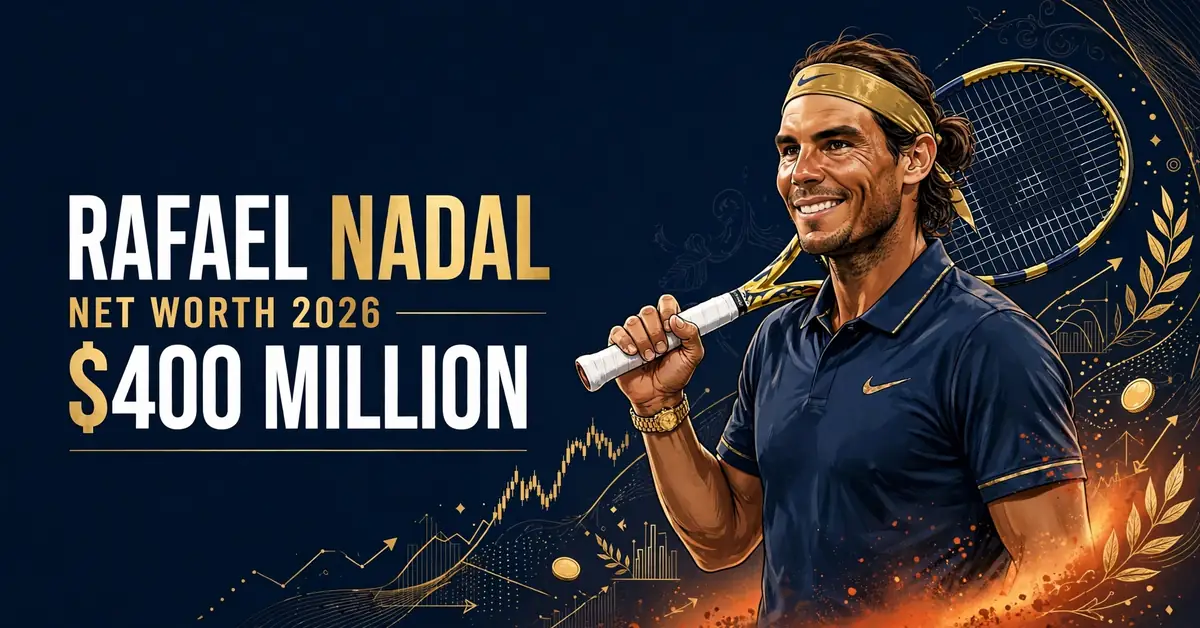
Rafael Nadal’s net worth in 2026 is estimated at $220 million to $400 million, anchored at $400 million. The anchor moved in November 2026, when Celebrity Net Worth revised its long-standing $220 million figure up to $400 million, and Forbes Spain put his fortune at €400 million in its rich list published 3 November 2026. Rafael Nadal Parera, born 3 June 1986 in Manacor, Mallorca, retired from professional tennis in November 2024 with 22 Grand Slam singles titles, 92 ATP titles, and $134,946,100 in official career prize money. Two years into retirement, his money story has shifted from pay cheques to balance sheets: a tennis academy sold in part for about $107 million, a hotel brand that opened its fifth property in November 2026, and a family holding company whose filed accounts show €375.4 million in net equity.
That last number is the reason this profile exists in its current form. Most pages on the internet still say $220 million. That figure was correct for years, then it stopped being correct, and the pages that carry it never noticed. The freshest reporting says the fortune is closer to $400 million, and Spanish corporate filings back the higher number with unusual force for a celebrity estimate. This article lays out every published figure with its date and source, explains why the range is so wide, and breaks down the three engines that built the fortune: $134.9 million in prize money, more than $550 million in pretax career earnings reported by Forbes, and a post-playing business portfolio — academy, hotels, real estate — that keeps growing after the last match was played.
Quick Facts
| Net Worth (2026) | $220–400 million (estimated, anchored at $400M) |
| Full Name | Rafael Nadal Parera |
| Born | 3 June 1986, Manacor, Mallorca, Spain |
| Age | 40 (turned 40 in June 2026) |
| Height | 6 ft 1 in (185 cm) |
| Career Prize Money | $134,946,100 (ATP official, singles + doubles) |
| Grand Slams | 22 singles titles, including a record 14 French Opens |
| ATP Titles | 92 singles titles; 209 weeks at world No. 1 |
| Retired | November 2024, Davis Cup Finals, Málaga |
| Main Income Sources | Prize money, Nike, Babolat, Kia, Richard Mille, Rafa Nadal Academy, ZEL Hotels, real estate |
| Spouse | María Francisca Perelló (married October 2019); one son, born October 2022 |
How This Estimate Was Made
Nadal has never published a personal balance sheet, and no outlet has seen one. Every net worth figure for him is an estimate built from public material. This profile anchors on the freshest published estimates — Celebrity Net Worth at $400 million (revised November 2026) and Forbes España at €400 million (3 November 2026) — and cross-checks them against the hardest evidence available: Spanish corporate filings for Aspemir, the Nadal family holding company, which ended 2024 with €375.4 million in net equity, roughly $428 million. Older pages still carrying $220 million are shown in the worksheet below with their dates, so readers can see exactly when the number moved and why.
Prize money comes from the ATP’s official database. Career earnings totals come from Forbes’ reporting, including its year-by-year lists. Endorsement figures are reported contract values from named outlets, not guesses. Business figures — the academy stake sale, hotel openings, real-estate projects — come from company announcements and reporting in 2025 and 2026. Where sources disagree, this article publishes a range and says so. Where a fee was never disclosed, such as Nadal’s Saudi ambassador pay, the article says it was never disclosed rather than inventing one.
+
Rafael Nadal’s Net Worth in 2026: The 0 Million Answer
The short answer is $400 million, with a published range of $220 million to $400 million. The range matters more than the single number, because the gap between its ends tells the story of the last twelve months. For most of a decade, every major outlet agreed on roughly $220 million. Celebrity Net Worth carried that figure for years, and it spread across hundreds of smaller sites until it became the default answer on the internet. Then, in November 2026, Celebrity Net Worth revised its Nadal page to $400 million, citing Spanish corporate filings that had not been part of the old estimate. Forbes Spain moved the same way in the same month, putting his fortune at €400 million in its rich list published 3 November 2026.
Two independent outlets landing on the same round number in the same month is not a coincidence. Both were reading the same underlying evidence: the filed accounts of Aspemir, Nadal’s investment holding company. Aspemir ended 2024 with €375.4 million in net equity, equivalent to roughly $428 million, up from €341.5 million, about $389 million, a year earlier. The company also reported a €14.5 million profit in 2024, around $16.5 million, after an extraordinary €94.1 million profit in 2023, about $107 million, driven largely by a restructuring and partial sale of the tennis-academy business. Those are filed numbers, not estimates, and they sit above the old $220 million anchor by a wide margin.
One caution belongs right next to the headline. Aspemir’s €375.4 million is company equity, not cash in Nadal’s personal bank account. A holding company’s net equity includes the value of its stakes — the academy, property, investments — minus its liabilities, and it is not the same as a person’s spendable wealth. Celebrity Net Worth makes the same point on its own page. But the direction of the evidence is clear: the filings support a fortune far closer to $400 million than to $220 million, and the two freshest published estimates agree on the higher figure. This profile anchors at $400 million and keeps the $220 million figure visible as the bottom of the range, because most of the internet still shows it and readers deserve to know why.
Forbes España’s own history with this number strengthens the case. The Spanish edition of Forbes has tracked Nadal’s fortune for years: €297 million in its 2023 survey of the richest people in Spanish sport, €310 million in November 2024 — the highest of any Spanish athlete that year — then €345 million in its 2025 regional breakdown, and now €400 million in November 2026. That is a steady climb of about €100 million in three years, not a sudden jump. The climb matches what happened off the court in that period: the academy stake sale, the hotel openings, and the compounding value of a portfolio that was built over two decades and never cashed out.
Why Estimates Range From 0 Million to 0 Million
Net worth estimates for a retired athlete disagree for a simple reason: nobody outside his family and his accountants can see the full picture. Prize money is public. Endorsement contracts are partly public, usually as reported ranges rather than exact figures. Business valuations are private, and they move with deals that are announced months after they close. Three different methods produce three different numbers, and each one is honest about a different slice of the truth.
The first method is the celebrity-wealth-site estimate. Outlets such as Celebrity Net Worth and WealthyGorilla build a number from public earnings, reported deals, and property records, then subtract an allowance for tax and spending. That method produced $220 million and held it for years, because it was slow to pick up the academy business as an asset rather than a hobby. A tennis academy looks like a cost centre until someone pays €94 million for a minority stake in it. The moment GPF Capital bought 44.9% of the Rafa Nadal Academy in 2025, the academy stopped being an expense line and became a priced asset — and the old estimate had no room for it.
The second method is the modelled estimate. Grizzly Bulls, which reviewed its evidence through 22 October 2026, publishes a $240 million base case with a $110 million bear case and a $450 million bull case. Its logic is conservative: it counts only personally retained tennis and commercial capital, after tax, agents, coaching, and travel costs, and it treats private business stakes as uncertain. The model’s bull case reaches $450 million, above even the new Celebrity Net Worth figure, which shows how much of the disagreement is about what counts rather than what was earned. Forbes reported more than $550 million in pretax career earnings by November 2024. Nobody disputes that Nadal earned that much. The argument is about how much of it survived tax, fees, and two decades of spending — and that is a question no public source can settle exactly.
The third method is the filings method. Spanish companies must file accounts, and Aspemir’s filings give a rare hard anchor: €375.4 million in net equity at the end of 2024. That figure does not settle the debate either. Aspemir is a holding company, and its equity includes assets that may be shared with family members and partners, while Nadal’s personal wealth also includes things held outside Aspemir. But it sets a floor under the discussion that the older estimates never had. A $220 million net worth is hard to square with a single holding company worth $428 million in equity, even allowing for shared ownership and debt. That tension is the real story of the November 2026 revision: the filings arrived, the old number stopped adding up, and the outlets that read the filings moved.
There is also a timing problem that keeps stale figures alive. Search results reward old pages. A page published in 2024 saying $220 million can keep ranking in 2026 if nobody updates it, and the sites that copy from it repeat the number without checking the source. WealthyGorilla’s page was updated 17 November 2026 and still shows $220 million. SportsNile’s page was updated 13 September 2026 and still shows $220 million. Readers who land on those pages get a number that was defensible two years ago and is not defensible now. The worksheet in the next section dates every figure so the revision is visible at a glance.
The Per-Source Worksheet: Every Published Figure, Dated
Most net worth articles quote one number and move on. That habit is how a stale figure survives for years. The table below lists every significant published estimate for Nadal, with its date and what it is based on, so readers can judge the anchor for themselves.
| Source | Figure | Date | Basis |
|---|---|---|---|
| Celebrity Net Worth | $400 million | Nov 2026 (snapshot 5 Nov 2026) | Aspemir filings; revised up from $220M |
| Forbes España | €400 million | 3 Nov 2026 | Forbes Spain rich list; richest Spanish athlete |
| Aspemir filings | €375.4M equity (~$428M) | End of 2024 | Filed accounts; €14.5M profit in 2024 |
| Forbes España | €345 million | Dec 2025 | Regional rich-list breakdown |
| TennisNetWorth | ~$300 million | 11 Nov 2026 | Midpoint estimate; no filings cited |
| Grizzly Bulls | $240M base ($110M–$450M) | Evidence to 22 Oct 2026 | Modelled retained capital |
| WealthyGorilla | $220 million | Updated 17 Nov 2026 | Stale; repeats pre-revision figure |
| SportsNile | $220 million | Updated 13 Sep 2026 | Stale; repeats pre-revision figure |
| Forbes España | €310 million | Nov 2024 | Richest Spanish athlete that year |
| Forbes España | €297 million | 2023 | Richest in Spanish sport survey |
Read the table from the bottom up and the story is a steady climb: €297 million, €310 million, €345 million, €400 million. Read it from the top down and the story is a split: the two freshest estimates agree on the higher end, the modelled estimate sits in the middle, and the pages that still show $220 million are the ones that have not caught up with the filings. The $300 million midpoint from TennisNetWorth, published 11 November 2026, is the only fresh estimate that sits between the camps, and it cites no filings — it reads as a hedge between the old number and the new one.
The honest way to present this is the range this profile uses: $220 million to $400 million, anchored at $400 million. The bottom of the range is what most of the internet still says. The top is what the freshest reporting says, backed by filed accounts and a Forbes rich list published in the same month. A reader who wants the single number should take $400 million. A reader who wants the full picture should keep the range in mind, because the gap between the two ends is a measure of how fast Nadal’s business life moved after he stopped playing.
Prize Money: 4,946,100 and Where It Came From
Prize money is the one part of Nadal’s fortune that is exact to the dollar. The ATP’s official database lists his career prize money at $134,946,100, covering singles and doubles combined across a professional career that ran from 2001 to November 2024. That total puts him second all-time among men, behind only Novak Djokovic, whose career prize money passed $190 million. It is also the most misunderstood number in Nadal’s finances, because readers keep treating it as his wealth. It is not. It is the gross pay for playing tennis, before tax, before his team’s salaries, before travel, and before the agent’s cut — and it is less than a quarter of what Forbes says he earned before tax over his career.
The prize money piled up in a shape that mirrors his career. The early years were lean by the standards of what followed: a teenager from Mallorca winning his first ATP match at 15 and his first French Open at 19, in 2005, in his debut appearance at Roland Garros. The peak years, roughly 2008 to 2013, produced the biggest cheques, as Grand Slam winner’s purses climbed past $2 million and then $3 million. His last great payday came at the 2022 French Open and Australian Open, the two titles that took him to 22 majors. By the time injuries ended his career, the annual prize money had slowed to a trickle — he played only a handful of events in 2023 and 2024 — but the lifetime total was already fixed in the record books.
Two details in the ATP figure deserve attention. First, it includes doubles prize money, which is small for Nadal: his doubles earnings are a fraction of the total, and his one doubles highlight, the Olympic gold medal with Marc López at Rio 2016, paid no prize money at all. Second, the figure excludes everything that made the real money: appearance fees, exhibition guarantees, and image-rights payments, none of which the ATP counts. The Six Kings Slam in Riyadh in October 2024, an exhibition, reportedly paid its first-round losers $1.5 million each and its winner, Jannik Sinner, $6 million. Nadal played in that event a month before retiring. None of that money appears in the $134.9 million. The ATP total is the floor of his tennis income, not the ceiling.
There is also the tax question, which most net worth pages skip. Nadal has lived in Mallorca throughout his career and paid Spanish tax, which is among the highest in Europe for top earners. Spain’s top marginal rates run above 45%, and the Balearic Islands add their own regional rates. A rough, labelled-as-illustrative pass through the numbers shows why $134.9 million in prize money never meant $134.9 million kept: after Spanish tax, a coaching team led for most of his career by his uncle Toni Nadal, a physio, a fitness trainer, an agent, and two decades of global travel, the retained share of prize money alone was likely well under half. That is not a criticism of his spending. It is the arithmetic that explains why endorsements, not prize money, built the fortune — and why the modelled estimates in the previous section apply such a heavy haircut to the gross earnings total.
The 22 Grand Slams That Built the Brand
Nadal’s wealth starts with a record that no sponsor could buy: 22 Grand Slam singles titles, including 14 French Opens, a record at a single tournament that may never be broken. He won his first in Paris in 2005, aged 19, and his last there in 2022, aged 36 — seventeen years apart, on the same crushed brick. The other eight came at the US Open (four), Wimbledon (two), and the Australian Open (two). He completed the career Grand Slam in 2010, at 24, and added the Olympic singles gold in Beijing in 2008 and the doubles gold in Rio in 2016, giving him the career Golden Slam. His full story, from a childhood in Manacor hitting against a wall to the farewell in Málaga, is covered in our Rafael Nadal biography; this section sticks to what those titles were worth.
The titles were worth money in three ways. The first was direct: winner’s cheques that grew as the sport’s revenues grew. A French Open title paid roughly €1 million in 2005 and €2.2 million by 2022. The second was indirect and far larger: each title raised his market value with sponsors, who pay for winners, not participants. Nike’s decision to sign him at 13 was a bet on a teenager; the ten-year, $100 million deal the brand signed with him in 2008 was a payment for a proven champion with five French Opens already banked. The third was durability: 209 weeks at world No. 1 and five year-end No. 1 finishes, spread across 2008, 2010, 2013, 2017, and 2019, kept him at the top of the sport’s commercial pyramid for a decade and a half, long after most stars fade.
His playing style was itself a commercial asset. The heavy topspin forehand, the endless rallies, the visible physical effort — built on a 6 ft 1 in, 185 cm frame that carried more muscle than any rival — made him unmistakable on television, and unmistakable is what sponsors pay for. Readers curious about the physical side can see the full breakdown in our piece on how tall Rafael Nadal is, which covers the 185 cm measurement and the debate around it. On court, that frame produced a 1,080–228 win-loss record, an 82.6% winning rate, and 92 ATP singles titles, the fourth-highest total in the Open era. The clay-court numbers sit apart from everything else: 63 of those 92 titles came on clay, and his French Open record of 112 wins against 4 losses is the most dominant run at any single tournament in tennis history.

The last title matters as much as the first for understanding the money. Nadal’s 2022 season, played through a chronic foot injury that required numbing injections before matches, produced the Australian Open and the French Open — two of the most valuable titles of his career, not for their cheques but for what they did to his legacy value. A player who wins his 21st and 22nd majors at 36, after two years of injury, is a different commercial property from one who retires at 30. The farewell season in 2024, even though it ended in defeat in the Davis Cup quarter-final against the Netherlands, kept him in the news for a full year and set up the retirement-era earning power described later in this article. Retirement, for Nadal, was not the end of the income. It was a change of product: from match fees to academy fees, hotel rooms, and ambassador contracts.
Career Earnings: How 0 Million Pretax Breaks Down
Forbes estimated in November 2024 that Nadal had earned more than $550 million before tax during his career, counting prize money, endorsements, appearance fees, and business income together. That is the single most useful number in his financial story, because it separates what he earned from what he kept. The table below breaks it into its reported pieces, using Forbes’ own year-by-year lists as compiled from the publication’s rankings.
| Income line | Reported figure | Source |
|---|---|---|
| Career prize money (ATP) | $134,946,100 | ATP official database |
| Forbes list earnings, Jun 2007–Jun 2024 | $515.2 million | Forbes annual lists, compiled by WealthyGorilla |
| Forbes lifetime pretax estimate | More than $550 million | Forbes, Nov 2024 retirement analysis |
| Off-court earnings, 2024 alone | ~$23 million | Forbes, via 2025 reporting |
| Nike relationship, lifetime | ~$160 million | WealthyGorilla estimate |
| Academy stake sale (44.9% to GPF) | ~€94 million (~$107M) | Reporting, 2025 |
Three things stand out in that table. First, prize money is less than a quarter of the lifetime total. The $134.9 million is the smallest of the big numbers, which surprises readers who assume tennis players are paid mainly to play tennis. They are not, at the top. The top players are paid mainly to be seen, and the seeing is where the money lives. Second, the Forbes year-by-year total of $515.2 million covers only the years Nadal appeared on Forbes’ lists, from June 2007 to June 2024, and the publication’s own retirement analysis still put the lifetime figure above $550 million — the difference is the early years, the exhibition fees, and the business income that never appears on an earnings list. Third, the academy sale is the only line in the table that is a capital event rather than income. Selling 44.9% of a business for about $107 million is not a salary. It is a valuation, and it is the line that forced the net worth revision.
The year-by-year pattern adds a detail competitors usually miss: Nadal’s earning power peaked late. His biggest Forbes years came after 2017, when the combination of a late-career resurgence, the academy opening, and the long Nike renewal stacked on top of each other. In 2024, his final year on tour, Forbes still credited him with about $23 million in off-court earnings — more than most active players earn in total. That is the number that explains his retirement. A player who can earn $23 million a year without winning a tournament does not need to keep playing through injury. The endorsements and the businesses had already overtaken the tennis, and the tennis was the part that hurt.
One more piece of arithmetic belongs here, labelled clearly as illustrative. Take the Forbes lifetime figure of $550 million-plus. Apply Spanish tax rates, which for top earners run above 45% before regional additions. Subtract agent fees of roughly 10–20% on endorsement income, a coaching and support team carried for two decades, and global travel for a family that rarely left his side. The retained figure lands somewhere in the low-to-mid hundreds of millions — which is exactly where the published net worth range sits. The models that produce $240 million, like Grizzly Bulls, are doing this maths with a heavy haircut. The filings-based estimates near $400 million are doing it with a lighter one, because they can see the assets — the academy stake, the hotels, the property — that the income-only models miss. Both approaches are defensible. The filings have the better evidence, which is why this profile anchors high.
Endorsements: Nike, Babolat, Kia and the Off-Court Machine
Endorsements produced most of Nadal’s money. Forbes’ numbers make the split plain: $134.9 million in prize money against more than $550 million in total pretax earnings means roughly three-quarters of his lifetime income came from off the court. The portfolio was unusually stable. Where other stars cycled through brands, Nadal kept the same names for decades, and the length of those relationships is itself a large part of their value. A sponsor who stays for twenty years pays more over time than a sponsor who signs for two, and the renewal terms reflect the history.
Nike is the foundation. The brand signed Nadal when he was 13, dressed him for his entire professional career, and built its tennis identity around him for two decades — the sleeveless shirts and long shorts of his teenage years, the headbands, and the later, more conventional kits. In 2008 Nike signed him to a ten-year deal reported at $100 million, and WealthyGorilla estimates the lifetime value of the relationship at roughly $160 million. SportsNile reports Nike paid him around $10 million a year at times, including bonuses. The brand also holds the rights to the Raging Bull symbol associated with him. No other single contract in his career comes close in size, and Nike’s willingness to keep paying after retirement — he remains a Nike athlete — is a large part of why his post-playing income has held up.
Babolat supplied his racquets for his whole career, and the relationship is the quietest money-maker in the portfolio. Equipment deals pay less than apparel deals, but they pay for longer and they come with signature product lines: the Pure Aero, the racquet Nadal played with, is one of the best-selling frames in tennis, and his name is attached to it. Kia began sponsoring him in Spain in 2004 and made him a global ambassador in 2006 — a twenty-year association that put his face on cars across Europe and Asia. Richard Mille, the luxury watchmaker, has been his partner since 2010, building ultra-light tourbillon watches under his name that retail for sums larger than most houses. The watch deal pays in a different currency from the others: it places him in the luxury world rather than the sports world, and that placement raises the value of everything else he endorses.
The rest of the portfolio fills out the picture of a Spanish star with global reach. Santander, the Spanish bank, and Telefónica, through its Movistar brand, tied him to the biggest companies in his home country — Movistar’s name sits on the academy itself. Infosys signed him in 2023 as a digital innovation ambassador. Cantabria Labs, through its Heliocare sun-care line, was a natural fit for a player who spent his life in the sun. Banco Sabadell and Mapfre added financial and insurance weight in Spain, Emporio Armani put him in a 2011 underwear campaign that ran worldwide, and Tommy Hilfiger dressed him off court. None of these deals individually matches Nike, but together they produced the $23 million in off-court earnings Forbes credited him with in 2024 alone, and the roughly $400 million in endorsement income implied by the gap between his prize money and his lifetime earnings total.
The portfolio also shows a discipline that matters for the net worth question. Nadal never became a serial endorser of crypto, betting, or short-term fads. His brands are the kind that renew: cars, watches, banks, telecoms, sportswear. That conservatism cost him some headline fees during the boom years, but it protected the value of his name, which is why the same brands are still paying him in retirement. A name that has never been attached to a scandal or a collapsed sponsor is worth more at 40 than a name that chased every cheque at 25.
The Rafa Nadal Academy: The Business That Rewrote His Net Worth
The Rafa Nadal Academy, opened in Manacor in 2016, is the single most important asset in Nadal’s post-playing fortune, and the one most net worth pages still undervalue. It began as a tennis school attached to a sports centre in his home town, built on land near the house where he grew up. It now operates as an international network, with academies and branded tennis centres in Mexico, Greece, Kuwait, Hong Kong, the Dominican Republic, Marbella, and Egypt, and announced projects in Brazil for 2027 and Lombok, Indonesia, for 2028. The Manacor flagship combines elite coaching, a school, and resort-style hospitality, so it earns from training fees, accommodation, and events at the same time.
The moment that repriced the academy came in 2025, when Nadal sold 44.9% of it to GPF Capital, a private investment firm, in a transaction reported at approximately €94 million, around $107 million. He kept a 55.1% stake and majority control, and he remains involved in management and strategy, stepping onto court when his expertise is needed. The sale did two things. First, it put a market price on the business: if 44.9% is worth €94 million, the whole academy is worth roughly €209 million on that maths. Second, it gave the academy a professional partner to fund international expansion, which is why the Brazil and Lombok projects were announced after the deal rather than before it. Aspemir’s filings tell the same story from the other side: the holding company’s extraordinary €94.1 million profit in 2023 was driven largely by the restructuring and partial sale of the academy business.
The academy earns its keep in ways a tennis school alone could not. It runs annual programmes that combine training with schooling — the Rafa Nadal School held its tenth annual graduation ceremony in 2026 — and it has added padel programmes as the sport has grown. It hosts an ATP Challenger tournament, the Rafa Nadal Open, now in its eighth edition. It sells the experience of training where Nadal trained, which is a product no other academy can offer, and it charges accordingly. The academy’s value is not in its courts. It is in the name on the gate, and the GPF deal proved that the market prices that name in the hundreds of millions of euros.
There is a second academy story running alongside the first: education. The UAX Rafa Nadal School of Sport, founded in 2022 as part of Alfonso X el Sabio University and renamed in 2025, prepares students for careers in sport, health, and business, and it exhibited at the Sports Summit Madrid in June 2026. It is a smaller business than the academy, but it points in the same direction — Nadal’s post-playing career is built on institutions that carry his name, not on one-off appearances. Institutions compound. Appearances do not.
ZEL Hotels and the Hospitality Bet
If the academy is Nadal’s biggest asset, ZEL Hotels is his fastest-growing one. ZEL is a lifestyle hotel brand he founded in 2022 with Meliá Hotels International, built around Mediterranean and Mallorcan influences. The first hotel, ZEL Mallorca, opened in 2023. Hotels in Costa Brava and Punta Cana in the Dominican Republic followed, and the fourth, in Fuerteventura in the Canary Islands, opened in 2026. The fifth arrived in November 2026: ZEL Cozumel, a 209-room resort on Santa Pilar Beach on the Mexican island of Cozumel, the brand’s first property in Mexico and its first in the Americas. Meliá’s president, Gabriel Escarrer, had announced four ZEL openings for 2026 — Madrid, Fuerteventura, Crete, and Cozumel — as part of the brand’s international expansion, and reporting in 2026 put the target at seven hotels by year-end, with five open and six more under construction at one point in the year.
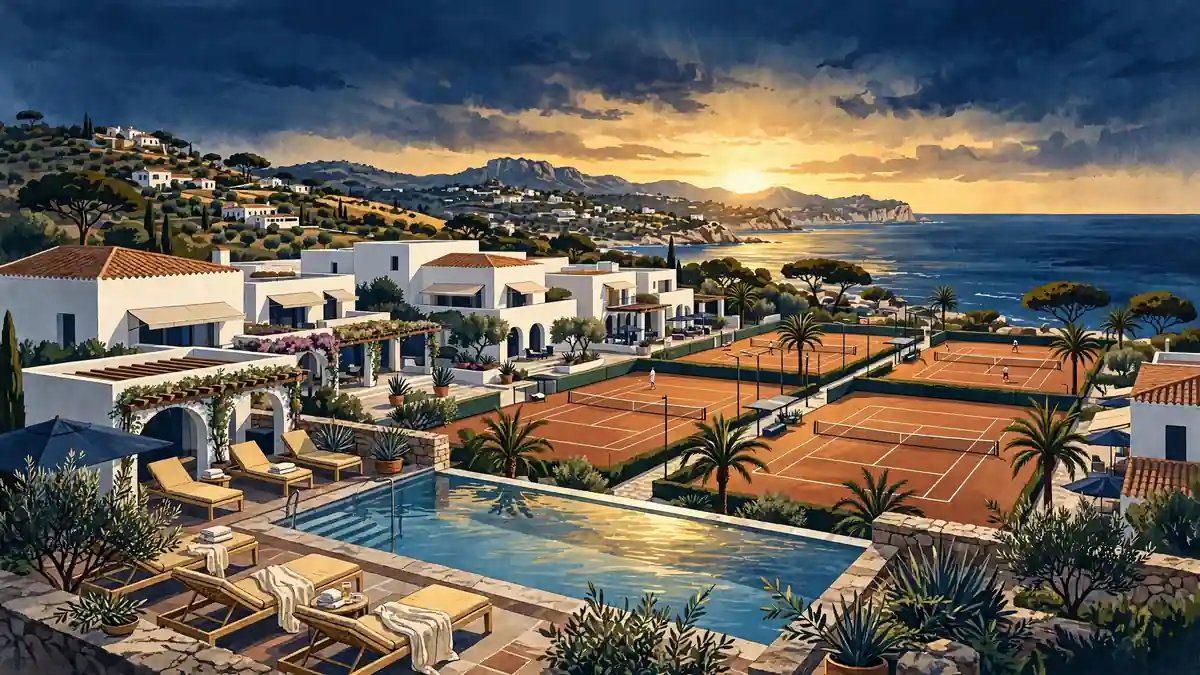
Hospitality suits Nadal’s money for a reason that has little to do with tennis. Hotels are asset-backed businesses: they own or lease real property, they earn every night, and they can be refinanced or sold. A sponsorship cheque stops when the contract ends. A hotel keeps earning. Nadal said in interviews in 2026 that people had started spending more on experiences, making hospitality a growing area to invest in, and the ZEL pipeline — Madrid, Crete, Cozumel, and more — shows he is acting on that view rather than talking about it. The brand is also deliberately placed where his name already means something: Mallorca, the Spanish coast, the Caribbean, and now Mexico, where the academy network already has a foothold.
The financial scale of ZEL is harder to pin down than the academy’s, because Meliá is the operating partner and the ownership split has not been published in the same detail as the GPF deal. What is public is the pace: four hotels in two years, a fifth in November 2026, and a stated pipeline that reaches into double digits. For a net worth estimate, the honest treatment is to count ZEL as a growing, asset-backed stake inside Aspemir’s equity rather than to assign it a separate headline value. The filings already capture it: Aspemir’s net equity rose from about $389 million to about $428 million during 2024, a year in which ZEL opened its second and third hotels. The hotels are part of why the equity climbed, and part of why the old $220 million estimate stopped fitting.
Real Estate, Aspemir and the Family Holding Company
Behind the academy, the hotels, and the endorsements sits a structure that most fans never see: Aspemir, the Nadal family’s investment holding company, which manages many of his business interests. Spanish corporate filings make Aspemir unusually visible for a celebrity vehicle. The company ended 2024 with €375.4 million in net equity, roughly $428 million, up from €341.5 million, about $389 million, a year earlier. It generated a €14.5 million profit in 2024, about $16.5 million, after the extraordinary €94.1 million profit in 2023, about $107 million, that followed the academy restructuring and partial sale. Those three numbers — equity, profit, and the jump between the years — are the strongest evidence in this profile, and they are the reason the net worth anchor moved in November 2026.
Aspemir’s portfolio extends beyond the academy and the hotels. Nadal is part of a residential development on the beachfront at Estepona, on Spain’s Costa del Sol, developed with the Matutes family and Sierra Blanca Estates. The project includes six exclusive villas and five three-storey buildings, and the alliance behind it has a total planned investment of around €200 million across two major projects, including a second development in Marbella where 33 luxury multi-family homes are planned on a 50,000-square-metre plot under the name Armani Residences Marbella. The Estepona city council approved the project in June 2026, and pre-sales for the homes had begun. These are long-cycle developments: the money is committed now, the returns arrive over years, and the value sits in the land and the planning permission as much as in the finished buildings.
The family character of the structure matters. Aspemir is a family holding company, run with the same small circle that ran his tennis career: his father Sebastián, who built the family’s business interests in Mallorca, his uncle Toni, who coached him, and his wife María Francisca Perelló, who is a central figure in the Rafa Nadal Foundation. The foundation works with children and young people through sport and education, and Perelló’s role in it is public and long-standing. The family’s control of the businesses is the reason there have been no public disputes over money, no leaked rows, and no fire sales. It is also the reason the filings are the best window into the fortune: a family that keeps its businesses in one holding company leaves a paper trail, and the paper trail is what moved the estimate.
One point of honesty is needed about what Aspemir’s equity does not prove. The €375.4 million is the holding company’s net equity, and it may include stakes shared with family members and partners, as well as assets held against liabilities that are not visible in the headline figure. Nadal’s personal wealth also includes things held outside Aspemir, and the company’s equity is not a bank balance he can spend. A reader who treats €375.4 million as Nadal’s personal net worth would be making the same error as a reader who treats $220 million as settled fact. The filings are evidence, not an answer. They support a fortune near $400 million. They do not fix it to the dollar.
Saudi Arabia, the Six Kings Slam and the Ambassador Pay Cheque
In January 2024, Nadal became an ambassador for the Saudi Tennis Federation, a role announced on 15 January 2024 that includes promoting tennis in Saudi Arabia, visiting junior clinics, spending dedicated time in the kingdom each year, and planning a Rafa Nadal Academy there. The Saudi Press Agency announcement described a long-term commitment to grow the sport and inspire a new generation of athletes, and the federation’s president, Arij Almutabagani, said Nadal embodied the values the federation holds dear. The role continues into retirement, and reporting in 2025 and 2026 describes Nadal as considering a new academy branch in Diriyah, north of Riyadh.
The money attached to the role has never been published. Nadal has said openly that the Saudi government pays him, telling the Spanish newspaper AS: “Do they pay me to come here? Yes.” He has also defended the role against criticism, saying in an interview with The National that he respects critics who criticise while respecting other people, and that his aim is to improve life and promote sport in the country. The criticism itself is part of the story: the widow of murdered journalist Jamal Khashoggi publicly appealed to Nadal after the announcement, and the role has been described by critics as sportswashing. This profile reports the role and the criticism without taking a side on either, because the money question is separate from the moral one — and on the money question, the public record is thin.
What is public is the scale of Saudi tennis spending around him. The Six Kings Slam, an exhibition held in Riyadh in October 2024, featured Nadal alongside Novak Djokovic, Carlos Alcaraz, Jannik Sinner, Daniil Medvedev, and Holger Rune, and it offered the largest prize money in tennis history for an exhibition: Sinner collected $6 million for winning it, beating Alcaraz in the final, while Medvedev and Rune received $1.5 million each for losing in the opening round. Nadal played in the event a month before his retirement. His own fee was not disclosed, but the event’s published payouts set the scale: a first-round loser was paid $1.5 million. Any estimate of his Saudi income has to reckon with numbers of that size, and any honest account has to say the exact fee is unknown. The ambassador role and the exhibition fees together make Saudi Arabia a real, if unquantifiable, line in his post-playing income — and one that will keep paying as long as the academy plan in the kingdom moves forward.
What Nadal Earns Now That He Has Retired
Nadal retired in November 2024, after the Davis Cup Finals in Málaga, where he lost his final match to Botic van de Zandschulp and Spain lost to the Netherlands in the quarter-final. He was 38. The farewell was staged, tearful, and watched around the world — and it was also, financially, a beginning rather than an end. In his last full year on tour, Forbes credited him with about $23 million in off-court earnings. Two years into retirement, the income lines that produced that figure — endorsements, the academy, the hotels, the Saudi role — are all still running, and two of them are growing.
The endorsement income has held up better than most retired athletes manage, for a reason that is easy to miss: Nadal’s sponsors were never paying mainly for his results. They were paying for his name, and the name did not retire. Nike, Babolat, Kia, Richard Mille, Santander, and Telefónica all remain attached to him, and the academy and hotel businesses give those brands new places to appear. A retired player with an academy network and a hotel chain is a more useful partner than a retired player with a trophy cabinet, because the businesses generate events, openings, and photographs. The ZEL Cozumel opening in November 2026, two years after his last match, is the proof: Nadal was there, on camera, opening a hotel, and the brands were there with him.
The academy and hotel income is harder to count but easier to understand. The academy earns from training fees, schooling, accommodation, and events, and the GPF deal means a professional investor now shares the cost of expansion. The hotels earn room by room, night by night, and the pipeline — Madrid, Crete, Cozumel, and beyond — means the earnings base is still widening. Neither business publishes Nadal’s personal take, and this profile does not invent one. What can be said is that Aspemir’s equity rose by roughly $39 million during 2024, a year in which he barely played, and the company’s profit, while smaller than the extraordinary 2023 figure, was still €14.5 million. A retired athlete whose holding company gains $39 million in equity in a year is not living off savings. He is running businesses.
His daily life in retirement, as he has described it in interviews in 2026, is built around family, the academy, and the businesses. He turned 40 in June 2026 — see how old Rafael Nadal is today for the full age breakdown — and the Mallorcan broadcaster IB3 marked the birthday with an interview in which he talked about life away from the courts. He spends time at the academy in Manacor, steps onto court when his expertise is needed, and takes part in the management and strategic planning of the businesses. The schedule is the point: he stopped doing the one thing that injured him, and kept doing everything else that paid him.
Houses, Cars and Life in Mallorca
Nadal has lived in Mallorca all his life, and his spending shows it. He married María Francisca Perelló, known as Mery, in October 2019, in a ceremony in Mallorca after fourteen years together. Their son was born in October 2022. The family lives in the Manacor and Porto Cristo area, close to the academy, and Nadal has spoken often about his wish to stay in Mallorca rather than move to a tax haven — a choice that costs him money every year in Spanish tax and tells its own story about his priorities. His life is not built around display. There are no fleets of supercars in the press, no yacht sagas, no property portfolio scattered across continents for show.
That is not to say he lives modestly. He owns property in Mallorca, including a home in Porto Cristo, and his real-estate interests extend through Aspemir into the Estepona and Marbella developments described above. He has a long association with Kia, which has supplied his cars for two decades, and his watch collection — anchored by the Richard Mille partnership — includes pieces worth more than most people’s houses. The difference between Nadal and the typical celebrity fortune is the ratio: the visible spending is a small fraction of the wealth, and the wealth is mostly held in businesses rather than in things. The academy, the hotels, and the holding company are the fortune. The house in Mallorca is where he sleeps.
The foundation is the other place his money goes visibly. The Rafa Nadal Foundation, with Perelló at its centre, works with children and young people at risk of social exclusion through sport and education, and it operates programmes in Spain and India. Nadal has also given his time to the foundation’s work in a way that is hard to fake: he has visited its centres, played with its children, and put his name on its fundraising. Charitable giving does not reduce a net worth estimate in any published methodology — the estimates count assets, not generosity — but it belongs in a profile of his money, because it is where a meaningful share of his time and attention goes now that the tennis has stopped.
Nadal vs Federer vs Djokovic: The Big Three Money Table
The three men who defined men’s tennis for twenty years also define its money table, and Nadal sits in the middle of it. The comparison is worth making because it shows how differently three similar careers can convert into wealth. Djokovic earned the most prize money — more than $190 million, against Nadal’s $134.9 million — and his net worth is estimated at $240 million in our own Novak Djokovic net worth profile, anchored on his prize-money record and his own endorsement portfolio. Federer earned less prize money than either of them but converted his career into the largest fortune of the three, with Forbes putting his wealth well above Nadal’s for years and some 2025–26 outlets arguing it approaches $1 billion, driven by his equity stake in the shoe brand On and a lifetime of premium endorsements.
| Player | Grand Slams | Career prize money | Net worth (2026) |
|---|---|---|---|
| Rafael Nadal | 22 | $134.9M | $220–400M (anchored $400M) |
| Novak Djokovic | 24 | $190M+ | ~$240M (Guide Net Worth) |
| Roger Federer | 20 | $130.6M | Well above Nadal; Forbes has put him far ahead for years |
| Carlos Alcaraz | 7 | ~$65M | $60–75M — see our Carlos Alcaraz net worth profile |
| Jannik Sinner | 5 | ~$48M | $60–80M — see our Jannik Sinner net worth profile |
The table carries a lesson that applies to the whole sport. Prize money predicts almost nothing about net worth. Federer won the least prize money of the Big Three and holds the most wealth, because he turned his career into equity — a stake in On that grew with the company — and into a premium brand that outlived his playing days. Djokovic won the most prize money and sits in the middle, because his endorsements, while large, never matched Federer’s premium positioning. Nadal sits between them, and his route is the third one: operating businesses. The academy and the hotels are not endorsements and not equity stakes in someone else’s company. They are his own companies, built on his own name, and their value is only now being priced by the market — which is why his estimate moved in 2026 while the others stayed still.
The next generation shows the same pattern starting over. Alcaraz, at 23, already carries an estimated $60–75 million net worth and a Nike deal reported at $15–20 million a year, and Sinner, at 25, sits near $60–80 million after winning the $6 million Six Kings Slam. Both are on the path Nadal walked: prize money first, endorsements second, and businesses later. Whether either of them builds an academy or a hotel chain remains to be seen. For readers who want the full picture of the sport’s money, our Celebrity Net Worth profiles cover the whole field, from the Big Three to the new generation.
Sources & Reporting
This profile was researched on 18 November 2026 from live reporting and public records. The net worth anchor comes from Celebrity Net Worth (Nadal page, revised November 2026, snapshot 5 November 2026) and Forbes España (rich list, 3 November 2026; earlier figures from its 2023, 2024, and 2025 editions as reported by 20minutos, El Confidencial, and Mallorca.com). The Aspemir figures come from Spanish corporate filings as reported by Celebrity Net Worth. Career prize money and titles come from the ATP Tour official database. Career earnings totals come from Forbes (November 2024 retirement analysis; 2024 off-court earnings). Forbes year-by-year list totals and the Nike lifetime estimate come from WealthyGorilla (updated 17 November 2026). The academy stake sale and GPF Capital deal come from 2025 reporting, including CNBC via RusSpain and FreshBlogNews (July 2026). ZEL Hotels openings come from Meliá Hotels International announcements and reporting by Riviera Maya News and eTurboNews (November 2026). The Saudi ambassador role comes from the Saudi Press Agency (15 January 2024) and the Associated Press via TSN; the Six Kings Slam payouts come from Tennis Infinity and tournament reporting. The Estepona and Marbella developments come from El Español reporting (June 2026) via Talk Tennis. Where outlets disagree, this article publishes a range and names the disagreement rather than picking a side. Figures are updated when new reporting emerges — contact us via the About page if you spot an error.
Frequently Asked Questions
What is Rafael Nadal’s net worth in 2026?
Rafael Nadal’s net worth in 2026 is estimated at $220 million to $400 million, anchored at $400 million. Celebrity Net Worth revised its figure up from $220 million to $400 million in November 2026, and Forbes Spain put his fortune at €400 million in its rich list published 3 November 2026. Spanish corporate filings for his holding company Aspemir, which ended 2024 with €375.4 million (about $428 million) in net equity, support the higher figure.
How much prize money did Rafael Nadal win in his career?
Nadal won $134,946,100 in official ATP career prize money, covering singles and doubles combined. That total puts him second all-time among men, behind only Novak Djokovic. It is less than a quarter of the more than $550 million Forbes says he earned before tax over his career — most of his income came from endorsements and business, not tournament cheques.
How much does Rafael Nadal make per year after retirement?
There is no single published annual figure for his retirement income. In his final year on tour, Forbes credited him with about $23 million in off-court earnings for 2024. Since retiring in November 2024, his income comes from endorsements that continue (Nike, Babolat, Kia, Richard Mille), the Rafa Nadal Academy, ZEL Hotels, real-estate projects, and his Saudi Tennis Federation ambassador role. His holding company Aspemir gained roughly $39 million in net equity during 2024, a year in which he barely played.
What brands sponsor Rafael Nadal?
Nike (since he was 13, including a ten-year, $100 million deal signed in 2008), Babolat (racquets for his whole career), Kia (in Spain from 2004, global ambassador from 2006), Richard Mille (watches since 2010), Santander, Telefónica/Movistar, Infosys, Cantabria Labs (Heliocare), Banco Sabadell, Mapfre, Emporio Armani, and Tommy Hilfiger.
How much is the Rafa Nadal Academy worth, and what did he sell?
In 2025 Nadal sold a 44.9% stake in the Rafa Nadal Academy to the investment firm GPF Capital for approximately €94 million, around $107 million. He kept a 55.1% stake and majority control. The sale implies a total academy value of roughly €209 million. The academy, opened in Manacor in 2016, now has locations in Mexico, Greece, Kuwait, Hong Kong, the Dominican Republic, Marbella, and Egypt, with Brazil (2027) and Lombok, Indonesia (2028) announced.
Is Rafael Nadal a billionaire?
No. The freshest published estimates put his net worth at $400 million, and his holding company’s filed net equity was about $428 million at the end of 2024. That is a large fortune, but it is well short of $1 billion. Among the Big Three, Roger Federer is the one whose fortune is discussed in billionaire terms; Nadal sits in the middle of the three on wealth.
What does Rafael Nadal do now after retiring?
He runs his businesses from Mallorca: the Rafa Nadal Academy network, ZEL Hotels (which opened its fifth property, ZEL Cozumel in Mexico, in November 2026), and real-estate developments at Estepona and Marbella. He remains an ambassador for the Saudi Tennis Federation, a role he took in January 2024, and he is involved in the UAX Rafa Nadal School of Sport and the Rafa Nadal Foundation. He lives in Mallorca with his wife María Francisca Perelló and their son, born in October 2022.
Who is richer, Nadal, Federer or Djokovic?
Federer is the richest of the three, with Forbes putting his fortune well above Nadal’s for years on the strength of premium endorsements and his equity stake in the shoe brand On. Nadal comes next at an estimated $220–400 million, anchored at $400 million. Djokovic, despite earning the most prize money (over $190 million), is estimated at about $240 million in our own Guide Net Worth profile — proof that prize money predicts almost nothing about net worth.
WRITTEN BY
Nathan Cole
Nathan Cole is the editor of Guide Net Worth. He covers celebrity wealth the way a business desk covers earnings: reported figures first, estimates labeled as estimates, and no invented numbers. Every profile on this site passes through his desk before it publishes. About Guide Net Worth · Corrections: figures are updated when new reporting emerges — contact us via the About page if you spot an error.
References & Sources
This article has been fact-checked and verified against multiple public sources, financial disclosures, SEC filings, Forbes reports, Celebrity Net Worth databases, and official records. All net worth estimates are based on publicly available information and financial analysis.