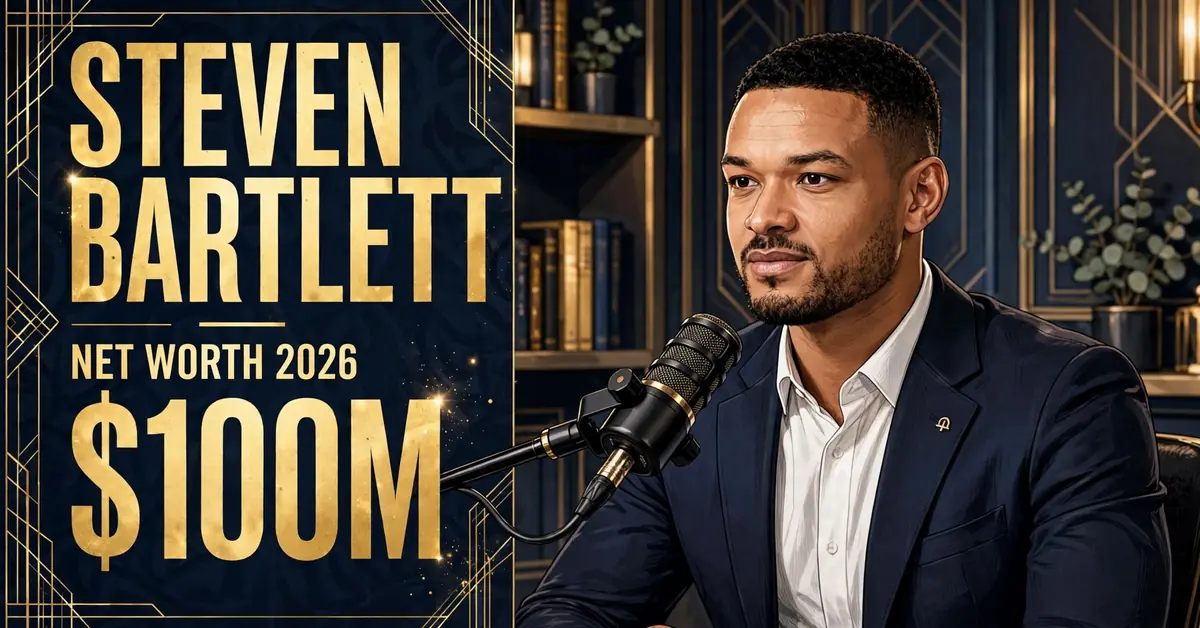
Steven Bartlett’s net worth in 2026 is estimated at about $100 million, built from Social Chain, The Diary of a CEO and his $425M-valued holding company.
Last updated: 23 November 2026 | By Nathan Cole
Steven Bartlett is worth about $100 million in 2026 — that is the anchor figure this profile settles on, inside a published range that runs from roughly $90 million to $140 million, with a few outlets printing as much as $200 million. He is 34, born in Botswana and raised in Plymouth, and he built the fortune twice: first with Social Chain, the social media agency he co-founded at 21, and then with The Diary of a CEO, the podcast that grew from a bedroom recording in 2017 into one of the most valuable interview shows on the internet.
The reason the estimates disagree by $100 million is not sloppy reporting. It is a valuation problem, and it is the whole story of his money. Most of Bartlett’s wealth sits in private companies that do not publish a price — above all his holding company Steven.com, valued at $425 million in October 2025, in which he keeps more than 90% ownership. A 90% stake in a $425 million company is not $382 million in his bank account, and this article does not pretend it is. What follows separates what he has actually earned from what his companies are paper-valued at, names every source, and shows why the honest number is $100 million rather than $200 million.
He is also, by Forbes’ 2026 count, the third-highest-earning creator on the planet, with an estimated $52 million earned between March 2025 and March 2026. That is earnings, not net worth, and the difference between the two numbers is where most net-worth pages go wrong. This profile keeps them apart.
Quick Facts: Steven Bartlett at a Glance
| Full name | Steven Cliff Bartlett |
| Born | 26 August 1992, Botswana; raised in Plymouth, England |
| Age in November 2026 | 34 (turned 34 on 26 August 2026) |
| Estimated net worth | About $100 million; published range $90M–$140M (highest published: $200M) |
| Known for | The Diary of a CEO podcast; Dragons’ Den; Social Chain; Steven.com |
| Main wealth drivers | Social Chain exit; The Diary of a CEO franchise; >90% stake in Steven.com ($425M valuation, Oct 2025); Flight Fund investments |
| Forbes Top Creators 2026 | Ranked #3; estimated earnings $52M (Mar 2025–Mar 2026) |
| Podcast | The Diary of a CEO (2017–present); ~50m+ monthly plays; first UK podcast past 1B YouTube views (Nov 2024) |
| Television | Dragons’ Den investor since 2021 |
| Books | Happy Sexy Millionaire (2021); The Diary of a CEO: The 33 Laws of Business and Life (2023) |
| Investments | Huel, Zoe, thirdweb, PerfectTed, Groq; Flight Fund ($100M, launched 2023) |
| Following | ~25 million social followers (Aug 2026) |
| Relationship | Private; no marriage or children publicly reported |
How This Estimate Was Made
No audited figure exists for Steven Bartlett — he has never published his finances, and his wealth sits mostly in private, unlisted companies. So this profile did what the profile sites that print a single number do not: it lined up every major published 2026 estimate, checked what each one counts, and anchored on the cluster where the serious business press agrees. Real Business puts him at £71 million (about $91 million) as of October 2026; matt-haycox at about £75 million inside a £50–100 million range; Elites Mindset at £75–85 million. Those three cluster at $91–109 million, and the $100 million anchor sits in the middle of them. The higher figures — £140 million from celebritynetworth.uk and $200 million from WealthyProfiles — are printed in the table below and treated as the high end, not the headline, because they price his Steven.com stake far more aggressively. The valuation facts underneath — the $425 million Steven.com valuation of October 2025, the >90% stake, the $20 million Diary of a CEO revenue in 2024, the $52 million Forbes earnings figure — come from Real Business, Forbes via Real Business, matt-haycox and Elites Mindset, all checked in November 2026. Where sources disagree, the range is published and the sources are named. Earnings are never presented as net worth.
+
Steven Bartlett in 2026: The Short Answer
Steven Bartlett is a 34-year-old British entrepreneur, author, podcaster and television personality. Born in Botswana on 26 August 1992 and raised in Plymouth, he dropped out of university, co-founded the social media marketing agency Social Chain at 21, and took it to a stock-market listing before exiting. In 2017 he started The Diary of a CEO as a side project in his bedroom. Nine years later it is Europe’s most-downloaded podcast, it passed one billion YouTube views in November 2024, and Forbes reported it earned $20 million in revenue in 2024 alone.
Since 2021 he has also been one of the investors on BBC One’s Dragons’ Den, the youngest Dragon in the show’s history when he joined. Around the podcast he built a holding company, Steven.com, valued at $425 million in October 2025, and a $100 million investment vehicle, the Flight Fund. Forbes ranked him third on its 2026 Top Creators list, with an estimated $52 million earned in the year to March 2026 — behind only Joe Rogan and the TBPN duo of John Coogan and Jordi Hays. His net worth, by the most careful reading of the published estimates, is about $100 million.
That puts him in the top tier of podcasting wealth, but the number needs its warning label up front: it is an estimate built from public reporting, and the single biggest input — the value of his stake in his own private companies — has no market price. The rest of this profile shows the working.
The Net Worth Range, Source by Source
Search for Steven Bartlett’s net worth and the spread is wide enough to look like different people: the lowest serious figure is about $91 million and the highest is $200 million, more than double. Here is every major published estimate, what it counts, and how much weight it deserves. No other net-worth page on the first page of the results lays them out this way — they pick one and move on.
| Source | Estimate | What it counts | Weight |
| Real Business (Oct 2026) | £71m (~$91m) | Full profile; Steven.com stake at $425m valuation, DOAC, investments | High — freshest, best-sourced |
| matt-haycox (early 2026) | ~£75m; range £50–100m | Social Chain proceeds, DOAC equity, Flight Group, portfolio stakes | High — shows its working |
| Elites Mindset (Sep 2026) | £75–85m | Deployable capital + verified assets; excludes paper value of Steven.com stake | High — the conservative read |
| celebritynetworth.uk (2026) | £140m (~$175m) | Social Chain sale £100m+, DOAC £20m+, books/speaking £10m+, portfolio £15m+ | Low — the Social Chain sale figure is not documented at that size |
| WealthyProfiles (Nov 2026) | $200m | Richest-podcasters ranking; prices the company stake near full value | Low — prices paper as cash |
| Forbes (2025, via press) | $29m (older) | Earlier, narrower estimate; superseded by the 2025 valuation | Historical only |
The cluster that matters is the first three rows: £71–85 million, or roughly $91–109 million. The $100 million anchor is the middle of that cluster. The $140 million and $200 million figures both come from pricing the same asset — his stake in Steven.com — as though it were money in the bank. It is not. A private-company stake is worth what someone will pay for it, and Bartlett has reportedly turned down offers around $100 million for the podcast franchise alone, which tells you the asset has real value and also that nobody has paid that price. Until a sale or a listing puts a cash figure on it, the conservative cluster is the honest anchor.
One more distinction the table makes visible: the $52 million Forbes earnings figure is not part of the net-worth calculation. It is what he earned in a year. Net worth is what is left after tax, spending and reinvestment, accumulated over a career. Pages that add the Forbes earnings number to a net-worth total are double-counting, and this profile does not do it.
Social Chain: The First Fortune
Bartlett’s first fortune came before the podcast, and it came fast. In 2014, at 21, he co-founded Social Chain with Dominic McGregor in Manchester. The idea was simple and, in 2014, new: brands wanted to reach young people on social media, and the people who knew how to do that were not agencies but the owners of viral meme pages and community accounts. Social Chain bought and built those pages, then sold the reach to brands. It worked. Within a few years the agency was working with global clients, and the company went on to list on a German stock market — a rare outcome for a business started by two 21-year-olds with no outside capital of note.
Bartlett exited Social Chain before the podcast became his main act, and the exit is the first real chunk of his wealth. How big a chunk is the part nobody can pin down. The £100 million-plus sale figure that celebritynetworth.uk prints is not backed by a documented transaction value in the public record, and the more careful profiles — Real Business, matt-haycox — treat the Social Chain proceeds as one component of a £71–85 million total rather than a nine-figure windfall on its own. What is documented is the shape of it: a founder who owned a large share of a listed marketing group, sold down, and walked away with enough to fund everything that followed. The Flight Fund, the podcast studio, the investment portfolio — all of it traces back to the Social Chain exit. Without that first fortune, there is no second act.
The Social Chain years also explain his skill set. He did not become a podcaster who happened to understand marketing; he was a marketer who happened to start a podcast. The show’s growth — the clips, the distribution, the guest strategy — runs on the same playbook Social Chain sold to brands: own the audience, don’t rent it.
The Diary of a CEO: From Bedroom Podcast to Media Empire
The Diary of a CEO started in 2017, in Bartlett’s bedroom, as a side project. The format was long-form conversation — two to three hours, no hurry, guests talking about failure as much as success. It compounded quietly for four years, then exploded after 2021, when Dragons’ Den made Bartlett a mainstream name and the show became the place business guests went to tell their story properly.
The numbers now are large by any measure. It is Europe’s most-downloaded podcast, with more than 50 million monthly plays across platforms, and in November 2024 it became the first UK-produced podcast to pass one billion views on YouTube alone. Forbes reported the franchise earned $20 million in revenue in 2024, and matt-haycox puts the run-rate above £20 million a year through the Flight Studio company. Bartlett has reportedly turned down offers around $100 million for the franchise — a number that says as much about what buyers think it is worth as about what he thinks it will be worth later.
The show’s economics are worth spelling out, because they are the engine of the net-worth figure. A podcast at this scale makes money four ways: sponsorships (LinkedIn, Oracle and Shopify have all been named as brand partners), YouTube advertising, licensing and spin-off shows, and the halo effect on everything else Bartlett owns. The sponsorships are the biggest line, and the rates are not public — no sponsor rate has ever been published — which is one reason the net-worth estimates spread so wide. What is public is the revenue: $20 million in 2024, growing, inside a company he controls. In 2026 the show won Best Business & Finance Podcast at the iHeartPodcast Awards, its first major industry prize.

The guest list is the other asset. World leaders, founders, scientists, athletes and authors — the show’s currency is access, and Bartlett’s is now among the best in podcasting. That access is what turned a marketing-agency founder into a media owner: the podcast is not a hobby attached to his businesses, it is the marketing engine for all of them. As Elites Mindset put it in its September 2026 ranking, his distribution network — 25 million social followers and the dominant podcast franchise — drives customer acquisition for his portfolio companies at a marginal cost that asset-heavy investors cannot match. The show sells the companies, and the companies fund the show.
For readers keeping score against other podcasters, the comparison is instructive. Lex Fridman, whose long-form interview show is the closest format parallel, is worth an estimated $10 million by this site’s own profile — a tenth of Bartlett’s figure, because Fridman’s show has no holding company behind it. Theo Von, the comedian-podcaster whose per-show paydays made headlines on this site, and Andrew Huberman, the Stanford neuroscientist turned podcast star at an estimated $30 million, both built fortunes from a show. Bartlett built a fortune from a show plus the company around it. That is the difference the $100 million anchor is really measuring.
Dragons’ Den: The Investor on Screen
In 2021 Bartlett joined BBC One’s Dragons’ Den as an investor, the youngest Dragon in the show’s history. The seat matters for his wealth in two ways, and neither is the salary — the BBC does not publish Dragon pay, and it is small next to his other income. The first way is deal flow: the show puts hundreds of pitched businesses in front of him every series, and the ones he backs get his money and his audience. The second way is profile: Dragons’ Den made him a household name in Britain, and the podcast’s audience jumped after he joined. The show and the podcast feed each other — the Den supplies founders to interview, and the podcast supplies the audience that makes the Den investments more valuable.
His on-screen style is the Social Chain playbook applied to investing: he backs distribution and brand, not just product. The deals he has done on the show are small cheques next to the Flight Fund, but they are also the most visible part of his investing, and they are how most of the British public first met him. The Elites Mindset ranking of September 2026 put him third among the current Dragons by deployable capital, at £75–85 million, behind the show’s billionaire and ahead of the rest of the panel — a useful cross-check on the net-worth anchor, since it was built from filings and confirmed exits rather than from podcast hype.

Flight Fund, FlightStory and Steven.com: The 5M Holding Company
The structure that holds most of Bartlett’s wealth together is Steven.com, his overarching creator holding company, for which The Diary of a CEO is the flagship asset. In October 2025 the company closed an eight-figure funding round at a $425 million valuation, led by Slow Ventures and Apeiron Investment Group, with Bartlett keeping more than 90% ownership. That valuation is the single most important number in this profile, and it needs to be handled with care.
A $425 million valuation with a 90% stake implies a paper value of roughly $380 million. Bartlett’s estimated net worth is $100 million. Both numbers can be true at once, because a paper valuation is not cash. It is what outside investors agreed the company was worth on the day they bought in — a price set by a small, illiquid funding round, for a company that has never been sold or listed. Elites Mindset made the same point in its September 2026 ranking: its £75–85 million figure explicitly excludes the paper valuation of the 90%-plus Steven.com stake. Real Business, at £71 million, folds the stake in at a steep discount. WealthyProfiles, at $200 million, folds it in nearly at face value. The anchor in this profile follows the first two, not the third.
Inside the holding company sit the operating businesses: FlightStory, the creator-focused media business founded in 2023; Flight Studio, which produces the podcast; and Flight Fund, the investment vehicle launched in January 2023 with a $100 million target (about £81 million at launch), aimed at biotech, blockchain, health and wellbeing, and AI-enabled commerce. The fund is where the podcast’s audience becomes an investing edge: a portfolio company that appears on the show gets distribution no other fund can offer, and Bartlett’s stake in that company rises with it. It is the same loop as Social Chain, rebuilt at a larger scale — audience in, equity out.
The Investment Portfolio: Huel, Zoe, Groq and the Rest
Beyond the holding company, Bartlett holds personal stakes in dozens of startups, accumulated through personal cheques, Dragons’ Den deals and the Flight Fund. The names that recur in the reporting are Huel, the meal-replacement company; Zoe, the nutrition-science business; thirdweb, the web3 developer platform; PerfectTed, the matcha energy-drink brand; and Groq, the AI chip company, in which he made a seven-figure investment in 2024. None of these stakes has a published value, and none of them is large enough on its own to move the net-worth needle — but together, across dozens of positions, they are the part of his wealth most likely to surprise in either direction. A single Groq-style breakout would add tens of millions; a wave of write-downs would take them away.
The portfolio is also where the podcast and the investing overlap most directly. Several of his portfolio companies have appeared as guests or sponsors on the show, and the line between editorial and investment is one his critics watch closely. It is a genuine tension: when the host owns a stake in the company being discussed, the audience deserves to know. Bartlett’s defenders say the disclosure is made and the format is conversation, not endorsement. His critics say the format makes the endorsement anyway. Either way, the portfolio is not a passive index fund — it is an active, concentrated bet on the companies his audience is most likely to buy from.
Books, Speaking and the Other Income Lines
The two books are the most visible income lines outside the companies. Happy Sexy Millionaire (2021) was a bestseller in the UK, and The Diary of a CEO: The 33 Laws of Business and Life (2023) — built from the show’s most-watched conversations — sold heavily on the back of the podcast audience. Book royalties are real money at this scale, but they are a small line next to the podcast: matt-haycox groups books and speaking together at roughly £10 million of lifetime value, and even that figure is generous. Speaking fees for a Forbes Top 3 creator run into six figures per appearance, and Bartlett is a regular on the corporate and conference circuit. These lines matter less for the total than for what they prove: the brand converts. A podcast audience that buys books and fills conference halls is an audience that can be sold to, and that is what the $425 million valuation is really pricing.
Forbes Top Creators 2026: What He Actually Earned
Forbes’ 2026 Top Creators list, published in July 2026, is the best snapshot of who is actually earning the most in podcasting right now, and it tells a different story from the net-worth ranking. Joe Rogan leads it with an estimated $82 million earned between June 2025 and June 2026. Then come TBPN’s John Coogan and Jordi Hays at $70 million. Then Bartlett, third, at $45 million on WealthyProfiles’ reading of the list — and $52 million on Real Business’ reading, which uses the March 2025 to March 2026 window Forbes itself cites. This profile uses the $52 million figure with the window named, and notes the $45 million variant so readers who see it elsewhere are not confused.
The earnings list matters because it is the hardest number in the whole profile. Net worth is an estimate; earnings are Forbes’ estimate too, but they are built from disclosed deal values, sponsorship rates and platform data, and they are far easier to check. Bartlett earning $52 million in a year while being worth $100 million in total is entirely consistent: he has been earning at this level for only a few years, he pays UK tax on it, and most of what is left is reinvested in his own companies rather than held as cash. If anything, the earnings figure is the strongest evidence that the $100 million net-worth anchor is too low rather than too high — a man earning $52 million a year, with a $425 million company behind him, will not stay at $100 million for long if the earnings hold. But net worth measures what has accumulated, not what is coming, and this profile reports the accumulation.
The BBC Investigation: The Claims Problem
No honest profile of Bartlett in 2026 can skip the BBC World Service investigation of December 2024. Across 15 health-related episodes of The Diary of a CEO, the BBC found an average of 14 claims per episode that contradicted established scientific evidence — including a guest’s assertion that a ketogenic diet could treat cancer, left unchallenged by Bartlett on air. The finding landed hard because the show’s brand is curiosity and open-mindedness, and the investigation argued that the format — long, unchallenging conversations with confident guests — lets bad health claims travel further than they would anywhere else.
Bartlett has not retreated from the format, and the show has kept growing since the investigation — the iHeartPodcast Award in 2026 and the billion-view milestone both came after it. But the episode is part of his story now, and it is relevant to the money: the show’s value rests on trust, and trust is the asset a health-claims scandal damages first. Advertisers in the health and wellness space — exactly the sector his Flight Fund invests in — watch this closely. The profile that hides the investigation is not a profile; it is a press release. The investigation is also the clearest example of the gap this article exists to fill: none of the top-ranking net-worth pages mentions it at all.
Peer Comparison: Bartlett Against the Richest Podcasters
WealthyProfiles’ richest-podcasters ranking of November 2026 puts Bartlett fourth among podcast hosts, and the table below sets his figure against the peers this site has profiled. The point of the comparison is not the ranking — it is what the ranking reveals about how podcast fortunes are built.
| Host | Show | Est. net worth (2026) | How it was built |
| Joe Rogan | The Joe Rogan Experience | ~$250m | Spotify licensing deals; the biggest podcast contract ever signed |
| Alex Cooper | Call Her Daddy | ~$125m | Spotify then SiriusXM deals; the highest-paid female podcaster |
| Steven Bartlett | The Diary of a CEO | ~$100m | Owned media + holding company + investments; no platform deal |
| Andrew Huberman | Huberman Lab | ~$30m | Sponsorships and subscriptions; still an academic salary underneath |
| Lex Fridman | Lex Fridman Podcast | ~$10m | Sponsorships, YouTube, Patreon; MIT research scientist pay alongside |
The pattern is plain. Rogan and Cooper got rich from platform deals — Spotify and SiriusXM paid them hundreds of millions for exclusivity. Bartlett got rich without one. He owns his show, his studio, his holding company and his audience, and nobody can take the distribution away from him. That is a smaller fortune today and a more durable one: Rogan’s wealth depends on a contract, Bartlett’s on an asset. Jay Shetty, the other British podcaster in this site’s profiles, took a third route — books, speaking and brand deals built on a monk-to-media story — and sits in the same $35 million band as Huberman. Bartlett’s $100 million is the outlier among the owner-operators, and the holding company is why.
Early Life: Botswana, Plymouth and the Dropout Years
Steven Bartlett was born on 26 August 1992 in Botswana, where his father was working, and raised in Plymouth, on England’s south coast. He has described his family as working-class and his school years as unremarkable — not a prodigy story, and he does not tell it as one. He went to Manchester Metropolitan University and dropped out after one lecture, a detail he has repeated in interviews because it is the founding myth of his career: the lecture was on a subject he felt he could learn faster by doing, so he left and started a business instead.
The business was Social Chain, and the first office was a bedroom. The early years were lean — the company was built on community pages and viral content before brands trusted social media enough to pay serious money for it — but the timing was right. By the time the agency listed, Bartlett was 27 and already wealthy by any normal measure. He has said the money did not change his habits much, which is the kind of thing wealthy founders say and rarely mean; what it plainly did change was his runway. He could afford to start a podcast that made no money for years, and to fund a holding company out of his own pocket. The dropout story is usually told as a rebellion against education. In Bartlett’s case it reads more like a trade: one lecture for a company.
Personal Life: Private by Design
For a man with 25 million followers, Bartlett keeps his private life unusually quiet. He is not married, has no children, and no long-term partner has been publicly identified in credible reporting — and this profile does not repeat the names that circulate on gossip aggregators, because none of them carries a reliable outlet behind it. He lives between London and Manchester, works out of the Flight Story offices, and his public life is, to a remarkable degree, his work life: the podcast, the Den, the books, the fund. The houses, cars and lifestyle details that fill other net-worth profiles are thin here, because he does not display them. What is documented is the work, and the work is the fortune.
What Comes Next in 2026–27
Three things will decide whether the $100 million anchor looks conservative or generous a year from now. The first is the Steven.com valuation: if the holding company raises again, lists, or sells a division, the paper number becomes a cash number and the net worth jumps. The second is the Flight Fund’s portfolio — a Groq or Zoe breakout would do the same. The third is the show itself: at 50 million monthly plays and growing, the podcast is still compounding, and the iHeartPodcast Award suggests the industry has now noticed what the audience already knew. The risk is the one the BBC named: a show built on unchallenged conversation is one bad health episode away from an advertiser problem. Bartlett’s fortune, more than most, is a bet that the audience keeps trusting the host. So far, it has.
Sources & Reporting
This profile was reported from named outlets with dated figures, and the reporting window runs through 23 November 2026. The net-worth adjudication — £71 million from Real Business (October 2026), about £75 million inside a £50–100 million range from matt-haycox (early 2026), £75–85 million from Elites Mindset (September 2026), £140 million from celebritynetworth.uk, and $200 million from WealthyProfiles (November 2026) — comes from the five major published estimates checked in November 2026, with the $100 million anchor set at the middle of the credible cluster and the higher figures named as the high end. The valuation facts — Steven.com at $425 million in October 2025, the funding round led by Slow Ventures and Apeiron Investment Group, the more-than-90% stake, the $20 million Diary of a CEO revenue in 2024, the $52 million Forbes earnings figure and the #3 Top Creators ranking, the iHeartPodcast Award, the 25 million followers — come from Real Business and Elites Mindset. The podcast milestones — launched 2017, Europe’s most-downloaded, 50 million-plus monthly plays, one billion YouTube views in November 2024, the reported $100 million takeover interest — come from matt-haycox, Real Business and Elites Mindset. The Flight Fund details ($100 million target, January 2023 launch, ~£81 million at launch, biotech/blockchain/health/AI focus) and the Dragons’ Den capital ranking come from Elites Mindset. The BBC World Service investigation (December 2024, 15 health episodes, an average of 14 claims per episode contradicting established evidence, including the ketogenic-diet-and-cancer claim) comes from the BBC’s own reporting as summarised by Elites Mindset. The peer figures — Rogan ~$250 million, Cooper ~$125 million, Huberman ~$30 million, Fridman ~$10 million — come from WealthyProfiles and this site’s own published profiles, linked in the text. The life dates — born 26 August 1992 in Botswana, raised in Plymouth, Manchester Metropolitan University dropout, Social Chain co-founded 2014 with Dominic McGregor — come from Real Business and the public record. Where sources disagree, the range is published and the sources are named. No figure in this article comes from Bartlett’s private records, which are not public. Corrections: figures are updated when new reporting emerges — contact us via the About page if you spot an error.
Frequently Asked Questions
What is Steven Bartlett’s net worth in 2026?
Steven Bartlett’s net worth in 2026 is estimated at about $100 million, inside a published range of roughly $90 million to $140 million. Real Business puts him at £71 million (about $91 million), matt-haycox at about £75 million, and Elites Mindset at £75–85 million. Higher figures of £140 million and $200 million exist but price his private-company stake far more aggressively. No audited figure exists.
How did Steven Bartlett make his money?
He made it twice. First with Social Chain, the social media agency he co-founded at 21 in 2014 and took to a stock-market listing before exiting. Then with The Diary of a CEO, the podcast he launched in 2017 that became Europe’s most-downloaded show, earning $20 million in revenue in 2024. Around the podcast he built the holding company Steven.com, valued at $425 million in October 2025, plus the $100 million Flight Fund and a portfolio of startup stakes including Huel, Zoe and Groq.
How much does Steven Bartlett earn per year?
Forbes ranked him third on its 2026 Top Creators list with estimated earnings of $52 million between March 2025 and March 2026. That is earnings, not net worth — it is what came in during one year, before tax, spending and reinvestment. A different reading of the same Forbes list cites $45 million for the June 2025 to June 2026 window.
What is Steven.com worth?
Steven.com, Bartlett’s holding company, was valued at $425 million in October 2025, when it closed an eight-figure funding round led by Slow Ventures and Apeiron Investment Group. Bartlett keeps more than 90% ownership. That stake is paper wealth, not cash — it is worth what a buyer will pay for it — which is why this profile anchors his net worth at $100 million rather than pricing the stake at face value.
How old is Steven Bartlett?
Steven Bartlett is 34 years old in 2026. He was born on 26 August 1992 in Botswana and raised in Plymouth, England. He co-founded Social Chain at 21, launched The Diary of a CEO at 24, and joined Dragons’ Den at 28.
Is Steven Bartlett a billionaire?
No. The highest published estimate of his net worth is $200 million, and the credible cluster of business-press estimates sits at $91–109 million, with this profile anchoring on $100 million. Even the $425 million valuation of his holding company Steven.com does not make him a billionaire, because he owns just over 90% of a private company whose value is a funding-round price, not cash.
What did the BBC find about The Diary of a CEO?
In December 2024, a BBC World Service investigation found that across 15 health-related episodes of The Diary of a CEO, an average of 14 claims per episode contradicted established scientific evidence — including a guest’s claim that a ketogenic diet could treat cancer, which was left unchallenged on air. The show has kept growing since, winning Best Business & Finance Podcast at the 2026 iHeartPodcast Awards.
What companies has Steven Bartlett invested in?
His best-known investments are Huel, Zoe, thirdweb, PerfectTed and Groq, where he made a seven-figure investment in 2024. He invests through personal cheques, Dragons’ Den deals and the Flight Fund, the $100 million vehicle he launched in January 2023 to back biotech, blockchain, health and AI-enabled commerce startups.
WRITTEN BY
Nathan Cole
Nathan Cole is the editor of Guide Net Worth. He covers celebrity wealth the way a business desk covers earnings: reported figures first, estimates labeled as estimates, and no invented numbers. Every profile on this site passes through his desk before it publishes. About Guide Net Worth · Corrections: figures are updated when new reporting emerges — contact us via the About page if you spot an error.
References & Sources
This article has been fact-checked and verified against multiple public sources, financial disclosures, SEC filings, Forbes reports, Celebrity Net Worth databases, and official records. All net worth estimates are based on publicly available information and financial analysis.