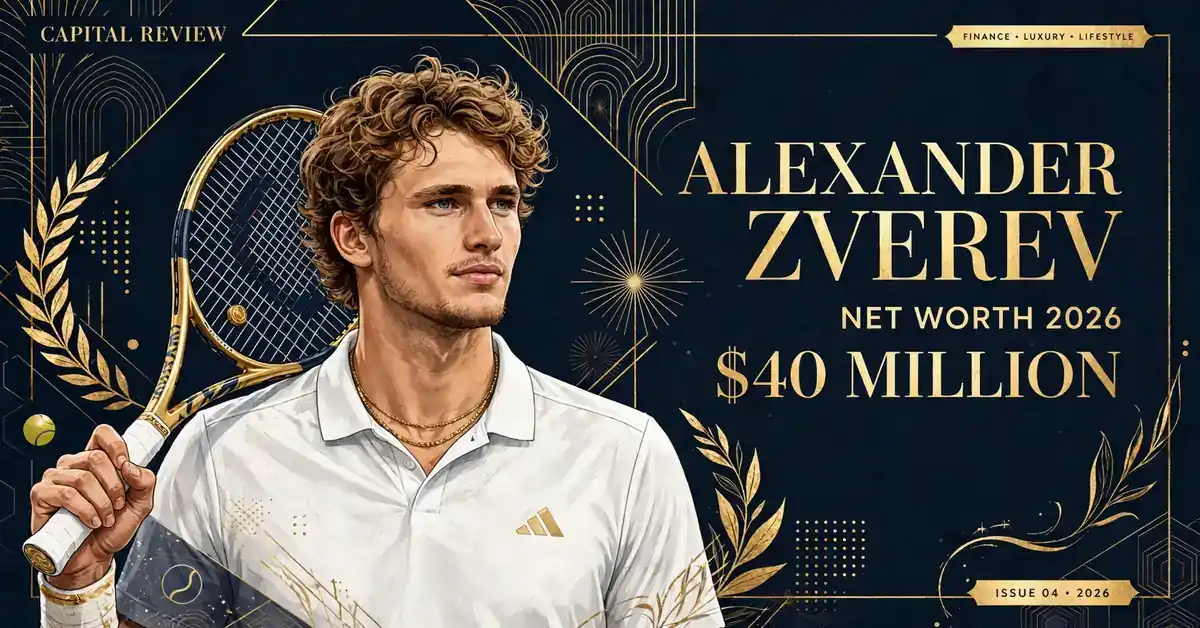
Alexander Zverev’s net worth is estimated at $40 million in 2026, backed by $74 million in career prize money and a world No. 1 ranking after a historic double.
Last updated: November 25, 2026 · By Nathan Cole
Alexander Zverev’s net worth is estimated at $40 million in 2026. The figure comes from Celebrity Net Worth, repeated by EssentiallySports and Surprise Sports in September–November 2026 reporting, and the honest range around it is $35–45 million. It is an estimate — Zverev has never disclosed his finances — and this article shows exactly how it was reached. The hard number underneath it is his career prize money: $74,022,821, fourth on the all-time men’s list, per Wikipedia’s player page updated October 1, 2026. The timing explains the fortune. Zverev, 29, became world No. 1 on November 2, 2026, after winning the French Open in June and the US Open in September — two Grand Slam titles in a single season, after thirteen years as a professional and three lost major finals.
Three money stories built the fortune. First, the prize money itself: roughly $8.92 million banked in 2026 alone, on top of a $12.7 million-plus season in 2024 and about $7.5 million in 2025. Second, the endorsements, reported at $5–8 million a year, led by Adidas and HEAD, with Rolex, Richard Mille, Peugeot, Zegna, Bitpanda, Jacob & Co and Electronic Arts on the list. Third, the 2026 double, which did something no pay cheque could: it turned the best player who had never won a major into the world No. 1, and that ranking is what the next round of deals will be priced on. Prize money is gross and pre-tax, so the estimate allows for taxes, coaching and agent fees before adding the endorsement income — the workings are in the box below.
Quick Facts
| Full Name | Alexander Zverev (“Sascha”) |
| Born | April 20, 1997, Hamburg, Germany (age 29 in 2026) |
| Height | 6 ft 6 in (1.98 m) |
| Profession | Professional Tennis Player |
| Nationality | German |
| Residence | Monte Carlo, Monaco |
| Net Worth (2026) | $40 million, estimated (range $35–45 million) |
| Career Prize Money | $74,022,821 (fourth all-time among men) |
| Career Titles | 26 singles, 3 doubles; 2 Grand Slams (French Open 2026, US Open 2026) |
| Ranking | World No. 1 since November 2, 2026 |
| Olympics | Gold medallist, Tokyo 2020 |
| Main Sponsors | Adidas, HEAD, Rolex, Richard Mille, Peugeot, Zegna, Bitpanda |
| Partner | Sophia Thomalla (since 2020) |
| Children | Daughter Mayla (born March 11, 2021) |
| Last Updated | November 25, 2026 |
How This Estimate Was Made
The anchor — $40 million — is the figure Celebrity Net Worth carries for Zverev in 2026, repeated by EssentiallySports and Surprise Sports in September and November 2026 reporting. The range, $35–45 million, comes from EssentiallySports’ comparison pieces. It is an estimate, not a reported fact: Zverev has never disclosed his finances. The hard number underneath it is his career prize money, $74,022,821 per Wikipedia’s player page updated October 1, 2026 — fourth on the all-time men’s list. Older published prize-money figures ($65.8 million from the ATP in June 2026, $68.5 million in September) are earlier snapshots of the same moving total, taken before the French Open and US Open paydays landed. Prize money is gross and pre-tax, so the estimate allows for taxes, coaching and agent fees, then adds endorsement income reported at $5–8 million a year. Our own October 2026 estimate was $30–40 million, anchored around $35 million; the two Grand Slam titles and the No. 1 ranking since then support the higher $40 million anchor used here. Anything uncertain is labeled as an estimate, not a fact.
+
The Number: Forty Million Dollars, Estimated
Alexander Zverev is worth an estimated $40 million in 2026, inside a published range of $35–45 million. Celebrity Net Worth carries the $40 million figure, and EssentiallySports and Surprise Sports repeated it in their September–November 2026 reporting. The range comes from EssentiallySports’ comparison pieces, which put Zverev’s fortune against his rivals’ and landed on the same spread. Every figure in this article is an estimate built on reported numbers, and the $40 million anchor is the one the reporting converges on.
The anchor moved this year. Our own October 2026 estimate was $30–40 million, anchored around $35 million. Then Zverev won the French Open in June, the US Open in September, and the world No. 1 ranking on November 2. Two Grand Slam titles and the top ranking in a single season are the kind of events that move a valuation, because they move the two things a tennis fortune is built on: the prize money cheques, which arrive immediately, and the endorsement rates, which get renegotiated on the back of them. The $40 million anchor reflects the player Zverev became in 2026, not the player he was in 2025.
It helps to say plainly what the number is not. It is not a bank balance. It is not a salary — tennis players have no salary, and any article that quotes one for Zverev is inventing it. It is a net worth estimate: career prize money and endorsement income, minus taxes, coaching costs, agent fees and thirteen years of life on tour, plus whatever value sits in the deals and assets that are not public. No reliable public breakdown exists for bonuses, appearance fees, property or cars, so none is claimed here. The sections below show the workings, starting with the one number nobody disputes.
Prize Money, Year by Year
The foundation of the fortune is prize money, and it is the only part of it that is exact. Zverev’s career prize money stands at $74,022,821, per Wikipedia’s player page updated October 1, 2026. That puts him fourth on the all-time men’s list, behind only the three players who defined the previous era. It is a gross figure — pre-tax, before coaching and agent fees — but as a measure of what his tennis has actually earned, it has no rival among the numbers in this article.
Readers who have seen other totals are not looking at errors. They are looking at older photographs of the same moving number. The ATP’s published figure of $65.8 million dates to June 2026, before the French Open payday landed. EssentiallySports’ $68.5 million is from September, after Paris but before the full US Open accounting. The $74 million figure is the latest snapshot, taken after the US Open. Each one was right on the day it was printed. The lesson is to check the date on any prize-money figure before quoting it, because a player who keeps winning makes last month’s total stale.
| Season | Prize money | What happened |
|---|---|---|
| 2024 | $12.7 million+ | A full, healthy season at the top of the game |
| 2025 | ~$7.5 million | A quieter year by his standards, still top-ten money |
| 2026 | ~$8.92 million (year to date) | French Open + US Open titles, world No. 1 |
| Career total | $74,022,821 | Fourth all-time among men (Oct 1, 2026) |
The 2026 figure deserves a closer look, because it shows how Grand Slam money works. The French Open winner’s prize in 2026 was $3.23 million; the runner-up took $1.62 million. Winning Paris rather than losing the final was worth about $1.6 million in a single afternoon — and that is before the US Open cheque, which is larger still. The two titles together account for most of the $8.92 million he banked in 2026, and they are the reason the career total jumped from the $65.8 million of June to $74 million by October. A Grand Slam title is the fastest way in tennis to add eight figures to a career total, and Zverev added two in four months.
Then comes the haircut, and it is large. Prize money is gross. A player based in Monte Carlo still pays tax on earnings in the countries where he wins them, pays his coach and his team, pays his agent, and pays for thirteen years of travel, hotels and training. No public figure exists for Zverev’s tax bill or his team’s cost, so this article will not invent one. But the shape of the arithmetic is clear enough to show as an illustration: take the $74 million career gross, allow roughly a third to a half for taxes and team costs across a career — an illustrative range, not a reported figure — and the tennis alone leaves something in the region of $37–50 million before a single endorsement dollar. Add the endorsement income, subtract thirteen years of living, and the $40 million anchor sits squarely inside the range the numbers support. The estimate is not precise. It is honest about where it is not precise, and the range is the point.
The 2026 Double: Paris and New York
The season that made the fortune started on the clay of Paris. Zverev won the French Open in June 2026, his first Grand Slam title, on the court where, four years earlier, he had torn three ligaments in his ankle in front of a packed Court Philippe-Chatrier. The symmetry was impossible to miss: the same tournament, the same court, the same stage — and this time, the trophy. The winner’s cheque was $3.23 million. The value of the win was larger than the cheque, because it ended the question that had followed him for a decade: could the most talented player of his generation actually win the biggest titles? The full story of the season is in our Alexander Zverev biography, which tracks the road from Hamburg to the top of the rankings.
Three months later he did it again. The US Open in September 2026 made him a two-time Grand Slam champion in a single season, and the second title did something the first could not: it proved the first was not a one-off. Players win one major and spend the rest of their careers answering questions about it. Players who win two in a year stop answering questions and start setting the terms. The US Open cheque pushed his 2026 prize money to roughly $8.92 million for the year and his career total to $74 million — and it pushed his ranking to the edge of the top spot.

The double also changed what his name is worth off the court. A player who has never won a major negotiates as a nearly-man. A player who has won two in a year negotiates as a champion, and the next round of endorsement talks — the Adidas renewal, the HEAD extension, the luxury brands — will be priced on the 2026 version of Alexander Zverev. That is the quiet way Grand Slam titles pay: through the winner’s cheque, and through the rate card for everything after it. The $40 million anchor is, in part, a bet that the market has already noticed.
World Number One at Twenty-Nine
On November 2, 2026, Alexander Zverev became the world No. 1. He is 29 years old — Alexander Zverev’s age in 2026 is 29, born April 20, 1997 — and he is the first German man to top the rankings since Boris Becker, 35 years earlier. He is the 30th man in history to reach No. 1, and the oldest first-time No. 1 in more than 50 years. Both of those facts say the same thing: this took a long time, and it took the long way.
The ranking matters to the money in a specific way. The No. 1 ranking is the line on a player’s record that sponsors pay for. Tournament appearance fees, which are not publicly disclosed for Zverev, rise with it. Endorsement renewals are negotiated against it. The ranking is also the reason the $40 million anchor replaced our October estimate of $30–40 million: the market value of a world No. 1 with two fresh Grand Slam titles is higher than the market value of a world No. 2 with none, and the gap is not small. Rankings are not money. They are the multiplier on everything that is.
The Endorsement Portfolio
If prize money is the foundation of Zverev’s fortune, endorsements are the second floor, and they are reported at $5–8 million a year. That range is the figure the reporting supports; per-deal values are not publicly disclosed, and this article does not invent them. What is public is the portfolio itself, and it is unusually broad for a tennis player: sportswear, racquets, watches, cars, fashion, crypto and gaming, all at once. Forbes lists adidas, Head, Bitpanda and Jacob & Co among his sponsors, and the full list runs to nine brands.
The shape of the portfolio tells its own story. The two cornerstone deals — Adidas and HEAD — have run for a decade, which is rare in a sport where players change racquet and clothing sponsors every few years. The luxury tier — Rolex, Richard Mille, Jacob & Co — arrived as his ranking and his profile rose. The newer deals — Bitpanda’s logo on his match shirts, Electronic Arts — show a player whose sponsors are buying his audience as much as his results. A tennis player with nine sponsors is a player the market trusts to stay visible, and Zverev has stayed visible for thirteen years.
Adidas and HEAD: The Cornerstone Deals
Two deals carry the portfolio, and both are a decade old. Adidas signed Zverev in 2016, when he was 19 and still a promise rather than a proven champion, and the deal covers him head to toe: clothing and footwear, on court and off it. The length of the relationship is the point. A clothing sponsor that stays with a player for ten years, through the injury and the rebuild and the years without a major, is a sponsor that bought the person, not the ranking. The renewal terms are not public, but the duration tells you the deal works for both sides.
HEAD is the other cornerstone, and it may be the more important one. Zverev plays with a HEAD Gravity racquet, and his deal with the company has been extended through 2030 — a commitment that runs four more years from this writing and that was agreed before the 2026 double. A racquet deal that long is unusual in tennis, where players switch frames the way footballers switch boots. It is also the deal that will look cheapest in hindsight: HEAD locked in a future world No. 1 at a pre-championship price, and Zverev locked in the stability of a racquet he trusts. Both sides won. That is what a good deal looks like.

Rolex, Richard Mille and the Luxury Tier
Above the cornerstone deals sits the luxury tier, and it is where the money gets serious. Rolex made Zverev a Testimonee in 2021, putting him in the company of the players the brand has chosen to represent it for generations. A Rolex deal carries a pay cheque, and it also signals to every other luxury brand that the player has arrived. Richard Mille followed the same logic earlier — Zverev has worn the brand since 2016 — and Jacob & Co joined the watch portfolio later. Three watch brands on one wrist is a lot, and it says something about how the luxury market sees him: tall, German, disciplined, and now a Grand Slam champion.
The rest of the portfolio fills out the picture. Peugeot signed him in 2017, Zegna in 2018 — including the Z Zegna line, which put a tennis player in a fashion house’s frame rather than a sports brand’s. Bitpanda, the crypto platform, put its logo on his match shirts, which is the most visible sponsorship in tennis: the logo sits on the chest, in every photograph, in every broadcast, in every highlight. Electronic Arts, the games company, rounds out a list that reaches beyond sport entirely. Nine brands, nine different audiences, one player.
None of the per-deal values is public, and this article will not guess at them. What the reporting does support is the total: $5–8 million a year from endorsements, a figure that has been stable enough to quote and large enough to matter. Over a decade, even the bottom of that range is $50 million in gross endorsement income — more than two-thirds of his career prize money. The fortune is not a prize-money fortune with endorsements on top. It is two roughly equal streams, and the endorsement stream is the one that will keep paying after the tennis stops.
Hamburg: A Childhood Inside Tennis
Alexander Zverev was born on April 20, 1997, in Hamburg, Germany, into a family where tennis was not a hobby but the family business. Both of his parents were professional players. His father, Alexander Zverev Sr., played for the Soviet Union and later coached; his mother, Irina, played professionally too. His older brother, Mischa, also became a professional tennis player. Zverev did not discover tennis. He was born inside it, and the court was the family living room.
The childhood had a shape that explains the player. He grew up hitting with his father as his coach — a relationship that continues today, with Alexander Zverev Sr. still in his corner — and with a brother five years older who had already walked the path he was about to walk. He learned the game the way children of professionals learn it: early, completely, and without the sense that it was optional. By the time he was a teenager, he was not a boy who played tennis. He was a tennis player who happened to be a boy.
Junior Years and the Turn to Professional Tennis
Zverev’s junior career announced him early. He reached junior world No. 1 at 17, and he was a teenage Masters champion — the kind of early success that puts a player on every sponsor’s list before he has won anything as a professional. He turned pro in 2013, at 16, and the decision was not a gamble. It was the next step for a player who had already outgrown the junior game.
The physical gift was obvious from the start, and it is worth naming because it shaped everything that followed. Zverev is 6 ft 6 in (1.98 m) tall — read the full breakdown in our Alexander Zverev height profile — and he plays right-handed with a two-handed backhand. At that height, the serve is a weapon most players cannot match, and the backhand, which is usually the weakness of very tall players, is one of the best in the game. The combination is rare: the height of a serve-and-volley giant with the groundstrokes of a baseliner. It is why sponsors signed him at 19 and why the tennis world waited a decade for the results to catch up with the talent.
The Breakthrough Seasons
The breakthrough came in stages, and the money followed each one. The teenage Masters title put him on the map. The ATP Finals titles — two of them — put him in the company of the players who win the season-ending championship, a tournament only the top eight reach. Seven Masters 1000 titles followed, each one a week of beating the best players in the world in succession. By the mid-2020s, his trophy cabinet held everything except the one thing that mattered most.
The prize money tracked the titles. The 2024 season, his best before 2026, brought in more than $12.7 million — a full, healthy year at the top of the game, with deep runs at the biggest events and the appearance fees and bonuses that follow them. The 2025 season brought in about $7.5 million, a quieter year by his standards but still top-ten money. The pattern is the pattern of a player who is always there: always in the draw, always in the second week, always in the money. Consistency pays in tennis, and Zverev has been consistent for a decade.
There is a detail from these years that belongs in any honest account of the man. Zverev has lived with type 1 diabetes since he was four years old, checking his blood sugar at changeovers in full view of the cameras, and in 2022 he started a foundation to help children with the same condition. It is not a money story, and this article does not pretend it is. It is a character story, and it matters to the fortune in the only way character matters to a fortune: sponsors pay for players the public trusts, and a player who manages a chronic condition in public, without hiding it, is a player the public trusts.
The Long Grand Slam Hunt
Before 2026, Zverev’s career had a hole in it, and everybody knew it. He had lost three Grand Slam finals. He had the titles, the ranking, the Olympic gold, the Masters titles, the money — and he did not have a major. The tennis world has a word for that player, and it is not a kind one: the best player who never won one. The label followed him for years, and it followed him into every press conference, every preview, every comparison with his rivals.
The hunt cost him in ways that do not show up in a prize-money table. A Grand Slam final pays well — the runner-up at the French Open in 2026 took $1.62 million — but the winner takes $3.23 million and the title, and the title is what the endorsement market pays for. Three lost finals meant three times the smaller cheque and three times the smaller story. The gap between winning and losing a major final is about $1.6 million in prize money and a multiple of that in the deals that follow. Zverev paid that gap three times.
Olympic Gold and the ATP Finals
The Grand Slam hunt was not the whole story of Zverev’s career, and the rest of it is full of titles that other players would trade their careers for. He is an Olympic gold medallist, winning at Tokyo 2020, and an Olympic gold is the one title in tennis that no amount of prize money can buy: there is no cheque for it, or none that matters, and the value is entirely in the record. He also owns two ATP Finals titles, the season-ending championship that only the top eight players in the world reach, and seven Masters 1000 titles. The cabinet was full. Only the majors were missing.
The Olympic gold deserves a sentence of its own, because it is the title that explains the player to people who do not follow tennis week to week. An Olympic champion is a national figure as well as a tennis figure, and in Germany — a country that had not seen a male world No. 1 since Boris Becker — an Olympic gold medallist who then became world No. 1 is a story the whole country follows. The gold did not pay a prize-money cheque. It paid in profile, and profile is what the endorsement market buys.
The Ankle Injury and the Comeback
In June 2022, in front of a packed Court Philippe-Chatrier at Roland Garros, Zverev tore three ligaments in his ankle. He was playing in the semi-final, against Rafael Nadal, in the match of his life, and the injury ended the match and the season. He spent the next year rebuilding his body and his ranking, and the rebuild was slow in the way rebuilds are: the ankle healed, the confidence took longer, the ranking took longer still.
The injury cost him money in the most direct way an injury can: he could not play, so he could not earn. The 2022 season ended in June. The 2023 season was a climb back, not a return to the top. The prize money for those two years is the gap in the career total — the money that would have been there if the ankle had held. No figure is published for what the injury cost, and this article does not estimate one. But the shape is visible in the table above: the $12.7 million season of 2024 was the first full, healthy season after the rebuild, and it arrived two years after the injury.
How Zverev Compares With His Peers
A net worth figure means more beside its peers, so here is Zverev against the two players who share his generation and his ranking battles. The figures for his rivals are our own Guide Net Worth estimates, published on this site and linked below, so the comparison is consistent — the same method, the same year, the same standard.
| Player | Net worth (2026) | Grand Slams |
|---|---|---|
| Alexander Zverev | $40 million (range $35–45M) | 2 (both 2026); career prize money $74.0M |
| Carlos Alcaraz | $75 million | Multiple, won earlier |
| Jannik Sinner | $60–80 million | Multiple, won earlier |
The gap has a simple explanation: time and timing. Carlos Alcaraz, whose $75 million fortune we break down on this site, reached the top at 19 and won his majors young, which gave him more years at championship rates. Jannik Sinner, worth an estimated $60–80 million by our figures, reached the top at 22 and won his majors earlier too. Zverev reached the top at 29, after thirteen years as a professional, and his two majors arrived in a single season. The fortune is smaller because the championship years started later — but the prize-money total is larger than either rival’s at the same age, because thirteen seasons of deep runs add up.
The comparison cuts the other way too. Zverev’s $74 million in career prize money is fourth on the all-time men’s list, and it was built the slow way: year after year, tournament after tournament, without the huge paydays that arrive with early major titles. Alcaraz and Sinner will pass him in career earnings — they are younger, and they are winning now. But Zverev’s fortune is the product of longevity, and longevity is the one asset in tennis that cannot be bought or hurried. The Celebrity Net Worth archive on this site is full of players who earned fast and faded; Zverev earned slowly and is still, at 29, at the very top.
What the Money Buys: The Lifestyle, Honestly Stated
Here is where this article stops and says what it does not know. No reliable public reporting gives a figure for Zverev’s property, his cars, or any business ventures, so no figure is published here. Articles that quote a house price or a car collection for him are guessing, and this site does not guess. What is public is the shape of the life: he lives in Monte Carlo, Monaco, where many tennis players base themselves; he travels the tour for most of the year; and his visible spending is the spending of a player whose sponsors dress him, drive him, and put watches on his wrist.
The honest version of the lifestyle section is short, and it should be. A $40 million fortune built on prize money and endorsements buys comfort, security, and freedom — the freedom to keep playing without worrying about the next cheque, and the freedom to stop when he chooses. It does not buy a public record of houses and cars, because Zverev has not given the public one. The fortune is real. The shopping list is not public, and this article will not invent it.
Personal Life: Sophia Thomalla, Mayla and Two Dachshunds
Zverev’s partner is Sophia Thomalla, the German actress and television presenter, and they have been together since 2020. She is a public figure in her own right in Germany, and the relationship has been conducted in the open — red carpets, tournaments, and the occasional shared photograph — without becoming a tabloid production. She was there for the 2026 season, and she was there for the years before it, when the majors were still missing.
Their daughter, Mayla, was born on March 11, 2021. She is five years old in 2026, and she is the reason the tour looks different from the inside now: a player with a young daughter travels with a family as well as a team, and the calendar is planned around school terms as well as tournaments. Zverev has kept Mayla largely out of the public eye, and this article follows that lead: the birth date is public, the details of her life are not, and they stay that way.
The household is completed by two dachshunds, who have their own following among tennis fans — the dogs appear in the background of training photographs and tournament-week posts, and they are the most reliable indicator that Zverev is home in Monte Carlo. It is a small detail, and it is the kind of detail that matters more than it seems: a player who goes home to a partner, a daughter and two dogs is a player with a life outside the ranking, and a life outside the ranking is what keeps a player sane through thirteen years on tour. The fortune bought the house they live in. The family is what makes it a home.
Sources & Reporting
Figures in this profile reflect reporting through November 2026. Key sources: Celebrity Net Worth (the $40 million anchor); EssentiallySports (the $35–45 million range, the $68.5 million September prize-money snapshot, comparison pieces); Surprise Sports (repeat of the $40 million figure, Sept–Nov 2026); Wikipedia / Alexander Zverev (career prize money $74,022,821, updated October 1, 2026; fourth all-time men’s list); ATP (the $65.8 million June 2026 prize-money snapshot); Forbes (adidas, Head, Bitpanda, Jacob & Co among his sponsors); Guide Net Worth (the Alexander Zverev biography, November 15, 2026 — the 2026 double, the November 2 world No. 1 ranking, the 26 singles titles, the diabetes foundation, the family details; our October 2026 estimate of $30–40 million; the Carlos Alcaraz $75 million and Jannik Sinner $60–80 million peer figures). Where outlets disagree on money, the article publishes a range and explains why. Where a figure rests on a single source, the article says so. No verified reporting was found on a salary figure (tennis players have none), on property or car values, or on a public breakdown of bonuses or appearance fees, so none are given.
Frequently Asked Questions
What is Alexander Zverev’s net worth in 2026?
Alexander Zverev’s net worth is estimated at $40 million in 2026, inside a published range of $35–45 million. Celebrity Net Worth carries the $40 million figure, repeated by EssentiallySports and Surprise Sports in September–November 2026 reporting. It is an estimate — Zverev has never disclosed his finances — built on $74 million in career prize money and $5–8 million a year in endorsements.
How much career prize money has Alexander Zverev won?
Alexander Zverev has won $74,022,821 in career prize money, per Wikipedia’s player page updated October 1, 2026 — fourth on the all-time men’s list. Older published totals ($65.8 million from the ATP in June 2026, $68.5 million in September) are earlier snapshots of the same moving total, taken before the French Open and US Open paydays landed. Prize money is gross and pre-tax.
How old is Alexander Zverev?
Alexander Zverev is 29 years old in 2026. He was born on April 20, 1997, in Hamburg, Germany, and he turned 29 on April 20, 2026. He became world No. 1 on November 2, 2026, at 29 — the oldest first-time No. 1 in more than 50 years.
How tall is Alexander Zverev?
Alexander Zverev is 6 ft 6 in tall (1.98 m). His height is a major part of his game: the serve of a very tall player combined with one of the best two-handed backhands in tennis, a combination that is rare at his size.
Who is Alexander Zverev’s girlfriend?
Alexander Zverev’s girlfriend is Sophia Thomalla, the German actress and television presenter. They have been together since 2020. They have a daughter, Mayla, born March 11, 2021, and two dachshunds.
What endorsements does Alexander Zverev have?
Alexander Zverev’s endorsements are reported at $5–8 million a year. The portfolio includes Adidas (since 2016), HEAD (Gravity racquet, deal extended through 2030), Rolex (Testimonee since 2021), Richard Mille (since 2016), Peugeot (since 2017), Zegna (since 2018), Bitpanda, Jacob & Co and Electronic Arts. Per-deal values are not publicly disclosed.
How many Grand Slams has Alexander Zverev won?
Alexander Zverev has won two Grand Slam titles, both in 2026: the French Open in June and the US Open in September. He had lost three Grand Slam finals before 2026. The double took him to world No. 1 on November 2, 2026, and he also owns an Olympic gold medal from Tokyo 2020, two ATP Finals titles and seven Masters 1000 titles.
Does Alexander Zverev have a salary?
No — tennis players do not have salaries. Alexander Zverev earns prize money (about $8.92 million in 2026, $74,022,821 across his career) plus endorsement income reported at $5–8 million a year. There is no salary figure to report, and any article quoting one is inventing it.
WRITTEN BY
Nathan Cole
Nathan Cole is the editor of Guide Net Worth. He covers celebrity wealth the way a business desk covers earnings: reported figures first, estimates labeled as estimates, and no invented numbers. Every profile on this site passes through his desk before it publishes. About Guide Net Worth · Corrections: figures are updated when new reporting emerges — contact us via the About page if you spot an error.
References & Sources
This article has been fact-checked and verified against multiple public sources, financial disclosures, SEC filings, Forbes reports, Celebrity Net Worth databases, and official records. All net worth estimates are based on publicly available information and financial analysis.