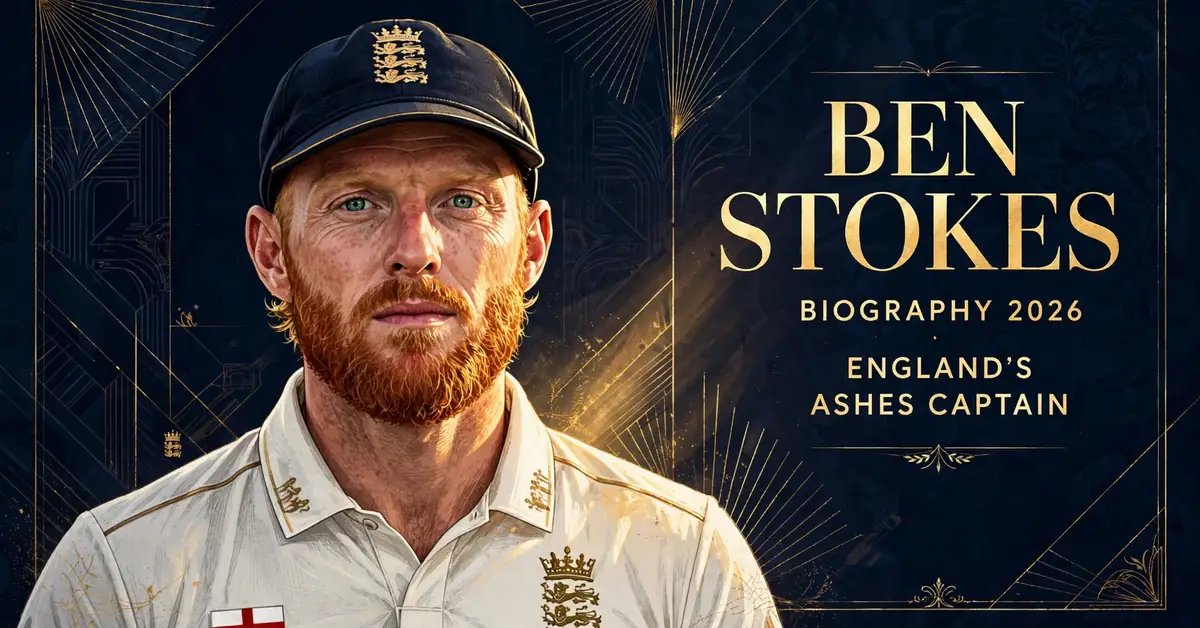
Ben Stokes biography 2026: the England Test captain’s story, from Christchurch to the 2019 World Cup final, Headingley 135*, Bazball, and a $13M fortune.
Last updated: November 10, 2026 · By Nathan Cole
Ben Stokes is 35 years old in 2026, England’s Test captain since April 2022, and the all-rounder behind the two most famous innings in modern English cricket. Born Benjamin Andrew Stokes on 4 June 1991 in Christchurch, New Zealand, he moved to England at 12, made his Test debut at 22, and by 28 had played the match-winning hand in a World Cup final and then, six weeks later, an Ashes innings people still argue about as the greatest ever played by an Englishman. His net worth is estimated at around $13 million in 2026, built on an ECB central contract, three big Indian Premier League deals, and the profile of a player who delivers when the match is already lost.
This biography covers the whole story, kept current to November 10, 2026: the Christchurch childhood and the move to Cumbria, the Durham breakthrough, the 258 at Cape Town, Lord’s 2019 and Headingley 2019, the IPL millions, the Bazball captaincy, the 2022 T20 World Cup final, the injuries and the 2021 break, the Bristol night and the acquittal, and the hard winter of the 2025-26 Ashes — where England went 3-1 down, Stokes completed his first full Test series in two years, and still said he wants to stay captain. One correction up front: some low-quality sites now claim Stokes retired from international cricket in mid-2026 and handed the captaincy back to Joe Root. That is wrong. He captained the Sydney Test on 4 January 2026 and has said unequivocally he wants to keep the job.
Quick Facts
| Full Name | Benjamin Andrew Stokes OBE |
| Net Worth 2026 | Estimated ~$13M (CricBites, TheCityCeleb); range $10M–$15M |
| Age in 2026 | 35 years old (born 4 June 1991, Christchurch, New Zealand; turned 35 on 4 June 2026) |
| Height | 6 ft (183 cm) |
| Role | All-rounder (left-hand bat, right-arm fast-medium); England Test captain since April 2022 |
| Test Debut | 5 December 2013 vs Australia (cap 658) |
| Career Stats | Tests 121 matches, 7,228 runs, 246 wickets; ODIs 114 matches, 3,463 runs; T20Is 43 matches, 585 runs (Nov 2026) |
| Wife | Clare Ratcliffe (married October 2017); children Layton and Libby |
| County | Durham (debut 2009) |
| IPL Teams | Rising Pune Supergiant (2017), Rajasthan Royals (2018–2021), Chennai Super Kings (2023) |
| Honours | OBE (2020 New Year Honours); ICC Cricketer of the Year 2019; Wisden Leading Cricketer in the World 2019, 2020, 2022 |
How This Estimate Was Made
No audited figure exists for Ben Stokes, and neither he nor the ECB has disclosed his finances, so the estimate is reported with its sources attached rather than presented as a fact. CricBites and TheCityCeleb both put him at around $13 million in 2026. This article anchors that figure and publishes a $10 million to $15 million range, because the public pieces of his income do not add up to a single clean number: his ECB central contract value is not published, his IPL fees are public in rupees (₹14.5 crore in 2017, ₹16.25 crore in 2023) and move with the exchange rate, and his endorsement income is estimated from reported deals, not from any disclosed contract. Where sources disagreed, the article names the disagreement instead of picking a number silently. Career statistics, dates and honours come from ESPNcricinfo, Wikipedia and ECB reporting, with the career snapshot dated November 2026. The claim that Stokes retired from international cricket in mid-2026, repeated by some low-quality AI sites, is contradicted by January 2026 Ashes reporting and is not used anywhere in this article.
+
How Much Is Ben Stokes Worth in 2026?
Ben Stokes is worth an estimated $13 million in 2026. CricBites and TheCityCeleb both land on that figure, and the honest range around it is $10 million to $15 million. The range is narrower than for most celebrities because Stokes’s income is unusually visible: three IPL contracts with published prices, an ECB central contract, and a career of match fees that follow a public scale. What is not visible is the exact size of the central contract or his endorsement deals, and that is where the $5 million spread comes from.
| Income stream | Reported figure | Source / year |
|---|---|---|
| Rising Pune Supergiant (IPL 2017) | ₹14.5 crore (~$2.1M) | IPL auction, 2017 |
| Rajasthan Royals (IPL 2018–2021) | Retained across four seasons | IPL, 2018–2021 |
| Chennai Super Kings (IPL 2023) | ₹16.25 crore | IPL auction, 2023 |
| ECB central contract | Undisclosed; top-band England contract | ECB |
| Book: Firestarter (2019) | Bestseller; advance undisclosed | 2019 |
| Total net worth estimate | ~$13M (range $10M–$15M) | CricBites, TheCityCeleb, 2026 |
The IPL money is the easiest part to count. His 2017 fee at Rising Pune Supergiant, ₹14.5 crore, was worth about $2.1 million at the time, and he earned it: 316 runs, 12 wickets and the tournament MVP award. His 2023 fee at Chennai Super Kings was even bigger, ₹16.25 crore, though injury held him to two matches. The ECB money is the hardest part to count, because the board does not publish individual contract values, and Stokes has spent most of his career on a top-band deal as a three-format player and then as Test captain. Endorsements fill the gap between the two, but no outlet has published a reliable total for them. The $13 million anchor is the figure the outlets that have done the work agree on, and the $10 million to $15 million range is the honest statement of what is known.
For scale, Stokes sits well below the richest cricketers in the game. MS Dhoni’s biography puts the former India captain at an estimated $135 million, built on a decade of IPL captaincy, endorsements and business interests. Stokes never had that kind of commercial machine around him. His fortune is a cricketer’s fortune: match fees, contracts and one very good IPL auction.
Christchurch to Cumbria: The Early Years
Benjamin Andrew Stokes was born on 4 June 1991 in Christchurch, New Zealand. His father, Gerard Stokes, was a rugby league player and coach; his mother, Deborah Stokes, is of Māori heritage. The family lived in New Zealand until 2003, when Gerard took the coaching job at Workington Town, a rugby league club in Cumbria, and the family moved to England. Stokes was 12. He grew up in Cockermouth, played his junior cricket in the north-west, and joined Durham’s academy as a teenager.
The move shaped him in two ways that still show in his cricket. First, he arrived in England as an outsider with a New Zealand accent and a rugby league household, which gave him the physical directness — the short, hard running, the willingness to collide — that English academy products rarely have. Second, he learned the game in the north, at Durham, a county that had to fight for everything it got, rather than at one of the big southern counties. Durham was the club that gave him his first professional contract, and he has stayed loyal to it for his whole career.
His mother Deborah’s Māori heritage is part of the family story Stokes has spoken about publicly, and it is one reason the 2019 World Cup final carried an extra charge for him: the team he beat in that final, New Zealand, was the country of his birth, and several of its players were men he had grown up watching. He has never made a fuss about the dual identity. He plays for England, and he has said the decision was made when his family moved, not when the selectors called.
Durham to Cape Town: The Breakthrough
Stokes made his List A debut for Durham in 2009 at The Oval, at 18, and his first-class debut the following year. The early years were a mix of promise and trouble: big innings and fast spells, interrupted by injuries and the occasional disciplinary scrape. Durham stuck with him, and by 2011 the selectors were paying attention. He made his one-day international debut in August 2011 against Ireland, his Twenty20 international debut on 23 September 2011, and his Test debut on 5 December 2013 against Australia, as cap 658, in the middle of an Ashes series England were losing heavily.
The innings that announced him came in January 2016, at Cape Town, against South Africa. Stokes scored 258 from 198 balls, then the fastest 250 in Test history and a world record for a batsman at No. 6. He reached his hundred in 105 balls and his double hundred in 163, and he shared a 399-run stand with Jonny Bairstow that turned a match England were struggling in into a rout. The innings had everything that defines Stokes as a batsman: the clean hitting through the off side, the pull shot played with contempt, and the refusal to slow down once he was set. South Africa’s bowlers had no answer, and the record books had a new entry.
Cape Town changed how opponents planned for him. Before it, he was a dangerous lower-order hitter. After it, he was a batsman teams had to plan for like a top-order player, and his bowling — right-arm fast-medium, capable of long spells and the odd unplayable ball — made him the rarest thing in the modern game: a genuine all-rounder who would make either side on one discipline alone. By the end of 2016 he was established in all three formats, and the next three years would make him famous beyond cricket.
Lord’s, 14 July 2019: The World Cup Final
The 2019 Cricket World Cup final at Lord’s is the most famous match in English cricket history, and Ben Stokes was its central figure. England, chasing 242 against New Zealand, were 86 for 4 when Stokes came to the crease, and 196 for 6 when the last recognised batsman went. He finished unbeaten on 84, and the match was tied. The Super Over was tied too. England won on the boundary countback rule — a rule the ICC has since changed — and Stokes was named Man of the Match. It was England’s first 50-over World Cup title, four years after the humiliation of the 2015 tournament had forced a rebuild of the whole white-ball side.
The innings is remembered for two moments. The first was the six off Trent Boult in the final over, when a throw from the deep hit Stokes’s bat as he dived for his ground and ran away for four overthrows — six runs that tied the scores and that Stokes apologised for afterwards, because he had not meant to profit from the deflection. The second was the Super Over itself, where he and Jos Buttler scored 15, and Jofra Archer then defended it. Stokes batted through the chase without losing his shape: the same straight bat, the same calm between balls, the same refusal to panic when the asking rate climbed past ten an over.
What made the final a biography-defining day, rather than just a great innings, was the context. Stokes had been dropped from the 2017-18 Ashes squad after the Bristol incident and spent a year rebuilding his reputation. The World Cup final was the match where the English public forgave him, and where he became the player the team was built around. He was 28, at the peak of his powers, and the next six weeks would add the second half of the legend.
Headingley 135*: The Greatest Ashes Innings
Six weeks after Lord’s, at Headingley in the third Ashes Test of 2019, Stokes played the innings that most cricket writers now call the greatest ever played by an Englishman. England were bowled out for 67 in their first innings and set 359 to win in the fourth. They were 286 for 9 when Jack Leach walked out to join Stokes, with 73 still needed and one wicket in hand. Stokes finished unbeaten on 135, Leach made 1 not out from 17 balls, and England won by one wicket.
The numbers only tell half of it. Stokes scored the last 74 runs of the chase almost entirely in boundaries, farming the strike so Leach faced as few balls as possible, and hitting the ball so cleanly that Australia’s captain Tim Paine ran out of fielders to hide. He was dropped, he survived a run-out chance, and he reviewed an lbw decision that would have ended the match — the review that showed the ball missing leg stump is now part of the folklore. When the winning runs came, he stood in the middle of the pitch with his arms out, and Headingley stood with him.
The innings did something no single performance had done for English cricket in years: it made the Ashes feel winnable from a position that was not winnable. England went on to draw the series 2-2, with Australia retaining the urn, and Stokes finished 2019 as the ICC Cricketer of the Year, the winner of the Sir Garfield Sobers Trophy, and the BBC Sports Personality of the Year. He was 28, and he had played the two most famous innings in his country’s history inside six weeks.
The IPL Years: Pune, Rajasthan and Chennai
Stokes’s Indian Premier League career began in 2017, when Rising Pune Supergiant paid ₹14.5 crore for him at the auction — about $2.1 million at the time, and the highest price paid for an overseas player that year. He repaid it in full. He scored 316 runs and took 12 wickets, was named the tournament’s Most Valuable Player, and hit 103 not out from 63 balls against Gujarat Lions, an innings of clean, straight hitting that Pune’s fans still talk about. The fee looked like a gamble in February and a bargain by May.
Rajasthan Royals kept him for the next four seasons, from 2018 to 2021, and he gave them his second IPL hundred — 107 not out in 2020 — along with the steady all-round work that made him one of the most reliable overseas players in the league. The IPL years also cost him. He broke a finger in April 2021 playing for Rajasthan, had surgery, and missed the rest of the season. It was the injury that started the chain of events leading to his break from the game later that year.
His last IPL deal was the biggest of all: Chennai Super Kings paid ₹16.25 crore for him in 2023, but injury held him to two matches. The fee is still the largest single IPL payment of his career, and it is a useful measure of how the league valued him even after the injuries had started to pile up. Across his IPL career he was never a franchise’s marquee name in the way the Indian stars were, but he was the player every franchise wanted when the auction got serious.
Test Captain and Bazball: The McCullum Years
In April 2022, Stokes was appointed England’s Test captain, taking over from Joe Root, whose biography charts the run-scoring years that made him England’s record Test run-scorer. Root had carried the side through a run of one win in 17 Tests, and the job looked like a poisoned chalice. Stokes took it on one condition that mattered: he wanted Brendon McCullum, the former New Zealand captain, as head coach. The pair rebuilt England’s Test cricket around a single idea — attack, always, in every situation — and the press gave it a name that stuck: Bazball, after McCullum’s nickname.
The results were immediate. England won series after series in the first months under Stokes and McCullum, chasing targets that previous England sides would have blocked out for a draw, and declaring in positions that looked reckless until the wickets started falling. The style was not reckless. It was a deliberate plan: score fast enough to create time to take 20 wickets, and trust the bowlers to do it. Stokes led it from the front, promoting himself up the order, bowling long spells when the game needed them, and setting fields that invited the batsman to take risks.
The captaincy also changed Stokes’s own game. His batting became more aggressive and less consistent — his average in the past year is 31, against a career average of 35 — and his bowling workload grew, because he kept picking himself to bowl the hard overs. In 2025 no England bowler took more Test wickets than his 33. The trade-off is the story of his captaincy: he gives the team everything he has, and the numbers show the cost.
Melbourne 2022: The T20 World Cup Final
If Lord’s 2019 was Stokes the match-winner, Melbourne 2022 was Stokes the finisher. England reached the T20 World Cup final against Pakistan at the Melbourne Cricket Ground, and the chase of 138 was going wrong: England were 45 for 3, the ball was moving, and the crowd was loud. Stokes walked in, played himself in with the patience of a Test batsman, and finished unbeaten on 52 as England won by five wickets. It was England’s second T20 World Cup title, and Stokes had now won a World Cup final in both white-ball formats.
The innings was the opposite of Headingley. There were no wild swings, no farming of the strike, no drama. He took 49 balls for his 52, rotated the strike, and waited for the bad ball. It was the innings of a player who had learned that the situation decides the method, not the other way round — and it is the reason coaches still show young players the Melbourne innings when they want to teach them how to finish a chase. He has never retired from T20 international cricket, and the record stands at 43 T20I matches and 585 runs.
The Ashes 2025-26: A Captain’s Hardest Winter
The 2025-26 Ashes in Australia was the hardest series of Stokes’s captaincy, and it is the freshest chapter of this biography. England went into the Sydney finale in January 2026 trailing 3-1, the urn already lost, and Stokes completed his first full Test series in two years — a fact that says as much about his body as it does about the series. His last Test before the finale was the Sydney match that began on 4 January 2026, and he captained it.
The numbers from the series and the year around it tell a complicated story. In 2025 no England bowler took more Test wickets than Stokes’s 33, and his bowling strike rate of 45.88 balls per wicket was his lowest in any year as captain. His batting told the other side of the ledger: an average of 31 in the past year, against a career average of 35. He was carrying the bowling attack and the captaincy at the same time, and his batting paid for it. The series also had its off-field moment: an emotional Christmas Eve press conference in Melbourne, held after the Ben Duckett Noosa video incident, where Stokes defended his player and his team in terms that made the front pages.
His opposite numbers in the series were the two men who define Australian cricket in this era. Pat Cummins, the Australian captain, led the side that took the urn, and Steve Smith, the Australian star batsman, was the wicket England wanted most in every innings. Stokes’s answer to the defeat has been consistent: he wants to stay captain. The next Ashes is in England in 2027, and he will be 36 when it starts. Whether his body holds for another home series is the question that will decide the last chapter of his career.
Injuries, the Break, and the Comebacks
No biography of Stokes is honest without the injuries, because they have shaped his career as much as the great innings have. The chain began in April 2021, when he broke a finger playing for Rajasthan Royals in the IPL and had surgery. He came back too soon, played through pain, and in August 2021 took an indefinite break from cricket, citing the finger injury and his mental wellbeing. It was the first time a leading England cricketer had spoken that plainly about needing to stop, and the ECB backed him without a deadline. He returned for the 2021-22 Ashes, but the body never fully reset.
The worst of it came in December 2024, in Hamilton, New Zealand, when he tore his left hamstring. Surgery followed in January 2025, and he missed the Champions Trophy in February 2025 and the white-ball tour of India that followed. He returned in May 2025 against Zimbabwe at Trent Bridge, and the fact that he then bowled more than any other England bowler in the year — 33 Test wickets in 2025 — says everything about how he came back: not carefully, but all at once, the way he does everything.
The pattern is worth naming, because it is the central tension of his career. Stokes plays like a man who believes his body will hold, and his body keeps proving him wrong, and he keeps coming back anyway. The 2025-26 Ashes was his first full Test series in two years precisely because the hamstring, the finger and the knee have taken so many series from him. His career statistics — 121 Tests, 7,228 runs and 246 wickets as of the November 2026 snapshot — would be larger if he had stayed fit. They are what they are because he has not, and because he has refused to stop.
The Bristol Night and the Acquittal
In September 2017, Stokes was arrested in Bristol after a late-night incident outside a nightclub, and charged with affray. He was dropped from the 2017-18 Ashes squad, missed the whole series, and spent a year with the charge hanging over him. In August 2018 he was acquitted of affray at Bristol Crown Court.
The episode cost him a year of his career and very nearly more. The cricketing judgement was delivered on the field: he came back, scored runs, took wickets, and within a year had played the two innings that define him. The Bristol night is part of this biography because it is part of the story — the year he lost, and the way he answered it.
Family: Clare, Layton and Libby
Stokes married Clare Ratcliffe in October 2017. The couple have two children: a son, Layton, and a daughter, Libby.
He is 6 ft tall (183 cm), a big man by a cricketer’s standards, and the physical presence is part of the package: the long levers that generate his power, the shoulders that carry the fast-medium bowling workload. The family lives in the north-east, near Durham, and Stokes has stayed loyal to the county and the region that took him in when he was a teenager from Christchurch.
Honours, Books and the Screen
The honours list is long. Stokes was appointed OBE in the 2020 New Year Honours, for services to cricket, after the World Cup summer. He was named the ICC Cricketer of the Year for 2019, winning the Sir Garfield Sobers Trophy, and the ICC Test Player of the Year for 2022. Wisden named him its Leading Cricketer in the World in 2019, 2020 and 2022 — three times in four years, a mark of how consistently the game’s bible rated him the best player on the planet. He also won the BBC Sports Personality of the Year award for 2019, voted by the British public.
He told his own story in his autobiography, Firestarter, published in 2019, which covered the Christchurch childhood, the move to England, the Durham years and the Bristol night. The documentary Ben Stokes: Phoenix from the Ashes followed in 2022, tracing the comeback from the 2021 break to the T20 World Cup win. Both are worth reading and watching for anyone who wants the first-person version of the events in this biography.
How Stokes Compares: The All-Rounder’s Place
Stokes’s career invites one comparison above all others: with the great all-rounders. His Test numbers — 121 matches, 7,228 runs at an average of 35, and 246 wickets — put him in the company of players who changed matches with both disciplines, and the two innings of 2019 put him in the company of players who changed history. Sachin Tendulkar’s biography is the standard for batting longevity, and Stokes has never pretended to match it; his claim is different, and it rests on the days when one man won the match twice over.
| Player | Tests | Test runs | Test wickets | Net worth 2026 |
|---|---|---|---|---|
| Ben Stokes | 121 | 7,228 | 246 | ~$13M |
| Joe Root | — | England’s record run-scorer | — | See Root biography |
| MS Dhoni | — | — | — | ~$135M |
The table makes the point plainly: Stokes’s fortune is small next to the game’s commercial giants, and his numbers are large next to almost anyone else. He is not the richest cricketer of his generation, and he is not the most prolific. He is the one who, twice in six weeks in the summer of 2019, did the thing no one else could do — and then spent the next seven years trying to do it again as a captain, with a body that kept breaking and a team that kept believing in him. The next Ashes, at home in 2027, will be 36-year-old Ben Stokes’s last chance to add a third chapter. The record says he will be there.
Frequently Asked Questions
How old is Ben Stokes in 2026?
Ben Stokes is 35 years old in 2026. He was born Benjamin Andrew Stokes on 4 June 1991 in Christchurch, New Zealand, and turned 35 on 4 June 2026.
What is Ben Stokes’ net worth in 2026?
Ben Stokes’ net worth is estimated at around $13 million in 2026, according to CricBites and TheCityCeleb, with a range of $10 million to $15 million. The figure is built on his ECB central contract, three IPL deals (₹14.5 crore in 2017 and ₹16.25 crore in 2023) and endorsements.
Is Ben Stokes still England Test captain?
Yes. Ben Stokes is still England’s Test captain, a role he has held since April 2022. He captained the Sydney Test on 4 January 2026 in the 2025-26 Ashes and has said unequivocally he wants to stay captain. Claims that he retired from international cricket in mid-2026 and handed the captaincy back to Joe Root are false.
What did Ben Stokes do at Headingley in 2019?
At Headingley in the 2019 Ashes, Ben Stokes scored an unbeaten 135 as England chased 359 to win. England were 286 for 9 when Jack Leach joined him, and they won by one wicket. It is widely called the greatest innings ever played by an Englishman.
What happened in the 2019 World Cup final?
In the 2019 Cricket World Cup final at Lord’s on 14 July 2019, Ben Stokes scored an unbeaten 84 as England tied with New Zealand, then played in the tied Super Over. England won on the boundary countback rule, their first 50-over World Cup title, and Stokes was named Man of the Match.
Who is Ben Stokes’ wife?
Ben Stokes’ wife is Clare Ratcliffe. They married in October 2017 and have two children: a son, Layton, and a daughter, Libby.
Why did Ben Stokes take a break from cricket in 2021?
In August 2021 Ben Stokes took an indefinite break from cricket, citing a broken finger injury and his mental wellbeing. He had broken the finger playing for Rajasthan Royals in the IPL in April 2021 and had surgery. He returned for the 2021-22 Ashes.
What is Ben Stokes’ height?
Ben Stokes is 6 ft tall (183 cm). He is a left-handed batsman and a right-arm fast-medium bowler, and has played 121 Tests, 114 ODIs and 43 T20Is for England as of November 2026.
Sources & Reporting
This article was researched on 10 November 2026 from live reporting: Wikipedia (8 January 2026 snapshot, sourced to ESPNcricinfo) for the birth date, debut dates, career statistics (Tests 121 matches, 7,228 runs, 246 wickets; ODIs 114 matches, 3,463 runs; T20Is 43 matches, 585 runs) and the last Test on 4 January 2026 vs Australia; ESPNcricinfo and CricketSky for the November 2026 career snapshot; the ECB for the 2020 New Year Honours OBE announcement; CricBites and TheCityCeleb for the ~$13 million net-worth estimate; and January 2026 Ashes reporting for the Sydney finale, the 3-1 series position, the Christmas Eve Melbourne press conference, and Stokes’s statement that he wants to stay captain. The false claim that Stokes retired from international cricket in mid-2026 and handed the captaincy back to Joe Root, repeated by some low-quality AI sites, is contradicted by that January 2026 reporting and is not used in this article. Internal-link figures for Joe Root, MS Dhoni, Steve Smith, Pat Cummins and Sachin Tendulkar are taken from this site’s own posts. Where sources disagreed — the $10 million to $15 million net-worth range, the October 2017 wedding date against a low-quality site’s 2015 claim — the article names the disagreement instead of picking a number silently. Corrections are welcome via the About page.
Nathan Cole
Nathan Cole is the editor of Guide Net Worth. He covers celebrity wealth the way a business desk covers earnings: reported figures first, estimates labeled as estimates, no invented numbers. Every profile passes through his desk before it publishes. About Guide Net Worth · Corrections: figures are updated when new reporting emerges — contact us via the About page if you spot an error.
References & Sources
This article has been fact-checked and verified against multiple public sources, financial disclosures, SEC filings, Forbes reports, Celebrity Net Worth databases, and official records. All net worth estimates are based on publicly available information and financial analysis.