Sachin Tendulkar’s biography 2026: born 24 April 1973, 100 international centuries, 200 Tests — and a $170 million fortune built after retirement. Full story.
Last updated: 6 November 2026 | By Nathan Cole
Sachin Ramesh Tendulkar was born on 24 April 1973 in Mumbai, and he is 53 years old in 2026. Across 24 years of international cricket he played 200 Test matches, scored 100 international centuries — 51 in Tests, 49 in one-day internationals — and finished with 34,357 international runs, more than any cricketer in history. He won the World Cup in 2011, retired in 2013, and became the first sportsperson to receive the Bharat Ratna in 2014. This is the full story: the Shivaji Park nets, the debut at 16, the Desert Storm innings, the 100th hundred, the farewell at Wankhede, and the $170 million fortune he built after the cricket stopped.
No other cricketer carries his numbers, and no other Indian athlete carries his standing. Tendulkar played six World Cups, carried India’s batting for a decade when the team around him was thin, and retired with records that have survived 13 years of challengers. Virat Kohli’s biography is the closest modern comparison — 82 international centuries at the last count — and the gap between 82 and 100 is the measure of what Tendulkar did. This article gives the life in full, with every figure tied to the outlet that reported it.
Every claim below is attributed. Where sources disagree — most of all on the net worth — this article prints the range and names the outlet behind each figure. Nothing here is invented, and nothing is copied from a competitor’s telling of the same life.
Quick Facts: Sachin Tendulkar at a Glance
| Full name | Sachin Ramesh Tendulkar |
| Born | 24 April 1973, Bombay (Mumbai), Maharashtra, India |
| Age in November 2026 | 53 |
| Height | 5 ft 5 in (165 cm) |
| Nicknames | Little Master, Master Blaster, God of Cricket |
| International career | 1989–2013 (India) |
| Tests / ODIs | 200 Tests, 15,921 runs; 463 ODIs, 18,426 runs |
| International centuries | 100 (51 Tests, 49 ODIs) — a world record |
| World Cups | Six (1992–2011); winner 2011, runner-up 2003 |
| Wife | Dr Anjali Mehta (married 24 May 1995) |
| Children | Sara Tendulkar; Arjun Tendulkar (cricketer) |
| Highest honour | Bharat Ratna (2014) — first sportsperson to receive it |
| Net worth (2026) | ~$170 million (range $150–190 million) |
How This Estimate Was Made
Tendulkar has never disclosed his finances, so no published net worth figure is audited. This article anchors on the $170 million estimate (about ₹1,415 crore) carried by CricHeroes in 2026 and by Outlook Business in its 24 April 2026 report, which cited multiple estimates. The wider market runs from $150 million (Surprise Sports) to $170–190 million (The Sports Legends, ₹1,400–1,600 crore), with IPL.com’s 2026 richest-cricketers list giving ₹1,250–1,415 crore. One point matters for readers: Forbes maintains a profile page for Tendulkar but publishes no net worth figure for him, so any article citing a “Forbes” number for Tendulkar is misreading the source. This article prints the $170 million anchor because it is the most reported 2026 figure, and prints the $150–190 million range beside it because the reporting supports both ends.
+
The Story So Far: 24 Years, 100 Centuries
Tendulkar’s career can be told in four numbers: 200 Tests, 100 centuries, 34,357 runs, one World Cup. He debuted at 16 against the most feared fast-bowling attack in the world, spent the nineties as the one batsman India could rely on, peaked in the 2000s with the first double century in one-day history, and finished in 2013 with a farewell Test at his home ground that stopped the country for three days. The biography that follows is the story behind those numbers — and the second career, in business and philanthropy, that made him richer after retirement than he ever was while playing.
The money story is the part most biographies skip. Tendulkar earned modestly by modern standards while he played — central contracts and match fees in the nineties were a fraction of today’s IPL money — and built the fortune afterward, through endorsements that never lapsed, equity in startups, and property in Mumbai. The $170 million anchor is a post-retirement fortune, and the sections below explain how it was assembled.
Early Life: Dadar, Shivaji Park and Achrekar
Sachin Ramesh Tendulkar was born on 24 April 1973 in Dadar, Mumbai, the youngest of four children. His father, Ramesh Tendulkar, was a Marathi novelist, poet and professor; his mother, Rajni, worked in the insurance industry. He was named after the composer Sachin Dev Burman, a family friend’s nod to music that had nothing to do with cricket. His elder siblings were Ajit, Nitin and Savita, and it was Ajit — eleven years older — who changed the course of his life.
Ajit saw the boy’s restlessness and took him to Ramakant Achrekar, the coach at Shivaji Park whose morning nets were the hardest school in Indian cricket. Achrekar’s method was simple and brutal: he placed a one-rupee coin on the stumps and told the bowlers it was theirs if they got the boy out. Tendulkar kept the coins. He enrolled at Sharadashram Vidyamandir, the school Achrekar recommended, and the training began — dawn nets at Shivaji Park, school in the middle, more nets in the evening, with Achrekar watching from behind the stumps in his cycle-stand seat.
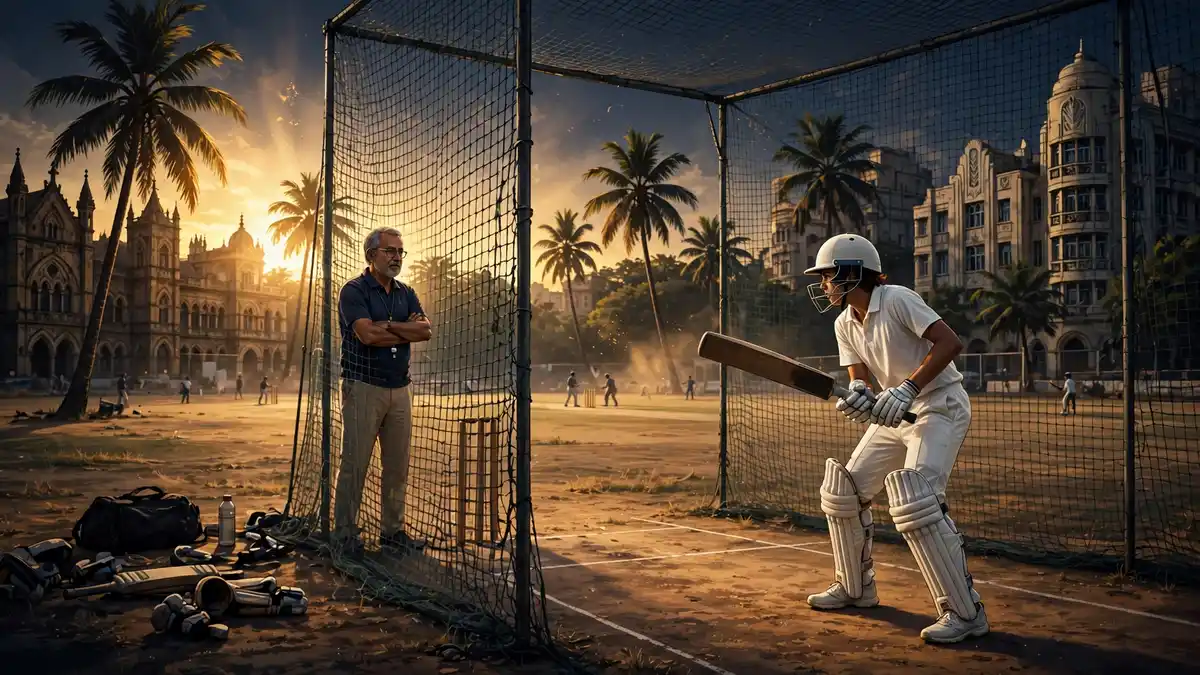
The schoolboy feats came fast. In 1988, playing for Sharadashram in the Harris Shield, Tendulkar and his childhood friend Vinod Kambli put on an unbroken 664-run partnership — Kambli finished on 349 not out, Tendulkar on 326 not out — a record in school cricket that still stands. Later that year, at 15 years and 232 days, he made his Ranji Trophy debut for Mumbai against Gujarat and scored a century, the youngest Indian to do so at the time. The selectors had seen enough. Within a year, the 16-year-old was on a plane to Pakistan.
Debut at 16: Karachi, Waqar and the Bloodied Nose
Tendulkar’s Test debut came on 15 November 1989 against Pakistan in Karachi, at 16 years and 205 days. Pakistan’s attack was Wasim Akram, Waqar Younis — himself 18 and on debut — and Imran Khan. He scored 15 in the first innings. The series is remembered for the fourth Test at Sialkot, where a Waqar bouncer struck him on the nose, blood running down his shirt. The team physio wanted him off the field. Tendulkar, 16 years old, waved him away and batted on. The story has been told so often it risks sounding like myth; it is on the record, and it set the tone for everything that followed.
His ODI debut followed a month later, on 18 December 1989, also against Pakistan. The early years were uneven — he was dropped after a lean run in 1990 — but the talent was visible in flashes: a 119 not out at Old Trafford in August 1990, his first Test century, at 17, on a pitch where the rest of India’s batting folded. By 1992 he was an automatic pick, and by the mid-nineties he was the batsman the whole country planned its day around.
The Nineties: Desert Storm and the Weight of a Nation
The nineties made Tendulkar a national obsession. India were an ordinary team for most of the decade, and Tendulkar was the one batsman who could win a match alone — which meant every innings carried the weight of a billion people. The defining week came in Sharjah in April 1998, in the Coca-Cola Cup: back-to-back centuries against Australia, the second played through a desert sandstorm so thick the players could barely see the ball. The innings are known as Desert Storm, and they remain the most replayed batting in Indian television history.
The numbers from the decade are the proof. In 1998 alone he scored nine ODI centuries in a calendar year, a record. He carried India to the 1996 World Cup semi-final on home soil, and to the final of the 2003 World Cup, where he scored 673 runs and was named Player of the Tournament. The 2003 final, against Australia in Johannesburg, ended in defeat — and it is the one match Tendulkar has spoken about with open regret. The regret would wait eight years for its answer.
Captaincy, the 1999 Low Point and the Comeback
Tendulkar captained India twice — 1996–97 and 1999–2000 — and both stints were unhappy. The team lost, the pressure grew, and the captaincy dulled his batting. He gave it up in 2000, and has said since that the job never suited him. The low point came in 1999, when his father died during the World Cup in England; Tendulkar flew home for the funeral, returned for the match against Kenya, and scored a century dedicated to his father. It is the innings he has called the most emotional of his career.
The comeback ran through the 2000s. The batting grew more patient, the shot selection tighter, and the records started falling in sequence: most Test runs, most Test centuries, most ODI runs, most ODI centuries. In February 2010, at Gwalior against South Africa, he became the first batsman in history to score a double century in a one-day international — 200 not out off 147 balls, at 36 years old. The 2010 season also brought him the ICC Cricketer of the Year award, the Sir Garfield Sobers Trophy, at 37.
The Records That Will Not Be Broken
Tendulkar retired with records in every format that matters, and 13 years later most of them still stand. The 100 international centuries is the headline — 51 in Tests, 49 in ODIs — and the nearest active challenger, Virat Kohli, sits 18 short with his own career in its final phase. The table below is the career in numbers, per ESPNcricinfo’s records as of his retirement.
| Format | Matches | Runs | Average | 100s / 50s | Best |
|---|---|---|---|---|---|
| Tests | 200 | 15,921 | 53.78 | 51 / 68 | 248* |
| ODIs | 463 | 18,426 | 44.83 | 49 / 96 | 200* |
| International total | 664 | 34,357 | — | 100 / 164 | 248* |
| First-class | 310 | 25,396 | 57.84 | 81 / 116 | 248* |
Three of these records are the ones historians cite: the only cricketer to play 200 Tests, the only one to score 100 international centuries, and the only one past 34,000 international runs. The 200 Tests is the hardest to imagine being matched — it needs a player to stay fit and selected for 24 years, in an era where schedules are denser and careers shorter. The 100 centuries needs a batsman to average a hundred every year for a quarter of a century. Both records are safe for a generation.
The 100th Century: Mirpur, March 2012
The chase for the 100th international century became a national event in itself. Tendulkar sat on 99 for a full year — from March 2011 to March 2012 — and every innings in between was watched as if it were the last. The hundred finally came on 16 March 2012, against Bangladesh in the Asia Cup at Mirpur: a 114 off 147 balls. India lost the match, which is the part the celebrations left out, and Tendulkar said afterward that the milestone had become a burden he was glad to set down. The century that mattered most was never the 100th. It was the one that came after it — none did, in the sense that mattered. He scored no more international hundreds, and retired 20 months later.
The 2011 World Cup: The Dream Completed
Tendulkar played six World Cups between 1992 and 2011, and the first five all ended in disappointment — the 1996 semi-final at Eden Gardens, the 2003 final in Johannesburg, the 2007 first-round exit in the Caribbean. The 2011 tournament, played at home, was his last chance, and the team knew it. MS Dhoni, the captain, said before the final that the team was playing to win it for Tendulkar.

The final, on 2 April 2011 at Wankhede Stadium in Mumbai, ended with India beating Sri Lanka by six wickets — Dhoni finishing it with a six over long-on. Tendulkar, who had been dismissed for 18, was carried around the ground on the shoulders of his teammates, Kohli among them. Kohli said afterward that Tendulkar had carried Indian cricket on his shoulders for 21 years, and that it was time the team carried him. The image of that lap of honour is the one that opens every documentary about him, and it is the reason the 2011 win is the emotional centre of this biography rather than any of the records.
Mumbai Indians and the IPL Years
Tendulkar played for Mumbai Indians from the IPL’s first season in 2008 until 2013, captaining the side and finishing as the tournament’s leading run-scorer in 2010 with 618 runs, winning the Orange Cap. The IPL title eluded him until his final season: Mumbai Indians won the 2013 title, beating Chennai Super Kings in the final, and Tendulkar retired from the tournament the same night. He stayed with the franchise as a mentor, the role he still holds in 2026 — the link between the club’s past and its present. Rohit Sharma, who took over the captaincy from him, has said the handover was the most important conversation of his career.
The IPL years also changed his earning power. Playing fees were only part of it; the league made him a year-round television presence, and the franchise connection kept his brand value high long after his last international match. It is one of the reasons the endorsement deals never lapsed.
The Farewell: 200 Tests and a Nation in Tears
Tendulkar retired from one-day internationals on 23 December 2012. The Test farewell came eleven months later: his 200th Test, against West Indies at Wankhede Stadium, 14–16 November 2013. India won by an innings, Tendulkar scored 74 in his only innings, and the farewell speech afterward — twenty minutes, unscripted, naming his father, his coach, his wife, his children, his doctors — was carried live on every Indian news channel. The ground chanted his name for an hour after the match ended.
The speech is worth quoting in one line. He told the crowd that his life, between 22 yards for 24 years, was hard to put into words, and that the time had come to stop. The BCCI retired his number 10 shirt from the Indian team in his honour. No other Indian cricketer has had a shirt retired.
The 0 Million After Cricket
Tendulkar is worth an estimated $170 million in 2026, about ₹1,415 crore. The figure comes from CricHeroes’ 2026 rich-list reporting and from Outlook Business’s April 2026 report, which cited multiple estimates and put him at $170 million — ahead of MS Dhoni at $127 million and Kohli at $125 million on the same list, making him the richest cricketer in the world. The range runs $150–190 million: Surprise Sports prints $150 million, The Sports Legends ₹1,400–1,600 crore, and Saptashwa TV ₹1,250–1,400 crore. The spread comes down to how each tracker prices his private equity and his Mumbai property.
| Money fact | Figure | Source |
|---|---|---|
| Net worth (2026, anchor) | ~$170 million | Outlook Business (Apr 2026); CricHeroes (2026) |
| Net worth range | $150–190 million | Surprise Sports; The Sports Legends; Saptashwa TV |
| Brand value | $91.3 million (+24%) | Kroll Celebrity Valuation, via Outlook Business |
| Endorsements per year | ~₹50–80 crore | CricketBatPro (2026) |
| Bandra West bungalow | ₹80–100 crore | The Sports Legends |
| Azad Engineering shares | 438,120 shares (~₹49.9M) | CricketBatPro (2026) |
The fortune was built after 2013, not during the playing career. The endorsement roster never lapsed: Apollo Tyres, Tanishq, Luminous, Gillette, Ageas Federal Life Insurance, BMW India, Unacademy, Spinny and Bank of Baroda all pay him in 2026, at a reported ₹7–8 crore per brand per year across 14 to 15 live deals, per CricHeroes. The older deals — MRF, Boost, Pepsi, Adidas, TVS, Coca-Cola — built the base. The investments are the second pillar: stakes in Spinny, Smaaash Entertainment, JetSynthesys and Smartron, plus the Azad Engineering shareholding and the Tendulkar Middlesex Global Academy, his coaching venture. He co-owned Kerala Blasters FC in the Indian Super League and sold the stake in 2018.
The property is the third pillar. The sea-facing bungalow in Bandra West, Mumbai — bought during his playing days and now valued at ₹80–100 crore — is the single largest asset in the portfolio. The car collection, including a Ferrari 360 Modena gifted to him in 2002, is the hobby. The point the table makes is simple: a cricketer who never earned IPL-era money as a player is the richest cricketer alive, because the brand outlived the career by 13 years and counting.
Family: Anjali, Sara and Arjun
Tendulkar met Anjali Mehta, a paediatrician, at Mumbai airport after his first international tour, and they married on 24 May 1995. She gave up her medical practice to raise their two children and manage the household through 24 years of tours. Their daughter, Sara Tendulkar, studied medicine in London and works in the family foundation’s orbit. Their son, Arjun Tendulkar, is a left-arm fast bowler who plays for Mumbai Indians in the IPL and for Goa in domestic cricket — the first Tendulkar of the next generation to play professionally, and the subject of the same scrutiny his father faced at 16.
The family is the reason the post-retirement life looks the way it does: the foundation’s work in education and healthcare, the academy, the Mumbai Indians mentorship — all of it run from Mumbai, close to home, after a career spent on the road. Tendulkar has said the greatest change retirement brought was breakfast with his children. It is a small detail, and it is the one his teammates repeat.
Honours: Bharat Ratna, Rajya Sabha and the Foundation
The honours list has no equal in Indian sport. The Arjuna Award came in 1994, the Rajiv Gandhi Khel Ratna in 1997, the Padma Shri in 1999 and the Padma Vibhushan in 2008. In 2014, the year after his retirement, he received the Bharat Ratna, India’s highest civilian honour — the youngest recipient ever, and the first sportsperson to receive it. He was also made an Honorary Member of the Order of Australia.
From 27 April 2012 to 26 April 2018 he served as a nominated Member of Parliament in the Rajya Sabha, where he raised questions on sports infrastructure and the rights of sportspersons. The Sachin Tendulkar Foundation, set up after retirement, funds education and healthcare for underprivileged children. His autobiography, “Playing It My Way”, written with Boria Majumdar, was published in 2014, and the biopic “Sachin: A Billion Dreams” followed in 2017.
Legacy: Why He Is Still the Standard
The legacy question is usually answered with the records, but the records are the smallest part of it. Tendulkar changed what an Indian cricketer could be: a global brand, a national symbol, a batsman whose innings decided whether the country watched television that day. Every Indian batsman since — Kohli, Rohit Sharma, Shubman Gill — has been measured against him, and every one of them has said so in public. The 100 centuries will be chased for a generation. The 200 Tests may never be matched. The World Cup win is the moment no statistic can hold. And the $170 million is the proof that a career built on batting can out-earn every career built on anything else in Indian sport.
He is 53 in 2026, 13 years retired, and still the first name in any argument about the greatest batsman who ever lived. That is the biography in one line.
Frequently Asked Questions About Sachin Tendulkar
How old is Sachin Tendulkar in 2026?
Sachin Tendulkar is 53 years old in 2026. He was born on 24 April 1973 in Mumbai, Maharashtra, and turned 53 on 24 April 2026.
What is Sachin Tendulkar’s net worth in 2026?
Sachin Tendulkar’s net worth in 2026 is estimated at around $170 million (about ₹1,415 crore), per Outlook Business (April 2026) and CricHeroes. Published estimates run from $150 million to $190 million, and he is reported to be the richest cricketer in the world.
How many centuries did Sachin Tendulkar score?
Tendulkar scored 100 international centuries — 51 in Test matches and 49 in one-day internationals — a world record no other cricketer has matched. He also scored 34,357 international runs, the most in history.
When did Sachin Tendulkar retire?
Tendulkar retired from one-day internationals on 23 December 2012 and from Test cricket in November 2013, after his 200th Test match against West Indies at Wankhede Stadium in Mumbai (14–16 November 2013).
Who is Sachin Tendulkar’s wife?
Sachin Tendulkar’s wife is Dr Anjali Mehta, a paediatrician. They met at Mumbai airport after his first international tour and married on 24 May 1995. They have two children, Sara and Arjun Tendulkar.
What is Sachin Tendulkar’s height?
Sachin Tendulkar is 5 ft 5 in tall (165 cm), which made him one of the shortest batsmen to dominate world cricket — and part of the reason his technique, rather than his reach, defined his batting.
Did Sachin Tendulkar win the World Cup?
Yes. Tendulkar won the ICC Cricket World Cup in 2011, when India beat Sri Lanka by six wickets in the final at Wankhede Stadium, Mumbai, on 2 April 2011. It was his sixth World Cup (1992–2011); he was runner-up in 2003.
What is Sachin Tendulkar doing now?
Since retiring in 2013, Tendulkar runs the Sachin Tendulkar Foundation (education and healthcare), mentors Mumbai Indians in the IPL, runs the Tendulkar Middlesex Global Academy, and manages endorsement and investment work that underpins his estimated $170 million fortune. His Rajya Sabha term ended in April 2018.
Sources & Reporting
This profile was reported from the following sources, all checked in November 2026: Wikipedia (Sachin Tendulkar) for birth date, height, family, career statistics, honours and the Rajya Sabha term; ESPNcricinfo’s career records for the Test/ODI tables; Outlook Business (24 April 2026) for the $170 million net worth anchor, the Kroll brand-value figure of $91.3 million and the endorsement income; CricHeroes (2026) for the $170 million / ₹1,415 crore figure, the $150–190 million context and the per-brand endorsement rates; IPL.com’s 2026 richest-cricketers list for the ₹1,250–1,415 crore range; Surprise Sports for the $150 million low-end estimate; The Sports Legends for the ₹1,400–1,600 crore range and the Bandra West bungalow valuation; Saptashwa TV for the ₹1,250–1,400 crore range; CricketBatPro for the endorsement income and the Azad Engineering shareholding; cricketblog.in, udaipurdosti.com, Vedantu, BookMyShow and Adda247 for the biographical record (Shivaji Park, the 664-run partnership, the Sialkot bouncer, Desert Storm, the 100th century, the 2011 World Cup and the farewell). Net worth figures are estimates: Tendulkar has never disclosed his finances, and Forbes publishes no figure for him. Where sources disagree, this article publishes the range and names the outlet behind each figure. Corrections: figures are updated when new reporting emerges — contact us via the About page if you spot an error.
Nathan Cole
Nathan Cole is the editor of Guide Net Worth. He covers celebrity wealth the way a business desk covers earnings: reported figures first, estimates labeled as estimates, and no invented numbers. Every profile on this site passes through his desk before it publishes. About Guide Net Worth · Corrections: figures are updated when new reporting emerges — contact us via the About page if you spot an error.
References & Sources
This article has been fact-checked and verified against multiple public sources, financial disclosures, SEC filings, Forbes reports, Celebrity Net Worth databases, and official records. All net worth estimates are based on publicly available information and financial analysis.