Chappell Roan biography: Kayleigh Rose Amstutz of Willard, Missouri, went from a dropped Atlantic teen to a Grammy-winning pop star worth $12M. The full story.
Last updated: November 20, 2026 · By Nathan Cole
Chappell Roan is 28 years old in 2026. She was born Kayleigh Rose Amstutz on February 19, 1998, in Willard, Missouri, and she turns 29 on February 19, 2027. Twelve years passed between the day she uploaded her first song from a summer arts camp and the night she won a Grammy. In between came a major-label deal at 17, a debut EP, a public dropping, a job at a donut shop, and a slow rebuild with one producer that ended with her standing on the biggest stages in pop music wearing a crown of red hair and white face paint.
Her net worth in 2026 is estimated at $12 million, inside a $6–12 million range across the trackers that follow her, with $10 million the single figure cited most often. One studio album, released in September 2023, did most of the work: it reached No. 2 on the Billboard 200, No. 1 in the UK, and produced four US top-five singles across two calendar years. She has won a Grammy for Best New Artist, been named BBC Radio 1’s Sound of 2025, and become M·A·C Cosmetics’ global ambassador — all while telling fans, plainly, that her second album does not exist yet and may take five years. This is the full picture, kept current to November 20, 2026: the Missouri childhood, the Atlantic years, the name her grandfather left her, the breakthrough, the awards, the money, and the life she keeps private.
Quick Facts
| Full Name | Kayleigh Rose Amstutz (stage name Chappell Roan) |
| Age in 2026 | 28 years old (born 19 February 1998, Willard, Missouri; turns 29 on 19 February 2027) |
| Net Worth 2026 | Estimated at $12 million, inside a $6–12 million range across trackers ($10 million most cited) |
| Height | No verified figure — biography trackers disagree, most commonly 5 ft 2 in (157 cm) |
| Parents | Kara Amstutz (veterinarian) and Dwight Amstutz (retired Naval Reservist) |
| Partner | Not publicly confirmed |
| Breakout | “Good Luck, Babe!” — April 2024, No. 4 Billboard Hot 100 |
| Debut Album | The Rise and Fall of a Midwest Princess — 22 September 2023, No. 2 Billboard 200 |
| Grammys | 1 win — Best New Artist, February 2025, from six nominations; two more nominations in 2026 |
| Labels | Amusement Records / Island Records (formerly Atlantic Records) |
How This Biography Was Researched
This biography was researched on 20 November 2026 from live reporting and reference sources: Wikipedia (updated 17 November 2026) for birth, family, career dates and the stage-name origin; popfiltr for the Missouri upbringing, the Atlantic signing, the nine-partner Amusement negotiation and the Grammy timeline; grammy.com and NME for the 67th Grammy Awards on 2 February 2025; Billboard reporting via American Songwriter for “The Giver” chart debut; the Official Charts Company and Music Week for the UK No. 1 singles; martincid.com (October 2026) for the second-album status, the Visions tour close, the Olivia Rodrigo collaboration and the Midwest Princess Project; TheIndustry.beauty, Happi and Cosmetics Business for the M·A·C ambassadorship announced 8 December 2025; and FameTally, MagazineSnap, Social Life Magazine and celebiograph for the net-worth range. Where sources disagree — the net-worth figure and her height — the article names the disagreement and gives the range instead of picking a number silently. Where a claim rests on her own words, it is attributed to her. Corrections are welcome via the About page.
+
Who Is Chappell Roan in 2026?
Chappell Roan is a 28-year-old American singer and songwriter from Willard, Missouri, who spent a decade in the music business before the world noticed her. Her real name is Kayleigh Rose Amstutz. The stage name is a tribute to her grandfather. The look — red hair, white-powdered face, erased eyebrows, red lips, costumes that belong in a drag revue — is hers alone, and it is the reason a casual listener can pick her out of a festival lineup from a hundred yards away.
She has released one studio album, The Rise and Fall of a Midwest Princess, in September 2023. That single record has done an unusual amount of work: it peaked at No. 2 on the Billboard 200 by the end of 2024, reached No. 1 on the UK Albums Chart in August 2024, and has now produced four US top-five singles — “Good Luck, Babe!”, “Pink Pony Club”, “The Giver” and “The Subway” — across 2024 and 2025. She won the Grammy for Best New Artist in February 2025, from six nominations, and was nominated twice more at the 68th Grammys in February 2026. Forbes put her on its 30 Under 30 Music list for 2025.
What makes her different from the other pop breakouts of her generation is the shape of the rise. There was no overnight moment. She signed to Atlantic at 17, released an EP at 19, and was dropped at 22. She worked a service job, moved back in with her parents for a period, and started again with one collaborator, Dan Nigro, on her own terms. When the breakthrough finally came in 2024, it came for songs that had been sitting on an album released the year before. The audience found her; she did not chase it.
Willard, Missouri: The Conservative Christian Childhood
Kayleigh Rose Amstutz was born on February 19, 1998, in Willard, Missouri, a small town near Springfield, and she is the oldest of four children. Her mother, Kara Amstutz (née Chappell), is a veterinarian. Her father, Dwight Amstutz, is a retired Naval Reservist who managed the family’s veterinary practice in Springfield and had earlier trained as a registered nurse, working in neurological and burn intensive care units. Her uncle, Darin Chappell, is a Republican member of the Missouri House of Representatives.
She has described her hometown and her upbringing as conservative and Christian, and she has said so in her own words across interviews: church three times a week, summers at Christian camp, a household where faith was the frame for everything. That background is not a footnote to her story. It is the material her whole stage persona pushes against. The drag-influenced costumes, the songs about queer desire, the Pink Pony Club itself — a fictional West Hollywood gay bar — all read as a direct answer to a childhood spent in a place where none of it was on offer.
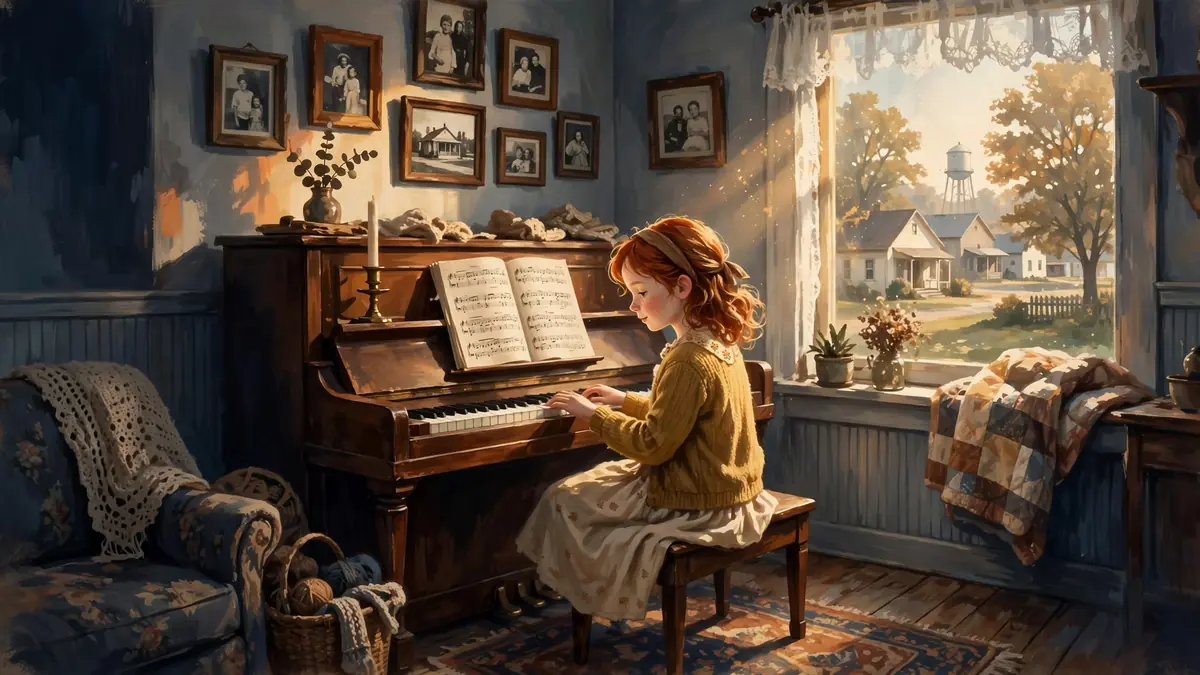
Willard is the kind of town where everybody knows the veterinarian’s daughter. She has talked about feeling isolated there, and about music as the thing that gave her a way out before she had any idea where out led. The piano came first. She started playing when she was ten or eleven years old and began taking lessons at twelve, teaching herself to play along by ear to her favorite records. The instrument gave her a private room inside a small town. The songs came next — and the first one arrived sooner than anyone expected.
Her first original song, “Die Young”, was written at a summer arts camp in 2014, when she was 16, and uploaded that November. It was a teenager’s song in the plainest sense — written in a few weeks at camp, recorded simply, put online without a plan — and it did something no one in Willard expected. Showcases in New York followed. A record deal followed that.
She signed with Atlantic Records in May 2015, at 17. The timeline matters because it shows how early the industry found her and how long it then took to find a use for her. Atlantic signed a teenager from Missouri with a piano and a voice and spent the next five years trying to fit her into a shape that did not hold. She was still performing under her own name, Kayleigh Rose, when the deal was signed. The name Chappell Roan did not exist yet.
The early years under Atlantic were slow by design. She was a minor when she signed, finishing school while the label figured out what to do with her. The work she did in that period — the writing, the sessions, the trips to New York and Los Angeles — built the craft. It did not build an audience. That came much later, after the label had given up on her.
Why “Chappell Roan”? The Name Her Grandfather Left Her
In 2016, at 18, she adopted the stage name Chappell Roan in honor of her grandfather, Dennis K. Chappell, who died of brain cancer that same year. Chappell was his surname. “Roan” came from his favorite song, “The Strawberry Roan” by Curley Fletcher. She took his name and a word from his favorite song and made a new person out of them.
The name is worth pausing on because it explains the split at the center of her act. Kayleigh Rose Amstutz is the woman from Willard. Chappell Roan is the character she built — the one in the white face paint and the red hair, the one who sings about the Pink Pony Club and dances like the room is hers. She has talked about the two as separate people, and about the stage name as a kind of armor: Kayleigh writes the songs, Chappell performs them. The grandfather’s name gave the character a root in the family she came from, even as the character ran as far from Willard as she could get.
She has said the name also marked a break. Under her own name she had been a teenage singer-songwriter with a piano. Under Chappell Roan she could be theatrical, loud, queer, and strange — everything the Atlantic years had sanded down. The name change came a year after the signing and a year before her debut single. It was the first decision she made that belonged entirely to her.
Atlantic Records at 17: The School Nights Years
Her debut single, “Good Hurt”, arrived in August 2017, when she was 19, followed a month later by her first EP, School Nights, a moody five-song set issued through Atlantic. The music was dark, synth-heavy pop — a long way from the camp spectacle she is known for now — and it found a small audience and not much more. She was 19, living between Missouri and Los Angeles, making the kind of record a major label makes when it does not know what it has.
The Atlantic years ended the way they do for most young artists on major labels: quietly, and not on the artist’s terms. She was dropped by Atlantic in 2020, at 22, the same year she released “Pink Pony Club” — the song that would eventually become her first UK No. 1, five years later. At the time it went nowhere. The label that had signed her as a teenager let her go, and she went back to Missouri for a period and then took a job at a donut shop in Los Angeles in 2022, working service while she figured out whether a music career was still possible at all.
That stretch — dropped, broke, working a counter job — is the part of the story she now tells most often, and it is the part that gives her Grammy speech its weight. She was not a teenager plucked from nowhere. She was a 22-year-old who had already failed in the music business once, publicly enough that everyone in it knew, and who decided to start over anyway. The donut shop is not a cute detail. It is the bottom of the arc, and everything after it reads differently because of it.
Dan Nigro and the Rebuild: 2018–2023
The rebuild started before the dropping. In late 2018 she began working with songwriter and producer Dan Nigro, the partnership that would define her sound. Nigro, formerly of the band As Tall As Lions, had a producer’s ear for 1980s synth-pop and early-2000s pop hits, and Roan had the voice and the nerve for them. The two of them wrote the songs that became the debut album over the next four years, slowly, without a label’s deadline hanging over them.
“Pink Pony Club” was the first fruit of that partnership, released in April 2020, weeks before Atlantic dropped her. It was a song about leaving Missouri for West Hollywood and finding a place where she belonged — and it flopped on release, because nobody was listening yet. The rest of the album’s songs arrived as singles across 2022: “Naked in Manhattan”, “My Kink Is Karma”, “Femininomenon”, “Casual”, “Red Wine Supernova”, “Hot to Go!”. Each one was a little louder, a little stranger, a little more herself than the last. None of them charted. All of them were building something.
The economics of those years were thin. She has said she was living with her parents at times, working jobs, and funding the music out of what she could spare. Nigro believed in the songs enough to keep making them. That patience is the reason the debut album sounds the way it does: it was written over five years, not five months, by two people who had nothing to lose and no one telling them to hurry. When the album finally came out, it sounded like a debut and a greatest-hits record at the same time, because in a sense it was both.
The Rise and Fall of a Midwest Princess: The Album That Waited a Year
In March 2023 she signed with Amusement Records, the imprint Nigro created expressly for her, in partnership with Island Records. She had weighed nine potential partners before choosing it, and she insisted on creative control as a condition of the deal — the lesson of the Atlantic years, applied before she signed anything. The arrangement gave her something rare for a pop artist on a major-label system: ownership of her direction, with Island handling distribution and marketing.
Her debut album, The Rise and Fall of a Midwest Princess, was released on September 22, 2023. It did not explode. It did not debut in the top ten. It sold modestly and reviewed well, and for the first six months of its life it looked like another good record that the market had missed. Then the festival summer of 2024 happened, and the record started moving. By the end of 2024 it had reached No. 2 on the Billboard 200, according to AllMusic, and it had hit No. 1 on the UK Albums Chart in August 2024. A fourteen-track album released in September 2023 became one of the defining pop records of 2024 — a year late, and right on time.
The album’s slow burn is the key to understanding her career. Almost nothing about Chappell Roan has happened fast. The songs were written over five years. The album took a year to find its audience. “Pink Pony Club” took five years to reach No. 1. The whole story is a lesson in what happens when a record is good enough to wait for its moment instead of being abandoned after its first week.
“Good Luck, Babe!”: The Breakthrough
On April 5, 2024, she released the stand-alone single “Good Luck, Babe!”, co-written with Justin Tranter and Nigro, who also produced it. It was not on the album. It was a one-off, a song about a relationship with a woman who would not admit what she was, and it became the biggest hit of her career. The song reached No. 4 on the Billboard Hot 100, spent 52 weeks on the chart — a full year — and has passed 1.7 billion streams on Spotify, according to iam.com’s chart reporting.
The song worked because it was specific. It named the situation — a lover who says “good luck, babe” and walks away from her own feelings — in language no pop song had used before, and it did it over a chorus big enough to fill a festival field. It earned three Grammy nominations, including Record of the Year and Song of the Year, and it turned a cult act into a household name in a single spring. She had been making music for ten years. The world caught up in ten weeks.
That summer, the numbers told the story in a way no press release could. At one point in 2024, seven Chappell Roan songs were on the Billboard Hot 100 at the same time — the new single, the old album tracks, “Pink Pony Club” climbing again. Festival crowds that had come to see someone else stayed for her set. Her monthly listeners on Spotify, which had sat in the low millions for years, multiplied. The donut-shop years were eighteen months behind her. The Grammy was ten months ahead.
The “Pink Pony Club” Summer and a Five-Year-Old No. 1
If “Good Luck, Babe!” was the breakthrough, “Pink Pony Club” was the song that proved it was not a fluke. Released in April 2020 and ignored at the time, the track had been climbing slowly ever since the album came out, carried by festival performances and word of mouth. In March 2025, five years after its release, it reached No. 1 on the UK Official Singles Chart, where it spent two weeks at the top, with 658,424 total UK sales at the moment it got there, according to NME. It was her first UK No. 1, and it was a song about a gay bar in West Hollywood, written by a woman from a town where the nearest thing to it was a five-hour drive away.
The chart run was a slow one even by her standards. The song entered the UK singles chart in September 2024, peaked at No. 13 before Christmas, disappeared over the holidays, re-entered in January 2025, and climbed week by week until it topped the chart in the same week she won two BRIT Awards. Her Grammy performance of the song in February 2025 — a tribute to Los Angeles after the wildfires, dedicated to her younger self — pushed it over the line. The UK, as she told Official Charts at the time, had been there since day one.
The lesson of “Pink Pony Club” is the lesson of her whole career: nothing she has made has failed, exactly. It has waited. The song was good in 2020. The audience was not ready, the label was not pushing it, and the moment had not arrived. Five years later, with a Grammy and a festival summer behind her, the same recording went to No. 1. Most pop careers are built on timing. Hers is built on songs that outlast bad timing.
The 2025 Grammys: Best New Artist and the Speech
She won Best New Artist at the 2024 MTV Video Music Awards in September 2024, performing “Good Luck, Babe!” at the ceremony. In January 2025, BBC Radio 1 named her its Sound of 2025, chosen by a panel of more than 180 musicians and experts that included Elton John and Dua Lipa, ahead of Ezra Collective, Barry Can’t Swim, Myles Smith and English Teacher. In March 2025 she won International Artist and International Song at the BRIT Awards. The industry had decided, in the space of six months, that she was the new thing.
The Grammy night made it official. At the 67th Grammy Awards on February 2, 2025, she won Best New Artist, her first Grammy, from six nominations — Album of the Year for The Rise and Fall of a Midwest Princess, Record of the Year and Song of the Year for “Good Luck, Babe!”, Best Pop Solo Performance, and Best Pop Vocal Album. She was nominated in all four of the general-field categories, a rare feat for a debut artist, and she won the one that names the future.
Her acceptance speech is the part people still quote. She used the platform to demand that record labels treat artists as valuable employees — to provide a livable wage and healthcare for developing artists, drawing on her own experience of being dropped at 22 and left without support. “Labels, we got you, but do you got us?” was the line that traveled. It was a speech only someone who had lived the bad version of the business could give, and it landed because the room knew she had. She performed “Pink Pony Club” at the same ceremony, in a tribute to Los Angeles after the wildfires, and dedicated it to the isolated younger version of herself who had needed the city to give her the courage to be who she wanted to be.
2025–2026: “The Giver”, “The Subway” and the Castle Stage
She spent 2025 proving the debut album was not the whole story. “The Giver”, her first country song, was first performed live on her Saturday Night Live debut on November 2, 2024, hosted by John Mulaney, and released as a single on March 13, 2025. It debuted at No. 5 on the Billboard Hot 100 — her third top-ten single and her first top-40 debut — and at No. 1 on the Hot Country Songs chart, making her only the third woman, after Beyoncé and Bebe Rexha, whose first entry on that chart debuted at No. 1. The first week brought 22.3 million US streams, 6,000 downloads and 2.2 million in radio audience, per Billboard’s chart reporting. She told Amazon Music’s Country Heat Weekly podcast that she wrote it because “I just think a lesbian country song is really funny” — a line that captures the whole joke and the whole point at once.
“The Subway” followed on July 31, 2025, a breakup ballad she had been playing live for a year, since her Governors Ball performance in June 2024. It debuted at No. 3 on the Hot 100 — her highest-charting single — and went straight to No. 1 on the UK Singles Chart, her second British No. 1 of the year and her first song to debut at No. 1, opening with 54,491 UK units. She became the first artist of 2025 to score two UK No. 1 singles with different tracks. The song earned a Silver certification from the BPI the following month, and two nominations at the 68th Grammy Awards: Record of the Year and Best Pop Solo Performance.
At the 68th Grammys on February 1, 2026, she came away empty-handed — both nominations lost — but she was there as a presenter as well as a nominee, and her custom Mugler red-carpet look, a maroon gown with medieval-inspired temporary tattoos, became one of the most talked-about outfits of the night. A year earlier she had been the story of the ceremony. A year later she was part of its furniture. That is what a breakthrough looks like when it sticks.
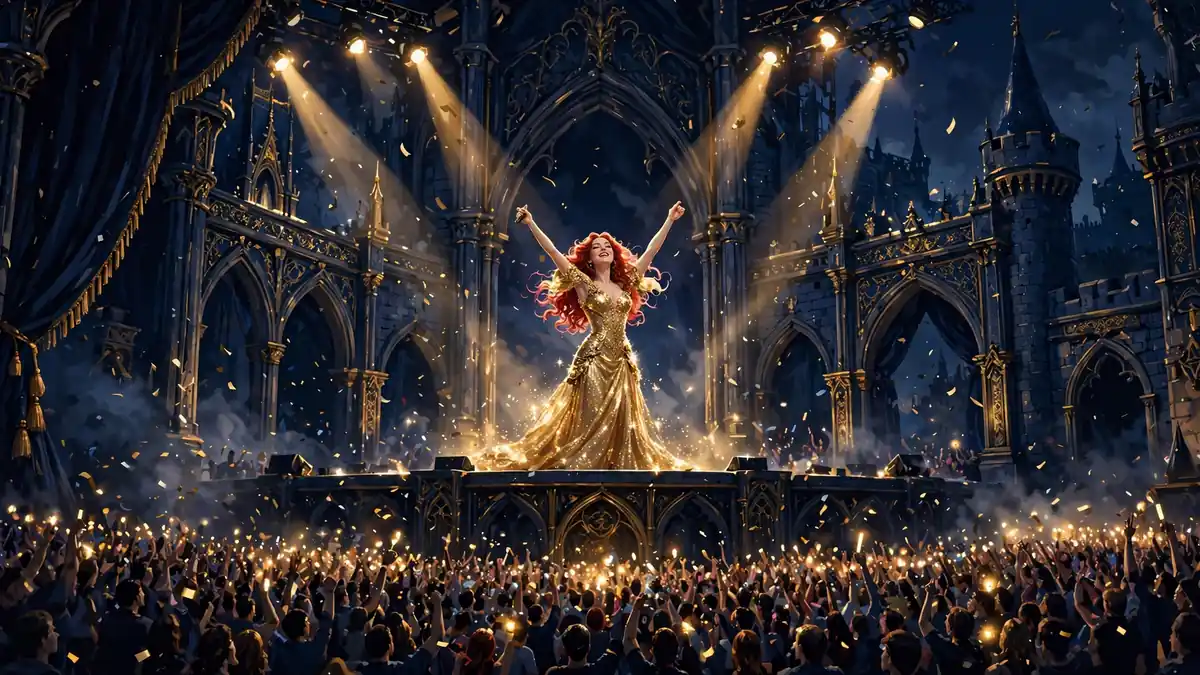
In October 2025 she launched the Visions of Damsels & Other Dangerous Things Tour, staged on a castle set that matched the medieval streak running through her recent visuals. The tour ran from 2025 into March 2026 and closed at Lollapalooza Brasil in São Paulo in March 2026. It was a deliberate choice to tour less and stage more: fewer dates, bigger rooms, a set built like a piece of theatre rather than a pop show.
The touring is where the money story starts to make sense. Her reported per-show booking rate rose from around $50,000 before the Grammy win to $150,000–$200,000 after it, according to MagazineSnap’s 2026 reporting, and festival headlining slots followed the same curve. She had spent 2024 playing festivals as the act people discovered by accident. By 2025 she was the act people bought the ticket to see, and the fee reflected it. The castle set was not decoration. It was a statement that the show was now the product, not the promotion for the product.
The Second Album That “Doesn’t Exist Yet”
The most-asked question about Chappell Roan in 2026 has a blunt answer. “The second project doesn’t exist yet,” she told Vogue in July 2025. “There is no album. There is no collection of songs.” She added that it took her five years to write the first one, and it would probably take at least five to write the next. As of November 2026, the follow-up is still known only by the placeholder CR2 — no title, no date, no promise attached.
She has said she is not the kind of writer who can pump out a record, and that her career has worked because she has done it her way and not compromised on morals or time. The three singles since the debut album — “Good Luck, Babe!”, “The Giver”, “The Subway” — each sound different from the last: pop, country, dream-pop ballad. She has teased a palette that runs from dance tracks to 1980s songs, acoustic ballads and a 1970s live-band sound. In an Apple Music interview she admitted she had no idea how the next album would sound, and that the uncertainty scared her. The honesty is the point. A five-year gap between albums is a career risk in pop music, and she is taking it in public, on purpose.
The one new recording of 2026 came from someone else’s album. In October 2026, Olivia Rodrigo released a remix of “expectations”, from her album you seem pretty sad for a girl so in love, with a new second verse sung by Roan — her first guest feature, produced by their shared collaborator Nigro, with a game-show parody video hosted by David Byrne. The connection runs deeper than the feature: Roan opened for Rodrigo’s GUTS Tour, and the two have been the most visible friendship in pop since. For the full story of the collaborator, see Olivia Rodrigo’s biography on Guide Net Worth.
The Art of Chappell Roan: Camp, Drag and the Midwest Princess
Her sound is built on 1980s synth-pop and early-2000s pop hits, filtered through a drag queen’s sense of theatre. The songs are big, melodic, and direct — choruses you can sing after one listen — and the performances are deliberately excessive: costumes, wigs, white face paint, eras that change with every single. The aesthetic is heavily influenced by drag queens, and she has never hidden it. The stage is a place where Kayleigh from Willard gets to be somebody else for two hours, and the somebody else is braver than she is.
The look is a collaboration, not an accident. Her stylist, Genesis Webb, builds the outfits with her — the Statue of Liberty look, the butterfly, the medieval gowns — and the makeup, erased eyebrows and all, is part of the character. She has said the drag influence is a choice, not a costume: the point is that femininity performed at full volume is a kind of power, and that a woman from a conservative town gets to decide what her own femininity looks like. The M·A·C deal, announced in December 2025, made that official in commercial terms. The beauty industry now pays her to be the thing she invented for herself.
What the artistry hides is the craft underneath it. The songs are written, not assembled. “Good Luck, Babe!” is a three-act story in three minutes. “The Subway” is a ballad that holds a single image — waiting for someone who is never coming back — for its whole length. “Casual” turns a situationship into a punchline and then into a wound. The camp is the packaging. The writing is the product, and it is the reason the songs survive when the costumes change.
Personal Life: Los Angeles, Identity and Health
Roan lives in Los Angeles, the city she has credited with giving her the courage to be who she wanted to be. She is a queer woman who has publicly identified as lesbian, and her songs — “Good Luck, Babe!”, “The Giver”, “Casual” — are written from that life without apology or euphemism. A current partner is not publicly confirmed, and this article does not guess at one. What she has chosen to share is the identity. What she has not shared is the relationship, and the distinction is hers to keep.
She was diagnosed with bipolar II disorder at 22, a fact she has discussed in her own public statements. It is mentioned here because she has spoken about it herself, and because it is part of the story of the hard years — the dropping, the donut shop, the rebuild — not as an explanation for them. The diagnosis came in the same period she has described as the most difficult of her life, and she has talked about treatment and management as ongoing parts of her adult life, not as a closed chapter. This article reports what she has said and goes no further.
She has also put money behind the communities that shaped her. In October 2025 she launched the Midwest Princess Project, a nonprofit supporting trans youth and LGBTQ+ communities, which has raised more than $800,000. Its first anniversary was marked by the Super Graphic Spectacular, two benefit nights at the Shrine in Los Angeles on October 21 and 22, 2026, with Lola Young, Tinashe, Caroline Polachek and MUNA on the bill and Roan closing both nights. The project is the clearest sign of what she intends to do with the platform: the girl who felt isolated in Willard is building the support she did not have.
There is no reliable answer to this question, and this article will not pretend otherwise. Biography trackers give her height as 5 feet 2 inches (157 cm) most often — celebswiki and sportsumup both list it — but other pages say 5 feet 5 inches, 5 feet 6 inches (168 cm), 5 feet 7 inches, or 5 feet 8 inches, and one page manages to list two different heights in the same article. No interview, profile, or official biography gives a verified figure, and she has never made height a talking point.
The disagreement has a visible cause. On stage she wears platform heels and towering costumes that add inches, and the drag-influenced presentation is designed to make her look larger than life. A red-carpet photo next to a 6-foot collaborator tells you nothing about her height in flat shoes. Until she or a primary source states a number, the honest answer is that the trackers disagree and the most commonly cited figure is 5 feet 2 inches — with a margin of error wide enough to cover the whole argument.
M·A·C and the Business of Being Chappell Roan
On December 8, 2025, M·A·C Cosmetics announced Roan as its newest Global Brand Ambassador, with global campaigns beginning in 2026 under a long-term partnership. Her first campaign was photographed by Inez & Vinoodh, with makeup by Andrew Dahling, in a theatrical monochrome look built around her signature cloud-white complexion, erased eyebrows and a Cool Teddy lip. “Partnering with MAC feels full circle,” she said in the announcement, and the brand’s global creative director, Nicola Formichetti, said he was excited to welcome her as the new ambassador.
The deal matters because it is the first major brand partnership of her career, and because it pays her for the thing she built for free. The white face paint and the drag-influenced glam were hers before any brand was involved. M·A·C, a brand with a long history of queer and theatrical beauty, is buying into an identity she already owned — which is the best kind of endorsement deal, the kind where the artist brings the value and the brand brings the money. The partnership also puts her at the front of the VIVA GLAM program, which has raised more than $540 million globally since its founding.
It is also, so far, the only deal of its kind. She has no string of endorsements, no fashion line, no fragrance, no tequila. The money in her story comes from music and from stages, with the M·A·C partnership as the first sign that brands are now willing to pay for access to her audience. That restraint is part of the brand: she has turned down more than she has accepted, and the one deal she took is the one that fits the act.
Chappell Roan’s Net Worth in 2026
Chappell Roan’s net worth in 2026 is estimated at $12 million, inside a $6–12 million range across the trackers that follow her. That is the honest answer, and the range matters more than the number. No audited figure exists, she has never published her finances, and the trackers disagree with each other by millions — which is normal for an artist whose career changed this fast, and which this article reports rather than hides.
| Source | Estimate | Why it differs |
|---|---|---|
| FameTally (Sep 2026) | $8–12M | Prices in touring + 2026 deals fully |
| MagazineSnap (Jul 2026) | $6–12M | $10M cited most often across trackers |
| Social Life Magazine (2026) | $10M | Post-Grammy booking-rate jump priced in |
| Guide Net Worth / NetWorthCraft | $12M | Top of the credible range; our anchor |
| celebiograph (2026) | $3–6M | Stale — built before the Grammy-era jump |
| Outliers ($15–35M) | Discounted | Pages carry basic errors (wrong birth year; false label dates) |
The money comes from four streams. Streaming and royalties lead: a catalog of one album plus three hit singles, with “Good Luck, Babe!” past 1.7 billion Spotify streams and “The Subway” and “The Giver” both charting in the Hot 100 top five. Touring is second, and growing fastest — her per-show rate reportedly tripled after the Grammy win, from around $50,000 to $150,000–$200,000, and the 2025–2026 castle-stage tour played the biggest rooms of her career. Merchandise is third, driven by a fanbase that buys the look as well as the music. Brand deals are fourth and newest, with the M·A·C ambassadorship as the first major check.
For the full breakdown of how the $12 million figure is built up, see Chappell Roan’s net worth on Guide Net Worth, which traces the same fortune from the donut-shop years to the Grammy stage, and Chappell Roan’s $12 million net worth on our sister site NetWorthCraft. Readers who want more profiles in the same bracket will find them in our Celebrity Net Worth archive.
One thing the number does not show is how fast it moved. In 2022 she was working at a donut shop, dropped by her label, and financially struggling. By February 2025 she was accepting a Grammy for Best New Artist. That eighteen-month swing — from food service to a $12 million estimate — is the fastest wealth build in her peer group, and it happened because the songs were already written. The money did not create the career. The career, finally, created the money.
How She Compares: Chappell Roan vs Her Pop Peers
Roan’s rise looks different next to the pop stars she is most often grouped with, and the comparison is worth making because it shows what is unusual about her. The table below lines her up against the peers she shares a Grammy class and a generation with, using birth dates and the figures published in Guide Net Worth’s own profiles.
| Star | Born | Age in 2026 | Breakout | Net Worth (GNW) |
|---|---|---|---|---|
| Chappell Roan | Feb 19, 1998 | 28 | “Good Luck, Babe!” (2024) | $12M |
| Sabrina Carpenter | May 11, 1999 | 27 | “Espresso” (2024) | $22M |
| Olivia Rodrigo | Feb 20, 2003 | 23 | “drivers license” (2021) | $45M |
The gap is a matter of time in the spotlight, not talent. Sabrina Carpenter’s biography shows the same 2024 breakout class — she was Roan’s fellow Best New Artist nominee at the 2025 Grammys, and the two have been linked ever since — but Carpenter had a Disney career and a longer runway behind her. Rodrigo, five years younger, broke through in 2021 and has two albums and a stadium tour behind her. Roan is the oldest of the three and the newest to fame, with one album and a fortune built in about eighteen months. The $12 million is a starting figure, not a ceiling, and the second album — whenever it arrives — is the number that will decide where it goes next.
Frequently Asked Questions
What is Chappell Roan’s real name?
Chappell Roan’s real name is Kayleigh Rose Amstutz. She adopted the stage name Chappell Roan in 2016 to honor her grandfather, Dennis K. Chappell, who died of brain cancer that year — “Chappell” was his surname, and “Roan” came from his favorite song, “The Strawberry Roan” by Curley Fletcher.
How old is Chappell Roan in 2026?
Chappell Roan is 28 years old in 2026. She was born on February 19, 1998, in Willard, Missouri, and she turns 29 on February 19, 2027. Pages that still list her as 27 were written before her 28th birthday in February 2026 and are out of date.
What is Chappell Roan’s net worth in 2026?
Chappell Roan’s net worth in 2026 is estimated at $12 million, inside a $6–12 million range across trackers, with $10 million the single figure cited most often. It is an outside estimate, not a confirmed accounting, built on streaming royalties, touring (her per-show rate reportedly rose from about $50,000 to $150,000–$200,000 after her Grammy win), merchandise, and her M·A·C Cosmetics ambassadorship.
When is Chappell Roan’s second album coming out?
There is no release date. Roan told Vogue in July 2025 that her second album “doesn’t exist yet” — “there is no album, there is no collection of songs” — and that it took her five years to write the first one, so the next will probably take at least five as well. As of November 2026 it is known only by the placeholder name CR2. Her most recent releases are the singles “The Giver” and “The Subway” from 2025 and a guest verse on Olivia Rodrigo’s “expectations” remix in October 2026.
Why is Chappell Roan called Chappell Roan?
She took the name in 2016 to honor her grandfather, Dennis K. Chappell, who died of brain cancer that year. “Chappell” was his surname, and “Roan” came from his favorite song, “The Strawberry Roan” by Curley Fletcher. She has described the name as a separate persona from Kayleigh Rose Amstutz — the character who performs, while Kayleigh writes the songs.
Is Chappell Roan gay, and who is her partner?
Chappell Roan has publicly identified as lesbian, and her songs — including “Good Luck, Babe!”, “The Giver” and “Casual” — are written from that life. A current partner is not publicly confirmed, and this article does not speculate about one. She lives in Los Angeles.
What is Chappell Roan’s biggest song?
“Good Luck, Babe!” is her biggest hit by US chart performance — it reached No. 4 on the Billboard Hot 100 in 2024, spent 52 weeks on the chart, and has passed 1.7 billion Spotify streams. “The Subway” charted higher, debuting at No. 3 in 2025, and “Pink Pony Club” was her first UK No. 1 in March 2025. All three are signature songs; “Good Luck, Babe!” is the one that broke her through.
How tall is Chappell Roan?
There is no verified figure for Chappell Roan’s height. Biography trackers disagree, listing anything from 5 feet 2 inches to 5 feet 8 inches, with 5 feet 2 inches (157 cm) the most commonly cited. She has never stated her height publicly, and her stage platform heels make red-carpet photos unreliable. Until a primary source confirms a number, any single figure should be treated as an estimate.
Sources & Reporting
This article was researched on 20 November 2026 from live reporting: Wikipedia (updated 17 November 2026) for the February 19, 1998 birth date, the Willard, Missouri birthplace, the oldest-of-four family, the parents’ professions, the uncle’s office, the piano lessons, the “Die Young” upload, the 2016 stage-name adoption, the grandfather’s death from brain cancer, the “Strawberry Roan” origin, the 2020 Atlantic dropping and the bipolar II diagnosis at 22; popfiltr (updated September 2026) for the church-three-times-a-week upbringing, the Christian summer camp, the summer-arts-camp songwriting, the May 2015 Atlantic signing, the August 2017 “Good Hurt” and September 2017 School Nights releases, the late-2018 Dan Nigro partnership, the March 2023 Amusement/Island signing after nine partners and the creative-control condition, the April 5, 2024 “Good Luck, Babe!” release, the 2024 VMA win, the January 2025 BBC Sound of 2025 panel and the February 2, 2025 Grammy win with six nominations; grammy.com (February 3, 2025) and NME for the Best New Artist win and the livable-wage acceptance speech; AllMusic for the Billboard 200 No. 2 peak by the end of 2024; NME (March 8, 2025) and the Official Charts Company for the “Pink Pony Club” UK No. 1 and its 658,424 UK sales; Billboard reporting via American Songwriter (March 24, 2025) for “The Giver” debut numbers of 22.3 million streams, 6,000 downloads and 2.2 million radio audience; the Official Charts Company and Music Week (August 2025) for “The Subway” UK No. 1 debut with 54,491 first-week units; martincid.com (October 2026) for the Visions tour closing at Lollapalooza Brasil in March 2026, the October 2026 Olivia Rodrigo “expectations” remix, the Midwest Princess Project raising $800,000+, and the Super Graphic Spectacular benefit on October 21–22, 2026; hellorayo.co.uk (updated 17 November 2026) for the 68th Grammy nominations and the empty-handed night of February 1, 2026; TheIndustry.beauty, Happi and Cosmetics Business (December 2025) for the M·A·C Global Brand Ambassador announcement of December 8, 2025, the Inez & Vinoodh campaign and the “full circle” quote; Numéro Netherlands for the VIVA GLAM program’s $540 million raised; FameTally (September 2026), MagazineSnap (July 2026), Social Life Magazine and celebiograph for the net-worth range; and justwebworld.com (September 2026) for the BRIT Awards double and the tour-date corrections. Where sources disagreed — the net-worth figure and her height — the article names the disagreement instead of picking a number silently. Corrections are welcome via the About page.
Nathan Cole
Nathan Cole is the editor of Guide Net Worth. He covers celebrity wealth the way a business desk covers earnings: reported figures first, estimates labeled as estimates, no invented numbers. Every profile passes through his desk before it publishes. About Guide Net Worth · Corrections: figures are updated when new reporting emerges — contact us via the About page if you spot an error.
References & Sources
This article has been fact-checked and verified against multiple public sources, financial disclosures, SEC filings, Forbes reports, Celebrity Net Worth databases, and official records. All net worth estimates are based on publicly available information and financial analysis.