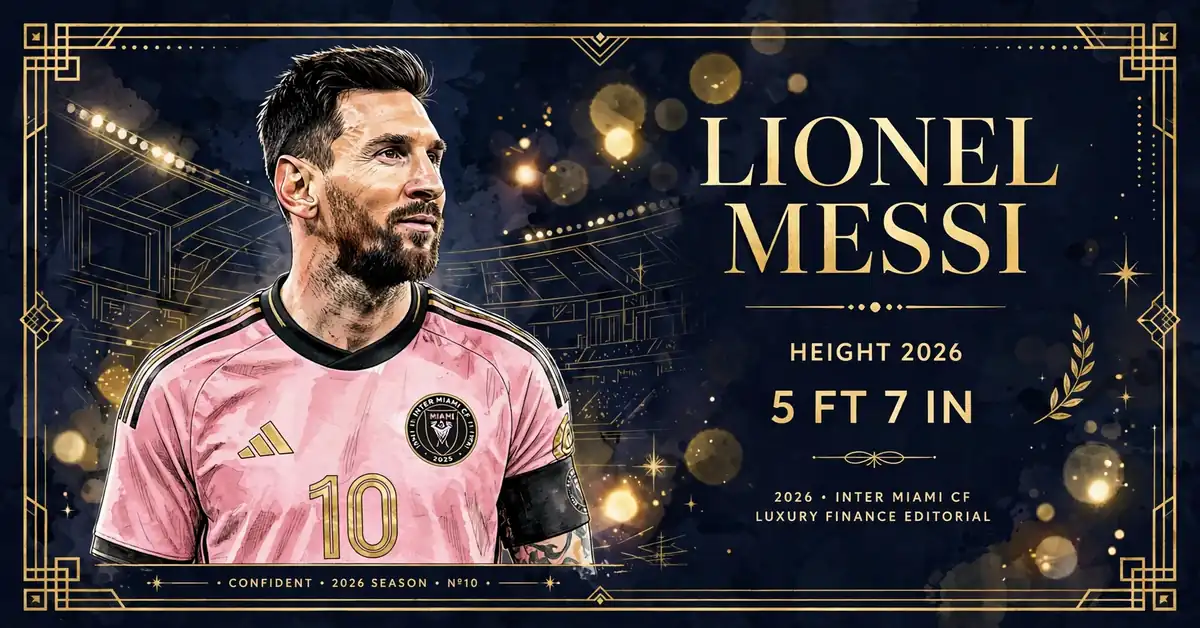
Lionel Messi height: 5 ft 7 in (170 cm), per Inter Miami. Behind the number: growth-hormone treatment, a napkin contract, and a career built on being short.
Last updated: November 20, 2026 · By Nathan Cole
Lionel Messi is 5 feet 7 inches tall — 170 cm. That is the figure his current club, Inter Miami CF, prints on his official profile, and it is the same figure Barcelona and Paris Saint-Germain printed before them. He has stood at that height through eight Ballon d’Or wins, a World Cup triumph in Qatar, a move to Miami at 36, and a sixth World Cup in 2026 at 39. The number itself is simple. The story behind it is not: as a child in Rosario, doctors told his family he might never reach 4 feet 7 inches, and the treatment that changed that cost more per month than his father earned.
This article answers the height question in full and keeps it current to November 20, 2026. It settles the 169 cm vs 170 cm confusion with the actual conversion, tells the growth-hormone story with the figures and the sources that disagree about them, explains why being short made Messi harder to stop rather than easier, and measures him against Ronaldo, Neymar, Haaland and the rest of the modern game. His height in 2026 is 5 ft 7 in (170 cm), his listed playing weight is about 67 kg (148 lb), and he is 39 years old — an age at which most forwards retired years ago, while he was winning a second straight MLS Golden Boot.
Quick Facts
| Full Name | Lionel Andrés Messi Cuccittini |
| Height | 5 ft 7 in (170 cm) — Inter Miami CF official profile; some databases list 169 cm (see the rounding note below) |
| Weight | About 67 kg (148 lb) listed playing weight |
| Age in 2026 | 39 years old (born June 24, 1987, Rosario, Argentina; turns 40 on June 24, 2027) |
| Born | June 24, 1987, Rosario, Santa Fe, Argentina |
| Current Club | Inter Miami CF (captain; contract through the end of the 2028 MLS season) |
| Position | Forward / right winger, left-footed |
| Childhood Diagnosis | Growth hormone deficiency, diagnosed age 11; doctors predicted a maximum adult height of about 4 ft 7 in without treatment |
| Ballon d’Or | 8 wins — a record |
| World Cups | 6 tournaments (2006–2026); winner 2022, captain; all-time top scorer in World Cup history with 18 goals after June 2026 |
| Career Goals | 900th senior career goal scored March 18, 2026, vs Nashville SC |
| Net Worth 2026 | About $1.1 billion, per Guide Net Worth’s own estimate |
| Family | Wife Antonela Roccuzzo (married June 30, 2017); sons Thiago, Mateo and Ciro |
How This Height Was Researched
This article was researched on 20 November 2026 from live sources: the Inter Miami CF official player profile for the 5 ft 7 in listing; FotMob for the 170 cm figure and the age-39 profile; comparingheights.org and heightandtall.com for the 169–170 cm rounding question; Dartmouth’s “Messi’s Medical Journey” (Marc Novicoff) for the 1999 diagnosis by Dr. Diego Schwarzstein, the predicted 4 ft 7 in ceiling and the napkin contract; Athlon Sports (October 6, 2026) and Medical Daily (July 16, 2026) for the treatment cost and the family’s struggle to pay; MLSsoccer.com (March 19, 2026) for the 900th goal; Reuters (November 8, 2026) for the 2026 Golden Boot and the 26-goal season; Inter Miami CF (October 23, 2025) for the contract extension through 2028; and June 2026 World Cup reporting for the hat-trick against Algeria, the record against Austria and the 200th cap. Where sources disagree — the treatment cost, the 169 cm listing, his exact height at age 11 — the article names the disagreement instead of picking a number silently.
+
How Tall Is Lionel Messi? The Short Answer
Lionel Messi is listed at 5 feet 7 inches (170 cm). Inter Miami CF, the club he captains, gives that figure on his official profile. Barcelona gave the same figure for 17 years. Paris Saint-Germain gave it during his two seasons in France. FotMob, the football database, answers its own “How tall is Lionel Messi?” question with the same words: “170 cm tall. Or 5 ft 7 in.”
That consistency matters, because celebrity heights are usually a mess of conflicting listings. Messi’s is not. Every mainstream source lands on the same imperial figure, and the only disagreement in the entire record is a single centimetre on the metric side. Some databases print 169 cm. A few print 170 cm. Both are describing the same man, and the reason is arithmetic, not a second measurement.
Five feet seven inches converts to exactly 170.18 cm. A site that rounds 170.18 down prints 170 cm. A site that converts from a rounded 5 ft 6.5 in figure, or that truncates instead of rounding, prints 169 cm. Comparingheights.org, which checked the listings in November 2026, puts it plainly: there is no competing mainstream figure, only the 1 cm wobble that comes from converting 5 ft 7 in to either 170 cm or 169 cm depending on the site’s rounding. The honest statement is that Messi’s listed height is 5 ft 7 in, about 170 cm — and that no barefoot measurement has ever been published, so the figure is a reported club listing rather than a laboratory result. Football does not measure players the way the NBA does. Clubs register a height, and that height follows the player from club to club.
For scale, 5 ft 7 in is about the average height of an adult man in Argentina. Messi is not short for his country. He is short for a footballer, and short for an athlete whose job involves jumping for headers against centre-backs who stand six inches taller. That gap is the whole point of this article: the height that should have been a problem became the shape of his game.
Rosario: The Small Boy Who Scored 500 Goals
Lionel Andrés Messi was born on June 24, 1987, in Rosario, a port city in the Argentine province of Santa Fe, about 300 km northwest of Buenos Aires. His father, Jorge, worked in a steel factory. His mother, Celia, worked part-time as a cleaner. He was the third of four children, and football was in the house from the start: his grandmother Celia took him to his first training sessions, and family lore has it that she told coaches to play the tiny boy because she could see what they could not.
He joined the youth academy of Newell’s Old Boys, Rosario’s biggest club, at six. What happened next is the first hard number in Messi’s story. Playing for Newell’s youth teams, he scored more than 500 goals, according to the biography by Luca Caioli cited in Dartmouth’s account of his medical history. Five hundred goals before his teens. The figure sounds inflated until you set it beside the rest of the record: the boy who scored them was already the best player on every pitch he stepped onto, and the adults around him were already arguing about whether his size would stop him.
It nearly did. By nine, Messi had stopped growing. His teammates shot up; he stayed where he was. At 11 he stood about 4 feet 2 inches tall, 127 cm, according to the most commonly cited accounts. One scholarly account, Dartmouth’s medical history, puts him at 4 feet 4 inches at diagnosis, citing the biographer Ian Hawkey. The two figures differ by a couple of inches, which is what happens when a childhood memory is reconstructed from interviews twenty years later. Either way, the picture is the same: an 11-year-old who had not grown since he was nine, playing against boys a head taller than him, and still scoring.
Rosario in the late 1990s was not a place with money to spare. Argentina’s economy was sliding toward the crisis that would explode in 2001. The Messi family had four children and two modest incomes. When the doctors gave them a diagnosis and a price, the gap between the two was the problem that would define the next three years of their lives.
The Growth Hormone Deficiency Diagnosis at 11
In 1999, after more than a year of tests, Messi’s doctor in Rosario, the endocrinologist Dr. Diego Schwarzstein, diagnosed him with growth hormone deficiency, known as GHD. The pituitary gland, a small gland at the base of the brain, was not producing enough growth hormone for normal childhood growth. GHD affects roughly 1 in 3,000 to 1 in 10,000 children. In Messi’s case the cause was never pinned to a single event; his pituitary gland simply did not make enough of the hormone.
Schwarzstein’s prediction was blunt. Without intervention, Messi would grow to a maximum height of about 4 feet 7 inches (140 cm). That figure appears in Dartmouth’s account, in Athlon Sports’ October 2026 reporting, and in Medical Daily’s July 2026 explainer. Three different sources, three different years, the same number. A 4 ft 7 in adult cannot play professional football at any serious level. The diagnosis was not just a medical verdict. It was, on the face of it, the end of the football career before it had started.
The treatment was daily injections of synthetic growth hormone, somatotropin, into the lower body. Messi started the injections at 11 and learned to give them to himself, in his thighs, as a matter of routine. The injections did not make him tall. They let him grow toward a normal height. He kept taking them through his early years at Barcelona, and some accounts say he may still have been taking them at the time of his competitive debut for the club at 17. The hormone is banned in sport without a therapeutic use exemption, and his treatment predated and overlapped with the start of his professional career under medical supervision.
Then came the price. Reports disagree about the exact monthly cost, and the disagreement is worth naming because it shows how the story was reported. Athlon Sports, in October 2026, put the cost at about $900 a month. Dartmouth’s account, citing the biographer Guillem Balague, puts it at $1,500 a month. Other accounts from the period land between $900 and $1,300. The honest range is $900–$1,500 a month in late-1990s dollars, for a family whose father worked in a steel plant and whose mother cleaned part-time. Jorge Messi’s health insurance covered the injections for about a year. Then, as Argentina’s economy crumbled, the money ran out. The family looked at moving to Australia, where the public health system would have covered the therapy. They looked at other clubs. Nobody would pay.
That is the part of the story that gets flattened in most retellings. The treatment existed. The family could not afford it. The boy kept scoring goals anyway, at 4 ft 2 in, against boys who towered over him, while his parents tried to find someone — anyone — who would pay for the medicine.

The Napkin Contract: Barcelona Pays for the Treatment
The way out came through family in Catalonia. Relatives sent footage of the tiny boy to FC Barcelona, and in September 2000, at 13, Messi and his father flew to Spain for a trial at La Masia, the club’s academy. The story of the trial has been told so often that it risks sounding like myth, but the details are consistent across the biographies. He scored five goals in the trial match. The coach was convinced within two minutes, according to the biographer Ian Hawkey. The club’s sporting director, Carles Rexach, watched a boy who was barely 4 ft 7 in at the time and decided to sign him anyway.
What Rexach signed, on December 14, 2000, was not a contract. It was a commitment written on a paper napkin in a tennis club restaurant, because no formal contract paper was at hand. Rexach and the club official Horacio Gaggioli signed it. The napkin promised Barcelona would sign Messi, pay for his growth-hormone treatment in full, and give his family a place to live in Spain. Messi himself said later that Barcelona was “the only club in the world that offered” to pay for his treatment. No other club had made the offer. River Plate, Argentina’s biggest club, had looked at him and passed. Newell’s could not pay. Barcelona could, and did.
The family split in half. Messi and his father stayed in Spain. His mother and his three siblings went back to Argentina after about six months. He was 13, living in a foreign country, injecting himself with growth hormone every day, learning a new language, and trying to grow into the body that football demanded. He has said the homesickness in those first months was so sharp he nearly went home. He stayed.
The treatment worked. By the time he reached his late teens, Messi had grown to the 5 ft 7 in he still lists today. The medicine did not make him tall by football standards — 5 ft 7 in is still short for a forward — but it made him a normal-sized adult, and normal-sized was enough. The napkin is now one of the most famous objects in football history, kept by the club. It is also the most literal answer to the question this article asks: Messi is 5 ft 7 in because a club in Barcelona paid for the medicine that let him get there.
Why 5 Ft 7 In Became a Weapon: The Low Centre of Gravity
Ask a coach what Messi’s height gave him and the answer is the same in every language: a low centre of gravity. A shorter player carries his weight closer to the ground. He changes direction faster, keeps his balance through contact, and keeps the ball closer to his feet when he runs. ScienceABC’s analysis of Messi’s dribbling puts it in plain terms — at 170 cm, with explosive acceleration and deceleration and decades of deliberate practice, close ball control becomes close to a reflex.
Watch him run with the ball and the physics is visible. The ball stays within a step of his left foot. Defenders reach for it and find his body between them and the ball, because his body is compact and his feet move faster than theirs. He does not beat a defender by running around him. He beats him by shifting his weight a few inches, letting the defender commit, and going the other way. At 6 ft 2 in, that shift takes longer. At 5 ft 7 in, it takes a fraction of a second less, and a fraction of a second is the whole game.
The numbers back the picture. Messi’s 91 goals in the calendar year of 2012 remain a world record. His 672 goals in 778 games for Barcelona are the most any player has scored for a single club in the sport’s history. He has more career assists than any player in history — over 400, passing Ferenc Puskás during the 2025 MLS Cup playoffs. None of those figures came from winning headers. They came from the thing his height gave him: the ball glued to his foot in traffic, at full speed, against defenders who could not get near it.
There is a cost, and it is real. Messi wins very few aerial duels. Teams that play long balls over the top do not aim them at him. Set-piece coaches do not post him up at the far post. He has scored headed goals — the 2009 Champions League final header against Manchester United, rising above Rio Ferdinand, is the most famous — but headers are the exception in his game, not the rule. The trade was clear from the start: give up the air, own the ground. Over twenty years, the ground paid better.
Opponents adapted, and their adaptations are part of the evidence. Teams learned that tackling Messi cleanly was close to impossible, so they fouled him instead — often, and tactically. He has been the most-fouled player in Europe’s top leagues in multiple seasons, and the fouls were not accidents. They were the only reliable way to stop a player who could not be caught and could not be reached. The fouls also explain why his game aged so well: a player who is fouled that often learns to release the ball a half-second earlier, and the half-second earlier release is what kept him productive at 38 and 39, when the sprinting stopped being an option.
It is also worth saying plainly that height alone explains nothing. Plenty of short players have low centres of gravity and never score 900 goals. Messi’s height shaped his game; his balance, his left foot, his vision and his decision-making built it. The height is the frame. The player is the painting.
Barcelona Debut at 17 and the Rise
Messi made his competitive debut for Barcelona on October 16, 2004, at 17 years and 114 days, against Espanyol. He was, at the time, the youngest player ever to appear for the club in La Liga. His first goal came on May 1, 2005, against Albacete — a lob over the goalkeeper from a Ronaldinho assist — making him the club’s youngest goalscorer. He was still a teenager, still growing into the 5 ft 7 in frame, and already playing first-team football against men.
The next two decades need little retelling, but the figures deserve their place because they are the proof that the height never mattered. At Barcelona he won 35 trophies, a club record, and became the club’s all-time record goalscorer. He won the Ballon d’Or eight times, more than any player in history. He won four Champions Leagues with Barcelona, in 2006, 2009, 2011 and 2015. In 2012 he scored 91 goals in a calendar year, passing Gerd Müller’s 40-year-old record of 85. He left Barcelona in 2021, after 778 games and 672 goals, because the club’s finances could not register his new contract — not because his body had given out.
The middle of the Barcelona years added the trophies that the early years had promised. In 2015, alongside Neymar and Luis Suárez — the “MSN” front three — Messi won a second treble of La Liga, the Copa del Rey and the Champions League, scoring 43 league goals that season. In 2019 he won his sixth Ballon d’Or, passing Ronaldo’s five and moving clear at the top of the award’s history; the seventh came in 2021 and the eighth in 2023, after the World Cup. The 2019 award is the one that matters most for this article’s question, because it came in a season when Messi was 32, playing deeper than ever, and winning the award as a creator as much as a scorer. The frame had not changed. The role around it had, and the role kept working.
Two seasons at Paris Saint-Germain followed, 2021 to 2023, with 32 goals and a Ligue 1 title in each season. The PSG years were the least loved of his career, but they kept the record moving: by the time he left Paris he had passed 800 career goals, and he arrived in Miami in July 2023 as a World Cup winner, at 36, with nothing left to prove and a new league to bend to his shape.
Messi vs Ronaldo: The 17 cm Gap That Never Decided Anything
No height question about Messi is asked alone. It is always asked next to Cristiano Ronaldo’s. Ronaldo is listed at 6 ft 2 in (187 cm). Messi is listed at 5 ft 7 in (170 cm). The gap is 17 cm — about 6.7 inches, roughly the length of a pencil. It is one of the most cited numbers in football, and one of the least decisive.
Ronaldo’s height gave him what Messi’s never could: the air. Ronaldo is one of the great headers of the ball in the sport’s history, a player whose leap and hang time turned crosses into goals for two decades. Messi’s height gave him the ground. Between them they have scored more than 1,800 career goals, won 13 Ballon d’Or awards, and split the argument about the greatest player of all time down the middle for fifteen years. The 17 cm never settled it, because the two players were never playing the same game. One owned the air. One owned the floor.
The comparison table below uses the headline listed figures for both men. Ronaldo’s figure carries the same caveat as Messi’s: some listings put him at 185 cm rather than 187 cm, the same rounding wobble, and neither man has a published barefoot measurement. What does not vary is the order. In every mainstream listing, Ronaldo is the taller of the two, by 15–17 cm.
| Player | Height | What the height gave him |
|---|---|---|
| Lionel Messi | 5 ft 7 in (170 cm) | Low centre of gravity, close control, balance in traffic |
| Cristiano Ronaldo | 6 ft 2 in (187 cm) | Aerial dominance, leap, headed goals |
| Difference | 17 cm (6.7 in) | — |
Ronaldo reached 900 career goals first, in 2024. Messi reached the same mark on March 18, 2026, against Nashville SC in the CONCACAF Champions Cup. They remain the only two players in history to score 900 senior career goals. The money story runs the other way: Cristiano Ronaldo’s net worth in 2026 is built on a reported $235M-a-year Al Nassr contract and a career-earnings figure past $2 billion, while Messi’s fortune sits near $1.1 billion on a smaller club salary and a different commercial model. Height decided none of it.
Messi vs His Peers: How Short Is He, Really?
Set Messi beside the other stars of his era and the picture sharpens. He is not the shortest elite player of his generation — Diego Maradona, the man he is most often compared with, stood 5 ft 5 in (165 cm), two inches shorter. Xavi Hernández, the midfielder who supplied him for a decade at Barcelona, is listed at the same 5 ft 7 in. Andrés Iniesta is an inch taller at 5 ft 8 in (171 cm). But against the modern forward, Messi is small. The table below uses the standard listed figures.
| Player | Height | Gap to Messi |
|---|---|---|
| Lionel Messi | 5 ft 7 in (170 cm) | — |
| Diego Maradona | 5 ft 5 in (165 cm) | 2 in shorter |
| Xavi Hernández | 5 ft 7 in (170 cm) | Same height |
| Andrés Iniesta | 5 ft 8 in (171 cm) | 1 in taller |
| Neymar | 5 ft 9 in (175 cm) | 2 in taller |
| Kylian Mbappé | 5 ft 10 in (178 cm) | 3 in taller |
| Mohamed Salah | 5 ft 9 in (175 cm) | 2 in taller |
| Harry Kane | 6 ft 2 in (188 cm) | 7 in taller |
| Erling Haaland | 6 ft 5 in (195 cm) | 10 in taller |
The gap to Haaland is the one that stops people. Ten inches separate the two best goalscorers of the modern era, and they score in opposite ways: Haaland runs through defenders and finishes crosses at the far post; Messi runs between defenders and finishes from inside the crowd. Erling Haaland’s height is 6 ft 5 in, and his game is built around it, just as Messi’s is built around 5 ft 7 in. Neither height is better. Each one is a different answer to the same question — how do you get the ball into the net?
Neymar, Messi’s former Barcelona and PSG teammate, stands 5 ft 9 in, two inches taller, and the two men played together for years without the difference ever mattering on the pitch. Neymar’s net worth in 2026 and his career took a different road — back to Santos, injuries, a fortune built earlier — but the height gap between him and Messi never decided a match between them. Football has room for both shapes. It always has: Maradona won a World Cup at 5 ft 5 in, and nobody has ever suggested he needed two more inches.
Career Timeline by Age: 17 to 39
Messi’s career reads differently when you lay it out by age, because the height story runs through every line of it. The boy who was 4 ft 2 in at 11 was a 5 ft 7 in professional at 17. The teenager who debuted for Barcelona became, within five years, the best player in the world. The 35-year-old who won the World Cup in Qatar became, at 39, the oldest player to score a World Cup hat-trick.
| Age | Year | Milestone |
|---|---|---|
| 6 | 1993 | Joins Newell’s Old Boys youth academy in Rosario |
| 11 | 1999 | Diagnosed with growth hormone deficiency; about 4 ft 2 in tall; daily injections begin |
| 13 | 2000 | Barcelona trial; napkin contract, December 14, 2000; moves to Spain |
| 17 | 2004 | Barcelona competitive debut, October 16; first goal May 1, 2005 |
| 19 | 2006 | First World Cup, Germany; first Champions League title |
| 22 | 2009 | First Ballon d’Or; famous headed goal in the Champions League final vs Manchester United |
| 25 | 2012 | 91 goals in a calendar year — a world record |
| 27 | 2014 | World Cup final with Argentina, Brazil; Golden Ball winner |
| 34 | 2021 | Copa América winner with Argentina; leaves Barcelona for PSG |
| 35 | 2022 | World Cup winner, Qatar; captain; 7 goals; Golden Ball |
| 36 | 2023 | Joins Inter Miami CF; Leagues Cup winner; 8th Ballon d’Or |
| 38 | 2025 | MLS Cup winner; 29 goals, 19 assists; Golden Boot; back-to-back MLS MVP |
| 38–39 | 2026 | 900th career goal; sixth World Cup as captain; 200th Argentina cap; back-to-back Golden Boot; retires from international football in October |
Two things stand out in that table. First, the career never had a peak and a decline in the usual shape. The goals kept coming at 38 and 39, in a new league, on a new continent. Second, the height never changed. He was 5 ft 7 in at 17 and 5 ft 7 in at 39. Everything else about his game adapted — deeper positions, fewer sprints, more passing — but the frame stayed the same, and the frame kept working. Lionel Messi’s age in 2026 is 39, and the full story of how he is still deciding matches at that age is told there; the short version is that a low centre of gravity ages better than pace, and Messi never relied on pace the way other forwards did.
Qatar 2022: The World Cup at 5 Ft 7 In
The 2022 World Cup in Qatar was the tournament that closed the argument about Messi’s career, and his height was on show in every match. He captained Argentina to the title, scored seven goals, won the Golden Ball as the tournament’s best player, and converted his penalty in the shootout that beat France in the final on December 18, 2022. He was 35. It was his fifth World Cup, and the one he had chased since his debut as a teenager in Germany in 2006.
The final is the best single piece of evidence that his height was never a limit. France’s midfield and defence were built from tall, powerful athletes — Aurélien Tchouaméni is 6 ft 2 in, Dayot Upamecano is 6 ft 1 in — and Messi spent 120 minutes slipping between them. He scored twice in the final, once from open play and once from the penalty spot, and his movement in tight spaces was the difference between the teams. When the trophy was lifted, the photograph that went around the world showed a 5 ft 7 in captain holding the World Cup above his head. The image is the same one this article uses as its second illustration: a short man, at the centre of the largest stage in football, holding the largest prize in the sport.
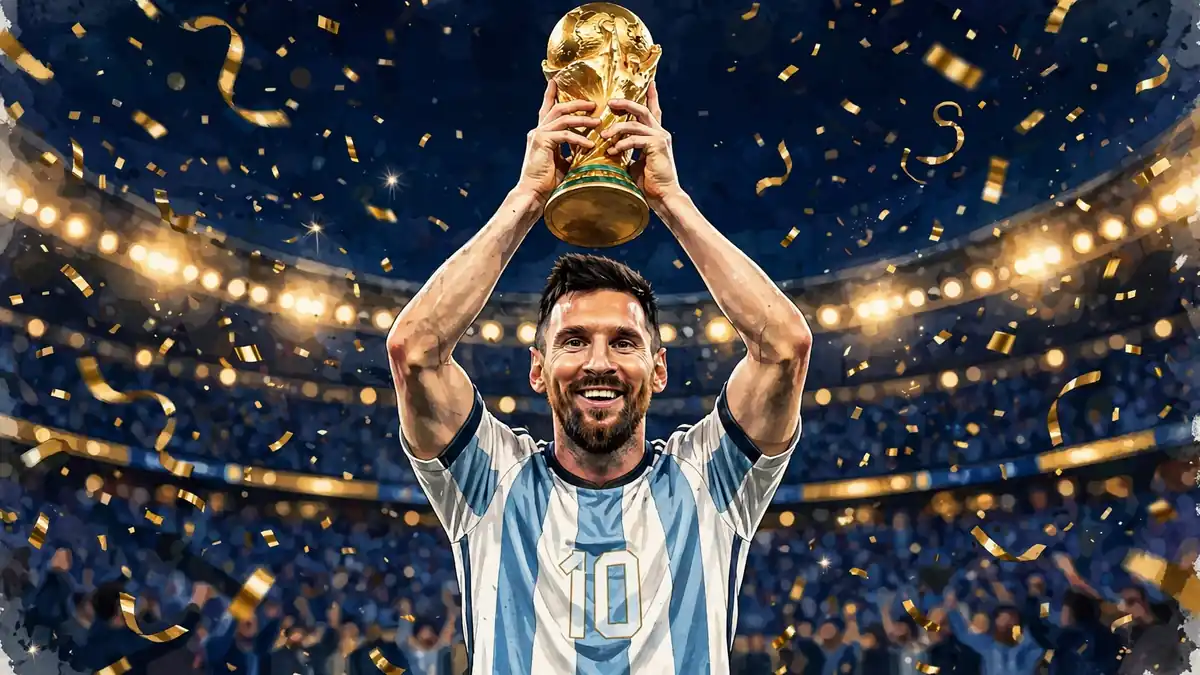
Qatar also settled the Maradona comparison in the eyes of most watchers. Maradona won his World Cup at 25, at 5 ft 5 in, in Mexico in 1986. Messi won his at 35, at 5 ft 7 in, in Qatar in 2022. Two short men from Rosario and Buenos Aires, two World Cups, forty years apart. The height was never the point. The point was what each man did with the space his height gave him.
The 2026 World Cup: Captain at 38, Turning 39 Mid-Tournament
Four years later, Messi went back. Named in Lionel Scaloni’s 26-man squad in May 2026, he captained Argentina’s defence of the title at a record sixth World Cup, the first man to play in six tournaments alongside Cristiano Ronaldo. He was 38 when the tournament began and turned 39 during it, on June 24, 2026. The idea that a sixth World Cup might be a farewell tour lasted about ninety minutes.
On June 16, 2026, in Kansas City, against Algeria, Messi won his 200th cap for Argentina — only the third man in history to reach 200 international appearances — and scored a hat-trick in a 3–0 win. It was his first World Cup hat-trick, and it made him the oldest player ever to score one. He moved level with Germany’s Miroslav Klose on 16 World Cup goals, tying the men’s all-time scoring record. Six days later, against Austria, he scored twice in a 2–0 win, moving to 17 and then 18 World Cup goals and passing Klose outright as the all-time top scorer in World Cup history. He added a free-kick goal against Jordan on June 28 as Argentina topped Group J with three wins from three matches.
The group stage alone rewrote the record book: six consecutive World Cup matches with a goal, the outright scoring record, 200 caps, and a hat-trick at 38. Asked after the Algeria match about a seventh World Cup in 2030, he laughed it off to TyC Sports: “No, no, that’s impossible.” He meant it. In October 2026, after 21 years with the national team, Messi retired from international football, with a farewell match against Benin on October 6. His Argentina career ended where the height story ends too: the small boy from Rosario who was told he would never reach 4 ft 7 in finished as his country’s most-capped player and the top scorer in World Cup history.
Inter Miami 2026: Golden Boot, 900 Goals and a Contract to 2028
Messi’s club football in 2026 was as productive as his international summer. He scored his 900th senior career goal on March 18, 2026, against Nashville SC in the CONCACAF Champions Cup, a low finish in the seventh minute of the second leg. He and Ronaldo are the only two players in history to reach 900. Two months later, on May 9, he recorded a goal and two assists in a 4–2 win away at Toronto, becoming the fastest player to reach 100 goal contributions in MLS. On August 29 he scored four goals, including two direct free kicks, in a 7–1 win over CF Montréal — his first four-goal match in MLS. On September 16 he scored his 100th goal for Inter Miami, against Cruz Azul in the Campeones Cup.
The season ended with the numbers that define it. Reuters reported on November 8, 2026 that Messi had won the MLS Golden Boot for a second consecutive season, with 26 goals in 31 matches and 43 goal contributions — the first player ever to win the award in back-to-back seasons. The year before, he had scored 29 goals with 19 assists in 28 regular-season games and won the Golden Boot, the MLS Cup and his second straight MLS MVP award, the first player in league history to win the MVP in consecutive years. At 38 and 39, in a league built for younger legs, he was still the most productive attacker in it.
The club has locked that production in. On October 23, 2025, Inter Miami announced a contract extension running through the end of the 2028 MLS season, when Messi will be 41. The deal also frames the club’s next chapter: the move to Miami Freedom Park, the new stadium in the heart of Miami, in 2026. “It makes me really happy to stay here and to continue with this project,” Messi said when the extension was announced. The reporting around the deal also notes a future minority ownership stake as part of his long-term tie to the club, though the exact terms have not been published. What is public is the term: three more seasons, through 2028, for a player who was told at 11 that he might never reach 4 ft 7 in.
Personal Life: Antonela, Three Sons and Life in Miami
Messi’s height is a public number. His private life is deliberately quiet, and this article keeps it to what is publicly confirmed. He married Antonela Roccuzzo, his childhood sweetheart from Rosario, on June 30, 2017, in their home city. The couple have three sons: Thiago, born in 2012; Mateo, born in 2015; and Ciro, born in 2018. The family moved to Miami in the summer of 2023, and the boys have grown up around the game — Thiago plays in Inter Miami’s academy system, and the family is a regular presence at Chase Stadium.
Antonela is 5 ft 2 in, which makes the couple a familiar sight in photographs: a 5 ft 7 in footballer beside a 5 ft 2 in partner, both shorter than the crowds around them. It is the kind of detail that gets asked about often enough to answer plainly, and the answer is that the family’s heights are ordinary. Messi is an ordinary height for an Argentine man. His wife is shorter than average. Their children will be whatever height their genes decide. None of it has anything to do with football, which is why it belongs in one paragraph and not a whole section.
Off the pitch, the family’s Miami life is settled: a home in Fort Lauderdale, the children in local schools and academies, and a routine built around training, school runs and the occasional trip back to Rosario. Messi has spoken in interviews about the calm the move brought after the pressure of Barcelona and Paris — fewer cameras at the training ground, a city where football is growing rather than suffocating, and a club that built itself around him. The contract through 2028 suggests the family plans to stay.
Net Worth in 2026: What the id=”net-worth”.1B Figure Means
A height article still has to answer the money question, because it is the question most readers ask next. Guide Net Worth’s own estimate puts Lionel Messi’s net worth in 2026 at about $1.1 billion. That figure is our estimate, built from his reported career earnings, his Inter Miami package — a guaranteed salary of about $20.4 million a year, plus revenue-sharing deals with Adidas and Apple TV+ and an option on an ownership stake — his endorsement portfolio, and his property holdings, including four luxury condominiums at the Cipriani Residences in Miami reported in February 2026. It is an outside estimate, not an audited balance sheet, and the full breakdown is in our net-worth profile.
The same $1.1 billion headline appears on our sister site: Lionel Messi’s net worth on NetWorthCraft carries the same figure, arrived at independently. Two sites, two research passes, the same number — which is reassuring, but still not a bank statement. No net-worth figure for any living athlete is. Treat $1.1 billion as the best available estimate, and read the full profile for the earnings, the deals and the assumptions behind it. Readers who want the money story in full should start there; this article’s job is the height, and the height is 5 ft 7 in.
One comparison is worth making. Ronaldo’s fortune is larger — his Al Nassr contract pays a reported $235 million a year, and his career earnings passed $2 billion in October 2026, according to Forbes. Messi earns less per year and is worth less in total, and the gap has nothing to do with the 17 cm between them. It has everything to do with where each man chose to play in his late thirties: Ronaldo took the biggest salary in the sport’s history in Saudi Arabia; Messi took a smaller salary, a revenue share and an ownership option in Miami. Different choices, different fortunes, same sport. Browse more profiles in the Celebrity Net Worth archive for the same treatment of the rest of the game’s stars.
What His Height Cost — and What It Gave Back
Every honest account of Messi’s height has to hold two facts at once. The first is that his height, or rather the condition behind it, nearly ended his career before it began. Without the growth-hormone treatment, the doctors said he would have stopped at about 4 ft 7 in. Without Barcelona’s money, there would have been no treatment. Without the treatment, there would have been no Barcelona debut at 17, no 672 goals, no eight Ballon d’Or awards, no World Cup. The height story is, at its root, a story about a medical bill that a working-class family could not pay and a football club that decided to pay it.
The second fact is that the height itself, once he reached it, was an advantage. The low centre of gravity, the balance, the ball glued to his foot, the ability to change direction in a space no taller player could use — those are the tools his frame gave him, and he spent twenty years sharpening them. He gave up the air and took the ground, and the ground turned out to be where most goals are scored.
There is a third fact, and it is the one that matters most for the young players who read articles like this one. Messi’s height did not make him great. Short players fail every day. What made him great was the work layered on top of the frame: the thousands of hours of dribbling practice, the vision, the left foot, the decision-making under pressure. The height is the beginning of the story, not the explanation for it. A 5 ft 7 in player who does not work becomes a short player who never makes it. A 5 ft 7 in player who works the way Messi did becomes the top scorer in World Cup history. The difference was never the centimetres. It was everything else.
Frequently Asked Questions
How tall is Lionel Messi?
Lionel Messi is 5 feet 7 inches tall (170 cm). That is the figure listed on his official Inter Miami CF player profile, and it is the same figure Barcelona and Paris Saint-Germain listed during his time with those clubs. His listed playing weight is about 67 kg (148 lb).
How tall is Messi in cm — 169 or 170?
170 cm. Five feet seven inches converts to exactly 170.18 cm, so sites that round the conversion print 170 cm. Some databases print 169 cm because they convert from a rounded 5 ft 6.5 in figure or truncate instead of rounding. There is no competing measurement — only a 1 cm rounding wobble — and every mainstream source agrees on the imperial figure of 5 ft 7 in.
Why is Messi so short?
Messi was diagnosed with growth hormone deficiency at age 11. His pituitary gland did not produce enough growth hormone for normal childhood growth, and doctors predicted he would reach a maximum adult height of about 4 ft 7 in without treatment. Daily injections of synthetic growth hormone, paid for by FC Barcelona after he signed for the club at 13, let him grow to 5 ft 7 in.
How tall was Messi at 11 years old?
About 4 feet 2 inches (127 cm), according to the most commonly cited accounts. He had not grown since he was nine. One scholarly account, Dartmouth’s medical history of Messi, puts him at 4 ft 4 in at diagnosis, citing the biographer Ian Hawkey. The accounts differ by a couple of inches; the picture is the same either way — an 11-year-old far shorter than his teammates, already scoring goals against boys a head taller than him.
Is Messi taller than Ronaldo?
No. Cristiano Ronaldo is listed at 6 feet 2 inches (187 cm), which makes him 17 cm (about 6.7 inches) taller than Messi. The gap never decided anything between them: Ronaldo’s height gave him the air and headed goals, while Messi’s gave him a low centre of gravity and close control on the ground. They are the only two players in history to score 900 senior career goals.
How tall is Messi compared to Neymar, Haaland and Mbappé?
Messi (5 ft 7 in / 170 cm) is shorter than all three. Neymar is 5 ft 9 in (175 cm), two inches taller. Kylian Mbappé is 5 ft 10 in (178 cm), three inches taller. Erling Haaland is 6 ft 5 in (195 cm), ten inches taller. The gap to Haaland is the widest: the two men score in opposite ways, Haaland through defenders and crosses at the far post, Messi between defenders from inside the crowd.
How old is Messi in 2026?
Messi is 39 years old in November 2026. He was born on June 24, 1987, in Rosario, Argentina, and he turned 39 on June 24, 2026, during the World Cup. He turns 40 on June 24, 2027. He captained Argentina at the 2026 World Cup at 38, won his second straight MLS Golden Boot at 39, and retired from international football in October 2026.
What is Messi’s net worth in 2026?
About $1.1 billion, per Guide Net Worth’s own estimate. The figure is built from his reported career earnings, his Inter Miami package (about $20.4 million a year in guaranteed salary, plus revenue-sharing deals with Adidas and Apple TV+ and an option on an ownership stake), endorsements and property. It is an outside estimate, not an audited balance sheet. Our sister site NetWorthCraft independently carries the same $1.1 billion headline.
Sources & Reporting
This article was researched on 20 November 2026 from live reporting: Inter Miami CF for the official 5 ft 7 in player profile and the October 23, 2025 contract extension through the end of the 2028 MLS season; FotMob for the 170 cm figure and the age-39 profile; comparingheights.org (November 2026) and heightandtall.com for the 169–170 cm rounding question and the Ronaldo comparison; ScienceABC for the low-centre-of-gravity dribbling analysis and the ~67 kg listed weight; Dartmouth’s “Messi’s Medical Journey” (Marc Novicoff) for the 1999 diagnosis by Dr. Diego Schwarzstein, the 4 ft 4 in figure at diagnosis, the predicted 4 ft 7 in ceiling, the $1,500-a-month cost, the five-goal trial and the napkin contract; Athlon Sports (October 6, 2026) for the $900-a-month cost and Messi’s “the only club in the world that offered” quote; Medical Daily (July 16, 2026) for the GHD explainer and the family’s struggle to pay; MLSsoccer.com (March 19, 2026) for the 900th goal and the Barcelona 672-goal record; Reuters (November 8, 2026) for the 2026 Golden Boot, the 26 goals in 31 matches and the 43 goal contributions; Wikipedia’s Career of Lionel Messi (updated November 2026) for the 2025 season figures, the 100th Inter Miami goal, the four-goal Montréal match and the October 2026 international retirement; and June 2026 World Cup reporting (A Sports, Business Elites Africa, KYNO Fresno, ClutchPoints) for the Algeria hat-trick, the 200th cap, the Klose record against Austria, the Jordan free kick and the “impossible” 2030 quote. Where sources disagreed — the treatment cost ($900 vs $1,500 a month), the 169 cm listing, and his exact height at 11 — the article names the disagreement instead of picking a number silently. Corrections are welcome via the About page.
Nathan Cole
Nathan Cole is the editor of Guide Net Worth. He covers celebrity wealth the way a business desk covers earnings: reported figures first, estimates labeled as estimates, no invented numbers. Every profile passes through his desk before it publishes. About Guide Net Worth · Corrections: figures are updated when new reporting emerges — contact us via the About page if you spot an error.
References & Sources
This article has been fact-checked and verified against multiple public sources, financial disclosures, SEC filings, Forbes reports, Celebrity Net Worth databases, and official records. All net worth estimates are based on publicly available information and financial analysis.