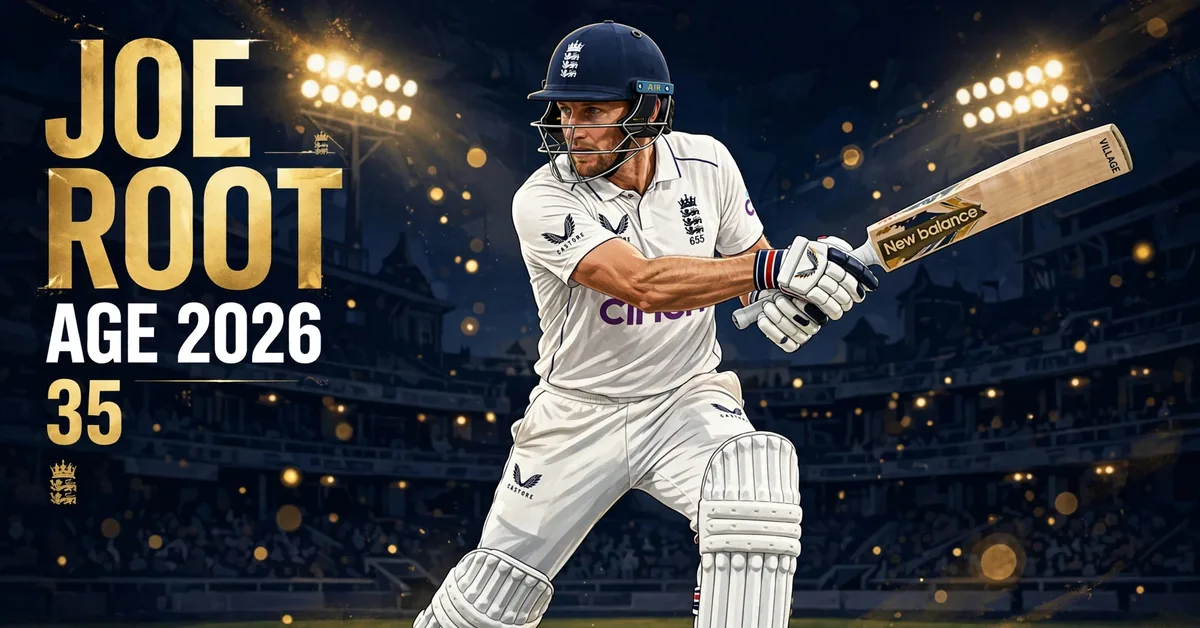
Joe Root age 2026: born December 30, 1990, the England star is 35 — second on Test cricket’s all-time runs list with 14,278, chasing Tendulkar’s 15,921.
Last updated: November 26, 2026 · By Nathan Cole
Joe Root is 35 years old in 2026. He was born Joseph Edward Root on December 30, 1990, in Sheffield, South Yorkshire, and he turns 36 on December 30, 2026. The England and Wales Cricket Board, the ICC and cricket.com.au all list him at 35, and the arithmetic is straightforward: 35 years and 331 days old on the day this profile was researched.
The number matters more than it usually does for a cricketer, because Root is chasing the biggest record in the sport. He has 14,278 Test runs as of November 13, 2026 — second on the all-time list, behind only Sachin Tendulkar’s 15,921. The gap is 1,643 runs. At 35, with his fitness intact and the captaincy back on his shoulders, the question is not whether he is old. It is whether he has enough years left to close a gap that has stood for thirteen years.
This profile answers the age question first, then follows the career the age belongs to: the Sheffield childhood, the Nagpur debut at 21, the captaincy, the Gabba hundred that ended a twelve-year drought, and the money that comes with being England’s greatest Test batter. Every figure carries its source and its date, and where outlets disagree — on the salary, and on the net worth — the range is shown rather than hidden.
Quick Facts
Full name: Joseph Edward Root
Born: December 30, 1990, Sheffield, South Yorkshire, England
Age: 35 years old in 2026 (turns 36 on December 30, 2026)
Height: 6 ft 0 in (183 cm)
Role: Right-handed top-order batter; England Test captain (returned 2026)
Test career: 169 Tests, 14,278 runs, average 50.45, 41 hundreds (as of November 13, 2026)
All-time rank: Second-highest Test run-scorer in history, behind Sachin Tendulkar (15,921)
ODI career: 192 matches, 7,826 runs, 20 centuries (as of August 2026) — England’s leading ODI run-scorer
Captaincy: England Test captain 2017–2022 (64 Tests, 27 wins); returned as captain in 2026
County: Yorkshire (Sheffield Collegiate Cricket Club)
Estimated net worth (2026): Around $10 million (£8 million); published range $3M–$10M
Family: Wife Carrie Cotterell (married December 2018); son Alfred (born January 2017), daughter Isabella (born July 2020)
How This Estimate Was Made
This profile adjudicates, it does not average. The age is settled by the birth date — December 30, 1990 — confirmed by the ECB, the ICC, cricket.com.au and Wikipedia, all of which list Root at 35 in 2026. The career totals are dated: 14,278 Test runs as of November 13, 2026, per Cricwall’s records table, and the ODI figures as of August 2026, per The Cricscope. The net worth is an estimate, not a fact: the consensus of 2026 reporting puts it at around $10 million (£8 million), while The Sports Legends and SurpriseSports publish a wider range of $3 million to $10 million. No cricketer publishes his bank balance, so the range is the reporting — and the article shows every figure with the outlet that published it.
+
How Old Is Joe Root in 2026?
Joe Root is 35 years old. He was born on December 30, 1990, which makes him 35 for almost the whole of 2026 — he turns 36 only on the last-but-one day of the year. The ECB’s official player profile lists his age as 35. The ICC’s rankings page lists his age as 35. Cricket.com.au lists his age as 35, with the date of birth shown as December 30, 1990. MyKhel’s profile puts it the same way: born December 30, 1990, and 35 years old as of 2026. Yorkshire CCC’s own stats page goes further and gives his exact age in days — 35 years, 295 days, at the time it was last updated.
There is no dispute about the date, which is worth saying plainly, because there is a dispute about almost everything else in this profile. The birth date is one of the few facts in cricket that nobody argues about. Root was born in Sheffield, in the last week of 1990, and every official source agrees. The confusion, when it happens, comes from the calendar: a player born on December 30 spends eleven months of every year at one age and one month at the next, and the profiles that round up early get it wrong for a few weeks. This one does not.
His age puts him in the middle of the great batting generation. Virat Kohli, born November 5, 1988, is 38. Steve Smith, born June 2, 1989, is 37. Kane Williamson, born August 8, 1990, is 36. Babar Azam, born October 15, 1994, is 32. Root, at 35, is younger than three of the four men he is measured against — and that is the first reason the Tendulkar chase is alive.
The age searches spike for a reason, and it is not curiosity alone. Every time Root passes another name on the all-time list, the question follows: how old is he, and how much time does he have left? The answer matters because the record is a race against the calendar. A batter who needs 1,643 runs at 35 has a realistic path. The same batter at 38 would not. Root’s age is the first number in the chase, and it is the one that keeps the chase alive.
Sheffield Roots: Childhood and the Yorkshire Academy
Root grew up in Sheffield, the son of Matt Root, a club cricketer, and Helen Root. Cricket was the family business in the ordinary sense: his father played, his younger brother Billy played — Billy went on to play first-class cricket for Glamorgan — and Joe played from the moment he could hold a bat. He attended King Ecgbert School in Sheffield and played for Sheffield Collegiate Cricket Club, the same club that produced Michael Vaughan, another Yorkshireman who went on to captain England.
He came through the Yorkshire academy, and the county spotted what it had early. Root was not a power hitter. He was a technician — compact, balanced, with a back-foot game that let him score square of the wicket, and a patience that coaches kept describing as old-fashioned. The academy years gave him the two things that still define his batting: the ability to leave the ball, which is the hardest skill in Test cricket, and the ability to bat for a very long time without getting bored.
The Debut: Nagpur, December 2012
Root made his Test debut against India at Nagpur in December 2012, at the age of 21. He scored 73 in the first innings, batting at No. 6, in a match England drew to win the series 2–1 — their first series win in India in 28 years. The innings was not flashy. It was watchful, disciplined and long, and it told the selectors what they needed to know: the youngster could bat time, in Asia, against spin, under pressure.
The debut matters to the age story because of how early it came. Root was 21 years and 350 days old. Fourteen years later, at 35, he has played 169 Tests — an average of twelve a year, every year, for fourteen years. That durability is the foundation of the record chase. Tendulkar played 200 Tests over 24 years. Root’s path to 15,921 runs runs through the same arithmetic: stay fit, keep getting picked, and score at the rate he has scored for a decade.
He made his ODI debut a month later, in January 2013, also against India, and he has been a fixture of England’s white-ball sides ever since — 192 ODIs by August 2026, with 7,826 runs and 20 centuries, which makes him England’s leading ODI run-scorer as well.
The Test Career: 14,278 Runs and Second All Time
As of November 13, 2026, Joe Root has scored 14,278 Test runs in 169 Tests and 309 innings, at an average of 50.45, with 41 hundreds and 69 fifties, and a highest score of 262. Those are Cricwall’s figures, current to November 13, 2026, and they make him the second-highest run-scorer in the history of Test cricket. Only Sachin Tendulkar, with 15,921 runs in 200 Tests, sits above him. The gap is 1,643 runs.
The climb to second took two years of milestones. He passed Alastair Cook’s England record of 12,472 runs at Multan in October 2024, reaching the mark with a boundary and going on to a big hundred in the same innings. He passed Rahul Dravid (13,288) and Jacques Kallis (13,289) during 2025. He passed Ricky Ponting (13,378) in July 2025, at Old Trafford in the fourth Test against India, hitting his 38th century — 121 not out at tea on day three — on his way to second place. He passed 14,000 runs on June 20, 2026, against New Zealand, in his 302nd Test innings, becoming only the second player in history to reach the mark. And in September 2026, at Edgbaston against Pakistan, he registered his 69th Test fifty, passing Tendulkar’s record of 68 — the most half-centuries any batter has ever made in Tests.
The average is the quiet part of the record. Root averages 50.45 across 309 innings, in an era when the ball has dominated the bat. Wisden’s assessment, written after the Gabba hundred, put it this way: on basically any metric, Root is up there with the best there has been, averaging more than 50 in a ball-dominated era, spending large swathes of his career as the only world-class batter in a struggling team. In every country where he has played three or more Tests, he averages at least 45. In six of them, he averages 50.
The Gabba Hundred: The Century That Ended the Drought
The one gap in Root’s record was Australia. Before the 2025–26 Ashes, he had played 15 Tests in Australia and 29 innings there without a century, and his highest score was 89. The local media reminded him of it at every opportunity. Darren Lehmann, the former Australia coach, had called the missing hundred a defining black mark against Root’s claim to be among the true elite. The series opener at Perth made it worse: Root scored 0 and 8 as England lost by eight wickets.
The answer came on December 4, 2025, at the Gabba, in the day-night second Test. Root walked in at 5 for 2, with Mitchell Starc rampant and only 15 deliveries old in the ball. He played and missed at his second ball, and was dropped off his third — Steve Smith parrying to Marnus Labuschagne, neither able to hold on. They would not get another chance. He reached his fifty from 83 deliveries, then took 78 painstaking balls to move from 60 past 90, into territory he had never reached in Australia. The century came off 181 balls, with a legside boundary against Scott Boland, in front of a capacity crowd of 37,117. He finished the day on an unbeaten 135, with England on 325 for 9 — his 40th Test hundred, in his 160th Test, and his first in Australia after twelve years of trying.
The partnerships tell the story of the innings: 117 with Zak Crawley (76), 54 with Harry Brook (31), 44 with Ben Stokes, and an unbroken 61 with No. 11 Jofra Archer, who made a career-best 32. Root had been dropped once, survived two lbw reviews, and batted through a day when everyone around him was falling. It was, as Wisden put it, a truly great hundred, to rank among Root’s finest. One gap remains: he has still never won a Test match in Australia, and that is the question the rest of the series left open.

Captain, Then Captain Again
Root captained England in Tests from 2017 to 2022 — 64 matches, 27 wins, the most wins by any England captain in history. The tenure had everything: a 2019 Ashes draw at home, a series win in Sri Lanka, and the lowest points, the 2021–22 Ashes defeat in Australia and a winless run that ended with his resignation in April 2022. He stepped down saying the job had taken a toll, and he went back to being what he had always been best at: the team’s best batter, without the captain’s burden.
Four years later, the job came back to him. Ben Stokes retired in July 2026, and Root returned as England’s Test captain — a move reported by the Independent on Saturday on July 25, 2026, and confirmed by 2026 reporting that lists Root as England’s Test skipper again. It is an unusual arc: a captain who resigned, rebuilt his batting, and was asked to lead again at 35. The timing is part of the story. The team that lost the 2025–26 Ashes opener needed a steady hand, and the player with 14,278 runs and 169 Tests was the steadiest hand available.
The 2026 Season: New Zealand, Pakistan and the Captaincy
Root’s 2026 began with the home summer, and the milestones came in pairs. In June, against New Zealand, he passed 14,000 Test runs — on June 20, in the second Test, in his 302nd innings — becoming only the second player in history to reach the mark. The achievement landed in the middle of a series England were expected to win comfortably, and it landed without fanfare: a nudge through the covers, a raised bat, and the crowd standing. Three months later, in September, against Pakistan at Edgbaston, he registered his 69th Test fifty, passing Tendulkar’s record of 68 half-centuries — a record that had stood for thirteen years, and one that speaks to consistency more than any other number in the book.
The season’s numbers, as of September 2026, were modest by Root’s standards: seven Tests, 429 runs at an average of 36.58, according to Yardbarker. That is the figure that invites the age question, and it deserves an honest answer. Root has always scored in clusters — a big series, then a quiet one — and 2026 was a quiet one by runs. But the two records he broke in the same season are the counterweight: the 14,000-run mark and the fifties record both came in 2026, at 35, in his fourteenth year of Test cricket. The runs will decide whether he catches Tendulkar. The records say he is still moving forward.
The captaincy return in July 2026, after Stokes retired, added a second job to the season. Root had spent four years as a pure batter, and the return to leadership meant field placings, bowling changes and press conferences on top of the batting. His first series back in charge was the home summer itself — New Zealand in June, Pakistan in September — and the team that had lost the Ashes opener in Perth was, by the autumn, a team with a direction again.
The White-Ball Career and the 2019 World Cup
Root’s white-ball career is often treated as a footnote to the Test record, which is unfair to it. He has 7,826 ODI runs in 192 matches at an average in the high 40s, with 20 centuries — England’s leading ODI run-scorer, ahead of every white-ball specialist the country has produced. He was a central figure in the team that won the 2019 World Cup at Lord’s, England’s first, and he scored 556 runs in the tournament — England’s leading scorer in the campaign.
He has not played T20 internationals since 2019, a decision that says something about how he manages his career at 35. The T20 game rewards power and innovation; Root’s game rewards patience and placement. He chose the formats where his skills pay best, and the choice has kept him fresh for the format that defines his legacy.
The Records Table: Where Root Stands
The numbers below are current to November 13, 2026, per Cricwall’s records table, with the ODI figures as of August 2026, per The Cricscope. Root is still playing, so every total here is a moving target — and that is the point. The gap to Tendulkar shrinks with every series.
| Record | Root’s Figure | All-Time Context |
|---|---|---|
| Test runs | 14,278 (169 Tests) | 2nd all-time; Tendulkar 15,921 (gap 1,643) |
| Test average | 50.45 | Above 50 across 309 innings |
| Test hundreds | 41 | Level with Ponting for 3rd on the hundreds list |
| Test fifties | 69 | All-time record; passed Tendulkar’s 68 in Sep 2026 |
| Highest Test score | 262 | vs Pakistan, Multan, Oct 2024 |
| ODI runs | 7,826 (192 matches) | England’s leading ODI run-scorer |
| ODI hundreds | 20 | Most by an England batter |
| Tests as captain | 64 (27 wins) | Most wins by an England Test captain |
Two records in that table deserve a second look. The 69 fifties matter because they show consistency: Root has passed fifty more times than any batter in Test history, including Tendulkar. And the 41 hundreds, level with Ponting for third on the all-time list, matter because they show conversion — the ability to turn starts into the scores that win matches.
Root at 35: How His Age Compares With His Peers
Root is the youngest of the great batters still playing, with one exception. Babar Azam, at 32, is younger — but Babar has played fewer than half as many Tests. Steve Smith is 37, and his Test tally sits well below Root’s. Kane Williamson is 36, and injuries have slowed his accumulation. Virat Kohli, at 38, has stepped away from Test cricket, which leaves Root alone at the top of the active list. The age gap is the reason the Tendulkar record is a live chase rather than a museum piece: Root has three or four years of Test cricket left if his body holds, and he needs 1,643 runs.
The comparison that matters most is the one with Ben Stokes, who is also 35 — born June 4, 1991, six months younger than Root — and who retired in July 2026. Stokes’s body gave out; Root’s has not. The two men shared a dressing room for fourteen years, and their careers diverged on durability. Stokes was the all-rounder whose bowling broke him. Root is the batter whose technique protects him. Pat Cummins, the Australia captain, is 33, and he was the bowler Root faced down at the Gabba — a reminder that the Ashes rivalry is also a generational one, and Root is the elder statesman of it now.
The Money: Net Worth and the ECB Contract
Joe Root’s net worth in 2026 is commonly estimated at around $10 million, approximately £8 million, according to WhatInsights, InfoCelebs, The Cricket Panda and BiographyLifes. The published range is wider: The Sports Legends and SurpriseSports put it at $3 million to $10 million (£2.4 million to £8 million). The consensus figure is $10 million, and it is the one this profile uses — with the range shown, because the outlets disagree about how much of his ECB package and franchise income to count.
For the full breakdown, our sister site CelebAmerica carries a Joe Root biography with the career story behind the money. The short version is this: the fortune comes from the ECB central contract, match fees, franchise cricket and endorsements. Root signed a three-year central contract in late 2023 that runs through 2026, and he sits on the ECB’s top tier. WhatInsights reports a base retainer of about £318,000 a year, with Test match fees of around £15,000 per appearance — which takes his total annual ECB income comfortably above £500,000 in a heavy Test season. Other outlets report the package higher: The Sports Legends puts the annual ECB salary at £900,000 to £1.2 million, and Durham CCC’s 2026 contract guide lists the three-year central contracts held by Root, Mark Wood and Harry Brook at up to £800,000. The honest reading is that the base retainer and the full package are different numbers, and the outlets are reporting different parts of the same deal.
Franchise cricket adds to it. Root played for the Rajasthan Royals in the 2023 IPL, bought for ₹1 crore (about £100,000), and played three matches, scoring 10 runs. In The Hundred, Welsh Fire signed him for £240,000, according to IceCric. Endorsements bring in an estimated $1 million to $2 million a year, per IceCric — his bat deal and his equipment partnerships are the main ones. None of these figures is official. The ECB does not publish individual contract values, and Root does not discuss his finances. The $10 million figure is an estimate built from the reported pieces, and it should be read as one.
Family and Personal Life
Root married Carrie Cotterell in December 2018. They have two children: a son, Alfred, born in January 2017, and a daughter, Isabella, born in July 2020. The family lives in Sheffield, close to Root’s roots, and he has spoken about how fatherhood changed the way he approaches the game — less frantic, more patient, more willing to leave the ball alone.
His height of 6 ft 0 in (183 cm) is covered in our own height profile, and his full career story is in our Joe Root biography. His younger brother Billy plays first-class cricket for Glamorgan, and his father Matt still follows the game from the Sheffield club circuit where Joe learned it. Root keeps his private life quiet — no social-media controversies, no public rows — and the profile reflects that: the cricket is the story, and the family is the background that makes it possible.
Sheffield is not just where he was born; it is where he still lives, and that choice says something about him. Plenty of England players move to London. Root stayed in Yorkshire, close to Headingley, close to his family, close to the club cricket that raised him. The commute to England duty is longer. The life around the cricket is quieter. For a player whose whole career has been built on patience, it fits.
Fitness and Longevity: How Long Can He Go On?
Root played seven Tests in 2026 and scored 429 runs at an average of 36.58, according to Yardbarker’s September 2026 figures — a quieter year than his best, and one that invites the question every 35-year-old batter gets asked. The answer, so far, is that he is still going. The Gabba hundred came at 34, in his 160th Test, after the worst start to a series of his career. The 14,000-run mark came at 35, in June 2026. The fifties record came at 35, in September 2026. The pattern is not decline. It is a batter who scores in bursts, then goes quiet, then scores again.
The arithmetic of the chase is simple. Root needs 1,643 runs to pass Tendulkar. England plays roughly ten to twelve Tests a year. At his career average of 50.45, and batting twice a match, that is about eighteen months of cricket — if he stays fit, if he keeps getting picked, and if the runs keep coming at the rate they have come for fourteen years. Viv Richards, who knows the record from the other side, has backed him to do it. Tendulkar himself has praised him. The record has stood since 2013. At 35, Root is the only active batter with a realistic chance of taking it, and the next two years will decide whether he does.
His technique is the reason the bet is reasonable. Root’s game is built on the sweep and the reverse sweep — shots he rebuilt himself during the 2021 tour of India, where he scored 218 at Chennai and showed he could dominate spin on turning pitches. He scores square of the wicket, he leaves well, and he rarely gives his wicket away to impatience. Batters who rely on reflexes fade in their mid-thirties. Batters who rely on judgement, as Root does, last longer. His injury record helps too: he has missed very little cricket to injury across fourteen years, and he has never had the kind of serious surgery that ends a fast bowler’s career or shortens a batter’s.
For readers who want the full picture across the sport, our Celebrity Net Worth archive carries the profiles of the players Root is measured against — Smith, Williamson, Kohli, Babar and Stokes — alongside the rest of our coverage. The age question has a short answer. The career it belongs to does not.
What Happens Next: The Chase in 2027
The calendar favours Root in 2027. The Ashes return to England in the home summer, and Root’s record at home is the strongest part of his career — he averages well above 50 in England, and the Gabba hundred removed the one statistical objection that followed him for a decade. A home Ashes series, with five Tests against the same attack he faced down in Brisbane, is the ideal setting to eat into a 1,643-run gap. If he scores at his career rate across the summer, the gap falls below a thousand before the year is out, and the record becomes a matter of when, not whether.
The risk is the same one every 35-year-old batter carries: form is not a straight line. Root’s 2026 average of 36.58, across seven Tests, was the quietest year of his career, and a second quiet year would stretch the chase into 2028, when he will be 37. The counterweight is the captaincy. Leading the side again gives him a reason to keep playing that goes beyond the record — and captains, historically, get picked longer than pure batters. The next eighteen months will answer the question the age profile asks: not how old Joe Root is, but how much cricket a 35-year-old with 14,278 runs still has in him.
Frequently Asked Questions
How old is Joe Root in 2026?
Joe Root is 35 years old in 2026. He was born on December 30, 1990, in Sheffield, England, and he turns 36 on December 30, 2026. The ECB, the ICC and cricket.com.au all list him at 35.
When was Joe Root born?
Joe Root was born Joseph Edward Root on December 30, 1990, in Sheffield, South Yorkshire, England. He is 35 years old for almost the whole of 2026, turning 36 only on December 30.
How many Test runs has Joe Root scored?
Joe Root has scored 14,278 Test runs in 169 Tests, at an average of 50.45, with 41 hundreds and 69 fifties, as of November 13, 2026. That makes him the second-highest run-scorer in Test history, behind Sachin Tendulkar’s 15,921. He needs 1,643 more runs to pass Tendulkar.
Did Joe Root score a century in Australia?
Yes. Joe Root scored his first century in Australia on December 4, 2025, making an unbeaten 135 at the Gabba in the day-night second Test of the 2025-26 Ashes. It was his 40th Test hundred, in his 160th Test, after 15 Tests and 29 innings in Australia without one. His previous best score in Australia was 89.
Is Joe Root England captain again?
Yes. Joe Root returned as England’s Test captain in 2026 after Ben Stokes retired in July 2026. Root previously captained England from 2017 to 2022, winning 27 of 64 Tests — the most wins by any England captain — before resigning in April 2022.
What is Joe Root’s net worth in 2026?
Joe Root’s net worth in 2026 is commonly estimated at around $10 million, approximately £8 million, according to WhatInsights, InfoCelebs, The Cricket Panda and BiographyLifes. The published range is $3 million to $10 million. His income comes from his ECB central contract, Test match fees, franchise cricket and endorsements.
How tall is Joe Root?
Joe Root is 6 ft 0 in tall (183 cm), according to his IPL player profile. The full evidence, including how his height compares with other England players, is covered in our separate Joe Root height profile on this site.
Is Joe Root married?
Yes. Joe Root married Carrie Cotterell in December 2018. They have two children: a son, Alfred, born in January 2017, and a daughter, Isabella, born in July 2020. The family lives in Sheffield.
Sources & Reporting
This profile was researched on November 26, 2026 from the following reporting: the ECB for Root’s age of 35 and his December 30, 1990 birth date; the ICC for his age of 35 and his career profile; cricket.com.au for his age of 35 and the December 30, 1990 birth date; Wikipedia for the December 30, 1990 birth date and the Sheffield background; Yorkshire CCC for his exact age in days and his county career; MyKhel for his age of 35 as of 2026; Cricwall for the 14,278 Test runs in 169 Tests, the 50.45 average, the 41 hundreds and 69 fifties, and the 1,643-run gap to Tendulkar, all as of November 13, 2026; Crictracker for the 69th Test fifty passing Tendulkar’s record of 68 in September 2026 at Edgbaston; The Cricscope for the 7,826 ODI runs in 192 matches, the 20 ODI centuries, the 14,216 Test runs as of September 11, 2026, and the return to the Test captaincy in 2026; the Associated Press (via Crictoday and Devdiscourse, December 4, 2025) for the unbeaten 135 at the Gabba, the 40th Test hundred, the 160th Test, the 37,117 crowd and the 0 and 8 in Perth; Wisden for the assessment of Root’s career and the Gabba innings; the Independent on Saturday (July 25, 2026) for the Test captaincy return after Stokes’ retirement; WhatInsights for the $10 million (£8 million) net worth, the £318,000 base retainer and the £15,000 Test match fee; InfoCelebs for the £8 million net worth; The Sports Legends for the $3 million to $10 million range and the £900,000 to £1.2 million ECB salary; SurpriseSports for the £3 million to £8 million range, the three-year contract signed in late 2023 and the £900,000 base salary; The Cricket Panda for the $10 million net worth; Durham CCC for the three-year central contracts up to £800,000; IceCric for the $1 million to $2 million annual endorsement income and the £240,000 Welsh Fire deal; and the IPL for the 6 ft 0 in (183 cm) height, the Rajasthan Royals 2023 stint for ₹1 crore and the 3 matches and 10 runs. Where sources disagreed — the net worth, and the ECB contract figures — the article names the disagreement and shows the range instead of picking a number silently. Corrections are welcome via the About page.
Nathan Cole
Nathan Cole is the editor of Guide Net Worth. He covers celebrity wealth the way a business desk covers earnings: reported figures first, estimates labeled as estimates, no invented numbers. Every profile passes through his desk before it publishes. About Guide Net Worth · Corrections: figures are updated when new reporting emerges — contact us via the About page if you spot an error.
References & Sources
This article has been fact-checked and verified against multiple public sources, financial disclosures, SEC filings, Forbes reports, Celebrity Net Worth databases, and official records. All net worth estimates are based on publicly available information and financial analysis.