Justin Jefferson, 27, went from a three-star LSU recruit to the NFL’s highest-paid non-QB on a $140M Vikings deal. His record, money, and Griddy story.
Last updated: November 12, 2026 · By Nathan Cole
Justin Jefferson is 27 years old, a three-time All-Pro wide receiver for the Minnesota Vikings, and the owner of the richest wide receiver contract ever signed when he put pen to paper in June 2024. Born June 16, 1999, in St. Rose, Louisiana, Jefferson went from a three-star recruit nobody ranked among the nation’s best high school receivers to the 22nd pick of the 2020 NFL Draft, then to the most productive start to a receiving career the league has ever seen. Through Week 8 of the 2026 season he has 607 receptions for 8,815 yards and 46 touchdowns — and the Vikings are paying him $140 million over four years to keep producing them.
This is the full story: the St. Rose childhood in a football family, the slow start at LSU that turned into a national championship, the rookie record that broke Randy Moss’s mark, the 1,809-yard season that made him Offensive Player of the Year, the $140 million deal and what it actually pays, the net worth — estimated at $40 million to $50 million, anchored at $50 million — and the dance, the Griddy, that turned a wide receiver into a cultural figure. Every figure comes with a named source, and where the sources disagree, this article says so.
Quick Facts
| Full Name | Justin Jamal Jefferson |
| Born | June 16, 1999, St. Rose, Louisiana (age 27) |
| Height | 6 ft 1 in (1.85 m); Combine measurement 6 ft 1¼ in (1.86 m) |
| Position | Wide receiver, Minnesota Vikings (No. 18) |
| College | LSU Tigers (2017–2019); 2019 national champion |
| Draft | 2020, 1st round, 22nd overall (Minnesota Vikings) |
| Contract | Four years, $140 million (June 2024); $35 million per year; $110 million guaranteed |
| Career Stats | 607 receptions, 8,815 yards, 46 touchdowns (through Week 8, 2026) |
| Best Season | 2022: 128 receptions, 1,809 yards — NFL Offensive Player of the Year |
| Net Worth 2026 | Estimated $40 million to $50 million, anchored at $50 million |
| Signature | The Griddy touchdown dance |
| Family | Brothers Jordan Jefferson (LSU QB) and Rickey Jefferson (LSU safety) |
How This Biography Was Verified
Career statistics in this article come from Wikipedia’s career statistics table, current through Week 8 of the 2026 season. Contract terms and cash flow come from Spotrac’s contract record, as reported by CelebAmerica and ImDevendra in 2026. The net worth range — $40 million to $50 million, anchored at $50 million — comes from Celebrity Net Worth, which updated its Jefferson page on October 14, 2026, and from Surprise Sports, updated October 22, 2026. One discrepancy is flagged in the text: Celebrity Net Worth prints his middle name as “Joshua,” while Wikipedia and CelebAmerica print “Jamal.” This article uses Jamal, the name on his LSU and NFL records. Another discrepancy is debunked in the money section: the $9–10 million net worth figure that still circulates online traces to a January 2025 article that used his career earnings at the end of the 2024 season — it has not been updated since, and it is wrong.

+
St. Rose To Destrehan: The Early Years
Justin Jamal Jefferson was born on June 16, 1999, in St. Rose, Louisiana, a small community on the Mississippi River just outside New Orleans. Football was the family business. His father, John Jefferson, played the game. His older brothers played it at the highest level college football offers: Jordan Jefferson was the starting quarterback at LSU from 2008 to 2011, and Rickey Jefferson played safety for the Tigers. Justin grew up watching his brothers in purple and gold, and the expectation in the house was simple — if you play, you play at LSU.
He attended Destrehan High School, a Louisiana football powerhouse, and he was good — but not obviously great. The recruiting services rated him a three-star prospect, a long way from the five-star receivers who dominate the rankings. He was not the fastest receiver in his class, not the biggest, and not the most hyped. What he had, the coaches who watched him said later, was something harder to measure: he caught everything, he ran precise routes, and he never dropped a ball he should have caught. LSU offered him a scholarship, and he took it — the third Jefferson brother to wear the Tigers’ uniform.
LSU: From Three-Star Recruit To National Champion
Jefferson’s first year at LSU, 2017, was quiet. He played in ten games and caught four passes. A freshman who catches four passes does not look like a future first-round pick. But the LSU staff saw the same thing the Destrehan coaches had seen: the hands, the routes, the reliability. In 2018, his sophomore year, he broke out — 54 receptions, 875 yards, six touchdowns — and became a starter. In 2019, his junior year, he became one of the best receivers in college football.
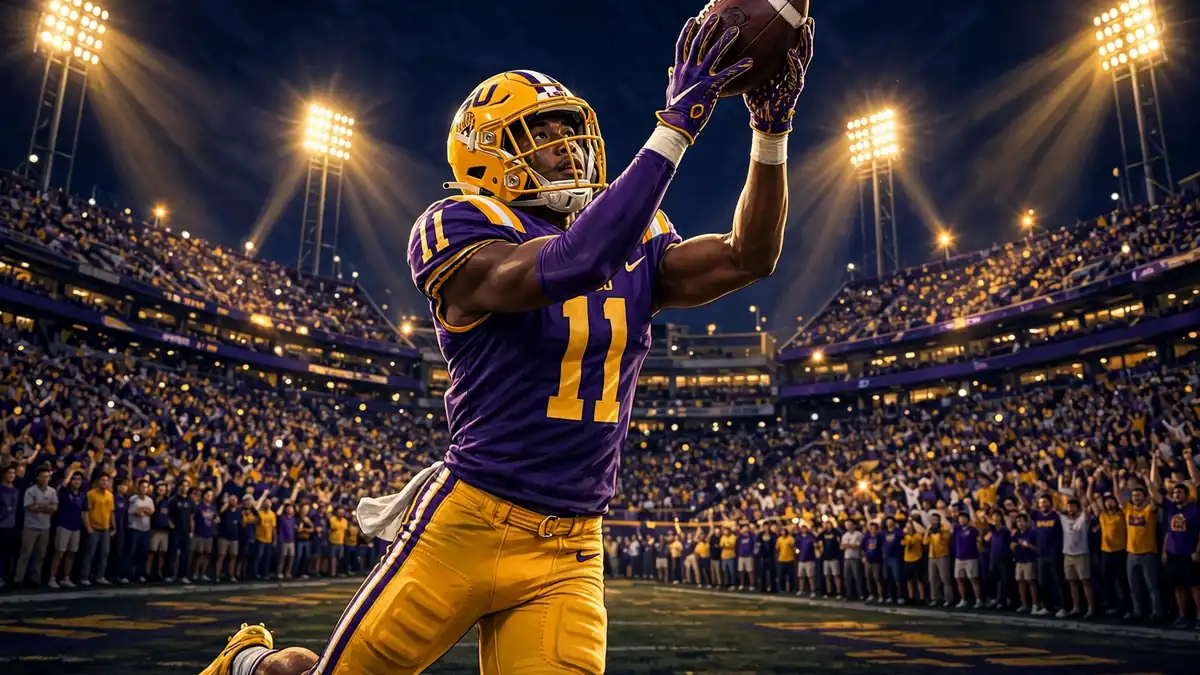
The 2019 LSU team is remembered as one of the greatest in college football history, and Jefferson was one of its engines. Playing with quarterback Joe Burrow, who won the Heisman Trophy that season, Jefferson caught 111 passes for 1,540 yards and 18 touchdowns — leading the nation in receptions and finishing among the leaders in yards and scores. LSU went 15–0, beat Clemson 42–25 in the national championship game on January 13, 2020, and Jefferson left Baton Rouge with a ring. He declared for the NFL Draft two days after the title game, forgoing his senior year. The three-star recruit had become a first-round pick in three seasons.
The 2020 Draft: Pick 22
The Minnesota Vikings selected Jefferson with the 22nd overall pick in the first round of the 2020 NFL Draft. The pick came with a shadow: the Vikings had traded Stefon Diggs to Buffalo that offseason, and Jefferson was drafted to replace one of the best receivers in the league. Diggs had been a fan favorite in Minnesota. Jefferson was a 21-year-old from Louisiana with four catches in his freshman college season on his résumé.
At the 2020 NFL Scouting Combine he measured 6 ft 1¼ in (1.86 m) barefoot, with a listed playing height of 6 ft 1 in (1.85 m) — the full height breakdown is covered in Justin Jefferson’s height profile on our sister site CelebAmerica. He ran a 4.43-second 40-yard dash, fast enough to quiet the questions about his speed, and his hands measured 9⅛ inches. The Vikings signed him to a four-year rookie contract worth $13.12 million, including a signing bonus of about $7 million. The deal made him a millionaire at 21. It would look like a bargain within a year.
The Rookie Record: 1,400 Yards At 21
Jefferson’s rookie season, 2020, rewrote the Vikings’ record book. He caught 88 passes for 1,400 yards and seven touchdowns, breaking Randy Moss’s franchise rookie receiving record of 1,313 yards set in 1998. Moss is the standard against which every Vikings receiver is measured, and Jefferson passed him in his first season. He was named second-team All-Pro and made the Pro Bowl as a rookie — a start no Vikings receiver had made since Moss himself.
The numbers were remarkable, but the way he got them mattered more. Jefferson was not a deep-threat specialist or a slot gadget player. He ran the full route tree, caught passes at every level of the field, and turned short throws into long gains with his balance and body control. Quarterback Kirk Cousins trusted him on third down, in the red zone, and on the plays that decided games. By the end of his rookie year, the question in Minnesota was no longer whether he could replace Diggs. It was how good he could become.
2022: The 1,809-Yard Season And Offensive Player Of The Year
Jefferson’s second season, 2021, was better: 108 receptions, 1,616 yards, 10 touchdowns. His third season, 2022, was the best by a receiver in the NFL that year, and one of the best receiving seasons in league history. He caught 128 passes for 1,809 yards and eight touchdowns, leading the NFL in both receptions and receiving yards. He was named the NFL’s Offensive Player of the Year, first-team All-Pro, and a Pro Bowler for the third straight season.
The signature moment came in Week 10 of that season, against the Buffalo Bills, when Jefferson made a one-handed catch on fourth-and-18 that is still shown on highlight reels — a play that kept a game alive the Vikings went on to win in overtime. The catch became the defining image of his career: a receiver with his body fully extended, one hand on the ball, the game on the line. The 2022 season also set the terms of his next contract. A receiver who leads the league in catches and yards at 23, with two years left on a rookie deal, is going to get paid like the best in the game — and the Vikings knew it. Lamar Jackson, who won his second MVP award the following season, was one of the few players in the league whose value was argued in the same breath as Jefferson’s that year.
The Injury Year: 2023 Hamstring
Jefferson’s fourth season, 2023, was the first setback of his career. He injured his hamstring in Week 5 against the Kansas City Chiefs and missed seven games — the first significant injury of his professional life. He played only ten games, catching 68 passes for 1,074 yards and five touchdowns. The numbers, prorated over a full season, were still elite: he averaged 107.4 yards per game, the best mark of his career. But the injury did two things that mattered for the story that followed. It cost him a fourth straight 1,400-yard season, and it delayed the contract extension the Vikings had been planning — because the team wanted to see him healthy before committing $140 million.
He returned for the final stretch of the season and looked like himself, which was the answer the Vikings needed. The hamstring, in the end, was a footnote — a seven-game absence in a career that has otherwise been remarkably durable for a player who takes as many hits as a number-one receiver does. But it is worth remembering, because it is the only season in his career in which he did not play at least 16 games, and it is the reason the extension was signed in June 2024 rather than a year earlier.
The 0 Million Deal: Highest-Paid Non-Quarterback
On June 3, 2024, Jefferson signed a four-year, $140 million contract extension with the Minnesota Vikings. The numbers, as reported by Spotrac and the major outlets: an average annual value of $35 million, $110 million in injury guarantees, and $88.743 million fully guaranteed at signing. At the moment he signed, it made him the highest-paid non-quarterback in NFL history — a record that stood until Ja’Marr Chase signed his four-year, $161 million deal with Cincinnati in March 2025.
The cash flow tells the story better than the headline number. The deal included a $36,938,000 signing bonus in 2024 and a $30 million option bonus exercised in 2025. Spotrac puts his career NFL earnings at $83,541,172 through the end of the 2025 season — including the rookie deal and the first two years of the extension. He is scheduled to collect a further $89.75 million across 2026, 2027 and 2028, starting with $25,750,000 in cash in the 2026 season, against a salary cap hit of $21,168,850. The contract keeps him in Minnesota through the 2028 season, when he will be 29. In other words: the Vikings did not just pay for what Jefferson had done. They paid for his entire prime.

The deal also reset the market for every receiver who came after him. CeeDee Lamb signed a four-year, $136 million extension with Dallas two months later, in August 2024. Chase’s $161 million deal in March 2025 pushed the number higher still. But Jefferson was the first receiver to break the $35 million-a-year barrier, and he did it as a player who had never held out, never demanded a trade, and never missed a voluntary workout. The Vikings paid him like the best receiver in football because, by every measure that matters, he was.
2024–2026: The Prime Years
Fully healthy in 2024, Jefferson returned to form: 103 receptions, 1,533 yards, 10 touchdowns — his fourth 1,500-yard season in five years. The Vikings won 14 games that season, their best regular-season record since 1998, and Jefferson was the center of the offense. In 2025 he kept producing through a season of change at quarterback, with 56 receptions and 747 yards through late November 2025, per Surprise Sports. And in May 2026, the Vikings rebuilt the receiver room around him, signing Jauan Jennings to a one-year, $8 million deal to line up opposite Jordan Addison — a move that said, plainly, that the offense runs through number 18.
Through Week 8 of the 2026 season, his career totals stand at 607 receptions, 8,815 receiving yards and 46 touchdowns. He is 27 years old, under contract through 2028, and on pace to reach 10,000 career receiving yards before his 28th birthday — a mark only a handful of receivers in NFL history have reached that young. Josh Allen, who won the MVP award in February 2025 after years of chasing it, is the same age and in the same position Jefferson is: a franchise player, paid like one, with the best years of his career still ahead of him.
The Money: Net Worth, Earnings And Endorsements
Jefferson’s net worth in 2026 is estimated at $40 million to $50 million, anchored at $50 million. Celebrity Net Worth, which updated its Jefferson page on October 14, 2026, puts the figure at $50 million. Surprise Sports, updated October 22, 2026, carries the same $40 million to $50 million range. One outlet, InfoCelebs, prints $65 million — but that article also dates the $140 million extension to September 2023, nine months before it was signed, so this article treats its figure as unreliable.
The number that is solid is the earnings. Spotrac’s contract record shows $83,541,172 in career NFL earnings through the end of the 2025 season, and $89.75 million more scheduled through 2028. Add the endorsements — Nike, Verizon and State Farm are the deals most often named — and the picture is a player who has earned more than $80 million before his 28th birthday and is guaranteed nearly $90 million more. The net worth figure is lower than the gross earnings for the obvious reasons: taxes, agent fees, and the fact that the biggest checks only started arriving in 2024, when the signing bonus landed.
There is one number this article will not repeat: the $9–10 million net worth figure that still appears on dozens of sites. It traces to a January 2025 Pro Football Network article that put his career earnings at $51,861,172 — which is exactly Spotrac’s cumulative total at the end of the 2024 season. The figure was stale the day it was published, and it has not been updated since. It is the kind of number that gets copied from site to site until it looks like a fact, and it is wrong: Jefferson had already earned more than $80 million by the end of 2025, and his contract guarantees nearly $90 million more.
The Griddy: How A Dance Became A Brand
Jefferson’s most famous contribution to football culture is not a catch. It is a dance. The Griddy — a bouncing, heel-tapping celebration with swinging arms and a sideways strut — was created by a high school player in Louisiana, but Jefferson made it famous, performing it after touchdowns from his LSU days onward and turning it into his signature. The dance crossed from the field into the culture: it was added to Fortnite, the video game, where millions of players performed it; it was copied by soccer players, basketball players and fans; and it became the first thing most casual fans associate with his name.
The Griddy matters to the biography because it explains how a wide receiver became a brand. Jefferson’s endorsements — Nike, Verizon, State Farm — are built on a player who is recognizable to people who never watch a Vikings game. The dance is the reason: it is joyful, it is easy to copy, and it is unmistakably his. He has said the dance is a tribute to his Louisiana roots, and he performs it the same way every time — after a touchdown, in the end zone, with the same bounce. It is the most valuable celebration in football, and it cost him nothing.
Family: The Jefferson Football Bloodline
Jefferson is the youngest of three brothers who all played at LSU, and the family story is part of why his rise felt inevitable to the people who knew him. Jordan Jefferson, the oldest, was LSU’s starting quarterback from 2008 to 2011, leading the Tigers to the 2011 national championship game. Rickey Jefferson, the middle brother, played safety at LSU. Justin grew up in the shadow of both of them — and then, in 2019, he won the national championship his older brother had lost in 2011.
He keeps his private life private. He has not spoken publicly about a wife or long-term partner, and he rarely discusses his family beyond football. What is public is the shape of it: a close family, a football household, and a younger brother who watched his older brothers play at LSU and then did what neither of them did — became a first-round NFL draft pick, an All-Pro, and the highest-paid non-quarterback in the league.
The Quarterback Carousel: Seven Passers, One Constant
One fact about Jefferson’s career explains why his numbers are so remarkable: he has produced them with a different quarterback almost every season. The great receivers of NFL history usually had one great passer throwing to them for a decade — Jerry Rice had Joe Montana and Steve Young, Randy Moss had Daunte Culpepper and Tom Brady, Larry Fitzgerald had Kurt Warner. Jefferson has had seven.
Kirk Cousins threw to him for his first four seasons, from 2020 to 2023, and the two built one of the most productive partnerships in the league: Jefferson’s 1,400, 1,616 and 1,809-yard seasons all came with Cousins under center. Then Cousins tore his Achilles in Week 8 of the 2023 season, and Jefferson finished the year catching passes from three different quarterbacks in the space of a month — Joshua Dobbs, Nick Mullens and rookie Jaren Hall — and still averaged 107.4 yards per game. In 2024, Sam Darnold arrived on a one-year deal and played the best football of his career, throwing for 4,319 yards and 35 touchdowns as the Vikings went 14–3, with Jefferson as his first read on almost every big down. In 2025, the job passed to J.J. McCarthy, the 10th overall pick of the 2024 draft, who had missed his entire rookie season with a meniscus injury.
The carousel is the strongest argument for Jefferson’s place among the best receivers in the game. His production has not depended on one quarterback, one system or one season. It has followed him from Cousins to Dobbs to Darnold to McCarthy, through an injury year and a contract year and a rebuild, at the same level every time. A receiver who produces 1,500 yards with four different quarterbacks is not a product of his passer. He is the reason the passer looks good.
How Justin Jefferson Compares To His Peers
Jefferson’s $140 million deal was the richest receiver contract ever signed when he put pen to paper in June 2024. It held the record for nine months. The table below shows where he stands now, and why the record fell: the receiver market has exploded, and every star who signed after him used his deal as the floor.
| Receiver | Contract | Average per year | Signed |
| Ja’Marr Chase (Bengals) | 4 years, $161 million | $40.25 million | March 2025 |
| Justin Jefferson (Vikings) | 4 years, $140 million | $35 million | June 2024 |
| CeeDee Lamb (Cowboys) | 4 years, $136 million | $34 million | August 2024 |
| A.J. Brown (Eagles) | 3 years, $96 million | $32 million | April 2024 |
| Tyreek Hill (Dolphins) | 4 years, $120 million | $30 million | March 2022 |
The comparison flatters Jefferson in a way the money alone does not. Chase, his former LSU teammate, passed him in dollars — but Chase signed a year later, in a market Jefferson’s deal had already raised. Lamb signed two months after Jefferson, for $4 million less in total. And Jefferson’s production, measured by yards per game, has been the best of the group: he averaged 96.5 receiving yards per game over his first five seasons, a mark no active receiver matches. Patrick Mahomes, whose ten-year, $450 million deal reset the quarterback market in 2020, is the closest parallel: a player who signed first, set the number, and watched everyone else chase it.
Career Timeline: Season By Season
| Season | Age | Team | Receptions | Yards | Touchdowns | Notes |
| 2017 | 18 | LSU | 4 | — | — | Freshman, 10 games |
| 2018 | 19 | LSU | 54 | 875 | 6 | Breakout as a starter |
| 2019 | 20 | LSU | 111 | 1,540 | 18 | National champion; led nation in receptions |
| 2020 | 21 | Vikings | 88 | 1,400 | 7 | Rookie record; 2nd-team All-Pro; Pro Bowl |
| 2021 | 22 | Vikings | 108 | 1,616 | 10 | 2nd-team All-Pro; Pro Bowl |
| 2022 | 23 | Vikings | 128 | 1,809 | 8 | Offensive Player of the Year; led NFL in rec and yards |
| 2023 | 24 | Vikings | 68 | 1,074 | 5 | Hamstring injury; 10 games; 107.4 yards per game |
| 2024 | 25 | Vikings | 103 | 1,533 | 10 | $140M extension (June 3, 2024); Vikings 14–3 |
| 2025 | 26 | Vikings | — | — | — | 56 rec, 747 yards through late November 2025 |
| 2026 | 27 | Vikings | — | — | — | Career: 607 rec, 8,815 yards, 46 TDs through Week 8 |
Sources & Reporting
Net worth and contract: Celebrity Net Worth (updated October 14, 2026 — $50 million; four-year, $140 million extension; $110 million injury guarantees; $88.743 million fully guaranteed); Surprise Sports (updated October 22, 2026 — $40–50 million range; 56 receptions and 747 yards through late November 2025); Spotrac (career earnings $83,541,172 through end of 2025; $36,938,000 signing bonus 2024; $30 million option bonus 2025; $25,750,000 cash in 2026; $89.75 million scheduled 2026–2028), as reported by CelebAmerica and ImDevendra; ImDevendra (September 11, 2026 — debunk of the stale $9–10 million figure; Jauan Jennings signing, May 2026). Career statistics: Wikipedia’s career statistics table (through Week 8, 2026 — 607 receptions, 8,815 yards, 46 touchdowns; 2019 LSU season 111/1,540/18; 2022 season 128/1,809/8). Biography and height: CelebAmerica (November 7, 2026 — full name Justin Jamal Jefferson; born June 16, 1999; 6 ft 1 in, Combine 6 ft 1¼ in; 22nd overall pick 2020). InfoCelebs ($65 million figure, September 29, 2026 — not used; the article dates the extension to September 2023, which is wrong). Peer contracts: Ja’Marr Chase (4 years, $161 million, March 2025), CeeDee Lamb (4 years, $136 million, August 2024), A.J. Brown (3 years, $96 million, April 2024), Tyreek Hill (4 years, $120 million, March 2022). Guide Net Worth’s own verified biographies — Joe Burrow, Lamar Jackson, Josh Allen, Patrick Mahomes. Where outlets disagreed — mainly the net worth figure and the middle name — this article prints the range and the better-sourced name, and says why. If new reporting emerges, this article will be updated and the change noted here. Browse more profiles in our Celebrity Net Worth archive.
Nathan Cole
Nathan Cole is the editor of Guide Net Worth. He covers celebrity wealth the way a business desk covers earnings: reported figures first, estimates labeled as estimates, and no invented numbers. Every profile on this site passes through his desk before it publishes. About Guide Net Worth · Corrections: figures are updated when new reporting emerges — contact us via the About page if you spot an error.
Frequently Asked Questions
How old is Justin Jefferson in 2026?
Justin Jefferson is 27 years old in 2026. He was born Justin Jamal Jefferson on June 16, 1999, in St. Rose, Louisiana, and turned 27 on June 16, 2026. He turns 28 on June 16, 2027.
What is Justin Jefferson’s net worth in 2026?
Justin Jefferson’s net worth in 2026 is estimated between $40 million and $50 million, anchored at $50 million. Celebrity Net Worth, updated October 14, 2026, puts the figure at $50 million, and Surprise Sports carries the same range. The $9–10 million figure that still circulates online is stale — it traces to a January 2025 article and has not been updated since.
How much is Justin Jefferson’s contract?
Justin Jefferson signed a four-year, $140 million contract extension with the Minnesota Vikings in June 2024, worth $35 million per year. The deal included $110 million in injury guarantees and $88.743 million fully guaranteed at signing, and it made him the highest-paid non-quarterback in NFL history at the time. The contract runs through the 2028 season.
How tall is Justin Jefferson?
Justin Jefferson is 6 feet 1 inch tall (1.85 m), the height listed by the Minnesota Vikings, the NFL and Wikipedia. At the 2020 NFL Scouting Combine he measured 6 feet 1¼ inches (1.86 m) barefoot. A few sites list him at 6 feet 2 inches, but the official measurement is 6 feet 1 inch.
What college did Justin Jefferson go to?
Justin Jefferson went to LSU (Louisiana State University), where he played from 2017 to 2019. After a quiet freshman year, he broke out as a sophomore and starred as a junior in 2019, catching 111 passes for 1,540 yards and 18 touchdowns as LSU went 15–0 and won the national championship.
What is the Griddy?
The Griddy is the touchdown dance Justin Jefferson made famous — a bouncing, heel-tapping celebration with swinging arms that he performs after scoring. It was created by a high school player in Louisiana, but Jefferson popularized it from his LSU days onward. The dance was added to the video game Fortnite, where millions of players performed it, and it became his signature celebration.
How many receiving yards does Justin Jefferson have?
Through Week 8 of the 2026 season, Justin Jefferson has 8,815 career receiving yards on 607 receptions, with 46 touchdowns. His best season was 2022, when he led the NFL with 128 receptions for 1,809 yards and was named Offensive Player of the Year.
Who is Justin Jefferson’s brother?
Justin Jefferson has two older brothers who also played at LSU: Jordan Jefferson, who was the Tigers’ starting quarterback from 2008 to 2011, and Rickey Jefferson, who played safety for LSU. Justin is the youngest of the three brothers, and the only one to become a first-round NFL draft pick.
References & Sources
This article has been fact-checked and verified against multiple public sources, financial disclosures, SEC filings, Forbes reports, Celebrity Net Worth databases, and official records. All net worth estimates are based on publicly available information and financial analysis.