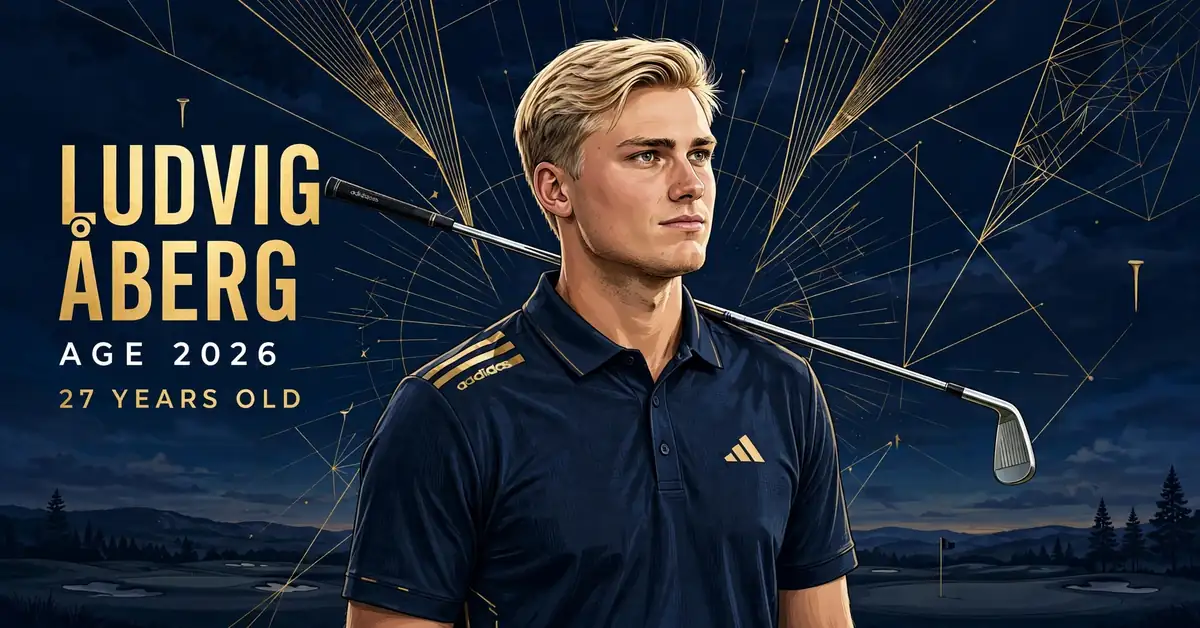
Ludvig Åberg is 27 in 2026 — he turned 27 on October 31, 2026. His Eslöv roots, Texas Tech years, two PGA Tour wins, Ryder Cup heroics and a $13M fortune.
Last updated: November 12, 2026 · By Nathan Cole
Ludvig Åberg is 27 years old in 2026. He was born on October 31, 1999, in Eslöv, Sweden, which means he turned 27 on Halloween 2026 — twelve days before this article was published. If the page you just read says 26, it was written before his birthday, and it is already out of date.
The age matters because the timeline behind it is so compressed. Åberg turned professional in June 2023 at 23. Within three months he had won on the DP World Tour and been picked for a Ryder Cup team before ever playing a major. Within seventeen months he had finished second at the Masters, reached world No. 4, and banked more than $20 million in prize money. By the end of 2026 he owns two Ryder Cup winners’ medals, two PGA Tour titles, and an estimated net worth of $13 million — built from $28.3 million in career PGA Tour earnings reported by Spotrac in March 2026 and a growing endorsement portfolio led by Adidas, Titleist, Rolex, and Mercedes-Benz.
This article settles the birthday with dated sources, explains why so many profiles still show the wrong age, and then walks through the whole story: the small town in southern Sweden, the Texas Tech years that rewrote the college record book, the 9-and-7 Ryder Cup win that made history, the $4 million Sunday at Torrey Pines, and a 2026 season that produced nine top-10 finishes without a trophy.
Quick Facts
| Full Name | Ludvig Noa Åberg |
| Age in 2026 | 27 — born October 31, 1999, Eslöv, Sweden (turned 27 on October 31, 2026) |
| Height | 6 ft 3 in (191 cm), per his PGA Tour profile |
| Net Worth 2026 | $13 million (estimated), inside a reported $12M–$15M range |
| Career Earnings | $28,338,389 in PGA Tour prize money as of March 2026 (Spotrac); $9,089,877 in 2026 prize money through October 21, 2026 (FOGOLF) |
| Turned Professional | June 2023, aged 23 |
| PGA Tour Wins | 2 — RSM Classic 2023, Genesis Invitational 2025 |
| Best Major Finish | Runner-up, 2024 Masters (on debut); T4, 2026 PGA Championship |
| Ryder Cup | 2023 and 2025, both wins for Europe; career record 4-4-0 |
| College | Texas Tech University, 2019–2023; Ben Hogan Award 2022 and 2023 |
| Caddie | Joe Skovron |
| Residence | Ponte Vedra Beach, Florida, USA |
| Partner | Olivia Peet |
| World Ranking | No. 18 on October 4, 2026; No. 21 in the PGA Tour’s latest profile; career high No. 4 (June 16, 2024) |
How This Estimate Was Made
No golfer publishes a balance sheet, so this figure is built from reported money, not audited accounts. The pillars are: verified on-course earnings (Spotrac’s $28,338,389 in PGA Tour prize money as of March 2026, plus $9,089,877 in 2026 prize money through October 21, 2026 per FOGOLF), the published net-worth estimates (SurpriseSports at $13 million in its November 2026 update; TWSN at $12 million to $15 million in March 2026), and endorsement reporting (Adidas, Titleist, Rolex, TUMI, Mercedes-Benz, and Legora, per EssentiallySports). The $2 million figure still carried by GlimmerSports is treated as stale: it sits against more than $28 million in career prize money and does not survive the tax-and-fees math the other trackers apply. Taxes, agent fees, caddie pay, and private investments are not public, so treat $13 million as a well-sourced estimate inside a $12 million to $15 million range, not a bank balance.
+
The Short Answer: 27 Years Old, Born on Halloween 1999
Ludvig Åberg was born on October 31, 1999, in Eslöv, Sweden. The date is one of the least disputed facts in golf. Wikipedia lists it as 31 October 1999 in Eslöv. Men’s Journal, reporting from TPC Sawgrass in March 2026, gives the same date and the same town. JBSA Golf, Where2Golf, National Club Golfer, and SurpriseSports all print October 31, 1999. No outlet of any standing gives a different birthday.
Do the arithmetic from that date and the answer is plain. Åberg turned 24 in October 2023, the year he turned professional. He turned 25 in October 2024, the year he finished second at the Masters. He turned 26 in October 2025, the year he won the Genesis Invitational and his second Ryder Cup. He turned 27 on October 31, 2026. He has been 27 for less than two weeks as this article goes live, which is exactly why the internet is currently split on the number.
The freshest primary source agrees with the arithmetic. The PGA Tour’s own player profile, crawled on November 11, 2026, lists his age as 27. The PGA Tour is the body that pays him, registers his birth date, and updates its profiles through the season, so its number carries more weight than any secondary bio page. When the tour says 27 and the calendar says his birthday passed on October 31, the case is closed.
His full name is Ludvig Noa Åberg. The middle name rarely appears in headlines, but it is on his Wikipedia infobox and in the profile tables published by SurpriseSports and bet365. He is Swedish, he is 6 feet 3 inches tall according to the same PGA Tour profile, and he plays on both the PGA Tour and the DP World Tour. Those three facts — the birth date, the height, the two-tour status — show up identically across every serious profile, which is why they anchor the Quick Facts box above.
Why So Many Pages Still Say 26
Search “Ludvig Åberg age” today and the results page looks confused. The PGA Tour says 27. TGL’s player page says 26. JBSA Golf’s profile table says 26. The TWSN net-worth page, dated March 15, 2026, says 26. Bet365’s profile, updated May 27, 2026, says 26. SurpriseSports’ biography table says 26. None of them are lying. All of them were written before October 31, 2026, when 26 was the correct answer.
That is the trap with a late-October birthday in a sport whose season runs almost year-round. A profile written in March 2026 is accurate in March and wrong in November, and nothing on the page tells the reader which month it was written in. Golf pages are especially prone to this because they are updated around tournaments rather than birthdays: a writer refreshing a bio during the Genesis Invitational in February has no reason to revisit it in November, and the age field sits there quietly going stale.
The confusion is worse for Åberg than for most golfers because his rise was so fast that the first wave of profiles was written when he was 24 and 25, and many of those pages have never been touched since. GOLF.com’s origin story, published in a 2025 issue of the magazine and republished in March 2026, calls him “the 25-year-old Swede” — correct for the magazine’s publication date, wrong for anyone reading it now. National Club Golfer’s profile still says he “is 25 years old” under a July 2025 update stamp. A reader who lands on any of those pages in November 2026 walks away believing he is 25 or 26, and the error compounds every time another site copies the number.
There is a simple test for any Åberg age page you are reading. Check the date on it. If it was published or updated before October 31, 2026, and it says 26, it was right when it was written and it is wrong now. If it was published after October 31, 2026, and it still says 26, it is wrong and its author did not check. The PGA Tour profile passes the test. This article passes it too: 27, born October 31, 1999, in Eslöv.
The same staleness problem affects his net worth, which is why the money section of this article dates every figure. A $2 million estimate from July 2026 and a $5–10 million range from November 2024 are not competing facts with the $13 million estimate from November 2026. They are snapshots from different moments in a career that has added roughly $9 million in prize money in 2026 alone. Age and money both move, and both need a date attached.
Early Life in Eslöv: Golf at Eight, Football Until Thirteen
Åberg was born in Eslöv, a town of roughly 20,000 people in southern Sweden, to parents Mia and Johan, and he has an elder sister named Linnea. His mother is a paralegal. His father sells parts for construction vehicles and was, in Men’s Journal’s phrase, “the family’s resident golf obsessive”. The family detail matters because it explains the shape of his childhood: golf was not a country-club inheritance handed down through generations of members. It was a father’s hobby that a son picked up at the local club.
His father introduced him to golf at age eight at the Eslöv Golf Club, the course he still returns to every time he is back home. Men’s Journal, which spent a day shadowing him at TPC Sawgrass in March 2026, reports that his mother spotted something more serious early on: while other kids at junior clinics were goofing off, her son was paying attention. That is the kind of detail a parent remembers and a profile usually misses, and it fits everything that came later — a player whose reputation is built on calm, repetition, and an almost stubborn lack of drama.
For his first five years in the game, golf was not even his main sport. Åberg played soccer through his early teens as a central midfielder, a position he loved for the sense of control it gave him, and he only switched his focus entirely to golf at 13. The soccer background shows up in the way coaches and writers describe him: balance, footwork, and a swing that looks unhurried because the athletic base was built somewhere else. He has described Eslöv with a loving shrug, telling GOLF.com that when he was a kid it was voted the most boring city in Sweden. The line has been quoted everywhere since, and it tells you something about the player: he comes from a place with nothing to distract a teenager except a golf course, and he used it.
By his late teens he was the best amateur in Sweden and then the best amateur in the world. He won his first Swedish Golf Tour event, the Katrineholm Open, in 2020 while still an amateur. He played on the Swedish team that won the 2019 European Amateur Team Championship. He reached No. 1 in the World Amateur Golf Ranking in September 2022 and held the top spot for 29 weeks in total, according to Wikipedia. That ranking is the bridge to everything that followed: it is what got Texas Tech’s coach on a plane to Europe, and it is what made his professional debut a news event rather than a formality.
The Eslöv years also explain his public manner. He is famously low-key in interviews, generous with credit to his team, and allergic to self-promotion. Players who grow up as the best junior in a small town usually arrive on tour with something to prove and a chip on their shoulder. Åberg arrived with the opposite: a game that had been tested against the world’s best amateurs for years, and no apparent need to tell anyone about it.
Texas Tech: Eight Wins and the Ben Hogan Double
In 2019, Åberg moved to Lubbock, Texas, on an athletic scholarship to Texas Tech University. He was 19, he had never lived outside Sweden, and he had been recruited by coach Greg Sands, who travelled to Europe specifically to watch him play. That trip is worth pausing on: American college coaches do not fly to Sweden for a player they are unsure about. Sands had seen the amateur ranking, seen the swing, and decided the distance was worth it.
What followed was the most decorated career in Texas Tech golf history. Åberg won a program-record eight times. He became the first player to win back-to-back Big 12 Conference Championship titles. He won the Ben Hogan Award as the best collegiate player in the United States in both 2022 and 2023 — an award so selective that only a handful of players have ever won it twice. Jon Rahm, who won it in 2015 and 2016, is one of them, and the parallel is a useful measure of what Åberg did in Lubbock: the standard he matched is the one set by a player whose Jon Rahm net worth of $250 million now sits among the biggest fortunes in golf.

His senior year swept the board. Åberg won all three major national player-of-the-year awards — the Ben Hogan, the Fred Haskins, and the Jack Nicklaus — becoming just the seventh player ever to achieve the feat, according to Billionhands. He also set school records for the lowest single-season scoring average and the most career victories. The numbers are the kind that usually belong to a player who dominated a weak conference. Åberg did it in the Big 12, against the deepest college fields in the country, while carrying the No. 1 amateur ranking in the world.
The payoff for all of it was structural, not just symbolic. Åberg finished No. 1 on the 2022–23 PGA Tour University ranking, which made him the first player ever to earn direct PGA Tour membership through collegiate merit. Before that rule, a college star still had to grind through qualifying school or the Korn Ferry Tour. Åberg walked out of university and straight onto the PGA Tour with a card in his pocket, at 23, without playing a single qualifying event. The pathway he used has since become the route every elite college golfer aims for, and he was the proof that it worked.
He left Lubbock in the summer of 2023 with a degree path behind him and no apprenticeship ahead of him. Most 23-year-old professionals spend their first year learning where the locker room is. Åberg spent his first year winning on two continents and playing in a Ryder Cup. The Texas Tech years explain why: he had already spent four years beating the best players his age in the world, on courses he did not know, under a scoring system that punished a bad week. The tour was a step up in prize money, not a step up in pressure.
Turning Pro in June 2023: Seventy-Five Days to a First Title
Åberg turned professional in June 2023 and made his debut at the RBC Canadian Open. He was 23 years and seven months old. The debut itself was unremarkable, which is precisely the point: there was no long adjustment period, no missed cuts piling up while he learned the ropes, no public struggle to justify the hype. He simply started playing professional golf at the level he had been playing amateur golf.
Seventy-five days later, he won. The Omega European Masters in Crans-Montana, Switzerland, in September 2023, closed with a final-round 64 that swept him to his first professional title. Men’s Journal puts the gap at 75 days, and the number has become the shorthand for his arrival: two and a half months from turning pro to holding a trophy on the DP World Tour. Most players wait years for that first win. Some wait their whole careers.
The win did more than fill a trophy cabinet. It put him on the radar of Luke Donald, the European Ryder Cup captain, at the exact moment Donald was finalising his team for Rome. It also gave him a world ranking that made the selection defensible on paper as well as on instinct. A captain can pick a rookie on a hunch; it is much easier to pick a rookie who has just shot 64 on Sunday to win a European Tour event.
What is easy to miss about the summer of 2023 is how little of it looked like a gamble from the inside. Åberg had been the world’s No. 1 amateur for 29 weeks. He had won eight times at Texas Tech. He had already earned his PGA Tour card through the university ranking. The professional ranks were not a leap into the unknown — they were the next rung on a ladder he had been climbing in order since he was 13. The 75-day win only looks startling if you did not watch the four years before it.
The 2023 Ryder Cup: A Debut Nobody Had Seen Before
When Luke Donald named Åberg as a captain’s pick for the 2023 Ryder Cup at Marco Simone in Rome, the Swede became the first player in Ryder Cup history to make his debut without ever having played in a major championship. He had been a professional for three months. He had played one DP World Tour event as a winner and a handful of PGA Tour events as a rookie. Donald picked him anyway, on the strength of the Crans-Montana win and a belief — shared by most of the European team room — that the occasion would not shrink him.
Donald was right. Åberg went 2-2-0 in Rome as Europe won 16.5–11.5, and one of those two wins is now part of Ryder Cup history. On Saturday morning, paired with Viktor Hovland in foursomes, he beat Scottie Scheffler — read how old Scottie Scheffler is and Brooks Koepka 9&7. The margin is the widest in any 18-hole match in Ryder Cup history, and the victims make it more remarkable, not less: Scheffler was the world No. 1, Koepka was a five-time major champion, and the pair had been expected to anchor the American team. They were beaten so thoroughly that the match ended on the 11th green.
The 9&7 win did something no statistic can capture. It announced Åberg to the American sporting public in a single morning. Before Rome, he was a name golf fans knew and casual fans did not. After the 11th hole on Saturday, he was the 23-year-old who had dismantled the world No. 1 on live television. GOLF.com’s origin story, published the following year, still opens with that match as the moment the wider world noticed him.
His overall record in Rome — two wins, two losses — was solid rather than spectacular, and that is the honest way to describe it. He lost matches too. But the two wins included a record-setting demolition and a contribution to a comfortable European victory, and his composure across the week convinced everyone who mattered that the pick had been justified. Donald’s gamble is now remembered as one of the great captain’s picks of the modern era, and Åberg’s three-month professional career is the reason it looked like a gamble at all.
First PGA Tour Win: Twenty-Nine Under at the RSM Classic
Six weeks after Rome, Åberg won on the PGA Tour. The RSM Classic in November 2023, at Sea Island in Georgia, ended with him at 29-under par, winning by four strokes. The score is the number to remember: 29-under across four rounds is not a grind-it-out victory or a putting contest that fell his way. It is a demolition, the kind of winning total that usually belongs to a player in the form of his life rather than a rookie in his first season.
The win closed his first calendar year as a professional with titles on both sides of the Atlantic, a Ryder Cup winners’ medal, and a world ranking hurtling toward the top ten. It also settled the only serious question anyone had asked about him: whether the college and amateur record would translate to the PGA Tour, where the fields are deeper and the courses are set up harder. The answer, delivered in Georgia in November, was 29-under par.
Financially, the RSM Classic was the first big cheque of his career, but its real value was positional. A PGA Tour win carries a two-year exemption, FedExCup points, and entry into the events that define a career — the majors, the signature events, the Players. Åberg was 24, and he had already secured his playing rights through 2025. He would not need to chase status or defend a ranking. He could plan a schedule around the tournaments that mattered, and that freedom shaped the next two seasons.
It is also worth noting what did not happen after the RSM Classic. There was no slump, no second-year regression, no long stretch of missed cuts while the tour worked out his game. He went straight into 2024 and contended at the Masters on debut. The RSM win was not a peak. It was a starting point, and the results that followed make that clear.
The 2024 Masters: Runner-Up on Debut
Åberg played his first major championship at the 2024 Masters, and he finished second. The sentence needs no decoration. Augusta National has ended the debuts of better-known players far more brutally: the course punishes a missed drive, a short-sided approach, a putt hit with too much respect. Åberg, playing the tournament for the first time, finished runner-up to Scottie Scheffler, who won his second green jacket that week.
The result is the best major finish of his career to date, and it arrived in his first attempt. He followed it with a T12 at the U.S. Open later that season, which meant his first two majors produced a second place and a top-12 finish. For context, most players spend years learning major championship golf before they contend in one. Åberg contended in his first, and he did it at the major where course knowledge is supposed to matter most.
Two months after Augusta, on June 16, 2024, he reached No. 4 in the Official World Golf Ranking. The speed of that climb is the story of his first full year as a professional: from turning pro in June 2023 to world No. 4 in June 2024, twelve months, with a Ryder Cup win, two tour titles on two continents, and a Masters runner-up finish along the way. There is no modern parallel for a rise that fast from a standing start. Players who reach the top five usually take years of top-10 finishes to get there. Åberg took one season.
He also represented Sweden at the Paris 2024 Olympics that summer, completing a first full year that had touched every part of the sport: team golf, stroke-play majors, Olympic golf, and the world ranking. He was 24 for almost all of it. He turned 25 on October 31, 2024, with the golf world already talking about him as a future major champion rather than a promising rookie.
The 2025 Genesis Invitational: A Four-Million-Dollar Sunday
Åberg’s second PGA Tour title came at the Genesis Invitational in February 2025, played that year at Torrey Pines. The win carried a $4 million first prize, his biggest single cheque, and SurpriseSports’ Swedish-golfers ranking singles it out as the defining payday of his career so far. A $4 million Sunday at 25 does not just add to a bank balance. It changes the arithmetic of everything around a player: the endorsement negotiations, the schedule choices, the willingness to skip a lesser event and wait for a bigger one.
The Genesis win also confirmed his place near the top of the European Ryder Cup standings a full seven months before the team was picked for Bethpage. He did not need a captain’s pick the second time. He had earned his place with results, and the 2025 season gave Donald a player who had already proved he could win a signature event and handle a Sunday lead.
Two months later, at the 2025 Masters, he produced one of the cruellest near-misses of the season. With two holes to go, Åberg was briefly tied for the lead with Rory McIlroy and Justin Rose at 10-under par. Then he played the 17th and 18th holes in a combined four-over par and tumbled out of contention. Wikipedia records the collapse plainly, and there is no kinder way to describe it: two holes, four shots dropped, a tournament gone. McIlroy went on to win the green jacket that week, completing the career grand slam, and the story of that Sunday is told as McIlroy’s triumph — but Åberg was tied for the lead with two holes to play, and that is a fact worth holding onto when judging his major championship record.
The Masters collapse is the worst Sunday of his professional career, and it is also useful evidence. Players who never contend do not lose tournaments on the 17th hole at Augusta. They lose them on Friday. Åberg lost his on Sunday, in a tie for the lead, at 25. The scar tissue from that afternoon is part of why his 2026 major results — a T4 at the PGA Championship and a T9 at The Open — read as progress rather than consolation.
The 2025 Ryder Cup at Bethpage: The Only European to Win on Sunday
Åberg’s second Ryder Cup, at Bethpage Black in New York in September 2025, was a harder week than Rome and a more important one. Europe arrived as the underdog on American soil, built a 11.5–4.5 lead after two days — the largest European lead after two days in Ryder Cup history — and then survived one of the great Sunday comebacks in the event’s history to win 15–13. It was Europe’s first away win since Medinah in 2012, and the fifth European victory on American soil.
Åberg went 2-2-0 again, identical to Rome, and his record across two Ryder Cups now stands at 4-4-0. But the shape of the week mattered more than the record. On Friday morning, paired with Matt Fitzpatrick in foursomes, he beat Scottie Scheffler and Russell Henley, repeating the trick of beating the world No. 1 in the opening session. On Saturday, the same pairing lost 4&2 to Bryson DeChambeau and Cameron Young in a match that gave the Americans their only point of the day. On Sunday, with the American comeback gathering force and the European lead shrinking by the hour, Åberg beat Patrick Cantlay 2&1 — the only European to win a singles match all day.
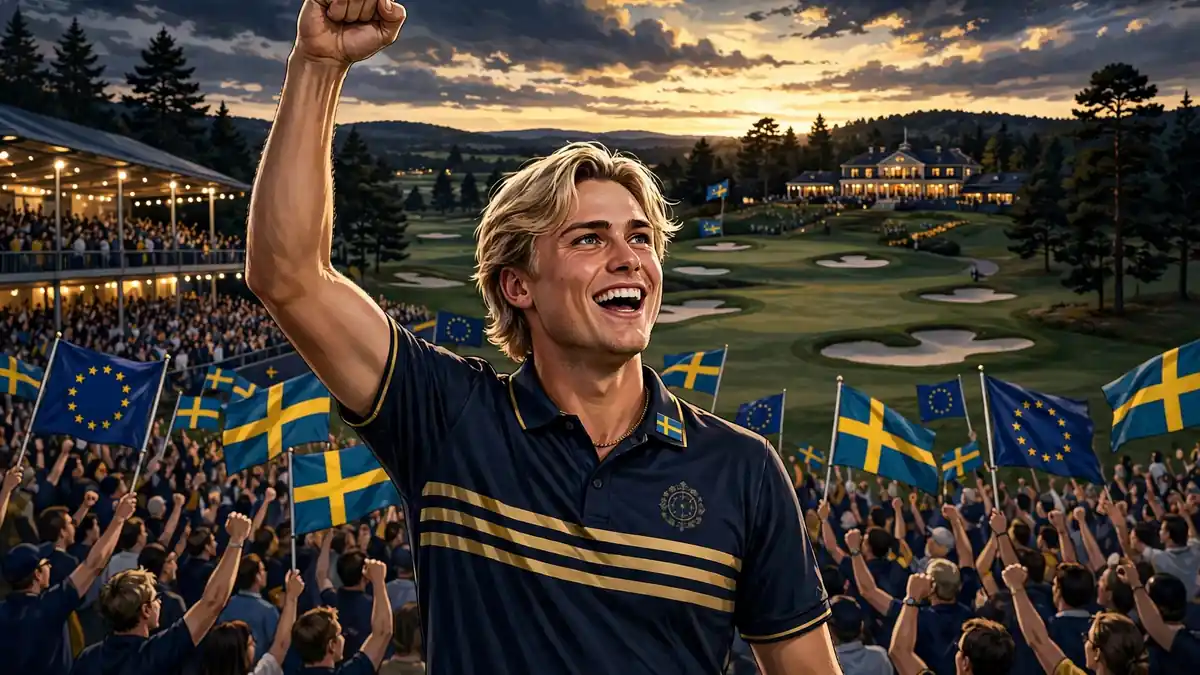
That last fact deserves emphasis because it is easy to lose inside the final score. Europe won only once on Sunday — its lowest singles win total since 1957 — and the American side took 8.5 points on the final day, tied for the most ever by one team in a Sunday session. Shane Lowry halved with Russell Henley to retain the cup, and Tyrrell Hatton halved with Collin Morikawa to seal the win outright. But the single outright European victory on Sunday belonged to Åberg, and it came against Cantlay, one of the Americans’ most reliable match-play performers, at the moment the tide was running hardest against Europe. Laureus, nominating the European team for its 2026 World Team of the Year award, singles out the same detail: Åberg “collected two points and defeated Patrick Cantlay in his singles match”.
He left Bethpage with two Ryder Cup winners’ medals at 25, a 4-4-0 career record, and a reputation that no longer needs the word “potential” attached to it. He has beaten the world No. 1 in foursomes at two consecutive Ryder Cups. He has won the only singles match his team managed on the hardest Sunday in recent memory. Whatever happens in the majors, the Ryder Cup record is already a career in itself.
The 2026 Season: Nine Top Tens, No Trophy
Åberg’s 2026 season is the hardest one to summarise, because it was very good and slightly unsatisfying at the same time. GolfMode’s season review, published in early October 2026, puts it plainly: no trophy in 2026, but plenty of Sundays in contention. He made 17 of 20 cuts, recorded nine top-10 finishes and 14 top-25s, and ranked fifth on the PGA Tour in Strokes Gained: Total. Those are the numbers of a player who is almost always in the tournament, and the trophy cabinet is the only place they do not show up.
The majors were steady rather than spectacular, and then one of them was genuinely excellent. He tied for 21st at the Masters, where Rory McIlroy won — McIlroy’s second green jacket in a row, and a measure of how hard the top of the sport is to crack at the moment. At the PGA Championship at Aronimink he shot 72-66-68-69 and tied for fourth, his best major finish of the year. At The Open at Royal Birkdale he shot 71-66-67-71 for 275 and tied for ninth. A T4 and a T9 in the same major season, with a T21 at Augusta, is the profile of a player who belongs in major contention. It is not the profile of a player who is missing.
There were flashes of the old dominance too. At THE PLAYERS Championship in March 2026, Åberg led at TPC Sawgrass after the second round, and Men’s Journal’s profile of him that week — “Who Is Ludvig Åberg? Everything to Know About the Leader at TPC Sawgrass” — treated him as the story of the tournament. He lives in Ponte Vedra Beach, which makes TPC Sawgrass essentially his home course, and leading there in front of a home crowd was the kind of week that suggested a win was close. It did not come, but the leaderboard position was real.
He finished the season tied for fourth in the FedExCup at 11-under, which is a better guide to his year than any single result: fourth in the season-long standings, fifth in Strokes Gained: Total, nine top-10s in twenty starts. The prize money tells the same story. FOGOLF’s ranking of the highest prize-money earners in men’s golf in 2026, published October 21, 2026, puts him 18th at $9,089,877 for the year. He was 26 for most of that season and 27 for its final days. The ranking moved a little during the autumn — No. 18 in the world on October 4, 2026, per GolfMode, and No. 21 in the PGA Tour’s latest profile — but the band is the same: a top-25 player in the world, still waiting for his first major, still winning enough money to sit 18th on the year’s earnings list without winning a tournament.
He also played the 2026 season as a member of The Bay Golf Club in TGL, the indoor team league, which keeps him visible through the winter months and pays appearance money on top of tournament earnings. It is a small part of his income and a useful part of his profile: a 27-year-old Swede who is already a franchise player in golf’s newest format as well as a two-time Ryder Cup winner in its oldest one.
Net Worth in 2026: The Thirteen-Million-Dollar Estimate
Ludvig Åberg’s net worth in 2026 is estimated at $13 million, inside a reported range of $12 million to $15 million. The anchor comes from SurpriseSports, which updated its Åberg profile in early November 2026 and put the figure at $13 million, with career prize money above $28 million. TWSN, in a March 2026 analysis, gives the range: $12 million to $15 million, against $28.3 million in career PGA Tour earnings as of that month. Two independent trackers, eight months apart, landing in the same band is about as good as net-worth reporting gets for a player who has never confirmed a figure himself.
The range exists because the underlying math is honest about what it cannot see. Start with the hard number: Spotrac had his PGA Tour career earnings at $28,338,389 in early March 2026, with the last paycheck in that figure coming from the Arnold Palmer Invitational, where he finished T3. Bet365, in May 2026, put it slightly higher — over $25 million on the PGA Tour plus $3.4 million from major championships, for $29.2 million in total career earnings. Then add the 2026 season: $9,089,877 in prize money through October 21, 2026, per FOGOLF, some of which overlaps with the March figure and some of which does not. Gross career earnings are now comfortably above $30 million, and the prize money alone explains why the low estimates cannot stand.
Then apply the haircut, because prize money is not wealth. American federal and state income tax takes a large share of a golfer who lives in Florida and plays most of his golf in the United States. His agent and management team take their percentage. His caddie, Joe Skovron, is paid a salary plus a percentage of winnings — the standard tour arrangement. Travel, coaching, and living costs run through the year. SurpriseSports makes this exact point in its own methodology note: net wealth accounts for taxes, agent and management fees, caddie earnings, and living expenses, which is why $28 million in prize money becomes a $13 million net worth rather than a $28 million one. That is the correct way to read the number, and it is why the $2 million figure still carried by GlimmerSports fails the test: it would require almost all of $28 million to have vanished, and no tax bill in golf is that large.
The older estimates tell the same story if you date them. GolfMagic, in November 2024, put him at $5–10 million — a reasonable figure for a player who had then earned roughly $20 million and was eighteen months into his career. The $2 million GlimmerSports figure, updated in July 2026, is harder to defend: by then he had already banked more than $23 million in career prize money by its own table, and its own text calls the Genesis Invitational win a $4 million payday. A tracker that prints $2 million next to $23 million in earnings has either made an error or is measuring something it does not explain. This article prints the disagreement and the reason for it, which is what the range is for.
Where does the money sit in the wider sport? Åberg’s $13 million puts him far behind the established stars — Scottie Scheffler is estimated at roughly $110 million, and Jon Rahm at $250 million — and far ahead of almost every other player his age. That gap is a function of time, not talent: Scheffler and Rahm have had years of major wins, signature-event purses, and nine-figure endorsement deals. Åberg has had three seasons. His earnings curve is steeper than either of theirs was at 27, because the purses he is playing for are larger than the purses they played for at the same age. If he wins a major, the endorsement side of the ledger changes overnight. Until then, $13 million is the honest number for a 27-year-old with two PGA Tour wins and $28 million in career prize money. Readers who want the wider picture can browse the rest of our Celebrity Net Worth archive for the same treatment of his peers.
| Year | What happened | Money signal |
| 2023 | Turned pro in June; Omega European Masters win; Ryder Cup debut; RSM Classic win | First tour earnings; exemption secured through 2025 |
| 2024 | Masters runner-up; U.S. Open T12; world No. 4 in June; Paris Olympics | Two runner-up cheques of $2.16M each reported by SurpriseSports (Masters, Pebble Beach) |
| 2025 | Genesis Invitational win; Masters near-miss; Ryder Cup win at Bethpage | $4M Genesis winner’s cheque; career earnings past $25M |
| 2026 | PGA Championship T4; The Open T9; FedExCup T4; 9 top-10s | $9,089,877 in 2026 prize money (FOGOLF, Oct 21, 2026); career total past $30M |
Endorsements, Equipment and the Caddie Behind Him
Åberg’s endorsement portfolio is unusually broad for a player with only two PGA Tour wins, and the breadth is the point. EssentiallySports, in its March 2026 breakdown of his deals, lists Adidas, Titleist, Rolex, and TUMI, and adds two more that show how his market value is priced: he is a global brand ambassador for Mercedes-Benz, and his sleeve carries the logo of Legora, the AI platform for lawyers. A sleeve sponsor is a telling detail. Sleeve space is the most visible advertising real estate in golf after the chest, and companies buy it on players they expect television to show on Sunday afternoons. Legora bought Åberg’s sleeve because it expects him to be on television on Sunday afternoons.
The Adidas relationship is the oldest and most visible. He wears the brand’s golf apparel, including the navy polos that have become his on-course uniform, and he was the subject of a GOLF.com magazine shoot in which he hit balls and took photos for his clothing sponsor at TPC Sawgrass. Titleist supplies his clubs and balls — the equipment side of the ledger, and the one that matters most to his results. Rolex is the watch deal that every top golfer collects eventually; Åberg collected his before his first major win, which says something about how the brand values trajectory over trophies. TUMI, the luggage brand, and Mercedes-Benz round out a portfolio that spans clothing, equipment, timepieces, travel, and cars: the full luxury-goods set, assembled by 26.
None of the endorsement figures are public, and this article does not invent them. What can be said is structural: endorsement income for a player of Åberg’s profile typically runs into seven figures a year once the portfolio reaches this size, and it grows sharply with a major win. The $13 million net-worth estimate already reflects that income in part, because the trackers that produce it build their figures from prize money plus reported endorsement portfolios. A major championship would reprice the portfolio overnight, which is why the money section of this article treats the estimate as a snapshot, not a ceiling.
Behind him on the course is Joe Skovron, his caddie, named in both the bet365 profile and the SurpriseSports biography. Skovron is the kind of caddie a young star needs: experienced, calm, and invisible in the coverage, which is exactly how a good caddie should be. The player-caddie relationship in golf is a business partnership as much as a friendship — the caddie reads greens, manages yardages, and keeps the player in the right frame of mind for four hours — and Åberg’s results since Skovron took the bag suggest the partnership works. He is not the story of Åberg’s career, and this article does not make him one. He is the person carrying the bag while the story happens.
Personal Life: Ponte Vedra Beach, Olivia Peet and Life Off the Course
Åberg lives in Ponte Vedra Beach, Florida, the town that hosts TPC Sawgrass and the PGA Tour’s headquarters. Men’s Journal, reporting from Sawgrass in March 2026, notes that living there makes the Players Championship essentially his home event, and the observation explains his second-round lead there that week: he plays the Stadium Course the way a local plays it, because he is one. TGL’s player page lists the same residence. It is a practical choice as much as a lifestyle one. Ponte Vedra Beach puts him minutes from the tour’s nerve centre, from a course he can practise on year-round, and from the airport that takes him to every tournament on the schedule.
His partner is Olivia Peet, listed as his life partner on Wikipedia. She keeps a low public profile, and this article respects that: there are no invented details about her career, no reported quotes that do not exist, and no speculation about wedding plans. What is public is that they are together, that she travels with him to tournaments, and that the relationship predates his fame — which, for a player who became famous in the space of three months in 2023, is a grounding fact rather than a gossip item. Older profiles, including a GolfMagic page that still lists Tallahassee as his residence, are out of date on the address and should not be relied on for the personal details either.
Off the course, he is famously low-maintenance. The GOLF.com origin story describes a player who answers questions with a shrug and a short sentence, who describes his hometown as the most boring city in Sweden with affection rather than complaint, and who treats a day of magazine photos and interviews as a job to be done rather than a stage to be enjoyed. His father still plays at Eslöv Golf Club, and Åberg still returns there when he is home. His mother, the paralegal who noticed her son paying attention at junior clinics while other children fooled around, is still the person who knows him best.
He is 27, single-minded about golf, and already one of the most recognisable Swedes in world sport. The personal life section of a profile like this is short because his life is short on drama and long on practice. That is not a criticism. It is the reason the golf section is so long.
How Åberg Stacks Up: The Peer Comparison
Put Åberg next to the players he shares leaderboards with and the picture sharpens. Scottie Scheffler, the man he beat 9&7 in Rome, is 30 — born June 21, 1996 — and estimated at roughly $110 million, with four major championships and more than $130 million in career prize money. The gap between them is the gap between a generational No. 1 and a 27-year-old still chasing his first major, and it is measured in majors and money rather than in talent. Scheffler is the standard Åberg is chasing, and the 9&7 win is the proof that he can beat that standard on a given day.
Jon Rahm is 32 — he turned 32 on November 10, 2026, two days before this article was published — and estimated at $250 million, built on a $300 million-plus LIV Golf deal and two major championships. Rahm’s fortune is a product of a decision Åberg has not faced: the choice between the PGA Tour and a guaranteed nine-figure contract from a rival league. Åberg has stayed on the PGA Tour, and his $13 million reflects that choice. The comparison is not a judgement. It is a price tag on two different career paths, and the LIV chapter of Rahm’s story is the reason his number is twenty times Åberg’s.
Xander Schauffele, who was on the losing end of Europe’s Friday-morning foursomes win at Bethpage alongside Patrick Cantlay, is 33 — read how old Xander Schauffele is — and the owner of two major championships from 2024, the PGA Championship and The Open. Schauffele is the closest parallel to Åberg’s next step: a player who spent years as a top-ten fixture without a major, then won two in a single season at 30 and repriced his entire career. Åberg’s 2026 major results, a T4 and a T9, look like the season before a breakthrough. Schauffele’s 2024 is what a breakthrough looks like.
| Player | Age (Nov 2026) | Majors | Net worth (est.) |
| Ludvig Åberg | 27 | 0 (best: 2nd, 2024 Masters) | $13M |
| Scottie Scheffler | 30 | 4 | ~$110M |
| Jon Rahm | 32 | 2 | $250M |
| Xander Schauffele | 33 | 2 (both 2024) | Not stated here — see his profile |
| Rory McIlroy | 37 | 5 (career grand slam, 2025 Masters) | ~$350M |
Rory McIlroy, who won the 2026 Masters that Åberg finished T21 in, is 37 and the owner of five majors and a career grand slam completed at Augusta in 2025. His estimated fortune of roughly $350 million — the figure behind Rory McIlroy’s net worth — is the far end of the scale: two decades of major wins, Ryder Cups, and endorsement deals at the very top of the sport. Åberg is ten years younger than McIlroy and $337 million behind him. That is not a gap to be embarrassed by. It is the distance a great career covers in a decade, and Åberg has already covered the first three years of it faster than almost anyone in the sport’s history.
The honest summary of the comparison is this: Åberg is the youngest player on the list, the only one without a major, and the only one whose best major result came on debut. His age is his advantage. He has ten years before he reaches McIlroy’s age, six before he reaches Schauffele’s, and five before he reaches Scheffler’s. The 2026 season — nine top-10s, a T4 and a T9 in majors, fourth in the FedExCup — suggests the breakthrough is a matter of when, not if. The number that will change first is the majors column. Everything else follows from it.
Sources & Reporting
This profile was reported from live sources in November 2026. The birth date (October 31, 1999, Eslöv) is carried by Wikipedia, Men’s Journal, JBSA Golf, Where2Golf, National Club Golfer, and SurpriseSports, with no disagreement anywhere in the record. The age of 27 is confirmed by the PGA Tour’s own player profile, crawled November 11, 2026, and by simple arithmetic from the birth date. The stale “26” figures on older pages are explained in the body of the article, with their publication dates.
Career and Ryder Cup reporting draws on Wikipedia’s Ludvig Åberg entry, Men’s Journal’s March 2026 profile from TPC Sawgrass, GOLF.com’s origin story, GolfMode’s 2026 season review, the PGA Tour’s Ryder Cup match recaps from September 2025, SFL Media’s Bethpage report, Laureus’s 2026 World Team of the Year nomination, and The Open’s official player profile. Earnings figures come from Spotrac via EssentiallySports (March 2026), bet365 (May 2026), and FOGOLF (October 2026). Net-worth estimates come from SurpriseSports (November 2026), TWSN (March 2026), GlimmerSports (July 2026), and GolfMagic (November 2024), with disagreements adjudicated in the text rather than hidden.
Reporting window: November 12, 2026. Figures are dated in the text wherever they could go stale. Corrections: if you spot an error, contact us via the About page and the figure will be checked against the source and updated.
Frequently Asked Questions
How old is Ludvig Åberg in 2026?
Ludvig Åberg is 27 years old in 2026. He was born on October 31, 1999, and turned 27 on October 31, 2026. Many profiles still say 26 because they were written before his birthday; the PGA Tour’s own profile, updated in November 2026, lists him as 27.
When was Ludvig Åberg born?
Ludvig Åberg was born on October 31, 1999 — Halloween — in Eslöv, Sweden, a town of roughly 20,000 people in the south of the country. His full name is Ludvig Noa Åberg, and every major profile, including Wikipedia and Men’s Journal, gives the same date.
How tall is Ludvig Åberg?
Ludvig Åberg is 6 feet 3 inches tall (191 cm), according to his PGA Tour profile. He is one of the taller players on tour, and his height is part of what gives his swing its long, unhurried arc.
What is Ludvig Åberg’s net worth in 2026?
Ludvig Åberg’s net worth in 2026 is estimated at $13 million, inside a reported range of $12 million to $15 million. SurpriseSports put the figure at $13 million in its November 2026 update, and TWSN gave the $12–15 million range in March 2026. His PGA Tour career earnings stood at $28,338,389 in March 2026, according to Spotrac, and he added $9,089,877 in 2026 prize money through October 21, 2026.
How many PGA Tour wins does Ludvig Åberg have?
Ludvig Åberg has won two PGA Tour events: the RSM Classic in November 2023, which he won at 29-under par by four strokes, and the Genesis Invitational in February 2025 at Torrey Pines, which paid $4 million. He has five professional wins in total, including the Omega European Masters in September 2023, his first title as a professional.
What is Ludvig Åberg’s Ryder Cup record?
Ludvig Åberg’s Ryder Cup record is 4 wins, 4 losses and 0 ties across two appearances, both wins for Europe. He went 2-2-0 in Rome in 2023, including a record 9&7 foursomes win with Viktor Hovland over Scottie Scheffler and Brooks Koepka, and 2-2-0 again at Bethpage Black in 2025, where his 2&1 Sunday win over Patrick Cantlay was the only European singles victory of the day.
Who is Ludvig Åberg’s girlfriend?
Ludvig Åberg’s partner is Olivia Peet, listed as his life partner on Wikipedia. She keeps a low public profile. Åberg lives in Ponte Vedra Beach, Florida, near TPC Sawgrass.
Where did Ludvig Åberg go to college?
Ludvig Åberg went to Texas Tech University in Lubbock, Texas, from 2019 to 2023. He won a program-record eight times, won the Ben Hogan Award as the best collegiate player in America in 2022 and 2023, swept all three national player-of-the-year awards as a senior, and finished No. 1 on the PGA Tour University ranking, earning direct PGA Tour membership — the first player ever to do so.
WRITTEN BY
Nathan Cole
Nathan Cole is the editor of Guide Net Worth. He covers celebrity wealth the way a business desk covers earnings: reported figures first, estimates labeled as estimates, and no invented numbers. Every profile on this site passes through his desk before it publishes. About Guide Net Worth · Corrections: figures are updated when new reporting emerges — contact us via the About page if you spot an error.
References & Sources
This article has been fact-checked and verified against multiple public sources, financial disclosures, SEC filings, Forbes reports, Celebrity Net Worth databases, and official records. All net worth estimates are based on publicly available information and financial analysis.