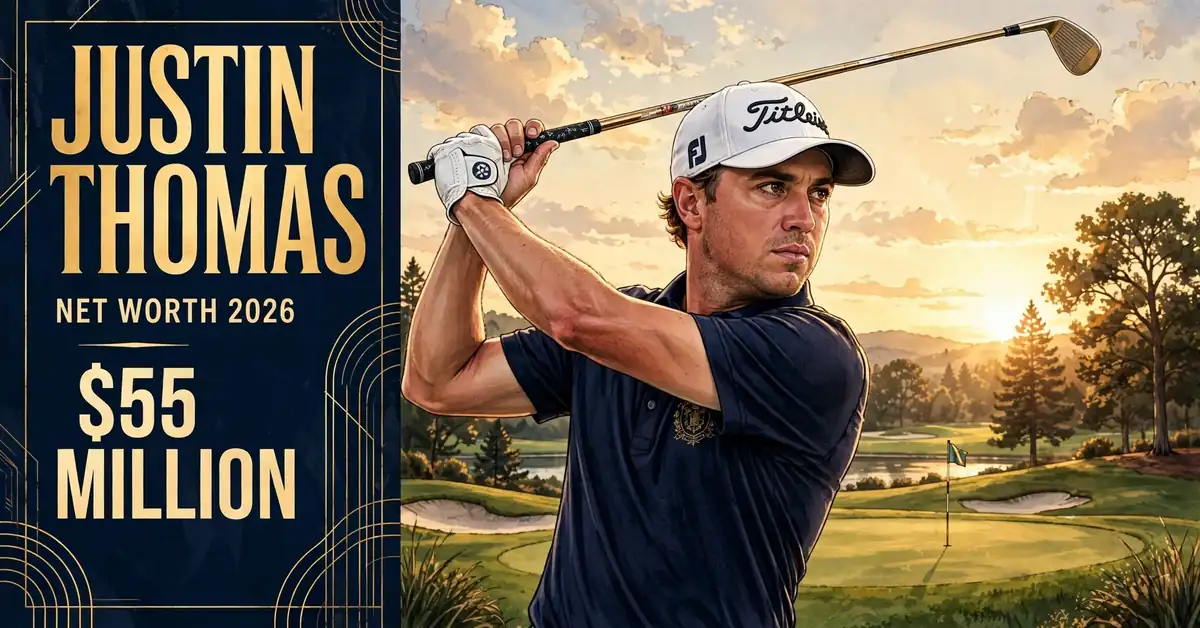
Justin Thomas is worth an estimated $55 million in 2026, per Celebrity Net Worth. Two majors, $71.3M in prize money and $20M a year in endorsements built it.
Last updated: November 8, 2026 · By Nathan Cole
Justin Thomas is worth an estimated $55 million in 2026. That is the figure Celebrity Net Worth carries on his profile, updated April 11, 2026, and it is the anchor for this page. The honest range around it is $45–55 million: Essentially Sports prints $45 million, several outlets land at $50 million, and Celebrity Net Worth and BounceMojo print $55 million. Nobody outside his own circle has seen his bank statements, and this article says so plainly. What it can do is show the reporting, the dates, and the reasons the $55 million figure holds up in November 2026.
The money did not arrive in one cheque. Thomas has banked more than $71.3 million in official PGA Tour prize money, a total that puts him inside the top 10 on the tour’s all-time earnings list. He won the FedEx Cup in 2017 and took home a $10 million bonus for it. He has collected millions more from the Player Impact Program, won two PGA Championships, and built an endorsement portfolio that several outlets value at roughly $20 million a year. He did all of it without a LIV Golf signing bonus — he stayed on the PGA Tour while some of his peers took nine-figure guarantees to leave it.
He is 33 in 2026, married with a baby daughter, coming back from back surgery, and still ranked among the best dozen players in the world. This page works through the number first, then the prize money, then the bonuses and the brand deals, then the season that tested him — and the family life that now sits at the centre of it.
Quick Facts
| Full Name | Justin Louis Thomas |
| Born | April 29, 1993, Louisville, Kentucky, United States |
| Age in November 2026 | 33 (turned 33 on April 29, 2026) |
| Height | Listed at 5’10” (178 cm) |
| Net Worth 2026 | Estimated $55 million (Celebrity Net Worth, updated April 11, 2026); honest range $45–55 million |
| Career Prize Money | $71.3 million+ official PGA Tour prize money (early 2026, Celebrity Net Worth); ~$90–100 million total on-course earnings including bonuses |
| PGA Tour Wins | 16, including 2 majors — PGA Championship 2017 and 2022 |
| Biggest Single Paydays | 2017 FedEx Cup bonus $10 million; RBC Heritage 2025 $3.6 million; THE PLAYERS 2021 $2.7 million |
| Endorsements | Estimated ~$20 million a year — Titleist, FootJoy, Citi, NetJets, Rolex, Greyson Clothiers, WHOOP, Beats |
| Family | Wife Jillian Wisniewski (married November 12, 2022); daughter Molly Grace Thomas (born November 18, 2024) |
| Turned Pro | 2013, after two years at the University of Alabama |
| Key Dates | Born 1993; first PGA Tour win 2015; PGA Championship + FedEx Cup 2017; World No. 1 in May 2018; second PGA Championship 2022; RBC Heritage win April 2025; back surgery November 2025; return February 2026 |
How This Estimate Was Made
Justin Thomas’s net worth is estimated at $55 million, anchored on Celebrity Net Worth’s profile, updated April 11, 2026 — the freshest of the major net-worth trackers and the one BounceMojo also uses as its base (May 2026 update). The range is $45–55 million: Essentially Sports prints $45 million (April 7, 2026), while Surprise Sports, Glimmer Sports, bet365 News and PlayersBio all land at $50 million. The lower figures of $30–40 million still floating around on smaller profile sites are stale — written before the 2025 RBC Heritage win, before the 2025 season’s $10.9 million in prize money, and before the 2026 updates. The prize-money base is solid: Celebrity Net Worth puts his official PGA Tour earnings above $71.3 million as of early 2026, and Glimmer Sports’ October 2026 update puts the figure at $74,636,960. On top of that sit the bonuses — a $10 million FedEx Cup win in 2017 and Player Impact Program payouts that different outlets total anywhere from $11 million to $19.5 million, a disagreement this article reports openly rather than smoothing over. Endorsements are estimated at roughly $20 million a year by Surprise Sports and BounceMojo; no brand has ever confirmed the contract values, so that figure is an estimate and is labelled as one. No one outside Thomas’s team has access to his bank accounts, contracts or tax returns, so every figure here is an estimate built from reported earnings and public estimates. Where sources disagree, this article prints the range and the reason for it.
+
The Number: Million, and the –55 Million Range
Justin Thomas’s net worth in 2026 is estimated at $55 million. The number comes from Celebrity Net Worth, whose profile was updated on April 11, 2026 — recent enough to cover the 2025 season, the RBC Heritage win, and the start of the comeback from back surgery. BounceMojo, updated in May 2026, prints the same $55 million figure and works from the same reporting base: the prize money, the FedEx Cup bonus, the Player Impact Program payouts, and the endorsement portfolio.
The range around the anchor is $45–55 million, and the range is worth understanding because it tells you which pages to trust. Essentially Sports, writing in April 2026, puts the figure at $45 million. Surprise Sports, Glimmer Sports, bet365 News and PlayersBio all land at $50 million. The $10 million spread between the lowest and highest of those is not a sign that anyone is guessing wildly — it is a sign that different outlets count different things. Some count only prize money and the biggest bonuses. Others add the full endorsement estimate. Others still add the value of future tour equity and business interests. A net worth estimate is a judgement about what to count, and the judgement differs from outlet to outlet.
What the range does not include is the stale tail. Several smaller profile sites still print $30 million, $35 million or $40 million for Thomas in 2026. Those numbers were written before April 2025, when he won the RBC Heritage and its $3.6 million first prize, and before the 2025 season delivered $10.9 million in official prize money — his best single-season total. A page that still prints $40 million in November 2026 is not lying; it is reading last year’s fortune, and the reader who takes it at face value is doing the same.
The shape of the fortune matters as much as the size. Thomas is 33, and his money is still mostly the money of an active athlete: prize money that arrives tournament by tournament, bonuses that arrive season by season, and endorsement cheques that arrive on contract schedules. He does not have a decade of post-career business income behind him, and he does not have a LIV signing bonus in his past — he turned down the breakaway league and stayed on the PGA Tour. What he has is a fortune built the slow way, over thirteen seasons, with the biggest single year of it arriving in 2025.
Prize Money vs Net Worth: Why Million Earned Is Not Million Kept
Readers trip over this one constantly, so it is worth stating plainly. Justin Thomas has earned more than $71.3 million in official PGA Tour prize money, and his net worth is estimated at $55 million. The prize money is bigger than the fortune. That looks wrong until you remember what prize money is: gross income, before anyone takes a cut.
A tour golfer’s prize money passes through several hands before it reaches his own account. His caddie takes a percentage — the standard deal is around 10 percent of a win and a smaller cut of other finishes, and Thomas’s caddie since April 2025 is Joe Greiner, who took over the bag after the long run with Jimmy Johnson. His agent and management take their percentage. His coach takes a fee. Travel, lodging, food, practice facilities and entry costs come out of the same pot: a PGA Tour player spends most of the year on the road, and the road is expensive. Then the taxman takes his share — and Thomas plays in Florida, California, New York and overseas, which means several different tax authorities. The $71.3 million is what the tour paid him. The $55 million is what is left after thirteen years of all of that, plus the endorsements and the bonuses, minus the spending.
An illustrative example makes the point without inventing a real split, because the real split is private. Imagine, purely for illustration, that a golfer kept 55 cents of every prize-money dollar after caddie, management, travel and tax. On $71.3 million of prize money, that would be about $39 million — before a single endorsement cheque arrived. The real percentage is different, and it is not public, but the shape of the math is the same in every case: the gross is big, the costs are many, and the take-home is a slice. Any page that prints the prize-money total as the net worth has skipped every step in between.
The other half of the equation is the money that never appears in a prize-money table. The FedEx Cup bonus, the Player Impact Program payouts, the TGL earnings and the endorsement income all sit outside the $71.3 million, and together they are worth tens of millions. Celebrity Net Worth puts his total on-course earnings — prize money plus FedEx Cup bonuses, PIP payouts and extra purses — at roughly $90–100 million. Spotrac’s tally, reported by GolfMagic in April 2025, put his total career earnings at $95,356,694. The net worth figure is a different kind of number from all of those. It is not one year’s earnings, and it is not a career gross. It is the accumulation of everything, minus everything it cost to earn it.
Year by Year: The Earnings Table
The fastest way to understand a golf fortune is to watch it arrive year by year. Thomas turned professional in 2013, and the table below tracks his official PGA Tour prize money by season, with the wins that drove each year. Two things jump out. The first is 2017: five wins, a major, a FedEx Cup, and $9.9 million in prize money before the $10 million bonus is even counted. The second is 2025: a single win, but $10.9 million in prize money — the biggest single-season total of his career, driven by purses that have grown enormously since he turned pro.
| Season | Wins | Official Prize Money | Highlight |
| 2013–14 | 0 | $170,237 | Rookie season on the Web.com Tour path |
| 2014–15 | 0 | $2,278,564 | First full PGA Tour season |
| 2015–16 | 1 | $4,126,366 | First win — CIMB Classic, Malaysia |
| 2016–17 | 5 | $9,921,560 | PGA Championship + FedEx Cup ($10M bonus) |
| 2017–18 | 3 | $8,694,821 | Money-list leader; reached World No. 1 |
| 2018–19 | 1 | $4,615,984 | BMW Championship win |
| 2019–20 | 3 | $7,299,040 | Three wins; topped the money list again |
| 2020–21 | 1 | $5,637,500 | THE PLAYERS Championship ($2.7M) |
| 2021–22 | 1 | $3,568,003 | PGA Championship at Southern Hills |
| 2022–23 | 0 | $3,536,653 | Winless season; Ryder Cup captain’s pick |
| 2024 | 0 | $4,611,924 | T3 American Express; T6 Pebble Beach |
| 2025 | 1 | $10,896,155 | RBC Heritage ($3.6M); best season total |
| 2026* | 0 | $3,966,774 | Return from back surgery; T8 THE PLAYERS |
*2026 season in progress at the time of writing. Figures: PGA Tour records via StatMuse and SalarySport. Season totals differ slightly between sources because some count by tour season and others by calendar year, and because majors prize money is sometimes listed separately — the 2026 figure above is StatMuse’s season tally. The table totals roughly $69.3 million; Celebrity Net Worth’s $71.3 million figure (early 2026) sits in the same band once unofficial events and the 2026 season’s later events are counted.
The table also shows the shape of a modern golf career. The lean years are real: 2022–23 brought no wins and $3.5 million, and 2024 brought no wins either, yet both years still paid millions because simply making cuts on the PGA Tour pays well. The fat years are very fat: 2017 and 2025 each cleared $9 million in prize money alone, and the 2025 total came with only one win, because purses have grown so large that a handful of high finishes can be worth more than a win was worth a decade ago. Thomas’s career is a clean example of that shift. His first win, at the CIMB Classic in Malaysia in October 2015, paid a fraction of what a single high finish at a signature event pays now.
2017: The Five-Win Season That Made the Fortune
Every great golf fortune has a season that does the heavy lifting, and for Justin Thomas it was 2017. He won five times in the 2016–17 season: the CIMB Classic, the Sentry Tournament of Champions, the Sony Open in Hawaii, the PGA Championship, and the Dell Technologies Championship. Five wins in one season is a number that puts a player in rare company — it is the kind of year that defines a career, and it arrived when Thomas was 23 and 24 years old.
The Sony Open win is the one golf fans still talk about. Thomas shot 59 in the first round at Waialae Country Club in Honolulu — a sub-60 round, one of the rarest feats in professional golf — and went on to win the tournament by seven shots. A 59 does not just win a tournament; it changes how the whole sport talks about a player. It was the round that announced Thomas as something more than a promising young pro. He was, from that week on, a player other players watched.
The money followed the wins. The five victories and the consistent high finishes added up to $9.9 million in official prize money for the season, and then came the FedEx Cup. Thomas won the season-long race in September 2017, and the bonus for winning it was $10 million — more than his entire season’s prize money, paid in one lump. That single bonus is the biggest one-day payday of his career, and it is the reason 2017 alone accounts for roughly $20 million of his career earnings. He finished the year as the PGA Tour Player of the Year, and he started 2018 as the money-list leader and, by May, the World No. 1.
What 2017 really did, though, was set the endorsement floor. A 24-year-old with five wins, a major and a FedEx Cup is a marketer’s dream: young, American, charismatic, and winning the biggest events. The Titleist and FootJoy deals he had carried since turning pro were renegotiated from a position of strength, and the bigger brands — the banks, the airlines, the watchmakers — came calling. The endorsement portfolio that now pays him an estimated $20 million a year was built on the back of that one season.
Two PGA Championships
Justin Thomas has won two major championships, and both of them are PGA Championships. The first came at Quail Hollow in Charlotte in August 2017, at the end of the five-win season. He shot a final-round 68 to win by two shots over Francesco Molinari, Louis Oosthuizen and Patrick Reed, and the victory made him the first player since 2011 to win five times in a season including a major. He was 24. The Wanamaker Trophy — the silver cup that goes to the PGA champion — was his, and the win carried a first prize of $1.89 million.

The second came at Southern Hills in Tulsa in May 2022, and it was a very different kind of win. Thomas started the final round seven shots behind the leader, Mito Pereira, and looked beaten. Then Pereira double-bogeyed the 18th, Thomas birdied it, and the tournament went to a three-hole playoff against Will Zalatoris. Thomas won the playoff by one shot. It was the largest final-round comeback in PGA Championship history at the time, and it ended a winless run that had stretched back to THE PLAYERS in March 2021. The first prize was $2.7 million, and the win was his 15th on the PGA Tour.
The two majors bookend the two halves of his career so far. The first was the coronation of a young star. The second was the rescue of a career that had stalled — the proof, after a year of missed cuts and lost form, that the player from 2017 was still in there. Between them sit the lean years of 2019 and 2023, the swing changes, the caddie change, and the public struggles with form that every golfer goes through and few talk about honestly. Thomas has talked about his openly, including the mental side of the game, and that honesty is part of why the golf public has stayed with him through the thin years.
Majors pay in more than prize money. A major win carries a five-year exemption on the PGA Tour, a ten-year exemption into the other majors, and a permanent place in the record books. It also carries a premium on every endorsement contract that follows it. Thomas’s two PGA Championships are the reason his name still commands top-tier sponsor money even in seasons when he does not win: the brands are buying the major champion, not the current form.
The FedEx Cup Million and the Bonus Machine
The FedEx Cup bonus is the single biggest cheque in Justin Thomas’s career, and it deserves its own section because it is also the most misunderstood part of a golfer’s income. In September 2017, Thomas won the FedEx Cup — the PGA Tour’s season-long points race — and the bonus for winning it was $10 million. That was the full bonus in 2017, paid as a lump sum. It is more than he earned in prize money in any single season before 2025, and it arrived in one payment.
The FedEx Cup has kept paying him since. The tour pays bonuses down the standings, not just to the winner, and Thomas has finished inside the top 10 of the FedEx Cup standings in most of his seasons — fourth in 2020–21, seventh in 2025. The tour’s own records, via SalarySport, show Tour Championship bonuses of $3.5 million in 2018–19, $4.5 million in 2019–20, $3 million in 2020–21 and $2.75 million in 2021–22. Those are the season-end payments, separate from the weekly prize money, and they add up to more than $14 million across his career.
Then there is the Player Impact Program, the tour’s bonus scheme for the players who move the needle on fan engagement, media attention and sponsor value. The PIP ran from 2021 to 2024, and Thomas was one of its biggest beneficiaries — but the exact total is the one figure in this article where the reporting genuinely disagrees, so here is the disagreement in full. GolfMagic, working from Spotrac data, reports $11 million: $3.5 million in 2021 and $7.5 million in 2022. SalarySport’s year-by-year table adds a $3.5 million PIP payment in 2024, taking the total to $14.5 million. Surprise Sports reports $19.5 million across four years: $3.5 million in 2021, $7.5 million in 2022, $5 million in 2023 and $3.5 million in 2024. This article does not pick one of those numbers and hide the others. The confirmed floor is $11 million; the reported ceiling is $19.5 million. The PIP was replaced by the Player Equity Program in 2025, and Thomas continues to benefit through that arrangement, which pays in tour equity rather than cash — another reason his net worth is hard to pin to a single number.
Put the bonuses together and the picture is clear. Prize money is the base, but the bonuses are the multiplier: a $10 million FedEx Cup win, $14 million-plus in Tour Championship payments, and somewhere between $11 million and $19.5 million from the PIP. That is $35–44 million in bonus income on top of the $71.3 million in prize money, which is how Celebrity Net Worth arrives at total on-course earnings of roughly $90–100 million. The bonuses are also the reason his earnings held up in the winless years. In 2022–23, a season with no wins, he still banked $3.5 million in prize money and stayed in the bonus system. The tour’s bonus structure rewards consistency and star power, not just victories, and Thomas has both.
Endorsements: The Million-a-Year Portfolio
If prize money is the base of Justin Thomas’s fortune, endorsements are the floor under it. Surprise Sports and BounceMojo both estimate his endorsement income at roughly $20 million a year — money that arrives on contract schedules whether he wins or misses the cut. That is the most valuable kind of income in professional sport: steady, predictable, and independent of form. It is also the part of his fortune with the least public documentation, because no brand has ever confirmed what it pays him. The $20 million figure is an estimate, and this article labels it as one.
The foundation is the equipment deal. Thomas has been a Titleist ambassador since turning professional in 2013, playing a full bag of Titleist equipment — a TSR3 driver, Vokey wedges and Pro V1x golf balls — in every tournament he plays. Surprise Sports estimates the Titleist deal at roughly $2 million a year. FootJoy, owned by the same parent company, Acushnet Holdings, supplies his footwear and has been a partner across his entire professional career. The two deals together are the spine of his endorsement income: equipment and shoes, from the same corporate family, for thirteen years running.
Around that spine sit the blue-chip names. Citigroup has maintained a long-running financial services sponsorship with Thomas. NetJets, the private aviation firm, gives him access to private air travel for a life spent flying between tournaments — a deal that pays in both cash and convenience. Rolex, the luxury watchmaker, puts him in its advertising campaigns and on its roster of sporting ambassadors. WHOOP, the fitness wearable brand, fits the performance side of his image. Beats Electronics covers the audio side. Troon, the golf-course management company, and Lineage Logistics, the cold-storage giant, round out a portfolio that spans finance, aviation, luxury goods, technology and logistics.
The apparel story is the one that shows how endorsement money really works. Thomas wore Ralph Lauren from around 2017, and the deal ended abruptly in January 2021 after he was caught on a hot microphone using a homophobic slur during the Sentry Tournament of Champions. Ralph Lauren dropped him within days. It was a public, expensive lesson in how fast a brand deal can disappear — and it is worth recording here because it is part of the money story, not separate from it. Thomas apologised, took the hit, and in 2022 signed with Greyson Clothiers as his apparel partner. Greyson is a smaller, golf-specific brand, and the deal is a good fit for a player who dresses like a golfer rather than a model. The Ralph Lauren episode cost him money in 2021. The Greyson deal, and the way he handled the aftermath, is part of why the rest of the portfolio stayed intact.
| Brand | Category | What We Know |
| Titleist | Equipment | Full bag since 2013; est. ~$2M a year (Surprise Sports) |
| FootJoy | Footwear | Partner since turning pro; same parent company as Titleist (Acushnet) |
| Citi | Finance | Long-running financial services sponsorship |
| NetJets | Private aviation | Private air travel for the tour schedule |
| Rolex | Luxury watches | Ambassador; appears in brand campaigns |
| Greyson Clothiers | Apparel | Apparel partner since 2022; replaced Ralph Lauren |
| WHOOP | Fitness wearable | Performance and recovery tracking partner |
| Beats | Electronics | Audio brand partner since around 2020 |
| Troon / Lineage / Woodford Reserve | Golf / logistics / spirits | Additional long-running partners (Surprise Sports) |
Why does a golfer with no wins in 2023 still earn $20 million a year from sponsors? Because the brands are not buying wins. They are buying the audience: Thomas is one of the most recognisable faces on the PGA Tour, a former World No. 1, a two-time major champion, a Ryder Cup regular, and a player with a large social media following and a reputation for candour. The Player Impact Program exists precisely because the tour knows that value is real — it pays players for the attention they bring, not just the trophies. Thomas’s endorsement income is the commercial version of the same idea. He brings the audience, and the audience is worth $20 million a year.
TGL and the New Golf Economy
There is a third income stream in Thomas’s career that did not exist when he turned pro: TGL, the tech-infused indoor golf league launched by Tiger Woods and Rory McIlroy. Thomas plays for Atlanta Drive GC, and the team won the inaugural TGL championship in March 2025. The league pays its players, and the championship share added a new line to his earnings — but the money is the smaller part of the story. The bigger part is what TGL represents: golf’s attempt to build a product for television and streaming audiences that the traditional tour does not reach.
TGL matches are played in a simulator arena in Palm Beach Gardens, Florida, in prime time, in about two hours, with microphones on the players and a shot clock keeping the pace up. It is golf redesigned for people who watch sport on a screen rather than on a course, and Thomas is one of its faces. His return to competitive golf after back surgery came at TGL, not on the tour: on February 23, 2026, he played for Atlanta Drive in a simulator match, his first competitive appearance since the microdiscectomy in November, and announced after it that his PGA Tour season debut would come the following week at the Arnold Palmer Invitational. The league gave him a low-stakes stage to test a repaired back before the real season started.
The financial significance of TGL is still small next to the tour — the league’s payouts are a fraction of a FedEx Cup bonus — but the direction of travel matters. The tour’s Player Equity Program, which replaced the PIP in 2025, pays players in equity in the tour’s commercial business. TGL pays in salary and prize money. Both are attempts to answer the same question: how does a golfer get paid for the value he brings beyond the weekly prize fund? Thomas, as a former World No. 1 and a two-time major champion who stayed loyal to the tour through the LIV split, sits at the centre of both answers. He is exactly the kind of player the tour’s equity program was designed to reward.
The 2026 Season: Surgery, Return, and the Grind Back
The 2026 season started without Justin Thomas in it. In November 2025, after the Ryder Cup at Bethpage, he underwent a microdiscectomy — a 40-minute operation to remove part of a herniated disc in his lower spine that had been pressing on a nerve. The disc had been causing what he described as nagging hip pain for months. The strange part, as he told the No Laying Up podcast, was that he had no back pain at all: the pain ran down his leg, and he could walk fine, but he could not bend, lift or twist. He chose surgery over a cortisone injection because the injection would only have masked the problem. The recovery was measured in months, not weeks, and he refused to set a return date, saying he wanted to be smart and patient and let the disc fully heal.
He missed the start of the 2026 season — the American Express, where he had finished in the top three in each of the previous two seasons, among other events — and missed the first two TGL matches of Atlanta Drive’s title defence. By late February, he was cleared. His first competitive appearance came at TGL on February 23, 2026, in a simulator match for Atlanta Drive, and a week later he made his PGA Tour season debut at the Arnold Palmer Invitational at Bay Hill, one of the tour’s signature events. He told reporters after the TGL match that he had been fully cleared for around three and a half weeks and had been practising normally for at least a month, but that competition was a different test from practice.

The best result of the comeback so far came at THE PLAYERS Championship, where he finished tied eighth and earned $731,250. His 2026 season earnings stood at approximately $897,000 through May 2026, according to Surprise Sports, with no wins yet on the season. The later-season tally, via StatMuse, reached $3,966,774 across 17 events — a respectable return for a player who missed the first two months of the year, but a long way from the $10.9 million of 2025.
The surgery matters for the money story in two ways. The first is obvious: a player who misses two months of the season misses two months of prize money, and a player returning from back surgery is not the same player who left. The second is less obvious and more important. Back surgery at 32 is the kind of event that changes how a golfer thinks about the rest of his career — and how his sponsors think about it. Thomas’s value to his brands has always rested on his longevity: a 33-year-old former World No. 1 with a decade of good golf ahead of him is worth more than a 33-year-old with a bad back. The comeback, so far, has gone well enough to protect that value. A tied eighth at THE PLAYERS, in his first big event back, is the kind of result that tells the sponsors the investment is safe.
Lifestyle and Real Estate: Jupiter, Travel, and the Quiet Life
Justin Thomas lives in Jupiter, Florida, the town on the Atlantic coast that has become the unofficial capital of professional golf. Half the PGA Tour seems to live within a few miles of each other there — the practice facilities are world-class, the weather allows year-round golf, and Florida has no state income tax, which matters when your income is measured in eight figures. Thomas’s base in Jupiter puts him a short drive from the tour’s Florida swing and a short flight, via his NetJets partnership, from everywhere else.
His lifestyle is notably quiet for a man worth $55 million. There are no tabloid stories about supercar collections or yacht parties, no public property portfolio to itemise, and no verified record of a headline-grabbing home purchase to report — and this article does not invent one. What is public is the shape of the life: a home in Jupiter, a family that travels with him when the schedule allows, and a travel setup built around the NetJets deal, which turns the tour’s brutal travel schedule — thirty-odd weeks a year, coast to coast and overseas — into something manageable. Private aviation is not a luxury for a tour golfer; it is a tool. A player who can fly home on a Sunday night instead of a Monday morning gets an extra day with his family and an extra day of rest before the next tournament.
The spending that is visible is the spending on the game itself. Thomas is known as one of the hardest workers on the range, and the support team around him — coach, caddie, physio, trainer — is a significant annual cost. The 2025 caddie change, when Joe Greiner took over the bag from Jimmy Johnson in April, was a reminder that even the team around a golfer is a business decision: the caddie takes a percentage of the winnings, and changing caddies is one of the few levers a player can pull when the results dry up. The change paid off quickly. Thomas won the RBC Heritage three weeks later, his first win in almost three years, with Greiner on the bag.
He has also been open about a health scare that changed his habits. In 2019, a mole on his left leg was removed and found to be cancerous — an early-stage melanoma that was caught in time. He has spoken since about getting his skin checked regularly, and the episode is a reminder that the fortune has a fragility to it that no endorsement deal can insure against. A golfer’s body is his business, and Thomas has now had two reminders of that in seven years: the mole in 2019 and the disc in 2025.
Family: Jillian, Molly, and the Louisville Roots
Justin Thomas married Jillian Wisniewski on November 12, 2022, in a private, phone-free ceremony in Franklin, Tennessee. His close friend and fellow major champion Jordan Spieth was his best man. The two had been together since around 2016, when they met through mutual friends while Thomas was at the University of Alabama and Wisniewski was at the University of Kentucky. They got engaged in November 2021, after about five years of dating, and married a year later.
Wisniewski graduated from the University of Kentucky in 2015 with a degree in journalism and works in advertising — she is a Senior Business Manager at McGarryBowen in Chicago. She is a former wellness coach, and Thomas has credited her more than once with keeping him steady through the lean years. After a rough round at the 2026 PGA Championship, he told reporters he had vented to his wife Jill the night before and that the conversation helped him reset for the final round. It is a small detail, but it is the kind of detail that explains why players talk about their families the way they do: the person at home is the only one in the whole travelling circus who is not paid to be there.
The couple’s first child, a daughter named Molly Grace Thomas, was born on November 18, 2024. Thomas announced her arrival on Instagram four days later, writing that Molly had arrived on 11/18/24 and that both mother and daughter were healthy. Molly met Tiger Woods at the Genesis Invitational in February 2025, when she was three months old — a story Thomas told with the delight of a new father — and she joined her parents at the Par 3 Contest at the 2025 Masters, playing alongside the Spieth and Max Homa families. A week after that Masters appearance, Thomas won the RBC Heritage, his first victory as a father, and he choked back tears afterwards talking about what it meant to have his wife and daughter there to see it. His CBS interviewer noted that when he won his previous tournament, the 2022 PGA Championship, Jillian was still his girlfriend and Molly did not exist yet. Three years had changed everything except the golf.
The Louisville roots run deep. Thomas’s father, Mike Thomas, is the head professional at Harmony Landing Country Club in Louisville, and his grandfather Paul Thomas was also a golf professional. Justin grew up on a golf course, literally — the family business was golf, and the boy who followed his father around the club became the man who won two majors. He played college golf at Alabama from 2011 to 2013, won the Haskins Award as the best college player in the country, and turned professional in 2013. The family story is the foundation of the fortune in the most literal sense: the swing, the work ethic, and the understanding of the game all came from home.
Peer Comparison: Thomas vs Spieth, and the Rest of the Class
The most useful comparison for Justin Thomas is the one the golf world has been making for a decade: Thomas versus Jordan Spieth. The two came up together — same generation, same Ryder Cup teams, best friends off the course, Spieth as best man at Thomas’s wedding. They are the same age, they turned pro in the same era, and they have spent their whole careers being measured against each other. The numbers tell a story that surprises most readers.
According to Celebrity Net Worth, Spieth is worth an estimated $120 million, more than double Thomas’s $55 million. Yet Thomas has earned more money than Spieth from PGA Tour tournaments: his $71.3 million-plus in official prize money sits ahead of Spieth’s total, and GolfMagic’s April 2025 reporting had Thomas in the top 10 on the all-time earnings list, just ahead of his close friend. Yardbarker’s comparison of the two makes the same point: the prize money favours Thomas, and the net worth favours Spieth by $65 million.
Why? The answer is endorsements, and specifically the kind of endorsements. Spieth’s deal with Under Armour, signed when he was the hottest young player in golf, was one of the biggest apparel deals in the sport’s history, and his portfolio has been built on the back of three major championships — one more than Thomas — and a longer run at the very top of the game. Thomas’s endorsement income, at an estimated $20 million a year, is enormous by any normal measure. Spieth’s has simply been bigger, for longer. The gap is a lesson in how golf fortunes are made: prize money is the base, but the brand money is the multiplier, and the multiplier rewards the players who win the most majors the earliest.
The wider class tells the same story. Rory McIlroy and Scottie Scheffler sit above Thomas in both prize money and estimated net worth — McIlroy through a decade and a half at the top of the game and a portfolio built on four majors, Scheffler through a run of dominance in the mid-2020s that has rewritten the tour’s single-season earnings records. Thomas’s place in that group is secure but distinct: he is the player who won two majors and a FedEx Cup before his 25th birthday, then spent his late twenties rebuilding, and is now, at 33, trying to add a third major to a career that already has the numbers to stand on its own. He does not need to catch Spieth or McIlroy to have had a great career. He needs one more major, and the conversation changes completely.
What Comes Next for the Million Fortune
Justin Thomas is 33, and the honest question for the fortune is whether it grows or plateaus from here. The case for growth is strong. He is a two-time major champion with a game that has no obvious weakness, a back that has been repaired rather than merely managed, and an endorsement portfolio that pays an estimated $20 million a year regardless of results. The 2025 season proved the game is still there: $10.9 million in prize money, a win at the RBC Heritage, a seventh-place FedEx Cup finish, and a fourth straight Ryder Cup appearance. A third major — the Masters or the U.S. Open, the two he has never won — would add millions in prize money and a step-change in endorsement value. The Player Equity Program, which replaced the PIP in 2025, means he now holds equity in the tour’s commercial business, an asset that grows with the tour itself.
The case for caution is the back. A microdiscectomy at 32 is not a career-ender — plenty of golfers have come back from them — but it is a reminder that the body has a vote in how long the prime lasts. The 2026 season, with no wins yet and $897,000 earned through May, is the cost of the surgery measured in dollars. If the back holds and the form of 2025 returns, the $55 million estimate will look conservative within a couple of years: another $10 million season, another major, and the range moves to $65–75 million. If the back flares again, the endorsement floor still protects him — $20 million a year does not depend on making cuts — but the prize-money engine slows, and the estimate stalls where it is.
Either way, the fortune is built to last. It was not built on one season or one deal. It was built on thirteen seasons of prize money, a $10 million FedEx Cup bonus, tens of millions in tour bonuses, and a decade of brand partnerships with companies that renew because the player keeps showing up. Thomas stayed on the PGA Tour when the money to leave was on the table, and the tour has paid him back in bonuses, equity and loyalty. The $55 million is a snapshot of a career that is still being played, not a final tally.
Sources & Reporting
Celebrity Net Worth (Justin Thomas net worth $55 million; profile updated April 11, 2026; career prize money $71.3 million-plus, top 10 all-time; total on-course earnings $90–100 million). BounceMojo (net worth $55 million; page updated May 2026; endorsement estimate ~$20 million a year). Surprise Sports (net worth $50 million; PIP total $19.5 million across 2021–2024; 2026 earnings ~$897,000 through May 2026; T8 at THE PLAYERS worth $731,250; Titleist deal est. ~$2 million a year). Glimmer Sports (net worth $50 million; career prize money $74,636,960; updated October 13, 2026). Essentially Sports (net worth $45 million, April 7, 2026; 2020–21 to 2025 season earnings; wife Jillian and daughter Molly; PGA Championship 2026). bet365 News (net worth ~$50 million; career prize money almost $71 million; updated May 27, 2026). GolfMagic (Spotrac total career earnings $95,356,694 as of April 30, 2025; PIP $11 million for 2021–22). Yardbarker (Spieth $120 million vs Thomas $55 million, both Celebrity Net Worth; Thomas ahead of Spieth in official prize money). pgatour.com (return at TGL February 23, 2026; microdiscectomy in November 2025; Arnold Palmer Invitational debut). StatMuse (year-by-year stats: 2025 $10,896,155, 2026 $3,966,774 across 17 events). SalarySport (year-by-year earnings table; Tour Championship and PIP bonuses by season). The Knot (marriage November 12, 2022, Franklin, Tennessee; daughter Molly Grace born November 18, 2024). Today’s Golfer (RBC Heritage 2025 win; Spieth as best man; Jillian’s background). Sports Illustrated (Molly’s play date before the 2026 PGA Championship; family details). Guide Net Worth internal: Jordan Spieth net worth, Rory McIlroy net worth, Scottie Scheffler net worth, Tiger Woods net worth. Reporting window: November 8, 2026. All net worth figures are estimates built from reported earnings and public estimates, not audited financial statements. Where outlets disagreed, this article prints the range and the reason for it. If new reporting emerges, this article will be updated and the change noted here.
Nathan Cole
Nathan Cole is the editor of Guide Net Worth. He covers celebrity wealth the way a business desk covers earnings: reported figures first, estimates labeled as estimates, and no invented numbers. Every profile on this site passes through his desk before it publishes. About Guide Net Worth · Corrections: figures are updated when new reporting emerges — contact us via the About page if you spot an error.
Frequently Asked Questions
What is Justin Thomas’s net worth in 2026?
Justin Thomas’s net worth in 2026 is estimated at $55 million, according to Celebrity Net Worth (profile updated April 11, 2026). The honest range is $45–55 million: Essentially Sports prints $45 million, while Surprise Sports, Glimmer Sports, bet365 News and PlayersBio all land at $50 million. Lower figures of $30–40 million on smaller profile sites are stale, written before the 2025 RBC Heritage win and the 2025 season’s $10.9 million in prize money.
How much has Justin Thomas earned in his career?
Thomas has earned more than $71.3 million in official PGA Tour prize money as of early 2026, placing him inside the top 10 on the tour’s all-time earnings list. Including FedEx Cup bonuses, Player Impact Program payouts and other purses, his total on-course earnings are estimated at roughly $90–100 million (Celebrity Net Worth), and Spotrac’s tally put his total career earnings at $95,356,694 as of April 30, 2025. Prize money is gross income, not net worth — caddie, management, travel and tax all come out of it before the money reaches him.
How much does Justin Thomas make from endorsements?
His endorsement income is estimated at roughly $20 million a year (Surprise Sports, BounceMojo). His longest-running deals are with Titleist (equipment, estimated at ~$2 million a year) and FootJoy (footwear), both held since he turned professional in 2013. The wider portfolio includes Citi, NetJets, Rolex, Greyson Clothiers (apparel since 2022), WHOOP, Beats, Troon, Lineage Logistics and Woodford Reserve. No brand has confirmed the contract values, so the $20 million figure is an estimate.
How many majors has Justin Thomas won?
Two, both PGA Championships: at Quail Hollow in 2017, won by two shots at age 24, and at Southern Hills in 2022, won in a three-hole playoff against Will Zalatoris after starting the final round seven shots back. He has 16 PGA Tour wins in total, and he reached World No. 1 in May 2018. He has never won the Masters or the U.S. Open.
Who is Justin Thomas’s wife?
Justin Thomas is married to Jillian Wisniewski, a University of Kentucky journalism graduate (2015) who works in advertising as a Senior Business Manager at McGarryBowen in Chicago. They met through mutual friends in college, dated from around 2016, got engaged in November 2021, and married on November 12, 2022, in a private, phone-free ceremony in Franklin, Tennessee. Jordan Spieth was his best man. Their daughter, Molly Grace Thomas, was born on November 18, 2024.
How old is Justin Thomas?
Justin Thomas is 33 years old in 2026. He was born on April 29, 1993, in Louisville, Kentucky, and turned 33 on April 29, 2026. He turned professional in 2013 after two years at the University of Alabama, won his first PGA Tour event at the CIMB Classic in October 2015, and won his first major at the PGA Championship in 2017 at age 24.
What happened to Justin Thomas in 2026?
Thomas underwent a microdiscectomy in November 2025 to fix a herniated disc that had caused months of hip pain, and he missed the start of the 2026 season. He returned to competition at TGL on February 23, 2026, playing for his Atlanta Drive team, and made his PGA Tour season debut the following week at the Arnold Palmer Invitational. His best result of the comeback so far is a tied-eighth finish at THE PLAYERS Championship, worth $731,250, and his 2026 season earnings stood at approximately $897,000 through May 2026.
Is Justin Thomas richer than Jordan Spieth?
No. According to Celebrity Net Worth, Jordan Spieth is worth an estimated $120 million, more than double Thomas’s $55 million. But Thomas has actually earned more money than Spieth from PGA Tour tournaments — his $71.3 million-plus in official prize money sits ahead of Spieth’s total. The gap is endorsements: Spieth’s brand portfolio, built on three majors and a longer run at the top, has simply been bigger for longer.
References & Sources
This article has been fact-checked and verified against multiple public sources, financial disclosures, SEC filings, Forbes reports, Celebrity Net Worth databases, and official records. All net worth estimates are based on publicly available information and financial analysis.