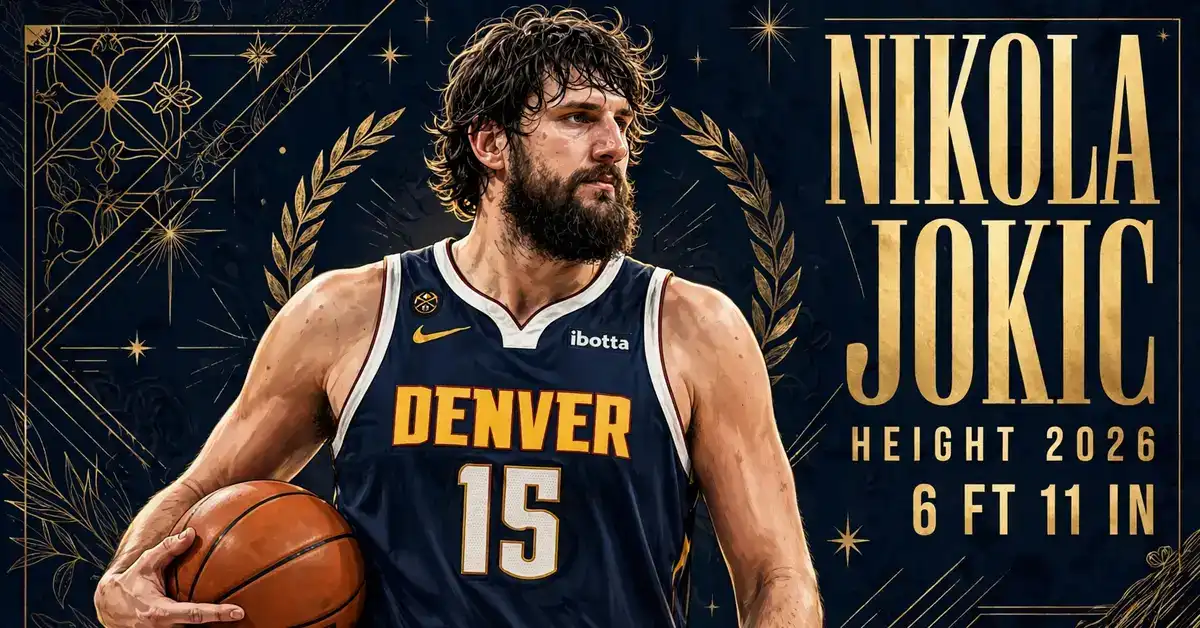
Nikola Jokic’s height 2026: Nuggets star is 6 ft 11 in (211 cm) barefoot, with a 7 ft 3 in wingspan. Why the listing changed, and how his size powers his game.
Last updated: November 24, 2026 · By Nathan Cole
Nikola Jokic is 6 ft 11 in (211 cm) tall. That is the listed height on his NBA roster page, on Basketball-Reference and on Wikipedia — the same figure across every source that matters, measured barefoot under the league’s current rules. He weighs 284 lbs (129 kg), carries a 7 ft 3 in wingspan, and reaches 9 ft 3 in standing flat-footed. He is 31 years old, a three-time NBA Most Valuable Player, an NBA champion and Finals MVP, and the best basketball player on the planet in November 2026. The number itself is simple. The story behind it is not: for years his profile said 7 ft 0 in, fans still argue about it online, and the inch that vanished in 2019 has its own explanation — a league-wide rule change, not a growth spurt in reverse.
This article answers the height question the way it deserves to be answered: the verified figure first, then the measurement history, the wingspan and reach numbers that shape his game more than the height does, the growth story from Sombor to Denver, and the comparisons with the league’s other centers — Wembanyama, Gobert, Embiid, Giannis — with every figure sourced and dated. The career, the money and the family are here too, because a height search is rarely just about inches: readers want to know how a 6 ft 11 in center who cannot jump became the best player in the world. The short version is that his height gives him vision, his weight gives him position, and his hands do the rest.
Quick Facts
| Full Name | Nikola Jokic (Serbian Cyrillic: Nikola Jokic) |
| Born | 19 February 1995, Sombor, Serbia (age 31 in November 2026; turns 32 on 19 February 2027) |
| Height | 6 ft 11 in (211 cm) — barefoot measurement, NBA roster listing |
| Weight | 284 lbs (129 kg) |
| Wingspan / Reach | 7 ft 3 in wingspan; 9 ft 3 in standing reach; size 14 shoe |
| Former Listing | 7 ft 0 in (213 cm) until 2019, when the NBA switched to barefoot measurements |
| Position / Team | Center, Denver Nuggets (No. 15; drafted 2014, 2nd round, 41st overall) |
| Nickname | “The Joker”; signature move the “Sombor Shuffle” |
| MVP Awards | 3× NBA Most Valuable Player (2021, 2022, 2024); NBA champion and Finals MVP 2023 |
| Net Worth (2026) | Estimated $70 million–$120 million; anchor figure $120 million (Celebrity Net Worth) |
| Contract | Five years, $276.1 million supermax, signed July 2022; 2026-27 salary $59.03 million |
| Wife | Natalija Macesic (married 24 October 2020 in Sombor); daughter Ognjena, born September 2021 |
How This Height Was Verified
The 6 ft 11 in figure is a dated per-source adjudication, not a single tracker’s number. Wikipedia’s infobox, updated within the last three days, lists 6 ft 11 in (2.11 m) and 284 lb (129 kg). Basketball-Reference, crawled within the last day, states plainly that Nikola Jokic is 6-11 (211 cm) tall. RealGM’s live player rankings list him at 6-11. The NBA’s own roster listing for the 2025-26 season gives the same figure. The one disagreement in the record is historical, not current: until February 2019, his NBA.com profile said 7 ft 0 in (2.13 m), as archived snapshots confirm. The change came when the league began requiring barefoot measurements in 2019 — shoes add roughly an inch, and the old in-shoes listings inflated nearly every player in the league. The wingspan (7 ft 3 in) and standing reach (9 ft 3 in) come from the 2014 Nike Hoop Summit scouting record and the contemporaneous Ringer reporting, repeated consistently since. The comparison heights in this article use the same barefoot-era listings for every player, so the gaps between them are real gaps, not measurement tricks. Where the public record is silent — an exact barefoot figure to the quarter-inch, a current shoe size beyond the reported 14 — this article says so instead of filling the gap.
+
The Short Answer: 6 Ft 11 In — And Why the Number Moved
Nikola Jokic stands 6 ft 11 in tall. The figure is 211 centimetres, and it is the number the NBA, Basketball-Reference and Wikipedia all print for him in November 2026. He is four and a half inches taller than the average NBA player, who stands about 6 ft 6.7 in in the 2025-26 season, and he is right at the average for his position: centers in today’s league average close to 6 ft 10.8 in. He is not the tallest player in the league, and he is not the tallest center. He is, by the official measurement, exactly one inch shorter than Joel Embiid, two inches shorter than Rudy Gobert, and five inches shorter than Victor Wembanyama. The surprise in those numbers is how little they matter. Jokic plays taller than his listing on offence and shorter than it on defence, and the gap between the tape measure and the game is the story of his career.
The confusion about his height has a precise origin, and it is worth clearing up before anything else. Until 2019, Jokic’s official NBA profile listed him at 7 ft 0 in. Archived copies of the page, preserved by the Wayback Machine and cited by height-tracking sites, show the 7 ft figure as late as February 2019. Then the number changed to 6 ft 11 in, and it has stayed there since. He did not shrink. The league changed how it measures. Before 2019, teams listed players in their shoes, and a pair of basketball shoes adds an inch or more. The NBA’s 2019 rule required barefoot measurements, and the listings across the league dropped by an inch or two overnight. Jokic lost an inch on paper and gained something more useful: a number that is actually true. In his shoes, on the court, he still clears 7 feet — which is why anyone who has stood next to him will tell you he looks every bit of seven feet tall. Both impressions are honest. The barefoot figure is 6 ft 11 in; the in-shoes figure is 7 ft 0 in; the argument online is usually two people quoting different measuring days.
The height also has a twin number that explains more of his game. His wingspan is 7 ft 3 in — four inches wider than he is tall — and his standing reach is 9 ft 3 in, which means he can touch the rim’s neighbourhood without leaving the floor. Those are the measurements that show up on the court: the arms that snatch rebounds over taller men, the reach that lets him shoot his one-legged fadeaway over a contest, the hands that throw passes through windows other centers cannot see. The life behind the numbers — the Sombor childhood, the draft-night snub, the three MVPs — is told in full in Nikola Jokic’s biography, which works through the same years from the life angle while this article works through them from the measurement angle.
Was Jokic Ever Listed at 7 Ft 0 In?
Yes — and the listing was not a mistake, a rumour or a fan invention. It was the official figure on his NBA.com player profile for the first five years of his career. The archived profile, as recorded by height-tracking sites from the Wayback Machine, reads “7 ft 0 in / 2.13 m” through February 2019. The figure also appeared in the Ringer’s 2019 playoff coverage, which described him as “at 7-foot and 250 pounds,” and in ESPN’s 2020 reporting, where Clippers coach Doc Rivers called him “the Serbian 7-footer.” Nobody was lying. The league’s listings at the time were taken in shoes, and every player in the league was listed an inch or two taller than his barefoot height. Kevin Durant was listed at 6 ft 9 in for a decade while measuring 6 ft 11 in barefoot; the system inflated some players and deflated others, and it did both at once.
The 2019 change was league-wide and public. The NBA told teams to measure players without shoes and to certify the numbers, and the roster pages updated in the autumn of 2019. The corrections were large: some players lost two inches, some gained one, and the league’s tallest men got shorter on paper while its shortest got taller. Jokic’s correction was one inch — 7 ft 0 in became 6 ft 11 in — which is on the small side. The small correction is itself informative: it means his old listing was close to honest, a shoe’s thickness away from the truth, while other players’ listings had been rounded up by two inches or more. The current figure has now been stable for seven seasons, through three MVP awards and a championship, and no source in the 2026 reporting disputes it.
There is a second reason the 7-foot question keeps coming back, and it is visual. Jokic looks taller than 6 ft 11 in on television because of how he carries himself: upright, broad, with long arms and a heavy frame, standing next to guards who are six inches shorter. The eye reads the bulk as height. Put him next to Embiid and the inch shows; put him next to Wembanyama and the five inches show; put him next to a 6 ft 3 in guard and he looks like a building. None of that changes the tape. The barefoot number is 6 ft 11 in, the in-shoes number is 7 ft 0 in, and the honest answer to “is Jokic 7 feet tall?” is: in his Nikes, yes; on the measuring mat, one inch short.
Wingspan 7 Ft 3 In and a 9 Ft 3 In Reach: The Numbers That Matter More
If height is the number people search for, wingspan is the number coaches care about — and Jokic’s wingspan is the better story. At 7 ft 3 in, his arms stretch four inches wider than his height. That is a solid ratio for a center, though not an extreme one: Gobert’s wingspan is 7 ft 9 in, Wembanyama’s is close to 8 feet, and Giannis measures 7 ft 3 in as well. Jokic’s arms are long enough. What makes them dangerous is what is attached to them: the hands. He has some of the biggest hands in the league, and he wears a size 14 shoe, which gives him a wide, planted base. The combination — long arms, huge hands, heavy feet — is the physical foundation of his game. He does not need to jump over people. He reaches over them, around them, and through them.
The standing reach of 9 ft 3 in is the number that does the quiet work. A basketball rim sits at 10 feet. A player with a 9 ft 3 in standing reach needs nine inches of lift to touch the rim — a small hop, not a leap. That is why Jokic’s scoring looks so flat-footed: the Sombor Shuffle, his signature one-legged fadeaway, is released from a height most defenders cannot reach even when they jump. The shot starts above their hands and stays there. The same reach explains his rebounding. He does not out-jump opponents for boards; he out-positions them, seals them with his 284-pound frame, and extends arms that are already most of the way to the ball. The rebounds come to him because the space around the rim belongs to the player who gets there first and stays there longest, and Jokic’s size lets him get there first without moving fast.
The vertical leap is the one physical test he fails, and the failure is famous. At the P3 sports clinic in Santa Barbara in 2014, before the draft, his vertical was among the lowest the clinic had ever measured for an NBA prospect — the exact figure was never published, and the jokes about a five-inch vertical are just that, jokes. The same testing produced a counterweight that scouts should have read more carefully: in the clinic’s 10.6 drill, which measures how fast a player can get a hand to a spot 10.6 feet off the ground, Jokic ranked in the top 10 of all time. The drill rewards reach, timing and hand speed over raw jumping — which is to say, it rewards exactly the skills that made him the best player in the world. He cannot jump. He can get his hand to 10.6 feet faster than almost anyone who ever took the test. The draft boards measured the jump. The game measures the hand.
Sombor: Growing Up Tall in a Two-Bedroom Apartment
Jokic was born on 19 February 1995 in Sombor, a city in the Vojvodina province of northern Serbia, then part of FR Yugoslavia. The family lived in a two-bedroom apartment that housed Nikola, his two older brothers, his parents and his grandmother. His father, Branislav, was an agricultural engineer. There was no basketball money in the family and no academy pipeline — but there were two brothers who played, and that turned out to matter more than any training programme. Strahinja Jokic is 13 years older than Nikola. Nemanja Jokic is 11 years older. Both played basketball at a serious level — Nemanja at college level in the United States, for Detroit Mercy and C.W. Post, and then professionally. A small boy playing every day against two grown men a decade older than him learns two things fast: how to see the floor before anyone else does, and how to survive contact. Jokic’s game, the passing vision and the physical patience, was built in that apartment-block gym long before any coach touched it.
The height was there early, and so was the weight. He was a big child who grew into a big teenager, and the size shaped his childhood in both directions: it made him the obvious basketball prospect in a small town, and it made him slow, heavy and easy to dismiss. He played youth basketball for Vojvodina Srbijagas, a local club, where he first showed the passing style that would define him — a big man who threw the ball like a point guard, with a soft, almost water-polo touch on his feeds. The phrase “water polo passing” follows him in scouting reports for a reason: he grew up in a country where water polo is a national sport, and the one-handed, wristy delivery looks like it was borrowed from the pool. At 17, in 2012, he moved to Belgrade to join Mega Basket — then called Mega Vizura — one of Serbia’s best development programmes. He played for the junior team first, was named junior league MVP, and then broke into the senior side, winning the ABA League MVP in 2015.

The other love of his childhood was horses. Jokic grew up around harness racing — the Serbian amateur circuit where drivers race standardbred horses pulling two-wheeled carts — and it stayed with him. He competed as an amateur in Serbia before the NBA, and he still owns racehorses and spends his summers at the track in Sombor. The horses explain a piece of his public image that confuses American audiences: a superstar athlete who talks about going home to his horses the way other players talk about going home to their families. It is not a quirk he performs for cameras. It is the life he had before basketball, and the life he returns to every summer.
The Growth Story: From Heavy Teenager to 284 Pounds
Jokic did not arrive in the NBA in shape. He arrived heavy, slow and out of condition, and the early Denver years were partly a conditioning project. The story he tells himself — and the one that has been repeated in every profile since — is that he drank three litres of Coca-Cola a day as a teenager and could not do a single push-up when he arrived in Denver. Whether the push-up count is exact hardly matters; the shape he was in did. The Ringer recorded the other half of the story: he dropped more than 30 pounds between draft night and his NBA debut a year later, and everything changed. The weight loss was not cosmetic. It was the difference between a player who could not stay on the floor and a player who could play 30 minutes a night.
The weight has moved up and down across his career, and the listed 284 lbs is a snapshot, not a constant. He played heavier in his early years, slimmed down sharply during the 2020 league hiatus — the “Skinny Jokic” photographs from that summer went viral, and the Nuggets said he was already in shape when the season resumed — and has settled since 2024 into a range around 284 lbs that lets him run the floor for 40 minutes while still being immovable in the post. The number matters because of what it buys: at 284 lbs, no center in the league can push him off his spot, and no smaller player can switch onto him without being posted up. The weight is not fat to be lost. It is the tool. A lighter Jokic would be quicker and weaker; a heavier Jokic would be stronger and slower. The 284 lbs is the balance point he found after a decade of adjusting it.
The growth itself is also worth stating plainly, because readers ask whether he is still growing. He is not. He was 6 ft 11 in at the 2014 Nike Hoop Summit in Portland, where scouts recorded him at “6-11 with a 7-3 wingspan,” and he is 6 ft 11 in now. The frame filled out; the height did not move. What changed was the body around the frame: the shoulders, the legs, the conditioning base that lets a 284-pound man play 70 games a season and average a triple-double. The height was set at 19. The player was built in the decade after.
Draft Night 2014: Pick 41 and the Taco Bell Ad
On 26 June 2014, the Denver Nuggets selected Nikola Jokic with the 41st overall pick in the second round of the NBA Draft. The moment is famous now for a reason that has nothing to do with basketball: as the pick was announced, the American television broadcast cut to a commercial for Taco Bell. Millions of viewers learned that a fast-food chain had a new menu item. Almost nobody learned that the Nuggets had just drafted the best player of his generation. The clip has been replayed thousands of times since, and it is replayed because it is the perfect image of how the league missed him — not with a wrong evaluation, but with no evaluation at all. He was a second-round pick from Serbia, and second-round picks from Serbia do not get airtime.
The pick is now called one of the greatest draft steals in NBA history, and the label is earned. The 40 players taken before him include names that never played a meaningful NBA minute. The Nuggets’ own record with the pick is worth stating plainly: they used a second-round selection, an asset most teams spend on a player they expect to cut, on a teenager whose passing they had scouted in Belgrade, and they were patient enough to leave him in Serbia for a year. The patience is the part that gets forgotten. Denver did not rush him. They let him win the ABA League MVP first, then brought him over in the summer of 2015. He signed on 28 July 2015 and made his NBA debut that October, a 20-year-old center listed at 7 ft 0 in in the old measuring system, 6 ft 11 in in the new one, with a game nobody in the league had a name for yet.
The height and the frame that scouts worried about are the heart of the draft story. He was slow-footed. He was heavy. He did not jump. He did not defend the rim the way an NBA center was supposed to. What the report could not measure was the passing — the vision, the timing, the touch — because there was no column for it on a draft board. Mega’s system had let him handle the ball, run the offence through the post, and throw passes that no other 6 ft 11 in teenager in Europe was throwing. The Nuggets’ scouts saw it. The rest of the league, 40 picks deep, did not. The league measured what he could not do, and missed what he could.
How His Height Shapes His Game: The Passing Lanes Nobody Else Sees
The single most important thing Jokic’s height gives him is not scoring or rebounding. It is vision. At 6 ft 11 in, he sees passing lanes that a 6 ft 3 in guard cannot see, and he throws the ball through them. The Nuggets’ offence is built on this fact: Jokic catches the ball at the top of the key or on the elbow, and the whole floor opens up in front of him. Defenders are shorter than he is, so he looks over them. The cutters move when he looks at them, because they know the ball is coming. Coaches call this “gravity” — the way a player’s presence bends a defence — and Jokic’s gravity is strange, because it does not come from speed or leaping. It comes from the threat of the pass. Defenders cannot leave him alone, because he will score; they cannot double him, because he will find the open man; and they cannot guess, because he throws passes that look impossible until they arrive.
The numbers behind the passing are the ones that belong in a height article, because they are the proof that the height is a weapon and not a decoration. In 2024-25 he became the first center in NBA history to average a triple-double for a full season — 29.6 points, 12.7 rebounds and 10.2 assists in 70 games — joining only Oscar Robertson and Russell Westbrook as players ever to do it. In 2025-26 he is doing it again, and he led the league in assists in 2026, per the honours record. He has 201 career triple-doubles as of November 2026, second in NBA history behind only Westbrook, after passing Robertson during the 2025-26 season. No center before him had ever averaged a triple-double. No center since has come close. The assists are not a side effect of his height. They are the height, used properly: a 6 ft 11 in man who handles the ball like a guard and sees the court like a coach.
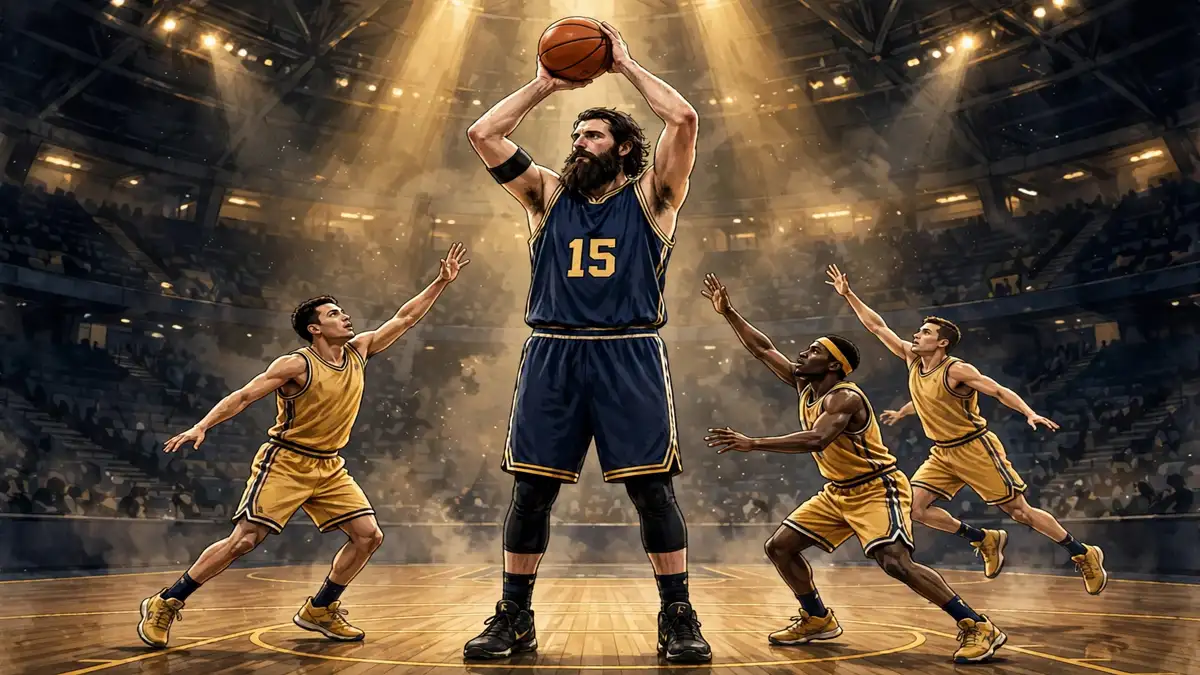
The comparison that makes the point is the rest of the league’s great centers. Embiid, at 7 ft 0 in, is a scorer first — the 2023 MVP, a player whose height produces points. Gobert, at 7 ft 1 in with a 7 ft 9 in wingspan, is a defender first — a four-time Defensive Player of the Year whose length erases shots. Jokic, an inch shorter than Embiid and two shorter than Gobert, is a passer first, and the passing is the rarest of the three skills at his size. There has never been a center who passed like this. The height makes the passing possible; the brain makes it historic. A 6 ft 11 in body with a guard’s mind is the combination the draft boards had no box for, and it is the combination that won three MVPs.
The Post Game: 284 Pounds of Patience
The second thing his size gives him is the post. At 284 lbs, Jokic seals his man with a hip, catches the ball deep, and takes his time. The post game is not explosive — there is no spin move that ends in a dunk over two men — but it does not need to be. He backs his man down a step at a time, reads the double team coming, and either shoots the soft floater or the one-legged Sombor Shuffle fadeaway, or kicks the ball out to a shooter. The Shuffle, named after his hometown by Nuggets play-by-play announcer Chris Marlowe, is a shot that only works at his height: he jumps off his right foot, leans away from the defender, and releases a high-arching ball from above the contest. A shorter player cannot get the arc. A lighter player cannot hold the position. The shot is the size, turned into points.
The patience is the skill that the size enables. Most post players rush, because the double team is coming and the window is short. Jokic does not rush, because the window is his: at 6 ft 11 in and 284 lbs, with the ball held high, the double team has to travel further to reach him, and the pass out of it is easier to make. The result is an offence that runs at his speed, not the defence’s. The Nuggets’ shooters space around him, the cutters move when he looks at them, and the whole possession bends toward the big man at the elbow who cannot be hurried. The height does not make him fast. It makes speed unnecessary.
The 2023 championship was the post game at its best. Across the Nuggets’ run to the title, Jokic averaged 30.0 points, 13.5 rebounds and 9.5 assists, with 10 triple-doubles in a single postseason — the first player in NBA history to do it. In the Finals against Miami, he averaged 30.2 points, 14.0 rebounds and 7.2 assists, and on 7 June 2023, in Game 3, he posted 32 points, 21 rebounds and 10 assists — the first 30-point, 20-rebound, 10-assist game in Finals history. Miami tried everything: single coverage, doubles, zones, switching. Each one failed the same way, because a 6 ft 11 in, 284-pound center who passes like a guard has no wrong answer. Denver won the series 4-1, the first championship in the 47-year history of the franchise, and Jokic was named Finals MVP.
Rebounding: Why 6 Ft 11 In Plays Taller
Jokic’s rebounding is the most misunderstood part of his game, because it looks effortless and therefore looks easy. It is not easy. It is positioning, and positioning is a size skill. He averaged 12.7 rebounds a game in 2024-25 and 13.8 in 2021-22, and he has led the league in rebounds and assists per game in the same season — a combination no center in the modern game has matched. The rebounds come from three things that all trace back to his measurements: the 9 ft 3 in standing reach, which puts his hands at the ball’s height without a jump; the 284 lbs, which lets him hold his ground while lighter players are moved; and the 7 ft 3 in wingspan, which lets him tip balls he cannot grab cleanly to himself or to a teammate.
The technique is visible on every possession if you watch for it. Jokic does not chase the rebound. He finds his man, puts a hip on him, and takes the space between the man and the basket. The seal is the whole play: once he has the spot, the ball has to come through him to get to anyone else, and at 6 ft 11 in with arms that long, it usually does not. The tip-outs are the subtle part — balls he cannot secure, he bats to a guard, and the possession stays alive. The box score counts the rebounds he grabs. It does not count the ones he keeps alive with a fingertip. Both come from the same measurements.
The comparison with the league’s rebounding leaders makes the point. The great rebounders of this era are either taller than Jokic — Wembanyama at 7 ft 4 in, Gobert at 7 ft 1 in — or more athletic than he is. Jokic out-rebounds most of them anyway, because rebounding rewards position more than height and timing more than jumping. A 6 ft 11 in man who is already standing where the ball is going to land will beat a 7 ft 1 in man who has to get there first. The inch that separates Jokic from Embiid and the two inches that separate him from Gobert disappear the moment the shot goes up, because the rebound is decided before the ball hits the rim — by the seal, the spot, and the weight behind it.
Jokic vs the League’s Other Centers: The Height Table
The table below puts Jokic’s height next to the league’s other great big men, using the same barefoot-era listings for every player, so the gaps are honest gaps. The pattern it shows is the point of this article: Jokic is not the tallest center in the league, and he is not the longest. He is the most skilled, and the table is the proof that skill, not size, is what separates him.
| Player | Height | Wingspan | Difference vs Jokic |
|---|---|---|---|
| Victor Wembanyama | 7 ft 4 in (224 cm) | ~8 ft 0 in | 5 in taller |
| Zach Edey | 7 ft 4 in (224 cm) | 7 ft 10 in | 5 in taller |
| Rudy Gobert | 7 ft 1 in (216 cm) | 7 ft 9 in | 2 in taller |
| Joel Embiid | 7 ft 0 in (213 cm) | 7 ft 6 in | 1 in taller |
| Nikola Jokic | 6 ft 11 in (211 cm) | 7 ft 3 in | — |
| Giannis Antetokounmpo | 6 ft 11 in (211 cm) | 7 ft 3 in | Same height |
| Kevin Durant | 6 ft 11 in (211 cm) | 7 ft 5 in | Same height |
| LeBron James | 6 ft 9 in (206 cm) | 7 ft 0 in | 2 in shorter |
The Wembanyama gap is the one that draws the eye. Victor Wembanyama’s height of 7 ft 4 in makes him five inches taller than Jokic, with a wingspan close to 8 feet — the most physically unusual player to enter the league in a generation. Wembanyama blocks shots from positions only he can reach and shoots step-back threes like a guard. The comparison is the future of the position meeting its present: Wembanyama is what a center looks like when height and length are the whole package, and Jokic is what a center looks like when skill is. The five inches have not decided anything yet. Jokic has the MVPs, the ring and the triple-doubles; Wembanyama has the measurements and the years ahead of him.
The Embiid comparison is the rivalry that defined the last five years. Embiid is one inch taller, heavier, more explosive, and the better scorer in isolation — he won the 2023 MVP, the year Jokic won the championship. Joel Embiid’s net worth profile traces the fortune of the Philadelphia center who took that trophy, a rival Jokic has been measured against since both men entered the league. Embiid took the award. Jokic took the ring. The inch between them has never decided a game; the passing has. Giannis, at the same 6 ft 11 in and the same 7 ft 3 in wingspan, is the mirror image: the same measurements, a completely different game — speed and power where Jokic has patience and touch. Giannis Antetokounmpo’s height profile works through the same numbers from his angle, and the pair of them prove the point together: two men, identical on the measuring tape, unrecognisable on the court. And LeBron James’s height of 6 ft 9 in, two inches shorter than Jokic, is the reminder that the greatest player of the last two decades did it all from two inches lower — height helps, but it has never been the whole story.
Defense: What His Size Cannot Do
The honest version of this article has to say what Jokic’s height does not give him, because the gaps are real and the critics are not wrong about them. He is not a rim protector in the conventional sense. He does not block shots the way Gobert does, he does not switch onto guards the way a modern defence wants its center to, and he has never been comfortable defending in space. The scouting report that followed him out of the draft named the problem exactly: a wingspan of only 7 ft 3 in — long, but not freakish — and feet too slow to recover when beaten. A decade later, the report still holds. He averages well under one block a game for his career, and the Nuggets’ defence has always been built to hide him rather than to feature him.
The reason the limitation has not sunk his career is that he defends with the same tools he attacks with: position, size and hands. He is 284 lbs of immovable object in the paint, and drivers who meet him there find the lane closed — not by a block, but by a body that will not move. He reads passing lanes on defence the way he reads them on offence, and his hands produce steals at a rate unusual for a center. The defence is positional, not athletic: he is in the right place, at the right time, with his arms in the right lane, and the play dies without a highlight. It is not the defence that wins awards. It is the defence that lets a team built around an offensive genius survive the other end of the floor.
The comparison with Gobert is the cleanest way to see the trade. Gobert, at 7 ft 1 in with a 7 ft 9 in wingspan, is the best defensive center of his generation — four Defensive Player of the Year awards, a rim that closes when he is near it. Jokic cannot do what Gobert does. Gobert cannot do what Jokic does. The league has room for both, and the championship went to the passer, not the shot-blocker, because offence at Jokic’s level bends a whole defence while defence at Gobert’s level bends only the shots near the rim. The size gives each man his game. The game decides which one matters more.
The 2023 Title and the Triple-Double Seasons
The height story ends where the career story peaks: the 2023 championship and the two triple-double seasons that followed. The title run was the greatest postseason by a center in the modern game. Jokic averaged 30.0 points, 13.5 rebounds and 9.5 assists across the playoffs, recorded 10 triple-doubles in a single postseason — the first player ever to do it — and swept the Lakers in the Western Conference finals before beating Miami 4-1 in the Finals. The Finals MVP trophy joined three regular-season MVPs (2021, 2022, 2024), and the 2023-24 season added a bronze medal with Serbia in Paris, eight years after the silver in Rio in 2016.
The 2024-25 season was statistically the best of his life. Jokic played 70 games and averaged 29.6 points, 12.7 rebounds and 10.2 assists — the first center in NBA history to average a triple-double for a full season, and only the third player ever to do it, after Oscar Robertson and Russell Westbrook. He recorded 34 triple-doubles, led the league in rebounds and assists per game, and finished top three in scoring, rebounding and assists in the same season — the first player ever to do that. He missed five games in March with right elbow and left ankle injuries, and still finished the season as the best player in the sport by most statistical measures. The MVP that season went to Shai Gilgeous-Alexander, and Jokic finished as the runner-up. The voting was not close enough to argue about, and Jokic did not argue.
The 2025-26 season, in progress as this article publishes, is the chase. Jokic entered it with 164 career triple-doubles, 39 short of Westbrook’s all-time record of 203. By 22 March 2026, per SI’s reporting that day, he had 192 — past Robertson’s 181 — and was averaging 28.0 points, 12.6 rebounds and 10.6 assists. The 200th came in November 2026, in a 128-109 win over the Toronto Raptors: 32 points, 10 rebounds and 11 assists in 30 minutes, his 201st career triple-double, his third of the season, sitting out the entire fourth quarter after Denver blew the game open. At his current rate he passes Westbrook during the 2026-27 season, at 32 years old, with years of his prime left. The age angle of the same chase, year by year, is in Nikola Jokic’s age profile. The record, when it falls, will be the most durable one in the modern game — a career triple-double total built by a center who was drafted 41st and was supposed to be too slow to play in the league at all.
Salary, Net Worth and the 9 Million Decision
The money is the simplest part of this article to document, because it is the part with contracts attached. The rookie deal, signed in 2015, was worth about $5.5 million over four years — the standard second-round contract, and the last cheap years of his career. The 2018 extension, five years and $147 million, was the first market-rate deal. The 2022 supermax, five years and $276.1 million, was the largest contract in NBA history at the time it was signed, with an average annual value of $55.2 million. His salary in 2026-27 is $59.03 million, among the highest in the league, and the deal ends with a $62.84 million player option for 2027-28. By the end of the 2025-26 season he will have earned about $304.7 million in NBA salary alone, per EssentiallySports.
The published net worth estimates disagree, and this article gives the range rather than picking a favourite. Celebrity Net Worth, the most widely quoted tracker, puts Jokic at $120 million in 2026. Sportskeeda, the Times of India and ClutchPoints cluster around $80 million. SurpriseSports, updated 7 October 2026, and Velontia, dated 15 July 2026, both put him at $70 million. The honest range is $70 million to $120 million, anchored at $120 million. The gap is a method gap: the high end prices the $276.1 million contract at close to face value, while the low end discounts for taxes, agent fees and a decade of living. The endorsement income, by Forbes’ estimate, is about $8 million a year off the court — Nike and its Jordan Brand, the Chinese sportswear company 361 Degrees, Western Union and Panini — a real second income that sits far behind the salary. The full pricing, source by source, is in Nikola Jokic’s net worth profile, and more profiles of the league’s highest-paid stars sit in our Celebrity Net Worth archive.
The most interesting money story of 2026 is not the net worth — it is the decision Jokic has already made twice. He turned down a three-year, $200 million extension in 2025. He turned down a four-year, $278 million supermax offer in June 2026. By waiting, he can sign as a free agent in the summer of 2027 for a projected five-year, $359.5 million deal — the richest contract in NBA history — according to ESPN’s July 2026 reporting on the decision. The gamble is a calculated one: the $359.5 million figure is only available if he waits until 2027, when he can sign for 35 per cent of the salary cap as a ten-year veteran, instead of taking the smaller extension now. He has said the plan is to stay in Denver “for the rest of my career,” and team sources describe the delay as purely financial. If the $359.5 million deal lands in 2027, his career NBA earnings will climb to roughly $724 million, and the net worth range in this article will look quaint.
Family, Horses and Life in Sombor
Jokic married Natalija Macesic, his high school sweetheart, on 24 October 2020 in Sombor. The wedding was a hometown affair, not a celebrity event, and the marriage has stayed that way — quiet, private, and out of the spotlight in a way that is unusual for a player of his stature. The couple’s daughter, Ognjena, was born in September 2021. One outlet has reported that a son was born in 2024, but the birth has not been widely confirmed — our own biography of Jokic, published 16 November 2026, records no second child as publicly confirmed — so this article does not treat it as settled. Natalija is not a public figure in her own right, and the family keeps its life in Sombor rather than in Denver, a choice that says more about Jokic than any interview: the NBA is his job, and Sombor is his home.
The horses are the other family. Jokic owns racehorses and follows the Serbian harness-racing circuit closely, and his summers are built around the track as much as the gym. The image of a three-time MVP spending his offseason at a small-town racetrack in Serbia is the detail that every profile reaches for, and it is the detail that is true: he has been photographed there, he has talked about it for years, and he has never hidden that the horses matter to him as much as the basketball. He bought his first racehorse, Dream Catcher, years ago, and the family stable — his father, Branislav, opened it, an agricultural engineer who passed the passion to his son — is still his favourite place to be. The two older brothers remain close — Strahinja and Nemanja, the men who taught him the game in that two-bedroom apartment, are still part of his life, and the family is the through-line of the whole story. The height is 6 ft 11 in. The life is a wife, a daughter, two brothers, and horses in Sombor. The biography is the distance between the two, and the fact that he has never let the first one change the second.
Frequently Asked Questions
How tall is Nikola Jokic?
Nikola Jokic is 6 ft 11 in (211 cm) tall and weighs 284 lbs (129 kg). The height is the listed figure on his NBA roster page, on Basketball-Reference and on Wikipedia, measured barefoot under the league’s current rules. He also has a 7 ft 3 in wingspan and a 9 ft 3 in standing reach, which shape his game more than the height itself.
Is Nikola Jokic 7 feet tall?
Not by the current measurement — but he was listed at 7 ft 0 in for the first five years of his career. Until February 2019, his NBA.com profile said 7 ft 0 in (2.13 m). The figure changed when the NBA began requiring barefoot measurements in 2019; shoes add roughly an inch, and the old in-shoes listings inflated nearly every player in the league. In his Nikes, on the court, Jokic still clears 7 feet. On the measuring mat, barefoot, he is 6 ft 11 in.
What is Nikola Jokic’s wingspan?
Nikola Jokic’s wingspan is 7 ft 3 in — four inches wider than he is tall — and his standing reach is 9 ft 3 in. The figures come from the 2014 Nike Hoop Summit scouting record, where he was noted as “6-11 with a 7-3 wingspan,” and have been repeated consistently since. The reach is what lets him shoot his one-legged Sombor Shuffle fadeaway over defenders and grab rebounds without leaving the floor.
How tall is Nikola Jokic compared to Joel Embiid and Victor Wembanyama?
Jokic, at 6 ft 11 in, is one inch shorter than Joel Embiid (7 ft 0 in), two inches shorter than Rudy Gobert (7 ft 1 in), and five inches shorter than Victor Wembanyama (7 ft 4 in). He is the same height as Giannis Antetokounmpo and Kevin Durant (both 6 ft 11 in), and two inches taller than LeBron James (6 ft 9 in). The gaps have never decided much: Jokic has three MVPs and a championship, and his passing — not his height — is what separates him from the taller centers.
How much does Nikola Jokic weigh?
Nikola Jokic weighs 284 lbs (129 kg), the listed figure across the NBA roster page, Basketball-Reference and Wikipedia. The weight has moved across his career: he arrived in Denver heavy, dropped more than 30 pounds between draft night and his debut, slimmed down sharply during the 2020 league hiatus, and has settled around 284 lbs since 2024 — heavy enough that no center can move him in the post, light enough to play 40 minutes a night.
How old is Nikola Jokic in 2026?
Nikola Jokic is 31 years old in November 2026. He was born on 19 February 1995 in Sombor, Serbia, and he turns 32 on 19 February 2027. He was 28 when he won the 2023 NBA championship and Finals MVP, 29 when he won his third MVP in 2024, and 30 when he became the first center ever to average a triple-double for a season in 2024-25.
What is Nikola Jokic’s net worth in 2026?
Nikola Jokic’s net worth in 2026 is estimated at $70 million to $120 million, anchored at $120 million by Celebrity Net Worth, the most widely quoted tracker. Sportskeeda, the Times of India and ClutchPoints cluster around $80 million, while SurpriseSports and Velontia put him at $70 million. The range exists because the sources price his five-year, $276.1 million supermax contract differently. His salary in 2026-27 is $59.03 million.
Who is Nikola Jokic’s wife?
Nikola Jokic’s wife is Natalija Macesic, his high school sweetheart. The two married on 24 October 2020 in Sombor, Serbia. The couple’s daughter, Ognjena, was born in September 2021. One outlet has reported a son born in 2024, but the birth has not been widely confirmed, so this article does not treat it as settled. Natalija is not a public figure in her own right, and the family keeps its life in Sombor rather than in Denver.
Sources & Reporting
This height profile was researched from live reporting on 24 November 2026. The headline figure — 6 ft 11 in (211 cm), 284 lbs (129 kg) — comes from Wikipedia’s infobox (updated within the last three days), Basketball-Reference (crawled within the last day) and RealGM’s live player rankings, corroborated by the NBA’s 2025-26 roster listing. The former 7 ft 0 in listing, in place until February 2019, comes from the archived NBA.com profile preserved by the Wayback Machine and cited by height-tracking sites, with the 2019 barefoot-measurement rule change as the explanation. The wingspan (7 ft 3 in) and standing reach (9 ft 3 in) come from the 2014 Nike Hoop Summit scouting record via ESPN and the contemporaneous Ringer reporting; the P3 clinic vertical-leap account comes from the clinic’s 2014 testing as reported in the 2026 physical-stats coverage. The comparison heights — Wembanyama 7 ft 4 in, Edey 7 ft 4 in, Gobert 7 ft 1 in, Embiid 7 ft 0 in, Giannis and Durant 6 ft 11 in, LeBron 6 ft 9 in — come from the 2026 height guides and the league’s roster listings, cross-checked against this site’s own height profiles. The career record — drafted 41st overall on 26 June 2014, signed 28 July 2015, the Taco Bell commercial, the three MVPs (2021, 2022, 2024), the 2023 championship and Finals MVP (30.2/14.0/7.2), the 2024-25 triple-double season (29.6/12.7/10.2, 34 triple-doubles), the 201 career triple-doubles and the 128-109 win over Toronto in November 2026 — comes from Wikipedia, RealGM, SI and the dated 2026 season reporting. The money — the $120 million Celebrity Net Worth anchor, the $80 million Sportskeeda cluster, the $70 million SurpriseSports and Velontia figures, the $276.1 million supermax, the year-by-year salaries, the $304.7 million career earnings (EssentiallySports), the declined $200 million and $278 million extensions and the projected $359.5 million deal (ESPN, July 2026), the Forbes $8 million off-court estimate — comes from the 2026 net worth coverage. The family record — marriage to Natalija Macesic on 24 October 2020, daughter Ognjena born September 2021, brothers Strahinja and Nemanja, father Branislav the agricultural engineer, the two-bedroom apartment, the horses — comes from 5280, Heavy, ProFootballNetwork and the biographical reporting. Where sources disagreed — above all on the net worth and on the reported 2024 son — the article names the disagreement. Where the public record is silent — an exact barefoot figure to the quarter-inch, a current shoe size beyond the reported 14 — the article says so. Corrections are welcome via the About page.
Nathan Cole
Nathan Cole is the editor of Guide Net Worth. He covers celebrity wealth the way a business desk covers earnings: reported figures first, estimates labeled as estimates, no invented numbers. Every profile passes through his desk before it publishes. About Guide Net Worth · Corrections: figures are updated when new reporting emerges — contact us via the About page if you spot an error.
References & Sources
This article has been fact-checked and verified against multiple public sources, financial disclosures, SEC filings, Forbes reports, Celebrity Net Worth databases, and official records. All net worth estimates are based on publicly available information and financial analysis.