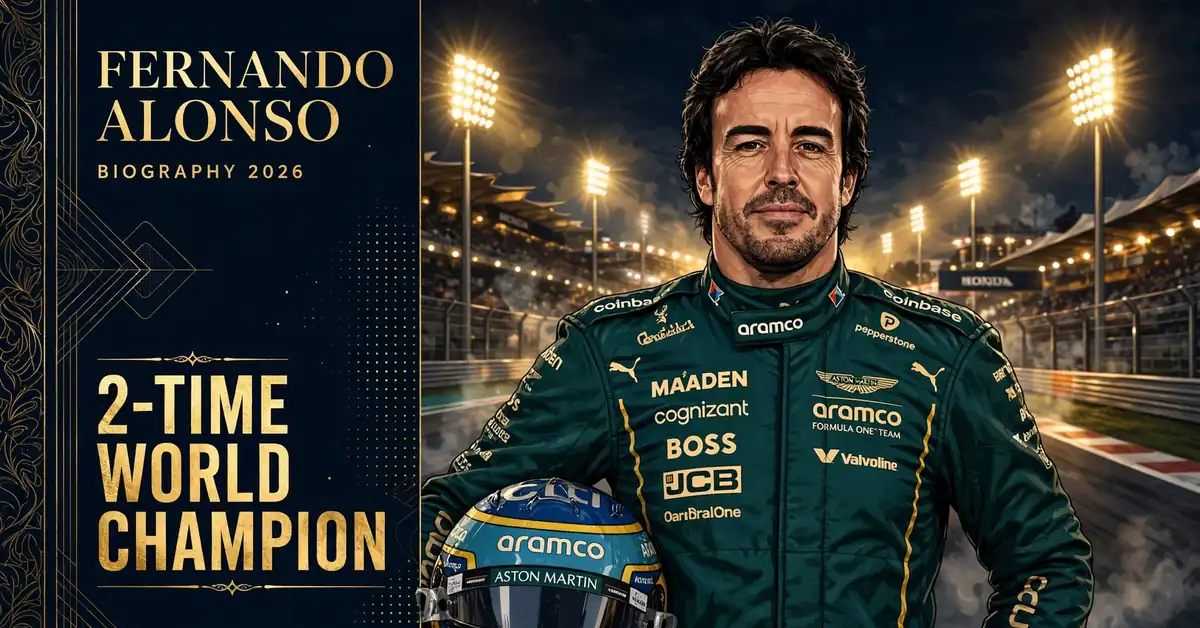
Fernando Alonso’s biography in 2026: born 29 July 1981 in Oviedo, two world titles, 446 Grand Prix starts, and racing at 45 with Aston Martin through 2027.
Last updated: November 24, 2026 · By Nathan Cole
Fernando Alonso Díaz, born 29 July 1981 in Oviedo, Spain, is a two-time Formula 1 world champion who is still racing at the top level at 45 years old. He won his titles with Renault in 2005 and 2006, collected 32 Grand Prix wins across 446 starts — more than any driver in the history of the sport — then walked away from Formula 1, won the 24 Hours of Le Mans twice and a World Endurance Championship with Toyota, and came back to finish on the podium again with Aston Martin. As of November 2026 he is under contract with Aston Martin through the end of 2027, the oldest driver on the grid and one of its most respected voices.
This biography follows the full arc: the working-class kid from Asturias who started karting in a kart his father built for his sister, the teenage champion who reached Formula 1 at 19, the two titles that ended Michael Schumacher’s run, the Ferrari years that came within three points of a third title, the wilderness years outside Formula 1, and the comeback that made him the first driver ever to contest 400 Grands Prix. It also covers the money honestly — a net worth estimated between $250 million and $300 million, a salary reported at $20 million to $24 million a year — and the businesses he built along the way.
Quick Facts: Fernando Alonso
| Full name | Fernando Alonso Díaz |
| Born | 29 July 1981, Oviedo, Asturias, Spain (age 45 in November 2026) |
| Height / weight | 5 ft 7 in (171 cm) / ~150 lbs (68 kg) reported |
| Current team | Aston Martin Aramco-Honda (contracted through end of 2027); car No. 14 |
| World championships | 2 (2005, 2006 with Renault) |
| Grand Prix starts | 446 (449 entries) — most in F1 history; first driver to 400 GPs (Mexico City, Oct 2024) |
| Wins / podiums / poles | 32 wins, 106 podiums, 22 pole positions, 26 fastest laps, 2,400 points |
| Teams | Minardi, Renault, McLaren, Ferrari, Alpine, Aston Martin |
| Outside F1 | Le Mans 24 Hours winner 2018, 2019; World Endurance Champion 2018–19; Daytona 24 Hours winner 2019 |
| Net worth (2026) | $250M–$300M (Celebrity Net Worth $260M, Apr 2026; Alux $300M, Oct 2026) |
| Salary (2026) | Base ~$20M–$24M a year at Aston Martin (reported, not confirmed) |
| Businesses | Kimoa (founder, 2017); Museo y Circuito Fernando Alonso, Oviedo; A14 Management; FA Racing |
| Ambassador | UNICEF Goodwill Ambassador since 2005 |
| Marriage | Raquel del Rosario (2006–2011, divorced); no children |
| 2026 status | 18th in the championship on 7 points after 21 starts; contract confirmed through 2027 on 29 September 2026 |
How This Biography Was Reported
Every fact in this article carries a named source. Career statistics are current as of the 2026 Las Vegas Grand Prix, per Wikipedia’s Fernando Alonso entry (updated November 2026) and Formula 1’s own records: 449 entries, 446 starts, 32 wins, 106 podiums, 22 poles, 26 fastest laps, 2,400 points. Season-by-season championship positions come from F1Live365 (updated 22 November 2026). Salary figures are reported, not confirmed — teams never publish driver pay — and the article gives the range across Spotrac (~$20 million base) and Forbes reporting via F1 Salaries ($24 million base, up to $26.5 million with bonuses) rather than presenting one as fact. Net worth is a reported estimate: Celebrity Net Worth $260 million (April 2026) and Alux $300 million (October 2026), giving the $250M–$300M range. Personal-life details are reported, not confirmed by Alonso himself. Corrections: Guide Net Worth corrects errors promptly — contact us via the site’s contact page.
+
Who Is Fernando Alonso in 2026?
Fernando Alonso is 45 years old, in his 23rd Formula 1 season, and still the driver other drivers study. He races for Aston Martin Aramco-Honda, car number 14, in a season that has been difficult — 18th in the championship on 7 points after 21 starts, in a car that has scored only three points in 15 rounds, all of them his. Yet in qualifying for the 2026 São Paulo Grand Prix he dragged that same car into Q3 and onto ninth place on the grid, one of his finest qualifying performances of the season. At 45, Alonso is still finding ways to squeeze performance out of machinery that gives him little to work with.
The numbers behind him are unmatched. No driver has started more Grands Prix: 446, with the 400th coming at the Mexico City Grand Prix in October 2024. He has won 32 races, stood on the podium 106 times, taken 22 pole positions and scored 2,400 championship points across teams from Minardi to Aston Martin. He won his two world titles before some of his current rivals were born — Oscar Piastri, his McLaren rival’s teammate, was not yet born when Alonso made his debut in Australia in 2001. On 29 September 2026 Aston Martin confirmed that Alonso and Lance Stroll would continue with the team in 2027, with the works Honda partnership now in place and Adrian Newey, the sport’s most successful designer, having joined in 2025.
Fernando Alonso’s age — 45, born 29 July 1981 — is the fact that frames everything else in this biography. He is not racing on reputation. He is racing because he is still fast, still fit, and still convinced a third title is possible. This profile explains how he got here, what it cost, and what he built along the way.
Early Life in Oviedo: A Kart Built by His Father
Fernando Alonso was born on 29 July 1981 in Oviedo, the capital of Asturias, a green, rain-washed region in the north of Spain. His father, José Luis Alonso, worked in an explosives factory and was a keen amateur karting mechanic. His mother, Ana Díaz, worked in a department store. The family was working-class, and the karting that made Alonso famous began as a piece of home engineering: his father built a go-kart for his elder sister, Lorena. She did not want to drive it. Fernando, about three years old, did.
He won his first race at seven. The kart his father built was not a toy bought from a catalogue — it was a machine assembled by a man who understood engines, and the boy who drove it understood racing lines before he understood school. He attended the Instituto Leopoldo Alas Clarín de San Lázaro in Oviedo until his racing career forced him to leave during his university orientation course in 2000, at 19, with Formula 1 already calling.
The Oviedo of Alonso’s childhood is still part of his identity. He built his museum there — the Museo y Circuito Fernando Alonso, opened in 2015, which houses his karts, his cars and his trophies — and the circuit attached to it trains the next generation of Asturian karters. The working-class kid who raced a kart his father built for his sister now owns the building that holds the kart.
Karting Prodigy: Spanish Titles and the Road to Cars
Alonso’s karting record reads like a coronation. He won three straight Spanish junior karting titles from 1993 to 1995, took a fourth in 1996, won the Five Continents Cup in 1996, and finished second in the European karting championship in 1997. He was not a rich kid buying wins with better equipment. He was a fast kid in a family that built what it could not buy, and the results were so consistent that the karting world started watching him before he was a teenager.
He moved to cars in 1999, winning the Euro Open by Nissan championship in his first season. Formula 3000 followed in 2000, the last step before Formula 1, and he finished fourth in the championship with a win at Spa-Francorchamps — a circuit that rewards exactly the kind of driver Alonso was becoming: brave in the wet, precise in the fast corners, and ruthless when a gap appeared. Flavio Briatore, the Renault team principal who had spotted Schumacher a decade earlier, signed him. The path from a homemade kart in Oviedo to a Formula 1 seat had taken 16 years, and Alonso was 19.
Minardi 2001: The Debut in the Slowest Car on the Grid
Alonso made his Formula 1 debut with Minardi at the 2001 Australian Grand Prix, in the slowest car on the grid, for a team that existed on a fraction of Ferrari’s budget. He qualified 19th and finished 12th. That sounds unremarkable until you look at what his teammate did: Alonso outqualified and outraced him all season, and by the end of the year the paddock was talking about the 20-year-old in the backmarker car who was driving it faster than it had any right to go.
The Minardi year is the purest evidence of Alonso’s talent, because there was nothing to hide behind — no fast car, no team orders, no strategy to flatter him. He spent 2002 as Renault’s test driver, learning the team and the car while Jenson Button and Jarno Trulli raced, and in 2003 he got the race seat. At the Malaysian Grand Prix that year, aged 21, he became the youngest pole-sitter in Formula 1 history. At the Hungarian Grand Prix, aged 22, he became the youngest race winner in history. Both records have since been broken, but the point stands: Alonso arrived in Formula 1 already complete.
Renault 2005–2006: Two Titles and the End of Schumacher
Alonso won his first world championship in 2005, at 24 years and 59 days the youngest champion in Formula 1 history at the time. He beat Michael Schumacher, who had won the previous five titles in a row, in a season-long fight that came down to consistency: seven wins, 15 podiums, and a Renault that was fast everywhere. The title was sealed at the Brazilian Grand Prix with two races to spare. Spain had its first Formula 1 world champion, and the Prince of Asturias Award followed the same year.
He defended the title in 2006, again against Schumacher, again in a fight that went to the final race in Brazil. Seven more wins, 14 podiums, and a second championship by 13 points. The back-to-back titles put Alonso in rare company: only a handful of drivers have ever won consecutive championships, and he did it against the most successful driver the sport had ever seen, in a team that was not Ferrari or McLaren. The Renault years are the foundation of everything that followed — the reputation, the salary, the fortune — and they remain the peak of his career by results.
McLaren 2007: The Hamilton Rivalry
Alonso moved to McLaren for 2007 expecting to be the team’s lead driver and a three-time champion in waiting. Instead he found a rookie teammate who was as fast as he was. Lewis Hamilton, in his first Formula 1 season, matched Alonso win for win — four each — and the two finished the season level on 109 points, one point behind champion Kimi Räikkönen. The relationship collapsed in public: arguments over qualifying strategy in Hungary, Alonso’s threat to expose team data during the spygate investigation, and a garage split into two camps. Lewis Hamilton’s biography tells that season from the other side, including the seven titles that followed; the net worth side of the rivalry is covered by our sister site’s look at Lewis Hamilton’s net worth, estimated at around $450 million.
Alonso left McLaren after a single season. It was the most expensive decision of his career. Hamilton stayed, won the title in 2008, and went on to become the most successful driver in the sport’s history. Alonso returned to Renault, a team in decline, and spent two years winning races a championship car would have turned into titles. The 2007 season is the great what-if of his career: had he stayed, or had McLaren managed the two drivers, the third title might have come a decade earlier than he is still chasing it.
Ferrari 2010–2014: Three Times Runner-Up
Alonso joined Ferrari in 2010, the team every driver dreams of, and spent five years coming closer to a third title than at any other point in his career. He won 11 races in red, and finished runner-up in the championship three times: in 2010, losing the title at the Abu Dhabi finale after a strategy error left him stuck behind Vitaly Petrov’s Renault; in 2012, losing to Sebastian Vettel by three points after a season in which he dragged an uncompetitive Ferrari into contention by sheer force of will; and in 2013, again behind Vettel’s dominant Red Bull.
The 2012 season is the one his admirers cite as proof of his greatness. The Ferrari F2012 was, by most estimates, the third- or fourth-fastest car on the grid at the start of the year. Alonso won in Malaysia, Valencia and Germany, led the championship for much of the season, and lost it only at the final race in Brazil, where he finished second and Vettel finished sixth — three points short. It is the closest he has ever come to a third title, and the season most often used to argue that he is the best driver of his generation, whatever the trophy count says.
By 2014 the Ferrari was uncompetitive and the relationship was over. Alonso left at the end of the season, with 11 wins and no title from five years in red. The Ferrari years paid him well — he was among the highest-paid drivers on the grid throughout — but they cost him the prime of his career in a car that could not win a championship.
The Wilderness: McLaren-Honda and the Exit (2015–2018)
Alonso returned to McLaren in 2015, this time with Honda engines, and walked into four of the worst years of his career. The Honda power unit was slow and unreliable, and the car was regularly the slowest on the grid. At the 2015 Japanese Grand Prix, Honda’s home race, Alonso’s radio message — that he was driving a “GP2 engine” — became the most famous complaint in modern Formula 1. It was also an honest one. He finished 17th in the championship that year, then 10th, 15th and 11th in the three seasons that followed.
The wilderness years are the reason the Alonso story is about more than titles. Most champions in his position would have retired or taken a comfortable seat at a midfield team. Alonso stayed, fought a car that could not fight back, and kept his reputation intact — because everyone in the paddock could see that the problem was the engine, not the driver. When he retired from Formula 1 at the end of 2018, it was not because he had slowed down. It was because there was nothing left to prove in a car that could not win, and something else to chase outside the sport.
Beyond F1: Le Mans, Daytona, Indianapolis
The two years away from Formula 1 were among the most successful of Alonso’s career. With Toyota, he won the 24 Hours of Le Mans in 2018 and again in 2019, and took the World Endurance Championship in 2018–19. He won the Daytona 24 Hours in 2019. He became only the second driver in history to win the so-called Triple Crown’s two endurance jewels — Le Mans and Monaco — with only the Indianapolis 500 missing, the race that would complete the set alongside Graham Hill.
Indianapolis is the one that got away. In 2017 he led 27 laps of the Indy 500 on his debut before his Honda engine failed with 21 laps to go, finishing 24th. In 2019, with McLaren, he failed to qualify at all — one of the most embarrassing weekends of his career, and a reminder that even the best driver in the world cannot overcome a badly prepared car. In 2020 he finished 21st. The Triple Crown remains unfinished, and it is the one achievement, beyond a third Formula 1 title, that he has spoken about wanting most.
The Comeback: Alpine 2021–2022
Alonso returned to Formula 1 in 2021 with Alpine, the team formerly known as Renault, at 39 years old. The paddock was sceptical: a two-year absence, a midfield car, a teammate in Esteban Ocon half his age. He answered at the Qatar Grand Prix that year, finishing third — his first podium since 2014, seven years earlier. It was a defensive masterclass, holding off a faster Hamilton for lap after lap to protect Ocon’s win, and it reminded everyone what Alonso does best: racecraft under pressure.
The second Alpine season was frustrating — poor reliability, a string of retirements, and no long-term contract on offer. He left for Aston Martin for 2023, a move that surprised the paddock at the time and looked inspired within months. Alpine has not won a race since he left. Alonso, in green, was back on the podium in his first race for his new team.
Aston Martin: Eight Podiums at 41 (2023–2026)
The 2023 season was Alonso’s best in a decade. Eight podium finishes in the first eight races of his Aston Martin career, fourth in the Drivers’ Championship on 206 points, and a string of performances — second in Monaco, wheel-to-wheel with Verstappen in Canada — that had the paddock asking whether a 41-year-old could win a third title. The car faded in the second half of the season, but the point was made: Alonso, in the right car, was still one of the three or four best drivers on the grid.
The seasons since have been harder. Ninth in 2024 on 70 points, tenth in 2025 on 56, and 18th in 2026 on seven points after 21 starts, in a car that has struggled badly in the first year of the works Honda partnership. His first points of 2026 came at Monaco; his best result was ninth at the Dutch Grand Prix; his best qualifying was ninth at São Paulo. The team confirmed on 29 September 2026 that he would continue through 2027, and the hope inside the team is that Adrian Newey’s first Aston Martin car, for the new regulations, will finally give Alonso the machinery his talent has deserved for a decade. He will be 46 when that car races. Nobody in the paddock is betting against him making it count.
The Money and the Businesses: 0M–0M
Fernando Alonso’s net worth in 2026 is estimated at between $250 million and $300 million. Celebrity Net Worth, the most widely cited source on driver wealth, lists him at $260 million in its April 2026 update and puts his cumulative career earnings at roughly $545 million. Alux puts its own October 2026 estimate at $300 million. InfoCelebs lands at around $250 million. The range is honest: teams never publish driver pay, Alonso’s companies are private, and the figure depends on how much of 25 years of salaries survived taxes, fees and spending. The full money story — the salary year by year, the sponsors and the breakdown — is covered in depth in Fernando Alonso’s net worth profile on this site.
The salary is the engine of the fortune. Reports on his Aston Martin pay differ, as they always do with driver contracts. Spotrac puts his base salary at around $20 million a year. F1 Salaries, drawing on Forbes reporting, puts his base at $24 million, with potential income of $26.5 million once bonuses are counted, and notes that Forbes had him on $24 million in each of his first three Aston Martin seasons. The fair reading is a base salary of $20 million to $24 million a year for 2026, before bonuses and personal sponsorships, making him the sixth-highest-paid driver on the grid. His two-year Aston Martin deal announced in April 2024 was worth about $48 million in base salary alone.
The businesses are the second half of the fortune. His best-known venture is Kimoa, the clothing and sunglasses brand he founded in 2017 and still fronts as brand ambassador. He runs A14 Management, a driver management firm that guides young Spanish talent. He owns the Museo y Circuito Fernando Alonso in Oviedo, a museum and karting circuit that houses his cars and trophies. He founded the FA Racing karting team. He tried, and failed, to establish a Fernando Alonso Cycling Team for UCI competition in 2015 — a rare public failure in a career of careful brand-building. His sponsors across the years include Banco Santander, TAG Heuer, Adidas, Bang & Olufsen, ING, Chandon, Silestone, Europcar, Cajastur and Liberbank, and in 2025 he became a brand ambassador for Flexicar, the Spanish used-vehicle retailer. He has been a UNICEF Goodwill Ambassador since 2005, a role that predates most of his fortune and has outlasted every team change.

Personal Life: Family, Monaco, and Life at 45
Alonso is based in Monaco, the traditional home for Formula 1 drivers, and keeps his private life more guarded than most of his rivals. He married the singer Raquel del Rosario in 2006; the marriage ended in divorce in 2011. Reported relationships since have included the model Dasha Kapustina, the television presenter Lara Álvarez, the model Linda Morselli, the journalist Andrea Schlager and, since 2023, the journalist Melissa Jiménez. He has no children. His elder sister Lorena, whose unwanted go-kart started everything, remains close to him, and his parents still live in Asturias.
He is 5 ft 7 in (171 cm) tall — short for a racing driver, which is an advantage in a sport where every kilogram and every centimetre of cockpit space matters — and his reported weight is about 150 lbs (68 kg). The fitness regime that keeps him racing at 45 is famously severe: cycling, karting, simulator work and a training schedule that younger drivers struggle to match. Fernando Alonso’s height is covered in detail in the companion profile on this site, including how it compares with the rest of the grid.
Alonso vs the F1 Greats
Placed next to his peers, Alonso’s career is the paradox of modern Formula 1: one of the greatest drivers ever, with a trophy count that does not match his talent, because he spent his prime years in the wrong cars. The table below gives the headline numbers for the champions discussed in this article.
| Driver | Titles | Wins | Podiums | Starts | Net worth (reported) |
|---|---|---|---|---|---|
| Fernando Alonso | 2 | 32 | 106 | 446 | $250M–$300M |
| Lewis Hamilton | 7 | 105 | 202 | ~380 | ~$450M |
| Max Verstappen | 4 | ~70 | ~120 | ~220 | ~$210M |
| Charles Leclerc | 0 | 8 | ~50 | ~170 | ~$70M |
| Lando Norris | 1 | ~10 | ~40 | ~150 | ~$30M |
| Oscar Piastri | 0 | ~10 | ~25 | ~70 | ~$20M |
The table’s last column is the one that tells the Alonso story. Max Verstappen’s biography covers a driver with four titles and roughly 70 wins who is still in his twenties; Charles Leclerc’s biography covers a Ferrari star with eight wins; Lando Norris’s biography covers the 2025 champion; and Oscar Piastri’s biography covers the McLaren driver who was not yet born when Alonso debuted. Alonso’s 446 starts are more than double any of theirs. His fortune, built over 25 years of top-level salaries rather than a short peak, is larger than all of theirs except Hamilton’s — the teammate whose career is the mirror image of his own, and the man he beat to nothing in 2007 and then watched win seven titles. The full set of profiles in this series sits in the Celebrity Net Worth archive, where the same reporting standard applies to every driver.
Frequently Asked Questions
How old is Fernando Alonso in 2026?
Fernando Alonso is 45 years old in November 2026. He was born Fernando Alonso Díaz on 29 July 1981 in Oviedo, Asturias, Spain, and he turned 45 on 29 July 2026. He is the oldest driver on the Formula 1 grid and the only active driver who raced against Michael Schumacher.
How many world championships has Fernando Alonso won?
Fernando Alonso has won two Formula 1 World Drivers’ Championships, in 2005 and 2006, both with Renault. He won the 2005 title at 24, the youngest champion in history at the time, ending Michael Schumacher’s five-year run. He finished runner-up three times with Ferrari, in 2010, 2012 and 2013 — losing the 2012 title to Sebastian Vettel by just three points.
How many Grand Prix has Fernando Alonso won?
Fernando Alonso has won 32 Grands Prix across 446 starts — more starts than any driver in Formula 1 history. He has also taken 106 podiums, 22 pole positions, 26 fastest laps and 2,400 championship points as of the 2026 Las Vegas Grand Prix. His first win came at the 2003 Hungarian Grand Prix and his most recent at the 2013 Spanish Grand Prix.
What team does Fernando Alonso drive for in 2026?
Fernando Alonso drives for Aston Martin Aramco-Honda in 2026, car number 14, in the team’s first year as a Honda works partner. On 29 September 2026 Aston Martin confirmed that Alonso and Lance Stroll would continue with the team in 2027. He joined Aston Martin in 2023 and scored eight podiums and fourth in the championship in his first season.
What is Fernando Alonso’s net worth in 2026?
Fernando Alonso’s net worth in 2026 is estimated at between $250 million and $300 million. Celebrity Net Worth lists him at $260 million in its April 2026 update, with cumulative career earnings of roughly $545 million, while Alux puts its October 2026 estimate at $300 million. The range reflects the fact that teams never publish driver pay and his companies are private.
How much does Fernando Alonso earn at Aston Martin?
Fernando Alonso’s Aston Martin base salary is reported at $20 million to $24 million a year for 2026, before bonuses and personal sponsorships. Spotrac puts the base at around $20 million, while Forbes reporting via F1 Salaries puts it at $24 million, with up to $26.5 million including bonuses. His two-year extension signed in April 2024 was worth about $48 million in base salary. The team has never confirmed the figures.
Did Fernando Alonso win Le Mans?
Yes. Fernando Alonso won the 24 Hours of Le Mans twice, in 2018 and 2019, driving for Toyota, and won the World Endurance Championship in 2018–19. He also won the Daytona 24 Hours in 2019. He is one of only two drivers to have won Le Mans and the Monaco Grand Prix; the Indianapolis 500 is the missing leg of motorsport’s Triple Crown — he led 27 laps on his 2017 debut before his engine failed.
Is Fernando Alonso married?
No. Fernando Alonso married the singer Raquel del Rosario in 2006 and they divorced in 2011. Reported relationships since have included Dasha Kapustina, Lara Álvarez, Linda Morselli, Andrea Schlager and, since 2023, the journalist Melissa Jiménez. He has no children and is based in Monaco.
Sources & Reporting
This article was reported from verified facts in November 2026. Identity and age: Fernando Alonso Díaz, born 29 July 1981, Oviedo, Asturias, Spain; 45 in November 2026, turned 45 on 29 July 2026; height 5 ft 7 in (171 cm), weight ~150 lbs (68 kg) reported; car No. 14; based in Monaco. Career statistics as of the 2026 Las Vegas Grand Prix: 449 entries, 446 starts (most in F1 history), 2 championships (2005, 2006), 32 wins, 106 podiums, 22 pole positions, 26 fastest laps, 2,400 points (Wikipedia, updated November 2026; Formula1.com; Honda Racing profile). Milestones: debut Minardi, Australian GP 2001; Renault test driver 2002; youngest pole-sitter Malaysia 2003 (21) and youngest winner Hungary 2003 (22) at the time; youngest champion 2005 (24 years 59 days) at the time; Prince of Asturias Award 2005; McLaren 2007, 4 wins, 3rd in championship, 1 point behind champion Kimi Räikkönen; Renault 2008–2009, wins Singapore and Japan 2008; Ferrari 2010–2014, 11 wins, runner-up 2010, 2012 (lost to Vettel by 3 points), 2013; McLaren-Honda 2015–2018, “GP2 engine” radio call, Japan 2015; retired end of 2018; Alpine 2021–2022, podium Qatar 2021; Aston Martin 2023, 8 podiums, 4th, 206 points; 2024, 9th, 70 points; 2025, 10th, 56 points; 2026, 18th, 7 points in 21 starts, first points Monaco, 9th Dutch GP, Q3 9th São Paulo GP qualifying (F1Live365, updated 22 November 2026; F1Decipher); 400th GP Mexico City GP, October 2024, first driver ever; contract confirmed 29 September 2026 through end of 2027; Honda works partnership from 2026; Adrian Newey joined 2025. Beyond F1: Le Mans 24 Hours winner 2018 and 2019 with Toyota; World Endurance Champion 2018–19; Daytona 24 Hours winner 2019; Indianapolis 500, 2017 led 27 laps, engine failure, finished 24th; 2019 failed to qualify; 2020 finished 21st. Money: net worth $250M–$300M (Celebrity Net Worth $260M, April 2026; Alux $300M, October 2026; InfoCelebs ~$250M); cumulative career earnings ~$545M (Celebrity Net Worth); salary base ~$20M (Spotrac) to $24M, up to $26.5M with bonuses (Forbes via F1 Salaries); April 2024 two-year extension ~$48M base; sixth-highest-paid driver. Business: Kimoa founded 2017; Museo y Circuito Fernando Alonso, Oviedo, opened 2015; A14 Management; FA Racing; Fernando Alonso Cycling Team project 2015 failed to materialise; sponsors Banco Santander, TAG Heuer, Adidas, Bang & Olufsen, ING, Chandon, Silestone, Europcar, Cajastur, Liberbank; Flexicar brand ambassador 2025; UNICEF Goodwill Ambassador since 2005. Early life: kart built by father José Luis Alonso for elder sister Lorena; karting from age ~3, first race win at 7; three straight Spanish junior titles 1993–1995, fourth 1996; Five Continents Cup 1996; 2nd European karting championship 1997; Euro Open by Nissan champion 1999; F3000 2000; Instituto Leopoldo Alas Clarín de San Lázaro, left during university orientation course 2000. Personal: married Raquel del Rosario 2006, divorced 2011; reported relationships Dasha Kapustina, Lara Álvarez, Linda Morselli, Andrea Schlager, Melissa Jiménez (2023–); no children. Peer figures: Lewis Hamilton 7 titles, 105 wins, ~$450M; Max Verstappen 4 titles, ~70 wins, ~$210M; Charles Leclerc 0 titles, 8 wins, ~$70M; Lando Norris 1 title, ~$30M; Oscar Piastri ~$20M — all reported estimates, labelled as such. Sources: Wikipedia (Fernando Alonso); Honda Racing; Formula1.com; F1Live365; Formula1Points; Alux; Celebrity Net Worth; InfoCelebs; F1Decipher; RacerWorth; CelebAmerica (23 November 2026 biography, fact cross-check only). Reporting window: November 2026.
References & Sources
This article has been fact-checked and verified against multiple public sources, financial disclosures, SEC filings, Forbes reports, Celebrity Net Worth databases, and official records. All net worth estimates are based on publicly available information and financial analysis.