Richard Branson’s biography: the dyslexic dropout who built Virgin from a student magazine into a $2.8B empire — records, airlines, space, and loss.
Last updated: November 5, 2026 · By Nathan Cole
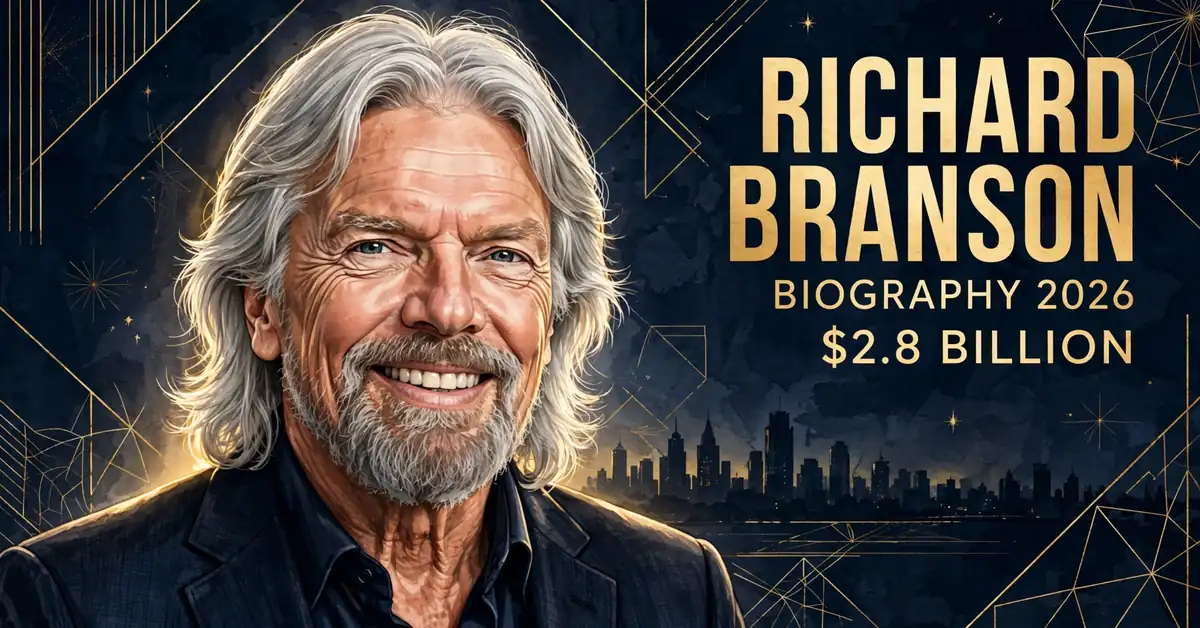
Richard Branson is 76 years old in 2026, worth an estimated $2.8 billion, and still the most famous entrepreneur Britain has ever produced. He left school at 16 with dyslexia and no qualifications, started a student magazine from a school phone box, and turned it into Virgin — a brand that has now stretched across records, airlines, trains, mobile phones, hotels, cruise ships and space tourism. Forbes puts his fortune at $2.8 billion as of July 2026, less than half what it was in 2021, and that fall is part of the story: the pandemic hammered his travel businesses and his listed space ventures lost most of their value.
This biography works through the whole arc, highlight reel included and failures too. The magazine that peaked at 100,000 copies. The record label built on one album, Tubular Bells. The airline launched with a single leased jumbo jet. The painful 1992 sale of Virgin Records for around $1 billion. The spaceflight in July 2021 that put him nine days ahead of Jeff Bezos. And the personal side, including the death of his wife Joan in November 2025 after fifty years together — a loss he announced himself, in his own words, on Instagram.
Branson has spent sixty years turning attention into money and money into more attention. The method never really changed. Find an industry that treats its customers badly, enter it with a cheaper and friendlier version, and make yourself the advertisement. What follows is how that method played out, deal by deal, from a Surrey schoolboy to a knighted billionaire who flew to space in his own spacecraft.
Quick Facts
| Full Name | Sir Richard Charles Nicholas Branson |
| Born | July 18, 1950, Blackheath, London, England |
| Age in 2026 | 76 years old (turned 76 on July 18, 2026) |
| Net Worth | Estimated $2.8 billion (Forbes, July 2026; range $2.5–3.5 billion) |
| Height | 6 ft (183 cm) |
| Occupation | Founder of the Virgin Group; entrepreneur, author, adventurer |
| Education | Scaitcliffe School; Stowe School (left at 16, no degree) |
| Known For | Virgin Records, Virgin Atlantic, Virgin Galactic; first founder to fly to space in his own spacecraft (2021) |
| Marital Status | Widowed — wife Joan Templeman died November 24, 2025, aged 80; first wife Kristen Tomassi (1972–1979) |
| Children | Holly and Sam Branson (a third child, a daughter, lived four days) |
| Major Honour | Knighted in 2000 for services to entrepreneurship |
| Famous Purchase | Necker Island, bought 1978 for $180,000, now valued around $200 million |
How This Biography Was Put Together
This profile is built from named, checkable sources rather than the unsourced roundups that dominate the Branson search results. The backbone is the Encyclopaedia Britannica biography and the EBSCO Research Starters entry, cross-checked against Wikipedia’s sourced biography and Encyclopedia.com. The fortune figure comes from Forbes reporting as of July 2026, with the 2021–2026 fall documented by Fortune (April 2024) and Wealthy Gorilla (updated November 5, 2026). The account of Joan Branson’s death and the September 2026 inquest comes from the Westminster Coroner’s Court reporting carried by The Australian Women’s Weekly, Internewscast and Health and Me in September 2026.
Where sources disagree, this article says so instead of picking the flattering number. The net-worth range is $2.5–3.5 billion because that is the spread across 2026 sources; the $2.8 billion anchor is the Forbes figure, named and dated. The knighthood is dated to 2000, the year of the ceremony, though some sources cite 1999, the year the honour was announced. Every figure that is an estimate is labeled one. Nothing here comes from an anonymous “sources say”.
Dates and ages were checked against the calendar for November 2026: Branson turned 76 on July 18, 2026, and Joan Branson died on November 24, 2025, aged 80. If new reporting changes a figure in this article, it will be updated with a dated note.
+
Early Life: Blackheath, Dyslexia and a School That Never Fit
Richard Charles Nicholas Branson was born on July 18, 1950, in Blackheath, London, the eldest of three children of Edward James Branson, a barrister, and Eve Huntley Branson, a former ballet dancer and air hostess who later became an entrepreneur in her own right. The family moved to Shamley Green in Surrey, and the childhood that followed was comfortable, middle-class, and — by Branson’s own account — shaped less by privilege than by a learning difficulty nobody had a name for at the time.
Branson has dyslexia. At Scaitcliffe, his preparatory school, and then at Stowe School in Buckinghamshire, he performed badly in the classroom. Reading and spelling came slowly; exams were a wall. What the schools missed, and what his mother spotted early, was that the boy who could not spell could sell, persuade and organise. Eve Branson encouraged the risk-taking rather than punishing it — a parenting choice that looks, in hindsight, like the single most valuable investment in the Virgin story.
He left Stowe at 16, without finishing secondary school and without going on to university. Most biographies treat that as the dramatic exit. It is worth pausing on what it actually meant in 1966: a sixteen-year-old with no qualifications, no trade, and no family business to inherit, walking out of the only system that was supposed to turn him into something. The next thing he did was start a magazine. The one after that was to build an empire. The gap between those two facts is the whole biography.
Student Magazine: The 16-Year-Old Publisher
In 1966, at sixteen, Branson and a school friend, Nick Powell, started Student, a magazine for secondary-school and university students. The first issue appeared in January 1968. The idea was simple and, for the time, sharp: young people were a market nobody was speaking to seriously, and a magazine that treated them as readers rather than children could sell advertising to companies that wanted their attention.
Branson ran the magazine out of a basement and, famously, from a school phone box, cold-calling advertisers and famous people alike for interviews. The interviews were the trick. He wrote to Mick Jagger, to Jean-Paul Sartre, to the people a schoolboy had no business reaching — and some of them said yes. At its peak, Student reached a print run of around 100,000 copies, according to Encyclopedia.com. For a magazine run by teenagers, that was a real business, not a school project.
The magazine also taught him the lesson that would carry through every Virgin company: attention is a currency, and you can trade it for money if you are shameless enough to ask. It also taught him the other side of the trade. Student began losing money. Rather than watch it die slowly, Branson pivoted the operation toward the thing that was actually selling: records by mail order. The magazine closed; the pivot became Virgin.
Virgin Records: From Mail Order to Tubular Bells
In 1970 Branson set up Virgin Mail Order Records, selling records by post at prices undercutting the high street. The name came from a suggestion that the founders were complete virgins at business — beginners, in other words, and happy to say so. In 1971 he opened the first British discount record store on Oxford Street in London. In 1972 he bought The Manor, a country house in Oxfordshire, and turned it into a recording studio.
Virgin Records itself was founded in 1973, and its first release decided everything that followed. Mike Oldfield’s Tubular Bells, recorded at The Manor, became a hit on a scale nobody at the tiny label expected. The album’s royalties gave Virgin the cash to sign more artists and, just as importantly, gave the label a reputation: this was the place that would back strange, ambitious music the big labels passed on.

The business model mattered as much as the taste. Virgin sold records cheaper than the established chains, advertised directly to the young customers the big retailers ignored, and kept the operation lean. The label grew through the 1970s on that combination: low prices, direct marketing, and a roster that felt current in a way the majors did not. By the end of the decade, Virgin Records was no longer a scrappy upstart. It was a force in British music.
The Sex Pistols Gamble and the Punk Years
In 1977 Branson signed the Sex Pistols, and the decision shows the Virgin method at its purest. The band had already been dropped by two labels. They were, by any conventional measure, a commercial risk and a public-relations problem. Branson saw the opposite: a band every young person in Britain was talking about, available at a discount because the industry was frightened of them.
The signing worked. Virgin became the principal label of punk and new wave, and the association gave the brand an edge it kept for decades: Virgin was the company that backed the outsider. Culture Club followed, then the Rolling Stones in the 1990s. The label’s catalogue became the asset that would later save the airline — a fact Branson has never hidden and has clearly never forgiven himself for, even though the sale was his own decision.
There is a temptation to treat the Sex Pistols story as a stunt. It was a business decision with a stunt’s publicity attached. The records sold. The label’s revenues grew. And the Virgin name, which had started on a student magazine, now meant something specific to a generation: the brand that was on your side against the establishment. That meaning would be worth billions in the decades that followed, because it could be pasted onto any industry Branson chose to enter next.
Virgin Atlantic: One Leased 747 Against British Airways
In June 1984 Branson became the majority backer of an airline he renamed Virgin Atlantic Airways. It launched with a single leased Boeing 747 flying between London and New York. The established carrier, British Airways, was bigger, richer, and — as the years of fare wars and legal battles that followed would show — not above fighting dirty to protect its routes.
The airline’s pitch was the same one Virgin had used on records: the incumbent treats customers badly, so offer them something better for less and make a noise about it. Virgin Atlantic put money into service, food, entertainment and attitude at a time when transatlantic flying was grim for anyone not in first class. It worked slowly, then all at once. The airline survived the threat of foreclosure in its early years and grew, in time, into one of the world’s best-known long-haul brands.
What the airline also did was nearly kill the group. Running an airline burns cash the way a record label never did, and the early 1990s brought a recession and a fare war at the same time. Virgin Atlantic needed money urgently, and the only asset big enough to provide it was the record label. That is why 1992 happened, and why Branson still talks about it as the worst day of his business life.
Selling Virgin Records: The id=”selling-virgin-records” Billion Heartbreak
In 1992, after 22 years at the helm of the label he had built from a mail-order operation, Branson sold the Virgin Music Group to Thorn EMI for a sum near one billion dollars. The money went to the airline. The decision was forced by the numbers — Virgin Atlantic was losing money it did not have, and the recession had cut off every other source of funding — but the price was personal.
Branson has written and said, repeatedly, that selling the label was the hardest business decision he ever made. The records business was his first success and his identity. The airline was a gamble on a future he could not yet see. He chose the future and paid for it with the past, and the choice is the clearest window into how he thinks: a business is a vehicle, not a child. When the vehicle that got you here cannot carry you further, you trade it, even if it hurts.
The sale also reveals something the hagiographies skip. Branson’s empire was not a smooth upward curve. It was a series of near-death experiences, each solved by selling something, borrowing something, or betting the whole company on the next idea. The $1 billion from Thorn EMI bought Virgin Atlantic its survival. Within a few years the airline was profitable, and the group was bigger than it had ever been. The trade worked. It still cost him the company he loved most.
The Virgin Empire: 400 Companies, One Brand
From the 1990s onward, Branson ran Virgin as a brand licensing machine. The model was simple: find a deregulating or badly served industry, enter it with a Virgin-branded challenger, take a minority stake and a licensing fee, and let local management run the operation. Over the years, more than 400 companies have carried the Virgin name, according to CEO.wiki and the British Journal’s 2026 profile. The list runs from Virgin Atlantic and Virgin Galactic to Virgin Voyages, Virgin Hotels, Virgin Mobile and Virgin Money.
The genius of the model was that the brand did the heavy lifting. Customers who trusted Virgin Records trusted Virgin Atlantic; customers who trusted the airline trusted the mobile network. Each new venture borrowed credibility from the last one, and the licensing fees flowed back to the group without the group having to run every business itself. It also meant the failures were contained: when a Virgin venture died, the brand survived, because the brand was never the business. It was the promise.
The model had a cost, and it shows in the fortune. Virgin Group is privately held and publishes no consolidated accounts, which is why every net-worth figure for Branson is an estimate built from public shareholdings, property records and licensing income rather than an audited balance sheet. Forbes’ $2.8 billion figure for July 2026 is an informed approximation of a sprawling, opaque empire — and the honest reporting says so, rather than pretending to a precision nobody has.
Virgin Galactic: The Space Gamble
In 2004 Branson founded Virgin Galactic, a space tourism company built around the SpaceShipTwo suborbital spaceplane, based at the Mojave Air and Space Port in California. The pitch was the most audacious version of the Virgin method yet: take the most exclusive experience on Earth — going to space — and sell it to people rich enough to pay. Tickets were priced at hundreds of thousands of dollars. The waiting list filled up.
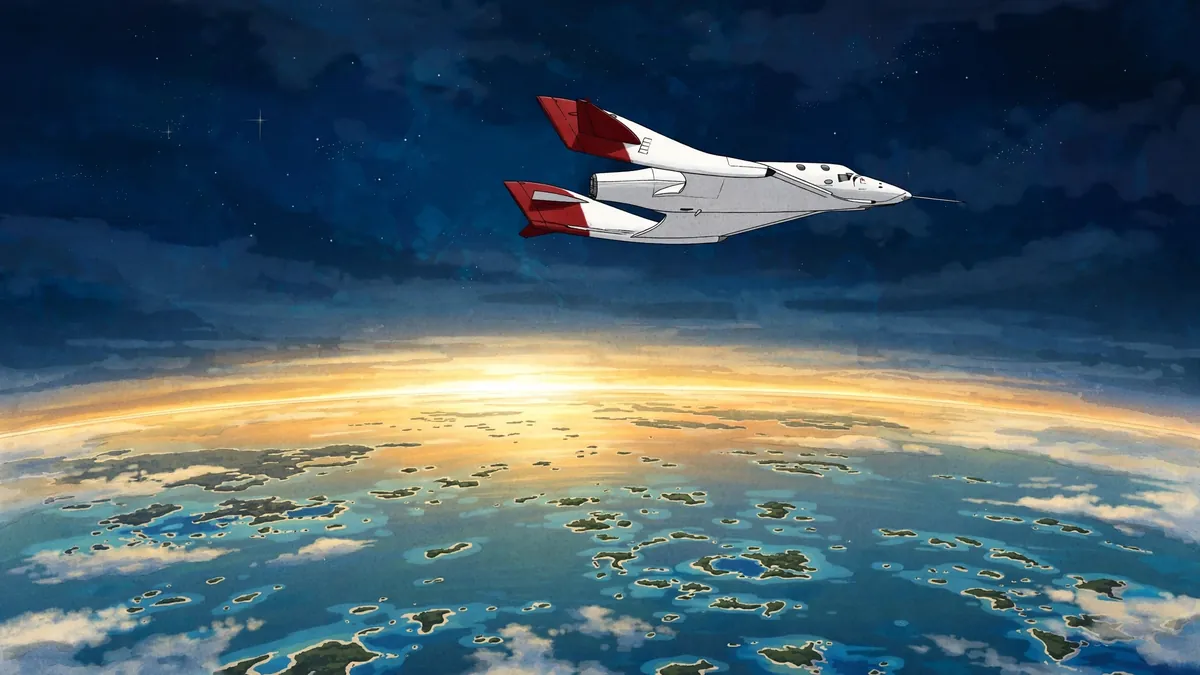
The road to space was longer and darker than the pitch suggested. In 2014 a SpaceShipTwo test flight broke apart over the Mojave Desert, killing test pilot Michael Alsbury. Branson flew to the site the same day and stayed with the team through the investigation. The programme continued, but the crash is the fact that belongs in any honest account of the space venture: a man died building the rocket Branson would later ride.
On July 11, 2021, Branson flew aboard Unity 22, becoming the first founder of a space company to travel to space in his own spacecraft — nine days ahead of Jeff Bezos. He has said he spent more than $1 billion of his own fortune on Galactic, according to Forbes reporting cited by UNLEASH. The flight was a triumph of publicity and a financial disappointment: the company’s listed value collapsed in the years that followed, and it is one of the two reasons — the pandemic’s damage to travel is the other — that his fortune fell by more than half from its 2021 peak.
The Adventurer: Balloons, Boats and World Records
Branson’s record attempts were never a hobby bolted onto the business. They were the business, in another form. In 1986 he was part of a two-man team that set a record for the fastest Atlantic crossing by powerboat. In 1987 he and Per Lindstrand became the first to cross the Atlantic in a hot-air balloon. In 1991 they did the same across the Pacific. Each attempt generated the kind of global publicity that money cannot buy, and each one put the Virgin name in front of audiences that had never bought a record or a plane ticket.
The attempts also nearly killed him more than once, and he has never pretended otherwise. The balloon flights, in particular, involved days over open ocean in a craft that could not be steered. The risk was the point, in the same way it was the point in business: a man who will bet his life on a balloon is a man customers believe will bet his company on them. The stunts and the strategy were the same thing, and the press coverage they earned was worth more than any advertising budget Virgin ever had.
That is the part of the Branson story that imitators usually get wrong. They copy the stunts and skip the arithmetic. The balloon crossings were cheap compared with a global advertising campaign, and they worked because the product behind them — the airline, the label, the brand — was real. A stunt without a business behind it is a hobby. Branson’s stunts always had a business behind them.
How Rich Is Richard Branson in 2026?
Forbes estimates Richard Branson’s net worth at $2.8 billion as of July 2026, ranking him around 1,477th among the world’s billionaires. Wealthy Gorilla’s profile, updated November 5, 2026, lists the same $2.8 billion, and Forbes Africa’s August 2026 reporting cites the Forbes figure too. That is the anchor this article uses. The honest range across 2026 sources runs from $2.5 billion (Celebs InfoSeeMedia) to $3.5 billion (EatHealthy365, which cites Forbes and Bloomberg without a dated figure). The $2.8 billion number is the one with a date and a methodology attached, so it leads.
The figure that matters more than the anchor is the fall. In 2021 Branson was worth around $5.9 billion by Forbes’ count. Fortune reported in April 2024 that his wealth had fallen by more than half since then, to around $3 billion, dragged down by pandemic losses at his travel businesses and the collapse in value of his listed space ventures. Wealthy Gorilla records a two-decade low of $2.1 billion in 2024, with a partial recovery to $2.8 billion since. The trajectory is the story of the last five years: a fortune built on travel and space, cut in half by a pandemic and a stock-market rout, now clawing back as Virgin Atlantic returns to profit and Virgin Australia relists.
| Year | Estimated net worth | What the number reflects |
|---|---|---|
| 1992 | $1.2 billion | Forbes billionaires debut; the year Virgin Records was sold |
| 2021 | ~$5.9 billion | Pre-pandemic peak; the year of the Unity 22 spaceflight |
| 2024 | $2.1 billion | Two-decade low; pandemic travel losses, space stocks collapsed |
| April 2024 | ~$3 billion | Fortune: “fallen by more than half since 2021” |
| July 2026 | $2.8 billion | Forbes; Virgin Atlantic profitable, Virgin Australia relisted |
Two exits softened the fall. Virgin Money was sold in a deal City AM valued at around £724 million for Branson in stake proceeds and brand fees. Virgin Australia went back on the stock market. And Virgin Atlantic, the business that nearly sank the group in the 1990s, returned to profit. The fortune is smaller than it was, but the businesses behind it are, by most measures, healthier than they were at the peak. That is the difference between a paper fortune and a real one, and it is why the $2.8 billion figure is more solid than the $5.9 billion ever was.
Necker Island: The 0,000 Purchase Now Worth 0 Million
Branson bought Necker Island, a 74-acre private island in the British Virgin Islands, in 1978 for $180,000. The story, as he tells it, is that he first offered far less, was refused, and came back with a price the owner would accept — then spent years and millions building it into the private resort it is today. WebTribunal’s 2026 survey puts the island’s current value at more than $200 million. It is the single best investment he ever made, measured as a multiple: roughly a thousand times the purchase price.
Necker is also where his life happened. He married Joan there in 1989. His children grew up visiting it. The family home there burned down in 2011 after a lightning strike — his mother Eve, then 90, was in the house and escaped unhurt — and he rebuilt it. Joan fell there in 2025, the fall that led to her death weeks later. The island is, in that sense, the whole biography in one place: the bargain, the building, the family, and the loss.
The island earns its keep as a luxury resort, rented out at tens of thousands of dollars a night when the family is not using it, with staff, a beach club and the kind of privacy money usually cannot buy. It is also the clearest example of Branson’s eye for assets: he bought something nobody else wanted, at a price nobody else would pay, and turned it into the most famous private island in the world.
Personal Life: Joan, Holly, Sam and a 50-Year Partnership
Branson married Kristen Tomassi in 1972. The marriage ended in divorce in 1979, and they had no children. In 1976, at The Manor recording studio in Oxfordshire, he met Joan Templeman, a Glaswegian who worked in an antiques shop and had no interest in the music business. They began a relationship that lasted, in Branson’s words, for fifty years.
Three children were born before their marriage: a daughter who lived for four days, a daughter, Holly, and a son, Sam. Branson and Joan married on Necker Island in 1989. Joan stayed out of the spotlight for most of those decades — she was, by every account including her husband’s, the steady centre of the family while he chased balloons, airlines and rockets. Holly and Sam both work in the family orbit today: Holly in the Virgin foundation and health work, Sam as a filmmaker and founder of the Sundog Pictures production company.
On November 24, 2025, Joan Branson died at the Lister Hospital in London, aged 80, after a cardiac arrest caused by a pulmonary embolism. She had been admitted on November 17 after a fall on Necker Island fractured her pelvis and right hip. Branson announced her death himself on Instagram on November 25, writing: “Heartbroken to share that Joan, my wife and partner for 50 years, has passed away. She was the most wonderful mum and grandmum our kids and grandkids could have ever wished for.” In September 2026, a Westminster Coroner’s Court inquest concluded that her death could probably have been prevented: despite a history of blood clots and being assessed at very high risk of deep vein thrombosis, she was not given prophylactic anticoagulant medication during her hospital stay. Senior coroner Professor Fiona Wilcox found that the lack of anticoagulation probably caused or contributed to her death.
The inquest findings are reported here because they are a matter of public record and because they are part of the story of Branson’s 2026. He has not hidden from them. In the months after Joan’s death he wrote publicly about their final year together, about being at her side when she died, and about the fifty years that came before. The biography of a man who spent his life performing in public ends, for now, with the most private chapter of all — and it is the one he has talked about most openly.
The Failures He Doesn’t Hide
Any honest biography of Branson has to give the failures the same space as the wins, because he gives them that space himself. Virgin Cola, launched to take on Coca-Cola, failed. Virgin Cars failed. Virgin Brides failed. Virgin Orbit, the satellite-launch company once valued at around $4 billion, went bankrupt in 2023. Virgin Galactic, the venture he poured more than $1 billion of his own money into, has lost most of its stock-market value since the 2021 flight.
The pattern in the failures is the same as the pattern in the wins, and that is the useful part. Branson enters industries where the incumbent is hated, and sometimes the incumbent is hated for a good reason — because the economics are brutal. Airlines, space, cola: these are businesses where the margins are thin, the capital costs are enormous, and the brand alone cannot save you. The Virgin name could get customers through the door. It could not make a rocket company profitable.
What the failures did not do was sink him, and the reason is structural. The licensing model meant most Virgin failures were someone else’s money as well as his, and the group’s private structure meant a bad year never became a public collapse. The fortune fell from $5.9 billion to $2.1 billion, which is a catastrophe by any normal measure — and the group survived it, restructured, and is growing again. That survival is the real skill in the biography, more than any single deal.
Philanthropy: The Elders, Ocean Unite and Giving Back
In 2007 Branson co-founded The Elders with Nelson Mandela and Archbishop Desmond Tutu — a group of independent global leaders working on peace, health and climate. The idea came from Mandela and from the singer Peter Gabriel, and Branson’s role was the practical one: funding, organisation, and the use of his name to open doors. The Elders remains active, and it is the philanthropic project Branson is most closely associated with.
Virgin Unite, the group’s non-profit arm, backs entrepreneurs in developing countries and funds work on ocean conservation through Ocean Unite, which Branson co-founded. He has also put his name and money behind climate campaigns, including a 2006 pledge to invest $3 billion of Virgin’s transport profits in renewable energy over ten years — a pledge that drew scepticism at the time, and that critics, including CEO.wiki’s 2026 profile, have noted was never fully delivered in the form announced.
The honest version of the philanthropy section is that it is real and it is incomplete, like the fortune. The Elders is a serious institution. The ocean work has funded real conservation. The climate pledge is a reminder that Branson’s promises, like his business plans, are best judged by what actually happened rather than by the press release. Both halves belong in the record.
What Branson’s Story Actually Teaches
Strip away the balloons and the beard, and the Branson biography comes down to four habits. First, he starts before he is ready: a magazine at sixteen, an airline with one leased plane, a space company with no rocket. Second, he sells the story before he sells the product — the interview, the stunt, the press conference are the marketing, and they cost less than advertising. Third, he protects the downside by licensing the brand instead of owning every business, so a failure costs him a venture rather than the group. Fourth, he keeps going after the failure: the label was sold, the airline survived, the rocket company went bankrupt, and he is still building.
The dyslexia is part of the story, not a decoration on it. A boy who could not read well learned to listen well, to delegate the paperwork, and to judge people quickly — and those became the management skills that ran a 400-company group. He has said that if he had been good at school, he would probably have stayed in it. The school system lost a mediocre student. The business world gained its most famous dropout.
At 76, with a $2.8 billion fortune, a spaceflight behind him and his wife of fifty years gone, Branson is still working. The biography is not finished, and any article that pretends to close it would be lying. What can be said, with the evidence of November 2026, is this: no entrepreneur of his generation did more with less formal preparation, lost more in public, or came back more often. That is the record. The rest is still being written.
Sources & Reporting
This biography was reported from named sources, all checked in November 2026. The core life story follows the Encyclopaedia Britannica biography of Richard Branson (updated March 2025) and the EBSCO Research Starters biography, cross-checked against Wikipedia’s sourced biography and Encyclopedia.com’s entry, which supplied the Student magazine peak circulation of 100,000 and the 1977 Sex Pistols signing detail. The fortune figure is Forbes’ $2.8 billion estimate as of July 2026, reported by WealthFuture (July 2026) and Wealthy Gorilla (updated November 5, 2026), with the 2021–2024 fall documented by Fortune (April 2024) and the $2.1 billion low recorded by Wealthy Gorilla. The Virgin Money exit figure of around £724 million comes from City AM reporting cited by WealthFuture. The Virgin Orbit bankruptcy (2023, once valued ~$4 billion) and the $1 billion-plus personal spend on Galactic come from Nation Now and UNLEASH’s Forbes-cited reporting. Height (6 ft / 183 cm) comes from Celebs InfoSeeMedia (June 2026).
The account of Joan Branson’s death and the September 2026 inquest follows reporting from The Australian Women’s Weekly (September 10, 2026), Internewscast (September 10, 2026), Health and Me (September 10, 2026) and Hemostasis Today, all reporting the Westminster Coroner’s Court findings of Senior Coroner Professor Fiona Wilcox. Branson’s own Instagram announcement of November 25, 2025 is quoted from the Attitude report of November 26, 2025. Where sources disagreed — the net-worth range, the knighthood year — the article names the disagreement and gives the reason for the figure chosen. Figures that no outlet has confirmed are labeled as reported or illustrative. Corrections: see our corrections policy on the About Us page; if a figure in this article changes, it will be updated with a dated note.
Richard Branson Biography — Frequently Asked Questions
How old is Richard Branson in 2026?
Richard Branson is 76 years old in 2026. He was born on July 18, 1950, in Blackheath, London, and he turned 76 on July 18, 2026. Many older biography pages still list him as 74 or 75 because they were written years ago and never updated.
What is Richard Branson’s net worth in 2026?
Richard Branson’s net worth is estimated at $2.8 billion in 2026, according to Forbes (July 2026), with Wealthy Gorilla (updated November 5, 2026) listing the same figure. The honest range across 2026 sources is $2.5–3.5 billion. His fortune peaked at around $5.9 billion in 2021 and fell to a low of $2.1 billion in 2024, hurt by pandemic travel losses and the collapse in his listed space ventures.
How did Richard Branson start Virgin?
Branson started with Student magazine in 1966, at age 16. When the magazine began losing money, he pivoted to mail-order records in 1970, opened a discount record shop on Oxford Street in 1971, and founded Virgin Records in 1973. The label’s first release, Mike Oldfield’s Tubular Bells, was the hit that funded everything that followed.
Did Richard Branson go to space?
Yes. On July 11, 2021, Branson flew aboard Virgin Galactic’s Unity 22, becoming the first founder of a space company to travel to space in his own spacecraft — nine days before Jeff Bezos flew on Blue Origin. He has reportedly spent more than $1 billion of his own fortune on Virgin Galactic.
Is Richard Branson married?
No — Branson is widowed. His wife Joan Templeman, his partner for 50 years, died on November 24, 2025, aged 80, after a fall on Necker Island led to a fatal pulmonary embolism. They married on Necker Island in 1989 and had two children, Holly and Sam. His first wife, Kristen Tomassi, was married to him from 1972 to 1979.
What companies does Richard Branson own?
Branson founded the Virgin Group, and more than 400 companies have carried the Virgin name over the years, including Virgin Atlantic, Virgin Galactic, Virgin Voyages, Virgin Hotels and Virgin Mobile. The group is privately held and works largely by brand licensing, so Branson owns stakes and licensing rights rather than running every company directly. Virgin Money has been sold and Virgin Orbit went bankrupt in 2023.
How tall is Richard Branson?
Richard Branson is 6 feet tall (183 cm), according to Celebs InfoSeeMedia’s June 2026 profile. He is often photographed alongside much taller figures at Virgin events, which is why the question comes up so often in search.
Why did Richard Branson sell Virgin Records?
Branson sold the Virgin Music Group to Thorn EMI in 1992 for around $1 billion because Virgin Atlantic needed the money. The airline was losing cash during a recession and a fare war, and the record label was the only asset large enough to fund it. He has called it the hardest business decision he ever made.
About the author: Nathan Cole covers celebrity wealth, business, and the people behind famous fortunes for Guide Net Worth. He reports net-worth figures only from named outlets, gives ranges where sources disagree, and updates every profile when new reporting lands.
References & Sources
This article has been fact-checked and verified against multiple public sources, financial disclosures, SEC filings, Forbes reports, Celebrity Net Worth databases, and official records. All net worth estimates are based on publicly available information and financial analysis.