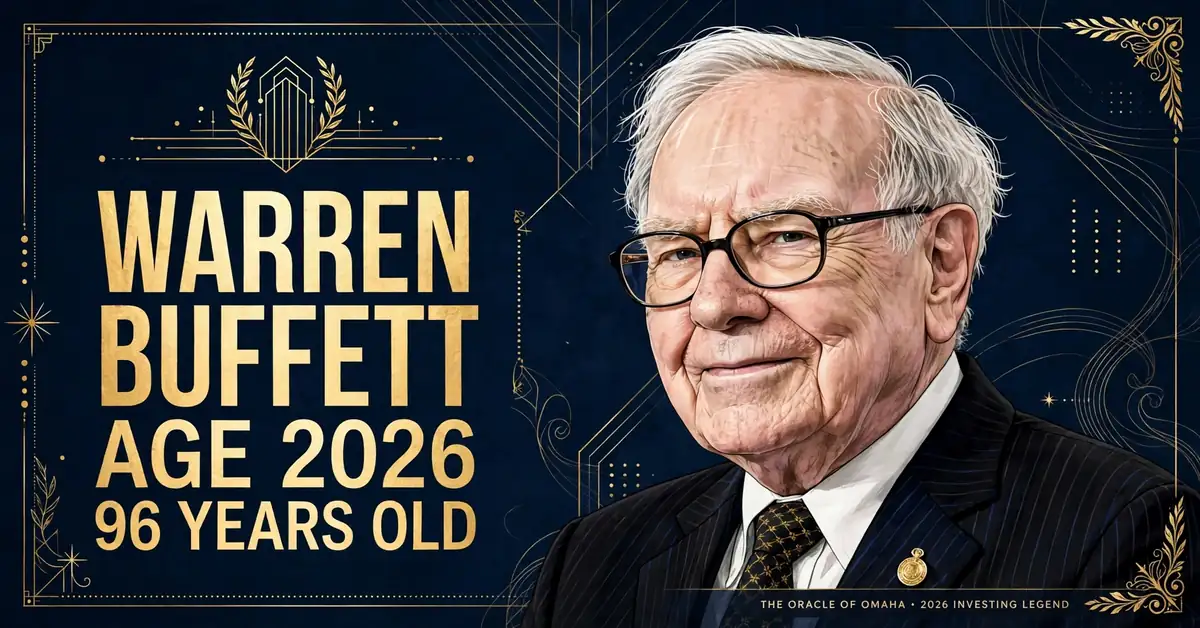
Warren Buffett’s age is 96 in 2026 — born August 30, 1930, in Omaha. He handed Berkshire to Greg Abel, kept a $162B fortune, and still lives in his 1958 house.
Last updated: November 21, 2026 · By Nathan Cole
Warren Buffett is 96 years old in 2026. Born Warren Edward Buffett on August 30, 1930, in Omaha, Nebraska, the man known as the Oracle of Omaha turned 96 on August 30, 2026 — and he spent that birthday year doing something no investor of his stature had ever done before: handing over the company he ran for six decades. Greg Abel took over as chief executive of Berkshire Hathaway on January 1, 2026, and on September 18, 2026, Buffett stepped down as chairman too, with his son Howard Buffett taking the chair. Buffett stayed on as chairman emeritus, a director, and Berkshire’s largest individual shareholder.
The age matters because the money still does. At 96, Buffett’s fortune sits at about $162 billion — a range of $149 billion to $168 billion across 2026 trackers, with Forbes’ real-time list putting him at roughly $162 billion and seventh-richest in the world on November 17, 2026. He has given away more than $72 billion over his lifetime, according to Forbes, and his will directs 99 percent or more of what remains to philanthropy. He still lives in the same Omaha house he bought in 1958 for $31,500, still draws a $100,000 salary, and still drinks Cherry Coke for breakfast.
This profile answers the age question properly: the birthdate and the arithmetic, the full life-by-age timeline from a six-year-old selling gum door to door to a 96-year-old chairman emeritus, the 2025–2026 handover in detail, the health and daily routine at 96, the fortune at 96, and how his age stacks up against the other billionaires on the 2026 rich list. Every figure carries a named source and a date, and where sources disagree, both sides are shown.
Quick Facts
| Full Name | Warren Edward Buffett |
| Born | August 30, 1930, Omaha, Nebraska, USA |
| Age (2026) | 96 — turned 96 on August 30, 2026; turns 97 on August 30, 2027 |
| Parents | Howard Buffett (stockbroker, congressman); Leila Stahl Buffett |
| Spouses | Susan Thompson (married 1952; died July 2004); Astrid Menks (married 2006) |
| Children | Susie, Howard and Peter Buffett |
| Career | Founder, Buffett Partnership (1956); chairman & CEO, Berkshire Hathaway (1965–2025); chairman emeritus (2026–present) |
| Net Worth (2026) | ~$162 billion (range $149B–$168B; Forbes real-time, Nov 17, 2026) |
| Given Away | Over $72 billion (Forbes); 99%+ of estate directed to philanthropy |
| Residence | Omaha, Nebraska — same house bought 1958 for $31,500 |
How This Age Was Verified
Warren Buffett’s birthdate — August 30, 1930 — is one of the best-documented dates in American business. It appears in his Wikipedia biography, in Britannica Money’s profile (updated October 18, 2026), and in Berkshire Hathaway’s own releases, which have tracked his age across six decades of annual meetings. The arithmetic is simple: 2026 minus 1930 is 96, and because his birthday falls on August 30, he was 95 through the first eight months of 2026 and 96 from August 30 onward. That is why many profiles still say 95 — they were written or last updated before his birthday, or they quote a Forbes snapshot from earlier in the year. Any page that calls him 95 in November 2026 is stale. The handover dates in this profile come from Berkshire Hathaway’s own announcements and from Britannica Money and TheStreet’s November 2026 reporting: Abel became chief executive on January 1, 2026, and Buffett stepped down as chairman on September 18, 2026. The net-worth figures are dated Forbes snapshots, not a single frozen number, because a fortune tied to Berkshire stock moves with the market.
+
How Old Is Warren Buffett in 2026?
Warren Buffett is 96 years old. He was born on August 30, 1930, which means he turned 96 on August 30, 2026. He will turn 97 on August 30, 2027, and he will turn 100 on August 30, 2030 — a date that now sits less than four years away and that the investing world has already started talking about, because Buffett has spent his whole career thinking in decades and the century mark is the last round number left on his personal timeline.
The confusion about his age is easy to explain and easy to fix. Through most of 2026, Buffett was 95: he did not turn 96 until late August. Any article written in the spring — including coverage of the May 2026 annual meeting, where he sat in the front row as Greg Abel ran the show for the first time — correctly called him 95 at the time. Those pages then went stale on August 30, and many of them were never updated. If you are reading this in November 2026, the right number is 96, and it will stay 96 until August 30, 2027.
Ninety-six puts Buffett in rare company even among the rich. He is older than almost every other active billionaire by a wide margin, and he has outlived the average American man by about two decades — average US male life expectancy sits near 76. His longtime partner Charlie Munger died in November 2023 at 99, which means Buffett has now spent three years as the last survivor of the partnership that built Berkshire. The age is not a footnote to his story. It is the frame around the handover, the giving, and the fortune itself: everything he did in 2026, he did as a 95- and then 96-year-old man closing out the longest chief-executive run in modern corporate history.
Warren Buffett’s Birthday and Birthplace
Warren Edward Buffett was born on August 30, 1930, in Omaha, Nebraska — the city he has never really left. He was the second of three children and the only son of Howard Buffett, a stockbroker who later served in Congress, and Leila Stahl Buffett. The family lived in Omaha through the Depression years, and the house on the city’s west side where Buffett grew up sat a short drive from the office where his father worked. Omaha is not a detail in Buffett’s biography. It is the whole setting: he was born there, built his fortune there, raised his family there, and still lives there at 96.
The birthdate is recorded the same way in every serious source — Wikipedia, Britannica Money, Berkshire Hathaway’s own filings and releases — and there is no dispute about it, which is more than can be said for most celebrity ages. The year matters as much as the day. Born in 1930, Buffett was 11 when the United States entered the Second World War, 15 when it ended, and 19 when he finished college. He came of age in the postwar boom, started his investment partnership in the Eisenhower years, and took over Berkshire in the mid-1960s, when the American stock market was a fraction of its current size. His age is a map of American financial history: every decade of his life lines up with a different era of the market, and he made money in all of them.
His birthday has become a small annual event in the investing world. Each August 30 brings a round of profiles, and the 96th, in 2026, landed in the middle of the handover year — eight months after Abel became chief executive and a little over two weeks before Buffett gave up the chairman’s seat. The timing gave the birthday a weight it would not otherwise have had: it was the last birthday he celebrated as Berkshire’s chairman, and the first he celebrated as chairman emeritus in waiting. He marked it the way he marks most things — quietly, in Omaha, without the kind of public celebration a man of his wealth could easily stage.
Warren Buffett’s Life by Age: A Timeline
Buffett’s life reads cleanly as a timeline because he started so young and never really stopped. The table below runs from his first sale at six to his last year as chairman at 96. The full story behind each date is covered in Warren Buffett’s full biography on this site, but the timeline alone tells you most of what you need to know: a child who sold things, a teenager who filed a tax return, a young man who learned investing from Benjamin Graham, and an old man who gave most of it away.
| Age | Year | Milestone |
|---|---|---|
| 6 | 1936 | Sold chewing gum and Coca-Cola door to door in Omaha |
| 7 | 1937 | Read “One Thousand Ways to Make $1000” from Omaha Public Library |
| 11 | 1942 | Bought first stock: 3 shares of Cities Service Preferred at $38 |
| 13 | 1943 | Filed first federal tax return; deducted $35 for bicycle and watch |
| 14–17 | 1944–47 | Pinball business with a friend; sold for $1,200 |
| 16 | 1947 | Graduated high school with about $5,000 saved |
| 19 | 1950 | Graduated University of Nebraska–Lincoln |
| 20 | 1951 | Columbia Business School under Benjamin Graham |
| 21 | 1952 | Married Susan Thompson |
| 25–26 | 1956 | Founded the Buffett Partnership with about $100,000 |
| 34–35 | 1965 | Took control of Berkshire Hathaway |
| 41–42 | 1972 | Bought See’s Candies |
| 58 | 1988 | Bought Coca-Cola stake |
| 74 | 2004 | Wife Susan died in July |
| 76 | 2006 | Married Astrid Menks |
| 80 | 2010 | Launched the Giving Pledge with Bill and Melinda Gates |
| 94 | 2025 | Announced CEO retirement at the May 3 annual meeting |
| 95 | 2026 | Greg Abel became Berkshire CEO on January 1 |
| 96 | 2026 | Stepped down as chairman September 18; became chairman emeritus |
Two things stand out in that table. The first is how early the pattern formed: the six-year-old selling six-packs and the 96-year-old running Berkshire are the same person doing the same thing — finding something people want, buying it cheap, and selling it for more. The second is how long the middle stretch ran. From the partnership in 1956 to the chairman’s exit in 2026 is 70 years of continuous investing, which is longer than most people’s entire careers. Buffett did not have one career. He had three or four, stacked end to end, and he was still adding to the last one at an age when most people have been retired for thirty years.
The Childhood Hustles: Ages 6 to 16
Buffett started selling things at six. He bought six-packs of Coca-Cola for 25 cents and sold the bottles door to door for five cents each, and he sold chewing gum the same way, house by house around the Omaha neighborhood. The numbers were tiny — a few cents of profit per sale — but the habit was the point. He was learning, before he could do long division, that money comes from buying low and selling high, and that the work is mostly showing up at the next door.
At seven he found the book that gave the habit a name. “One Thousand Ways to Make $1000,” borrowed from the Omaha Public Library, was a catalogue of small-business ideas, and Buffett read it the way other children read adventure stories. He has talked about it for the rest of his life, and the detail that stuck with him was the compounding: a dollar saved at seven, put to work, becomes something larger at seventeen, and larger still at twenty-seven. The book did not make him rich. It gave him the idea that would.
The teenage years added scale. Between 14 and 17, Buffett and a friend ran a pinball business under the name Wilson Coin Co. They bought a used pinball machine for $25, placed it in a barbershop, and split the takings. It worked well enough that they bought more machines, placed them in more shops, and eventually sold the whole operation for $1,200 — a serious sum in the late 1940s, and a serious return on a $25 machine. By the time he graduated from high school in 1947, at 16, he had about $5,000 saved. That figure is worth pausing on: $5,000 in 1947 was roughly a year’s wages for many American workers, and Buffett had it before he was old enough to vote. He had also learned the lesson the pinball machines taught — that a business you own pays you while you sleep, which is the idea Berkshire Hathaway would later be built on at a scale nobody in Omaha could have imagined.
First Stock at 11: The Cities Service Lesson
Buffett bought his first stock at 11, in 1942. He put his money into three shares of Cities Service Preferred at $38 a share, and he bought three more for his sister Doris. The stock dropped, and Buffett — eleven years old, watching his savings shrink — sold at $40 a share, taking a small profit and a large lesson. The stock then ran to nearly $200. He has told the story for eighty years because the lesson never changed: patience pays, and selling early out of nerves is the most expensive habit an investor can have.
The story is often told as a cute anecdote, but the numbers underneath it are what made Buffett. He was eleven, in the middle of a world war, buying shares of an oil company with money he had earned selling gum and soda. Most eleven-year-olds in 1942 had never heard of a stock. Buffett had a brokerage account, a sister’s money to manage alongside his own, and a father who worked in the business. The head start was real, and he has never pretended otherwise — his father was a stockbroker, and the dinner table was a classroom. What the head start does not explain is the discipline: an eleven-year-old who sells at $40 and then watches the stock hit $200 learns something that most adults never do, and Buffett learned it before puberty.
Two years later, at 13, he filed his first federal tax return. He deducted $35 for his bicycle and his watch, arguing — correctly, in his view — that both were tools of his paper route and his selling rounds. The return was legal, the deduction was small, and the instinct was the same one that would later shape Berkshire’s tax planning: know the rules, use them, and keep a record. A thirteen-year-old who thinks about taxes is a thirteen-year-old who is already thinking like an owner, not an employee.
Education: Wharton, Nebraska, Columbia
Buffett went to the Wharton School at the University of Pennsylvania at 17, in 1947, and left after two years. Wharton was the most prestigious business school in America, and Buffett has been blunt about why he left: he felt he was learning more from books than from lectures, and he wanted to be closer to the work itself. He transferred to the University of Nebraska–Lincoln and graduated in 1950, at 19, with a degree in business administration. He was nineteen years old with a college degree, $5,000-plus in savings from his teenage businesses, and a clear idea of what he wanted to do next.
What he wanted was to study under Benjamin Graham. Graham, the Columbia Business School professor who wrote “The Intelligent Investor” and “Security Analysis,” was the father of value investing — the idea that a stock is a piece of a business, that you should buy it for less than it is worth, and that the market’s daily moods are noise. Buffett applied to Columbia, was accepted, and arrived in 1950 at age 20. The year at Columbia is the most famous year of schooling in investing history, and the most quoted fact about it is that Buffett was, by the widely reported account, the only student ever to earn an A+ in Graham’s class. The claim is lore rather than a document — Columbia did not publish a ranking — but it is repeated in every serious biography, including Wikipedia, and Buffett himself has never disputed it.
The Columbia year did more than teach him a method. It gave him a teacher, a framework, and a standard he would spend the next seventy years applying. Graham taught him to think of the market as a voting machine in the short run and a weighing machine in the long run, and to buy businesses the way a sensible person buys a farm — for what it produces, not for what someone else might pay for it tomorrow. Buffett left Columbia in 1951 with a master’s degree in economics and a letter of recommendation from Graham that mattered less than the ideas themselves. He went home to Omaha, worked briefly in his father’s brokerage, and started looking for his own bargains.
The Partnership Years: Ages 25 to 39
Buffett founded the Buffett Partnership in 1956, at 25, with about $100,000 in assets — some of it his own money, most of it from family and friends in Omaha who trusted a young man with a Columbia degree and a reputation for reading annual reports the way other people read novels. The structure was simple: Buffett managed the money, took a share of the profits above a threshold, and charged nothing if the partnership lost money. The terms were generous to the investors and brutal to the manager, which was the point — Buffett wanted partners, not clients, and he wanted the incentives lined up the way Graham had taught him.
The partnership compounded at roughly 29.5 to 31 percent a year, depending on how the years are counted, and by the time Buffett wound it up in 1969–70 it had grown to about $104 million. The cumulative return was about 2,958 percent, against roughly 185 percent for the Dow Jones Industrial Average over the same stretch. Those numbers are the reason Buffett’s name still carries weight: he did not just beat the market once, in a lucky year. He beat it by a factor of sixteen, for thirteen years, with other people’s money on the line. The partnership years are also where the Buffett style settled into its final shape — buy undervalued businesses, hold them, ignore the market’s moods, and let the compounding do the work.
He closed the partnership at 39 because he thought the market had become too expensive to find bargains, and because he was tired of managing other people’s money. It was a decision that looks strange in hindsight — he was walking away from the best-performing investment vehicle in America — but it fits the pattern of his whole career: he quit while he was ahead, kept his own capital in the game, and moved the operation into a vehicle he controlled outright. That vehicle was Berkshire Hathaway, a struggling textile mill in New England that he had been buying shares in since 1962.
Taking Over Berkshire at 34
Buffett began buying Berkshire Hathaway stock in 1962, at 32, because it looked cheap — a textile company whose shares traded below the value of its assets. He kept buying, and by 1965, at 34, he had enough stock to take control. The takeover itself is one of the most famous stories in business, and the reason is a grudge over an eighth of a dollar. Berkshire’s management had offered to buy Buffett’s shares back at $11.50 each; when the formal tender offer arrived, the price was $11 3/8 — twelve and a half cents less. Buffett, insulted by what he read as a broken promise, refused to sell and bought more stock instead, until he owned the company.
He has called Berkshire the biggest mistake of his investing life, and he has said so in public, in writing, more than once. The textile mill was a dying business in a dying industry, and Buffett spent years pouring money into it before he understood that the right move was to stop feeding the mill and start using it as a holding company — a shell that could own other, better businesses. The mistake cost him time and capital, but it also gave him the platform. Berkshire Hathaway, the name on the door of a failed textile company, became the name on one of the largest companies in the world. The $11 3/8 dispute is the hinge of the whole story: without it, Buffett sells his shares, takes his profit, and goes back to running a partnership. With it, he owns a public company, and everything after 1965 runs through it.
The takeover also set the template for how Buffett would run a company for the next sixty years. He kept the headquarters in Omaha, kept the staff small, kept his own salary low — $100,000 a year, a figure that would not change for decades — and let the managers of the businesses Berkshire bought run those businesses themselves. He bought companies and left them alone, which is the opposite of how most conglomerates work, and it is the reason so many owners were willing to sell to him. The man who took over Berkshire at 34 was not a corporate raider. He was a collector of good businesses, and he stayed one until he was 96.
Building the Empire: Ages 40 to 70
The three decades from 40 to 70 are when Berkshire stopped being a textile mill with ambitions and became an empire. Buffett bought insurance companies first, because insurance gave him something no other business could: float — the premiums customers pay before claims come due, money he could invest while it waited. National Indemnity, bought in 1967, and GEICO, bought in stages through the 1970s and 1990s, turned Berkshire into a machine that generated investable cash every year, rain or shine. The float is the least glamorous and most important part of the Berkshire story. It is the reason Buffett could buy what he wanted, when he wanted, without borrowing.
Then came the consumer brands. In 1972, at 41, Buffett bought See’s Candies, a California chocolate company, for $25 million. See’s was the purchase that changed his thinking: it was not cheap by Graham’s standards, but it was a wonderful business — loyal customers, a product people bought every year, and the power to raise prices without losing sales. Charlie Munger, his partner, pushed him toward it, and Buffett has credited Munger ever since with teaching him that it is better to buy a wonderful business at a fair price than a fair business at a wonderful price. See’s went on to generate more than $2 billion in profits for Berkshire over the following decades, on a $25 million purchase price.

The biggest consumer bet came in 1988, when Buffett was 58. He bought a stake in Coca-Cola, the company whose six-packs he had sold door to door at six, and kept buying until Berkshire owned a large slice of it. The Coca-Cola stake is the most poetic investment in the Berkshire portfolio — the boy who sold Coke became the man who owned part of the company that makes it — and it is also one of the most profitable. Berkshire paid roughly $1.3 billion for its Coca-Cola shares in the late 1980s; the stake has paid billions in dividends since and is worth many times the purchase price today. Buffett still drinks Cherry Coke every day at 96, and the company still pays him for the privilege.
The compounding across those thirty years is the number that defines Buffett’s career. Berkshire Hathaway’s shares compounded at roughly 19.7 to 19.9 percent a year from 1965 to 2025, against about 10.5 percent a year for the S&P 500 with dividends included, according to Berkshire’s own 2025 reporting. The overall gain over that stretch was about 6,100,000 percent for Berkshire, against about 46,000 percent for the index. Those are not typos. A dollar invested in Berkshire in 1965 became roughly $61,000 by 2025; a dollar in the S&P became roughly $460. Berkshire’s market value crossed $1 trillion in August 2024, when Buffett was 93 — the first non-technology American company to reach that mark. The empire was built one purchase at a time, over thirty years, by a man who never moved to New York, never hired an army of bankers, and never paid himself more than $100,000 a year.
Family: Susan, Astrid and the Children
Buffett married Susan Thompson in 1952, at 21. Susan was the social heart of the Buffett household for half a century — the one who hosted, who introduced him to people, who kept the family connected while he read annual reports. They had three children: Susie, Howard, and Peter Buffett. The marriage lasted 52 years, though the last decades of it were unconventional: Susan moved to San Francisco in 1977 to pursue her own life and singing career, and Buffett’s companion in Omaha from 1978 onward was Astrid Menks, a waitress he met at a French cafe in the city. Susan and Astrid knew each other, liked each other, and sent each other Christmas cards. It was, by any normal standard, an unusual arrangement, and Buffett has never hidden it or dressed it up.
Susan died in July 2004, when Buffett was 74. Her death hit him hard — she had been the emotional center of his life since he was 21, and he has said since that the years after her death were the hardest of his life. Two years later, at 76, he married Astrid Menks, formalizing a partnership that had already lasted 28 years. Astrid, who is younger than Buffett and famously private, has been his wife through the last two decades of his career, including the handover years. She rarely appears in public, and Buffett rarely talks about her, which is how she prefers it.
The children took different paths, and Buffett has been careful not to hand them the company. Susie runs the family’s philanthropic work. Howard, the middle child, is a farmer and a conservationist who has served on Berkshire’s board — and who became Berkshire’s chairman in September 2026, when his father stepped down. Peter is a musician and composer. None of the three was groomed to run Berkshire, and Buffett has said plainly that the job should go to the best person, not to a family member. That is why the chief executive’s job went to Greg Abel, an outsider to the family, and why the chairman’s job went to Howard only as a guardian of the culture, not as an operator. The family story, at 96, is a story of a man who kept his money and his children in separate boxes — and who trusted his son to protect the company without running it.
The Giving: Billion and Counting
Buffett has given away more than $72 billion, according to Forbes — the largest sum any living person has ever donated, and a figure that keeps growing because the gifts are made in Berkshire stock, which keeps appreciating. The giving started in earnest in 2006, when he announced that he would donate the bulk of his Berkshire shares to five foundations, led by the Gates Foundation, and it has continued every year since, usually in a large summer gift announced with little ceremony. In 2010, at 80, he went further: he launched the Giving Pledge with Bill and Melinda Gates, a public promise by the world’s richest people to give away at least half their fortunes. More than 240 billionaires have since signed it.
The July 2026 gift was the biggest of the year and the most closely watched. Buffett gave away about $6 billion — roughly 12 million Berkshire B shares — to four family foundations, and for the first time since 2006 the gift left out the Gates Foundation, according to AP and WealthyGarage reporting. The omission was deliberate and widely noted: Buffett has been shifting his giving toward the foundations run by his children, and the 2026 gift made that shift visible. The four recipients were the Susan Thompson Buffett Foundation, named for his late wife, and the foundations run by Susie, Howard, and Peter. The Gates Foundation, which received the largest share of his gifts for eighteen years, received nothing in July 2026.
The plan for what remains is written into his will. Buffett has directed that 99 percent or more of his estate go to philanthropy, and the remaining Berkshire shares are to be donated by December 31, 2034, with his children overseeing the distribution. After his Thanksgiving gift, Berkshire’s November 16, 2026 release stated that he holds 182,140 Class A shares and 1,162 Class B shares — still the largest individual stake in the company, and still worth well over $100 billion at current prices. The giving is not a side project. It is the second half of the Buffett story, and it is the reason the fortune at 96 is smaller than it would otherwise be: he has already given away more than most billionaires will ever have.
Stepping Down: The 2025–2026 Handover
The handover began on May 3, 2025, at Berkshire’s annual meeting in Omaha. Buffett was 94. Near the end of the meeting, in a moment that caught even his own board off guard, he announced that he would step down as chief executive at the end of the year and that Greg Abel, Berkshire’s vice chairman for non-insurance operations, would take over. The room — tens of thousands of shareholders in the CHI Health Center arena — rose and applauded for minutes. Buffett had run Berkshire for sixty years. He gave the job away in a sentence.
Abel became chief executive on January 1, 2026, when Buffett was 95. His first shareholder letter arrived on February 28, 2026, and it set the tone for the new era: Berkshire’s 2025 operating earnings were $44.5 billion, and its cash and Treasury holdings stood at over $370 billion, according to Abel’s letter as reported. Abel’s first annual meeting as chief executive followed on May 2, 2026, in Omaha, with Buffett sitting in the front row, watching the meeting he had run for six decades from the audience. He gave a 30-minute backstage interview to CNBC’s Becky Quick during the meeting — still sharp, still funny, still answering questions about the market the way he always had, only now as a spectator rather than a boss. Berkshire retired his No. 60 jersey at the meeting, hanging it beside Charlie Munger’s No. 45 — a sports tribute for a man who never played professional sports, and a sign of how the company now thinks of him: a retired number, not a departing employee.

The final step came on September 18, 2026, eighteen days after Buffett’s 96th birthday. He stepped down as chairman, and his son Howard Buffett became chairman in his place. Buffett became chairman emeritus, a title that carries honor and no operating authority, and he remained a director and Berkshire’s largest individual shareholder, according to Britannica Money (updated October 18, 2026) and TheStreet’s November 2026 reporting. The board’s message was clear: Howard’s job is to protect the culture — the decentralization, the patience, the refusal to chase fashion — while Abel runs the business. Buffett himself has said he will stay available to Abel, and Abel has said he will call. The handover, by the standards of corporate succession, went as smoothly as anyone could have hoped: two dates, two men, no drama, and a 96-year-old founder still sitting in the front row.
Life at 96: Health, Diet and Daily Routine
Buffett’s daily life at 96 looks a lot like his daily life at 66, which is the point he makes whenever anyone asks. He still lives in the same Omaha house he bought in 1958 for $31,500 — a five-bedroom home in the Dundee neighborhood that he has refused to trade for anything grander, even though he could buy a street of them with a day’s dividends. He still drives himself to the office, still works from the same desk, and still has no computer on it. The desk has a telephone, a newspaper, and a stack of annual reports. The rest of the world went digital. Buffett did not.
The diet is the most famous part of the routine, and the least advisable. Buffett has said, in his own words, “I eat like a six-year-old,” and the menu backs him up: Cherry Coke through the day, a McDonald’s breakfast most mornings, and a fondness for See’s Candies and Dairy Queen — both Berkshire companies, which means he is, in a sense, eating his own inventory. TheStreet’s November 2026 headline put it plainly: “Warren Buffett, 96, credits Coke and McDonald’s for his long life.” Doctors would not recommend it. Buffett, who has outlived the average American man by two decades, is not asking for their approval. He has also said that he drinks about five cans of Coca-Cola a day and that the sugar has never seemed to hurt him, which is a claim about his own body, not a health recommendation, and it should be read that way.
The workday is built around reading. By his own account, Buffett spends five to six hours a day reading — annual reports, newspapers, trade publications, and the occasional book — and he has done so for decades. The reading is the job: he is not managing people or attending meetings, he is absorbing information and waiting for a price that makes sense. The routine held through 2026, with one interruption: CNBC reported that Buffett broke his leg earlier in the year (covered by networth.com), an injury that slowed him down but did not stop him from attending the May annual meeting or giving the backstage interview with Becky Quick. At 96, the routine is the story. He reads, he drinks Cherry Coke, he goes home to the house he bought in 1958, and he does it again the next day.
Warren Buffett’s Net Worth at 96
Warren Buffett’s net worth at 96 is about $162 billion, with a range of $149 billion to $168 billion across 2026 trackers. The range exists because the fortune is almost entirely Berkshire Hathaway stock, and Berkshire’s share price moves — a few percent in either direction is a few billion dollars. Forbes’ real-time tracker put him at roughly $162 billion and seventh-richest in the world on November 17, 2026. Earlier in the year the same tracker had him lower: $148.9 billion and ninth in January 2026, and $148.9 billion and tenth on October 14, 2026. The movement between those snapshots is the market, not a change in Buffett’s life — he was not buying or selling in any meaningful way. The full breakdown of the figure, the share count behind it, and the range around it is laid out in Warren Buffett’s net worth in 2026 on this site.
The share count is the hard anchor underneath the estimate. After his Thanksgiving gift, Berkshire’s November 16, 2026 release stated that Buffett holds 182,140 Class A shares and 1,162 Class B shares. That is still the largest individual stake in Berkshire, and it is the reason his net worth tracks the company’s share price so closely. The July 2026 gift of about $6 billion trimmed the stake, and the gifts will keep trimming it: his will directs that the remaining shares be donated by December 31, 2034. Every year from now on, the fortune will shrink a little by design, and the given-away total — already over $72 billion, according to Forbes — will grow a little more.
The number that puts the fortune in perspective is not the $162 billion. It is the $100,000. Buffett’s annual salary as Berkshire’s chief executive was $100,000, unchanged for decades, and it stayed $100,000 through his final year in the job. He did not get rich from a salary. He got rich from owning the company, holding it for sixty years, and letting the compounding work. At 96, the fortune is a record of patience more than anything else: a man who bought his first stock at 11, took over a textile mill at 34, and never sold the good businesses.
How Warren Buffett’s Age Compares With Other Billionaires
Buffett is 96. The next-oldest names on the rich list are not close. The table below puts him beside the four billionaires readers most often ask about, with their birthdates from the standard public record and their ages in 2026. The gap is the story: Buffett is 25 years older than Bill Gates, 34 years older than Jeff Bezos, 41 years older than Elon Musk, and 54 years older than Mark Zuckerberg. He was already running Berkshire before Zuckerberg was born, and he was already a billionaire before Bezos founded Amazon.
| Billionaire | Born | Age in 2026 | Gap to Buffett |
|---|---|---|---|
| Warren Buffett | Aug 30, 1930 | 96 | — |
| Bill Gates | Oct 28, 1955 | 71 | 25 years younger |
| Jeff Bezos | Jan 12, 1964 | 62 | 34 years younger |
| Elon Musk | June 28, 1971 | 55 | 41 years younger |
| Mark Zuckerberg | May 14, 1984 | 42 | 54 years younger |
The comparison cuts two ways. On one side, Buffett’s age is a record of endurance: he built his fortune over 70 years of investing, while the men below him built theirs in 20 or 30. How old Bill Gates is — 71 — puts the gap in human terms: Gates co-founded Microsoft in 1975, when Buffett was already 45 and had been running Berkshire for a decade. Jeff Bezos’s age, 62, and Elon Musk’s age, 55, tell the same story from the other direction: both men built companies that changed the world, and both are a generation younger than the man who bought See’s Candies before either of them was born.
On the other side, the age is a limit, and 2026 made it visible. Buffett handed the chief executive’s job to Abel and the chairman’s job to his son in the same year, and the handover was orderly precisely because it was planned years in advance. The 2026 rich list around him includes younger founders whose fortunes are still growing fast — Nvidia chief Jensen Huang, for one, whose net worth sits near $142 billion on the back of the AI boom — while Buffett’s fortune is now deliberately shrinking through giving. The comparison is not a contest. It is a reminder that Buffett’s achievement is not just the size of the fortune. It is the length of the run: 96 years old, 70 years investing, and a handover completed on his own terms. Readers looking for more of our billionaire coverage can browse the Celebrity Net Worth archive, where this profile sits alongside the founders, investors and tech chiefs of every generation.
Warren Buffett Age FAQs
How old is Warren Buffett in 2026?
Warren Buffett is 96 years old in 2026. He was born on August 30, 1930, in Omaha, Nebraska, and he turned 96 on August 30, 2026. He was 95 through the first eight months of the year, which is why some profiles still say 95 — those pages were written before his birthday and never updated. He turns 97 on August 30, 2027.
When was Warren Buffett born?
Warren Buffett was born on August 30, 1930, in Omaha, Nebraska. He is Warren Edward Buffett, the second of three children and the only son of stockbroker and congressman Howard Buffett and Leila Stahl Buffett. His birthdate is recorded the same way in Wikipedia, Britannica Money, and Berkshire Hathaway’s own releases, and there is no dispute about it.
When does Warren Buffett turn 97?
Warren Buffett turns 97 on August 30, 2027. He turned 96 on August 30, 2026, and he will turn 100 on August 30, 2030 — less than four years away. His birthday has become a small annual event in the investing world, and the 96th, in 2026, landed in the middle of the handover year, eight months after Greg Abel became chief executive and a little over two weeks before Buffett gave up the chairman’s seat.
Is Warren Buffett still CEO of Berkshire Hathaway?
No. Warren Buffett announced at Berkshire’s annual meeting on May 3, 2025, when he was 94, that he would step down as chief executive, and Greg Abel took over as CEO on January 1, 2026. Buffett then stepped down as chairman on September 18, 2026, at 96, and became chairman emeritus. He remains a director of Berkshire Hathaway and its largest individual shareholder.
Who took over from Warren Buffett?
Two people took over from Warren Buffett, in two steps. Greg Abel, Berkshire’s vice chairman for non-insurance operations, became chief executive on January 1, 2026. Buffett’s son Howard Buffett became chairman on September 18, 2026, when his father stepped down from the chair and became chairman emeritus. Abel runs the business; Howard’s job is to protect Berkshire’s culture.
What is Warren Buffett’s net worth at 96?
Warren Buffett’s net worth at 96 is about $162 billion, with a range of $149 billion to $168 billion across 2026 trackers. Forbes’ real-time tracker put him at roughly $162 billion and seventh-richest in the world on November 17, 2026. After his Thanksgiving gift, Berkshire’s November 16, 2026 release stated that he holds 182,140 Class A shares and 1,162 Class B shares — still the largest individual stake in the company.
How old was Warren Buffett when he bought his first stock?
Warren Buffett was 11 years old when he bought his first stock, in 1942. He bought three shares of Cities Service Preferred at $38 a share, and three more for his sister Doris. He sold at $40 a share, taking a small profit — and then watched the stock run to nearly $200. He has told the story for eighty years as a lesson in patience: selling early out of nerves is the most expensive habit an investor can have.
Where does Warren Buffett live?
Warren Buffett lives in Omaha, Nebraska, in the same house he bought in 1958 for $31,500 — a five-bedroom home in the city’s Dundee neighborhood. He was born in Omaha, built his fortune there, raised his family there, and has refused to move despite a fortune of about $162 billion. He still drives himself to the office and works from a desk with no computer on it.
Sources & Reporting
Biography and early life: Wikipedia, “Warren Buffett” (born August 30, 1930, Omaha, Nebraska; parents Howard Buffett and Leila Stahl Buffett; second of three children; door-to-door gum and Coca-Cola sales at six; “One Thousand Ways to Make $1000” at seven; first stock at 11 — Cities Service Preferred, $38 a share, sold at $40, later near $200; first tax return at 13, $35 bicycle and watch deduction; Wilson Coin Co. pinball business, $25 machine, sold for $1,200; high-school graduation 1947 with about $5,000 saved; Wharton, University of Nebraska–Lincoln graduation 1950, Columbia Business School 1951 under Benjamin Graham; marriage to Susan Thompson 1952; Buffett Partnership 1956, about $100,000, about 2,958% cumulative return vs Dow 185%; Berkshire takeover 1965; See’s Candies 1972; Coca-Cola stake 1988; Susan’s death July 2004; marriage to Astrid Menks 2006; Giving Pledge 2010). Handover and 2026 reporting: Berkshire Hathaway press releases (November 16, 2026 share count — 182,140 Class A shares and 1,162 Class B shares; Abel’s February 28, 2026 shareholder letter — 2025 operating earnings $44.5 billion, cash and Treasuries over $370 billion; Berkshire’s own 2025 reporting — 19.7–19.9% annual compounding 1965–2025 vs S&P about 10.5% with dividends, overall gain about 6,100,000% vs about 46,000%); Britannica Money (updated October 18, 2026 — chairman emeritus, Howard Buffett as chairman); TheStreet, November 2026 (“Warren Buffett, 96, credits Coke and McDonald’s for his long life”; chairman step-down). Net worth: Forbes real-time tracker (November 17, 2026 about $162 billion, No. 7; January 2026 $148.9 billion, 9th; October 14, 2026 $148.9 billion, 10th; total given away over $72 billion); Guide Net Worth, “Warren Buffett Net Worth 2026: The $162B Oracle Fortune” ($162 billion anchor, $149B–$168B range). Giving: AP and WealthyGarage (July 2026 gift about $6 billion, about 12 million B shares, first Gates Foundation omission since 2006). Daily life and health: CNBC via networth.com (2026 leg injury; Becky Quick backstage interview, May 2026 meeting). Peers: Guide Net Worth, “Bill Gates Age 2026: How Old Is Bill Gates at 71?”, “Jeff Bezos Age 2026: How Old Is Jeff Bezos at 62?”, “Elon Musk Age 2026: How Old Is Elon Musk at 55 Today?”, “Jensen Huang Net Worth 2026: The $142B Nvidia Fortune”, “Warren Buffett Biography 2026: The $145B Oracle at 96”. Reporting window: November 2026. Where sources disagreed — the $162 billion anchor against the $149B–$168B range, and the stale “95” figure still shown on older profiles — both sides are shown with their sources and dates, and no figure is presented as confirmed where no primary source confirms it. Cross-site check: CelebAmerica has a live Warren Buffett age post (same angle — not linked); NetWorthCraft has no Warren Buffett post. Internal links: Warren Buffett net worth and biography profiles plus Bill Gates, Jeff Bezos, Elon Musk age profiles, Jensen Huang net worth, and the Celebrity Net Worth category archive on Guide Net Worth.
Nathan Cole
Nathan Cole is the editor of Guide Net Worth. He covers celebrity wealth the way a business desk covers earnings: reported figures first, estimates labeled as estimates, and no invented numbers. Every profile on this site passes through his desk before it publishes. About Guide Net Worth · Corrections: figures are updated when new reporting emerges — contact us via the About page if you spot an error.
References & Sources
This article has been fact-checked and verified against multiple public sources, financial disclosures, SEC filings, Forbes reports, Celebrity Net Worth databases, and official records. All net worth estimates are based on publicly available information and financial analysis.