Recording your own voiceover sounds straightforward until you actually try to do it consistently.
The microphone picks up the hum of your HVAC system. You flub a line on take seven and lose the thread of the paragraph. Your voice sounds different at 9am versus 3pm, and two episodes recorded a week apart don’t quite match. You spend forty minutes recording ten minutes of usable audio, then another hour cleaning it up in editing.
None of that is the work. It’s the overhead around the work — and for a growing number of creators, an AI text to speech tool has made most of that overhead simply disappear.
This isn’t a post about replacing human creativity with automation. It’s about understanding where AI voice generation genuinely saves time and money, who it’s actually built for, and how to use it without producing audio that sounds like a robot reading a terms and conditions document.
+
The Problem With “Just Record It Yourself”
The default advice for anyone starting a YouTube channel, podcast, or online course is always the same: just record yourself. It’s authentic. It’s personal. It builds connection.
That advice isn’t wrong. But it assumes a few things that don’t apply to everyone.
It assumes you have a reasonably quiet recording environment. It assumes your voice holds up across long recording sessions. It assumes you’re comfortable with the sound of your own voice and can deliver consistent takes without significant retakes. It assumes you have time to record, edit, and clean audio on top of everything else that goes into producing content.
For a lot of creators — especially people running content operations solo or on a lean team — those assumptions don’t hold. And for use cases like corporate training videos, explainer content, course narration, and marketing voiceovers, the “authentic personal voice” argument doesn’t really apply in the first place.
That’s the gap AI voice generation fills.
What Modern TTS Actually Sounds Like
The reputation of AI voice technology is still catching up with the reality.
Most people’s mental model of synthetic voice comes from early smartphone assistants or navigation apps — clipped, robotic, weirdly stressed on the wrong syllables. That technology is about three generations old at this point.
Modern AI voice models are trained on vast libraries of real human speech. The output captures natural rhythm, appropriate pacing between sentences, contextually aware intonation, and in the best tools, genuine emotional range. Listeners who encounter well-configured AI voiceover in a YouTube tutorial or online course often don’t register it as synthetic at all.
What makes the difference between robotic and natural output:
- Emotion controls — the ability to set a voice as happy, calm, serious, sad, or neutral rather than defaulting to one flat tone
- Voice variety — a large enough library that you can match the voice to the content rather than forcing the content to fit one voice
- Natural phrasing — well-written input text that uses natural sentence breaks, not run-on copy pasted from a document
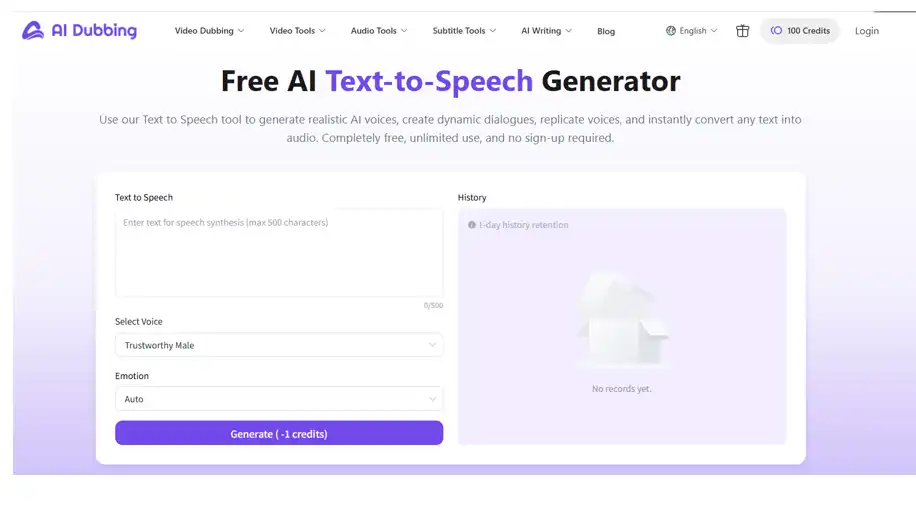
AIDubbing’s voice generator covers all three. It offers 100+ voice profiles across male, female, and character voices — everything from deep broadcast narrators to soft conversational tones to expressive storytelling voices — with eight distinct emotion settings that actually shift the delivery rather than just relabeling the same output.
Who Gets the Most Out of AI Text to Speech
YouTubers and Video Creators
The most obvious use case, and for good reason.
A faceless YouTube channel — tutorials, explainers, commentary, finance, tech, productivity — doesn’t need the creator’s literal voice. It needs a clear, engaging voiceover that holds the viewer’s attention. AI voice generation handles that reliably, at any hour, without re-recording when the script changes.
Creators who have switched report two consistent benefits: faster publishing cadence (no more waiting for a good recording window) and easier iteration (changing a line means regenerating ten seconds of audio, not re-recording a full segment).
Online Course Creators and Educators
Course narration is one of the strongest use cases for AI text to speech, for a specific reason: consistency.
A course recorded across multiple sessions will have audible differences between lessons — different room acoustics, different energy levels, different microphone placement. Students notice, even subconsciously. AI-generated narration is acoustically identical across every lesson, every module, every time.
It also makes localization practical. Generating your course narration in Spanish, French, or Portuguese from the same script takes hours instead of weeks, with no voice actor coordination required.
Marketing and Advertising Teams
Video ads, product demos, explainer videos, social media content — all of these need voiceover, and all of them get revised constantly.
The traditional workflow: script → briefing a voice actor → recording session → delivery → edit → revise → re-record. With an AI voice generator, the workflow is: script → generate → listen → adjust → done. Iterations that used to require scheduling another session now take minutes.
Corporate Training and Internal Communications
HR onboarding videos. Compliance training modules. Internal product updates. These are high-volume, low-glamour content categories where consistent, professional-sounding narration matters but budget for bespoke voice actor sessions usually doesn’t exist.
AI voice narration is a natural fit. The content is primarily informational, the tone is professional, and the volume of material makes a scalable solution more practical than a human one.
Podcasters and Audio Content Creators
Daily or high-frequency podcast formats — news briefings, market updates, trend summaries — benefit enormously from AI voice generation. Writing the content is the work. The audio production should be a button click, not a separate project.
Even for podcasters who record their own voice, the tool is useful for generating episode intros, ad reads, or segment transitions with a consistent audio identity that doesn’t depend on the host being in front of a microphone.
Accessibility and Inclusive Design
Text to speech has always been foundational to accessibility. Modern AI TTS takes it further — generating audio that doesn’t just read content but delivers it in a way that’s genuinely pleasant to listen to, removing the friction that made older TTS tools more duty than preference for many users.
Getting Good Output: Practical Tips
The tool handles the voice. Your job is to give it good input to work with.
Write for the ear, not the eye. Copy that reads well on screen often sounds flat or unnatural when spoken. Short sentences, clear structure, and natural spoken phrasing (“you’ll notice” rather than “it will be observed”) produce significantly better output.
Use punctuation deliberately. Commas and periods create pauses. An em dash can create a beat. Ellipses slow delivery. These aren’t just grammatical choices — they’re timing controls for the audio output.
Match the emotion setting to the content. A product tutorial benefits from calm or neutral. A marketing voiceover might want upbeat or energetic. A story-driven explainer benefits from expressive. Don’t leave it on auto if you know what tone you need.
Test voices on representative text. The voice that sounds good in a ten-word demo clip may not hold up across three minutes of narration. Generate a full paragraph before committing to a voice for a large project.
Regenerate selectively. If one sentence in a paragraph sounds slightly off, you don’t need to regenerate the whole piece. Identify the problem sentence, adjust the phrasing or punctuation, regenerate that segment, and splice it in.
The Commercial Use Question
One thing creators ask consistently: can AI-generated audio actually be used commercially?
For AIDubbing’s tool, the answer is yes — generated audio can be used in monetized YouTube videos, paid courses, client deliverables, advertising, and any other commercial application. There are no royalty fees, no per-use licensing, and no platform restrictions on where the audio can be published.
That matters because the economics of AI voice generation only make sense if you can use the output without additional cost at scale. The point is to replace a recurring production expense, not add a new one.
TTS vs. Hiring a Voice Actor: An Honest Comparison
This technology is not always the right choice. Being clear about where human voice work still wins makes the comparison more useful.
| Scenario | Better Choice |
| High-volume content (10+ pieces/month) | AI TTS |
| One-off prestige project with emotional nuance | Voice actor |
| Multilingual content at scale | AI TTS |
| Brand character voice requiring deep personality | Voice actor |
| Fast turnaround, frequent revisions | AI TTS |
| Long-form audiobook with dramatic performance | Voice actor |
| Corporate training, e-learning narration | AI TTS |
| Content where creator’s personal voice is the brand | Record yourself |
The pattern is clear: volume, speed, iteration, and multilingual reach favor AI. Unique emotional performance and deep brand personality favor human voice work.
Most content falls in the first column.
Conclusion
Text to speech technology has crossed a threshold that most people haven’t fully registered yet. The output from a modern AI voice generator doesn’t just pass casual listening tests — it holds up in professional contexts where audio quality actually matters.
For creators who have been putting off starting a YouTube channel because they hate the sound of their own voice, or educators who want to offer their course in three languages but can’t afford three separate voice actors, or marketing teams spending too much time coordinating recording sessions — the friction that was stopping them is largely gone.
Paste your script, pick a voice, set the tone, and download. It really is that fast. If you haven’t tried a free TTS generator recently, the experience is probably different from what you’re expecting.
References & Sources
This article has been fact-checked and verified against multiple public sources, financial disclosures, SEC filings, Forbes reports, Celebrity Net Worth databases, and official records. All net worth estimates are based on publicly available information and financial analysis.