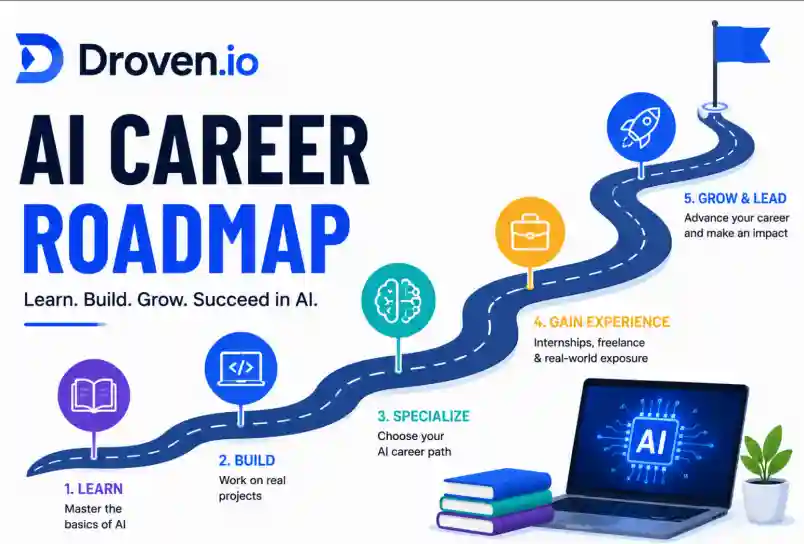
The Droven.io AI Career Roadmap is a step-by-step path for going from complete beginner to job-ready in artificial intelligence — typically over 9 to 18 months. It moves through foundations, Python and data skills, core machine learning, real tools, a project portfolio, a chosen specialization, and job readiness. This guide breaks down each stage with realistic timelines, salary data, and the mistakes that quietly derail most beginners.
Breaking into artificial intelligence looks intimidating from the outside — a wall of unfamiliar terms, endless tools, and conflicting advice about where to start. The truth is more encouraging: AI careers follow a learnable sequence, and most people who fail do so not from lack of talent but from a lack of structure. They jump between tutorials, collect tools they never use, and skip the fundamentals that everything else depends on.
The Droven.io AI career roadmap addresses exactly that problem. Instead of treating AI as a pile of topics to memorise, it lays out a practical order: what to learn first, what to ignore for now, what to actually build, and how to turn that work into a job. This article expands on that framework with current labour-market data, concrete tool recommendations, and honest guidance — written for students, career switchers, and working professionals alike.
You will find realistic timelines (not the “learn AI in 30 days” fantasy), verified salary figures from the U.S. Bureau of Labor Statistics, a stage-by-stage plan, and a clear-eyed comparison of this roadmap against bootcamps, degrees, and pure self-study. The goal is a path you can actually follow to a real career — not just a reading list.
+
Why AI Careers Are Growing Rapidly in 2026
The demand signal for AI skills is unusually strong and backed by hard data. The World Economic Forum’s Future of Jobs research consistently ranks AI and big data among the fastest-growing skill areas, with AI and machine learning specialists near the top of the fastest-growing roles. This is not hype cycling — it is a structural shift in how work gets done.
The labour statistics reinforce it. The U.S. Bureau of Labor Statistics (BLS) projects data scientist employment to grow about 34% from 2024 to 2034 — far faster than the average for all occupations — and software developer roles to grow around 17.9%. Independent indicators agree: Stanford’s AI Index documents accelerating business adoption and investment, while GitHub’s Octoverse reports rapid growth in AI-related development activity worldwide.
Crucially, the demand is broad, not narrow. Companies are not only hiring PhD researchers; they need people who can build AI systems, manage and clean data, integrate tools into real workflows, and demonstrate business value. That widens the door for analysts, automation specialists, and problem-solvers — exactly the audience this roadmap serves.
What Is the Droven.io AI Career Roadmap?
The Droven.io AI career roadmap is a structured learning and career path designed to build a complete AI skill ecosystem rather than a scattered collection of facts. It carries a learner from foundational understanding, through tool mastery and hands-on projects, into a focused specialization and finally job readiness.
What makes a roadmap valuable is sequencing. Knowing that you need Python, statistics, and machine learning is easy; knowing the order to learn them, how deep to go at each stage, and when to stop studying and start building is what saves months of wasted effort. The roadmap answers the questions beginners actually search for: how to start, what to learn first, how long it takes, which tools matter, what the jobs pay, and which mistakes to avoid.
Who Should Follow This AI Career Roadmap?
The path is deliberately broad because AI now touches nearly every function. It fits:
- Students preparing for future-focused, high-demand fields.
- Career switchers from non-technical backgrounds who want a credible route in.
- Software developers expanding into ML engineering or LLM application development.
- Freelancers, marketers, analysts, and operations professionals moving toward AI automation and business-intelligence roles.
You do not need a computer-science degree to begin. You need consistency, a willingness to build, and the patience to learn fundamentals before chasing the newest tool.
The Step-by-Step Droven.io AI Career Roadmap
The roadmap unfolds in seven stages. Resist the urge to skip ahead — each stage is the foundation for the next.
Stage 1: Foundations — Learn the Language of AI
Start by understanding the core concepts: machine learning, deep learning, neural networks, training data, and inference. The goal here is comprehension, not mastery — you want to grasp how the field talks and where AI is actually applied in business, products, and automation. Learn to distinguish rule-based automation from genuine AI-driven systems, because most hiring is for practical applications: reporting, customer operations, search, recommendations, content, and software tools.
Stage 2: Technical Skill Development
Python is the primary language of AI, a fact reinforced year after year by GitHub’s usage data. Build competency with data structures, basic logic, and the math that underpins models: linear algebra, probability, and statistics. Add notebooks, working with datasets, and SQL. Even non-engineers need data fluency, because AI work is deeply tied to structured and unstructured data.
Stage 3: Core AI and Machine Learning Skills
Now go deeper into ML itself: supervised and unsupervised learning, evaluation metrics, feature engineering, model training, overfitting, and model selection. Modern learners should also cover working with APIs and deployment basics — knowing how to use existing AI services responsibly and effectively is now as valuable as training models from scratch.
Stage 4: Tools, Platforms, and Workflows
Get hands-on with the standard stack: Python, Jupyter Notebook, Pandas, NumPy, scikit-learn, TensorFlow, and PyTorch. Business-focused learners should add SQL, Tableau, Power BI, and a cloud platform like AWS or Google Cloud. Include automation tools and no-code/low-code AI workflows, which increasingly drive real business adoption.
Stage 5: Real-World Projects and Portfolio
This is where careers are made. Employers care about applied capability, so build and publish projects: sentiment analysis, a recommendation engine, document summarization, image classification, or a chatbot. Quality, clarity, and a clear explanation of what you built and why beat inflated claims every time.
Stage 6: Choose a Specialization
Once you have breadth, pick a direction to go deep:
- AI Engineer — building AI-powered systems and integrations
- Data Scientist — analysis, modelling, and insight generation
- ML Engineer — production models, pipelines, and deployment
- AI Automation Specialist — workflow design and operational efficiency
- NLP / LLM Specialist — language systems, search, summarization, and conversational AI
Stage 7: Career and Job Readiness
Becoming hireable is its own skill. Develop a focused resume, optimise your LinkedIn, document projects clearly on GitHub, and prepare for interviews. Most importantly, learn to translate technical work into business terms. Many capable candidates fail simply because they can’t tell a clear story: what they learned, what they built, what problems they solved, and what role they want.
How Long Does It Take to Follow the Roadmap?
Honesty matters here, because unrealistic timelines cause people to quit. A realistic progression:
| Phase | Timeframe | What you achieve |
|---|---|---|
| Foundational literacy | 2–3 months | Understand AI concepts and language |
| Functional intermediate | +4–8 months | Python, data handling, basic ML |
| Job-ready | 9–18 months total | Portfolio, specialization, interview prep |
Your actual pace depends on prior background, study intensity, and chosen path. Someone coding daily with a math background moves faster than a full-time professional studying evenings — and that’s fine. Consistency beats speed.
Best Tools to Learn for an AI Career
Focus on a small, high-leverage toolset rather than collecting everything:
- Programming & experimentation: Python and Jupyter Notebook
- Data analysis: Pandas and NumPy
- Machine learning: scikit-learn (start here), then TensorFlow and PyTorch
- Version control & portfolio: GitHub
- Data work: SQL
- Deployment & infrastructure: AWS, Google Cloud, or Azure
- 2026 essentials: LLM APIs, vector databases, prompt design, and evaluation workflows
The field has moved beyond traditional model training alone — knowing how to build with existing models is now a core, employable skill.
Generative AI, Prompt Engineering, and AI Agents
No 2026 roadmap is complete without generative AI. Add these to your plan:
- Prompt engineering — getting reliable results from language models
- LLM application building — turning models into products
- AI agents and workflow orchestration — systems that take multi-step actions
- Retrieval-augmented generation (RAG) — grounding AI in your own data
- Model evaluation and responsible AI with human-in-the-loop design
Stanford’s AI Index shows strong momentum in generative-AI investment, and GitHub reports rapid growth in public generative-AI projects. Fluency here is now valuable across software, data, content, support, search, and automation roles — not just specialist ones.
Salary and Earning Potential in AI Careers
AI skills command a clear wage premium. According to U.S. Bureau of Labor Statistics data (2024 median annual wages):
| Role | Median annual wage (BLS, 2024) |
|---|---|
| Computer & information research scientists | $140,910 |
| Database architects | $135,980 |
| Data scientists | $112,590 |
| Computer & IT occupations (overall) | $105,990 |
For context, these figures sit far above the overall U.S. median wage of roughly $49,500. The strongest earning potential goes to those who combine technical depth with the ability to apply AI to real business problems — proof that the project-and-communication stages of this roadmap pay off literally.
Career Opportunities After Following This Roadmap
| Role | Main focus | Why it matters |
|---|---|---|
| AI Engineer | Builds AI systems and products | High, sustained demand |
| Data Scientist | Data analysis and prediction | Strong salary growth |
| ML Engineer | Deploys and maintains models | Core AI infrastructure |
| AI Analyst | Applies AI to business questions | Accessible bridge role |
| AI Automation Specialist | Automates workflows | Fast-growing demand |
| NLP / LLM Specialist | Language-based AI systems | Central to the GenAI era |
Real-World Example: From Beginner to Job-Ready
Picture someone with no AI background following the roadmap:
- Months 1–3: learn Python, basic statistics, and data handling.
- Months 4–6: build small ML projects and simple LLM-API applications.
- Portfolio phase: publish projects on GitHub, each explained in plain business terms.
- LinkedIn: build a focused professional profile around the target role.
- Specialization: commit to one direction — say, AI analyst or automation specialist.
- Targeted projects: tailor later work to that specific role.
The thread running through it all: success comes from showing you can solve problems, not just repeat lessons.
Certifications and Learning Resources
Certifications help most when they back up a portfolio, not when they stand alone. Pair them with real projects. Useful resources include official cloud-learning paths, university-backed AI courses, coding-practice platforms, Kaggle competitions, a strong GitHub presence, and role-specific interview preparation. A certificate proves you studied; a project proves you can do the work — employers weigh the second more heavily.
Common Mistakes to Avoid in an AI Career Journey
- Tool overload: learning many tools at once stalls real progress — go deep on a few.
- Skipping foundations: weak Python, statistics, or data literacy creates problems that compound later.
- Tutorial dependency: watching endless tutorials without building original projects leaves dangerous gaps.
- Neglecting communication: real jobs require explaining models, decisions, risks, and business value clearly.
- Avoiding implementation: much opportunity lies in applying AI effectively, not building everything from scratch.
Roadmap vs Self-Learning vs Bootcamps vs Degrees
| Path | Cost | Speed | Practical exposure | Best for |
|---|---|---|---|---|
| Structured roadmap | Low–medium | Medium | High if project-based | Beginners & switchers |
| Self-learning only | Low | Varies | Medium unless structured | Highly independent learners |
| Bootcamps | Medium–high | Faster | Often high | Those wanting deadlines & support |
| Formal degree | High | Slower | Varies by program | Deeper academic grounding |
For most working adults and career switchers, a project-based roadmap offers the best balance of cost, speed, and real-world relevance — with the flexibility to add a bootcamp or formal study later if needed.
Future Skills That Will Matter Most Beyond 2026
Technical skill alone won’t future-proof a career. The World Economic Forum highlights rising demand for creative thinking, resilience, flexibility, curiosity, and lifelong learning alongside AI and big data. The professionals who thrive will pair technical ability with adaptability — people who learn new systems quickly, evaluate tools critically, collaborate with non-technical teams, and turn AI capability into useful outcomes. As the field matures, AI–human collaboration may matter just as much as raw technical skill.
Benefits of Following the Droven.io AI Career Roadmap
- Structure: it cuts through complexity by showing what to learn first and what to ignore for now.
- Relevance: it ties learning to real roles, real tools, and real outcomes rather than purely academic study.
- Flexibility: it lets you grow from beginner toward analytics, automation, LLM applications, ML engineering, or research over time — useful for students and professionals alike.
Key Takeaways
- The roadmap runs in 7 stages: foundations → Python/data → core ML → tools → projects → specialization → job readiness.
- Expect 9–18 months to job-ready; consistency matters more than speed.
- Python, projects, and GitHub matter more than collecting certificates.
- AI roles pay well — BLS lists data scientists at a $112,590 median, well above the ~$49,500 overall median.
- Add generative AI, prompt engineering, and RAG — and learn to communicate business value.
Conclusion
The Droven.io AI career roadmap is best understood not as a list of topics but as a practical sequence for building a real career. Modern learners need more than a syllabus — they need salary context, realistic timelines, tooling guidance, a portfolio strategy, generative-AI awareness, and clarity on the mistakes that trip people up.
If you take one action from this guide, make it this: start with Python and AI fundamentals, build one real project, publish your work, then choose a single direction and go deeper. Done consistently over a year or so, that simple loop turns a curious beginner into a hireable AI professional — whatever the job market throws at you next.
Frequently Asked Questions
Is the Droven.io AI career roadmap suitable for non-technical beginners?
Yes. It is built around step-by-step learning, starting from basic concepts and moving toward practical AI applications, so people from non-technical backgrounds can follow it with consistency.
How long does it take to complete the roadmap?
Typically 6 to 18 months depending on your consistency and prior experience. A common pattern is 2–3 months for fundamentals, several more for intermediate skills, and 9–18 months total to become job-ready.
Can the roadmap help build a strong portfolio?
Yes. It emphasises real-world projects — like sentiment analysis, recommendation engines, or chatbots — published on GitHub, which is exactly what attracts employers.
What skills does the roadmap cover?
Python, machine learning, data analysis, core AI tools (Pandas, scikit-learn, TensorFlow, PyTorch), generative AI and prompt engineering, plus practical implementation and communication skills.
Is the roadmap useful for career switching?
Yes. It is well suited to career switchers moving into AI, automation, or data-related roles, because it assumes no prior AI background and focuses on building demonstrable, job-relevant skills.
Do I need a degree to start an AI career?
No. While a degree can help, many AI roles prioritise demonstrable skills and a strong portfolio. A project-based roadmap can make you hireable without a formal AI degree, though continued learning is essential.
References & Authoritative Sources
The labour-market and salary figures in this guide are drawn from authoritative public sources:
- U.S. Bureau of Labor Statistics — Occupational Outlook for data scientists and computer occupations. bls.gov
- World Economic Forum — Future of Jobs Report on in-demand skills. weforum.org
- Stanford HAI — The AI Index, data on AI adoption and investment. hai.stanford.edu
- GitHub Octoverse — Annual report on developer and AI activity. github.blog
Last reviewed in 2026. Salary and employment figures reflect U.S. Bureau of Labor Statistics data and may change; confirm the latest figures on official sources. Public details about Droven.io specifically are limited, so the roadmap here reflects widely accepted AI-career best practices.
References & Sources
This article has been fact-checked and verified against multiple public sources, financial disclosures, SEC filings, Forbes reports, Celebrity Net Worth databases, and official records. All net worth estimates are based on publicly available information and financial analysis.