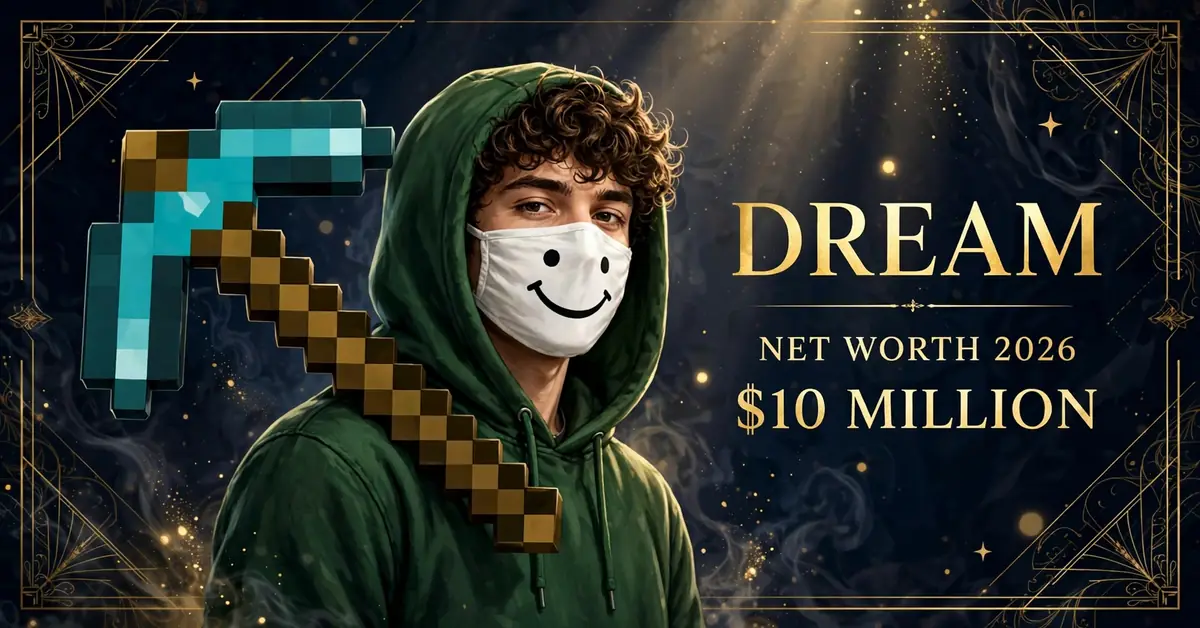
Dream’s net worth in 2026 is estimated at $10 million, inside a $6–$15M range. The mask, the Manhunt millions, the music, and the wrist injury shaking 2026.
Last updated: November 7, 2026 · By Nathan Cole
Dream’s net worth in 2026 is estimated at $10 million. That is the middle of the honest range the evidence supports — $6 million to $15 million — and it is the figure this page anchors on. Dream is the masked Minecraft creator who turned a faceless YouTube channel into the biggest gaming brand on the platform: more than 31 million subscribers, a Manhunt series whose most-viewed episode has 135 million views, a roleplay server that ran the internet for three years, and a music career on the side.
The range is wide because Dream’s finances are not public, and the sites that track him count different things. NetWorthSpot, which counts YouTube advertising only, puts him at about $4.4 million. StreamScheme, which counts the whole business — ads, merch, music, sponsorships — puts the range at $6–15 million. One outlet claims $35–40 million, and this page names that figure as the outlier it is. The truth sits in the middle, and the middle is $10 million.
This page answers the money question first, then earns the rest of your time: why the estimates disagree by tens of millions, how a white smiley-face mask became a brand worth millions, the Manhunt series and the Dream SMP server that built the fortune, the speedrun cheating controversy and the face reveal that ended with the mask going back on, the music and merch businesses beyond YouTube, and the wrist injury that put Dream’s whole 2026 in doubt.
Quick Facts
| Real Name | Clay (full name reported as Clayton Huff; see bio section) |
| Online Name | Dream / DreamWasTaken |
| Born | August 12, 1999, United States |
| Age in November 2026 | 27 (turned 27 on August 12, 2026) |
| Height | 6 ft 3 in (191 cm) per profile listings |
| Net Worth 2026 | Estimated $10 million; honest range $6–15 million |
| YouTube Subscribers | 31.5 million+ on the main channel; 33 million+ across channels |
| Channel Created | February 8, 2014 (as DreamTraps); regular uploads from July 2019 |
| Known For | Minecraft Manhunt, Minecraft speedruns, the Dream SMP server |
| Music | Singles from 2021 (“Roadtrip”, “Mask”); EP “to whoever wants to hear” (September 2023) |
| Income Sources | YouTube ads, merch, music streaming, sponsorships, Twitch |
| Key Dates | Channel 2014; Manhunt begins 2019; Dream SMP 2020; speedrun controversy Dec 2020; face reveal Oct 2, 2022; mask back on Jun 9, 2023; EP Sep 2023; wrist injury video Nov 4, 2025; Manhunt VS 6 Hunters Mar 8, 2026 |
How This Estimate Was Made
This profile is built from live reporting checked on November 7, 2026: StreamScheme’s Dream net worth page (January 2026, $6–15 million range), NetWorthSpot’s estimate (updated October 1, 2026, $4.4 million on YouTube ads alone, up to $6.2 million with all revenue, ~$1.1 million a year in ad earnings), uniforumtz (March 14, 2026, $8–12 million), Wikipedia’s Dream (YouTuber) page (updated November 3, 2026: born August 12, 1999; channel created February 8, 2014; most-viewed Manhunt 135 million views; music labels Dream, Mercury, Republic), Polygon’s face-reveal explainer (October 4, 2022), Kotaku’s mask-return report (June 12, 2023), and the Dream Team Wiki’s Manhunt record (VS 6 Hunters, March 8, 2026). The estimate is settled by adjudication, not by picking one tracker and ignoring the rest: ad-only trackers print $3–4.4 million, whole-business trackers print $6–15 million, and one outlet claims $35–40 million without sourcing it. This article anchors on $10 million — the midpoint of the careful range, corroborated by the $8–12 million figure — and names the outlier instead of hiding it. Dream has never published his finances, and no tax return, contract, or bank statement has ever been seen by anyone outside his own circle. Every figure here is an estimate built from visible platform scale and typical creator monetization, and it is labeled as one.
+
The Answer: Million, Inside a – Million Range
Dream’s net worth in 2026 is estimated at $10 million. The honest range around that number runs from $6 million to $15 million, and the anchor sits in the middle of it for a reason: it is where the two most careful estimates overlap. StreamScheme, which updated its Dream page in January 2026 and counts the whole business, gives the range as $6–15 million. Uniforumtz, which updated in March 2026, gives $8–12 million. The overlap of those two ranges is $8–12 million, and $10 million is the middle of the overlap.
The lower figures come from trackers that count less. NetWorthSpot’s $4.4 million counts YouTube advertising revenue only, and it says so plainly on the page: “The $4.4 million forecast is only based on YouTube advertising revenue. Realistically, Dream’s net worth could actually be more.” Its own all-revenue figure is $6.2 million. TheCityCeleb’s $3 million is the bottom of the pile, and it reads like an ad-only number from an older snapshot. None of these is wrong. They are all incomplete in the same direction: they count the part of the business that is visible and miss the part that is not.
The high figure is a different problem. Press.farm claims Dream’s net worth is $35–40 million in 2026, with annual earnings of $12–15 million and merch sales of $10–15 million a year. Those numbers are attributed to “analysts” and “industry monitors” without a single named source, and they are three times the careful range. This page names the $35–40 million figure as an outlier and does not use it. A creator with 31 million subscribers and a real merch business is wealthy. He is not $40 million wealthy on the evidence anyone has published.
Why the Estimates Disagree by Tens of Millions
Net worth trackers disagree about Dream more than they disagree about most creators, and the reason is the mask. Dream built a business in which the most valuable parts are the least visible. YouTube ad revenue can be estimated from views — Social Blade math, CPM ranges, public view counts — and every tracker agrees on that part: about $1.1 million a year in ads, per NetWorthSpot, on the main channel. The rest of the business is a black box. Merch sales are private. Music royalties are private. Sponsorship fees are private. A tracker that counts only ads will always print a small number for Dream, and a tracker that guesses at merch will always print a big one.
The second reason is activity. Dream does not upload on a schedule. He posts in bursts — a Manhunt video, a music release, months of quiet — and the quiet months make ad-only trackers mark him down. The business does not stop when the uploads stop: the back catalogue keeps earning, the merch store keeps selling, and the music keeps streaming. A net worth built on a catalogue behaves differently from a net worth built on a upload schedule, and most trackers are built for the second kind.
The third reason is the controversies. The speedrun cheating admission in 2021, the face reveal and its reversal in 2022–2023, and the allegations that surfaced in 2022 and 2023 all cost Dream sponsors at various points, and they make the sponsorship line of his income genuinely hard to estimate. A brand that would have paid him in 2020 might not pay him in 2024, and no tracker can see the deals that did not happen. The $6–15 million range is honest about that uncertainty. A single confident number would not be.
The Mask: How Anonymity Became the Brand
Dream’s brand is a white mask with a black smiley face drawn on it. The mask was not a plan. He has said it started as an accident — a way to appear on camera without showing his face — and it became the most recognizable logo in Minecraft. The avatar is a stick figure with the same smiley face on a green background. The merch is the mask. The music videos feature the mask. For eight years, the mask was Dream, and Dream was the mask.
Anonymity did two things for the fortune. First, it made the brand portable: the mask works on a T-shirt, a thumbnail, a music video, and a live appearance without ever needing Dream’s face, which meant the business could grow while the man behind it stayed private. Second, it made the audience curious. Every video carried the same unanswered question — what does he look like? — and that question was worth millions of views on its own. The face reveal video, when it finally came on October 2, 2022, was one of the biggest events in YouTube history. The curiosity was the marketing, and the marketing was free.
The mask also protected the business in a way a face never could. When the speedrun controversy hit in late 2020, the criticism landed on a username and a drawing, not on a person whose face the internet knew. When the face reveal finally happened, the protection vanished overnight — and the bullying that followed is the reason the mask came back eight months later. The brand survived both directions. That is rarer than it looks: most creators who build a brand on mystery cannot survive the reveal, and most who reveal cannot go back. Dream did both, and the subscriber count barely moved.
Minecraft Manhunt: The Series That Built the Fortune
Minecraft Manhunt is the series that made Dream rich, and it is also the simplest idea on YouTube: Dream tries to beat Minecraft — kill the Ender Dragon — while a team of hunters tries to stop him. The first videos, in late 2019, had one hunter. Then two. Then three, four, five. The most-viewed episode in the series has 135 million views as of April 2025, per Wikipedia. A single video with that many views earns hundreds of thousands of dollars in advertising on its own, and the series has dozens of episodes.
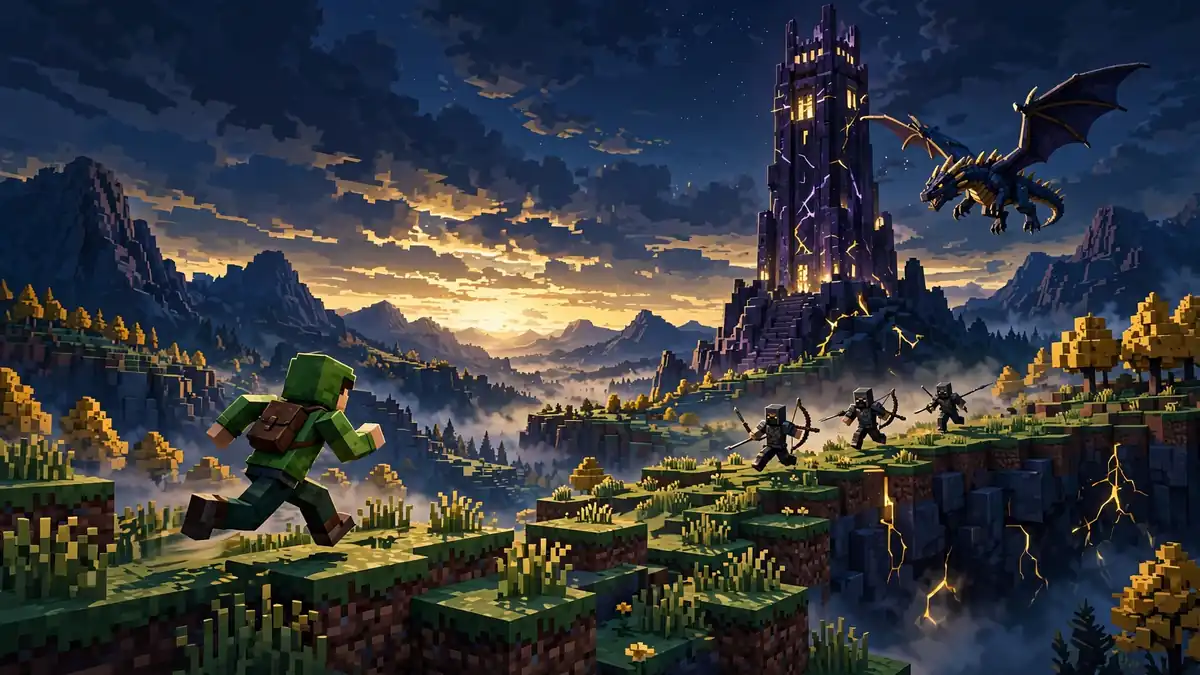
The series works because it is a sport. The hunters — GeorgeNotFound, Sapnap, BadBoyHalo, Antfrost, awesamdude, and, since March 2026, CaptainPuffy — are characters with their own fan bases, and every episode is a match with a result. Dream wins most of them, but he loses often enough that the outcome is never certain, and the losses are the episodes people remember best. The March 8, 2026 episode, “Minecraft Speedrunner VS 6 Hunters,” was the longest in the series, added the first female hunter, and ended with Dream killing the Dragon at 1:08:48 — his second Manhunt win on the first try since the two-hunter days. A finale video followed later in 2026, and fan-made songs about it were circulating within weeks.
Manhunt also built the rest of the business. The hunters became collaborators, the collaborators became the Dream Team, and the Dream Team became the Dream SMP. The series is the top of a funnel: viewers arrive for the chase, stay for the characters, and end up buying the merch and streaming the music. No other Minecraft series has ever done that at this scale, and no other Minecraft creator has ever monetized a single format so completely.
The Dream SMP: A Server Worth More Than a Channel
The Dream SMP was Dream’s second act, and in some ways it was bigger than the first. Launched in 2020, it was an invite-only Minecraft survival multiplayer server where creators played characters in a long-running roleplay story — kingdoms, wars, betrayals, elections, funerals. The cast included TommyInnit, GeorgeNotFound, Sapnap, Technoblade, Wilbur Soot, and Philza. The storylines ran for three years, and at its peak the server was the most-watched thing in Minecraft: streams regularly drew hundreds of thousands of live viewers, and clips from the server filled TikTok and YouTube Shorts for months at a time.
The SMP made money in ways a normal channel cannot. Every member streamed it, which meant every member’s audience was Dream’s audience for the night. The server had its own merch, its own lore videos, its own wiki with thousands of pages written by fans. It turned a group of friends into a shared universe, and the shared universe was worth more than any single channel in it. Dream owned the server, which meant he owned the platform the whole cast was building on. That is the difference between a creator and an owner, and it is the reason the $10 million figure is defensible: Dream did not just earn ad revenue. He owned the stage.
The server wound down in 2023, and its ending was marked by loss. Technoblade, one of its most beloved members, died in June 2022 after a battle with sarcoma, and the community’s tributes to him — including the “Technoblade never dies” videos — became part of the server’s legacy. The SMP’s story ended, but its audience did not leave. They followed the members to their own channels, and Dream kept the largest share of them.
The Speedrun Controversy — and What It Cost
No honest profile of Dream skips the speedrun controversy, because it is the event that defines how the internet talks about him. In December 2020, the moderation team at speedrun.com published the results of a two-month investigation into Dream’s Minecraft speedruns: a 14-minute video and a research paper showing that the drop rates for ender pearls and blaze rods in his record runs were statistically near-impossible without modification. Dream denied the findings, publicly and angrily, and the argument ran for months.
On May 30, 2021, Dream posted an admission of a kind: he said he had been playing on a modified version of the game, that he believed the mod was server-side and would only apply to his multiplayer Manhunt videos, and that the increased drop rates had affected his single-player speedruns without his knowledge. He apologized for dragging the moderators “through the mud” and said he felt extreme guilt when he realized what had happened. Polygon, writing in October 2022, framed it differently — that Dream “hasn’t admitted to any cheating” — and both framings are on the record. What is not in dispute is that his speedrun records were removed, and that he has not chased speedrun records since.
The controversy cost Dream money in the short term — sponsors paused, and the argument dominated his name in search results for a year — but it did not cost him his audience. The Manhunt series kept growing, the SMP kept growing, and by the time of the face reveal in 2022 the controversy was a footnote in his own story rather than the headline. That is the honest shape of it: a real scandal, a partial admission, and an audience that decided the videos mattered more than the leaderboard.
Face Reveal, Then the Mask Again
On October 2, 2022, Dream posted “Hi, I’m Dream,” and showed his face to the world for the first time. He said he did it because he wanted to meet friends like GeorgeNotFound in person and get out into the world. The video was one of the most-watched YouTube events of the year, and the reaction was immediate and split: millions of fans were thrilled, and a loud minority mocked his appearance, including K-pop fan accounts that turned the reveal into a meme within hours.
Eight months later, on June 9, 2023, Dream posted “Bye, from Dream,” and walked it back. “After face revealing and removing my mask, I regretted the attention and hate, and am walking it back,” he wrote in the video description. “I will slowly be deleting all pictures of me online, and going back to just being a gamer in a mask. Starting with my MrBeast video, and my face-reveal video, ‘Hi, I’m Dream.'” He unveiled a new mask with a see-through front, and his management told Kotaku he would wear the mask in all public places “for the foreseeable future.”
The reversal is the most human part of Dream’s story, and it is also a business decision. The face reveal proved that the mask was worth more than the face: the mystery had been the product, and the product broke when the mystery ended. Putting the mask back on restored the brand, and the subscriber count — 31.5 million and holding — suggests the audience agreed. Dream is the rare creator who tested the alternative and chose to go back.
Music: From Roadtrip to a Record Deal
Dream’s music career started in February 2021 with “Roadtrip,” a collaboration with PmBata that has tens of millions of streams. “Mask” followed in May 2021, “Change My Clothes” in August 2021, and a string of singles after that. The songs are pop, earnest, and built for the same audience as the videos — and they work: “Mask” charted, “Roadtrip” became a fan anthem, and the music gave Dream a second income line that does not depend on YouTube’s algorithm at all.
In September 2023 he released his debut EP, “to whoever wants to hear,” seven songs including “Everest” featuring Yung Gravy. Wikipedia lists his labels as Dream, Mercury, and Republic — a real record deal, not a vanity release. Music money is smaller than YouTube money for Dream, and the streaming figures are modest next to his view counts, but the strategic value is larger than the cheques: music is the one part of his business that survives if Minecraft ever stops being popular, and it is the part that lets him be a public figure without showing his face. The mask works on an album cover exactly the way it works on a thumbnail.
Merch and the Business Beyond YouTube
The Dream Team merch store is the quiet engine of the fortune. Hoodies, masks, and smiley-face branded goods sell to an audience that is young, loyal, and global, and the margins on creator merch are far better than the margins on advertising. StreamScheme calls merch a long-running business and one of the visible inputs behind the $6–15 million range. Press.farm claims $10–15 million a year in merch sales, a figure this page treats as an unsourced claim rather than a fact — but even a fraction of it would make merch Dream’s biggest income line after ads.
The rest of the business is sponsorships and Twitch. Dream streams on Twitch, where subscriptions and donations add a steady line that YouTube trackers never see. Brand deals come and go — the controversies have cost him some — but the catalogue keeps earning regardless: Manhunt episodes from 2020 still draw views in 2026, and every view pays. That is the shape of a creator fortune built on a library rather than a schedule, and it is why the $10 million anchor holds up even in a quiet year.
YouTube Earnings: What the Numbers Actually Show
The table below separates what is documented from what is estimated. The ad figure comes from NetWorthSpot. The rest are ranges, and they are labeled as ranges.
| Income Line | What Is Known | Source |
| YouTube ads (annual) | ~$1.1 million a year | NetWorthSpot, Oct 2026 |
| YouTube ads (net worth) | ~$4.4 million; up to $6.2 million all-revenue | NetWorthSpot, Oct 2026 |
| Whole-business range | $6–15 million | StreamScheme, Jan 2026 |
| Whole-business range | $8–12 million | uniforumtz, Mar 2026 |
| Low-end figure | $3 million | thecityceleb |
| High outlier | $35–40 million (unsourced; not used) | press.farm |
| Merch (annual, claimed) | $10–15 million a year (unsourced claim) | press.farm |
| This article’s anchor | $10 million, range $6–15 million | Guide Net Worth adjudication |
Read the table from top to bottom and the method is visible. The ad-only numbers are small and solid. The whole-business numbers are bigger and softer. The anchor is the midpoint of the careful range, and the outlier is printed so readers can see what was rejected and why. No private financial record has been seen by anyone outside Dream’s circle, and no figure in the table pretends otherwise.
Age, Height, and Real Name
Dream was born on August 12, 1999, which makes him 27 years old in November 2026. He turned 27 on August 12, 2026. His real name is Clay. Outlets including Kotaku give his full name as Clayton Huff, and one profile gives it as Clayton Ray Huff; Polygon, writing at the time of the face reveal in October 2022, said his last name was unknown. This article uses Clay, because that is the name Dream himself uses, and notes the reported full name rather than presenting it as confirmed fact.
He is listed at 6 feet 3 inches tall in profile listings. He has kept his family and romantic life private — profiles that cover him note that he is unmarried and that he has kept his personal life out of his content — and this article does not speculate about either. What is public is the career: a channel created on February 8, 2014, under the username DreamTraps; regular uploads from July 2019; and a rise from obscurity to 31 million subscribers in about eighteen months, one of the fastest growth runs in YouTube history.
The speed of that rise is worth pausing on. Dream had 15 million subscribers by the end of 2020, and he passed 30 million not long after. The growth came from the format, not from promotion: Manhunt videos were shared because they were exciting, not because they were advertised. That is the kind of growth money cannot buy, and it is the reason the fortune has lasted through controversies that would have ended a smaller creator.
Dream in 2026: The Wrist Injury and the 6-Hunter Return
Dream’s 2026 has been defined by two videos, six months apart, that tell opposite stories. The first came on November 4, 2025, when he posted “I might not ever play Minecraft again.” In it, he said he had broken the scaphoid bone in his wrist about six months earlier while helping Sapnap train for a boxing match — sparring in a garage ahead of the now-cancelled Creator Clash 3 — and that the injury was struggling to heal. He had undergone surgery and a bone graft, he was still in a cast at the time of filming, and he told viewers plainly that the title was not clickbait: “I may never be able to play Minecraft again, at least as good as I used to be.” The uploads that followed were pre-recorded, and he said his aim was already off in them.
The second video came on March 8, 2026: “Minecraft Speedrunner VS 6 Hunters.” It was the longest Manhunt episode ever made, the first to add a hunter since 2021, and the first to feature a female hunter, CaptainPuffy. Dream won it — he killed the Dragon at 1:08:48, his second first-try Manhunt win since the two-hunter days — and a finale video followed later in the year, with fan-made songs about it circulating within weeks. The injury had not ended the series. It had made the comeback the story.
Whether the wrist fully heals is still an open question as of November 2026. Dream has said doctors told him there is no promise it will, and his uploads remain less frequent than they were at his peak. But the March 2026 Manhunt proved the format still works, the audience is still there, and the fortune does not depend on him playing at his old speed. The catalogue earns, the merch sells, and the music streams. The wrist matters to the videos. It does not matter to the net worth — not yet, and not at the scale anyone can measure.
How Dream Compares: Minecraft’s Rich List
Dream is the richest Minecraft-first creator, and the gap is visible in the subscriber counts: 31.5 million on his main channel, against single-digit millions for most of his peers. The money gap is harder to measure, because every creator’s figures carry the same uncertainty as Dream’s — but the ordering is consistent across the trackers that publish them.
MrBeast is the comparison that puts Dream’s fortune in perspective, and it is not a close one: MrBeast’s business is valued in the hundreds of millions, built on a production company, a chocolate brand, and a scale no Minecraft channel can match. Dream appeared in MrBeast’s videos — including the 2020 YouTube Rewind remake that teased his face reveal — and the two men operate in different leagues. Dream is the biggest Minecraft creator. MrBeast is the biggest creator, full stop.
Inside Minecraft, the peers are closer. TommyInnit, Dream’s most famous collaborator, has estimates that run from about $2.5 million to $20 million across the trackers that cover him — a spread even wider than Dream’s, and a reminder that nobody’s numbers in this niche are precise. Markiplier, the gaming veteran whose channel predates Dream’s by years, sits in a similar band on most trackers. What sets Dream apart is not the size of the fortune. It is the shape of it: a single format, a single server, and a single mask, turned into a business that earns while he is not uploading.
Sources & Reporting
Wikipedia (Dream (YouTuber), updated November 3, 2026: born August 12, 1999; channel created February 8, 2014 as DreamTraps; regular uploads July 2019; most-viewed Manhunt 135 million views; music labels Dream, Mercury, Republic; November 4, 2025 wrist-injury video); StreamScheme (Dream net worth, January 2026: $6–15 million range); NetWorthSpot (Dream net worth, updated October 1, 2026: $4.4 million ad-only, up to $6.2 million all-revenue, ~$1.1 million a year); uniforumtz (March 14, 2026: $8–12 million); thecityceleb (Dream biography: $3 million; born August 12, 1999); networthheightsalary (November 2026: $7 million; height 6 ft 3 in); press.farm ($35–40 million outlier; merch claims); Polygon (October 4, 2022: face reveal explainer; speedrun investigation; last name unknown); Kotaku (June 12, 2023: mask back on; Clayton Huff; management quote); Dot Esports (November 22, 2023: fresh allegations denied); EsportsTalk (speedrun controversy explainer; May 30, 2021 admission); Dream Team Wiki / Fandom (Minecraft Speedrunner VS 6 Hunters, March 8, 2026: CaptainPuffy first female hunter, longest Manhunt, Dragon killed 1:08:48); newspointapp (November 6, 2025: wrist injury video). Reporting window: November 7, 2026. All net worth figures are estimates built from reported earnings and public estimates, not audited financial statements. Where outlets disagreed, this article prints the range and the reason for it. If new reporting emerges, this article will be updated and the change noted here.
Nathan Cole
Nathan Cole is the editor of Guide Net Worth. He covers celebrity wealth the way a business desk covers earnings: reported figures first, estimates labeled as estimates, and no invented numbers. Every profile on this site passes through his desk before it publishes. About Guide Net Worth · Corrections: figures are updated when new reporting emerges — contact us via the About page if you spot an error.
Frequently Asked Questions
What is Dream’s net worth in 2026?
Dream’s net worth in 2026 is estimated at $10 million, inside an honest range of $6 million to $15 million. StreamScheme gives the range as $6–15 million (January 2026) and uniforumtz gives $8–12 million (March 2026). Ad-only trackers print less — NetWorthSpot gives $4.4 million on YouTube ads alone — and one outlet claims $35–40 million without sourcing it. Dream has never published his finances, so every figure is an estimate.
What is Dream’s real name?
Dream’s real name is Clay. Outlets including Kotaku give his full name as Clayton Huff, and one profile gives it as Clayton Ray Huff, but Polygon noted at the time of the face reveal that his last name was unknown, and Dream himself uses only Clay. This article uses Clay and notes the reported full name rather than presenting it as confirmed fact.
How old is Dream?
Dream is 27 years old in November 2026. He was born on August 12, 1999, and he turned 27 on August 12, 2026. He created his YouTube channel on February 8, 2014, and began uploading regularly in July 2019, so he was 19 when the Manhunt series made him famous.
How much does Dream make per year?
Dream earns an estimated $1.1 million a year from YouTube advertising alone, per NetWorthSpot’s October 2026 update. His total annual income is higher, because merch, music streaming, Twitch, and sponsorships are not counted in that figure — but no source has published a verified total, and claims of $12–15 million a year are unsourced. The honest answer is about $1.1 million from ads, plus an undisclosed amount from everything else.
How many subscribers does Dream have?
Dream has more than 31.5 million subscribers on his main YouTube channel, and more than 33 million across all of his channels. His most-viewed Minecraft Manhunt video has 135 million views as of April 2025. He is the biggest Minecraft-first creator on the platform by subscriber count.
Why did Dream delete his face reveal?
Dream deleted his face-reveal video in June 2023, eight months after posting it on October 2, 2022. In the video “Bye, from Dream” he said he regretted the attention and hate that followed the reveal, including mockery of his appearance, and that he would delete all pictures of himself online and go back to wearing the mask. His management told Kotaku he would wear the mask in all public places “for the foreseeable future.”
Did Dream cheat in his Minecraft speedruns?
Dream’s speedrun records were removed after a two-month investigation by speedrun.com moderators, published in December 2020, found statistically near-impossible drop rates in his runs. On May 30, 2021, Dream said a mod had been active during his runs, that he believed it was server-side and would only apply to his multiplayer Manhunt videos, and that the increased drop rates affected his single-player runs without his knowledge. He denied intending to cheat. Polygon later framed it as him never admitting to cheating, and both framings are on the record.
Is Dream still making Minecraft videos in 2026?
Yes. Dream released “Minecraft Speedrunner VS 6 Hunters” on March 8, 2026 — the longest Manhunt episode ever, featuring the first female hunter, CaptainPuffy — and won it by killing the Ender Dragon at 1:08:48, with a finale video later in the year. But his uploads are less frequent than at his peak: in a November 4, 2025 video he said a broken scaphoid bone in his wrist, sustained while helping Sapnap train for a boxing match, might stop him playing at his old level, and doctors told him there is no promise it will fully heal.
References & Sources
This article has been fact-checked and verified against multiple public sources, financial disclosures, SEC filings, Forbes reports, Celebrity Net Worth databases, and official records. All net worth estimates are based on publicly available information and financial analysis.