Andrew Huberman biography: the Stanford neuroscientist, 51, turned a skateboarding youth into a $20–30M Huberman Lab empire — book, critics and private life.
Last updated: November 10, 2026 · By Nathan Cole
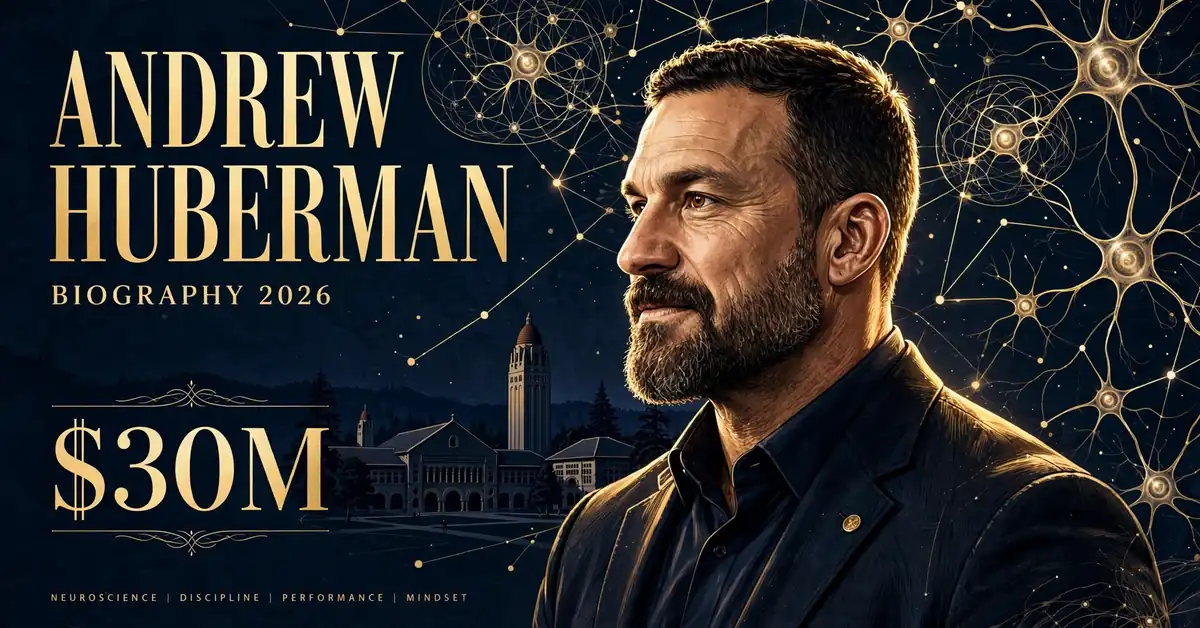
Andrew Huberman is a Stanford neuroscientist, author and podcaster who turned a troubled teenage life into a $20–30 million media empire. Born on September 26, 1975, in Palo Alto, California, the 51-year-old went from skating the Embarcadero streets of San Francisco and a stint in a youth detention facility to a tenured professorship at Stanford University School of Medicine — and then, in January 2021, to the most-listened-to health and science podcast on the planet. His estimated net worth in 2026 is anchored at $30 million by Celebrity Net Worth (May 2026), a figure built almost entirely on media revenue, sponsorships and equity rather than his academic salary.
The arc is what makes the story worth telling in full. Huberman’s father was a Stanford physicist. His mother wrote children’s books. His parents divorced when he was 12, and the boy who lobbied his city council for a skatepark at 13 nearly lost his way entirely before a court-ordered therapist pointed him toward biopsychology. The PhD from UC Davis followed in 2004. The Stanford lab followed in 2016. Then came the podcast, the sponsors, the supplement equity, a $10-a-month membership, and in September 2026 a book that debuted at number one on The New York Times bestseller list. This biography works through each stage with dated sources, explains where the money comes from, and gives the criticism its full weight — because the same year that made him a bestseller also brought the sharpest scrutiny of his career.
Quick Facts
| Full Name | Andrew David Huberman |
| Born | September 26, 1975, Stanford Hospital, Palo Alto, California, USA |
| Age in 2026 | 51 (turned 51 on September 26, 2026) |
| Net Worth 2026 | $30 million (estimated, inside a $20M–$30M range; Celebrity Net Worth, May 2026) |
| Main Income | Huberman Lab podcast sponsors, Momentous equity, AG1 investment, Premium membership, book, live events |
| Job | Associate Professor of Neurobiology and Ophthalmology, Stanford University School of Medicine |
| Podcast | Huberman Lab (since January 2021); 456 episodes, ~3 million weekly listeners (November 2026) |
| Book | Protocols: An Operating Manual for the Human Body (September 2026, No. 1 NYT bestseller) |
| Education | BA psychology, UC Santa Barbara (1998); MA psychology, UC Berkeley (2000); PhD neuroscience, UC Davis (2004) |
| Height / Weight | 6’1″ (185 cm), ~225 lbs (102 kg) |
| Marital Status | Never married; no children reported |
| Top Award | Cogan Award for vision science (2017); Pew Biomedical Scholar; McKnight Neuroscience Scholar |
How This Biography Was Verified
Every dated claim in this article is tied to a named source: Stanford Profiles for the academic record, Wikipedia for the biographical spine (updated within days of publication), Celebrity Net Worth and InvestorMint for the money figures, hubermanlab.com for the podcast’s own numbers, Podstatus for the episode count, and the New York Post (September 25, 2026) for the live-show and listener figures. Where sources disagree — most visibly on the net worth, where estimates run from $5 million to $30 million — the article publishes the range and names the outlet behind each figure instead of picking the biggest number and hiding the rest. Anything Huberman has not disclosed himself, including his exact sponsorship fees and equity percentages, is labelled an estimate, not a fact.
+
Early Life: Born at Stanford, Raised in Palo Alto
Andrew David Huberman was born on September 26, 1975, at Stanford Hospital in Palo Alto, California — the same institution where he would one day hold a tenured professorship. The symmetry is hard to miss, and it runs through his whole story. His father, Bernardo Huberman, was an Argentine physicist and a professor at Stanford. His mother was a children’s book author. Science and storytelling were the two languages spoken at home, and Huberman ended up fluent in both: the peer-reviewed paper and the three-hour podcast monologue.
Palo Alto in the late 1970s and 1980s was already the centre of the technology world, but Huberman’s childhood was not a straight line toward academia. His parents divorced when he was 12, and the split unsettled him. School stopped holding his attention. He has been open in interviews about the period that followed: a difficult teenager, drawn to the street, drifting away from the classroom at exactly the age when most future professors are settling into it.
What saved the story from becoming a cautionary tale was a single intervention. After a stint in a youth detention facility, a court-ordered therapist worked with him — and, by Huberman’s own telling, that therapist was the pivot point. The boy who had been heading nowhere started asking how the brain worked, and why people behaved the way they did. The question that would define his career arrived before he had any of the tools to answer it.
The Skateboarding Years: Embarcadero and the Greer Skatepark Fight
Before neuroscience, there was skateboarding. As a teenager in the late 1980s and early 1990s, Huberman was part of the Embarcadero scene in San Francisco — the EMB plaza that produced some of skateboarding’s most storied names. He skated the ledges and concrete of the Ferry Building plaza at a time when the scene was a genuine subculture, not a sport with Olympic medals. It gave him a tribe, a discipline of repetition, and a habit of watching how bodies learn movement — a thread that runs, unbroken, to his later research on neural plasticity.
He was 13 when he lobbied the Palo Alto City Council to build a skatepark. The campaign worked: Greer Skatepark exists because a teenager who could barely sit still in class learned how to make a civic argument. He also forged a work permit to get a job — a detail he has told with a mixture of pride and sheepishness, and one that fits the pattern of a kid who was always looking for a door and willing to pick the lock if the door stayed shut.

The skate years matter to the biography for a reason beyond colour. Huberman’s later fame rests on protocols — repeatable routines for sleep, focus, exercise and stress — and the first protocol he ever followed was the skater’s: show up every day, fall, get up, try the trick again. His audience hears a Stanford professor talking about deliberate practice. The practice itself started on concrete, not in a laboratory.
Education: From Community College to a UC Davis PhD
Huberman’s route into science was not the polished one. He started at Foothill College and Santa Barbara City College before transferring to the University of California, Santa Barbara, where he earned a B.A. in psychology in 1998. The subject was biopsychology, and by his own description he became obsessed with it — the study of how the brain produces behaviour, the exact question the therapist had planted years earlier.
The degrees stacked up fast after that. He took an M.A. in psychology from the University of California, Berkeley, in 2000, then a Ph.D. in neuroscience from the University of California, Davis, in 2004. His doctoral work on retinal development won the Allan G. Marr Prize for the best Ph.D. dissertation at UC Davis — the first formal sign that the kid from the skatepark could do science at the highest level. His thesis examined neural activity and axon guidance cues in the development of the eye’s wiring to the brain, the foundation of the vision research that would define his laboratory.
The education table tells its own story about late bloomers. A student who started at community college after a troubled adolescence finished a PhD at 29 from one of the best neuroscience programmes in the country. Huberman has never hidden the messy start, and his audience — millions of people who feel behind in their own lives — hears the mess as permission.
Postdoc Under Ben Barres and the UC San Diego Years
After the PhD, Huberman spent five years as a postdoctoral researcher at Stanford University School of Medicine, from 2005 to 2010, as a Helen Hay Whitney Postdoctoral Fellow. His mentor was Ben Barres, one of the most influential neuroscientists of his generation, a pioneer in the study of glial cells who reshaped how the field understood the brain’s support cells. Working under Barres, Huberman developed genetic tools to study the visual system — the molecular mechanisms by which damaged nerves might, under the right conditions, rewire themselves.
From 2011 to 2015 he held his first faculty post: assistant professor of neurobiology and neuroscience at the University of California, San Diego. He built an independent laboratory investigating how the visual system regenerates after damage, work with direct relevance to glaucoma and other conditions that destroy sight. The papers from those years — on retinal ganglion cells, on the genes that control whether a damaged neuron regrows — are the scientific bedrock under everything that came later. They are also the reason his podcast carries weight that a pure wellness influencer’s cannot: the man talking about the brain has published in Nature, Science, Cell and Neuron.
Across his career he has published more than 75 peer-reviewed articles, with a Google H-index of 46 and over 14,742 citations as of the latest Wikipedia update. The honours followed the work: the Cogan Award from the Association for Research in Vision and Ophthalmology in 2017, given annually to the field’s most significant contributor, along with the Pew Biomedical Scholar Award and the McKnight Neuroscience Scholar Award.
Stanford and the Huberman Laboratory
In 2016, Huberman returned to Stanford University School of Medicine as an associate professor of neurobiology and ophthalmology, where he now directs the Huberman Laboratory. The return closed a circle: born at Stanford Hospital, educated across the University of California system, postdoc at Stanford, and now tenured faculty at the same institution. His lab studies vision regeneration, stress mitigation, and non-pharmacological interventions for anxiety — the science of helping the brain heal itself without drugs.
The lab’s work is genuinely serious. Using virtual reality to stimulate retinal neuron regrowth, mapping the circuits that control stress and fear, testing how light, breathing and sleep change the brain’s wiring — these are long, slow, grant-funded projects, the kind of research that takes years to produce a single paper. Huberman’s academic salary for all of it sits, according to Celebrity Net Worth, in the $250,000–$350,000 range a year. That number matters because it frames everything that follows: the fortune he built after 2021 did not come from Stanford. It came from a microphone.
A 2024 New York Magazine report noted the tension at the heart of the lab’s public profile — a working scientist whose public brand had grown far larger than his research programme. The lab continues to publish, and its 2023 paper on stress mitigation with David Spiegel drew wide attention, but by 2024 the podcast, not the laboratory, was the centre of Huberman’s public life.
Huberman Lab: The Podcast That Made Science Prime Time
In January 2021, Huberman launched the Huberman Lab podcast. The premise was simple and, at the time, commercially unproven: a Stanford neuroscientist explaining how the brain works, in episodes that often ran three hours, with no co-host, no celebrity guests in the early days, and no dumbing down. The show’s own site calls it the most popular health and science podcast in the world, and the numbers back the claim. By 2023 it ranked third among all podcasts in the United States on Spotify. By 2025 it had crossed 400 episodes and won Best Wellness Podcast at the iHeart awards. As of November 2026 the catalogue stands at 456 episodes, and the New York Post reported in September 2026 that the show draws about 3 million weekly listeners.
The audience numbers around the podcast are large by any measure. The YouTube channel has crossed 8 million subscribers, and the New York Post counted nearly 16 million followers across YouTube and Instagram combined, plus more than half a million on TikTok and a 55,000-member Reddit community whose members call themselves “sungazers” — a joke about the morning-sunlight protocol that became the show’s signature advice. The free newsletter has more than a million subscribers. Huberman co-founded Scicomm Media, the company behind the podcast, with fellow creators including Andy Galpin and David Senra.

What made the show work was the format. Each episode took one topic — sleep, dopamine, cold exposure, learning — and worked through the mechanism before the advice. Listeners got the science first and the protocol second, which is the opposite of how most wellness content is built. The show also made Huberman a regular on other people’s microphones. He has appeared on Joe Rogan’s biography subject’s show multiple times, most recently episode #2553 in September 2026 to promote the book, and on Lex Fridman’s biography subject’s podcast, the Tim Ferriss Show, and the Megyn Kelly Show — a circuit of long-form conversation that kept his name in front of exactly the audience most likely to subscribe.
The Protocols: Sunlight, Cold Water and Non-Sleep Deep Rest
Huberman’s fame rests on a handful of routines his audience now recites like scripture. Morning sunlight: get outside within an hour of waking and look toward the sun for a few minutes, which he says sets the circadian clock and sharpens the day’s cortisol rhythm. Non-sleep deep rest, or NSDR: a 10–20 minute guided relaxation practice, drawn from yoga nidra, that he presents as a tool for restoring focus. Deliberate cold exposure: ice baths and cold showers to raise dopamine and build stress tolerance. And the sleep toolkit: a dark, cool room, consistent wake times, and no bright light late at night.
The routines are free, which is part of their appeal — and part of the business model. A listener who tries the sunlight protocol and feels better becomes a listener who trusts the next recommendation, including the ones attached to sponsors. The morning-light advice has been widely adopted by athletes, surgeons and Navy SEALs, according to profiles of the show’s audience, and it has also been widely argued about. The criticism, covered in full below, is that some protocols rest on animal studies or small human trials, and that Huberman does not always say how thin the evidence is when he turns a study into a routine.
Whether the protocols work as advertised is a question for the reader’s own doctor, not this article. What is not in dispute is that they built the brand. The word “protocols” now belongs to Huberman in the public mind to the point that his book carries it in the title — and the book, not the podcast, is the newest and largest revenue line.
Net Worth 2026: The Million Anchor and Why the Range Is So Wide
Andrew Huberman’s estimated net worth in 2026 is $30 million, the figure published by Celebrity Net Worth in May 2026 and the one most outlets repeat. InvestorMint, working through the same public data in May 2026, put the reasonable band at $20–30 million. Other trackers land lower: Zyntharo published $15–25 million in July 2026, while several biography sites put the range at $5–16 million, and one site still lists a flat $5 million. The honest statement is the range, and the range exists for a specific reason: almost nothing about Huberman’s money is public. He has never disclosed his sponsorship fees, his equity percentages, or his book advance. Every number attached to his name is an outside estimate built from audience metrics and typical creator-economy rates.
| Source | Estimate | Date |
|---|---|---|
| Celebrity Net Worth | $30 million | May 2026 |
| InvestorMint | $20–30 million | May 2026 |
| Zyntharo | $15–25 million | July 2026 |
| Uplarn / biography trackers | $5–16 million | February 2026 |
| TheCityCeleb | $5 million | 2026 |
The $30 million anchor is the most defensible figure for three reasons. First, it is the most recent estimate from the most-cited tracker, published after the podcast’s 2025 growth and the book deal. Second, the income math supports it: the New York Post‘s September 2026 profile noted revenue streams “estimated to generate well over $15 million annually”, and InvestorMint models podcast sponsorships alone at $10 million-plus a year. Third, the low estimates are visibly stale — the $5 million figure predates the book, the live shows and the Premium membership, and counts little more than a professor’s salary plus early podcast ads.
For scale, Huberman sits in the middle of the science-podcast economy. He is far richer than a working academic — a tenured Stanford professor’s salary of $250,000–$350,000 is roughly 1% of his estimated annual revenue — and far below the entertainment podcasters in the same business. Joe Rogan’s biography subject built a $250 million empire on a Spotify deal; Lex Fridman’s biography subject, another MIT-to-microphone story, sits in a similar tier of science podcasting without Huberman’s supplement equity. The comparison that matters most is with Huberman’s own past: in 2020, before the podcast, his wealth was a professor’s wealth. In 2026 it is a media company’s wealth, wearing a professor’s title.
Where the Money Comes From: Sponsors, Supplements and Subscriptions
The fortune is built on five streams, and the podcast sits at the centre of all of them. Sponsorship is the largest. AG1 (formerly Athletic Greens) is the flagship sponsor and the highest-value individual deal, with LMNT, Eight Sleep and InsideTracker listed on the show’s site as of October 2026. The show’s ad reads are long, personal and repeated across hundreds of episodes — the kind of inventory that commands premium rates, and the reason InvestorMint models the podcast at more than $10 million a year in sponsorship revenue alone.
Equity is the second stream, and the hardest to value. In 2022 Huberman partnered with Momentous, a performance supplement company, to create an endorsed product line built around his protocols. Zyntharo estimated in July 2026 that Momentous revenue attributed to his influence runs $20–50 million a year in sales, with his stake generating $2–8 million in distributions or equity value. He is also an investor in AG1, a company Celebrity Net Worth reports as valued at over $1 billion. Neither stake has a disclosed percentage, which is why the net worth range is wide: a 1% AG1 stake and a 5% AG1 stake are very different fortunes, and nobody outside the cap table knows which one he holds.
The third stream is the audience itself. Huberman Lab Premium costs $10 a month and sells transcripts, bonus episodes and AMA access to the most committed listeners. The newsletter has more than a million subscribers, and the live shows — headlined by the Radio City Music Hall date on September 17, 2026, where nearly 6,000 superfans packed the hall — add ticket and merchandise revenue. The fourth stream is the book: a Simon & Schuster hardcover that debuted at number one on The New York Times bestseller list, with a German edition following on October 1, 2026. The fifth is the smallest and the most stable: the Stanford salary, $250,000–$350,000 a year, which he has kept throughout the media career.
| Revenue Stream | Estimated Annual Value (2026) | Basis |
|---|---|---|
| Podcast sponsorships (AG1, LMNT, Eight Sleep, InsideTracker) | $5–12M | InvestorMint / Zyntharo models |
| Momentous equity and distributions | $2–8M | Zyntharo, July 2026 |
| Premium membership, book, live events | $1–3M | Reported $10/mo Premium; NYT No. 1 book |
| Stanford salary (tenured professor) | $250–350K | Celebrity Net Worth |
| YouTube ad revenue (8M+ subscribers) | $1–2M | Audience-metric models |
One structural fact explains the whole business: about 80% of the wealth is media and business, roughly 10% is the Stanford salary, and roughly 10% is investments and equity, per InvestorMint’s breakdown. Huberman is a professor who happens to own a media company, and the media company pays roughly thirty times what the professorship does.
The Book: Protocols Hits Number One
For five years Huberman’s audience asked for a book. In September 2026 they got one. Protocols: An Operating Manual for the Human Body, published by Simon & Schuster, distils the most-asked-for practices from the first 200-plus podcast episodes into scripted routines across seven areas: sleep, exercise, focus, stress, nutrition, light and personal growth. It debuted at number one on The New York Times Best Seller list in the Advice, How-To & Miscellaneous category, the first book he had ever written, and the launch was staged like a rock tour rather than an academic publication.
The centrepiece was September 17, 2026, at Radio City Music Hall in New York, where nearly 6,000 superfans packed the hall for a live Huberman Lab show, holding up copies of the book as a photo carousel played across the screens. The New York Post‘s report from the night captured the strangeness of the scene: a neuroscientist filling a concert hall with people who treat his sleep advice the way other audiences treat a band’s setlist. He appeared on Real Time with Bill Maher on September 25, 2026, to promote the book, and on the Joe Rogan Experience the same month. A German edition followed on October 1, 2026, from Knaur Balance, running to 752 pages.
The book matters to the biography because it converts the podcast’s free advice into a durable asset. A podcast episode earns once; a bestselling book earns for years, in royalties, in foreign editions, and in the speaking fees that follow a number-one debut. It also marks the moment Huberman stopped being only a podcaster and became an author with a backlist — the same transition that turned other podcasters, from Steven Bartlett’s biography subject to Alex Cooper’s biography subject, from voices into brands.
Criticism and Controversy: The 2024 Reckoning
No honest biography of Andrew Huberman can skip 2024, the year the scrutiny caught up with the fame. In March 2024, New York Magazine published a lengthy investigation into his laboratory and his public claims, reporting that scientists had criticised him for promoting dietary supplements and for making poorly evidenced health claims. The core charge, repeated by other researchers since, is a methodological one: Huberman sometimes moves from animal studies or small human trials to broad, oddly exact recommendations without saying how thin the evidence is. A protocol built on a mouse study is not the same as a protocol built on a randomised trial, and the magazine argued that his audience rarely hears the difference.
Two months later, in May 2024, The New York Times published a separate investigation into his personal life, reporting on alleged simultaneous relationships with multiple women who said they were unaware of each other. The reporting landed hard because Huberman’s brand is built on trust — listeners follow his advice about their bodies because they believe the man giving it. Huberman has not married, has no children, and keeps his private life mostly out of public view, and this article does not repeat the Times‘ detailed allegations beyond noting that the investigation exists and that it was widely covered.
The criticism has not slowed the business. The podcast kept growing through 2024 and 2025, the book hit number one in 2026, and the Radio City show sold out. But the criticism changed the conversation around him: where early profiles treated him as a scientist who happened to podcast, later coverage treats him as a media figure who happens to be a scientist, and asks whether the two roles can coexist without the second compromising the first. It is the central question of his career, and it is still open.
Personal Life: Unmarried, Private, and 6’1″
Huberman has never married and has no children, a fact every major profile repeats because his audience asks about it constantly. He keeps his romantic life private, and beyond the 2024 reporting there is little on the public record. He lives and works in the Stanford area, trains heavily — weightlifting, running, and the cold exposure he prescribes — and has spoken about the discipline of his daily routine as the load-bearing wall of his life: early light, exercise, long focused work blocks, and a strict sleep schedule.
The physical details are part of the brand. For the full breakdown of his measurements, see how tall Andrew Huberman is on this site: he stands 6’1″ (185 cm) at around 225 lbs (102 kg), a build he maintains with the same protocols he sells. The gym, the ice bath and the morning run are not hobbies attached to the career. They are the career, performed daily, in public, as proof that the advice works on the man giving it.
His parents’ story closes the personal circle. Bernardo Huberman, the Argentine physicist, still works in the Stanford orbit where his son now holds tenure. The boy who was born in the hospital down the road, who nearly lost his way at 12, who found his way back through a therapist’s office and a skateboard, now runs a laboratory in the same institution that delivered him. It is the kind of symmetry a novelist would be accused of inventing, and it happens to be true.
Huberman vs. the Other Science Podcasters
Huberman did not invent the science podcast, but he owns its most valuable version. The table below places him against the names his audience actually compares him with — fellow long-form podcasters who turned expertise into media businesses.
| Podcaster | Field | Est. Net Worth 2026 | The Difference |
|---|---|---|---|
| Andrew Huberman | Neuroscience | $20–30M | Supplement equity + book; still a working professor |
| Joe Rogan | Comedy / talk | ~$250M | Spotify exclusivity deal; 10x the scale |
| Lex Fridman | AI / science | ~$10–15M | No supplement business; MIT researcher turned podcaster |
| Steven Bartlett | Business | ~$40M+ | Diary of a CEO + Flight Story fund; entrepreneur first |
| Alex Cooper | Culture / talk | ~$125M | $125M SiriusXM deal; the biggest podcast contract of the group |
The table makes the point plainly. Huberman is the only one of the five who still holds a university post, and the only one whose fortune depends on selling products tied to his own advice — which is both his advantage and his vulnerability. Rogan sells attention. Cooper sells attention. Huberman sells attention plus supplements, and the supplements are where the money and the criticism both live. For the full stories of the peers named here, see the Celebrity Net Worth archive on this site.
What’s Next in 2026 and Beyond
As of November 2026 the podcast is still publishing weekly — the transcript library on hubermanlab.com shows new episodes through late October, including a conversation with endurance athlete Ross Edgley on unlocking motivation and resilience. The book tour continues, the Premium membership keeps adding subscribers, and the lab keeps publishing. The open questions are the ones that will decide the second half of the story: whether the supplement business survives the scrutiny it attracted in 2024, whether the book becomes a series, and whether a tenured professor can keep running a media empire without one of the two jobs eventually giving way.
What is certain is the scale of what has already happened. A teenager who skated the Embarcadero, spent time in a detention facility, started at community college and earned a PhD at 29 now runs a laboratory at Stanford, hosts the most popular health podcast in the world, and has an estimated $30 million to show for it. The biography is not a story about a genius who was always going to make it. It is a story about a late start, a lucky intervention, and a man who turned the science of the brain into the business of telling people how to use theirs.
Sources & Reporting
This biography was reported from public sources between 2024 and November 2026. The academic record — degrees, appointments, publications, awards — comes from Stanford Profiles and Wikipedia (Andrew Huberman, updated within days of publication). The podcast figures — episode count, rankings, listener numbers — come from hubermanlab.com, Podstatus (456 episodes, November 2026) and the New York Post profile of September 25, 2026, which also supplied the Radio City Music Hall attendance and the combined follower count. The book’s publication date and bestseller debut come from Simon & Schuster listings, Wikipedia and the New York Post. The money figures come from Celebrity Net Worth (May 2026), InvestorMint (May 2026), Zyntharo (July 2026) and Uplarn (February 2026). The criticism section draws on the New York Magazine investigation of March 2024 and The New York Times investigation of May 2024. The height and weight figures come from Guide Net Worth’s own October 2026 profile. No figure in this article was supplied by Huberman or his representatives, and none of his private financial records have ever been made public.
Frequently Asked Questions
How old is Andrew Huberman in 2026?
Andrew Huberman is 51 years old in 2026. He was born Andrew David Huberman on September 26, 1975, at Stanford Hospital in Palo Alto, California, and turned 51 on September 26, 2026. He earned his PhD in neuroscience from UC Davis in 2004, at age 29, and joined the Stanford faculty in 2016.
What is Andrew Huberman’s net worth in 2026?
Andrew Huberman’s net worth in 2026 is estimated at $30 million, the figure published by Celebrity Net Worth in May 2026, inside a $20–30 million range. InvestorMint put the same band at $20–30 million, while lower estimates from other trackers run from $5 million to $25 million. The range exists because his sponsorship fees and equity percentages have never been disclosed. His wealth comes from the Huberman Lab podcast, sponsors like AG1 and LMNT, equity in Momentous, a $10-a-month Premium membership, his number-one bestselling book, and live events — not from his Stanford salary of $250,000–$350,000 a year.
How did Andrew Huberman become famous?
Huberman became famous through the Huberman Lab podcast, which he launched in January 2021. A tenured Stanford neuroscientist explaining brain science in three-hour episodes, the show became the number-one health and fitness podcast on Apple Podcasts and Spotify, passed 400 episodes by 2025, and reached about 3 million weekly listeners by September 2026. His morning-sunlight, cold-exposure and sleep protocols spread far beyond the podcast, and his September 2026 book Protocols debuted at number one on The New York Times bestseller list.
Where did Andrew Huberman go to school?
Huberman started at Foothill College and Santa Barbara City College before transferring to UC Santa Barbara, where he earned a B.A. in psychology in 1998. He then earned an M.A. in psychology from UC Berkeley in 2000 and a Ph.D. in neuroscience from UC Davis in 2004, winning the Allan G. Marr Prize for his doctoral dissertation on retinal development. He completed a five-year postdoctoral fellowship at Stanford under Ben Barres from 2005 to 2010.
Is Andrew Huberman married?
No. Andrew Huberman has never married and has no children. He keeps his private life mostly out of public view. In May 2024 The New York Times published an investigation into his personal life, reporting on alleged simultaneous relationships; this article does not repeat the detailed allegations. No partner has been publicly confirmed in the reporting used for this biography.
How tall is Andrew Huberman?
Andrew Huberman is 6’1″ (185 cm) tall and weighs around 225 lbs (102 kg). Guide Net Worth verified the height against nine published sources in October 2026: eight of nine agreed on 6’1″, confirmed by two independent September 2026 profiles. For the full source-by-source breakdown, see our Andrew Huberman height profile on this site.
What is Andrew Huberman’s book Protocols about?
Protocols: An Operating Manual for the Human Body, published by Simon & Schuster in September 2026, distils the most-asked-for practices from the first 200-plus Huberman Lab episodes into scripted routines across seven areas: sleep, exercise, focus, stress, nutrition, light and personal growth. It debuted at number one on The New York Times Best Seller list in the Advice, How-To & Miscellaneous category, and a German edition followed on October 1, 2026.
Why do scientists criticise Andrew Huberman?
Scientists criticise Huberman mainly for the gap between the evidence and the advice. A 2024 New York Magazine investigation reported that researchers fault him for promoting dietary supplements and for making health claims that rest on thin evidence — jumping from animal studies or small human trials to broad, exact recommendations without always saying how thin the evidence is. His defenders note that he cites studies on air and that his protocols are free routines, not medical prescriptions. The criticism has not slowed the podcast’s growth, but it is the central debate around his career.
About the Author
Nathan Cole covers celebrity and podcast fortunes for Guide Net Worth, checking every figure against named reporting before it is published.
Corrections: spotted an error in this profile? Contact us and we will correct it promptly. Figures marked as estimates are outside estimates, not statements by the person profiled.
References & Sources
This article has been fact-checked and verified against multiple public sources, financial disclosures, SEC filings, Forbes reports, Celebrity Net Worth databases, and official records. All net worth estimates are based on publicly available information and financial analysis.