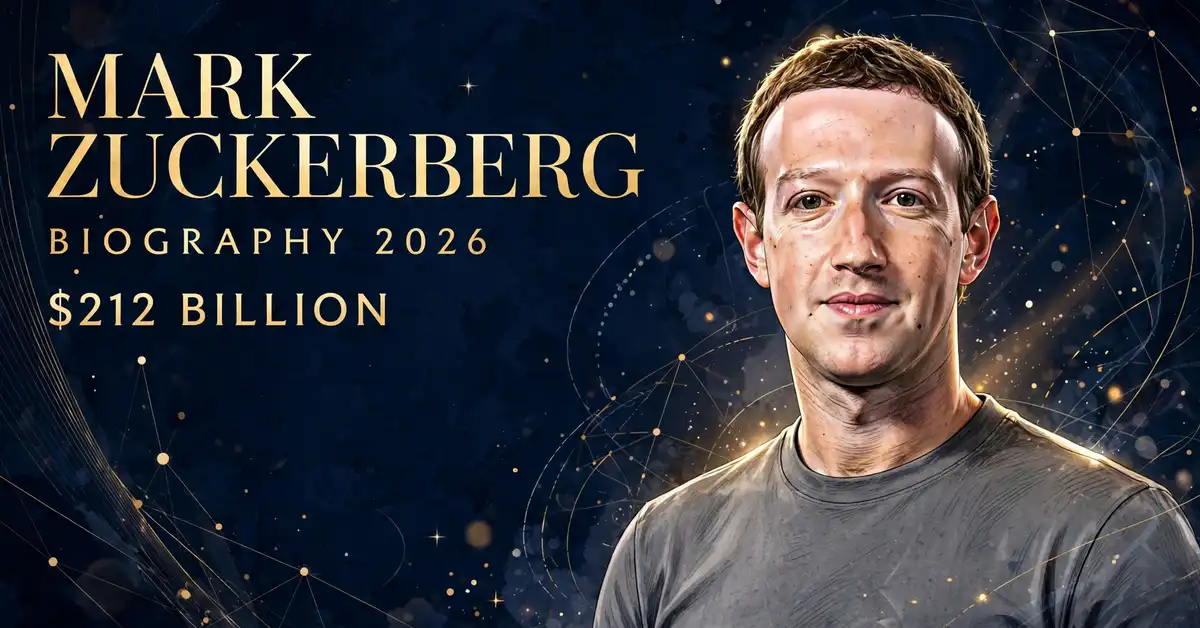
Mark Zuckerberg is 42, co-founder and CEO of Meta, worth about $212 billion in 2026. The Harvard dorm-room launch, the $1 salary and the AI-era Meta behind it.
Mark Zuckerberg is 42 years old, the co-founder, chairman and chief executive of Meta Platforms, and one of the richest people alive. Forbes puts his fortune at about $212 billion on its real-time billionaires list as of November 6, 2026 — a figure that has swung between roughly $212 billion and $258 billion across 2026 alone, because almost all of his wealth sits in Meta stock and moves with the share price. He owns about 13 percent of the company and controls about 60.8 percent of its voting power.
He built that position from a Harvard dorm room. In February 2004, at 19, he launched Facebook with four classmates. Within four years he was the world’s youngest self-made billionaire. Within eight he had taken the company public at a $104 billion valuation. The acquisitions followed — Instagram for about $1 billion in 2012, WhatsApp for about $19 billion in 2014 — and in 2021 he renamed the company Meta and bet its future on the metaverse, then on artificial intelligence.
This biography follows the full arc: the childhood bedroom in Dobbs Ferry where an 11-year-old built a messaging system for his father’s dental office, the Harvard dorm room where Facebook was born, the lawsuits and the IPO, the $1 salary, the family he built with Priscilla Chan, the philanthropy pledge of 99 percent of his shares, and the Meta of late 2026 — a company reporting $64.6 billion in quarterly revenue while fighting a $17 billion settlement and a California wealth-tax ballot at the same time.
| Full name | Mark Elliot Zuckerberg |
| Born | May 14, 1984, White Plains, New York, USA |
| Age in 2026 | 42 (turned 42 on May 14, 2026) |
| Height | 5 ft 7 in (171 cm) |
| Estimated net worth (2026) | ~$212 billion (Forbes real-time, Nov 6, 2026); 2026 range ~$212–258 billion |
| Role | Co-founder, chairman and CEO of Meta Platforms |
| Ownership | ~13% of Meta equity; ~60.8% of voting power |
| Education | Phillips Exeter Academy; Harvard University (dropped out 2004) |
| Wife | Dr. Priscilla Chan (married May 19, 2012) |
| Children | Maxima (b. 2015), August (b. 2017), Aurelia (b. 2023) |
| Salary | $1 per year (symbolic base salary) |
| Philanthropy | Chan Zuckerberg Initiative (founded 2015); pledged 99% of Meta shares |
How This Biography Was Researched
The headline fortune — about $212 billion — is Forbes’ real-time estimate as of November 6, 2026. The 2026 range of roughly $212–258 billion comes from Forbes’ own real-time tracker as cited across the year: $258 billion in September 2026, about $222 billion on October 23, 2026, and $214.6 billion on the Motley Fool’s 2026 annual list. The figure moves daily because it is almost entirely Meta stock. Biographical facts come from Wikipedia, Britannica and Built In, with 2026 developments from Meta’s own October 21, 2026 earnings release and AP/CNBC reporting on the October 22, 2026 SEC filing. No figure in this article is invented; estimates are labelled as estimates, and where sources disagree the range is shown.
+
Early Life and Childhood in Dobbs Ferry
Mark Elliot Zuckerberg was born on May 14, 1984, in White Plains, New York, to Dr. Edward Zuckerberg, a dentist, and Karen Kempner, a psychiatrist. He grew up in Dobbs Ferry, a suburb north of New York City, as the middle child and only son among four siblings. The house ran on two professional parents’ schedules, and the boy found his own lane early: computers.
At 11 he built ZuckNet, a small messaging program that linked the computers in his father’s dental office — the receptionist could ping the dentist in the back room. It was a child’s project with a grown-up shape: a network, built to connect people who were already in the same building. His father hired a private tutor, software developer David Newman, who later said he found it hard to stay ahead of his student. By high school Zuckerberg was writing programs and games, and at Phillips Exeter Academy he built a music-recommendation program called Synapse that drew acquisition interest from Microsoft and AOL. He turned both down.
He arrived at Harvard in 2002 to study computer science. The Synapse episode had already shown the pattern that would define his career: build something people want, refuse to sell it, and keep control.
The Harvard Dorm Room: Facebook Is Born
Facebook went live on February 4, 2004, from Zuckerberg’s Kirkland House dorm room. The co-founders were his roommates and classmates: Eduardo Saverin, Andrew McCollum, Dustin Moskovitz and Chris Hughes. The idea was simple — an online directory where Harvard students could see each other’s profiles — and it spread fast. Within a month it was at Stanford, Columbia and Yale. By the end of 2004 it had a million users.
The launch also started the first fight of his career. Cameron and Tyler Winklevoss, with Divya Narendra, said Zuckerberg had been hired to build a similar site for them, HarvardConnection, and had stolen the idea. Zuckerberg denied it. The dispute ran for four years and ended in a 2008 settlement reported at $65 million in cash and stock. The settlement is part of the story, not a footnote: it set the tone for how Zuckerberg would handle challenges to his ownership — pay, settle, and never give up control.
That same year, 2004, Zuckerberg dropped out of Harvard in his sophomore year and moved the company to Palo Alto, California. Accel Partners invested $12.7 million in 2005. The domain facebook.com was bought for a reported $200,000, and the “the” was dropped from the name.

The Youngest Self-Made Billionaire
In 2008, at 23, Zuckerberg became the world’s youngest self-made billionaire, with a fortune Forbes put at about $1.5 billion. The number itself was less remarkable than what it rested on: a private company that had never turned a serious profit, valued on its user count and its growth. Facebook had 100 million users by August 2008 and 500 million by July 2010. The valuation was a bet on the future, and the bet kept paying.
He refused to sell along the way. Yahoo reportedly offered $1 billion in 2006. Zuckerberg said no — a decision the board questioned at the time and that history has settled. The refusals were not stubbornness for its own sake. Each one kept him in control of a company he intended to run for decades, and the control structure he later built — Class B shares carrying ten votes each — made that control permanent.
The IPO and the Acquisitions
Facebook went public on May 18, 2012, at $38 a share, valuing the company at about $104 billion — the largest technology IPO of its time. The first day of trading was messy: a technical glitch on the Nasdaq delayed trading, and the stock slid below its offer price in the following weeks. Critics called the valuation a bubble. Within a year the stock had recovered, and the IPO is now remembered as the moment the dorm-room project became a public company with a market value in the hundreds of billions.
The acquisitions are the other half of the story. Instagram, bought in April 2012 for about $1 billion in cash and stock, looked expensive for a 13-person company with no revenue. It is now the most valuable acquisition in technology history, worth many times what Facebook paid. WhatsApp followed in 2014 for about $19 billion — the largest price ever paid for a startup at the time — and Oculus VR the same year for $2 billion. Each deal did the same job: it bought the next generation of users before a rival could.
| Year | Milestone | Detail |
|---|---|---|
| 2004 | Facebook launches | February 4, Harvard dorm room |
| 2005 | Accel invests | $12.7 million; facebook.com domain bought |
| 2008 | Youngest self-made billionaire | Age 23, ~$1.5 billion (Forbes) |
| 2012 | Instagram acquired; IPO | ~$1 billion; May 18 IPO at ~$104 billion valuation |
| 2014 | WhatsApp and Oculus | ~$19 billion and $2 billion |
| 2015 | Chan Zuckerberg Initiative | 99% of Meta shares pledged |
| 2021 | Rebrand to Meta | October 2021; metaverse pivot |
| 2023 | Threads launches | July 2023, built on Instagram |
| 2026 | AI and the wealth-tax fight | Meta Compute build-out; Class C share plan |
From Facebook to Meta
In October 2021 Zuckerberg renamed the company Meta Platforms and announced a pivot to the metaverse — virtual worlds built on the Oculus hardware he had bought in 2014. The market hated it at first. Meta’s stock fell sharply in 2022 as Reality Labs burned billions, and Zuckerberg declared 2023 the “year of efficiency,” cutting tens of thousands of jobs. The pivot looked, for a while, like the most expensive mistake in technology.
Then the strategy changed shape. The AI wave of 2023–2026 gave Meta a second act for the same spending: the data centres, the chips and the research teams built for the metaverse were redirected at artificial intelligence. Meta AI and the open-weight Llama models became the centre of the company, and by 2026 Zuckerberg was talking about “Meta Compute” — a build-out of hundreds of gigawatts of computing capacity. The metaverse bet has not paid off in the way he described in 2021. The AI bet is the one the market is now pricing in.

Net Worth in 2026: The 2 Billion Figure
Forbes’ real-time tracker put Zuckerberg at about $212 billion on November 6, 2026. That is the anchor figure for this article, but it is a photograph of a moving target. Forbes had him at $258 billion in September 2026 and about $222 billion on October 23, 2026. The Motley Fool’s 2026 annual list put him at $214.6 billion. Listofceo, updating in March 2026, gave a $220–230 billion range. The honest range for 2026 is roughly $212 billion to $258 billion — a $46 billion spread that says more about Meta’s share price than about Zuckerberg himself.
The reason the number moves so much is concentration. About 13 percent of Meta’s equity sits in his hands, and that stock is nearly all of his wealth. When Meta reports a strong quarter, he gains billions overnight; when the market worries about AI spending or legal costs, he loses them just as fast. He collects a symbolic $1 base salary as CEO, so there is no paycheque smoothing the picture. The fortune is a stock price with a name on it.
Control is the other half of the money story. His shares carry about 60.8 percent of Meta’s voting power through the Class B structure, which means he can be outvoted by nobody. That control is why the 2026 Class C share plan matters: Meta is creating non-voting shares so Zuckerberg can sell stock — to pay tax, to fund philanthropy — without giving up a vote. Control, for him, has always been the asset that matters more than cash.
Family: Priscilla Chan and Three Daughters
Zuckerberg met Priscilla Chan in 2003 at a Harvard fraternity party, while he was a sophomore and she was a freshman. They dated through the Facebook years — she was there for the dorm-room launch, the move to Palo Alto, the IPO — and married on May 19, 2012, the day after the IPO, in a small ceremony in their backyard. Chan is a paediatrician by training, and the couple’s public life has been built around two things: the company and the philanthropy.
They have three daughters: Maxima, born in December 2015; August, born in August 2017; and Aurelia, born in March 2023. Zuckerberg’s public image has softened with fatherhood — the man who once wore the same grey t-shirt every day now posts about family dinners, his daughters’ birthdays and the books he reads to them. He is 5 ft 7 in tall, a detail his own site’s readers keep asking about: Mark Zuckerberg’s height is 5 ft 7 in (171 cm).
The Chan Zuckerberg Initiative
In December 2015, on the birth of their first daughter, Zuckerberg and Chan announced they would give away 99 percent of their Meta shares over their lifetimes, through the Chan Zuckerberg Initiative. The pledge, made in a public letter to Maxima, was worth about $45 billion at the time. The initiative funds science, education and criminal-justice reform, and it is structured as an LLC rather than a foundation — a choice that lets it invest in companies and lobby, not just give grants.
The pledge is real money moving: the initiative has committed billions to biomedical research, including a goal to cure, prevent or manage all disease by the end of the century, and to education technology. Critics note the obvious — 99 percent of a fortune that keeps growing is a pledge that never quite arrives, and an LLC is not a charity. Both points are fair. The pledge is also the largest philanthropic commitment ever made by a person his age, and it shapes how the fortune will end: not inherited, but spent down over the couple’s lifetimes.
Meta in 2026: AI, Lawsuits and a Wealth Tax
2026 has been a crowded year for Meta. The third-quarter results, released October 21, 2026, showed revenue of $64.6 billion — a company still printing money from advertising — alongside a $9.89 billion legal charge. In August 2026 Meta agreed to pay up to $17 billion to settle a lawsuit brought by 47 states and Washington, D.C., which alleged that Facebook and Instagram were designed to hook children and teenagers and harm their mental health. The settlement is one of the largest of its kind, and it is not the end of the legal pressure: the $9.89 billion charge in the third quarter shows the cases keep coming.
October 2026 brought a different kind of fight. On October 22, Meta disclosed a plan built around new non-voting Class C shares and an eight-year commitment from Zuckerberg to remain a California resident, tied to Proposition 40 — a proposed California wealth tax heading to the November 3 ballot that would levy a one-time tax of about 5 percent on covered assets over $1 billion. The filing, reported by AP and CNBC, is designed to let Zuckerberg sell stock to cover a potential tax bill without losing voting control. It is a reminder that a $212 billion fortune built on one stock is also a tax problem waiting for a legislature.
And then there is the property. In March 2026, Zuckerberg and Chan bought a home on Indian Creek, Florida — the island enclave known as “Billionaire Bunker” — and in August 2026 they bought Strancally Castle in County Waterford, Ireland. The purchases are small against the fortune. They are also a signal: the world’s third-richest man is spreading his life across three countries.
How Zuckerberg Compares
Among the founders of his generation, Zuckerberg sits in a group of four. Elon Musk’s biography is the story of a fortune built on cars and rockets; Jeff Bezos’ biography is the story of a fortune built on retail and the cloud; Warren Buffett’s biography is the story of a fortune built over 60 years of investing. Richard Branson’s biography is the story of a fortune built on brand and risk. Zuckerberg’s is the only one built on a single company he still runs day to day, at 42, with voting control no shareholder can take from him.
That control is the thread through the whole biography. He refused to sell Facebook at 22, refused to give up control at the IPO, built a share structure that makes him unfireable, and is now engineering a new share class so he can sell stock without losing a vote. Every other founder on that list has either stepped back, diversified, or handed over the company. Zuckerberg has done none of those things. The biography is not finished, because the man at its centre has no plans to leave.
The Scandals: What Critics Get Right
No honest biography of Zuckerberg skips the scandals, and the biggest came in 2018. Cambridge Analytica, a political consulting firm, harvested the data of up to 87 million Facebook users without their consent and used it for political advertising. Zuckerberg was called before the US Congress and the European Parliament, apologised, and agreed to a $5 billion settlement with the Federal Trade Commission in 2019 — the largest fine the agency had ever imposed on a technology company. The episode changed how the public saw him: not a dorm-room idealist any more, but the head of a company that had treated its users’ data as raw material.
The criticism did not stop there. Facebook’s role in the spread of misinformation — during the 2016 US election, the Rohingya crisis in Myanmar, and the COVID-19 pandemic — put Zuckerberg in front of lawmakers again and again. His defence, repeated across hearings, was that the company was too big to police perfectly and was spending billions trying. His critics’ answer was that a company too big to police should not be that big. Both positions are on the record, and the reader can judge them. What is not in dispute is the cost: the fines, the settlements and the $17 billion agreement of August 2026 are now a permanent line in Meta’s accounts.
The other charge is simpler and harder to answer: that the business model itself — free services paid for by attention sold to advertisers — is what creates the harm. Zuckerberg’s answer has always been that connection is a good in itself, and that billions of people choose it every day. The counter is that choice means little when the product is designed to hold attention. This article does not settle that argument. It records that it exists, that it has followed him for a decade, and that it now costs his company billions a year.
The id=”salary” Salary and How He Actually Gets Cash
Zuckerberg’s base salary is $1 a year, a symbolic figure he adopted in 2013 and has kept ever since. The number is a statement, not a sacrifice: he does not need a salary. His wealth is stock, and he turns stock into cash by selling it. Meta discloses those sales in SEC filings, and they run into the hundreds of millions of dollars a year — the money that funds his life, his property purchases and the Chan Zuckerberg Initiative.
The sales are the reason the Class C plan of October 2026 matters. Every share he sells is a share of voting power given up, unless the share is non-voting. Class C shares let him convert his wealth into cash — to pay a possible California wealth tax, to fund the philanthropy — without losing a single vote. It is the same instinct that shaped the whole biography: keep the money moving, keep the control still.
There is a second, quieter point about the $1 salary. It means Meta’s board cannot use pay to discipline its chief executive, and it means Zuckerberg’s incentives are the same as any large shareholder’s: the stock price. When the stock falls, he loses billions on paper. When it rises, he gains them. The alignment is total, and it is also the reason the fortune swings by tens of billions in a single year.
Daily Life: The Grey T-Shirt, MMA and the Boats
For years Zuckerberg wore the same thing every day: a grey t-shirt, jeans and sneakers. He said the uniform removed a decision from his mornings, so he could spend the decision on the company. The habit became a symbol — the programmer-founder who dressed like an employee — and then, quietly, it changed. In recent years he has appeared in tailored suits, at fashion events and on magazine covers, a public image rebuilt for a man who now runs a company valued in the trillions.
He trains in Brazilian jiu-jitsu and mixed martial arts, a hobby that became public in 2023 when he fought in a tournament and tore his ACL training later that year. He sails, surfs and hydrofoils, and the purchases — the Indian Creek home, the Irish castle — suggest a man building a life outside the office he once never left. He reads widely and posts an annual reading list, a habit from 2015 that he has kept up in public.
None of this changes the fortune. It changes the picture. The 19-year-old who built a website in his dorm room is now a 42-year-old father of three who trains in martial arts, buys castles and fights wealth-tax ballots. The biography keeps moving because the man at its centre keeps moving — and because, unlike the founders he is compared with, he has not handed the company to anyone else.
Sources & Reporting
This article was researched on November 12, 2026, from live reporting and published profiles. The net-worth anchor is Forbes’ real-time billionaires list as of November 6, 2026 (about $212 billion); the 2026 range draws on Forbes’ September 2026 figure ($258 billion), its October 23, 2026 figure (about $222 billion), the Motley Fool’s 2026 annual list ($214.6 billion) and listofceo’s March 2026 update ($220–230 billion). Biographical facts come from Wikipedia and Britannica, with career detail from Built In. The 2026 developments — third-quarter revenue of $64.6 billion and the $9.89 billion legal charge (Meta earnings release, October 21, 2026), the Class C share plan and California residency commitment (SEC filing, October 22, 2026, reported by AP and CNBC), the $17 billion settlement (August 2026, 47 states and D.C.) and the Indian Creek and Strancally Castle purchases (March and August 2026) — are drawn from those sources as cited. No figure in this article is invented; estimates are labelled as estimates, and where sources disagree the range is shown.
Corrections: if any figure in this article is wrong, contact us via the contact page and we will correct it. See our corrections policy.
Mark Zuckerberg Biography — FAQs
How old is Mark Zuckerberg in 2026?
Mark Zuckerberg is 42 years old in 2026. He was born on May 14, 1984, in White Plains, New York, and turned 42 on May 14, 2026.
What is Mark Zuckerberg’s net worth in 2026?
Forbes’ real-time tracker puts Mark Zuckerberg’s net worth at about $212 billion as of November 6, 2026, inside a 2026 range of roughly $212–258 billion. The figure moves with Meta’s share price because almost all of his wealth is Meta stock — about 13 percent of the company’s equity.
How did Mark Zuckerberg start Facebook?
Zuckerberg launched Facebook on February 4, 2004, from his Harvard dorm room, with co-founders Eduardo Saverin, Andrew McCollum, Dustin Moskovitz and Chris Hughes. He dropped out of Harvard in his sophomore year, moved the company to Palo Alto, and took a $12.7 million investment from Accel Partners in 2005.
Who is Mark Zuckerberg’s wife?
Mark Zuckerberg’s wife is Dr. Priscilla Chan, a paediatrician. They met at Harvard in 2003 and married on May 19, 2012, the day after Facebook’s IPO. They have three daughters: Maxima (born 2015), August (born 2017) and Aurelia (born 2023).
How much of Meta does Mark Zuckerberg own?
Zuckerberg owns about 13 percent of Meta’s equity and controls about 60.8 percent of its voting power through Class B shares. In October 2026 Meta disclosed a plan for new non-voting Class C shares so he can sell stock without losing voting control.
Why did Facebook change its name to Meta?
Facebook Inc. renamed itself Meta Platforms in October 2021 to reflect a pivot beyond social media toward the metaverse — virtual worlds built on its Oculus hardware. The company kept Facebook as a product; only the parent company changed its name. The AI build-out of 2024–2026 has since become the centre of the strategy.
What is the Chan Zuckerberg Initiative?
The Chan Zuckerberg Initiative is the philanthropic organisation Zuckerberg and Chan founded in December 2015, on the birth of their first daughter. They pledged to give away 99 percent of their Meta shares over their lifetimes. It funds science, education and criminal-justice reform, and is structured as an LLC rather than a foundation.
How tall is Mark Zuckerberg?
Mark Zuckerberg is 5 ft 7 in (171 cm) tall, as listed in his profiles.
References & Sources
This article has been fact-checked and verified against multiple public sources, financial disclosures, SEC filings, Forbes reports, Celebrity Net Worth databases, and official records. All net worth estimates are based on publicly available information and financial analysis.