Alexander Zverev biography 2026: the Hamburg-born German became world No. 1 after winning the French Open and US Open. His $40M net worth and family story.
Last updated: November 15, 2026 · By Nathan Cole
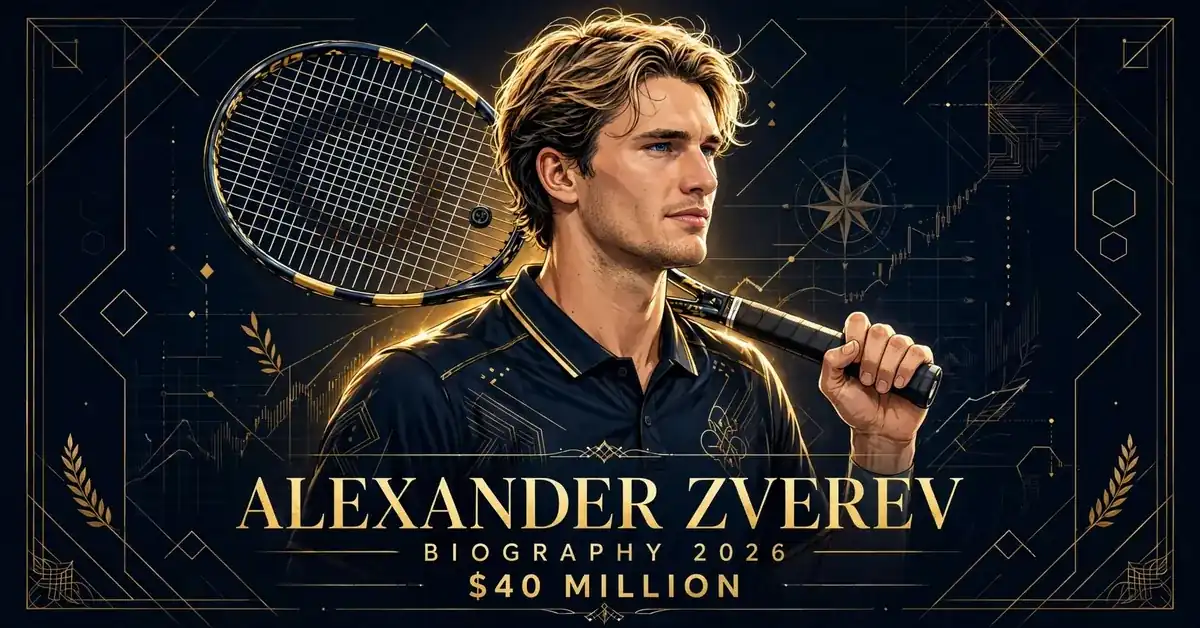
Alexander Zverev is 29 years old, a two-time Grand Slam champion, and the world No. 1. He reached the top of men’s tennis on November 2, 2026, after a season that finally answered the question that had followed him for a decade: could the most talented player of his generation actually win the biggest titles? He won two of them in the same year, the French Open in June and the US Open in September, and the ranking followed. His net worth in 2026 is estimated at $40 million, built on $74 million in career prize money and endorsement deals with Adidas, HEAD and Rolex.
The road to No. 1 took thirteen years as a professional, and it was never a straight line. Zverev was a junior world No. 1 and a teenage Masters champion, then the owner of three lost Grand Slam finals, an Olympic gold medal, two ATP Finals titles and a reputation — fair or not — as the best player who had never won a major. In June 2022 he tore three ligaments in his ankle in front of a packed Court Philippe-Chatrier and spent the next year rebuilding his body and his ranking. He has lived with type 1 diabetes since he was four years old, checking his blood sugar at changeovers in full view of the cameras, and in 2022 he started a foundation to help children with the same condition.
This is the full biography: the Hamburg childhood inside a tennis family, the junior titles, the breakthrough and the heartbreaks, the injury, the 2026 double that changed everything, the money behind it, and the family life — girlfriend Sophia Thomalla, daughter Mayla, and the two dachshunds — that waits for him when the tour stops.
Quick Facts
| Full Name | Alexander Zverev (“Sascha”) |
| Born | April 20, 1997, Hamburg, Germany |
| Age in 2026 | 29 years old (turned 29 on April 20, 2026) |
| Height | 6 ft 6 in (198 cm) |
| Residence | Monte Carlo, Monaco |
| Turned Pro | 2013 |
| Career Titles | 26 singles, 3 doubles |
| Grand Slams | 2 — French Open 2026, US Open 2026 |
| Career-High Ranking | World No. 1 (November 2, 2026) |
| Career Prize Money | $74,022,821 (fourth all-time) |
| Net Worth (2026) | Estimated $40 million (range $35–45 million) |
| Main Sponsors | Adidas, HEAD, Rolex, Richard Mille, Peugeot, Bitpanda |
| Partner | Sophia Thomalla (since 2020) |
| Children | Daughter Mayla (born March 11, 2021) |
| Coach | Alexander Zverev Sr. (his father) |
How This Estimate Was Made
The anchor — $40 million — is the figure Celebrity Net Worth carries for Zverev in 2026, repeated by EssentiallySports and Surprise Sports in September and November 2026 reporting. The range, $35–45 million, comes from EssentiallySports’ comparison pieces. It is an estimate, not a reported fact: Zverev has never disclosed his finances. The hard number underneath it is his career prize money, $74,022,821 per Wikipedia’s page updated October 1, 2026 — fourth on the all-time men’s list. Older published prize-money figures ($65.8 million from the ATP in June 2026, $68.5 million in September) are earlier snapshots of the same moving total, taken before the French Open and US Open paydays landed. Prize money is gross and pre-tax, so the estimate allows for taxes, coaching and agent fees, then adds endorsement income reported at $5–8 million a year. Guide Net Worth’s own October 2026 estimate was $30–40 million, anchored around $35 million; the two Grand Slam titles and the No. 1 ranking since then support the higher $40 million anchor used here.
+
Who Is Alexander Zverev?
Alexander Zverev is a German professional tennis player, the world No. 1 since November 2, 2026, and the first German man to top the rankings since Boris Becker 35 years earlier. He is the 30th man in history to reach No. 1, and the oldest first-time No. 1 in more than 50 years — a detail that says everything about how long this took. He won his first two Grand Slam titles in 2026, at the French Open and the US Open, after losing his first three major finals. He also owns an Olympic gold medal from Tokyo 2020, two ATP Finals titles, seven Masters 1000 titles and 26 tour-level singles titles in total.
He is 6 ft 6 in tall, plays right-handed with a two-handed backhand, and is known on tour simply as Sascha, the Russian diminutive of Alexander. His serve is one of the biggest weapons in the sport, his backhand is the shot opponents avoid, and his return game has been the part critics have picked at for years. Off court he is one of the most recognizable German athletes alive: a Monte Carlo resident, an Adidas and Rolex ambassador, a father, and a type 1 diabetic who monitors his insulin at changeovers in front of millions of viewers.
The 2026 season made him, in the Associated Press’s words, a player who “shed his reputation as a talented underachiever and became a two-time Grand Slam champion.” The record that year was 65–17 at the time he took No. 1, and he had banked 9,350 points in the Race to Turin — more than 3,000 clear of second-placed Carlos Alcaraz. He arrives at the ATP Finals in Turin, which begin November 15, 2026, as the top seed and the year-end No. 1, guaranteed.
Early Life: A Tennis Family From Hamburg
Alexander Zverev was born on April 20, 1997, in Hamburg, Germany, into a family where tennis was not a hobby but the family business. Both of his parents, Irina Zvereva and Alexander Zverev Sr., played tennis at the highest level in the former Soviet Union — his father was a top Soviet player, his mother was known for her technique — and the family emigrated to Germany in 1991, when his older brother Mischa was four. Mischa, born nearly a decade before Alexander, also became a professional tennis player, reaching the world’s top 25.
Zverev started playing tennis at the age of three. By five he was a regular on the professional tour, travelling with Mischa and hitting with top players while other children his age were learning to read. HEAD, his racquet sponsor, describes a five-year-old hitting with top players as if it were the most natural thing in the world. For the Zverevs it was: tennis was the language spoken at home, the job both parents had done, and the path the older brother was already walking.
There was one complication that shaped everything that followed. At the age of four, Zverev was diagnosed with type 1 diabetes. It has never been a secret — he is frequently seen monitoring his insulin levels at changeovers — but for most of his career he barely spoke about it. That changed in 2022, when he created the Alexander Zverev Foundation to support children with diabetes and provide medication for those in developing countries. The foundation is the most personal project of his life outside tennis, and it is the reason his biography is not only a story about trophies.
Junior Career: World No. 1 at 17
Zverev’s junior career was as fast as his senior career would later prove slow to ignite. He finished as the junior world No. 1 and won the boys’ singles title at the 2014 Australian Open, the junior major that has launched more professional careers than any other. He turned professional in 2013, at 16, and became one of the youngest ATP Challenger Tour title winners in history at 17.
The early breakthroughs came in a rush. He won his first tour-level title at 19, in St. Petersburg in 2016, and his first Masters 1000 title just days after his 20th birthday, beating Novak Djokovic in the Rome final in 2017. He was 20 years old, ranked inside the world’s top 10, and already being talked about as the future of the sport. The German press called him the greatest German player since the Becker-Graf-Stich era, and the comparison was not meant as flattery. It was meant as expectation.
By 2018 he had won the ATP Finals in London, again beating Djokovic in the final, and by 2021 he had won the year-end championship a second time and added an Olympic gold medal. The trophies were real and the ranking was high — he reached a career-high of No. 2 in June 2022 — but the Grand Slams, the titles that decide how a career is remembered, kept slipping away.
2020: The US Open Final He Let Slip
The first Grand Slam final was the one that hurt most. At the 2020 US Open, played in an empty Arthur Ashe Stadium during the pandemic, Zverev led Dominic Thiem by two sets and stood two points from the title. He lost in a fifth-set tiebreak, 8–6. It was the first US Open final ever decided by a fifth-set tiebreak, and for years it was the match people mentioned first whenever Zverev’s name came up.
The defeat set a pattern. He lost his next two major finals as well — the 2024 French Open final against Carlos Alcaraz and the 2025 Australian Open final against Jannik Sinner — and the Associated Press, writing in November 2026, described him plainly as a player who had “lost his first three Grand Slam finals.” The label stuck: the best player never to win a major, the talented underachiever, the man who could beat anyone in a semi-final and nobody in a final.
What the label missed was everything else he was winning. The Olympic gold in Tokyo, where he beat Djokovic in the semi-final on his way to the title, was the biggest singles prize in the sport outside the Slams. The two ATP Finals titles, in 2018 and 2021, were won against the best eight players of each season. The seven Masters 1000 titles, the most recent in Paris in 2024, put him among the most decorated players of his generation. The Slam gap was real, but it was the only gap.
Olympic Gold and the ATP Finals Double
Zverev’s Olympic gold medal, won at the delayed Tokyo Games in 2021, is the title he has always talked about with the most pride. He beat Novak Djokovic in the semi-final — Djokovic was chasing the Golden Slam that year — and then beat Karen Khachanov in the final. For a German player, Olympic gold carries a weight that tour titles do not, and Zverev has worn the medal’s meaning in every interview since. He is one of only a handful of men to own both an Olympic singles gold and an ATP Finals title, and the only German man of his generation to own either.
The ATP Finals wins bookend his prime. In 2018, at 21, he beat Djokovic in the final in London. In 2021, in Turin, he beat Daniil Medvedev in the final. The tournament suits him: indoor hard courts, a fast ball, and a format where one great serving week is enough. He returns to Turin in November 2026 as the top seed, having won the event twice before, and it is the last tournament of the season that can still change how 2026 is remembered.
2022: The Ankle Injury at Roland Garros
June 3, 2022, is the date Zverev’s career split in two. In the French Open semi-final against Rafael Nadal, he was matching the 14-time champion stroke for stroke in a superb contest. Nadal had won the first set after saving four set points, and Zverev had just levelled the second at 6–6 when he ran for a ball, rolled his right ankle, and went down screaming. He tore three ligaments. He left the court in a wheelchair.
The injury cost him the rest of 2022 and most of his ranking. He had been world No. 2 that June; by the time he was fit again, he was outside the top 20 and starting over at smaller events. The comeback took the whole of 2023, and it was not a straight line back: early exits, questions about his movement, and the slow work of trusting an ankle that had failed him on the biggest stage of his life. HEAD, his sponsor, describes the period as two distinct parts of his career — the rise to No. 3 in the world, and the comeback that began in 2023 after what it calls a horrific injury.
The scar from that day is part of why the 2026 French Open title matters so much. He won it on the same court where the ankle gave way, four years later, against an opponent 10 years younger, in five sets. It was the first Grand Slam title of his career, and it was won on the court that had nearly ended it.
The Long Road Back: 2023–2025
Between the injury and the breakthrough, Zverev rebuilt his career the unglamorous way: match by match, tournament by tournament, with no shortcuts. He won titles again in 2023 and 2024, reached the French Open final in 2024, and won his seventh Masters 1000 title in Paris in late 2024. His ranking climbed back inside the top five, then back to No. 2. But the Slam finals kept ending the same way, and by the start of 2026 the question had changed from whether he would win a major to whether he ever would.
The numbers from those years tell the story of a player who was never far away. His career win-loss record stands at 574–236, a 70.9 percent winning rate, built across more than a decade. His career prize money passed $65 million in 2026 and kept climbing. His endorsement portfolio — Adidas since 2016, HEAD, Rolex since 2021, Richard Mille, Peugeot, Zegna, Bitpanda — stayed intact through the injury, which is the sponsor market’s way of saying it believed the comeback would happen. Forbes lists Adidas, HEAD, Bitpanda and Jacob & Co among his sponsors, and EssentiallySports puts his off-court income at $5–8 million a year.
2026: The French Open Breakthrough
The breakthrough came in Paris, in June 2026, and it came the hard way. Zverev beat Flavio Cobolli in a marathon five-set French Open final to win his first Grand Slam title, on the court where his ankle had given way four years earlier. The winner’s prize was $3.23 million, and the win pushed his career prize money past $65 million and vaulted him from eighth to fourth on the all-time men’s earnings list, behind only Djokovic, Nadal and Federer.
The title changed his season and his standing in one afternoon. It also changed the arithmetic of his career: a player with an Olympic gold, two ATP Finals titles, seven Masters titles and a Grand Slam could no longer be described as the best player never to win one. The French Open trophy did what thirteen years of near-misses had not — it closed the argument about whether he belonged in the sport’s top tier.

2026: The US Open and World No. 1
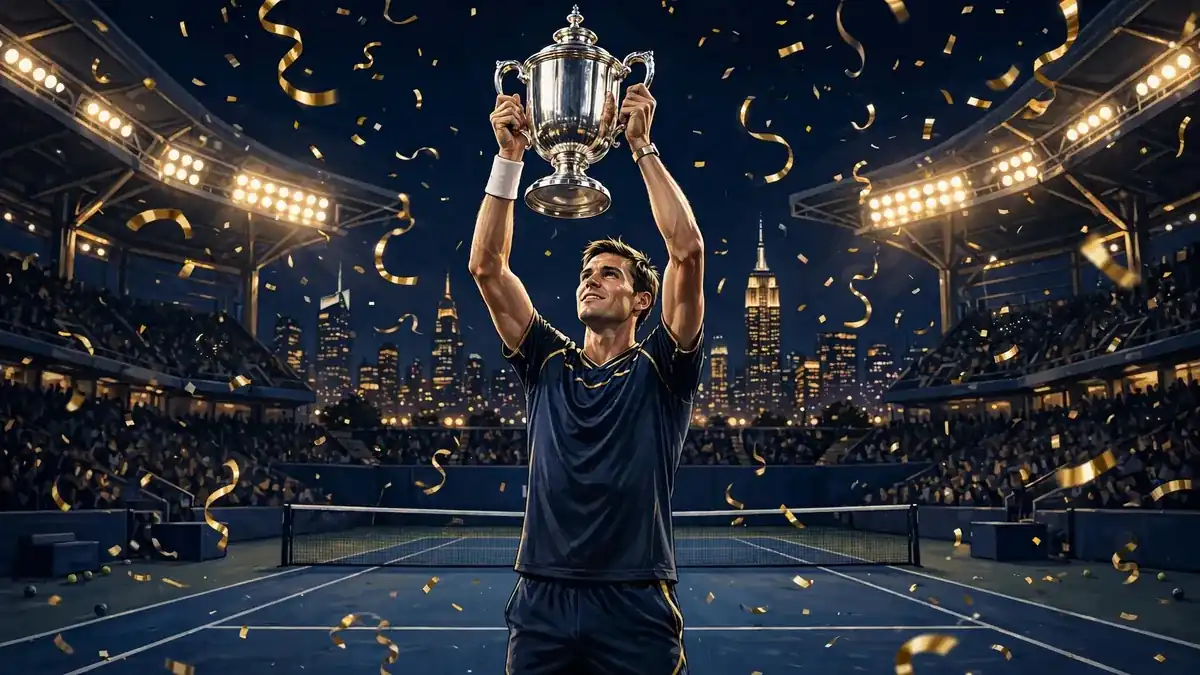
Three months later he did it again. At the US Open in September 2026, Zverev beat Ben Shelton in the final, 6–3, 7–6, 5–7, 6–2, to win his second Grand Slam title. Shelton had ended Carlos Alcaraz’s run at Flushing Meadows, and Zverev beat him in the final — a detail that matters, because it is the first thing critics mention about his 2026 titles. He won the French Open without facing Jannik Sinner, who was struggling with health problems, and the US Open without facing Alcaraz. In a Corriere della Sera interview published on November 9, 2026, he answered the criticism head-on: “Is it a crime?”
The ranking followed the trophies. On November 2, 2026, Zverev rose to world No. 1 for the first time, the 30th man to reach the top and the oldest first-time No. 1 in more than 50 years. He is only the second German man to hold the ranking, after Boris Becker, and the first since Becker 35 years ago. He is guaranteed the year-end No. 1 ranking, and he banked 9,350 points in the Race to Turin — more than 3,000 clear of Alcaraz in second.
The season’s numbers are the strongest of his career: 65 wins against 17 defeats at the time he took No. 1, according to the Associated Press, with 62 of those wins coming against players ranked No. 11 or lower, per BBC Sport. The same BBC report notes the weakness his critics keep returning to: a 3–9 record against top-10 players in 2026, including ten straight defeats to Sinner and four defeats in his last five meetings with Alcaraz. Jimmy Connors, writing in November 2026, said Zverev now has an “obligation” to play like a two-time Grand Slam champion. Roger Federer, in comments reported on November 6, said he had advised Zverev for years behind the scenes — “For years, I advised him” — and pointed to the Slam double as the result.
The season is not over. He lost to Lorenzo Musetti at the Paris Masters on November 4, 7–6 (5), 6–2, and arrived in Turin for the ATP Finals — which begin November 15, 2026 — as the top seed and the man to beat. He has won the tournament twice before, and a third title would put a seal on the best season of his life.
Net Worth and Earnings: What the Career Built
Alexander Zverev’s net worth in 2026 is estimated at $40 million, inside a published range of $35–45 million. Celebrity Net Worth carries the $40 million figure, and EssentiallySports and Surprise Sports repeated it in September and November 2026 reporting. It is an estimate — Zverev has never opened his books — but it rests on the hardest number in tennis: official prize money, which is public, audited and impossible to inflate.
That number is $74,022,821, per Wikipedia’s player page updated October 1, 2026. It puts Zverev fourth on the all-time men’s earnings list, behind only Novak Djokovic, Rafael Nadal and Roger Federer. The figure moves with every tournament, which is why published totals disagree: the ATP’s $65.8 million figure dates to June 2026, before the French Open payday, and EssentiallySports’ $68.5 million comes from September. The $74 million total is the latest snapshot, taken after the US Open, and it is the one this article anchors on. His 2026 prize money alone stood at about $8.92 million by September, including the $3.23 million winner’s cheque from Roland Garros.
| Source | Figure | Date | Basis |
|---|---|---|---|
| Celebrity Net Worth | $40 million | 2026 | Prize money + endorsements |
| EssentiallySports | $35–45 million | June 2026 | Range across reporting |
| Wikipedia / ATP data | $74,022,821 prize money | Oct 1, 2026 | Official career prize money, 4th all-time |
| ATP Tour | $65.8 million prize money | June 2026 | Pre-French Open snapshot |
| EssentiallySports | $5–8 million a year | Sept 2026 | Estimated endorsement income |
Prize money is gross, before tax and before the fees that come with a professional career. Zverev is based in Monte Carlo, he travels with a team led by his father, and his management takes its cut — all of which is why $74 million in prize money becomes a $40 million net worth rather than a $74 million one. The endorsement income, estimated at $5–8 million a year, is what closes the gap, and it has grown with the 2026 titles: a world No. 1 with two Grand Slams is worth considerably more to a sponsor than a world No. 2 who has never won one. Readers looking for more celebrity wealth profiles can browse the Celebrity Net Worth category on this site.
Endorsements: Adidas, HEAD, Rolex and the Rest
Zverev’s endorsement portfolio is one of the most stable in tennis, and it survived the ankle injury without a scratch — a sign of how much sponsors trust his long-term value. His longest-standing deal is with Adidas, which signed him in 2016 for a head-to-toe tennis partnership covering his clothing and footwear. He plays with a HEAD Gravity racquet under a deal that has been extended through 2030, one of the longest equipment contracts in the sport.
The luxury end of the portfolio is where the money is. Rolex has been a partner since 2021, and Richard Mille — the watchmaker whose timepieces cost more than most houses — has been linked to him since 2016. The carmaker Peugeot, the Italian fashion house Zegna, and the crypto investment platform Bitpanda, which signed a three-year deal in late 2024 and puts its logo on his match shirts, round out a roster that Forbes summarises as Adidas, HEAD, Bitpanda and Jacob & Co. He has also worked with Electronic Arts and Beats by Dre over the course of his career.
The deals are worth an estimated $5–8 million a year, according to EssentiallySports, and they explain why his net worth keeps climbing even in years when his prize money dips. Tennis players have no salary — every dollar comes from winning matches and from sponsors — so a portfolio this broad is the closest thing to a fixed income the sport offers. The 2026 season, with two Slams and the No. 1 ranking, is the year that portfolio pays for itself many times over.
Personal Life: Family, Diabetes and the Foundation
Zverev has been in a relationship with Sophia Thomalla since 2020. Thomalla, born October 6, 1989, in East Berlin, is a German actress, model and television presenter — a star in her own right in Germany, where she is far better known than the average tennis girlfriend. She is a regular in his box at the majors, and the couple share two dachshunds, Mishka and Buba. Some outlets date the relationship to 2021; the earliest reporting, from Athlon Sports and others, puts it at 2020.
He is also a father. His daughter Mayla was born on March 11, 2021, to his former girlfriend Brenda Patea, a German model he dated in 2019 and 2020. The couple split before Mayla’s birth, and Zverev confirmed his paternity publicly in 2020, saying: “Even though Brenda and I are no longer together, we have a good relationship and I will live up to my responsibility as a father.” In 2024, the Associated Press reported that Zverev and Patea had agreed to share custody of Mayla after settling a lawsuit Patea had filed. Patea had accused Zverev of physical assault, allegations he has consistently denied; the court proceedings were formally discontinued, with no conviction, no finding of guilt, no guilty plea and no criminal fine or sentence, and the settlement included a €200,000 payment to the state and charitable organisations.
The diabetes is the thread that runs through his whole life. Diagnosed at four, he has managed type 1 diabetes through a junior career, a professional career and thirteen years on tour, checking his blood sugar at changeovers in full view of the cameras. In 2022 he turned that private routine into a public project, creating the Alexander Zverev Foundation to support children with diabetes and fund medication for those in developing countries. It is the part of his biography he talks about with the least guard and the most pride, and it is the part that will outlast every trophy.
Playing Style: What 6 ft 6 in Buys You
At 6 ft 6 in, Zverev is one of the tallest players ever to reach world No. 1, and his game is built around what that height gives him. The serve is the first weapon: flat, fast and hard to read, it wins him free points on every surface and lets him hold serve with a margin for error shorter players do not have. His height is the subject of its own profile on this site — Alexander Zverev’s height and what it has meant for his career — because it shapes everything else about how he plays.
The second weapon is the backhand. Zverev’s two-handed backhand is the most reliable shot in his game, hit flat and deep, and it is the shot opponents avoid when they have a choice. The forehand has been the volatile one, brilliant on its day and the shot that breaks down under pressure, and his return game — particularly the second-serve return — has been the target of most of the criticism aimed at him over the years. His movement for a man his size is exceptional, a legacy of the footwork drilled into him as a child in Hamburg, and it is the reason the ankle injury was so frightening: it attacked the one thing a 6 ft 6 in player cannot afford to lose.
Zverev vs Sinner and Alcaraz: The Argument About No. 1
No biography of Zverev in 2026 is complete without the argument about his No. 1 ranking, because it is the argument the whole tennis world has been having since November 2. The case against him is simple: he won his two Grand Slams without beating either of the two players who have defined the sport for the last three years. He has lost his last ten meetings with Jannik Sinner, and four of his last five against Carlos Alcaraz. His 3–9 record against top-10 players in 2026 is the number his critics quote first, and it is a real number — BBC Sport reported it on November 4, 2026.
The case for him is simpler still: he won the tournaments that were in front of him. Sinner’s health problems kept him out of Zverev’s path at the French Open; Alcaraz lost to Ben Shelton at the US Open, and Zverev beat Shelton in the final. Nobody chooses their draw. The 65–17 season record, the 9,350 Race points, the two Slams and the year-end No. 1 are all facts, and they are the facts the ranking measures. As Zverev put it to Corriere della Sera on November 9: “Is it a crime?”
The rivalry numbers will be settled on court, and the ATP Finals in Turin — starting November 15, 2026 — are the first chance. Sinner and Alcaraz will both be there, and a win over either would do more for Zverev’s standing than any interview answer. Until then, the argument is a matter of taste: whether a No. 1 is the player who beats the best, or the player who wins the most. In 2026, Zverev was the second, and the ranking says the second is enough.
The older generation is watching with interest. Roger Federer, whose own career was defined by rivalries with Nadal and Djokovic, has said he advised Zverev for years behind the scenes. Novak Djokovic, the man Zverev beat in the Rome final in 2017 and in the Tokyo Olympic semi-final in 2021, remains the benchmark for longevity at the top. Zverev’s career, measured against theirs, still has chapters to write.
What Comes Next: Turin and 2027
The ATP Finals in Turin begin on November 15, 2026 — today — and Zverev arrives as the top seed, the year-end No. 1, and a two-time former champion of the event. It is the last tournament of the season, and the last chance in 2026 to answer the argument about his ranking with a racquet instead of words. He has won this tournament in 2018 and 2021, and the indoor hard courts suit his serve better than any surface on the calendar.
Beyond Turin, the 2027 season holds the questions that will define the second half of his career. Can he defend a Grand Slam title? Can he beat Sinner, ten straight defeats and counting? Can he turn a 3–9 record against the top 10 into something a No. 1 can be proud of? He is 29, an age when most players are counting down, but his game — built on a serve that does not age and a backhand that does not break down — is built to last. The oldest first-time No. 1 in half a century has time, and for the first time in his career, he has the trophies to match the talent.
Sources & Reporting
This biography was reported from live sources in November 2026. The career record, titles and ranking history come from Wikipedia’s Alexander Zverev page, updated November 9, 2026, and from his HEAD athlete profile, updated November 2, 2026. The 2026 season, the No. 1 ranking and the 65–17 record come from the Associated Press report of November 2, 2026, and the deutschland.de profile of November 6–9, 2026. The top-10 record, the Sinner and Alcaraz head-to-heads, and the Musetti defeat come from BBC Sport’s November 4, 2026 report and tennis365’s November 6, 2026 coverage. The Corriere della Sera interview, the Federer comments and the US Open final scoreline come from Yardbarker’s November 6 and 11, 2026 reports. The net-worth figure, the prize-money totals and the endorsement portfolio come from EssentiallySports (September–November 2026) and Surprise Sports (November 5, 2026). The personal-life reporting — Sophia Thomalla, daughter Mayla, the custody settlement — comes from Athlon Sports and TV Insider (September 2026) and the Associated Press (2024). Prize-money figures move with every tournament; the $74,022,821 total is the Wikipedia snapshot of October 1, 2026. Net-worth figures are estimates, not disclosed facts, and are labelled as such throughout. Corrections: figures are updated when new reporting emerges — contact us via the About page if you spot an error.
Frequently Asked Questions
How old is Alexander Zverev?
Alexander Zverev is 29 years old in 2026. He was born on April 20, 1997, in Hamburg, Germany, and he turned 29 on April 20, 2026. He became the oldest first-time world No. 1 in more than 50 years when he topped the rankings on November 2, 2026.
What is Alexander Zverev’s net worth in 2026?
Alexander Zverev’s net worth in 2026 is estimated at $40 million, inside a published range of $35–45 million. Celebrity Net Worth carries the $40 million figure. It is built on $74,022,821 in career prize money — fourth on the all-time men’s list — plus endorsement income estimated at $5–8 million a year from Adidas, HEAD, Rolex and others.
How many Grand Slams has Alexander Zverev won?
Alexander Zverev has won two Grand Slam titles, both in 2026: the French Open in June, where he beat Flavio Cobolli in a five-set final, and the US Open in September, where he beat Ben Shelton 6–3, 7–6, 5–7, 6–2. He had lost his first three Grand Slam finals before 2026.
When did Alexander Zverev become world No. 1?
Alexander Zverev became world No. 1 on November 2, 2026, after winning the French Open and the US Open in the same season. He is the 30th man to reach No. 1, the oldest first-time No. 1 in more than 50 years, and only the second German man after Boris Becker. He is guaranteed the year-end No. 1 ranking.
Who is Alexander Zverev’s girlfriend?
Alexander Zverev’s girlfriend is Sophia Thomalla, a German actress, model and television presenter born October 6, 1989, in East Berlin. The couple have been dating since 2020 and share two dachshunds, Mishka and Buba.
Does Alexander Zverev have a child?
Yes, Alexander Zverev has a daughter named Mayla, born on March 11, 2021, to his former girlfriend Brenda Patea, a German model he dated in 2019 and 2020. Zverev and Patea share custody of Mayla after a 2024 out-of-court settlement.
How tall is Alexander Zverev?
Alexander Zverev is 6 ft 6 in tall (198 cm), according to the ATP Tour’s official player profile. His height is a major part of his game — it powers one of the biggest serves in tennis — and it is covered in detail in our profile of Alexander Zverev’s height.
What happened to Alexander Zverev’s ankle in 2022?
In the 2022 French Open semi-final against Rafael Nadal, Alexander Zverev tore three ligaments in his right ankle after levelling the second set at 6–6. He left the court in a wheelchair, missed the rest of 2022, and spent most of 2023 rebuilding his ranking. He won the French Open on the same court four years later, in June 2026.
Nathan Cole
Nathan Cole is the editor of Guide Net Worth. He covers celebrity wealth the way a business desk covers earnings: reported figures first, estimates labeled as estimates, no invented numbers. Every profile passes through his desk before it publishes. About Guide Net Worth · Corrections: figures are updated when new reporting emerges — contact us via the About page if you spot an error.
References & Sources
This article has been fact-checked and verified against multiple public sources, financial disclosures, SEC filings, Forbes reports, Celebrity Net Worth databases, and official records. All net worth estimates are based on publicly available information and financial analysis.