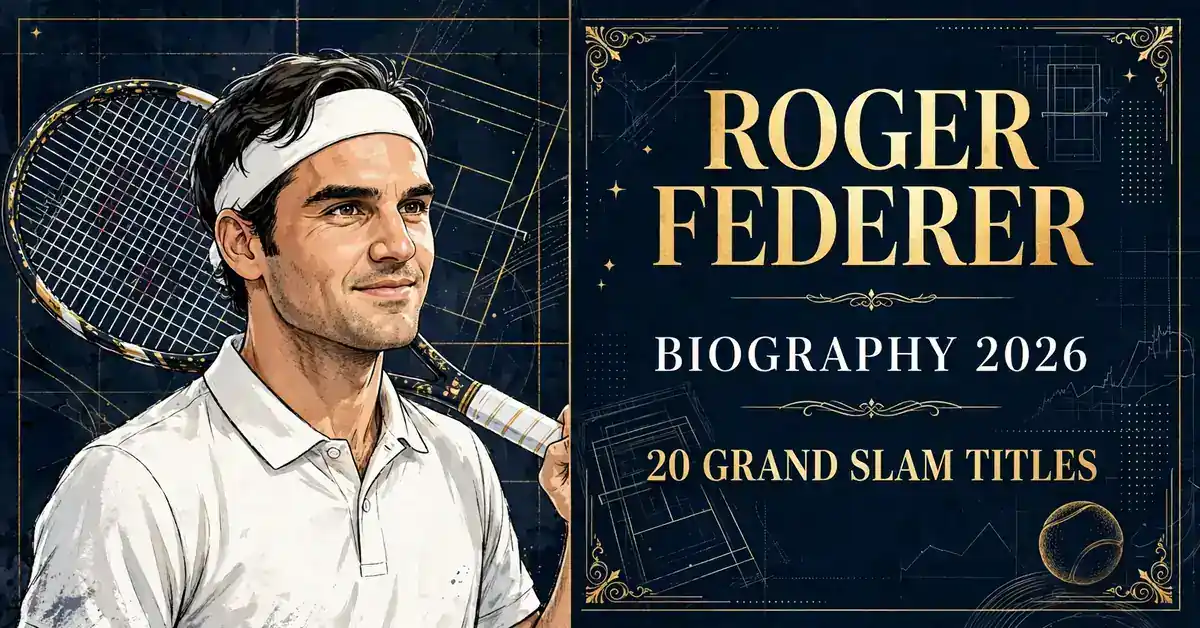
Roger Federer biography 2026: the 45-year-old Swiss legend’s story — 20 Grand Slams, wife Mirka, four kids, and a $1.1B fortune built on Uniqlo and On.
Last updated October 2, 2026 · By Nathan Cole
Roger Federer is 45. The Swiss former world No. 1 — 20 Grand Slam titles, 103 tour titles, 310 weeks at the top of the rankings — retired in September 2022 and has spent the four years since converting a playing career into a business empire: a $300 million Uniqlo contract, a roughly 3% stake in the Swiss shoe company On Holding, and, as of March 2026, a debut on the Forbes billionaires list at $1.1 billion.
He married fellow player Mirka Vavrinec in 2009. They have four children — two sets of twins — and live in Valbella, Switzerland. On August 29, 2026, Federer was inducted into the International Tennis Hall of Fame in Newport, Rhode Island, on the first ballot, closing the loop on a 24-year professional career.
This profile covers the full arc: the Basel childhood, the 2001 Sampras upset, the 2004–2007 peak, the rivalries with Rafael Nadal and Novak Djokovic, the 2017 comeback, the money, the family, and the foundation work. Every figure is sourced and dated; where sources disagree, the article says so.
Quick Facts
| Age (2026) | 45 (born August 8, 1981) |
| Net Worth (2026) | $950 million – $1.3 billion (estimated) |
| Full Name | Roger Federer |
| Born | August 8, 1981, Basel, Switzerland |
| Height | 1.85 m (6 ft 1 in) |
| Profession | Former professional tennis player, entrepreneur, philanthropist |
| Nationality | Swiss |
| Wife | Mirka Federer (née Vavrinec), married 2009 |
| Children | 4 — Myla Rose & Charlene Riva (b. 2009), Leo & Lenny (b. 2014) |
| Wealth Sources | Prize money, Uniqlo, On Holding stake, Rolex, Mercedes-Benz |
| Last Updated | October 2, 2026 |
How This Profile Was Researched
This is a reported biography, not a press release. Career numbers come from ATP records and the International Tennis Hall of Fame; the wealth figure is an independent estimate — Federer has never disclosed his finances publicly. Our process: gather every credibly reported deal, salary, and asset; cross-check them across reputable outlets (Forbes, Bloomberg, the Financial Times); allow for taxes, representation fees, and spending; and publish a range wherever sources disagree, with the reasoning shown in the article. Anything uncertain is labeled as an estimate, not a fact.
+
Early Life & Family Background
Roger Federer was born on August 8, 1981, in Basel, Switzerland, to Robert Federer, a Swiss executive, and Lynette Federer (née Du Rand), a South African. His parents met on a business trip while both worked for a pharmaceutical company. He has an older sister, Diana.
He picked up a racket at eight, playing at a local Basel club, and spent his childhood split between two sports: tennis and soccer, where he played youth football for FC Concordia Basel. As a boy he was also a ball boy at the Swiss Indoors tournament in his hometown — the event he would later win ten times.
Swiss-German is his first language. He also speaks German, English, and French fluently, with some Swedish and Italian — a product of a junior career spent crisscrossing Europe from his early teens.
Junior Career & Turning Pro
By 14, Federer was Switzerland’s national junior champion and had been selected to train at the Swiss National Tennis Center in Ecublens. The results came fast: in 1998 he won the Wimbledon junior singles and doubles titles, added the Orange Bowl in Miami, and finished the year as the ITF Junior World Champion — the year-end junior world No. 1.
He turned professional later that year, aged 17. The transition was steady rather than explosive: he finished 1999 ranked No. 64 in the world and reached the semifinals of the 2000 Sydney Olympics, where he finished fourth — and where he met Mirka Vavrinec, the Slovak-born Swiss player who would become his wife.
Breakthrough: The Sampras Upset & the First Slam
The early Federer was not the composed figure the world came to know. He smashed rackets, argued calls, and let his temper cost him matches. His longtime junior coach, the Australian Peter Carter, was the steadying influence — and Carter’s death in a car crash in South Africa in August 2002 hit Federer hard. He has said repeatedly that the loss pushed him to take his talent seriously.
The announcement to the wider world came at Wimbledon 2001. In the fourth round, the 19-year-old beat defending champion Pete Sampras 7–6(7), 5–7, 6–4, 6–7(2), 7–5, ending Sampras’ 31-match winning streak at the All England Club. It read like a changing of the guard, and it was.
Two years later he made it official. At Wimbledon 2003, Federer beat Mark Philippoussis in straight sets in the final to win his first Grand Slam — the first Swiss man ever to win a major singles title. He wept on Centre Court. The floodgates were open: his first Masters 1000 title had already come at Hamburg in 2002, and the tour’s No. 1 ranking was 18 months away.
The Dominance Era: 2004–2007
Federer won the 2004 Australian Open and became world No. 1 on February 2, 2004. He would not give the ranking up for 237 consecutive weeks — still the all-time record. What followed was the most dominant four-year stretch in the Open Era:
| Season | Win–Loss | Titles | Grand Slams |
|---|---|---|---|
| 2004 | 74–6 | 11 | Australian Open, Wimbledon, US Open |
| 2005 | 81–4 | 11 | Wimbledon, US Open |
| 2006 | 92–5 | 12 | Australian Open, Wimbledon, US Open |
| 2007 | 68–9 | 8 | Australian Open, Wimbledon, US Open |
The 2006 season — 92 wins against 5 losses — remains one of the great single years in tennis history. Across the four seasons he won 11 of 16 majors; only Rafael Nadal on clay kept him from more. He finished year-end No. 1 five times and collected the Laureus World Sportsman of the Year award four years running (2005–2008), a record, then again in 2018.
The Rivalries: Nadal & Djokovic
Two rivalries define Federer’s career, and both produced matches people still argue about.
Rafael Nadal. They met 40 times; Nadal leads 24–16. The 2008 Wimbledon final — Nadal winning 6–4, 6–4, 6–7, 6–7, 9–7 in 4 hours 48 minutes, in near-darkness — is the match most often named the greatest ever played. Seven months later Nadal beat him again in the 2009 Australian Open final, five sets, and Federer wept at the trophy ceremony. He got his revenge in the 2017 Australian Open final, beating Nadal in five sets at 35, after six months away from the tour.
Novak Djokovic. They met 50 times — the most meetings in Open Era men’s tennis — and Djokovic leads 27–23. The cruelest was the 2019 Wimbledon final: Federer served for the title at 8–7 in the fifth, held two championship points at 40–15, and lost 13–12 in the first final-set tiebreak Wimbledon ever played. Djokovic had also beaten him in the 2014 and 2015 Wimbledon finals. Federer won their first Slam final, the 2007 US Open, and beat Djokovic in the 2011 French Open semifinal to end the Serb’s 43-match winning streak.
For the record, Federer leads Andy Murray 14–11. The three rivalries together — the “Big Three” era — carried men’s tennis through two decades of record television audiences.
2009: The Career Grand Slam
Roland Garros was the one that got away. Nadal had beaten Federer in the French Open final three straight years (2006–2008). Then, in the fourth round of the 2009 tournament, Robin Söderling did the unthinkable and ended Nadal’s 31-match winning streak in Paris.
Federer did not waste the opening. He beat Söderling in the final to win the French Open — completing the Career Grand Slam, all four majors — and regained the No. 1 ranking. Five weeks later at Wimbledon, he beat Andy Roddick 16–14 in the fifth set of the final to win his 15th major, passing Pete Sampras’ record of 14. The record that had defined men’s tennis for a decade was his.
2017–2018: The Comeback
By 2016 the body was breaking down. Federer had knee surgery in February 2016, lost the Wimbledon semifinal to Milos Raonic, and shut down his season — the first extended absence of his career. He was 35, ranked outside the top 15, and the obituaries were being drafted.
He returned at the 2017 Australian Open and beat four top-10 players in a row, closing with that five-set win over Nadal for his 18th major. He skipped the entire clay season to protect the knee, then won Wimbledon without dropping a set — his eighth title there, a record. In February 2018, at 36, he returned to world No. 1, the oldest No. 1 in ATP history. A month earlier he had beaten Marin Čilić to win the 2018 Australian Open: Grand Slam No. 20. Nobody has won more majors after turning 35.
Playing Style & Equipment
Federer’s game was built on economy: a one-handed backhand he could hit flat, sliced, or on the run; a forehand that dictated rallies from the first ball; a precise serve; and footwork so quiet that opponents described playing him as “hitting into a wall that moves.” The nicknames — FedExpress, the Swiss Maestro — were earned, not marketed.
His equipment choices were famously conservative. He played Wilson Pro Staff frames with a tiny 90-square-inch head well into the 2010s, then moved in 2014 to the Wilson RF97 Autograph — a 97-square-inch frame built with his input. Wilson launched the RF Classics line in 2025, blending his old nCode design with modern technology, and it remains a key partnership in retirement.
Apparel tells the money story: Nike from 1994 until March 2018, when he signed with Uniqlo. On his feet, after the Nike split, came his own project — The Roger Pro, the first tennis shoe from the Swiss company On, in which he is an investor and creative partner.
The Business Empire: Endorsements & Investments
Federer was the highest-paid tennis player in the world for 16 straight years, per Forbes — and almost none of it came from prize money. The off-court machine:
| Brand / Venture | Deal detail | Reported value |
|---|---|---|
| Uniqlo | Apparel contract signed March 2018, runs through 2028 — pays during retirement | $300M over 10 years (~$30M/yr) |
| On Holding | Equity stake taken 2019; IPO on NYSE Sept 2021; creative partner on The Roger line | ~3% stake (Forbes Aug 2026: ~2.5%); worth $300M+ after 2026 pullback |
| Rolex | Partner since 2001 — one of the longest athlete deals in sports | ~$8M/yr reported |
| Mercedes-Benz | Long-term global ambassador | ~$5M/yr reported |
| Others | Lindt, Moët & Chandon, Barilla, Wilson, Gillette, Rimowa, Sunrise, NetJets; Credit Suisse (ended after UBS takeover) | Undisclosed |
| Laver Cup | Co-founded 2017 with TEAM8 (his management company with Tony Godsick) | Revenue £23.2M (2024) → £35M (2025), per Financial Times |
The Uniqlo deal is the key to his post-retirement income: signed when he left Nike in 2018, it runs a full decade and keeps paying roughly $30 million a year whether he plays or not. Combined with the On stake, his estimated annual income in 2026 sits between $50 million and $95 million — without hitting a ball.
Roger Federer Net Worth 2026
Our estimate: $950 million to $1.3 billion, anchored at $1.1 billion. That makes Federer one of a tiny handful of athlete billionaires — and, by Forbes’ count, only the second person from the tennis world to cross the line, after Romania’s Ion Țiriac.
The number moves because the On Holding stake moves. Here is what the outlets have actually reported, and when:
| Source | Date | Figure | Context |
|---|---|---|---|
| Forbes World’s Billionaires List | March 2026 | $1.1B | Annual-list debut (rank 3,185) |
| Forbes | August 2026 | ~$952.4M | After On shares plunged 19% on weak quarterly sales |
| Bloomberg | 2025 (peak) | $1.3B | Peak valuation before the 2026 slide |
| Forbes | 2024 | ~$550M | Stale — predates the On valuation surge |
Why the estimates disagree is straightforward: the On stake (reported at ~3%, or ~2.5% by Forbes in August 2026) is priced by the public market, so a single bad quarter can erase $150 million from his paper wealth overnight. The private deals — Uniqlo, Rolex, Mercedes — are never disclosed, so no outlet sees the full ledger. Any single figure presented without a date is misleading; the range above is the honest picture.
For scale: his career prize money of $130.6 million — the third-highest in tennis history — accounts for barely a tenth of the fortune. The rest is endorsements and equity. Compared with his great rivals, the gap is wide: Novak Djokovic sits around $240 million and Rafael Nadal around $220 million by the same outlets’ math. The On investment, not the trophies, is what made Federer a billionaire.
Personal Life: Mirka & Four Kids
Federer met Miroslava “Mirka” Vavrinec at the 2000 Sydney Olympics, where both were playing for Switzerland. Born in what was then Czechoslovakia, Mirka reached the world’s top 100 before a foot injury ended her career in 2002. She then became one of the most important people in Federer’s operation — traveling with him, managing logistics, and, players say, keeping him grounded.
They married on April 11, 2009, in a small ceremony in Basel. Three months later their twin daughters were born: Myla Rose and Charlene Riva (July 2009). In May 2014 came twin boys, Leo and Lenny — two sets of twins, four children, one famously camera-shy family.
Forbes lists his residence as Valbella, Switzerland; Swiss outlets also report a family home in Wollerau, in the canton of Schwyz. Unlike many athletes of his wealth, the Federers have kept their private life almost entirely out of the press — no reality shows, no tell-alls, no social-media oversharing.
Philanthropy: The Federer Foundation
Federer started his foundation in 2003, when he was 22 — early enough that people assumed it was a tax vehicle. It wasn’t. In April 2026 it was renamed the Federer Foundation as part of a new 2026–2030 strategy, and its numbers are serious: by the end of 2025 it reported reaching 3.82 million children, training 72,076 teachers, and strengthening 18,445 educational institutions, focused on early-childhood education in Lesotho, Malawi, Namibia, South Africa, Zambia, and Zimbabwe, plus projects in Switzerland.
The work is deliberately unglamorous — tablet-based teacher training in Zambian schools, school-readiness assessments built into Zimbabwe’s teacher colleges — and deliberately long-term, through local partners rather than one-off grants. Forbes reports the organization has invested nearly $100 million since its founding.
Other giving: one million Swiss francs to vulnerable Swiss families and another million to the foundation’s African programs during COVID-19 (2020); $500,000 to War Child Holland for Ukrainian children’s education after Russia’s 2022 invasion. He has been a UNICEF Goodwill Ambassador since 2006. In September 2026, four one-of-a-kind Rolex Daytonas were auctioned for charity, raising nearly $25 million for the foundation among other causes.
Retirement & Life in 2026
Federer announced his retirement on September 15, 2022. His final match came eight days later, on September 23, 2022, at the Laver Cup in London: a doubles match partnered with Rafael Nadal, against Frances Tiafoe and Jack Sock. They lost 4–6, 7–6(2), 11–9. Both men cried at the net. It was, by common consent, the most emotional farewell tennis has staged.
He has been clear the retirement is permanent — no comebacks. Instead he has built a second act: creative partner at On, a driving force behind the Laver Cup’s growth, president of his foundation, and a fixture at exhibitions and fashion weeks. In June 2024 he gave the Dartmouth College commencement address — “effortless is a myth,” he told the graduates, revealing he had won just 54% of the points in his career — and the documentary Federer: Twelve Final Days premiered the same month.
Then, on August 29, 2026, came the formal capstone: induction into the International Tennis Hall of Fame in Newport, Rhode Island, on the first ballot, alongside broadcaster Mary Carillo. Mirka introduced him; John McEnroe, Martina Navratilova, Stefan Edberg, and Billie Jean King watched from the crowd. Federer spoke for nearly 30 minutes, often in tears, and later called it “a reality check in a major way”: “Tennis is always the winner, the biggest of all.”
Legacy & Career Records
The numbers, in one place:
| Record / Milestone | Figure |
|---|---|
| Grand Slam singles titles | 20 — Wimbledon 8 (record), Australian Open 6, US Open 5, French Open 1 |
| ATP singles titles | 103 (2nd in the Open Era) |
| Career win–loss | 1251–275 (82%) |
| Weeks at world No. 1 | 310, including a record 237 consecutive |
| Year-end No. 1 finishes | 5 |
| Masters 1000 titles | 28 |
| ATP Finals titles | 6 (2003, 2004, 2006, 2007, 2010, 2011) |
| Career prize money | $130,594,339 (3rd all-time) |
| Olympics | Doubles gold 2008 (with Stan Wawrinka), singles silver 2012 |
| Team titles | Davis Cup 2014 (Switzerland’s first); Hopman Cup 2001, 2018, 2019 |
| Laureus World Sportsman of the Year | 5 (2005–2008, 2018) |
| Stefan Edberg Sportsmanship Award | 13 times |
Grand Slam titles by tournament:
| Tournament | Titles | Winning years |
|---|---|---|
| Wimbledon | 8 (men’s record) | 2003, 2004, 2005, 2006, 2007, 2009, 2012, 2017 |
| Australian Open | 6 | 2004, 2006, 2007, 2010, 2017, 2018 |
| US Open | 5 | 2004, 2005, 2006, 2007, 2008 |
| French Open | 1 | 2009 |
Sources & Reporting
Figures in this profile reflect reporting through September 2026. Key sources: Forbes (the March 2026 billionaires-list debut at $1.1B and the August 2026 update at ~$952.4M after On Holding’s share slide); Bloomberg (the 2025 peak valuation of $1.3B and the ~3% On stake); the Financial Times (Laver Cup revenue growth, 2024–2025); Wikipedia / ATP records (career statistics, verified against the live infobox); Tennis365 and the Laver Cup site (Hall of Fame induction details and Federer’s September 2026 remarks); Sports Business Journal (induction weekend reporting, August 30, 2026). Where outlets disagree on the net worth figure, the article publishes a range and explains the On Holding volatility behind it rather than picking a side.
Frequently Asked Questions
How old is Roger Federer in 2026?
Roger Federer is 45. He was born on August 8, 1981, in Basel, Switzerland, which made him 45 at the time of his Hall of Fame induction in August 2026.
What is Roger Federer’s net worth in 2026?
Roger Federer’s net worth is estimated between $950 million and $1.3 billion, anchored at $1.1 billion — the figure Forbes published when he debuted on its World’s Billionaires List in March 2026. The range reflects the volatility of his ~3% stake in On Holding; Forbes’ August 2026 update put him at ~$952.4M after On shares fell 19%.
Who is Roger Federer’s wife?
Federer’s wife is Miroslava “Mirka” Vavrinec, a former professional tennis player born in Czechoslovakia who represented Switzerland. They met at the 2000 Sydney Olympics; she retired in 2002 with a foot injury and they married on April 11, 2009, in Basel.
How many children does Roger Federer have?
Roger Federer has four children — two sets of twins. Twin daughters Myla Rose and Charlene Riva were born in July 2009; twin sons Leo and Lenny were born in May 2014.
How many Grand Slam titles did Roger Federer win?
Federer won 20 Grand Slam singles titles: a men’s-record 8 at Wimbledon (2003–2007, 2009, 2012, 2017), 6 Australian Opens, 5 consecutive US Opens (2004–2008), and 1 French Open (2009), which completed his Career Grand Slam.
When did Roger Federer retire?
Federer announced his retirement on September 15, 2022, and played his final match on September 23, 2022, at the Laver Cup in London — a doubles match partnered with Rafael Nadal against Frances Tiafoe and Jack Sock. He was inducted into the International Tennis Hall of Fame on August 29, 2026.
Why did Federer leave Nike for Uniqlo?
Federer signed with Uniqlo in March 2018 on a 10-year contract reportedly worth $300 million — about $30 million a year — one of the largest apparel deals ever signed by an athlete. Crucially, it pays through 2028 regardless of whether he plays, which made it far more valuable in retirement than a performance-based Nike deal.
What is Roger Federer doing now?
Since retiring in 2022, Federer has focused on business and philanthropy: he is an investor and creative partner at On Holding, a driving force behind the Laver Cup, and president of the Federer Foundation. He has ruled out a comeback, saying his retirement is permanent.
WRITTEN BY
Nathan Cole
Nathan Cole is the editor of Guide Net Worth. He covers celebrity wealth the way a business desk covers earnings: reported figures first, estimates labeled as estimates, and no invented numbers. Every profile on this site passes through his desk before it publishes. About Guide Net Worth · Corrections: figures are updated when new reporting emerges — contact us via the About page if you spot an error.
References & Sources
This article has been fact-checked and verified against multiple public sources, financial disclosures, SEC filings, Forbes reports, Celebrity Net Worth databases, and official records. All net worth estimates are based on publicly available information and financial analysis.