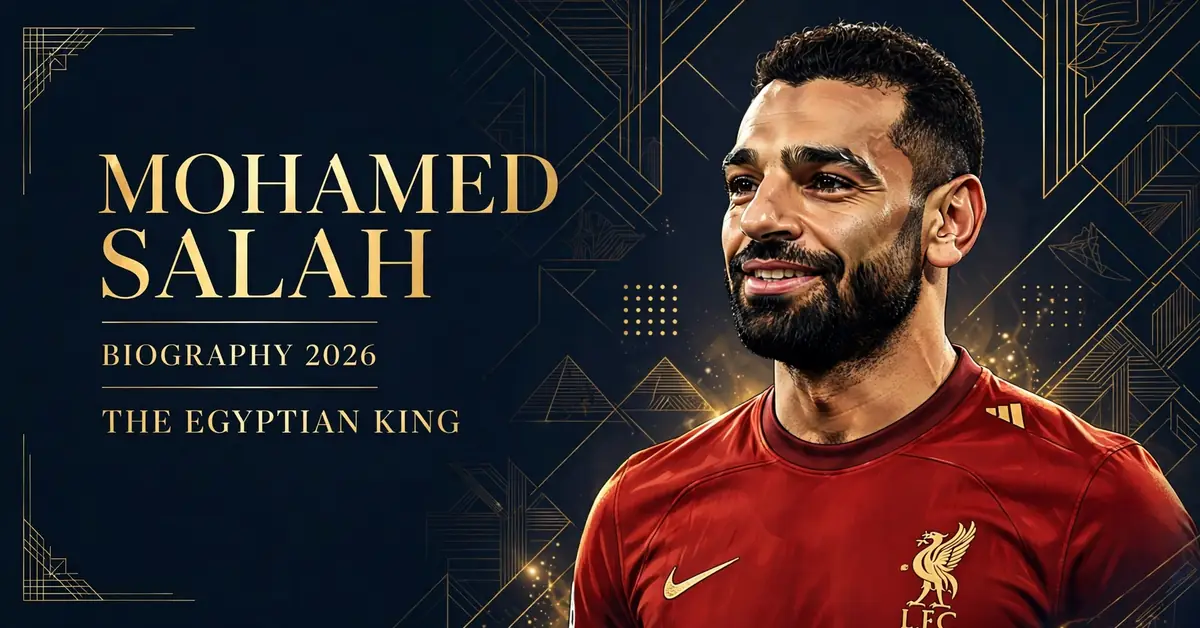
Mohamed Salah biography: from five-hour bus rides in Nagrig to Liverpool legend — 257 goals, a $140M fortune, and a shock 2026 move to Trabzonspor at 34.
Last updated: November 18, 2026 · By Nathan Cole
Mohamed Salah’s biography in 2026 reads like two different careers stitched together. The first is the one everyone knows: a boy from the Nile Delta village of Nagrig who rode four or five buses each way to training in Cairo, survived a dead-end spell at Chelsea, rebuilt himself in Italy, and then became the third-highest goalscorer in Liverpool’s history with 257 goals in 442 appearances. The second career started in August 2026, when the 34-year-old left Anfield as a free agent and signed for Trabzonspor in Turkey — a move almost nobody predicted, and one that has him leading the Süper Lig scoring race three months later.
Salah was born Mohamed Salah Hamed Mahrous Ghaly on 15 June 1992 in Nagrig, Egypt, and he captains the Egypt national team. He is 34 years old, stands 1.75 metres tall, and his net worth in 2026 is reported between $90 million and $140 million, anchored at $140 million by Celebrity Net Worth. Between the village and the fortune sit nine years at Liverpool, two Premier League titles, a Champions League winners’ medal, a record 32-goal season, a World Cup in the summer of 2026 where Egypt won matches at the tournament for the first time, and a farewell season that ended in a public falling-out with his manager. This is the full story, with the numbers dated and the sources named.
The freshness matters here more than usual. Most biography pages about Salah still list Liverpool as his current club. They are out of date. He played his last Liverpool game on 24 May 2026 against Brentford, announced in March that he would leave, and signed a two-year deal with Trabzonspor on 6 August 2026 worth a reported €17 million a season. By mid-November he had scored nine goals in 11 league games in Turkey and, in the same month, became Egypt’s all-time record goalscorer. The article below covers the whole arc — and it starts, as it has to, with the buses.
Quick Facts
| Full Name | Mohamed Salah Hamed Mahrous Ghaly |
| Born | 15 June 1992, Nagrig, Basyoun, Gharbia Governorate, Egypt |
| Age in 2026 | 34 years old (turned 34 on 15 June 2026) |
| Height | 1.75 m (5 ft 9 in) |
| Position | Right winger; captains Egypt |
| Current Club | Trabzonspor (Süper Lig, Turkey) — signed 6 August 2026, two-year deal |
| Former Club | Liverpool (2017–2026): 257 goals in 442 appearances |
| Net Worth 2026 | $90 million – $140 million; $140 million anchor (Celebrity Net Worth) |
| Salary 2026–27 | €17 million per season at Trabzonspor (reported: €10M salary + €7M signing payment) |
| Major Honours | Champions League 2019; Premier League 2019–20 and 2024–25; 2× Swiss Super League |
| Individual | 3× Premier League Golden Boot; PFA Players’ Player of the Year 2018; FWA Footballer of the Year |
| Family | Married to Maggi Salah since December 2013; three children, including daughters Makka and Kayan |
How This Estimate Was Made
Mohamed Salah has never published his finances, and no club has ever disclosed his full contract terms, so every wealth figure in this article is a reported estimate, not an audited fact. The range rests on dated reporting. At the top sits Celebrity Net Worth at $140 million — the figure Liverpool.com repeated on 7 July 2026 and SportsBrief used for its 2026 World Cup rich list on 3 June 2026, where Salah ranked joint-fifth alongside Harry Kane. The low end comes from SurpriseSports at $90 million (updated 25 March 2026) and SportsDunia’s $90–$140 million range. One stale page still prints $80 million from March 2026; it predates the Trabzonspor deal and the September 2026 updates. Forbes, working from earnings rather than wealth, reported Salah earned $55 million in its 2025 football earnings period — $35 million on the pitch and $20 million off it. The article anchors at $140 million because it is the freshest figure from the most-cited tracker, and it keeps the $90 million floor visible so the reader can see where the disagreement sits.
+
From Nagrig to Cairo: The Five-Hour Bus Rides
Mohamed Salah was born on 15 June 1992 in Nagrig, a small village in the Basyoun district of Egypt’s Nile Delta, about 130 kilometres north of Cairo. His full name is Mohamed Salah Hamed Mahrous Ghaly, and the family was middle-class by village standards — his father worked in local administration, and the household revolved around school, the mosque and football. Nagrig had no academy, no scouts, no pathway. The nearest real football was in Cairo, and Cairo was a journey.
At 14, in 2006, Salah joined the youth setup of Al Mokawloon Al Arab Sporting Club, known in English as Arab Contractors, in Cairo. The commute became the founding fact of his biography. He travelled around five hours each way to reach training, transferring between four or five buses in each direction, and he frequently missed school to make the trip. BounceMojo’s biography of Salah, updated in 2026, puts the detail plainly: the boy from the Delta spent most of his teenage years on buses. The Sport Review and FootballPickr tell the same story with the same numbers — a four-to-five-hour round trip, day after day, for years.
The detail matters because it explains the player. Salah’s game was built on endurance and repetition rather than academy polish. He was small — he is still only 1.75 metres tall, a fact that gets its own treatment in our sister site’s piece on how tall Mohamed Salah is — and he was not a prodigy in the conventional sense. No European giant came for him at 15. What he had was a willingness to make a journey most teenagers would have quit, and a left foot that kept getting better with every session he refused to miss.

He stayed at Al Mokawloon through his teens, playing for local youth sides Ittihad Basyoun and Othmason Tanta before the Cairo move. The village noticed him early, but the rest of Egypt did not. That changed in 2010, when the 18-year-old made his senior debut — and then, almost immediately, Egyptian football stopped.
Al Mokawloon: The First Breakthrough
Salah made his senior debut for Al Mokawloon in 2010, at 18, and spent two seasons in the Egyptian Premier League. The numbers were modest: a handful of goals, a winger learning to use his pace against grown defenders. What scouts noticed was not the output but the profile — a left-footed right winger who cut inside at speed, worked back, and never stopped running.
Then came the Port Said stadium disaster in February 2012, in which 74 people died after a match between Al Masry and Al Ahly. The Egyptian league was suspended, and for months there was no football at all. For a 19-year-old trying to build a career, it was a dead end. It was also, by accident, the break. With the league shut down, Egypt’s youth teams played friendlies abroad, and European scouts who would never have flown to Cairo to watch Al Mokawloon saw Salah in Switzerland and France instead.
FC Basel were the club that acted. They had watched him in a friendly against their own side and liked what they saw enough to sign him in the summer of 2012. The fee was never officially disclosed; reports at the time put it in the region of €2.5 million. For a teenager from Nagrig who had spent four years on buses, it was the first professional contract that changed his family’s life.
Basel: The Swiss Springboard
Basel was the right club at the right time. The Swiss champions played Champions League football every season, which meant Salah got to test himself against Europe’s best while still learning the professional game. In his first season, 2012–13, he won the Swiss Super League. In his second, he won it again — and he scored against Chelsea in both Champions League group games in the autumn of 2013, home and away.
Those two goals against Chelsea did more for his career than any league title. José Mourinho, then Chelsea’s manager, watched a 21-year-old Egyptian score at Stamford Bridge and then again at St. Jakob-Park, and decided he wanted him. The goals also announced Salah to the wider European audience: a winger with genuine pace, a left foot that could finish, and a habit of scoring in the biggest games on the calendar.
Basel’s role in the story is often skipped over, but it deserves its place. The club gave Salah two league titles, regular Champions League football, and a shop window. He left Switzerland in January 2014 with 20 goals in 79 appearances and a reputation as the most exciting young African attacker in Europe. Chelsea paid a reported £11 million for him — a fee that, in hindsight, looks like a bargain and, at the time, looked like a gamble.
Chelsea: The £11 Million Lesson
Salah joined Chelsea in January 2014 for a reported £11 million. It was the biggest move of his life and, for two years, the worst period of his career. Under Mourinho, he made 19 appearances and scored two goals across 18 months. He started three Premier League games. The manager did not trust him, the system did not fit him, and the club’s squad was stacked with established internationals in his position.
The Chelsea spell is the part of the biography that gets misread most often. It is usually told as a failure, but it was a lesson in the economics of elite football: a 21-year-old winger does not develop by sitting on a bench in London, no matter how big the club. Salah understood that faster than most players his age would have. He did not agitate, he did not give interviews complaining about his treatment, and he did not let the move define him. He asked for a loan, and he went to Italy to play.
There is a useful comparison from the same Chelsea era. Kevin De Bruyne, another young attacker who could not get a game under Mourinho, left Chelsea in the same window and rebuilt his career in Germany before becoming one of the best midfielders in the world. Salah’s route was the Italian version of the same story: leave the bench, find minutes, and let the football do the talking.
Italy Rebuilt Him: Fiorentina and Roma
Salah joined Fiorentina on loan in February 2015, and the change was immediate. In half a season he scored nine goals in 26 appearances, including a brace against Juventus in the Coppa Italia semi-final first leg in Turin. Fiorentina wanted to keep him. Salah, advised that the club’s option terms were not right, chose Roma instead — first on loan for 2015–16, then permanently in the summer of 2016 for a reported €15 million.
Roma was where the modern Salah appeared. Under Rudi Garcia and then Luciano Spalletti, he played as a right winger in a front three, cut inside onto his left foot, and scored 19 goals in all competitions in 2016–17. The pace that had been a curiosity at Basel became a weapon in Serie A. He finished the season as one of the best attackers in Italy, and the clubs that had ignored him two years earlier started calling again.
The Italian years also changed his body and his game. He arrived in Florence as a raw sprinter; he left Rome as a finisher who understood space, timing and the value of the first touch. Chelsea, who still held his registration until the permanent Roma deal, had sold a player they never used for roughly what they paid — and watched him become, within a year, the most expensive Egyptian footballer in history.
Liverpool 2017: The £36.9 Million Gamble That Paid Off
In June 2017, Liverpool signed Mohamed Salah from Roma for a reported £36.9 million — a club record at the time. The reaction in England was sceptical. This was the Chelsea reject, the player Mourinho had discarded, and Liverpool were paying a record fee for him. Rival fans mocked the deal. Even some Liverpool supporters wondered whether the money should have gone elsewhere.
Jürgen Klopp did not share the doubt. The Liverpool manager had watched Salah at Roma and saw a player whose pace would stretch defences in a system built on pressing and counter-attacking. Klopp built the attack around him from the first day of pre-season, and Salah repaid the faith immediately: he scored on his Premier League debut against Watford in August 2017 and did not stop.
The fee is worth pausing on, because it frames everything that followed. Liverpool’s £36.9 million bought a player who would score 257 goals for the club, win two league titles and a Champions League, and become the third-highest scorer in Liverpool’s history. For scale, the club’s later signings in the same price bracket never came close to that return. The mockery lasted about a month.
2017–18: 32 Goals and a Record That Still Stands
Salah’s first Liverpool season was the best debut campaign by any player in Premier League history. He scored 32 league goals in 36 games — a record for a 38-game season — and 44 goals in all competitions. He won the Golden Boot, the PFA Players’ Player of the Year award and the Football Writers’ Association Footballer of the Year award. Liverpool reached the Champions League final in Kyiv, where Salah was injured in a challenge with Sergio Ramos in the first half and Real Madrid won 3–1.
The 32-goal record deserves its context. The previous mark for a 38-game season was 31, shared by Alan Shearer, Cristiano Ronaldo and Luis Suárez. Salah broke it in a season when he was supposed to be a supporting act to Philippe Coutinho and Roberto Firmino. Coutinho left for Barcelona in January 2018; Salah simply scored more. His goals came from everywhere — cut-inside finishes, headers, tap-ins, long-range strikes — and they came against everyone, including all of the top six.
That season also fixed his nickname in the English game. The Anfield crowd had started singing about the “Egyptian King” within weeks of his arrival, and the name stuck because the numbers backed it up. He was not a one-season wonder — the next eight years proved that — but 2017–18 remains the single greatest individual season any Liverpool player has produced in the Premier League era.
Champions League 2019 and the Premier League Title
The trophies arrived in the two seasons after the record campaign. In June 2019, Salah scored a penalty in the second minute of the Champions League final against Tottenham in Madrid, and Liverpool won 2–0. It was his second final in two years, and this time he finished the game. The medal mattered to him more than the goal; he had left Kyiv the year before in tears, and Madrid was the repair.
The following season brought the prize Liverpool had chased for 30 years. Liverpool won the Premier League in 2019–20, finishing 18 points clear, with Salah scoring 19 league goals. The title was confirmed in June 2020, during the Covid-19 pandemic, in empty stadiums — but the achievement was no less real for the silence. Salah had joined a club that had not won the league since 1990, and in three seasons he had helped end the wait.
Between the two titles he added a UEFA Super Cup and a FIFA Club World Cup in 2019, and in 2022 he collected an FA Cup and a League Cup. The trophy list is the answer to anyone who still calls him a flat-track bully or a one-season player: Champions League, two Premier Leagues, two domestic cups, and a Club World Cup, all as the attack’s first name on the team sheet.
The Peak Years: Records, Golden Boots and 257 Goals
Salah’s Liverpool career did not peak in 2018 and fade. It kept producing. He won the Golden Boot again in 2018–19 (shared, 22 goals) and in 2021–22 (shared, 23 goals), giving him three in five seasons. In 2023 he became Liverpool’s all-time top scorer in the Premier League, passing Robbie Fowler. By the time he left, he was the club’s third-highest scorer in all competitions with 257 goals in 442 appearances — behind only Ian Rush and Roger Hunt — and the all-time top foreign scorer in Premier League history.
He also became the all-time top African scorer in the UEFA Champions League, a record that puts him ahead of every African player who came before him in Europe’s biggest competition, including Didier Drogba and Samuel Eto’o. The scale of that record is easy to miss: African players have been starring in the Champions League for three decades, and Salah outscored all of them.
For a sense of where his fortune sits among his peers, the 2026 World Cup rich list compiled by Pulse Sports from Celebrity Net Worth figures ranked Salah joint-fifth among players at the tournament, level with Harry Kane at $140 million. The players above him were the sport’s two billionaires-in-waiting: Lionel Messi, whose fortune the same list put past $1 billion, and Cristiano Ronaldo, the highest-paid footballer on the planet. Salah’s company, in other words, was the very top of the game.
2024–25: The Record Season That Ended in a Title
Salah’s last full season at Liverpool was his best since the debut campaign — and the numbers prove it. In 2024–25 he recorded 47 goal contributions in the Premier League, with 29 goals and 18 assists, a record for a 38-game season. He won the Golden Boot and the Playmaker award in the same year, a combination no player had managed before, and Liverpool won the league again under Arne Slot.
The season mattered for another reason: it was played out against a contract that was running down. Salah’s deal was due to expire in the summer of 2025, and for months the negotiation dominated Liverpool’s coverage. In April 2025 the club announced a two-year extension, and the relief around Anfield was genuine — the best player in the league had committed to two more years. Nobody at the time, inside or outside the club, expected that the extension would be terminated a year early.
That 2024–25 campaign is also the answer to the question of whether Salah declined in his thirties. He was 32 turning 33 during it, and he produced the most productive season of his career by goal contributions. The decline, when it came, arrived suddenly and in the following season — which is why the farewell that followed caught everyone off guard.
The Final Liverpool Season: The Slot Rift and the Farewell
The 2025–26 season was the worst of Salah’s Liverpool career, and it ended his nine years at the club. He scored 12 goals in all competitions, seven of them in the Premier League, and his relationship with head coach Arne Slot broke down in public. Reports through the season described a player frustrated by the team’s style of play and by his own reduced role, and in March 2026 he announced that he would leave at the end of the season.
He was 33 when he made the announcement, and he turned 34 in June, days before the decision took effect — the full timeline of how old Mohamed Salah is in 2026 explains why so many pages still get his age wrong. The club agreed to terminate the final year of the April 2025 extension, and Salah left as a free agent. His last game was on 24 May 2026 against Brentford. There was no farewell tour, no final Anfield lap of honour in the usual sense — just a mutual agreement, a handshake, and the end of the most productive nine years any Liverpool forward has ever had.
The way it ended has been argued over ever since. Some blame Slot, some blame Salah’s form, some blame the contract structure that left a 33-year-old star negotiating from a position of weakness. What is not in doubt is the record he left behind: 257 goals, two league titles, a European Cup, and a place in the club’s all-time top three scorers. Liverpool have struggled for goals since he left — a fact the club’s own results in the autumn of 2026 made plain — and the farewell, however messy, has not dented his standing with the supporters.
World Cup 2026: Egypt’s First Wins and the Round of 16
Between the Liverpool farewell and the Trabzonspor move, Salah captained Egypt at the 2026 World Cup in the United States, Canada and Mexico. It was the fourth time Egypt had qualified for the tournament, and the first three appearances had produced no wins at all. This time was different: Egypt won matches at a World Cup for the first time in the country’s history and reached the round of 16 for the first time.
Salah’s role was bigger than the goals. He was the captain, the focal point and the player every opponent planned around, and he carried a team that had arrived with low expectations into the knockout stage. The run ended in the round of 16, but it was the most successful World Cup in Egyptian history, and it gave Salah a final international stage before the move to Turkey.
The World Cup also explains the timing of the Trabzonspor deal. Salah joined up with Egypt straight after the Liverpool season, played the tournament, and only then settled his club future in August. The free-agent market had waited for him — and the club that won the race was not one of the European giants or a Saudi Pro League side, but a Turkish club that offered him the one thing he said mattered most: the chance to focus entirely on football.
Trabzonspor: A New Dawn at 34
On 6 August 2026, Trabzonspor announced the signing of Mohamed Salah on a two-year contract running to June 2028. The deal was a free transfer — Liverpool had released him — and the terms were disclosed to Borsa Istanbul, where Trabzonspor’s shares trade: a guaranteed €17 million per season, made up of a €10 million annual salary and a €7 million signing payment in each season, plus performance bonuses and 20 per cent of the proceeds from products sold under his name through the club’s retail operation. Reuters reported the package in full; it made Salah one of the highest-paid players in the Süper Lig.
The choice surprised almost everyone. Beşiktaş had been the early favourite among Turkish clubs, and offers from elsewhere were reported through the summer. Salah chose Trabzonspor, a club based on the Black Sea coast in the far north-east of Turkey, and the reasons reported by BBC Sport were revealing: he wanted a quieter life away from the intensity of a major city like Istanbul, and the ability to focus entirely on his football was said to be the driving force. Trabzonspor, seven-time Turkish champions, offered him a team built around him, a city that treats football as a civic religion, and a league he could dominate.
He made his debut off the bench in the opening league game against Kasımpaşa in August, and the goals came immediately. By the start of November he had scored eight goals with three assists in his first 10 league appearances; by mid-November the tally was nine goals in 11 league games, enough to lead the Süper Lig scoring race. Trabzonspor sat third, three points behind leaders Galatasaray, with Salah’s new teammates — Fabinho, André Onana and Stefan Savić — around him. The Associated Press, reporting from Trabzon in late October, described the move as “a new dawn” rather than a twilight: the Egyptian had rediscovered his scoring touch, and an entire city was turning into a fan club.
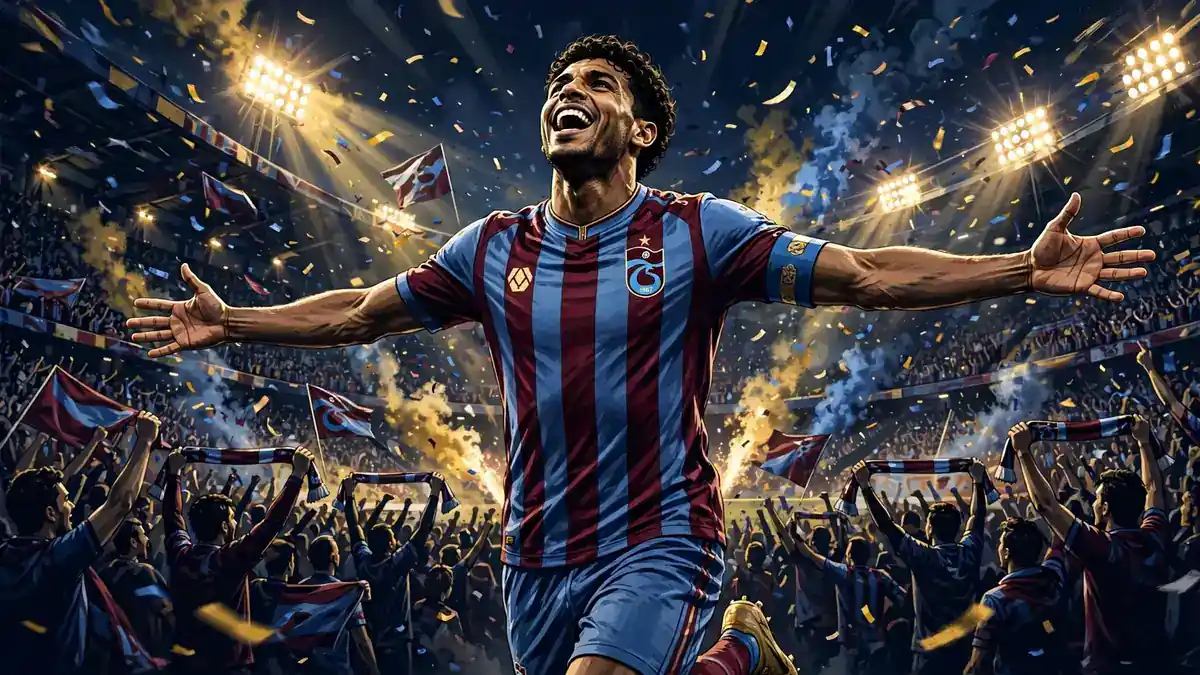
The commercial impact has matched the sporting one. Trabzonspor’s shirt sales and social media following surged after the signing, and fans began travelling to a remote highland spot outside the city where Salah had posted a photograph of himself sitting on a boulder, turning it into a viral photo location. In November, reports from Turkey said Salah, his wife and their three children were set to be granted Turkish citizenship, and that he would receive the State Medal for Distinguished Service at a ceremony recognising his contribution to Turkish sport and tourism. Neither the Turkish government nor Trabzonspor has confirmed those plans, and no official announcement has been made — so they are reported here as reports, not facts.
Mohamed Salah’s Net Worth in 2026: M–0M
Mohamed Salah’s net worth in 2026 is reported between $90 million and $140 million, anchored at $140 million. The anchor is Celebrity Net Worth, the tracker nearly every outlet cites, and the figure was repeated by Liverpool.com on 7 July 2026 and by SportsBrief’s World Cup rich list on 3 June 2026. The low end comes from SurpriseSports at $90 million and SportsDunia’s $90–$140 million range. The full detail of the range, and why it is a freshness gap rather than a dispute about the earnings, is covered in the Mohamed Salah net worth breakdown on this site.
The money is easy to trace. At Liverpool, Salah earned £400,000 a week in his final season — £20.8 million a year — making him the second-highest-paid player in the Premier League behind only Erling Haaland. Celebrity Net Worth estimates he earned around $160 million in playing salary through 2026. Forbes, which measures annual earnings rather than wealth, reported he took home $55 million in its 2025 football earnings period: $35 million on the pitch and $20 million off it.
Off the pitch, the endorsements run at roughly $15–$18 million a year: Adidas, Pepsi, Vodafone Egypt and DHL are the headline deals, and his image-rights company, Salah UK Commercial Ltd, holds nearly £37 million in assets. The Trabzonspor deal adds a guaranteed €17 million a season, plus a fifth of the merchandise sold under his name. The fortune, in short, was built the slow way — nine years of elite wages, a decade of endorsements, and no public record of the extravagant spending that drains so many footballers’ wealth.
| Income stream | Reported figure | Source |
| Liverpool wage, 2025–26 | £400,000/week (£20.8M/year) | FBref / Capology |
| Trabzonspor package, 2026–28 | €17M/season (€10M salary + €7M signing fee) | Reuters / Borsa Istanbul filing |
| Endorsements | ~$15–18M/year | SportsDunia |
| Forbes 2025 earnings | $55M ($35M on-field, $20M off-field) | Forbes |
| Career playing salary to 2026 | ~$160M cumulative | Celebrity Net Worth |
| Salah UK Commercial Ltd assets | ~£37M | SportsDunia |
Family and Personal Life: Maggi, the Children and Nagrig
Salah married his wife Maggi in December 2013. The two met as schoolchildren in Nagrig, and Maggi has stayed almost entirely out of the public eye throughout his career — a deliberate choice the couple have maintained for more than a decade. They have three children, including daughters Makka, born in 2014, and Kayan, born in 2020. The family lived in Liverpool through the nine Anfield years, and moved with him to Turkey in the summer of 2026.
He is a devout Muslim, and his faith is visible in his football: after scoring, he performs the sujood, pressing his forehead to the turf in prayer. The gesture became one of the most recognised celebrations in world football, and it made him a hero far beyond Egypt — to Muslim supporters across the Middle East, Africa and Europe, he is not just a footballer but a representative. He has spoken about his faith rarely and plainly, and he has never used it as a brand.
Outside football, he keeps a small circle. His parents still live in Egypt, his siblings are close, and the village of Nagrig remains the centre of his private life. He returns regularly, he funds projects there, and he has never moved his family away from the place that made him in the way many players do. The bus rides ended years ago. The connection to Nagrig did not.
Giving Back: The Village He Never Left Behind
Salah’s philanthropy is not a foundation with a logo and a gala dinner. It is a village. In Nagrig he has funded a school, an ambulance station and a youth centre, and he has paid for water and sanitation projects that the local authorities could not. Football Paparazzi’s March 2026 report on how he uses his fortune put it simply: an entire community runs, in part, on Mohamed Salah’s money.
The giving extends beyond Nagrig. He has donated to hospitals in Cairo, funded food parcels during Ramadan, and supported Egyptian causes quietly, without press releases. The pattern is consistent with everything else about him: no announcements, no self-promotion, and a preference for projects he can see with his own eyes. It is also, by any measure, the most under-reported part of his story — the goals get the headlines, and the school in Nagrig gets a paragraph.
There is a practical point here too. Salah’s fortune is large, but the Nagrig spending is the reason it is not larger. He has chosen, year after year, to send a meaningful share of it home. That choice is part of why the “Egyptian King” nickname has stuck: in Egypt, it is not only about the goals. It is about a man who left the village, became one of the richest footballers on earth, and never stopped paying for the village’s school.
Legacy: What Salah Leaves Behind
Mohamed Salah’s legacy is already secure, and the Trabzonspor chapter is adding to it rather than diluting it. At Liverpool he is the third-highest scorer in the club’s history, the top foreign scorer in Premier League history, and the top African scorer in Champions League history. At Egypt he is the captain who led the country to its first World Cup wins and its first round of 16, and since November 2026, the national team’s all-time record goalscorer.
The wider legacy is harder to measure and more important. He changed what an Arab and African footballer could be in the Premier League: not a curiosity or a squad player, but the best player in the league, the face of its biggest club, and a global commercial star. He did it without scandal, without a transfer saga every summer, and without ever hiding who he was. For a generation of young players from the Delta to Dakar, the five-hour bus ride is now a story with a destination.
What happens next is still being written. The Trabzonspor contract runs to June 2028, when Salah will be 36. Whether he extends in Turkey, returns to Egypt, or takes one last big move, the biography already has its shape: a boy from Nagrig who rode buses to training, conquered England, and then — when everyone expected the slow fade — went to the Black Sea and started scoring again. For more profiles in this series, browse the Celebrity Net Worth archive.
Frequently Asked Questions
How old is Mohamed Salah in 2026?
Mohamed Salah is 34 years old in 2026. He was born on 15 June 1992 in Nagrig, Egypt, and turned 34 on 15 June 2026. He was 33 when he announced his Liverpool departure in March 2026 and 34 when he signed for Trabzonspor in August 2026.
What is Mohamed Salah’s net worth in 2026?
Mohamed Salah’s net worth in 2026 is reported between $90 million and $140 million, anchored at $140 million by Celebrity Net Worth. The low end comes from SurpriseSports at $90 million (March 2026). Forbes reported he earned $55 million in its 2025 football earnings period — $35 million on the pitch and $20 million off it.
Why did Mohamed Salah leave Liverpool?
Salah announced in March 2026 that he would leave Liverpool at the end of the 2025–26 season. His final season produced only 12 goals in all competitions and his relationship with head coach Arne Slot had broken down. Liverpool agreed to terminate the final year of the two-year extension he signed in April 2025, and he left as a free agent after nine years, 257 goals and 442 appearances.
Which club does Mohamed Salah play for now?
Mohamed Salah plays for Trabzonspor in the Turkish Süper Lig. He signed a two-year deal on 6 August 2026, running to June 2028, on a free transfer after leaving Liverpool. The package is worth a reported €17 million per season — a €10 million salary plus a €7 million signing payment each season — with performance bonuses and 20 per cent of merchandise proceeds under his name.
How many goals did Mohamed Salah score for Liverpool?
Mohamed Salah scored 257 goals in 442 appearances for Liverpool between 2017 and 2026, making him the club’s third-highest scorer of all time behind Ian Rush and Roger Hunt. He scored 191 of those goals in the Premier League, making him the all-time top foreign scorer in Premier League history.
Is Mohamed Salah married?
Yes, Mohamed Salah is married to Maggi Salah. They met as schoolchildren in Nagrig and married in December 2013. They have three children, including daughters Makka (born 2014) and Kayan (born 2020). Maggi stays almost entirely out of the public eye.
How tall is Mohamed Salah?
Mohamed Salah is 1.75 metres tall, which is 5 feet 9 inches. He is shorter than most Premier League wingers, and his height has never limited his game — his pace, balance and left foot have always been the defining attributes.
What is Mohamed Salah’s salary at Trabzonspor?
Mohamed Salah earns a reported €17 million per season at Trabzonspor, made up of a €10 million annual salary and a €7 million signing payment in each season of his two-year deal. The terms were disclosed to Borsa Istanbul and reported by Reuters. He also receives performance bonuses and 20 per cent of proceeds from products sold under his name.
Sources & Reporting
This article was researched on 18 November 2026 from live reporting: Wikipedia, “Mohamed Salah” (updated 17 November 2026) for the birth date and place, the Trabzonspor move, the 257-goal Liverpool record and the 2026 World Cup run; theScore / Associated Press, “Salah-mania grips Turkey as fans seek viral photo spot” (26 October 2026) for the Trabzonspor debut, the 12-goal final Liverpool season, the Slot falling-out and the March 2026 departure announcement; TNT Sports (19 October 2026) for the nine goals in 11 league games, the Golden Boot race and the 257 goals in 442 appearances; Liverpool.com (9 November 2026) for the Trabzonspor form, the €17 million package and the Besiktas interest, and (13 November 2026) for the Egypt record-goalscorer night against Malawi; TheMiddleEastIcons (28 September 2026) for the Trabzonspor contract structure, the £400,000-a-week Liverpool wage, the $140 million Celebrity Net Worth figure and the $55 million Forbes earnings; SportsDunia (April 2026) for the $90–$140 million range, the $15–$18 million endorsement estimate and the £37 million Salah UK Commercial Ltd assets; SurpriseSports (25 March 2026) for the $90 million low-end figure; SportsBrief / Pulse Sports (3 June 2026) for the $140 million World Cup rich-list ranking; BounceMojo (2026) for the five-hour bus commute and the Nagrig early life; Billionaires.Africa (3 November 2026) and Sportbible (3 November 2026) for the unconfirmed Turkish citizenship and State Medal reports; the Football Paparazzi (14 March 2026) for the Nagrig philanthropy. Figures that were never officially disclosed — transfer fees, wages and net worth — are labelled reported or estimated throughout.
Nathan Cole
Nathan Cole is the editor of Guide Net Worth. He covers celebrity wealth the way a business desk covers earnings: reported figures first, estimates labeled as estimates, no invented numbers. Every profile passes through his desk before it publishes. About Guide Net Worth · Corrections: figures are updated when new reporting emerges — contact us via the About page if you spot an error.
References & Sources
This article has been fact-checked and verified against multiple public sources, financial disclosures, SEC filings, Forbes reports, Celebrity Net Worth databases, and official records. All net worth estimates are based on publicly available information and financial analysis.