Novak Djokovic age: the 39-year-old reached the 2026 Australian Open final, won title No. 102 in Beijing, missed the ATP Finals, and turns 40 in May 2027.
Last updated: November 18, 2026 · By Nathan Cole
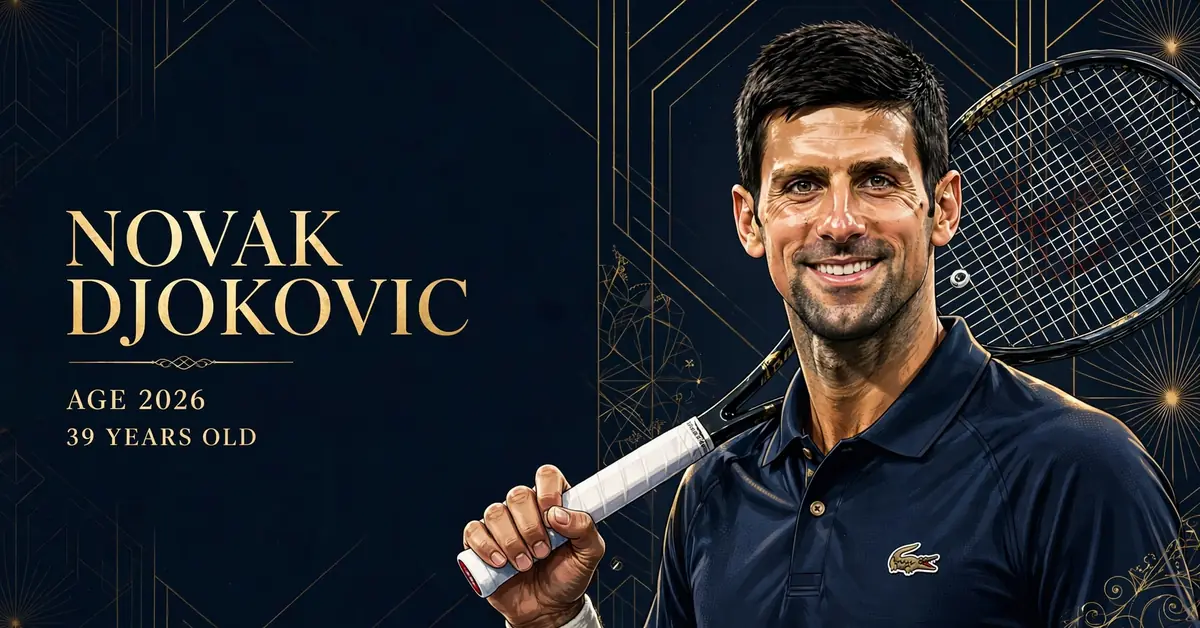
Novak Djokovic is 39 years old in 2026. He was born on 22 May 1987 in Belgrade, Serbia, and he turns 40 on 22 May 2027. That number — 39 — is the most important fact in tennis right now, because everything Djokovic does is measured against it: the Australian Open final he reached in January, the 102nd title he won in Beijing in October, the ATP Finals he missed in November, and the question of whether a 39-year-old body can still win a 25th Grand Slam.
It is also the number most of the internet gets wrong. Search for Djokovic’s age today and you will find pages that still say 38, some of them updated within the last few weeks. They were written before his birthday in May, or they were never updated after it. This article gives the correct age, explains why the wrong one keeps circulating, and then does what an age article should do: it tells the story of a 39-year-old who is still, against every precedent in the sport, competing in Grand Slam finals — and what the 2026 season says about how much longer he can.
The short version of 2026: Djokovic beat Jannik Sinner to reach his 11th Australian Open final, lost it to Carlos Alcaraz in four sets, won his 102nd career title in Beijing in October, and then lost his last match of the year to a qualifier in Paris on 4 November. He finished the season ranked No. 12, outside the top 10 for the first time since 2017, and he has already confirmed he will be back for the 2027 Australian Open. The full version follows.
Quick Facts
| Full Name | Novak Djokovic |
| Born | 22 May 1987, Belgrade, Serbia |
| Age in 2026 | 39 years old (turns 40 on 22 May 2027) |
| Height | 1.88 m (6 ft 2 in) |
| Turned Pro | 2003 (age 16) |
| Grand Slams | 24 singles titles — most in men’s history |
| Career Titles | 102 (one behind Roger Federer’s 103) |
| Weeks at No. 1 | 428 — the all-time record |
| Ranking Nov 2026 | World No. 12 |
| Career Prize Money | More than $193 million — most in tennis history |
| Net Worth 2026 | $240 million – $250 million; $240 million anchor (Celebrity Net Worth) |
| Family | Married to Jelena Djokovic since July 2014; children Stefan (b. 2014) and Tara (b. 2017) |
How This Estimate Was Made
Novak Djokovic has never published his finances, and his endorsement contracts are private, so every wealth figure in this article is a reported estimate, not an audited fact. The range rests on dated reporting. At the top sits Celebrity Net Worth at $240 million — the figure used by SureBets in its July 2026 editorial range of $240–$250 million, by NetWorthSpike in November 2026 and by Augustman’s richest-tennis-players list in January 2026. The anchor is cross-checked against the one hard number in the story: $193,469,626 in official ATP career prize money (Perfect Tennis, July 2026), the most any tennis player has ever earned on court. Forbes adds the income picture: $30.2 million pretax in the 12 months to August 2026, of which $25 million came from off-court activity — Lacoste, Head, ASICS, Hublot and Qatar Airways. A scenario model from Grizzly Bulls (evidence through 20 October 2026) puts the base case at $240 million, with a bear case of $130 million and a bull case of $390 million. One outlet claimed Forbes valued him at $510 million in 2023; that figure has no corroboration and is excluded from the range.
+
The Answer: 39 Years Old, Turning 40 in May 2027
Novak Djokovic was born on 22 May 1987, which makes him 39 years old as of November 2026. He will turn 40 on 22 May 2027, during the clay-court season, a few days before the French Open begins. His birthplace was Belgrade, then part of Yugoslavia, and he has played his entire career under the Serbian flag.
Put the number in context. When Djokovic won his first Grand Slam, the 2008 Australian Open, he was 20. When he completed the career Grand Slam at Roland Garros in 2016, he was 29. When he won Olympic gold in Paris in 2024, he was 37. At 39 he is older than any man who has ever won a Grand Slam singles title — the record belongs to Ken Rosewall, who won the 1972 Australian Open at 37 — and older than Roger Federer was when he won his last major, at 36, in 2018. The full detail of his career is covered in our Novak Djokovic biography on this site.
His height is part of the same physical story. Djokovic stands 1.88 metres — 6 feet 2 inches — a figure the ATP Tour’s own profile and Encyclopaedia Britannica (updated October 2026) agree on exactly. Our sister site’s piece on how tall Novak Djokovic is breaks down how that frame compares with Federer, Nadal, Alcaraz and Sinner, and what it does for his serve, his return and his movement. At 39, the height is unchanged. The speed around it is the question.
Why Some Pages Still Say 38
If you search “Novak Djokovic age” today, a surprising number of results still say 38. Tennis Majors, reporting from Rome in May 2026, called him “aged 38” — correct at the time, since his birthday fell later that month. A Sportskeeda piece from December 2025 calls him “the 38-year-old Serbian tennis legend”. NetWorthSpike, updated on 9 November 2026 — six months after the birthday — still describes him as “at 38, still competing deep into Grand Slams”. None of these pages is lying. All of them are stale.
The pattern is common for athletes with mid-year birthdays: pages written in the first half of the year carry the old age, and pages that scrape or summarise them repeat it. The error then propagates, because each new page cites the last one. The giveaway is the date. Any page that says 38 and was published or last updated after 22 May 2026 is wrong, and there are several in the top results right now.
The same staleness affects the other members of the old guard. Rafael Nadal turned 40 in June 2026 and Roger Federer turned 45 in August 2026, figures confirmed by GiveMeSport in November 2026 — yet pages still describe them as 39 and 44. Djokovic’s case is the one that matters most, because he is the only one of the three still playing, and his age is the frame for every question about his future.
Belgrade: A Childhood Between War and Tennis
Djokovic was born in Belgrade on 22 May 1987, the eldest son of Srdjan and Dijana Djokovic. His father had been a professional skier; his mother ran the family business. He has two younger brothers, Marko and Djordje, who both played tennis professionally at a lower level. The family lived above the restaurant they ran, and the tennis courts where the young Novak first played were part of that same small world.
He picked up a racket at four. At six he was spotted by Jelena Genčić, the coach who had mentored Monica Seles and Goran Ivanišević, and who told his parents the boy had the talent to be the best in the world. At 12 he left home for the Niki Pilić academy in Munich, where he trained in a system built for professionals while still a child.
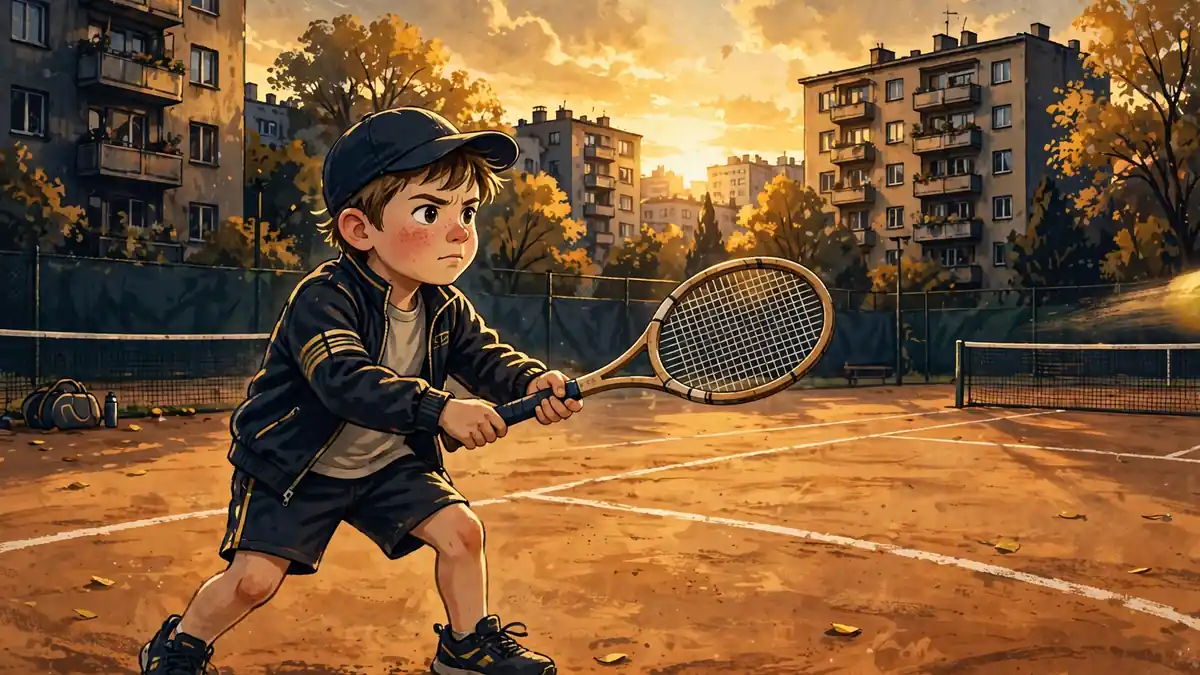
The childhood had a shadow that shaped him. In 1999, when Djokovic was 11, NATO bombed Belgrade for 78 days. He has spoken many times since about practising in the mornings and sheltering in the afternoons, about the sound of the sirens and the fear, and about how the experience gave him a hunger that players from comfortable backgrounds did not have. It is the part of his biography that gets quoted most often, and it is also the part that explains the mental side of his game: the player who came through that spring does not get rattled by a break point.
The Rise: From Teenage Pro to World No. 1
Djokovic turned professional in 2003, at 16. He won his first ATP title in Amersfoort in 2006, and his first Grand Slam at the Australian Open in 2008, beating Jo-Wilfried Tsonga in the final at 20. For three years after that he was the third man — behind Federer and Nadal, ahead of everyone else — and the question was whether he would ever break the duopoly.
The answer came in 2011, the greatest single season in the Open Era. Djokovic went 70–6, won three Grand Slams, five Masters 1000 titles, and beat Nadal in six finals in a row. He reached world No. 1 for the first time on 4 July 2011, at 24, and he has now spent 428 weeks there — more than any man or woman in history. The 2011 season also followed the change that made it possible: the gluten-free diet he adopted in late 2010, after a diagnosis arranged by Dr Igor Četojević, which ended the breathing problems and mid-match collapses that had dogged his early career.
The rise was not a straight line. He lost finals, he had a difficult 2017 when an elbow injury and a loss of motivation dropped him outside the top 10, and he rebuilt himself twice — once in 2018, and again after the 2022 deportation from Australia over his vaccination status, which cost him the chance to defend his title in Melbourne. Each rebuild added to the record rather than subtracting from it.
The Peak: 24 Slams, 428 Weeks at No. 1
The numbers Djokovic accumulated between 2011 and 2023 are the reason he is called the greatest of all time, and they are worth stating plainly. He has won 24 Grand Slam singles titles — 10 Australian Opens, 7 Wimbledons, 4 US Opens and 3 French Opens — more than any man in history, and two more than Nadal’s 22 and four more than Federer’s 20. He has won 40 Masters 1000 titles, another record. He has won the ATP Finals seven times. He has won 102 tour titles in total, one behind Federer’s 103.
The 2023 season, played at 36, was the last full peak: three Grand Slams, the ATP Finals, and a return to No. 1. Then came the Olympic gold in Paris in August 2024, beating Carlos Alcaraz in the final in straight sets — the one prize his career had lacked, won at 37, in the last realistic window. He has not won a Grand Slam since the 2023 US Open, which is now three seasons ago, and that drought is the other half of the age story.
For comparison with his great rivals, the Rafael Nadal biography on this site covers the Spaniard’s 22 Slams and his retirement at 38, and the Roger Federer biography covers the Swiss’s 20 Slams and his retirement at 41. Djokovic, at 39, has outlasted them both — and that is precisely why the question of when he stops matters so much.
The Body at 39: Diet, Recovery and the Science of Longevity
Djokovic’s longevity is not an accident. It is a system, built over fifteen years, and it is the reason he is still reaching Grand Slam finals at an age when every predecessor had retired. The best-known part is the diet: gluten-free since late 2010, plant-based for much of the time since, with a famously disciplined approach to sugar, alcohol and processed food. He has written about it, spoken about it, and credited it with the transformation that produced the 2011 season.
The less visible parts matter more at 39. He travels with a team that includes a physiotherapist, a fitness coach and a recovery specialist. He schedules ruthlessly — he played a reduced calendar in 2026, skipping events to protect his body for the Slams. He uses hyperbaric chambers, cold exposure and sleep tracking, and he has spoken openly about meditation and breathing work as part of his preparation. None of this is new in elite sport. What is unusual is the discipline with which he has applied it for a decade and a half without a break.
It has limits, and 2026 showed them. The body still recovers, but it recovers more slowly, and the margin for error in five-set matches has narrowed. He reached the Australian Open final and the Wimbledon semi-final, but he also lost early in Rome, Cincinnati, Shanghai and Paris — results that would have been unthinkable five years ago. The system keeps him competitive. It no longer makes him inevitable.
The 2026 Season: A Final in Melbourne, a Title in Beijing
The 2026 season started as well as it could have. In Melbourne, Djokovic beat Jannik Sinner in the semi-final to reach his 11th Australian Open final, becoming the oldest finalist in the tournament’s history. He lost the final to Carlos Alcaraz, 2–6, 6–2, 6–3, 7–5, in a match that turned on the second set. Alcaraz, 23, completed the career Grand Slam that day and became the youngest man in the Open Era to win all four majors. Djokovic collected A$2.15 million as runner-up — about $1.45 million — and the consolation that he had reached a Grand Slam final at 38, something no man his age had ever done.
After Melbourne, the season thinned out. He reached the Wimbledon semi-final, but he lost his opening match in Rome to 19-year-old Dino Prizmic, went out early in Cincinnati and Shanghai, and for the first time since 2005 failed to reach a single Masters 1000 quarter-final in a season. The pattern was clear: still dangerous in the Slams, increasingly vulnerable everywhere else.
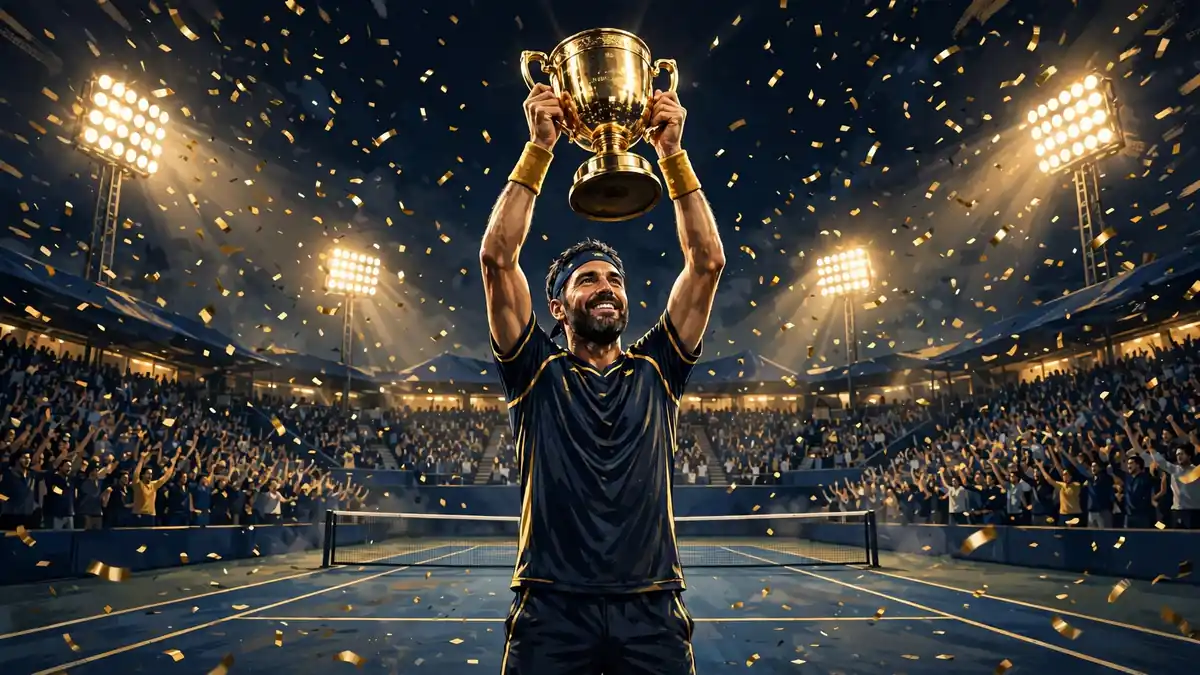
Then came Beijing. On 6 October 2026, Djokovic won the China Open, beating Alexander Zverev and Daniil Medvedev on the way to the final, where Alex de Minaur retired with an adductor injury at 7–6(7–3), 0–1. It was his 102nd career title, his seventh in Beijing — where his career record is now 34 wins from 34 matches — and it made him the first player in tennis history to win at least one title in 21 consecutive seasons. The winner’s cheque was $764,750. He had waited more than nine months for a title in 2026, since the Hellenic Championships in Athens the previous November, and the wait showed in how he celebrated.
The season ended on 4 November, when he lost 2–6, 6–3, 6–3 to Australian qualifier Rinky Hijikata in the second round of the Paris Masters. It was his tenth defeat of the year, and it ended his season. SportsRivo’s season-end tally puts his record at 22–10; other outlets list it slightly lower, at 20–10 or 21–10, depending on which matches they count. Either way, he finished the year ranked No. 12, missed the ATP Finals for only the second time since 2007, and earned roughly $4 million in prize money for the season — a fraction of what he made in his peak years, and a figure that tells its own story about where he now stands.
The Decline Question: What Moya Said, and What the Numbers Say
In November 2026, Carlos Moya — the former world No. 1 who coached Rafael Nadal — said publicly that Djokovic was facing “the decline that ends every career”, and that his struggles at 39 were a normal result of age, injuries and wear. The comments came days after Djokovic failed to qualify for the ATP Finals, and they were widely reported because they said out loud what many in tennis had been thinking quietly.
Moya has a point, and the numbers support him. Djokovic has not won a Grand Slam in three seasons. He has not reached a Masters quarter-final in a year. He finished outside the top 10 for the first time since 2017. His body, which carried him through 428 weeks at No. 1, now needs more recovery time between matches than the schedule allows. That is what decline looks like in tennis: not a collapse, but a narrowing — fewer tournaments, fewer deep runs, fewer weeks at the top.
But the counter-argument is also in the numbers. He reached a Grand Slam final in January. He won a title in October. He beat Sinner, Zverev and Medvedev — three top-10 players — in the space of a week in Beijing. Rick Macci, who coached Serena and Venus Williams, said in November that Djokovic’s ability to play at his level at 39 deserves more appreciation than it gets, and that his mental fortitude, motivation and movement are “something the sport has never seen at this level and maybe won’t again”. Both things are true. He is declining, and he is still extraordinary. The tension between those two facts is the story of his 39th year.
Family and Personal Life: Jelena, Stefan and Tara
Djokovic married Jelena Ristić on 10 July 2014, in a ceremony in Montenegro. They had met as teenagers in Belgrade, and Jelena — who runs the Novak Djokovic Foundation — has been the constant presence of his adult life. Their son Stefan was born in October 2014, and their daughter Tara in September 2017. The children travel with him when the schedule allows, and they were in the players’ box in Melbourne in January, watching their father reach another final.
Family is the other reason he keeps playing, and the reason he may stop. He has said that the decision to continue is no longer about rankings or records but about whether the travel and the training are worth the time away from home. Stefan is 12 now, Tara is nine, and the school calendar matters more than it did when they were small. The 2026 schedule — reduced, targeted, built around the Slams — was designed with that in mind.
The family also runs the foundation he established in 2007, which funds early-childhood education in Serbia. It is the least publicised part of his life and the one he talks about with the most pride. The foundation has built and renovated dozens of kindergartens across Serbia, and Jelena runs it day to day. It is the part of the Djokovic story that will outlast the tennis.
Faith and the Mount Athos Visit
Djokovic is a devout Serbian Orthodox Christian, and his faith has become more visible as he has got older. He crosses himself before matches, he has spoken about prayer as part of his preparation, and in 2011 he received the Order of Saint Sava from the Serbian Orthodox Church. The faith is not a public performance; it is the private structure of his life, and it has become more important to him as the career winds down.
In November 2026, after the season ended, he visited Mount Athos in Greece with his father Srdjan and his uncle Goran, and was filmed reading the Lord’s Prayer inside the Hilandar Monastery church. The footage spread quickly, and the reporting around it was careful: the video does not establish the exact order of every activity during his stay, and there is no reason to treat it as a ceremony. What it showed was a 39-year-old man, at the end of a long season, spending his break in prayer with his father. The Prime Video documentary released earlier in 2026, “Novak Djokovic: The Wolf in Winter”, covers the same ground in more depth — the faith, the family, and the question of how much longer the wolf keeps hunting.
Net Worth at 39: 0M–0M
Novak Djokovic’s net worth in 2026 is reported between $240 million and $250 million, anchored at $240 million. The anchor is Celebrity Net Worth, the tracker nearly every outlet cites, and the figure is consistent across SureBets’ July 2026 range, NetWorthSpike’s November 2026 update and Augustman’s January 2026 ranking. The full detail of the range is covered in the Novak Djokovic biography on this site, but the short version is this: the fortune rests on the largest pile of prize money in tennis history and two decades of endorsements.
The prize money is the one part that is publicly verifiable. The ATP’s official career total stands at $193,469,626 (Perfect Tennis, July 2026) — more than any player, man or woman, has ever earned on court. Serbian outlet Telegraf, adding the roughly $4 million he earned in 2026, puts the running total past $200 million. Either way, the record is his by a wide margin: the next man on the list, Nadal, finished his career tens of millions behind.
Off the court, Forbes estimated his pretax income at $30.2 million for the 12 months to August 2026 — $5.2 million from tennis and $25 million from endorsements. The portfolio has been remarkably stable: Lacoste for apparel since 2017, Head for rackets since the start of his career, ASICS, Hublot, Qatar Airways, Waterdrop and Aman. At 39, with the on-court income falling, the off-court income is doing more of the work — and it is the reason his net worth has barely moved while his ranking has dropped.
| Money fact | Figure | Source |
| Net worth 2026 | $240M–$250M (anchor $240M) | Celebrity Net Worth |
| Career prize money | $193.5M+ (ATP official) | Perfect Tennis, Jul 2026 |
| Forbes 12-month income | $30.2M ($5.2M on-court, $25M off-court) | Forbes, Aug 2026 |
| 2026 prize money | ~$4.0M | Telegraf |
| Australian Open 2026 runner-up | A$2.15M (~$1.45M) | Tennis Overload |
| China Open 2026 winner | $764,750 | BetMGM / ATP |
39 Compared: Federer, Nadal and the Next Generation
Age looks different depending on who you compare it with. Roger Federer won his last Grand Slam at 36 and retired at 41; Rafael Nadal won his last at 36 and retired at 38. Djokovic, at 39, has already played longer than either of them did at the top, and he has done it against a generation that was supposed to have replaced him years ago. The Andy Murray biography on this site tells the fourth story of the same era: Murray, born a week before Djokovic in May 1987, retired in 2024 at 37, his body worn out by hip surgery. Of the Big Four, only Djokovic is still playing.
The next generation is not waiting politely. Carlos Alcaraz, 23, has now won all four majors and beaten Djokovic in the Australian Open final. Jannik Sinner, 25, is the world No. 1 and the player Djokovic had to beat in the Melbourne semi-final to reach that final. The age gap between Djokovic and Alcaraz is 16 years — the largest between two Grand Slam finalists in the Open Era. When Djokovic won his first Slam in 2008, Alcaraz was four years old.
That gap is the real measure of 39. It is not that Djokovic is old for a tennis player; it is that he is competing, in finals, against men who were children when he started. No player in the history of the sport has done that. The question is not whether he can keep doing it forever — he cannot — but whether he can do it one more time, in Melbourne, in January.
What Happens Next: The 2027 Australian Open and 40
Djokovic has confirmed he will play the 2027 Australian Open, and his December preparation, according to Sport Klub, will be strong. It is the tournament that has defined his career — 10 titles, 11 finals, and the scene of his greatest wins — and it is the obvious target for a 25th Grand Slam. He will be 39 when it starts and 40 by the time the clay season arrives in May.
Rick Macci, the coach who guided Serena and Venus Williams, laid out three conditions for a Melbourne win in November 2026: the draw, the body, and the belief. The draw he cannot control. The body he can manage, as he has for fifteen years. The belief has never been the problem. Macci’s verdict was blunt: “The fact that he is still playing at this level at 39, people don’t appreciate the mental fortitude and the motivation, and even how he covers the court. It is something the sport has never seen at this level and maybe won’t again.”
Beyond Melbourne, the calendar is open. He has not announced a retirement date, and he has not committed to a full season. The most likely shape of 2027 is the shape of 2026: the Slams, a handful of chosen events, and a decision at the end of the year. If the body holds and the draw breaks his way, the 25th Slam is still possible. If it does not, he will retire as the greatest player the sport has ever seen, with the numbers to prove it and nothing left to chase.
Legacy: The Greatest of All Time, Still Playing
Novak Djokovic’s legacy does not depend on what happens next. The 24 Grand Slams, the 428 weeks at No. 1, the 40 Masters titles, the Olympic gold and the $193 million in prize money already settle the argument for most people who follow the sport. He is the most successful player in tennis history by every measure that counts, and he did it against the two other greatest players who ever lived.
What the 39th year adds is something the numbers cannot capture: the sight of a man who has won everything, still chasing one more title, still losing early in tournaments he used to win, and still coming back. The Beijing title in October — his 102nd, won after nine months without one — was the season’s real story, not the Paris defeat that ended it. It showed that the hunger is intact, even as the body fades.
He turns 40 in May 2027. Whatever happens in Melbourne in January, the age article will need updating again — and that, in the end, is the point. Djokovic is 39, he is still playing, and the sport has never seen anything like it. For more profiles in this series, browse the Celebrity Net Worth archive.
Frequently Asked Questions
How old is Novak Djokovic in 2026?
Novak Djokovic is 39 years old in 2026. He was born on 22 May 1987 in Belgrade, Serbia, and turned 39 on 22 May 2026. He turns 40 on 22 May 2027.
When does Novak Djokovic turn 40?
Novak Djokovic turns 40 on 22 May 2027, during the clay-court season, a few days before the French Open begins. He will be 39 when the 2027 Australian Open starts in January.
How many Grand Slams has Novak Djokovic won?
Novak Djokovic has won 24 Grand Slam singles titles — the most in men’s tennis history. The breakdown is 10 Australian Opens, 7 Wimbledons, 4 US Opens and 3 French Opens. His last Grand Slam title was the 2023 US Open.
What is Novak Djokovic’s net worth in 2026?
Novak Djokovic’s net worth in 2026 is reported between $240 million and $250 million, anchored at $240 million by Celebrity Net Worth. He has earned more than $193 million in official ATP career prize money — the most in tennis history — and Forbes estimated his off-court income at about $25 million a year.
Is Novak Djokovic still playing in 2026?
Yes. Novak Djokovic is still playing at 39. In 2026 he reached the Australian Open final, won his 102nd career title at the China Open in Beijing in October, and finished the season ranked No. 12. He has confirmed he will play the 2027 Australian Open.
Why did Novak Djokovic miss the ATP Finals 2026?
Djokovic missed the 2026 ATP Finals because his season ended early. He lost 2–6, 6–3, 6–3 to Australian qualifier Rinky Hijikata in the second round of the Paris Masters on 4 November 2026, and the defeat left him outside the eight qualifying places. It was only the second time he had missed the ATP Finals since 2007.
How tall is Novak Djokovic?
Novak Djokovic is 1.88 metres tall, which is 6 feet 2 inches. The figure is confirmed by the ATP Tour’s official player profile and by Encyclopaedia Britannica, updated in October 2026.
Who is Novak Djokovic’s wife?
Novak Djokovic’s wife is Jelena Djokovic (née Ristić). They met as teenagers in Belgrade and married on 10 July 2014 in Montenegro. They have two children: Stefan, born in October 2014, and Tara, born in September 2017. Jelena runs the Novak Djokovic Foundation.
Sources & Reporting
This article was researched on 18 November 2026 from live reporting: Sportradar and Kick-Serve (November 2026) for the 22 May 1987 birth date and age 39; Tennis Watcher (13 November 2026) for Carlos Moya’s comments on decline at 39 and the 21–10 season record; Tennis Majors (May 2026) for the “aged 38” staleness example; Athlon Sports (15 November 2026) for the missed ATP Finals and the Paris loss to Rinky Hijikata; Tennis World USA (16 November 2026) for the Mount Athos visit and the Hilandar Monastery reading; Yardbarker (12 November 2026) for Rick Macci’s three conditions for the 2027 Australian Open; GiveMeSport (14 November 2026) for Nadal at 40 and Federer at 45; SportsRivo (November 2026) for the 2026 season summary, the 22–10 record, the No. 12 ranking and the 102nd title; NovakDjokovic.com for the Beijing title, the 21 consecutive seasons record and the 34–0 Beijing record; Wikipedia, “2026 China Open” for the de Minaur retirement scoreline and the $764,750 winner’s cheque; Srpske / Sport Klub (6 November 2026) for the 20–10 record, the $4 million season earnings and the confirmed 2027 Australian Open; SureBets (updated 28 July 2026) for the $240–$250 million net worth range and the $193,469,626 prize-money total; Grizzly Bulls (evidence through 20 October 2026) for the $240 million base case and the Forbes $30.2 million income figure; NetWorthSpike (9 November 2026) and Augustman (21 January 2026) for the $240 million anchor; CelebAmerica, “Novak Djokovic Height 2026” (6 November 2026) for the 1.88 m height confirmation and the Britannica/ATP agreement. Season win-loss tallies vary slightly by outlet (20–10 to 22–10); the article attributes the 22–10 figure to SportsRivo. Figures that were never officially disclosed — net worth, endorsement values — are labelled reported or estimated throughout.
Nathan Cole
Nathan Cole is the editor of Guide Net Worth. He covers celebrity wealth the way a business desk covers earnings: reported figures first, estimates labeled as estimates, no invented numbers. Every profile passes through his desk before it publishes. About Guide Net Worth · Corrections: figures are updated when new reporting emerges — contact us via the About page if you spot an error.
References & Sources
This article has been fact-checked and verified against multiple public sources, financial disclosures, SEC filings, Forbes reports, Celebrity Net Worth databases, and official records. All net worth estimates are based on publicly available information and financial analysis.