Chris Rock biography 2026: at 61, the comedy legend directs Misty Green after a $40M Netflix deal and a $40M divorce — net worth $60M, career, family, future.
Last updated: November 21, 2026 · By Nathan Cole
Chris Rock is 61 years old in 2026. He was born Christopher Julius Rock on February 7, 1965, in Andrews, South Carolina, and he turned 61 on February 7, 2026. His estimated net worth is $60 million, anchored to Celebrity Net Worth’s profile, last updated March 2, 2026, inside a $60–75 million range. He is coming off the busiest creative stretch of his later career: a live Netflix special in 2023, a starring turn in Rustin the same year, an animated sequel to his childhood sitcom in 2024, and, in October 2026, the Toronto premiere of Misty Green, the first film he has written and directed in twelve years.
The short version of the life is this. A bullied Brooklyn schoolboy who dropped out at 17 starts doing stand-up in a Manhattan club in 1984, gets spotted by Eddie Murphy, survives three years on Saturday Night Live, then detonates with one HBO special in 1996 and becomes the most talked-about comedian in America. He builds the second act as an actor, a sitcom creator, a Broadway performer, and a director, collects four Emmys and three Grammys, loses a reported $40 million in a divorce, gets slapped on live television at the 2022 Oscars, answers it with a live Netflix special a year later, and at 61 is directing a Martin Luther King Jr. biopic for Steven Spielberg. No other American comedian has a career shaped quite like that. This biography follows it date by date.
This profile works from the documented record, with dates attached to every claim that carries one. Where sources disagree — his birthplace, his net worth, the size of his Netflix deal — the disagreement is shown rather than smoothed over. Where a figure comes from a single outlet, it is labeled that way. The money is labeled as estimates throughout, because no outlet has seen his accounts.
Quick Facts
| Full Name | Christopher Julius Rock |
| Born | February 7, 1965, Andrews, South Carolina, USA (age 61 in 2026) |
| Occupation | Comedian, actor, writer, producer, director |
| Known For | Bring the Pain, Saturday Night Live, Everybody Hates Chris, Madagascar, Top Five, Misty Green |
| Height | 5 ft 10 in (178 cm) — most-cited figure; no official measurement |
| Estimated Net Worth | $60 million, inside a $60–75 million range (see breakdown) |
| Years Active | 1984–present |
| Spouse | Malaak Compton-Rock (married 1996; divorced 2016) |
| Children | Two daughters |
| Awards | 4 Primetime Emmy Awards, 3 Grammy Awards, 1 Golden Globe nomination |
| Last Updated | November 21, 2026 |
How This Profile Was Put Together
This biography is built from the documented record, not from profile-site copies: Wikipedia’s sourced Chris Rock biography (updated November 20, 2026), Britannica’s Chris Rock biography (updated October 26, 2026), Variety’s September 8, 2026 Misty Green profile and its October 5, 2023 MLK biopic report, Deadline’s October 21, 2026 Misty Green streaming report and its January 29, 2024 Another Round report, NPR’s October 12, 2026 Misty Green review, Celebrity Net Worth (updated March 2, 2026), Parade’s January 2026 net-worth profile, Wealthy Gorilla (updated November 20, 2026), The Hollywood Reporter’s October 30, 2016 Netflix deal report, and the Emmy and Grammy records. Net worth figures are third-party estimates from Celebrity Net Worth, Parade, and smaller outlets, and are labeled as estimates throughout. Figures reflect reporting through November 2026.
+
A Bed-Stuy Childhood: Bullied, Bused, and Dropped Out at 17
Chris Rock was born in Andrews, South Carolina, on February 7, 1965, and the family moved north almost immediately, first to Crown Heights and then, when he was six, to a yellow-brick house in Bedford-Stuyvesant, Brooklyn — a neighborhood Rock has called “one of the most famous ghettos in the world.” His mother, Rosalie, was a teacher and a social worker who cared for people with developmental disabilities. His father, Julius, drove a truck and delivered newspapers for the Daily News. Julius died in 1988, after ulcer surgery, when Rock was 23 and his career was just starting to move.
Rock was the eldest of seven children — six boys and one girl — and the one who took the hardest road through school. His parents, worried about the local schools, had him bused to predominantly white schools in Brooklyn: Public School 277 in Gerritsen Beach, then Marine Park Junior High. The bullying started in second grade and never really stopped. He has described himself as “a little skinny runt” and, in his own words, “a fucking nerdy motherfucker” who got picked on by white kids and, he joked, would probably have been picked on at a black school too. The experience became the spine of his most personal work, two decades later, when he turned his school years into a sitcom.
He attended James Madison High School and dropped out in 1982, at 17. He later earned a GED, worked fast-food jobs including a stint as a busboy at Red Lobster, and spent a year at Kingsborough Community College in Brooklyn studying communications. In 2021, Kingsborough gave him an honorary doctorate — the college he had left after a year, honoring the comedian he had become. One detail in the record deserves a note: Britannica’s October 26, 2026 update lists his birthplace as Georgetown, South Carolina, not Andrews. Wikipedia and most other sources say Andrews, and this profile follows them, but the disagreement is on the record.
The family history runs deeper than Brooklyn. In 2008, the PBS series African American Lives 2 profiled Rock’s ancestry: a DNA test traced his line to the Udeme people of northern Cameroon, and his great-great-grandfather, Julius Caesar Tingman, had been enslaved for 21 years before serving in the Union Army’s United States Colored Troops and then winning two terms in the South Carolina House of Representatives. Rock’s younger brothers Tony, Kenny, and Jordan all went into entertainment too. His older paternal half-brother, Charles, died in 2006.
Catch a Rising Star: Eddie Murphy Spots Him in 1984
Rock started doing stand-up in 1984, at Catch a Rising Star in Manhattan. He was 19, working clubs at night and scraping by during the day, and the act was still forming — fast, angry, and built on race in a way white club audiences had not heard from a teenager. Eddie Murphy saw him at a nightclub, befriended him, and mentored him. Murphy gave Rock his first film role, a small part in Beverly Hills Cop II in 1987, and the older comic’s backing opened doors that a 22-year-old from Bed-Stuy could not have opened alone.
The late 1980s were a grind of bit parts and club sets. Rock appeared in I’m Gonna Git You Sucka (1988) and on an episode of Miami Vice, and he kept working the rooms while older comics — Sam Kinison among them — took him under their wings. The apprenticeship mattered. Murphy’s career showed Rock what a black comic could become in Hollywood, and Murphy’s example also showed him the trap: a comic who becomes a movie star and stops being a comic. Rock spent the next forty years refusing to fall into it.
What Murphy gave him, beyond the first role, was a standard. Rock has named his influences as Bill Cosby, Redd Foxx, Dick Gregory, Flip Wilson, Richard Pryor, Steve Martin, Pigmeat Markham, Woody Allen, Bill Maher, Sam Kinison, George Carlin, Mort Sahl, and Rodney Dangerfield — a list that runs from the Chitlin’ Circuit to the Borscht Belt. The range shows in the act. Pryor’s honesty, Carlin’s precision, Cosby’s storytelling, and Murphy’s swagger all sit inside Rock’s pacing, the stalk across the stage and the voice that climbs half an octave when he is about to say the thing nobody else will.
Saturday Night Live: Three Years, the Bad Boys, and a Firing
In 1990, Rock joined the cast of Saturday Night Live. He was 25, and he spent three seasons, 1990 to 1993, as part of the group that became known as the Bad Boys of SNL — Rock, Chris Farley, Adam Sandler, whose age profile Guide Net Worth covers in full, Rob Schneider, and David Spade. The show gave him national exposure, and it gave him a problem: the cast was crowded, the writing was uneven, and Rock’s stand-up voice never quite fit the sketch format. He released his first comedy album, Born Suspect, in 1991, and won attention for a dramatic turn as the crack addict Pookie in New Jack City the same year, then appeared in Murphy’s Boomerang in 1992.
With plans to leave after the 1992–93 season, Rock was effectively fired from the show. He has told the story since as a break that saved him. That fall he joined In Living Color as a special guest star for six episodes; the show was canceled a month after he arrived. Then he wrote and starred in CB4 (1993), a low-budget parody of gangsta rap that made $18 million against a $6 million budget and proved he could carry a film built on his own voice. He signed with 3 Arts Entertainment, and the stand-up career that SNL had interrupted took over again.
The SNL years still pay dividends. Rock has hosted the show four times — in 1996, 2014, 2020, and 2024 — and the Bad Boys connection runs through the rest of his filmography. Sandler cast him in The Longest Yard, Grown Ups, and The Week Of. Spade and Schneider shared screens with him for decades. The firing, in hindsight, was the best thing that happened to him: it forced him back onto the stage, where his real career was waiting.
Bring the Pain: The Night in 1996 That Changed Everything
Rock’s first HBO special, Big Ass Jokes, aired in 1994 as part of HBO Comedy Half-Hour. It was a warm-up. The second, Bring the Pain, taped in 1996, made him the most acclaimed and commercially successful comedian in the country. The special won two Emmy Awards and turned a routine about the difference between “niggas” and “black people” into one of the most quoted — and most argued-over — bits in stand-up history. Time and Entertainment Weekly both called him the funniest man in America within a few years of it.
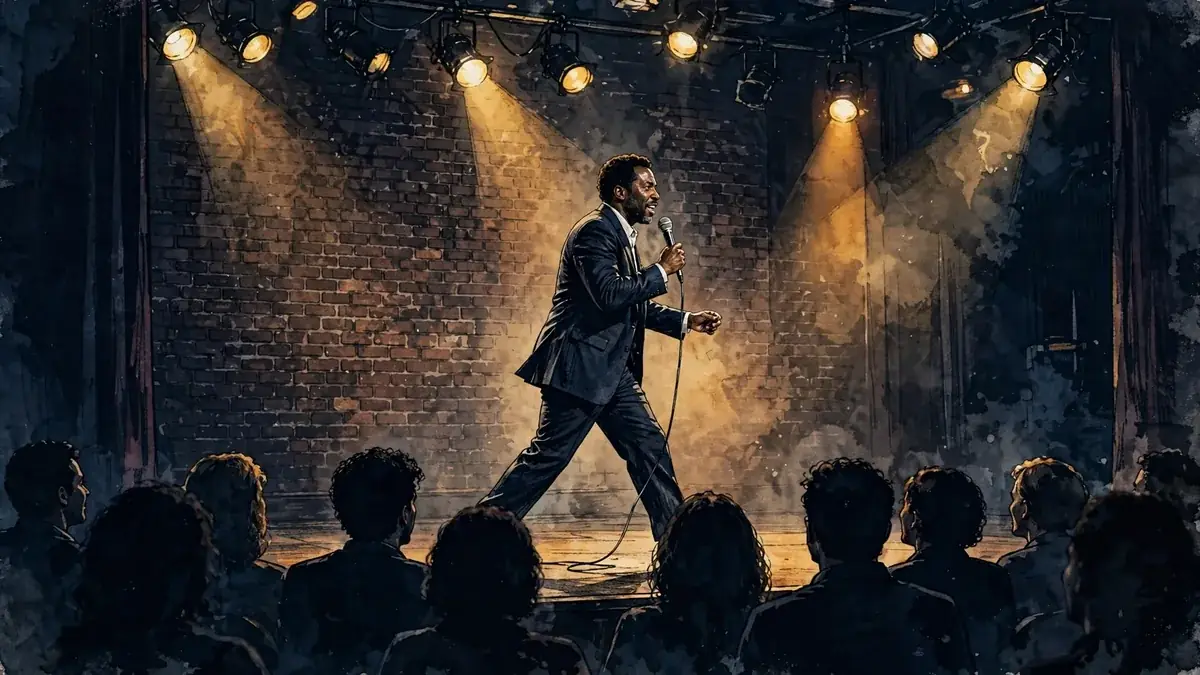
The specials kept coming, and each one landed. Bigger & Blacker arrived in 1999, Never Scared in 2004, and Kill the Messenger in 2008, which won him another Emmy for writing. The albums matched them: Roll with the New (1997), Bigger & Blacker (1999), and Never Scared (2004) each won the Grammy for Best Comedy Album — three Grammys in total, a record for a comic of his generation. He also became a fixture of 1990s pop culture in smaller ways: he voiced the “Lil Penny” puppet, Penny Hardaway’s alter ego, in Nike shoe commercials from 1994 to 1998, hosted the 1997 MTV Video Music Awards, and served as a commentator for Comedy Central’s Politically Incorrect during the 1996 presidential election, earning another Emmy nomination.
The money in this era was real but modest by later standards. HBO paid for the specials, the albums sold, and the tours grew, but Rock was not yet the eight-figure earner he would become. What Bring the Pain bought him was something worth more: the freedom to choose. From 1996 on, he never had to take a job he did not want, and the choices he made next — a talk show, a sitcom, a documentary, a Broadway play — show a comic who understood that the stage was the base, not the ceiling.
The Chris Rock Show and the HBO Talk-Show Years
From 1997 to 2000, HBO aired The Chris Rock Show, a talk show that mixed celebrity interviews, political guests, and filmed pieces, and it won an Emmy for writing. The show mattered because it showed Rock’s range: he could interview a senator in the same hour he did a street piece, and the political edge that had always sat inside the stand-up got a weekly platform. It also showed his instinct for control. He was not a guest on someone else’s show anymore. He owned the room.
He published his first book, Rock This!, in 1997, a memoir that climbed the New York Times and Wall Street Journal bestseller lists. The same year he hosted the MTV Video Music Awards. By the end of the decade, he was established as one of the preeminent stand-up comedians and comic minds of his generation — and he was already looking past stand-up. The film roles were getting bigger, the directing itch was starting, and the talk show had proved he could hold an audience without a punchline every thirty seconds.
The HBO years also set the pattern for the rest of his career: a burst of stand-up, then a pivot to something else, then a return to the stage with new material. He has never stayed in one lane for long. The talk show ended in 2000, the specials continued, and the films took over the 2000s — but the stage never went away. Every few years, he comes back to it, and the audience is still there.
Film Stardom: From Lethal Weapon 4 to the Madagascar Franchise
It was not until the success of his stand-up in the late 1990s that Rock began receiving leading-man status in films. The run started with supporting roles — Lethal Weapon 4 (1998), Kevin Smith’s Dogma (1999), which premiered at Cannes — and then the 2000s piled them up: the dark comedy Nurse Betty (2000), Down to Earth (2001), which he co-wrote with Louis C.K., Bad Company (2002) opposite Anthony Hopkins, and The Longest Yard (2005) opposite Sandler. He also produced and starred in Pootie Tang (2001), directed by C.K., a cult comedy that flopped on release and found its audience later.
The biggest film job of his life was a voice. Starting in 2005, Rock voiced Marty, the eccentric zebra, in DreamWorks’ Madagascar franchise, returning for Madagascar: Escape 2 Africa (2008) and Madagascar 3: Europe’s Most Wanted (2012). The three films grossed well over $2 billion worldwide between them, and Marty’s hyperactive optimism became the character children knew him for — a second audience, built entirely on a voice. In 2007 he voiced Mooseblood the Mosquito in Jerry Seinfeld’s Bee Movie. The animation work paid well, ran for years, and asked nothing of his image: a zebra does not get typecast.
The live-action comedies kept coming. Death at a Funeral (2010), the remake of the British comedy, put him alongside Peter Dinklage, Martin Lawrence, Tracy Morgan, Kevin Hart, whose biography Guide Net Worth covers in full, and Zoe Saldaña; Roger Ebert praised it as the best comedy since The Hangover. Grown Ups (2010) reunited the SNL Bad Boys — Sandler, Schneider, Spade, Kevin James, Maya Rudolph — for a summer hit big enough to earn a 2013 sequel. What to Expect When You’re Expecting (2012) was a commercial success despite poor reviews, and 2 Days in New York (2012), opposite Julie Delpy, premiered at Sundance to strong reviews for the pair’s chemistry.
Everybody Hates Chris: Turning a Bullied Childhood Into a Sitcom
In September 2005, UPN premiered Everybody Hates Chris, a comedy loosely based on Rock’s school days, for which he was executive producer and narrator. The show ran four seasons, through 2009, and it was the most personal thing he had made: the bused schoolboy, the strict parents, the bullying, the Brooklyn of the 1980s, all played as a warm family comedy with Tyler James Williams as the young Chris and Rock’s voice-over carrying the adult’s hindsight. It was nominated for a 2006 Golden Globe for Best TV Series (Musical or Comedy), won a 2006 People’s Choice Award for Favorite New Television Comedy, and earned two Primetime Emmy nominations for costuming and cinematography.
The show’s real achievement was tonal. A childhood built on beatings and humiliation became funny without becoming cruel, and the family at its center — a working-class black family in Bed-Stuy, run by a father who worked two jobs and a mother who ran the house like a drill sergeant — became one of the most loved sitcom families of the decade. Rock has said the show was the closest he has come to explaining himself. The stand-up told jokes about the childhood. The sitcom showed it.
In 2024, the story came back as animation. Everybody Still Hates Chris, an animated sequel with Rock again narrating, premiered on Comedy Central, picking up the same family and the same Brooklyn in a new form. Nineteen years after the original, the material still worked — proof that the childhood had not been a bit. It was the foundation of everything.
Broadway, Top Five, and the Director’s Chair
Rock had been directing for years before anyone called him a director. He wrote and directed the political comedy Head of State (2003), playing an alderman drafted into a presidential race, and the marital comedy I Think I Love My Wife (2007), a remake of Éric Rohmer’s Chloe in the Afternoon — both films he also starred in, both received coolly by critics. The directing instinct was there; the vehicle was not. Then, in 2011, he did something no one expected: he made his Broadway debut in Stephen Adly Guirgis’ play The Motherfucker with the Hat, alongside Bobby Cannavale and Annabella Sciorra, and earned a Drama League Award nomination. He told Vibe he chose Broadway because he wanted people to see him “really act” — comedy, he said, can be formulaic, and good directors struggle to see past it.
The film that answered that was Top Five (2014). Rock scripted, directed, and starred in it, playing a stand-up turned movie star who wants to be taken seriously, and it premiered at the 2014 Toronto International Film Festival to the best reviews of his film career. Variety‘s Scott Foundas wrote that Rock had “finally found a big-screen vehicle for himself that comes close to capturing the electric wit, shrewd social observations and deeply autobiographical vein of his standup comedy.” Peter Travers, in Rolling Stone, called it “Rock’s best movie by a mile.” Paramount bought it at Toronto. Twelve years later, Top Five is still the film critics reach for when they argue that Rock’s best work behind the camera was ahead of him.
He kept the production side going through the decade. He produced the series Totally Biased with W. Kamau Bell, which premiered in August 2012, under his company Chris Rock Enterprises. He directed the Red Hot Chili Peppers’ “Hump de Bump” music video. He released his first documentary, Good Hair (2009), about how African-American women perceive and style their hair — it premiered at Sundance, won a Special Jury Prize, and was named one of the five best documentaries of the year by the National Board of Review. The through-line is a comic who kept testing whether he could do the next thing, and kept finding out he could.
The Netflix Deal: Million, Two Specials, and a Ten-Year Wait
On October 30, 2016, Netflix announced it would release two new stand-up specials from Rock, with a deal reported by Variety and The Hollywood Reporter at $40 million for the pair. The number deserves care, because it is often misreported: some outlets and reference pages describe it as $40 million per special, but the trade reporting at the time — Variety’s headline and THR’s — says $40 million for two specials, and that is the figure this profile uses. Either way, it was the biggest stand-up payday of the streaming era to that point, and it ended a ten-year gap since his last special.
The first special, Chris Rock: Tamborine, was released on Netflix on February 14, 2018, filmed at the Brooklyn Academy of Music and directed by comedian Bo Burnham. It earned a Grammy nomination for Best Comedy Album. The second half of the deal took five more years. Chris Rock: Selective Outrage streamed live from the Hippodrome Theatre in Baltimore on March 4, 2023 — Netflix’s first-ever live event — and it received three Primetime Emmy nominations, including two for Rock himself, for Outstanding Variety Special (Live) and Outstanding Writing for a Variety Special.
The economics of the deal explain a lot about Rock’s later career. A $40 million guarantee for two hours of stage time, spread over seven years, gave him the freedom to pick film and directing work without worrying about the next paycheck. It also set the market: the Netflix deal became the number every other comic’s agent quoted for years after. And it kept the stage central. For all the films and the directing, the specials are still the spine of the career — the thing the audience waits for, and the thing Rock returns to when he has something to say.
Fargo, Spiral, and Rustin: The Dramatic Turn
In 2020, Rock took the most serious acting role of his career: Loy Cannon, the head of a black crime family in 1950 Kansas City, in the fourth season of FX’s Fargo. Critics singled him out — NBC News called him the season’s surprise highlight — and the role proved what the Broadway run had argued: he could carry a drama without a joke in sight. He followed it with Spiral (2021), a spin-off of the Saw franchise in which he starred as a detective hunting a copycat killer, and then Amsterdam (2022), David O. Russell’s period ensemble, and Rustin (2023), in which he played a supporting role in the story of Bayard Rustin, the organizer of the 1963 March on Washington.
The dramatic turn was not a reinvention. It was a return to the instinct that had driven the Broadway play and Top Five: a comic who wants to be seen as an actor, and who is willing to take the smaller, harder role to prove it. He appeared as himself in Sofia Coppola’s A Very Murray Christmas (2015) and in Sandler’s Sandy Wexler (2017) and The Week Of (2018), and he made a brief appearance in Dolemite Is My Name (2019), Murphy’s return to form as Rudy Ray Moore. He also took television roles on Empire and Kevin Can Wait. The filmography, taken together, is the record of a comic who never stopped auditioning for the next thing.
None of it paid like the stand-up. The dramatic roles were prestige, not money — and that is the point. By 2020, Rock did not need the money. He needed the work to mean something, and the work he chose after Fargo — a civil-rights biopic to direct, a remake of an Oscar winner, a small drama about a faded actress — shows a man picking projects the way a 61-year-old picks them: for the challenge, not the check.
The 2022 Oscars Slap: What Happened, and What It Cost
On March 27, 2022, Rock presented the award for Best Documentary Feature at the 94th Academy Awards. He made a joke about Jada Pinkett Smith’s shaved head, comparing it to Demi Moore’s in G.I. Jane — “Jada, I love ya. G.I. Jane 2, can’t wait to see it!” Pinkett Smith had shaved her head because of alopecia areata. Her husband, Will Smith, walked onstage and slapped Rock across the face, then returned to his seat and shouted twice, “Keep my wife’s name out your fucking mouth!” Rock, holding himself together on live television, said, “Will Smith just smacked the shit out of me,” and called it “the greatest night in the history of television.” Later that night, Smith won Best Actor for King Richard.
The aftermath ran for a year. Smith apologized to Rock the next day in a public Instagram post, calling his behavior “unacceptable and inexcusable” and saying a joke about Jada’s medical condition was “too much for me to bear.” Rock declined to file a report with the Los Angeles Police Department. In a stand-up show in Boston later that month, he said Smith had not contacted him personally and they had not spoken since the ceremony. The Academy banned Smith from its events for ten years.
Rock’s own answer came on stage, a year later, in Selective Outrage. He did not litigate the slap. He folded it into an hour about fame, marriage, and getting older, and he let the audience decide what it meant. The special’s live format — Netflix’s first live event — turned the response into an event of its own, and the three Emmy nominations it earned suggest the industry heard it. The slap is now a permanent part of his biography, the way the firing from SNL is: an incident that could have ended a career, and instead became a chapter in it. In a September 2026 Variety profile, Rock said he would not return to the Oscars unless he was nominated — a line that reads, four years on, as the last word on the night.
The Directing Pivot: MLK, Another Round, and Misty Green
The most important story in Rock’s career right now is not a special or a film role. It is the pivot behind the camera. In October 2023, Variety reported that Rock would direct a biopic of Martin Luther King Jr., with Steven Spielberg producing, based on Jonathan Eig’s biography King: A Life. In January 2024, Deadline reported he would direct an English-language remake of Thomas Vinterberg’s Oscar-winning Another Round (2020), for Appian Way, Makeready, and Fifth Season. Two prestige directing jobs, announced within three months, for a man who had not directed a feature in a decade.

The first of the three to reach audiences was the one Rock made himself. He wrote, directed, and starred in Misty Green, a drama about a former television star trying to claw her way back into an industry that has stopped returning her calls, with Rock playing Jordan. The film was shown at the American Film Market in November 2024, premiered at the Toronto International Film Festival in October 2026, and, per Deadline on October 21, 2026, began streaming on Netflix in early November 2026. Variety‘s September 8, 2026 profile, “The New Chris Rock,” framed it as a return to directing after twelve years away — and NPR’s October 12, 2026 review called it high-powered, if problematic, and praised Rock’s choice to make the gentlest film of his career.
The pivot makes sense when the whole career is laid out. Rock spent his twenties learning the stage, his thirties learning the screen, his forties learning television and Broadway, and his fifties learning that the stage would always be there. At 61, the directing jobs are the work that fits: a filmmaker’s projects, chosen slowly, made his way, with the comic’s eye for character doing the heavy lifting. The MLK biopic, if it films as announced, would be the biggest film of his life — and the one that finally puts his name on a story larger than himself.
The Money: A Million Fortune, and Why It Is Not Bigger
Chris Rock’s estimated net worth is $60 million as of 2026, according to Celebrity Net Worth, whose profile was last updated on March 2, 2026. That is the figure most 2026 outlets cite — Parade’s January 2026 profile uses the same number, and Wealthy Gorilla, updated November 20, 2026, lists $60 million as well. A few smaller sites put the total higher, around $75 million, so a fair range is $60–75 million, with $60 million the number the strongest sources agree on. Guide Net Worth’s full net-worth profile of Chris Rock works through each pillar of the fortune in detail.
The headline number hides a more interesting story: Rock should be considerably richer than he is. Celebrity Net Worth itself notes that his fortune “could be much higher” but for a divorce settlement that cost him tens of millions — reportedly as much as $40 million in real estate and liquid assets — when his twenty-year marriage ended in 2016. A comedian who earned a $40 million Netflix deal, headlined arenas for four decades, voiced a billion-dollar animation franchise, and directed studio films has, on paper, earned well over $150 million across his career. The gap between what he earned and what he kept is the divorce, and it is the single biggest fact in his financial story.
One figure deserves a burial. A fan blog still circulates a $220 million net worth for Rock, built on unsourced claims about investments and endorsements. No credible outlet supports it — every 2026 profile from a named source lands at $60 million or, at most, $75 million — and this profile rejects it. The honest number is $60 million, and the honest story is that a $40 million divorce is what keeps it there.
| Outlet | Estimate | Date |
| Celebrity Net Worth | $60 million | Updated March 2, 2026 |
| Parade | $60 million | January 2026 |
| Wealthy Gorilla | $60 million | Updated November 20, 2026 |
| CoinCodex | $60 million | 2026 |
| Celebs InfoSeeMedia | $75 million | June 19, 2026 |
| Fan blog (rejected) | $220 million | Unsourced — not used |
Three pillars hold the fortune up. The first is stand-up: four decades of touring, seven specials, and the $40 million Netflix deal for two. The second is film and television: the Madagascar voice work, the ensemble comedies, the Everybody Hates Chris syndication, and the dramatic roles of the 2020s. The third is directing and producing, from Top Five to Misty Green and the Chris Rock Enterprises slate. The Celebrity Net Worth category on Guide Net Worth tracks how the same pillars — touring, franchise voice work, and a production company — build fortunes across the comedy world. Against his peers, Rock sits well below the richest comics: Dave Chappelle, whose biography Guide Net Worth covers in full, is estimated at around $100 million, and Kevin Hart, whose biography Guide Net Worth covers in full, at around $300 million. The gap is not a talent contest. Chappelle and Hart built business empires around their comedy. Rock built a career around his craft — and then paid $40 million for a divorce.
Personal Life: Marriage, Divorce, and Two Daughters
Rock married Malaak Compton-Rock on November 23, 1996. Compton-Rock is the founder and executive director of StyleWorks, a non-profit, full-service hair salon that provides free services for women leaving welfare and entering the workforce. The couple lived in Alpine, New Jersey, with their two daughters. In December 2014, Rock filed for divorce. He has spoken publicly about infidelity in the marriage, and about struggling with a pornography addiction. The divorce was finalized on August 22, 2016, and the settlement — reportedly around $40 million in real estate and liquid assets — is the largest single financial event of his life.
On July 7, 2022, it was reported that Rock had started dating actress, screenwriter, and director Lake Bell. He later described himself as single in his 2023 Netflix special. As of November 2026, no new marriage has been reported, and this profile does not speculate about his current relationship status beyond the documented record.
Two other facts about his life outside work are worth recording. On September 18, 2020, Rock said he had been diagnosed with a non-verbal learning disorder, a neurological condition that makes it difficult for him to read non-verbal social cues — a disclosure that reframed, for many fans, the intensity of his stage persona. And on August 20, 2019, he joined several other celebrities in a funding round for Lowell Herb Co, a California cannabis brand; he is known as a dedicated cannabis consumer. He has been a fan of the New York Mets since childhood, and he once complained, on David Letterman’s show in 2011, that his team “had no money.” Guide Net Worth’s age profile of Chris Rock covers his 61st birthday and the 2026 year in full, and CelebAmerica’s height profile of Chris Rock settles the 5-foot-10 question source by source.
The Awards Shelf: 4 Emmys, 3 Grammys, and Two Number-Five Rankings
Rock has won four Primetime Emmy Awards and three Grammy Awards, with a Golden Globe nomination for Everybody Hates Chris — a record that puts him among the most decorated comedians of his generation without ever chasing the ceremonies. The Emmys break down as two for Bring the Pain (1996), one for writing on The Chris Rock Show, and one for writing on Kill the Messenger (2008), with fifteen nominations in total across his television work. The Grammys are all for Best Comedy Album: Roll with the New (1997), Bigger & Blacker (1999), and Never Scared (2004).
The rankings matter as much as the trophies. Comedy Central placed him at No. 5 on its list of the 100 Greatest Stand-ups of All Time. Rolling Stone placed him at No. 5 on its list of the 50 Best Stand-Up Comics of All Time. Two different lists, two different decades, the same number — and the same judgment: Rock is not the funniest comedian who ever lived, but he is in the conversation, and he has been there for thirty years.
The influence runs in both directions. Rock has cited Pryor, Carlin, Cosby, Foxx, Gregory, Wilson, Martin, and Murphy as his influences. Dave Chappelle, whose biography Guide Net Worth covers in full, has cited Rock as an influence, as have Trevor Noah, whose biography Guide Net Worth covers in full, Kevin Hart, George Lopez, and Christian Finnegan. The line from Pryor to Rock to Chappelle to the comics working clubs tonight is the spine of American stand-up, and Rock is the middle link that holds it together.
| Honor | Year | Detail |
| Primetime Emmy (×2) | 1997 | Bring the Pain — Outstanding Variety Special + Writing |
| Grammy, Best Comedy Album | 1998 | Roll with the New |
| Primetime Emmy, Writing | 1998 | The Chris Rock Show |
| Grammy, Best Comedy Album | 2000 | Bigger & Blacker |
| Grammy, Best Comedy Album | 2005 | Never Scared |
| Golden Globe nomination | 2006 | Best TV Series (Musical or Comedy), Everybody Hates Chris |
| Primetime Emmy, Writing | 2009 | Kill the Messenger |
| Drama League Award nomination | 2012 | The Motherfucker with the Hat (Broadway) |
| Primetime Emmy nominations (×3) | 2023 | Selective Outrage (live special) |
| Comedy Central ranking | — | No. 5, 100 Greatest Stand-ups of All Time |
| Rolling Stone ranking | 2017 | No. 5, 50 Best Stand-Up Comics of All Time |
What Comes Next at 61
At 61, Rock is in a position few comics reach: the stage still pays, the films still come, and the directing jobs are the biggest of his life. The MLK biopic, with Spielberg producing, is the project that would define the next decade if it films as announced. The Another Round remake is the kind of prestige assignment that proves a director has arrived. And Misty Green, now streaming on Netflix after its October 2026 Toronto premiere, is the proof that he can still make a film his way, about a subject nobody else would choose, and get it seen.
The stand-up will continue. Rock has never gone more than a few years without a special, and the live format of Selective Outrage showed him a new way to do it — a live event, not a taped hour, with the audience watching in real time. A new special has not been announced as of November 2026, but the pattern of the career says one is coming, and the material is not hard to imagine: a 61-year-old director, a divorce a decade behind him, a slap four years behind him, and a country that keeps giving him things to talk about.
The biography, as of November 21, 2026, is still being written live, by a man who has now spent 42 years on stage — from a 19-year-old at Catch a Rising Star to a 61-year-old director at Toronto — and who has made a career out of refusing to stay in the lane he was put in. The next film will arrive when it is ready. That has always been the deal, and it is the reason the audience is still waiting.
Sources & Reporting
This profile draws on Wikipedia’s sourced Chris Rock biography (updated November 20, 2026) and its filmography, discography, and awards lists; Britannica’s Chris Rock biography (updated October 26, 2026); Variety’s September 8, 2026 Misty Green profile (“The New Chris Rock”), its October 30, 2016 Netflix deal report, and its October 5, 2023 MLK biopic report; Deadline’s October 21, 2026 Misty Green streaming report and its January 29, 2024 Another Round report; NPR’s October 12, 2026 Misty Green review; Celebrity Net Worth (updated March 2, 2026); Parade’s January 2026 net-worth profile; Wealthy Gorilla (updated November 20, 2026); CoinCodex’s 2026 net-worth profile; The Hollywood Reporter’s October 30, 2016 Netflix deal report; the Emmy and Grammy records; and Guide Net Worth’s own Chris Rock net-worth and age profiles, plus CelebAmerica’s Chris Rock height profile. Net worth figures are third-party estimates and are labeled as estimates. Box-office figures are trade-tracker estimates and are rounded. Corrections: figures are updated when new reporting emerges — contact us via the About page if you spot an error.
Frequently Asked Questions
How old is Chris Rock in 2026?
Chris Rock is 61 years old in 2026. He was born Christopher Julius Rock on February 7, 1965, in Andrews, South Carolina, and he turned 61 on February 7, 2026. Some profiles list his birthplace as Georgetown, South Carolina — Britannica’s October 26, 2026 update does — but most sources, including Wikipedia, say Andrews.
What is Chris Rock’s net worth in 2026?
Chris Rock’s net worth in 2026 is estimated at $60 million, inside a $60–75 million range. Celebrity Net Worth, whose profile was last updated on March 2, 2026, gives $60 million, and Parade’s January 2026 profile and Wealthy Gorilla (updated November 20, 2026) agree. A few smaller outlets put the figure at $75 million. A $220 million figure circulating on a fan blog is unsourced and rejected. No outlet has seen his accounts, so every figure is an estimate.
Who is Chris Rock’s wife in 2026?
Chris Rock has no wife in 2026. He was married to Malaak Compton-Rock from November 23, 1996, until their divorce was finalized on August 22, 2016. Compton-Rock founded StyleWorks, a non-profit salon that provides free services for women leaving welfare and entering the workforce. Rock was reported to be dating actress Lake Bell in July 2022, and he described himself as single in his 2023 Netflix special.
How many children does Chris Rock have?
Chris Rock has two daughters with his ex-wife Malaak Compton-Rock. The family lived in Alpine, New Jersey, during the marriage. Rock has kept his daughters largely out of the public eye, and this profile does not publish details about them beyond the documented record.
How tall is Chris Rock?
Chris Rock is listed at 5 ft 10 in (178 cm), the figure most biography and height trackers use. There is no officially verified measurement, and some profiles round it to 5 ft 9 in or 5 ft 11 in. CelebAmerica’s height profile of Chris Rock settles the question source by source.
What was Chris Rock’s first movie?
Chris Rock’s first film role was a small part in Beverly Hills Cop II (1987), given to him by Eddie Murphy, who had spotted his stand-up in a New York club. His first leading film roles came later: New Jack City (1991), where he played the crack addict Pookie, and CB4 (1993), a gangsta-rap parody he wrote and starred in that made $18 million on a $6 million budget.
What is Chris Rock’s biggest movie?
Chris Rock’s biggest movies are the Madagascar films, in which he voiced Marty the zebra — the three films grossed well over $2 billion worldwide between them. His biggest stand-up special is Bring the Pain (HBO, 1996), which won two Emmys and made him the most talked-about comedian in America. His best-reviewed film is Top Five (2014), which he wrote, directed, and starred in.
What awards has Chris Rock won?
Chris Rock has won four Primetime Emmy Awards and three Grammy Awards, with a Golden Globe nomination for Everybody Hates Chris. The Emmys include two for Bring the Pain (1996) and one each for The Chris Rock Show and Kill the Messenger. The Grammys are all for Best Comedy Album: Roll with the New (1997), Bigger & Blacker (1999), and Never Scared (2004). Comedy Central ranks him No. 5 among the 100 Greatest Stand-ups of All Time, and Rolling Stone ranks him No. 5 among the 50 Best Stand-Up Comics of All Time.
Nathan Cole
Nathan Cole is the editor of Guide Net Worth. He covers celebrity wealth the way a business desk covers earnings: reported figures first, estimates labeled as estimates, and no invented numbers. Every profile on this site passes through his desk before it publishes. About Guide Net Worth · Corrections: figures are updated when new reporting emerges — contact us via the About page if you spot an error.
References & Sources
This article has been fact-checked and verified against multiple public sources, financial disclosures, SEC filings, Forbes reports, Celebrity Net Worth databases, and official records. All net worth estimates are based on publicly available information and financial analysis.