Dave Chappelle biography 2026: from the Apollo at 14 to the $50M walkaway, a $60M Netflix deal, six Grammys and a $100M fortune — the full story, sourced.
Last updated: November 16, 2026 · By Nathan Cole
Dave Chappelle is 53 years old in November 2026, and his biography reads like two careers stitched together by a single decision. David Khari Webber Chappelle was born on 24 August 1973 in Washington, D.C., took a stage for the first time at 14, and by 31 was the most talked-about comedian in America — then walked away from a reported $50 million contract in the middle of his own hit show and disappeared to South Africa. The comeback took a decade: a reported $60 million Netflix deal in 2016, eight specials, six Grammy Awards, five Primetime Emmy Awards, the Mark Twain Prize, and a fortune that Celebrity Net Worth now puts at about $100 million. He lives on a farm near Yellow Springs, Ohio, with his wife of 25 years and their three children, and he still tours on his own terms.
This is the full life story, told with dates and named sources: the professor’s son who grew up between Washington and Ohio, the Apollo stage at 14, the Duke Ellington School of the Arts, the 1990s film years, the two seasons of Chappelle’s Show that remade American sketch comedy, the walkaway and what he actually said about it, the quiet decade, the Netflix run special by special, the awards shelf with the Emmy count settled, the family and the Ohio farm, and the money — every figure attributed, every disagreement named. Nothing here is a guess. Where the public record is silent, the article says so.
Quick Facts
| Full Name | David Khari Webber Chappelle |
| Born | 24 August 1973, Washington, D.C., United States (age 53 in November 2026; turns 54 on 24 August 2027) |
| Height | Listed at 6 ft 0 in (183 cm); Chappelle himself has said 5 ft 11 in — honest range 5 ft 11 in–6 ft 0 in, no officially measured figure published |
| Wife | Elaine Erfe (Elaine Mendoza Erfe), married 2001 |
| Children | Three: sons Sulayman and Ibrahim, daughter Sanaa |
| Home | Farm near Yellow Springs, Ohio (reportedly around 65 acres) |
| Net Worth (2026) | About $100 million estimated (Celebrity Net Worth), inside a $60–$100 million published range |
| Breakthrough | Chappelle’s Show, Comedy Central, 2003–2006 (co-created with Neal Brennan) |
| Netflix Deal | Reported $60 million for three specials, signed November 2016 ($20 million per special) |
| Major Awards | Six Grammy Awards for Best Comedy Album; five Primetime Emmy Awards; Mark Twain Prize for American Humor (2019); NAACP President’s Award (2025) |
| Education | Duke Ellington School of the Arts, Washington, D.C. — graduated 1991 |
How This Biography Was Put Together
Every date and dollar figure in this article comes from a named source checked against the live record in November 2026: Wikipedia’s biography and awards list for the career dates and the five-Emmy count; Oprah.com for the 2005 walkaway in Chappelle’s own words; Celebrity Net Worth for the $60 million Netflix deal, the $20 million per-special figure, the Forbes earnings years and the ~$100 million net worth; the NAACP and The Hollywood Reporter for the 22 February 2025 President’s Award; the Kennedy Center for the 2019 Mark Twain Prize; Ticketmaster and Live Nation biographies for the five-Emmy breakdown; Wealthy Gorilla (updated 5 November 2026) and Net Worth Radar (October 2026) for the low end of the net-worth range; the Yellow Springs News for the 2026 county appraisals of his Ohio property; Pollstar for the $44.2 million tour gross; and Guide Net Worth’s own live Dave Chappelle age post (6 November 2026) for the cross-checked facts — the 24 August 1973 birth, the Apollo at 14, the 1991 Duke Ellington graduation, the eight Netflix specials, the five Emmys and six Grammys, and the November 2026 Madison Square Garden dates. Where sources disagree — above all on the Emmy count and the net worth — the article names the disagreement and gives the verified figure with its reasoning. Where the public record is silent — the fees for his later Netflix specials, the exact value of his Ohio property portfolio, his current touring income — the article says so instead of filling the gap.
+
Dave Chappelle in 2026: The Short Version
Dave Chappelle is 53 in November 2026. He was born David Khari Webber Chappelle on 24 August 1973 in Washington, D.C., and he turns 54 on 24 August 2027. The short version of his life runs like this. A professor’s son from Washington and Yellow Springs, Ohio, started doing stand-up at 14, moved to New York after high school, and spent the 1990s building a film career one supporting role at a time. In 2003 he got his own sketch show on Comedy Central, and within two years it made him the most talked-about comedian in America — then he walked away from a reported $50 million contract in the middle of season three and disappeared to South Africa. The comeback took a decade: a $60 million Netflix deal in 2016, eight specials, six Grammy Awards, five Emmys, the Mark Twain Prize, and a fortune that Celebrity Net Worth now puts at $100 million. He lives on a farm in Ohio with his wife of 25 years and their three children, and he still tours on his own terms.
The walkaway is the hinge of the whole story, and it is also the most misunderstood part of it. The version that stuck in the public mind — a comedian cracking up, fleeing to Africa, turning down $50 million because he had lost his mind — is the version the rumour mill wrote in May 2005, when nobody knew where he was. The version Chappelle himself gave, first to Time magazine from South Africa and then to Oprah Winfrey on 3 February 2006, is different: burnout, a loss of creative control, a work environment that had turned stressful, and a father whose death seven years earlier he had never stopped to mourn. “I wasn’t walking away from the money,” he told Oprah. “I was walking away from the circumstances.” The rest of this article is the evidence for that sentence, year by year.
The money matters here because it is the measure of what the walkaway cost and what the comeback repaid. The $50 million contract he left behind was, at the time, one of the largest deals ever offered to a comedian. The $60 million Netflix deal he signed eleven years later was larger. Between the two sits the only decade in modern comedy where the biggest star in the form simply stopped being famous on television’s terms — and the fortune that followed, about $100 million by Celebrity Net Worth’s current estimate, was built the slow way: touring, specials, and property in a small Ohio village, rather than a network salary. That is the shape of this biography: a fast rise, a deliberate stop, and a second rise built on his own schedule.
Early Life: A Professor’s Son in Washington and Ohio
Dave Chappelle was born into a family of educators. His father, William David Chappelle III, was a professor of vocal performance and a dean of students at Antioch College in Yellow Springs, Ohio. His parents separated when he was young, and the split set the geography of his childhood: he grew up in Washington, D.C., and spent summers in Yellow Springs, where his father taught. The two places stayed with him for life — Washington gave him the politics and the street sense that runs through his comedy, and Yellow Springs gave him the small town he would eventually move back to.
Washington in the 1970s and 1980s was a city where a bright kid from an academic family could find comedy early. Chappelle has described growing up around books, music and argument, and the household’s academic bent shows in the work: his routines are built on observation and history as much as on jokes, and the bits that last — the ones about race, money, fame and power — are the ones that read like essays with punchlines. The education was not only at home. He attended the Duke Ellington School of the Arts in Washington, a public arts high school, where he studied theatre. He graduated in 1991, at 17, and moved to New York to do stand-up full time.
At a listed 6 ft 0 in, he has always been a tall presence on stage, and the height is one of the few physical facts about him that the record keeps straight: most profiles list 6 ft 0 in (183 cm), while Chappelle himself once told Vanity Fair he is 5 ft 11 in, so the honest answer is the range, 5 ft 11 in to 6 ft 0 in, with no officially measured figure ever published. The full height adjudication, with the sources laid out, is on our sister site in Dave Chappelle’s height profile, which settles the question the same way this article settles the money: by showing the sources instead of picking one number and hiding the rest.
The other fact that shaped his childhood was loss. His father died in 1998, when Chappelle was 24 and his career was gathering speed. He threw himself into work and did not stop to mourn — a point he made himself years later, on Inside the Actors Studio, when he said his father’s death had influenced his decision to leave for South Africa in 2005. The grief, deferred for seven years, is part of the walkaway story, and it is the part that makes the decision look less like a breakdown and more like a bill coming due.
The Apollo at 14 and Duke Ellington
Chappelle first did stand-up at 14, at the Apollo Theater’s amateur night in Harlem, and the set went badly — he was booed off the stage. He has told the story himself, more than once, and the telling matters more than the booing: a 14-year-old who gets booed at the Apollo and comes back to comedy anyway has already learned the one lesson the business teaches hardest, which is that a bad night is survivable. He kept doing it, in clubs around Washington, through his teens, while he was still a student at Duke Ellington.
The Ellington years gave him the other half of his toolkit. A theatre education at 16 and 17 is an education in timing, voice, and the discipline of a stage — and Chappelle’s stand-up, for all its looseness, is built on timing that looks casual and is not. The long pauses, the stories that wander and then snap shut, the characters who arrive mid-sentence: that is stagecraft, learned young, and it is what separates his hour specials from a string of jokes. He graduated in 1991 and moved to New York the same year, at 17, to chase the clubs full time.
New York in the early 1990s was a hard room for a teenager. The comedy boom of the late 1980s had already cooled, the clubs were crowded, and a 17-year-old from Washington had to earn stage time the slow way — open mics, late spots, rooms that paid in experience. He did it for a year, and the break came in 1992, when he appeared on HBO’s Def Comedy Jam, the Russell Simmons showcase that was then the fastest route from the clubs to a national audience. The set put his name in front of the industry, and the film work followed: a small part in Mel Brooks’s Robin Hood: Men in Tights in 1993, when he was 19, as Ahchoo, alongside Cary Elwes and a cast of veterans. It was a few scenes and a few jokes, and it put a teenager on a studio film set with one of the great comedy directors.
The 1990s: Def Comedy Jam, Film Roles and Half Baked
The 1990s were a decade of supporting roles, and Chappelle collected them steadily. After Robin Hood: Men in Tights in 1993 came The Nutty Professor in 1996, where he played Reggie Warrington, the heckler in the comedy club scene, opposite Eddie Murphy. The part was small, but the room was the right one: Murphy was the biggest comedy star in the world, and a scene with him was a credential. Chappelle also turned down a role that would have made him famous sooner — Bubba, in Forrest Gump (1994), a part he has said he passed on, and which went to Mykelti Williamson. It is the kind of decision that looks strange in hindsight and makes sense in the moment: he did not want to be the simple country sidekick, and the instinct to protect the work, even at the cost of a hit film, is the same instinct that would end Chappelle’s Show eleven years later.
Half Baked, in 1998, was the film that finally carried his name. He co-wrote it with Neal Brennan — the writing partner who would later co-create Chappelle’s Show — and played Thurgood Jenkins, a stoner janitor who starts selling marijuana to raise bail money for a friend. The film made little money on release and then became a cult hit on video, the way comedies did in the 1990s, and it is still the film his fans quote first. The writing credit matters as much as the acting: Chappelle was not only a performer for hire, he was a writer building his own material, and the partnership with Brennan was the creative engine of everything that followed.
The decade closed with his first hour of stand-up on television. Dave Chappelle: Killin’ Them Softly, an HBO special in 2000 directed by Stan Lathan, was the first full-length showcase of what he could do alone on a stage for an hour — the long stories, the voices, the political edge, the crowd work. Lathan would go on to direct his Netflix specials, and the two men would still be working together a quarter of a century later, when Lathan was honoured alongside Chappelle at the 2025 NAACP Image Awards. The special did not make him a star. It made him a comedian other comedians watched, and that is a different, slower kind of arrival — the kind that lasts.
Chappelle’s Show: Two Seasons That Changed Comedy
Chappelle’s Show premiered on Comedy Central on 22 January 2003, co-created by Chappelle and Neal Brennan, and within two years it had done something no sketch show had done in a generation: it made sketch comedy the centre of American pop culture again. The format was simple — Chappelle on a street corner or on a stage, introducing sketches performed by a small repertory company — and the sketches were not simple at all. Clayton Bigsby, a blind white supremacist who does not know he is Black. The Rick James sketch, built around the singer’s own stories and the catchphrase “I’m Rick James, bitch.” The Prince sketch, in which Prince beats Chappelle’s crew at basketball in a blouse and serves them pancakes. Wayne Brady, Lil Jon, the “Mad Real World,” Samuel L. Jackson hawking beer, “When Keeping It Real Goes Wrong.” The bits travelled by word of mouth and then by DVD, and the show’s audience grew the way cult hits grow: one viewer at a time, telling the next one.
The show worked because Chappelle and Brennan wrote it from the inside of American race relations rather than from the outside. The sketches were not jokes about race; they were jokes built out of the contradictions of race — the way a blind bigot can be funny and horrifying in the same line, the way a white audience laughs at a Black comedian’s pain and then has to sit with why it laughed. That edge was the show’s value and its risk. Comedy Central had given Chappelle creative control at the start, when the show did not look lucrative, and the control was what let the sketches go as far as they did. The trouble, as Chappelle would later explain, began in the middle of the first season, during a contract renegotiation, when the money got large enough for other people to want a say in what the show was.
The numbers behind the show tell the story of its scale. The show’s catchphrases entered everyday speech in a way no sketch show had managed since Saturday Night Live in the 1970s, and the season DVDs sold well enough to make the show a home-video hit as well as a television one. Chappelle was 30 when the show premiered and 31 when the second season aired, and he was, by every measure that counts in comedy, the biggest star in the form. The network responded the way networks do when a show becomes that large: with a new contract. In 2004, a year after the show premiered, Chappelle signed a two-year, $50 million deal to continue it — one of the largest contracts ever offered to a comedian, and the figure that would define the next chapter of his life, because it was the figure he walked away from.
The money was never the point of the show, and that is the first thing to understand about what happened next. Chappelle has said, on the record, that money was never an issue when the show started, because it did not look lucrative, and the creative control that came with a small show was the whole reason the work was good. The $50 million changed the balance. A show that big has more people with a stake in it, more meetings, more notes, more pressure to repeat the bits that worked — and a comedian who writes from instinct does not do well in a room full of people telling him which instinct to have. By the third season, the tension on the set had gone from bad to worse, and the breaking point arrived during the filming of a single sketch.
The Million Walkaway: South Africa, 2005
Season three of Chappelle’s Show was scheduled to begin airing on 31 May 2005. Earlier that month, in the middle of production, Chappelle left. He did not tell the network, and he did not tell most of the people around him. He called his brother with a list of people to call once he was gone, boarded a flight, and went to South Africa, where he had family friends. He did not tell his wife before he left. “It wasn’t that I didn’t tell my wife,” he said later. “It was more like, ‘I’m not telling her until after I’m gone.’ Which was a mistake, but it wasn’t a crazy mistake.” He was gone for two weeks. The rumour mill, in his absence, wrote a wilder story: that he had cracked up, that he was on drugs, that he had checked himself into a mental institution. On 11 May 2005, news reports said he had entered a psychiatric facility in South Africa. None of it was true, and he has denied it ever since.
The real reasons came out in two interviews. The first was with Time magazine, whose reporter found him in South Africa on 14 May 2005 and was told, plainly, that he had left to be in a quiet place for a while, that he was not on drugs, and that no psychiatric treatment was happening or needed. The second, fuller account came on The Oprah Winfrey Show on 3 February 2006, in his first televised interview since the departure. He told Oprah he was not crazy, but the environment was incredibly stressful, and that when you are a man who generates a lot of money, people have a vested interest in controlling you. The people trying to control him, he said, were putting him through stressful situations on purpose. Burnout, a loss of creative control, and a work environment that had turned uncomfortable: those were the reasons he gave, and he did not rule out returning to finish what he started — but only if the production changed, including his demand that half the show’s DVD sales go to charity.
The sketch that broke him was the “Black Pixie” sketch. During filming, a white spectator in the audience laughed — loud, and long — at a bit Chappelle had written to satirise stereotypes, and the laugh made him wonder whether he was reinforcing the stereotypes instead of satirising them. “When he laughed, it made me uncomfortable,” he said, and the discomfort was the last thing he shot before deciding he had to take time out. “My head almost exploded.” It was not the only reason, and it was not a small one: a comedian who writes about race for a living has to trust that the audience is laughing with the joke, and the moment he stops trusting that, the work stops working. The pixie sketch was the moment the trust broke.
There was a quieter reason, and he named it on Inside the Actors Studio. His father had died in 1998, and by throwing himself into the show’s production he had never taken the time to mourn. “I would go to work on the show and I felt awful every day,” he said. “That’s not the way it was. I felt like some kind of prostitute or something. If I feel so bad, why keep on showing up to this place? I’m going to Africa. The hardest thing to do is to be true to yourself, especially when everybody is watching.” The two-week trip, in his own telling, was a chance to reflect — on the show, on the money, on the grief he had deferred for seven years. Comedy Central aired the unfinished material as Chappelle’s Show: The Lost Episodes on 9 July 2006, over his objections. He told CNN’s Anderson Cooper afterward that he would not return. The show was over. He was 31, and he had just walked away from the biggest contract in comedy.
The Quiet Decade: 2005–2016
The decade after the walkaway is the least documented part of Dave Chappelle’s life, and that is by design. He did not take another television show. He did not take a film franchise. He went home to Ohio, to the farm near Yellow Springs, and he did stand-up the way comedians did it before television: clubs, colleges, small rooms, long sets, no cameras. The work continued, and the fame did not. For ten years he was a comedian again rather than a television star, and the distinction mattered to him more than the money he had left behind.
The stand-up never stopped, and the rooms got bigger on their own. He toured steadily through the late 2000s and early 2010s, playing theatres and festivals, testing material that would eventually become the Netflix specials. The 2010s were a boom time for stand-up as a live business — the streaming era had not yet swallowed the form, and the road was where the money was — and Chappelle was one of the acts who could fill a theatre on his name alone, without a show on television to promote. His peers in that touring economy were the comics who had built their names the same way, one room at a time, and two of them have their own profiles on this site: Bill Burr’s age profile covers a comic who turned the same road into a career, and John Mulaney’s age profile covers a younger headliner who came up through the same clubs a decade later. The three of them belong to the same story — stand-up as a craft that pays in rooms, not in network deals.
Ohio became the centre of his life in those years. He had bought land near Yellow Springs, and the farm — reportedly around 65 acres — became home for him, his wife Elaine and their three children. The village is small, a few thousand people, and he became part of it rather than a celebrity living above it: a neighbour, a regular at local places, a man whose kids went to local schools. The property story grew quietly alongside the life. Through his company, Iron Table Holdings, he acquired more than 20 properties in and around the village, including an old firehouse bought for a comedy venue, and county appraisals reported by the Yellow Springs News in 2026 put his residential and commercial holdings there at about $10.9 million. Appraisal is not sale value and not net equity, but it is a real number from a public record, and it anchors the Ohio side of the fortune in a way no tracker estimate can.
The decade ended the way it began: on his terms. There was no comeback announcement, no big television deal, no apology tour. There was a comedian who had spent ten years working rooms and raising children, and who was ready to work again at scale — but only on a deal that left him in control. Netflix, in 2016, offered him one.
The Netflix Deal: Million for Three Specials
In November 2016, Chappelle signed an agreement with Netflix to deliver three stand-up specials, reportedly for $60 million — $20 million per special, and one of the most lucrative deals ever made for a comic in any medium. He was 43. The figure was reported by Celebrity Net Worth and repeated across the industry, and it has never been disputed: the deal was real, the number was real, and the scale of it was the point. Eleven years after walking away from $50 million, he had signed for $60 million — more money, on better terms, from a company that did not run a network schedule and did not send notes to a set.
The deal’s timing explains its size. Netflix in 2016 was buying comedy the way it bought everything else: aggressively, and with the aim of owning the form. Chappelle was the biggest name in stand-up who was not already tied to a network, and the three specials were the company’s way of announcing that it owned the form now. The first two arrived together in March 2017 — The Age of Spin and Deep in the Heart of Texas — and the first of them became, according to Insider, Netflix’s most-watched comedy special of all time. The third and fourth, Equanimity and The Bird Revelation, followed in December 2017. A fourth special had been announced by Netflix in December 2017, and the run kept going: Sticks & Stones in August 2019, The Closer in October 2021, What’s in a Name? in September 2022, and The Dreamer in December 2023. Eight specials in all, spanning six years, taking him from 43 to 50.
The money around the deal is larger than the deal itself. Forbes’ earnings lists put his income at $47 million between June 2016 and June 2017, and $35 million between June 2017 and June 2018 — the two biggest earning years of his life, and the years when the Netflix money, the touring money and the back-end money all landed at once. The fees for the later specials were never disclosed, which is why the total is a range rather than a figure: reports put his total reported pay from Netflix projects at more than $80 million, and internal Netflix figures reported in 2021 put the company’s own spending on Sticks & Stones alone at $23.6 million. Gross deal values are not net worth — tax, agents, managers, production costs and a decade of living all come out first — but the scale of the inflow is what makes the $100 million net worth credible, and the next section lays out the specials one by one.
Eight Specials, Six Grammys: The Netflix Run
The Netflix run is the cleanest part of Chappelle’s career to count, because it is a list with dates. Eight specials, six years, and a Grammy for Best Comedy Album for six of them — a run no other comedian has matched in the category. The table below gives each special its year and its Grammy, so the reader can see the run whole.
| Special | Released | Grammy (Best Comedy Album) |
|---|---|---|
| The Age of Spin | March 2017 | Won, 2018 ceremony |
| Deep in the Heart of Texas | March 2017 | — (paired with The Age of Spin for the 2018 win) |
| Equanimity | December 2017 | Won, 2019 ceremony (with The Bird Revelation) |
| The Bird Revelation | December 2017 | — (paired with Equanimity for the 2019 win) |
| Sticks & Stones | August 2019 | Won, 2020 ceremony |
| The Closer | October 2021 | Won, 2022 ceremony |
| What’s in a Name? | September 2022 | Won, 2024 ceremony |
| The Dreamer | December 2023 | Won, 2025 ceremony |
The specials themselves changed as the run went on. The first two, filmed in Los Angeles and Austin, were a homecoming: the jokes were the ones he had been testing on the road for a decade, polished and delivered to a room that had waited ten years to hear them. Equanimity and The Bird Revelation, filmed in Washington, D.C., were looser and more political, and Equanimity won the Emmy for Outstanding Variety Special (Pre-Recorded) as well as the Grammy. Sticks & Stones, filmed in Atlanta in 2019, was the most confrontational of the run, and it split the critics — the reviews were harsh, the audience numbers were large, and the Grammy followed anyway. The Closer, in October 2021, drew the fiercest response of all, over its material about transgender people: Netflix employees walked out in protest, the company’s co-CEO Ted Sarandos defended keeping the special up, and Chappelle answered the controversy on stage rather than in a statement, saying he would meet with the trans community but would not be “bending to anybody’s demands.”
What’s in a Name?, from September 2022, was a different kind of special: a speech, filmed at the Hollywood Bowl, about his old high school renaming its theatre after him — a story about honour, and about what a name is worth. The Dreamer, from December 2023, closed the run with the longest view of all: a comedian at 50, looking back at the kid who got booed at the Apollo and the man who walked away from $50 million, and telling the audience that the dream had not been fame at all. Six specials, six Grammys — one for each album release tied to the run — and a record in the category that no other comedian has matched. The run also produced a smaller, quieter special that does not appear in the table: 8:46, a surprise 27-minute release in June 2020, recorded in Ohio in the days after the killing of George Floyd, which Netflix put out for free. It won no Grammy, and it is the one his fans cite most often when they talk about why he matters.
The live business ran alongside the specials, and it paid on a scale the specials only hint at. Pollstar reported $44.2 million in ticket sales from 30 shows — a gross, not income, and the money the box office took in before venues, promoters, production, travel, staff and tax — but it is the only hard touring number in the public record, and it shows what the road was worth once the Netflix deal had made every room bigger. A tracker that counts the gross as income lands near $100 million. A tracker that counts it as a gross, and then takes the costs out, lands lower. The gap between those two ways of counting is the gap between the top and the bottom of the net-worth range, and the net-worth section below works through it source by source.
The Trophy Shelf: Five Emmys, the Mark Twain Prize, the NAACP Award
The awards record is the cleanest way to measure the Netflix era, because it is counted by institutions rather than estimated by trackers. Chappelle has won six Grammy Awards for Best Comedy Album and five Primetime Emmy Awards, and the two numbers are worth keeping separate — because a surprising number of profiles do not. Plenty of pages on the internet say he has won six Emmys. The count is five, and the breakdown is worth spelling out because so many profiles get it wrong.
Wikipedia’s awards list records five Emmy wins from twelve nominations. The NAACP’s February 2025 release says “five Emmy awards, including three for his Netflix comedy specials and two for hosting Saturday Night Live.” Ticketmaster’s biography says the same: five Emmys, three for his Netflix specials and two for hosting Saturday Night Live. The two hosting wins came for the post-election monologues — the November 2016 broadcast, which won at the 2017 ceremony, and the November 2020 broadcast, which won at the 2021 ceremony. The 2020 monologue ran about 17 minutes, the longest in the show’s 50-year history, and it is still quoted. The three special wins came in the Outstanding Variety Special (Pre-Recorded) category, including Equanimity and Sticks & Stones. Six is the Grammy count, and somewhere along the line the two numbers got swapped in the copying. This article uses five Emmys and six Grammys, and the table above shows the Grammy breakdown so readers can check it themselves.
The Mark Twain Prize for American Humor, presented by the John F. Kennedy Center for the Performing Arts on 27 October 2019, is the honour the comedy world itself rates highest — the Kennedy Center calls it America’s highest comedy honour — and Chappelle received it in his hometown, Washington, D.C., at 46. The prize put him in the company of Richard Pryor, George Carlin, Tina Fey and Eddie Murphy, and it marked the moment the establishment stopped treating him as a renegade and started treating him as an institution. He was also nominated for a Screen Actors Guild Award as part of the ensemble of A Star Is Born (2018), in which he played Noodles, the old friend of Bradley Cooper’s Jackson Maine — a small, warm performance in a film that was never about him, and a reminder that the film career he built in the 1990s never quite went away.
The newest honour on the shelf came on 22 February 2025, at the 56th NAACP Image Awards at the Pasadena Civic Auditorium, where he received the NAACP President’s Award — the first comedian ever to receive it. The award, presented by NAACP president and CEO Derrick Johnson, honours people whose work has advanced the cause of social justice, and past recipients include Muhammad Ali, Jay-Z, Lauryn Hill, Rihanna and John Legend. Chappelle called it, in his acceptance speech, “probably the most special award I’ve ever gotten,” and used the speech to honour Stan Lathan, the director who has filmed his specials since Killin’ Them Softly in 2000, and his “god brother” Ben Jealous, the former NAACP president. It was also, in its way, a closing of the circle: the NAACP is the institution that has spent a century fighting the images Chappelle’s comedy has spent a career dissecting, and the award said the two projects were, in the end, on the same side.
Family and the Ohio Farm: Elaine, Three Children, Yellow Springs
Dave Chappelle married Elaine Erfe in 2001, when he was 27 and two years before Chappelle’s Show premiered. She is Filipino-American, from Brooklyn, and she has stayed out of the public eye for the whole of their marriage — no interviews, no social media presence, no red-carpet circuit. The marriage has lasted 25 years, through the walkaway, the quiet decade, the Netflix run and the controversies, and the one thing Chappelle has said about it in public is the one that matters: that leaving for South Africa without telling her first was a mistake, and that she was, in his words, “still a little salty” about the $50 million. “Don’t think you’re going to walk away from $50 million, and your wife’s just gonna be cool with it,” he said on Late Night with Conan O’Brien. She stayed. That is the whole of the public record on the marriage, and the article leaves it there, because the couple have kept the rest private and the privacy is the point.
They have three children: sons Sulayman and Ibrahim, and a daughter, Sanaa. The children were born in the 2000s, grew up on the farm, and have been kept out of the spotlight the same way their mother has. Chappelle has talked about them on stage — the jokes about fatherhood, about raising Black children in a small Ohio town, about the farm — but he has not put them in front of cameras, and this article does not add detail the family has not chosen to share. The birth years of the children have not been published, and no figure is given here.
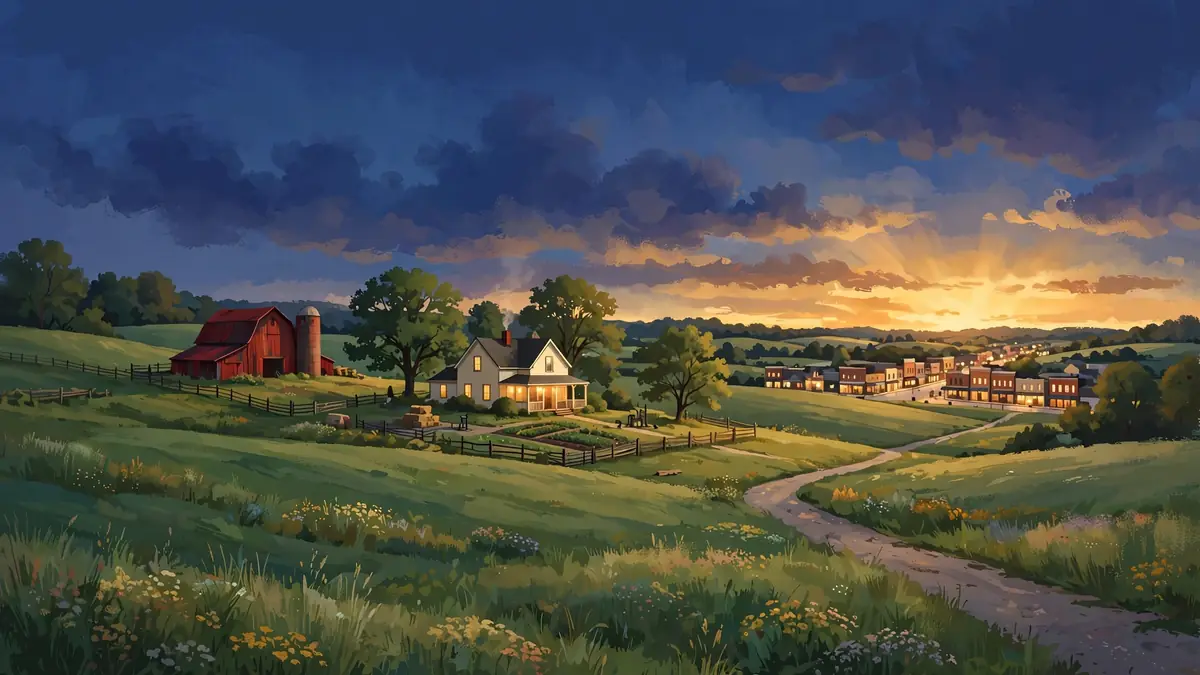
The farm is the other half of the family story. The house sits on land reported at around 65 acres outside Yellow Springs, a village of a few thousand people in southwestern Ohio, and the family has lived there since the mid-2000s — through the quiet decade, when Ohio was the refuge, and through the Netflix years, when it became the base. Chappelle has put money back into the village through Iron Table Holdings, his property company, buying homes and commercial buildings — more than 20 properties in all, including an old firehouse he bought for a comedy venue — and he talked about the purchases in an April 2026 interview with PBS NewsHour, in which he also discussed supporting a local public radio station. The village, in return, has mostly left him alone, which is the deal he wanted: a famous man living an ordinary life in a small town, and a small town that treats him as a neighbour first.
The Ohio life is also the answer to the question people ask most often about the walkaway, which is whether he regrets it. He has never said he does. The farm, the family, the property, the control over his own schedule — all of it was bought with the decision to leave, and all of it would have been harder to hold onto if he had stayed. The $50 million would have made him richer in 2005. The $60 million, eleven years later, made him richer on his own terms, and the difference between those two sentences is the whole of this biography.
The 0 Million Fortune: What the Trackers Say in 2026
Dave Chappelle’s net worth in 2026 is estimated at about $100 million by Celebrity Net Worth, inside a published range that runs from roughly $60 million to $100 million. Wealthy Gorilla, updated on 5 November 2026, still lists $60 million. Net Worth Radar, modelling the figure in October 2026, lands at $95 million with a likely range of $73 million to $121 million. Guide Net Worth’s own Dave Chappelle net worth post, last updated in July 2026, reported $60–70 million. This article anchors on $100 million per Celebrity Net Worth inside the $60–100 million range and labels it for what it is: an estimate. No audited balance sheet exists, no tax return is public, and the fees for his later Netflix specials were never disclosed, which means nobody outside his accountants can price his wealth with precision.
| Source | Figure Given | Date | What It Is |
|---|---|---|---|
| Celebrity Net Worth | ~$100 million | November 2026 | The most widely cited tracker; the anchor used in this article |
| Net Worth Radar | $95 million (range $73–121M) | October 2026 | A modelled figure; the range shows how wide the uncertainty is |
| Wealthy Gorilla | $60 million | Updated 5 Nov 2026 | The low end of the range; an older estimate that has not moved |
| Guide Net Worth (own post) | $60–70 million | July 2026 | Our own earlier estimate, before the Celebrity Net Worth revision |
| Older trackers | $50–70 million | 2022–2024 | Stale figures from before the later specials and the touring years |
The range exists for a reason, and the reason is the gap between gross and net. The inflows are large and mostly public: $60 million for the first Netflix deal, more than $80 million in total reported pay from Netflix projects, $47 million earned between June 2016 and June 2017 and $35 million the year after, per Forbes’ earnings lists, and $44.2 million in Pollstar-reported ticket sales from 30 shows. The outflows are private: tax on eight years of peak earnings, agents and managers, production costs, the farm and the property portfolio, and twenty years of living. A tracker that adds the inflows and forgets the outflows lands at $100 million and above. A tracker that prices the outflows generously lands at $60 million. The honest figure is the range, $60–100 million, with the anchor at $100 million because that is where the freshest widely cited tracker sits.
The peer comparison puts the figure in context. Chappelle’s $100 million sits below the biggest comedy fortunes — Jim Carrey’s net worth, at $180 million on this site, was built on film salaries of a scale Chappelle never chased — and above the working comics who stayed on the road without a Netflix deal of his size. The full money story, with the per-source adjudication and the year-by-year earnings, is on our sister site NetWorthCraft in Dave Chappelle’s net worth profile, which works through the same figures from the money angle while this article tells the life behind them. The difference between the two is the difference between a fortune and a biography: the fortune is $100 million, and the biography is the story of how a man who walked away from $50 million ended up with more.
Dave Chappelle in 2026: Madison Square Garden and the Road
The year 2026 has been a working year, not a quiet one. On 14 September 2026, the KFC Yum! Center in Louisville announced a Chappelle show for 24 October 2026, part of a fall run of arena and theatre dates. Then, in November, he headlined Madison Square Garden — two nights, 6 and 7 November 2026, as the opening act of the 2026 New York Comedy Festival — at 53, in the room where the biggest comics in the world measure themselves. The full account of his age at each of those milestones, and the arithmetic that puts him at 53 in November 2026 and 54 in August 2027, is on this site in Dave Chappelle’s age profile, which covers the 53 years from the age angle while this article covers the life.
The spring had its own news. In an April 2026 interview with PBS NewsHour, he discussed acquiring commercial buildings in Yellow Springs and supporting a local public radio station — the property story and the village story, told in his own words, and a reminder that the Ohio life is not a retirement but a project. The interview is the freshest first-person material in the public record this year, and it is the one that shows the man most clearly: a comedian at 53, with a farm, a family, a property portfolio and a touring schedule, talking about a small town’s radio station rather than a new television deal.
There is no new special announced as of November 2026, and no new television show. The eight Netflix specials run from 2017 to 2023, and the road is where the work happens now: theatres, arenas, festivals, and the occasional surprise set. A December 2025 Netflix special titled Dave Chappelle: The Unstoppable has been mentioned on at least one site, but it is not corroborated by the other reporting this article checked, so it is not treated here as fact. The verified record is the eight specials, the two MSG nights, the Louisville date, and the PBS interview — and the record says a comedian at 53 is still working, still touring, and still doing it on his own schedule.
Dave Chappelle at Every Age: The Career Timeline
The table below puts a number on every moment that made him, from the birth in Washington to the 53rd birthday in August 2026. Readers who want his age at any point in the story can find it here.
| Age | Year | Moment |
|---|---|---|
| 0 | 1973 | Born 24 August, Washington, D.C. — David Khari Webber Chappelle |
| 14 | 1987–88 | First stand-up, at the Apollo Theater’s amateur night — booed off the stage |
| 17 | 1991 | Graduates from the Duke Ellington School of the Arts; moves to New York |
| 18 | 1992 | Appears on HBO’s Def Comedy Jam |
| 19 | 1993 | Film debut as Ahchoo in Robin Hood: Men in Tights |
| 20 | 1994 | Turns down the role of Bubba in Forrest Gump |
| 22 | 1996 | The Nutty Professor, as Reggie Warrington |
| 24 | 1998 | Half Baked (co-written with Neal Brennan); father dies |
| 26 | 2000 | Killin’ Them Softly, first HBO hour special |
| 27 | 2001 | Marries Elaine Erfe |
| 29 | 2003 | Chappelle’s Show premieres on Comedy Central (22 January) |
| 30 | 2004 | Signs two-year, $50 million contract to continue the show |
| 31 | 2005 | Walks away mid-season-three; two weeks in South Africa; Time interview 14 May |
| 32 | 2006 | Oprah interview 3 February; The Lost Episodes air 9 July |
| 43 | 2016 | Signs reported $60 million Netflix deal (November); hosts Saturday Night Live (12 November) |
| 44 | 2017 | Four Netflix specials; first Grammy (The Age of Spin); first Emmy (SNL hosting) |
| 45 | 2018 | A Star Is Born, as Noodles; SAG ensemble nomination |
| 46 | 2019 | Sticks & Stones (August); Mark Twain Prize, 27 October |
| 47 | 2020 | 8:46 surprise special (June); hosts SNL again (7 November) |
| 48 | 2021 | The Closer (October); second SNL hosting Emmy |
| 50 | 2023 | The Dreamer (December); eighth Netflix special |
| 51 | 2025 | NAACP President’s Award, 22 February — first comedian to receive it; sixth Grammy (The Dreamer) |
| 53 | 2026 | Turns 53 on 24 August; PBS NewsHour interview (April); Louisville show (24 October); Madison Square Garden, 6–7 November |
The table tells the shape of the career in one glance: the rise was fast — first stand-up at 14, film debut at 19, his own show at 29 — and the fall was a choice, not an accident. The fifty years between the birth in Washington and the Madison Square Garden dates hold three acts: the kid from the Apollo, the television star who walked away, and the comedian who came back on his own terms. The fortune was built in the third act, and the farm in Ohio is where it lives. The first act built the name. The second act tested it. The third act cashed it in — slowly, and on his schedule.
Frequently Asked Questions
How old is Dave Chappelle in 2026?
Dave Chappelle is 53 years old in November 2026. He was born David Khari Webber Chappelle on 24 August 1973 in Washington, D.C., and he turns 54 on 24 August 2027. He first did stand-up at 14, graduated from the Duke Ellington School of the Arts in 1991, got Chappelle’s Show at 29, walked away from it at 31, and signed the Netflix deal at 43.
What is Dave Chappelle’s net worth in 2026?
Dave Chappelle’s net worth is estimated at about $100 million in 2026 by Celebrity Net Worth, inside a published range of $60 million to $100 million. Wealthy Gorilla (updated 5 November 2026) lists $60 million, Net Worth Radar (October 2026) models $95 million, and Guide Net Worth’s own July 2026 post reported $60–70 million. No audited figure exists, and the fees for his later Netflix specials were never disclosed, so the honest answer is the range with the $100 million anchor.
Why did Dave Chappelle leave Chappelle’s Show?
He left in May 2005, in the middle of season-three production, because of burnout, a loss of creative control and a work environment that had turned stressful — his own words, given to Oprah Winfrey on 3 February 2006. The breaking point came during the “Black Pixie” sketch, when a white audience member’s long laugh made him wonder whether he was reinforcing stereotypes instead of satirising them. He also said his father’s death in 1998, which he had never stopped to mourn, played a part. He flew to South Africa for two weeks to reflect; the rumours about drugs or a mental institution were false, and he has denied them ever since. “I wasn’t walking away from the money,” he told Oprah. “I was walking away from the circumstances.”
Who is Dave Chappelle’s wife?
Dave Chappelle’s wife is Elaine Erfe (Elaine Mendoza Erfe), whom he married in 2001, two years before Chappelle’s Show premiered. They have three children — sons Sulayman and Ibrahim, and a daughter, Sanaa — and live on a farm near Yellow Springs, Ohio. Elaine stays out of the public eye, and the couple have kept their family life private; this article does not add detail they have not chosen to share.
How many Grammys and Emmys has Dave Chappelle won?
Dave Chappelle has won six Grammy Awards for Best Comedy Album — for The Age of Spin, Equanimity & The Bird Revelation, Sticks & Stones, The Closer, What’s in a Name? and The Dreamer — and five Primetime Emmy Awards, from twelve nominations. The five Emmys break down as three for his Netflix specials, including Equanimity and Sticks & Stones, and two for hosting Saturday Night Live in 2016 and 2020. Many profiles say six Emmys, but six is the Grammy count; the Emmy count is five, per Wikipedia’s awards list, the NAACP’s February 2025 release and Ticketmaster’s biography.
Where does Dave Chappelle live?
Dave Chappelle lives on a farm near Yellow Springs, Ohio, reportedly on around 65 acres, with his wife Elaine and their three children. He has lived there since the mid-2000s. Through his company Iron Table Holdings he owns more than 20 properties in and around the village, including an old firehouse bought for a comedy venue, and county appraisals reported by the Yellow Springs News in 2026 put his residential and commercial holdings there at about $10.9 million.
How tall is Dave Chappelle?
Dave Chappelle is listed at 6 ft 0 in (183 cm) in most profiles, but he once told Vanity Fair he is 5 ft 11 in, so the honest answer is a range of 5 ft 11 in to 6 ft 0 in (180–183 cm). No officially measured figure has ever been published. The full height adjudication, with the sources laid out, is on our sister site in the Dave Chappelle height profile.
Is Dave Chappelle still doing stand-up in 2026?
Yes. Dave Chappelle played the KFC Yum! Center in Louisville on 24 October 2026 and headlined Madison Square Garden on 6 and 7 November 2026 as the opening act of the 2026 New York Comedy Festival, at 53. He also gave an April 2026 interview to PBS NewsHour about his Yellow Springs property and a local public radio station. No new Netflix special has been announced as of November 2026; his eight specials run from 2017 to 2023, and the road is where the work happens now.
Sources & Reporting
This article was researched on 16 November 2026 from live reporting and dated listings: Wikipedia (Dave Chappelle biography; List of awards and nominations received by Dave Chappelle) for the career dates, the five-Emmy count from twelve nominations, and the six-Grammy list; Oprah.com (“Chappelle’s Story”) for the 2005 walkaway in Chappelle’s own words, the two-year $50 million contract, the South Africa trip, the two-week absence, the pixie sketch and the 3 February 2006 interview; Time magazine (14 May 2005, via its South Africa interview) and Inside the Actors Studio for the walkaway’s causes, including his father’s 1998 death; Celebrity Net Worth for the November 2016 Netflix deal ($60 million, $20 million per special), the Forbes earnings years ($47 million June 2016–June 2017; $35 million June 2017–June 2018) and the ~$100 million net worth; Wealthy Gorilla (updated 5 November 2026) for the $60 million figure; Net Worth Radar (October 2026) for the $95 million model and the $73–121 million range; the NAACP, The Hollywood Reporter and Chortle (February 2025) for the President’s Award on 22 February 2025, the first-comedian distinction and the “probably the most special award I’ve ever gotten” quote; the John F. Kennedy Center for the Performing Arts for the 27 October 2019 Mark Twain Prize; Ticketmaster, Live Nation and the KFC Yum! Center (announced 14 September 2026) for the five-Emmy breakdown, the 17-minute 2020 Saturday Night Live monologue and the 24 October 2026 Louisville show; the Yellow Springs News (2026) for the ~$10.9 million county appraisals of his Ohio property; Pollstar for the $44.2 million tour gross from 30 shows; PBS NewsHour (April 2026) for the Yellow Springs property and public-radio interview; Guide Net Worth’s own live Dave Chappelle age post (6 November 2026) for the cross-checked facts — the 24 August 1973 birth, the Apollo at 14, the 1991 Duke Ellington graduation, the 1993 film debut as Ahchoo, the Bubba role turned down, the eight Netflix specials with dates, the five Emmys and six Grammys, the Iron Table Holdings portfolio, the Pollstar gross, and the 6–7 November 2026 Madison Square Garden dates; Guide Net Worth’s own live Jim Carrey net worth post for the $180 million peer figure; and the established public record for the remaining biographical facts — the 1992 Def Comedy Jam appearance, Half Baked (1998, co-written with Neal Brennan), Killin’ Them Softly (2000), the Chappelle’s Show run (2003–2006) and The Lost Episodes (9 July 2006), the 2001 marriage to Elaine Erfe, the three children Sulayman, Ibrahim and Sanaa, and the 8:46 special (June 2020) and The Closer walkout (October 2021). Where sources disagreed — above all on the Emmy count and the net worth — the article names the disagreement and gives the range. Where the public record is silent — the fees for his later Netflix specials, the exact value of his Ohio property portfolio, his current touring income, the birth years of his children — the article says so. A December 2025 Netflix special titled Dave Chappelle: The Unstoppable was mentioned on one site but not corroborated, so it is not treated here as fact. Corrections are welcome via the About page.
Nathan Cole
Nathan Cole is the editor of Guide Net Worth. He covers celebrity wealth the way a business desk covers earnings: reported figures first, estimates labeled as estimates, no invented numbers. Every profile passes through his desk before it publishes. About Guide Net Worth · Corrections: figures are updated when new reporting emerges — contact us via the About page if you spot an error.
References & Sources
This article has been fact-checked and verified against multiple public sources, financial disclosures, SEC filings, Forbes reports, Celebrity Net Worth databases, and official records. All net worth estimates are based on publicly available information and financial analysis.