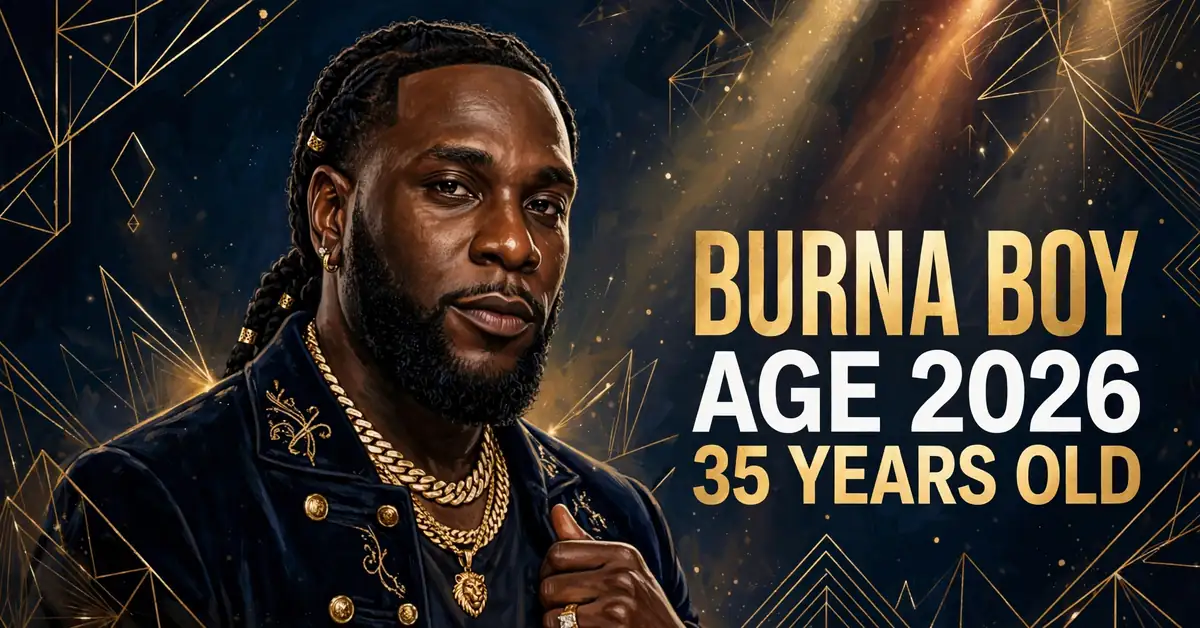
Burna Boy age 2026: Damini Ogulu, born 2 July 1991 in Port Harcourt, is 35 — from FruityLoops at 10 to a Grammy win and the 2026 World Cup final stage.
Last updated: November 16, 2026 · By Nathan Cole
Burna Boy is 35 years old in November 2026. Damini Ebunoluwa Ogulu was born on 2 July 1991 in Port Harcourt, Rivers State, Nigeria, and he turned 35 on 2 July 2026 — two weeks before he walked out at MetLife Stadium for the first-ever FIFA World Cup final halftime show. The Nigerian Afrobeats star has spent 25 of those 35 years making music: he started producing beats on FruityLoops at 10, signed his first record deal at 20, won a Grammy at 29, headlined a UK stadium at 31, and released his eighth studio album, No Sign of Weakness, at 34. His fortune is estimated at $22 million–$50 million, anchored at about $40 million, and he stands 6 ft 1 in (185 cm) tall.
This profile answers the age question properly: not with a single number copied from a tracker, but with the birth date checked against the record, the arithmetic shown, and the 35 years filled in — the Port Harcourt childhood, the London university years he walked away from, every album in order, the Grammy, the stadiums, the family, the money, and the 2026 court dispute over his early masters. Every date carries a named source. Where sources disagree — above all on the net worth — the article names the disagreement and gives the range. Where the public record is silent, it says so.
Quick Facts
| Full Name | Damini Ebunoluwa Ogulu |
| Born | 2 July 1991, Port Harcourt, Rivers State, Nigeria (age 35 in November 2026; turns 36 on 2 July 2027) |
| Also Known As | African Giant, ODG, Big 7 |
| Height | 6 ft 1 in (185 cm), per eight outlets; never publicly measured |
| Parents | Samuel Ogulu (welding-company manager) and Bose Ogulu, “Mama Burna” (translator turned manager) |
| Grandfather | Benson Idonije, radio broadcaster and Fela Kuti’s first manager |
| Siblings | Nissi Ogulu (singer) and Ronami Ogulu |
| Education | Corona Secondary School, Agbara; University of Sussex (2008–2009); Oxford Brookes University (2009–2010) — left both without a degree |
| Net Worth (2026) | Estimated $22 million–$50 million; anchor figure ~$40 million; no audited figure exists |
| Grammy | Best Global Music Album for Twice as Tall, March 2021 ceremony |
| Breakthrough | “Like to Party” (2012); “Ye” (2018); African Giant (2019) |
| 2026 Milestone | Performed “Dai Dai” with Shakira at the FIFA World Cup final halftime show, 19 July 2026, MetLife Stadium |
How This Age Was Verified
The birth date in this article — 2 July 1991 — is the one every source checked agrees on: Wikipedia’s biography, Guide Net Worth’s own Burna Boy biography post (31 October 2026) and height post (4 October 2026), Melodyflare (updated 12 November 2026), Bolavip (updated 25 October 2026), Biox, Whoworth (updated 15 November 2026), Storybasic and the live age calculators, which read 35 years, 3 months and 17 days at the time of checking. No source checked gives a different birth date, and no source checked disputes the year. The arithmetic is simple: 2 July 1991 to 2 July 2026 is 35 years, so he is 35 from July 2026 until 2 July 2027, when he turns 36. The career dates in the timeline were checked the same way, against Wikipedia, AllMusic and Nigerian and international music press, and the 2026 items — the World Cup final, the NFL Paris halftime show, the Apple Music Hall date, the tour grosses and the masters case — against the dated reporting named in Sources & Reporting. Where a claim rests on a single report, or on a pre-event announcement rather than a post-event recap, this article says so in the text or in the research note behind it. Where the public record is silent — a current partner, children, an exact salary, the price of a car — the article says so instead of filling the gap.
+
Burna Boy at 35: The Short Version
Burna Boy is 35, and the number only makes sense against the length of the run behind it. He has been making music for 25 years — since he was 10 — and famous for 14 of them, since “Like to Party” broke in 2012. He is the eldest of three children from Port Harcourt, the grandson of the man who first managed Fela Kuti, and the son of a translator who became his manager. He left two universities without a degree, built his own record label at 23, signed to Atlantic at 25, and won a Grammy at 29. At 31 he became the first African artist to headline a UK stadium. At 34 he released his eighth album. At 35, in a single summer, he sang the official World Cup song at the tournament’s opening ceremony and then again at the first halftime show a World Cup final ever had.
The age matters to the story because Burna Boy’s career has always run ahead of his years. He was producing before he was a teenager, signed before he could legally drink in the United States, and running his own label before most artists his age had released a second album. The other side of that coin is the wear: 25 years in music by 35 means the career has already had a first act, a collapse and rebuild, a global breakthrough, and a stadium era — and the 2026 headlines, from the World Cup stage to a courtroom fight over the masters of his first two records, read like a man in the middle of his career rather than at its start. The full life story, with the family, the schooling, every album and the money worked through in order, is on this site in Burna Boy’s biography profile, which covers the 35 years from the life angle while this article covers them from the age angle.
Three facts frame everything that follows. First, the birth date is settled — 2 July 1991, agreed by every source checked, with no dissenting date in the record. Second, the age is easy to get wrong in print, because a profile written in February 2026 calls him 34 and one written in August calls him 35, and both are right on the day they were written; the stale “34” figures still circulating on some tracker pages are simply profiles that were never updated after his July birthday. Third, the fortune is not settled at all: the published range runs from $22 million to $50 million, the anchor sits near $40 million, and the man himself has called the low end “way off.” The rest of this article is the evidence for those three sentences, year by year.
How Old Is Burna Boy? The Answer, Verified
Burna Boy is 35 years old in November 2026. He was born Damini Ebunoluwa Ogulu on 2 July 1991 in Port Harcourt, Rivers State, Nigeria, and he turns 36 on 2 July 2027. The arithmetic leaves no room for argument: 2026 minus 1991 is 35, and his birthday for the year has already passed, so 35 is the number until next July. He turned 30 on 2 July 2021, four months after his Grammy win. He turned 33 on 2 July 2024, a year before his eighth album arrived. He turned 35 on 2 July 2026, seventeen days before the World Cup final halftime show — the birthday fell between the tournament’s opening ceremony on 11 June, where he performed, and the final on 19 July, where he performed again.
Why do some pages still say 34? Because age is a moving number and the internet is full of pages that stopped moving. StarScoopz, published in February 2026, says 34 — correct in February, wrong now. Storybasic’s biography still reads 34 in its text while its own fact table gives the 2 July 1991 birth date that proves 35. Iborntoday’s birthday page lists him as 34 because its age figure was calculated months ago and never refreshed. The pattern is the same in every case: the birth date is right, the age is stale. A reader who wants the current number should trust the date and do the subtraction, not the headline figure on an undated page.
The same test settles the other numbers people ask about alongside the age. His height is listed at 6 ft 1 in (185 cm) across eight outlets, and our own height post worked through that figure source by source — the full adjudication, including the fact that he has never publicly measured himself, is on this site in Burna Boy’s height profile. His zodiac sign is Cancer, for a 2 July birth. His full name, Damini Ebunoluwa Ogulu, is the name on his birth record and the one his family still uses; “Burna Boy” is the stage name, and “African Giant” and “ODG” are the nicknames that came later, the first from his 2019 album title and the second from his own branding. None of these is disputed anywhere in the record. The age is the only figure that changes, and it changes once a year, on 2 July.
Early Life in Port Harcourt: A Family Steeped in Music
Burna Boy was born in Port Harcourt, the capital of Rivers State in southern Nigeria, and raised there. His father, Samuel Ogulu, managed a welding company. His mother, Bose Ogulu, worked as a language translator before becoming her son’s manager — and later the founder of her own entertainment company, Spaceship Collective. He is the eldest of three children and the family’s only son. His younger sister Nissi Ogulu became a singer in her own right, and his other sister, Ronami, works in design and engineering. Music was not a hobby in that household. It was the family business, two generations deep.
The second generation back is the one that explains the most about him. His maternal grandfather, Benson Idonije, was a radio broadcaster and music critic, and the first manager of Fela Kuti, the Afrobeat pioneer whose records were part of the household soundtrack as Burna Boy grew up. Idonije managed Fela during a formative period of the Afrobeat movement, and the connection runs through Burna Boy’s whole career: the Fela samples, the live bands, the long politically charged songs, the stagecraft built around a full band rather than a backing track. He was six years old when Fela died in 1997, so the influence came through the records and through his grandfather, not from meeting the man — a distinction worth making, because some profiles write as though the two overlapped as musicians.
Two corrections belong in any careful account of his background, because the lazy versions circulate widely. First, Burna Boy is frequently described online as Yoruba. The reporting that traces his parentage says otherwise: his father is Ogoni, from Rivers State, and his mother is Edo, from Otuo town in Edo State. The Yoruba label looks like an inference from his Lagos base and his Yoruba-language lyrics, not from his family background. Second, some sites claim his mother danced for Fela Kuti as one of his “Kalakuta Queens.” Benson Idonije himself dismissed that story, calling it a “wicked lie.” This article follows the grandfather’s word over the rumour. He grew up in southern Nigeria, attended Montessori International School and then Corona Secondary School in Agbara, Ogun State, and the music started before the schooling finished.
Age 10: FruityLoops and the First Beats
The single most important date in Burna Boy’s musical life, after his birth, is 2001 — the year he turned 10 and started making his own beats. A classmate at Corona Secondary School handed him a copy of FruityLoops, the production software now known as FL Studio, and he started building tracks on it. The detail is reported by Wikipedia, by his own biographical profiles, and by the Nigerian press, and it matters because it dates his production career a full decade before his fame. By the time “Like to Party” arrived in 2012, he had been producing for roughly half his life.
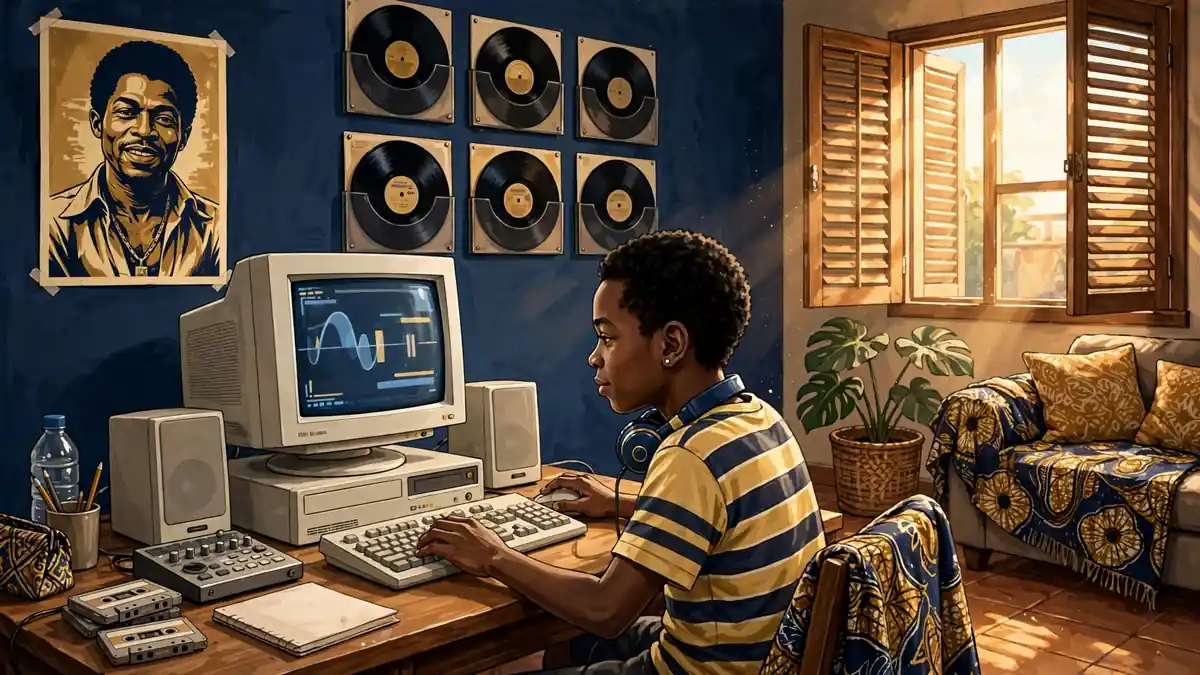
He did not only make beats in his bedroom. At Corona he formed a school band that performed at school functions, and the performing habit stuck: the boy who made tracks on a computer was also the boy who stood up and played them for a room. The two halves of his later career — the producer’s ear and the performer’s command of a stage — were both in place before he left secondary school. He was still a child, and the work was already serious. The software was a cracked copy, by some accounts, on a family computer, in a house where his grandfather’s Fela records were on the wall. The image is easy to romanticise. The fact underneath it is plain: he started at 10, he never stopped, and the 25 years since are the reason the catalogue sounds the way it does.
The FruityLoops story also explains a habit that runs through his whole career: he writes and produces from inside the music rather than waiting for someone else’s beat. Most Afrobeats stars of his generation arrived as singers first and learned production later, if at all. Burna Boy arrived as a producer who could sing, and the control that gave him — over sound, over tempo, over the shape of a record — is the same control he later demanded over his label, his masters and his touring. The thread from the 10-year-old with the software to the 35-year-old fighting in court over his early masters is a straight line, and the court case gets its own section below.
London at 16: University, Dropout, and the Return
At 16, Burna Boy moved to London to continue his education, following a path familiar to many middle-class Nigerian families. He studied Media Technology at the University of Sussex from 2008 to 2009, then Media Communications and Culture at Oxford Brookes University from 2009 to 2010. He did not finish a degree at either institution. The dropout is now part of the legend, but the sequence matters: he left formal education twice, in two different cities, before committing to music full time. He was 17 when he started at Sussex and 19 when he left Oxford Brookes.
London gave him something the classroom did not. He absorbed the UK’s dancehall, grime and garage scenes, and the reggae and dancehall influences that later defined Afro-fusion were shaped as much by London sound systems as by Lagos street pop. The city also gave him an insider’s understanding of the British market — the audience, the clubs, the radio — that would pay off a decade later, when he headlined London Stadium and sold out arenas across the country. After returning to Nigeria he interned at a radio station in Port Harcourt, a stint that put him inside the broadcasting business his grandfather had worked in and gave him a practical education in how songs reach audiences.
One claim about the London years is left out of this article on purpose. A single site reports that he was expelled from a UK school for behavioural issues. No other source checked — not Wikipedia, not the Nigerian press profiles, not Guide Net Worth’s own biography — corroborates it, so it is not stated here as fact. The verified record is the one above: two universities, two unfinished degrees, a radio internship, and a return to Nigeria at 19 with a producer’s ear and a London education in sound. Within two years of his return he had a record deal and a breakout single, and within five he had his own label.
Age 20–21: “Like to Party” and the Aristokrat Years
Burna Boy’s professional career began in 2010, but the record that changed it arrived in 2012. “Like to Party,” produced by LeriQ, was the lead single from his debut studio album and the first song that made him a national name in Nigeria. He was 20 when he signed with Aristokrat Records in July 2011, and 21 when the single broke. The track’s easy dancehall swing was a deliberate break from the harder street-pop sound dominating Lagos at the time, and it announced a singer who could carry a melody across genres rather than a rapper who sang hooks. The 2012 Headies award for Next Rated, which he won that year, is the kind of early-career marker that looks minor in retrospect and mattered enormously at the time: in Nigerian music, the Next Rated prize is a formal anointing, telling promoters, brands and radio that the industry has picked its next star.
The debut album, L.I.F.E — an acronym for “Leaving an Impact for Eternity” — followed in 2013 on Aristokrat Records, when he was 22, and it peaked at number seven on the Billboard Reggae Albums chart — an early sign that his audience was already forming outside Nigeria. Its singles included “Run My Race” and “Tonight,” and its guest list placed the newcomer alongside the two biggest names in Nigerian pop: 2Baba and Wizkid, whose own biography runs on a parallel track from the same Lagos scene, the same Headies stage and the same generation of Afrobeats stars. The Aristokrat deal gave Burna Boy distribution and a platform. It also gave him his first lesson in label politics, and his time there ended as he moved toward building his own operation.
He parted ways with Aristokrat in May 2014, when his contract expired, aged 22. The split looked clean at the time. Twelve years later it is the subject of a court case over the masters of the records he made there — the L.I.F.E album and the Redemption EP — and the details of that dispute are set out in the masters section below. Aristokrat’s founder, Piriye Isokrari, said in an interview in October 2026 that the label chose not to renew the contract because Burna Boy asked for a large non-recoverable advance and a Porsche. That is Isokrari’s account, reported in his own words, and this article presents it as such rather than as settled fact. What is settled is the timing: the contract ended in May 2014, and the label chapter of his career closed at 22.
Age 23–24: Spaceship and Going Independent
In 2015, Burna Boy founded Spaceship Entertainment and released his second studio album, On a Spaceship, on it. He was 23 going on 24. The move looks obvious now — every major Afrobeats star eventually owns a label — but in 2015 it was a statement of intent from an artist who had spent three years inside someone else’s system. Spaceship gave him control of his masters, his signings and his release schedule, and it became the vehicle for everything that followed, from the Atlantic deal to the stadium tours. His mother Bose Ogulu’s Spaceship Collective grew alongside it as a management and entertainment company, and keeping the business inside the family is the single most important structural fact about Burna Boy’s fortune: where other artists split touring, recording and management revenue across separate companies, his circle kept a larger share of each stream in-house.
On a Spaceship itself was a transitional record: less immediate than L.I.F.E, more experimental in its production, and a sign that Burna Boy was thinking about albums as statements rather than collections of singles. The following year brought the Redemption EP in 2016, a shorter project that kept him in circulation while the bigger move — a major-label deal — was negotiated. The EP’s title was not accidental. Burna Boy had spent 2014 and 2015 rebuilding his reputation after a period in which his public image, including a well-publicised legal incident, threatened to outrun his music. Redemption was the reset, and it worked: by the end of 2016, the conversation was about the music again.
The independence was never absolute, and the next deal proved it. In 2017, aged 25 going on 26, he signed with Atlantic Records and its parent company, Warner Music Group — the deal that took him from Nigerian star to global artist. Spaceship stayed his home imprint, and the Atlantic deal gave him the machinery of a major: international distribution, radio promotion, festival bookings. The combination — his own label for control, a major for reach — is the structure his whole career since has run on. It is also the structure at the centre of the 2026 court case, because the disputed sale moved his early masters from Aristokrat to Spaceship, the company he owns with his mother.
Age 26–27: Outside, “Ye”, and the Global Breakthrough
Burna Boy’s third studio album and major-label debut, Outside, arrived in January 2018, when he was 26, and reached number three on the Billboard Reggae Albums chart, winning Album of the Year at the Nigeria Entertainment Awards. The album’s centrepiece was “Ye,” a track that started as an album cut and became a phenomenon: it spread through African diaspora communities, then through European clubs, then into the global streaming charts, and it remains his signature song. The track’s rise coincided with the global Afrobeats wave of 2018–2019, but it was not a wave-rider: its production, built around a warm mid-tempo groove and a hook that worked in any language, was designed to travel, and it did.
“Ye” deserves its own paragraph because it changed the economics of his career. Before “Ye,” Burna Boy was a Nigerian star with international potential. After “Ye,” he was a festival headliner with a song that promoters in London, Paris and New York could book on. The song also gave him a second identity: the “Ye” moment is when the African Giant nickname, still a year away from becoming an album title, started to fit. He was 27 by the end of that year, and the arithmetic of the career had shifted — the eight years from FruityLoops at 10 to “Like to Party” at 21 had been slow, and the six years from the single to “Ye” had been steady, but the year after “Ye” would be the fastest of his life.
Outside also clarified the Afro-fusion formula. The album moves between dancehall, reggae, R&B and Afrobeat without announcing the shifts, and its guest list — including British artists — signalled that Burna Boy was building a UK base as deliberately as a Nigerian one. The London years were paying off: he understood the British market as an insider, not an export, and Atlantic’s deal gave him the machinery to exploit that understanding. The album did not make him rich. It made him bookable everywhere, which is the thing that makes an artist rich.
Age 27–29: African Giant, Twice as Tall, and the Grammy
African Giant arrived in July 2019, days after Burna Boy turned 28, and it is the album that made him undeniable. The title became the nickname, and the nickname became the identity: the African Giant, the artist who carried the continent’s sound onto the world’s biggest stages. The record earned a Grammy nomination for Best World Music Album, and it turned the festival-headliner status “Ye” had won into a touring business. A year later, Twice as Tall arrived in August 2020, when he was 29, executive-produced by Sean “Diddy” Combs, and it won the Grammy for Best Global Music Album at the March 2021 ceremony. He was 29 at the win, days short of 30, and the award is widely described as the first Grammy won by a Nigerian solo artist as a lead act.
The Grammy matters here for two reasons, and only one of them is the trophy. The first is the timing: he won it at 29, after eleven years of professional work and nineteen years of making music — a slow build by pop standards, and a fast one by the standards of an artist who had been written off more than once. The second is the money: a Grammy changes the fee. Festival guarantees rise, brand deals get bigger, and the touring business that already paid the bills starts paying much more. The Grammy did not make the fortune on its own. It repriced everything around it.
He has one Grammy from thirteen nominations, per the Recording Academy’s own artist page, and the count is worth stating plainly because tracker pages inflate it. Some profiles credit him with multiple Grammys, or fold nominations into wins. The record is one win — Twice as Tall, Best Global Music Album, March 2021 — and five of his eight studio albums have earned nominations in the album categories: African Giant in 2020, Twice as Tall in 2021, Love, Damini in 2023, I Told Them… in 2024, and No Sign of Weakness at the 68th Grammys in February 2026, which did not win. He is the first Nigerian artist to earn five Grammy album nominations. The remaining nominations sit in the song and performance categories, including Best African Music Performance. The BET Awards for Best International Act, which he won more than once, sit alongside the Grammy on the shelf, but the Grammy is the one that changed the career.
Age 30–32: Love, Damini and the Stadium Years
Love, Damini arrived in July 2022, days after Burna Boy turned 31, and it is the album of the stadium era. The record’s title used his first name, and the tour behind it used the biggest rooms he had ever played. In June 2023, at 31 going on 32, he headlined London Stadium and became the first African artist to headline a UK stadium — an 80,000-capacity room that had previously been the preserve of rock bands and pop’s biggest names. The show sold out, and the reports that followed talked about it as a line being crossed, not a concert being played. A July 2026 report credited him with 14.46 million equivalent album sales worldwide and called him Africa’s best-selling artist of all time; that figure comes from a single report rather than an industry body, so this profile attributes it rather than stating it as settled fact.
I Told Them… followed in August 2023, when he was 32, and its tour became the best-documented money story of his career. According to Touring Data, the concert box-office tracker, the I Told Them… tour grossed $30.46 million from 302,801 tickets across 22 reported shows between 2023 and 2025. The figure is a gross — box-office receipts before venues, promoters, crews, taxes and management take their cuts — and this article cites it as a gross, never as take-home pay. But it is the hardest number in the whole fortune story, because it comes from reported boxscores rather than a tracker’s model, and it is the number that makes the low-end net-worth estimates look shaky to anyone who follows the touring business.
The stadium years also put him in company he had spent a decade chasing and then passing. Davido’s biography runs the parallel story: the same Lagos generation, the same Headies stage, the same climb from Nigerian stardom to global touring, with Davido’s own fortune estimated far higher on some trackers and his career taking a different shape — more pop, more features, a different kind of fame. The two men have shared bills, shared stages and shared the argument about who carries Afrobeats, and the argument itself is part of the genre’s story. Burna Boy’s answer to it, at 31 and 32, was the stadium: the biggest room, the biggest crowd, the first African artist to fill it.
Age 33–34: No Sign of Weakness and the 2025–26 Tour
No Sign of Weakness, his eighth studio album, arrived on 10 July 2025, eight days after Burna Boy turned 34. The record runs 16 tracks and features Travis Scott, Mick Jagger, Stromae and Shaboozey — a guest list that shows how far his reach extends beyond Afrobeats. By late October 2026 it had passed 400 million streams on Spotify, becoming his sixth project to reach that mark, the most by any African artist. The title reads like a statement of intent from a man who had spent the previous year in the headlines for reasons other than music, and the record’s confidence is the point: at 34, with eight albums behind him, he was not rebuilding. He was consolidating.
The tour behind the album kept the machine running into 2026, and the numbers landed in November 2026 — the freshest touring figures in this profile. According to Touring Data, via reports published on 14 November 2026, the No Sign of Weakness tour grossed $9.09 million and sold 101,301 tickets across 17 of the tour’s 21 shows, an average of $534,522 and 5,959 tickets a show. The North American leg did most of the work: about $5.96 million and 70,355 tickets from 13 reported shows at 12 venues, opening at Red Rocks Amphitheatre in Colorado on 12 November 2025 and closing with two nights at Scotiabank Arena in Toronto on 17 and 18 December. The four-show Oceania leg in October 2025 grossed about $3.12 million from 30,946 tickets, at an average ticket price of $100.94 — the highest of the tour. Four shows, in Minneapolis, Chicago, Boston and Orlando, had not been reported when the figures were published, so the final gross will climb once their numbers land.
The 2025–26 run also extended his presence as a collaborator rather than just a headliner. Apple Music lists him on J. Cole’s 2026 album The Fall-Off, and in August 2026 reports circulated that he would return to London Stadium for a third headline show in 2027 — a return to the 80,000-capacity venue that first made him a stadium artist. Early in 2026 he was also reported to have become the first African artist to chart a song on the Billboard Hot 100 for six consecutive years, from 2021 to 2026. The business moves stacked up alongside the music: a multi-year deal with Swiss sportswear brand On that produced his first sneaker collection in October 2026, and reports in 2026 of a $15 million investment alongside music executive L.A. Reid in MOON Ultra, a Texas-based consumer electronics company. None of these ventures has published verified revenue, so this article names them and moves on rather than pricing them.
Age 35: The 2026 World Cup Final Halftime Show
Burna Boy’s 35th year began at the centre of the world’s biggest sporting event. In May 2026 he joined Colombian superstar Shakira on “Dai Dai,” the official song of the 2026 FIFA World Cup. FIFA then announced both artists as performers of the song at the tournament’s opening ceremony in Mexico City on 11 June 2026 — and Burna Boy returned to the World Cup stage for the tournament’s historic final halftime show on 19 July 2026, at MetLife Stadium in New Jersey, the first halftime show ever attached to a World Cup final. He had turned 35 seventeen days earlier. The two performances, five weeks apart, put him on the biggest stages in world sport twice in the same summer.
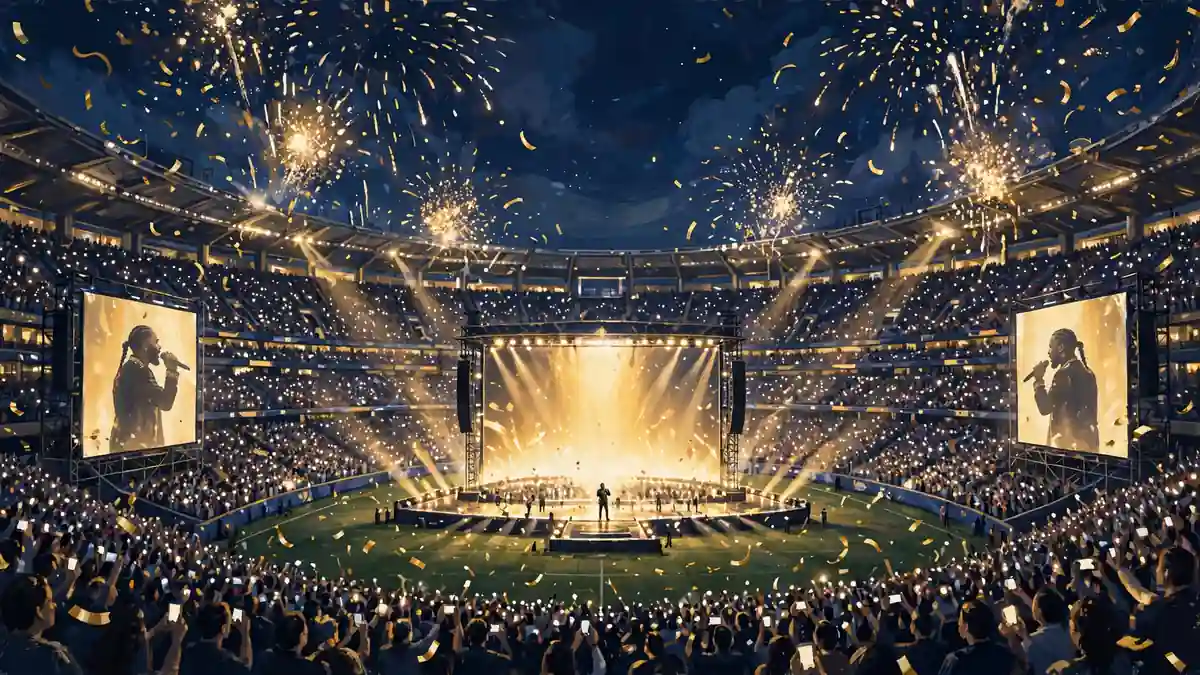
The final itself was the first World Cup final halftime show in the tournament’s history, and the scale of it is worth setting out plainly. FIFA announced the show as a co-headline bill: Madonna, Shakira, BTS and Justin Bieber at the top, with Burna Boy, conductor Gustavo Dudamel, the PS22 Chorus featuring Coldplay, Uganda’s Ghetto Kids dance troupe and others as guests. The production was curated by Coldplay frontman Chris Martin, produced by Global Citizen in partnership with Live Nation and Done + Dusted, and directed by Hamish Hamilton. Burna Boy and Shakira performed “Dai Dai” together, the song they had already performed at the opening ceremony. He became the first Nigerian artiste to perform at a World Cup final halftime show — a distinction the Nigerian press reported the day after, on 21 July 2026.
The show also drew criticism, and the criticism belongs in the record. The halftime lasted 27 minutes and 22 seconds, against the 15-minute interval the laws of the game allow, and the breach of the interval rule was the sharpest complaint. The show’s commercial scale — a Super Bowl-style spectacle at football’s showpiece event — drew the wider charge of Americanisation. FIFA had told broadcasters on 17 July that the halftime would run 18 minutes, including seven minutes of stage installation and an 11-minute show; the reality ran longer. Spain beat Argentina 1–0 after extra time in the match itself, and the football, in the end, was the smaller story of the night. “Dai Dai” also placed Burna Boy on the official FIFA World Cup 2026 album alongside Future, Tyla, 21 Savage, Stormzy, Davido, Rema and Ayra Starr — and Rema’s biography on this site covers another of the young Nigerian stars who shared that album tracklist and the global stage it came with.
The World Cup was not the only first of that autumn. On 25 October 2026, aged 35, he headlined the halftime show at the NFL’s first-ever regular-season game on French soil — the Pittsburgh Steelers against the New Orleans Saints at the Stade de France in Paris — a billing announced in September 2026 and profiled as the headliner slot in the weeks before the game. Four days later, on 29 October, he performed at Apple Music Hall, Apple’s new live music venue at Battersea Power Station in London, billed as the first African artiste to play the venue. The two dates, a week apart, show the shape of his 35th year: not a victory lap, but a run of firsts — the first Nigerian at a World Cup final halftime show, the first regular-season NFL game in Paris, the first African at Apple’s new hall.
Family and Personal Life at 35
Burna Boy is not publicly married, and at 35 he keeps his private life the way he has kept it since fame arrived: behind a wall his family built together. His mother, Bose Ogulu, is his manager and the founder of Spaceship Collective, and she has been the constant of his career since the start — the translator who became the manager, the parent who became the business partner. His father, Samuel Ogulu, stays out of the spotlight. His sisters, Nissi and Ronami, have their own careers — Nissi as a singer, Ronami in design and engineering — and the family operates as a unit in a way few pop careers do: the label, the management and the touring business all run through people who share his surname.
His most public relationship was with British rapper Stefflon Don, whom he dated from 2018 to 2022. The split was public, the details were not, and the years since have been quiet on that front: no current partner has been confirmed publicly, and this article does not guess at one. The question readers ask most often after the partner question is whether he has children. The answer is that no children have been publicly confirmed, and he has not announced any. A profile that names children for him would be inventing a family, so this one does not.
He was raised in a Christian home, and his faith comes up in his music more than in interviews — the gospel phrasing in some of his hooks, the church-choir warmth of his backing vocals, the moral language of songs like “Ye” and “Common Person.” He does not discuss his religious views publicly in detail, and this article leaves it there. What he does discuss, often and at length, is Pan-African identity: the Fela lineage, the claim to the African Giant name, the insistence that Afrobeats is not a trend but a tradition. At 35, with a Grammy, a stadium record and a World Cup final behind him, the persona and the person have converged: the man who calls himself the African Giant is, by the numbers, the biggest touring artist African music has produced.
The Money at 35: A M–M Estimate
Burna Boy’s net worth in 2026 is best stated as a range: $22 million to $50 million, anchored at around $40 million. The floor comes from Celebrity Net Worth at $22 million, corroborated on the low side by ThrillNG’s October 2026 ranking at $19–25 million. The ceiling comes from Pulse Nigeria’s November 2025 profile at $45–50 million, with annual earnings estimated at around $20 million. Between those poles sit worth.ng at about $35 million and EssentiallySports, writing in July 2026, at around $28 million on Celebrity Net Worth’s figures. The full money story, with the per-source adjudication and the year-by-year earnings, is on our sister site CelebAmerica in Burna Boy’s net worth profile, which works through the same figures from the money angle while this article tells the life behind them.
| Source | Figure Given | Date | What It Is |
|---|---|---|---|
| Celebrity Net Worth | $22 million | Current listing | The most widely cited tracker; the floor of the range |
| EssentiallySports (per CNW) | ~$28 million | July 2026 | A July reading of the same tracker — the CNW figure appears to have moved since |
| worth.ng | ~$35 million | 2026 profile | Near the middle of the range |
| Pulse Nigeria | $45–50 million | November 2025 | The ceiling; ~$20 million annual earnings estimated alongside it |
| ThrillNG | $19–25 million | October 2026 | Corroborates the low end |
The range exists because nobody outside his camp can price his wealth with precision, and because Burna Boy himself has said the low end is wrong. Asked in 2023 whether the $22 million figure was accurate, he laughed it off, and The Nation reported his reply: “Let’s not talk about that one,” followed by, “Well, I prefer them to think that. That’s cool.” Reporting in late 2025 has him calling the figure “way off” again, on Complex’s 360 With Speedy. He has never published a balance sheet, so nobody outside his camp knows the exact number — and the honest answer is the range, not a single figure. The anchor sits near $40 million because that is where the freshest full-length profiles on both sister sites land, and because the touring numbers support it: a $30.46 million gross on one tour and a $9.09 million gross on the next are hard box-office facts, and they sit awkwardly next to a $22 million net worth for a man who has been touring at that level for years.
The outliers deserve a warning, because they are the first results a search returns. One magazine puts him at $120–150 million “according to Forbes” — no Forbes list supports that figure, and Forbes has never published a Burna Boy net worth. Another site lists $80 million, a third $70 million, “verified” by its own arithmetic, and a fourth argues past $100 million by adding tour grosses together as though grosses were profits. All four make the same error: they count revenue as wealth, and they forget tax, agents, managers, production costs and twenty-five years of living. A tracker that adds the inflows and forgets the outflows lands above $100 million. A tracker that prices the outflows lands at $22 million. The honest figure is the range, $22–50 million, with the anchor at $40 million — and the reader who wants a single number should know that the single number does not exist.
The 2026 Masters Dispute: What Is Actually in Court
The least glamorous story of Burna Boy’s 35th year is also the one with the most money attached to it: a legal fight over who owns the masters of his first records. The dispute centres on a transaction in May or June 2024, in which Aristokrat Music — the label that signed him in 2011 — sold the intellectual property and master recordings from his early years to Spaceship Music, his current imprint, owned by him and his mother Bose Ogulu. The catalogue covers the albums L.I.F.E (2013) and Redemption (2016), along with the early singles that shaped his Afro-fusion style. The buyer was, in effect, the artist himself. The seller was his old label. The problem, according to the party suing, is that the sale happened without the knowledge or consent of the label’s other owners.
The party suing is 960 Music Group, which owns 40 per cent of Aristokrat Music. In February 2026 it filed a civil suit in the Federal High Court in Port Harcourt — 960 Music Ltd v. Aristokrat Records Nigeria Ltd & Ors, suit number FHC/PH/CS/188/2024 — asking the court to void the multimillion-dollar sale and order the proceeds returned. Its argument is a corporate-governance one: the catalogue is the company’s crown-jewel asset, and it could not legally be sold without the approval of all major shareholders. The case is still ongoing as of November 2026, and nothing in it has been decided.
The dispute also took on a criminal dimension, and that part has been decided. Nigeria’s Force Criminal Investigation Department filed charges against Aristokrat Records founder Piriye Isokrari, following investigations into allegations of fraud and breach of fiduciary duty around the sale. On 11 June 2026, a federal high court in Ikoyi, Lagos, struck out the criminal case — Commissioner of Police v. Aristokrat Records Nigeria Ltd & Anor, charge number FHC/L/1087/2025 — and criticised the police for what it called a careless approach to handling the intellectual property dispute. The criminal case is over. The civil case is not. In March 2026, 960’s lawyers formally asked Warner Music Group to suspend all distribution, marketing, monetisation and licensing of the disputed works; at the date of that report, no formal response had been received.
What does it mean for the age question? Nothing directly, and everything indirectly. The masters fight is the 35-year-old version of the 10-year-old with FruityLoops: the same instinct for control, now exercised in a courtroom instead of a bedroom studio. If 960 Music wins, Spaceship could be required to surrender rights to some of his breakthrough recordings. If Aristokrat’s sale stands, Burna Boy owns his early catalogue outright — the thing he has been working toward since he founded Spaceship at 23. Either way, the case is a reminder that the fortune in the previous section is not a bank balance. It is a bundle of rights, contracts and court dates, and the bundle is still being argued over.
Burna Boy at Every Age: The Career Timeline
The table below puts a number on every moment that made him, from the birth in Port Harcourt to the World Cup final at 35. Ages are the age he turned in that year — the birthday falls on 2 July, so a January event finds him a year younger than a December one in the same row.
| Age | Year | Moment |
|---|---|---|
| 0 | 1991 | Born 2 July, Port Harcourt, Rivers State, Nigeria — Damini Ebunoluwa Ogulu |
| 6 | 1997 | Fela Kuti dies; the influence reaches Burna Boy through records and his grandfather |
| 10 | 2001 | Starts making beats on FruityLoops from a classmate’s copy; school band at Corona |
| 16 | 2007 | Moves to London to continue his education |
| 17–18 | 2008–2009 | Media Technology, University of Sussex — leaves without a degree |
| 18–19 | 2009–2010 | Media Communications and Culture, Oxford Brookes — leaves without a degree; radio internship in Port Harcourt |
| 20 | 2011 | Signs with Aristokrat Records (July) |
| 21 | 2012 | “Like to Party” breaks; Headies Next Rated award |
| 22 | 2013–2014 | Debut album L.I.F.E (2013, No. 7 Billboard Reggae Albums); parts with Aristokrat (May 2014) |
| 24 | 2015 | Founds Spaceship Entertainment; On a Spaceship |
| 25 | 2016 | Redemption EP |
| 26 | 2017–2018 | Signs Atlantic/Warner (2017); Outside and “Ye” (January 2018) |
| 28 | 2019 | African Giant (July); first Grammy nomination |
| 29 | 2020–2021 | Twice as Tall (August 2020); Grammy win, Best Global Music Album (March 2021) |
| 31 | 2022 | Love, Damini (July); ends relationship with Stefflon Don |
| 32 | 2023 | First African artist to headline a UK stadium, London Stadium (June); I Told Them… (August) |
| 33 | 2024 | Early masters sold by Aristokrat to Spaceship (May/June); 960 Music files civil suit |
| 34 | 2025 | No Sign of Weakness (10 July); North America and Oceania tour legs; fifth Grammy album nomination announced (November) |
| 35 | 2026 | Turns 35 on 2 July; “Dai Dai” with Shakira (May); World Cup opening ceremony (11 June) and final halftime show (19 July); NFL Paris halftime (25 October); Apple Music Hall (29 October); tour grosses published ($9.09M); criminal masters case struck out (11 June), civil case ongoing |
The table tells the shape of the career in one glance: the rise was slow — first beats at 10, first hit at 21 — and the peak has been long, from “Ye” at 27 to the World Cup at 35. The twenty-five years between the FruityLoops copy and the MetLife Stadium stage hold three acts: the kid from Port Harcourt, the independent who built his own label, and the stadium headliner who sings World Cup songs. The fortune was built in the third act, and the masters fight is the price of the second. The first act built the ear. The second act built the business. The third act cashed both in — and at 35, with a 36th birthday eight months away, the third act is still running.
Frequently Asked Questions
How old is Burna Boy in 2026?
Burna Boy is 35 years old in November 2026. He was born Damini Ebunoluwa Ogulu on 2 July 1991 in Port Harcourt, Rivers State, Nigeria, and he turns 36 on 2 July 2027. He started making beats at 10, signed his first record deal at 20, won a Grammy at 29, headlined a UK stadium at 31, and performed at the FIFA World Cup final halftime show at 35.
What is Burna Boy’s real name?
Burna Boy’s real name is Damini Ebunoluwa Ogulu. “Burna Boy” is his stage name, and his best-known nicknames are African Giant — taken from his 2019 album of the same name — ODG and Big 7.
How tall is Burna Boy?
Burna Boy is listed at 6 ft 1 in (185 cm) across eight outlets, and that is the figure this site’s height profile works through source by source. He has never publicly measured himself, so no officially measured figure exists. The full height adjudication is on this site in the Burna Boy height profile.
What is Burna Boy’s net worth in 2026?
Burna Boy’s net worth in 2026 is estimated at $22 million to $50 million, anchored at around $40 million. Celebrity Net Worth puts him at $22 million, Pulse Nigeria’s November 2025 profile estimated $45 million to $50 million with annual earnings of about $20 million, worth.ng put him at about $35 million, and EssentiallySports reported around $28 million in July 2026. He has never published a balance sheet, and he has publicly called the $22 million figure “way off,” so the range — not a single figure — is the honest answer.
Did Burna Boy perform at the 2026 World Cup final?
Yes. Burna Boy performed “Dai Dai” with Shakira at the first-ever FIFA World Cup final halftime show on 19 July 2026 at MetLife Stadium in New Jersey, seventeen days after turning 35. He had already performed the song at the tournament’s opening ceremony in Mexico City on 11 June 2026. He was the first Nigerian artiste to perform at a World Cup final halftime show. Spain beat Argentina 1–0 after extra time in the final, and the halftime show — co-headlined by Madonna, Shakira, BTS and Justin Bieber — lasted 27 minutes and 22 seconds.
Who is Burna Boy’s wife or girlfriend?
Burna Boy is not publicly married. His most public relationship was with British rapper Stefflon Don, whom he dated from 2018 to 2022. No current partner has been confirmed publicly since the split, and no children have been publicly confirmed. This article does not guess at a current partner or invent children.
How many Grammys has Burna Boy won?
Burna Boy has won one Grammy — Best Global Music Album for Twice as Tall at the March 2021 ceremony — from thirteen nominations, per the Recording Academy’s own artist page. Five of his eight studio albums earned nominations in the album categories: African Giant (2020), Twice as Tall (2021, win), Love, Damini (2023), I Told Them… (2024) and No Sign of Weakness (2026). He is the first Nigerian artist to earn five Grammy album nominations.
What is the Burna Boy masters dispute about?
The dispute is over who owns the masters of Burna Boy’s early catalogue — the L.I.F.E album (2013) and the Redemption EP (2016) plus early singles. In May or June 2024, his former label Aristokrat Music sold those masters to Spaceship Music, the imprint he owns with his mother Bose Ogulu. 960 Music Group, which owns 40 per cent of Aristokrat, sued in February 2026, saying the sale happened without its knowledge, consent or board approval, and asked the Federal High Court in Port Harcourt to void it. The civil case is still ongoing. A separate criminal case over the same sale was struck out by a Lagos federal high court on 11 June 2026.
Sources & Reporting
This article was researched on 16 November 2026 from live reporting and dated listings: Wikipedia (Burna Boy biography; 2026 FIFA World Cup final halftime show) for the birth date, family details, album sequence and the halftime-show facts; the Recording Academy (grammy.com) for the one win from thirteen nominations and the five album nominations; FIFA’s own release (vod.fifa.com) for the 19 July 2026 halftime show lineup; Guide Net Worth’s own live Burna Boy biography post (31 October 2026) and Burna Boy height post (4 October 2026) for the cross-checked facts — the 2 July 1991 birth, the FruityLoops story, the Sussex and Oxford Brookes years, the Aristokrat dates, the Atlantic deal, the $30.46 million I Told Them tour gross, the 14.46 million album-sales report, the J. Cole feature and the On deal; CelebAmerica’s Burna Boy net worth post (13 November 2026) for the $22–50 million range, the $40 million anchor, the 400 million Spotify streams and the Bugatti report; The Sun Nigeria (9 February 2026), tnx.africa (21 February 2026) and el-balad (20 March 2026, updated 4 July 2026) for the masters dispute, the suit numbers and the Warner Music notice; phoenix-browser (11 June 2026) for the criminal case being struck out; gidipoint (29 October 2026) for Isokrari’s account of the 2014 non-renewal; billionaires.africa and qncnews (both 14 November 2026) for the $9.09 million No Sign of Weakness tour gross; africanewseye (21 July 2026) and cpcnews (19 July 2026) for the first-Nigerian distinction and the final score; afroyard (14 November 2026) and thenollywoodreporter (28 September 2026) for the World Cup performances and the Apple Music Hall date; DancehallMag (18 September 2026) for the NFL Paris halftime billing; EssentiallySports (19 July 2026) for the ~$28 million net-worth reading; Pulse Nigeria (November 2025) for the $45–50 million estimate; Melodyflare (updated 12 November 2026), Bolavip (updated 25 October 2026), Biox, Whoworth (updated 15 November 2026), Storybasic, iborntoday and ask-oracle for the age cross-check; biographies.com.ng, sidomexentertainment and verilynews for the early-life details, the Idonije denial of the “Kalakuta Queen” rumour and the Christian upbringing. Where sources disagreed — above all on the net worth and on the Celebrity Net Worth figure itself — the article names the disagreement and gives the range. Where the public record is silent — a current partner, children, an exact salary, the price of a car, the fees for his later tours — the article says so. The NFL Paris and Apple Music Hall performances rest on pre-event announcements and headliner profiles rather than separate post-event recaps, and this note records that limit. Corrections are welcome via the About page.
Nathan Cole
Nathan Cole is the editor of Guide Net Worth. He covers celebrity wealth the way a business desk covers earnings: reported figures first, estimates labeled as estimates, no invented numbers. Every profile passes through his desk before it publishes. About Guide Net Worth · Corrections: figures are updated when new reporting emerges — contact us via the About page if you spot an error.
References & Sources
This article has been fact-checked and verified against multiple public sources, financial disclosures, SEC filings, Forbes reports, Celebrity Net Worth databases, and official records. All net worth estimates are based on publicly available information and financial analysis.