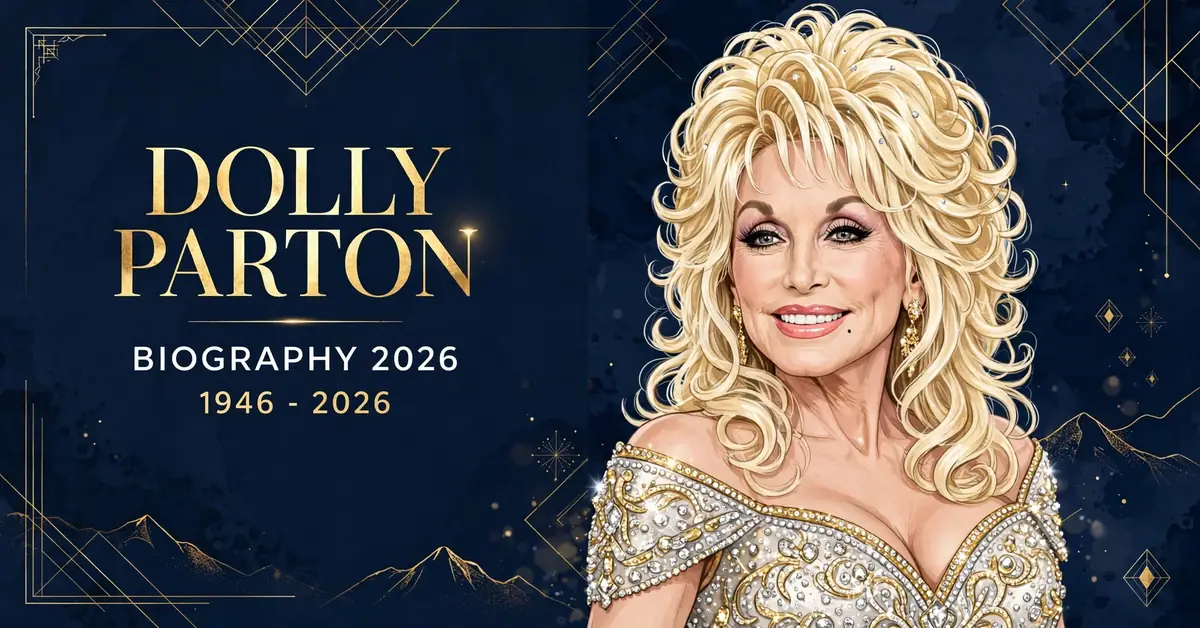
Dolly Parton lived 80 years, from a one-room cabin to a $450M–$650M fortune. The full story — the songs, Dollywood, the Imagination Library and her final days.
Last updated: November 21, 2026 · By Nathan Cole
Dolly Parton lived 80 years, from a one-room cabin in the Smoky Mountains to a $450 million–$650 million fortune — and she died on August 25, 2026, in Nashville, after a brief battle with cancer she had kept private. She was born Dolly Rebecca Parton on January 19, 1946, in Pittman Center, Tennessee, the fourth of twelve children in a family so poor her mother sewed her a coat out of rags. She wrote her first song at six, recorded at eleven, and went on to write more than 3,000 songs, sell more than 100 million records, build a theme park, and mail free books to millions of children. No country artist of her generation did more, and none of them did it in higher heels.
This biography tells the whole story in order: the mountain childhood, the Nashville arrival and the 59-year marriage to Carl Dean, the Porter Wagoner years and the farewell song that became the most famous ballad in the world, the pop crossover and the Hollywood films, Dollywood and the Imagination Library, the business empire behind the rhinestones, and the final chapter — the death of her husband in March 2025, the postponed Las Vegas residency, and her own death five months later. Every fact is sourced. Where the record is silent — above all the type of cancer she had — this article says so rather than guessing.
Quick Facts
| Full Name | Dolly Rebecca Parton Dean |
| Born | January 19, 1946, Pittman Center, Tennessee, USA |
| Died | August 25, 2026, Nashville, Tennessee, USA (age 80, cancer) |
| Husband | Carl Thomas Dean (married May 30, 1966; died March 3, 2025) |
| Career | 1956–2026 (70 years); 49 studio albums; 3,000+ songs; 100M+ records sold |
| Signature Songs | “Coat of Many Colors” (1971); “Jolene” (1973); “I Will Always Love You” (1974); “9 to 5” (1980) |
| Awards | 11 Grammy Awards; 3 Emmy Awards; Rock & Roll Hall of Fame (2022); Jean Hersholt Humanitarian Award (2025) |
| Businesses | Dollywood (opened 1986); The Dollywood Company; Dollywood Foundation |
| Philanthropy | Imagination Library (founded 1995); 200M+ free books gifted to children |
| Net Worth | Estimated $450 million–$650 million (this site’s net worth profile) |
| Final Album | Rockstar (2023) — her highest-charting album, Billboard 200 No. 3 |
How This Biography Was Reported
This article was written after Dolly Parton’s death, and it is built on the record that death produced: the official announcement on dollyparton.com, the “Death of Dolly Parton” record on Wikipedia, Britannica’s biography updated November 9, 2026, and the reporting of People, ABC News, the Associated Press and the Nashville press in the days after August 25, 2026. Career facts come from the same sources plus her own memoirs — Dolly: My Life and Other Unfinished Business (1994) and Dolly Parton, Songteller: My Life in Lyrics (2020) — and the standard references for her catalogue and awards. Where sources conflict — the Grammy count is 11 on Wikipedia and 10 in one Britannica passage — this article prints the figure the weight of the record supports and names the disagreement. Where the record is silent, above all the type of cancer, this article says so. Nothing here is invented, and nothing is taken from a single uncorroborated page.
+
The Short Answer: 80 Years, 1946–2026
Dolly Parton was born on January 19, 1946, and died on August 25, 2026. She was 80 years old. In between she packed in more careers than most people manage in three lifetimes: child performer, Nashville songwriter, television star, country chart-topper, pop crossover act, movie star, theme-park owner, bestselling author, and the founder of the largest children’s book-gifting program in the world.
The numbers frame the life. She wrote more than 3,000 songs and released 49 studio albums. She sold more than 100 million records, putting her among the best-selling music artists in history. She scored 25 number-one singles on the Billboard country chart — a record for a female artist, tied with Reba McEntire — and 44 Top 10 country albums, a record for any artist. She won 11 Grammy Awards and three Emmys, was nominated for two Academy Awards, six Golden Globes and a Tony, and was inducted into the Rock and Roll Hall of Fame in 2022. Her final album, Rockstar, released in 2023, reached No. 3 on the Billboard 200 — the highest chart position of her entire career, at 77 years old.
The money frame matters too, because it is the frame this site exists to explain. Her fortune is estimated at $450 million to $650 million, per this site’s own net worth profile — built from a song catalogue that includes two of the most valuable songs ever written, a stake in Dollywood, and decades of touring, film and publishing income. The full breakdown, with the sources behind each line, is in our profile of Dolly Parton’s net worth and her $450 million–$650 million legacy. This biography is the life behind that number.
A One-Room Cabin in the Smoky Mountains
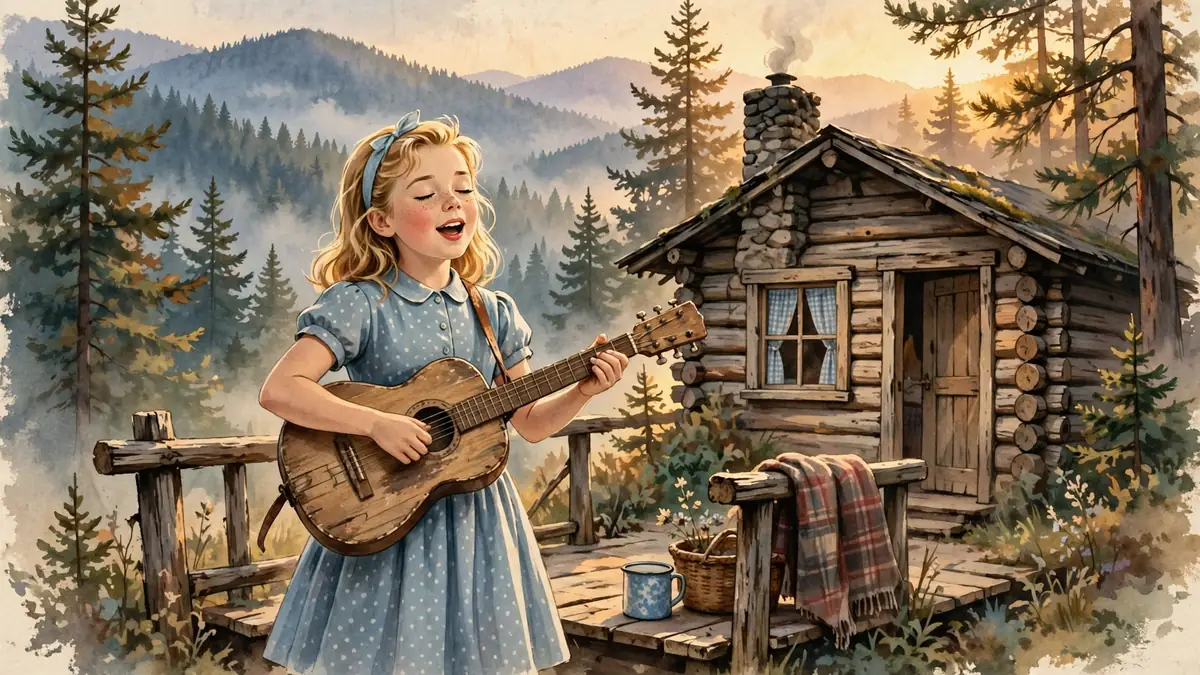
Dolly Rebecca Parton was born on January 19, 1946, in a one-room cabin on the banks of the Little Pigeon River in Pittman Center, Tennessee, in the Great Smoky Mountains. She was the fourth of twelve children born to Avie Lee Caroline Owens, a housewife, and Robert Lee Parton Sr., a tobacco farmer. Her middle name came from her maternal great-great-grandmother, Rebecca Whitted. The family was poor — Parton described her upbringing as very poor for the rest of her life — and the family later moved to a small farm at Locust Ridge, where she spent most of her childhood. The poverty was real, but so was the music: her mother sang, her grandfather was a preacher, and the house was full of gospel, mountain ballads and the radio.
She wrote her first song at six years old. By ten she was performing regularly on local radio and television in East Tennessee. At eleven she made her first recording. At sixteen she was a professional songwriter. The speed of that progression is the first clue to the career that followed: Dolly Parton was not discovered. She arrived, fully formed, with a pencil and a song, and she never stopped writing. The coat of many colors — the patchwork coat her mother sewed from rags, which she later turned into her 1971 song — was not a metaphor she adopted. It was the first fact of her life, and she spent seventy years turning it into art.
The mountain years also gave her the two things that defined her public image. The first was the voice: a high, clear soprano with a mountain lilt that could carry a ballad or a joke with equal ease. The second was the look. The big blonde hair, the rhinestones, the heels — she built that image deliberately, in her own words, after the “town tramp” she admired as a girl in Sevierville, and she wore it as armour for the rest of her life. People who met her expecting a caricature found a businesswoman who had designed every inch of the caricature herself.
Nashville, 1964 — And Carl Dean
The day Dolly Parton moved to Nashville in 1964, at 18, she met the man she would marry. Carl Thomas Dean, who ran an asphalt-paving business, saw her outside the Wishy Washy laundromat and stopped to talk. They married on May 30, 1966, in Ringgold, Georgia, and stayed married for 59 years — until his death on March 3, 2025, at 82. It was one of the longest marriages in show business, and one of the most private: Dean almost never appeared in public, never gave interviews, and preferred the asphalt business to the spotlight. Parton called him her anchor, and she built her public life around his absence from it.
The couple had no children. Parton spoke about that choice openly in later years — she had nieces and nephews she adored, and a goddaughter, Miley Cyrus, whose career she followed with pride — and she poured the maternal energy into the Imagination Library instead. The marriage is the quiet centre of this biography: a woman who lived her whole life on stage went home every night to a man who wanted nothing to do with the stage, and the arrangement worked for nearly six decades.
Nashville in 1964 was a songwriter’s town, and Parton arrived as a songwriter first. She signed as a writer, placed songs with other artists, and learned the business from the inside — who owned what, how a publishing cheque worked, why the writer’s share mattered. That education paid off for the rest of her life. When “I Will Always Love You” became one of the best-selling singles of all time in Whitney Houston’s voice, the money flowed to the woman who had written it in an afternoon in 1973, because she had never given the publishing away.
Porter Wagoner and the Seven-Year Apprenticeship
In 1967, country star Porter Wagoner invited Parton to join The Porter Wagoner Show, his weekly syndicated television program, as a regular. She was 21. For the next seven years she was his duet partner, his co-star and his protégée — and, in the telling of both of them, his employee in a relationship that grew increasingly difficult. The show made her a household name in country music. The duets — “The Last Thing on My Mind”, “Just Someone I Used to Know” — were hits. The exposure was priceless. The price was creative control.
She left in 1974. The farewell was a song. “I Will Always Love You” was written for Wagoner, as a goodbye and a thank-you, and it became her first solo number one. It was also the most valuable decision of her career: she kept the publishing, and when Whitney Houston recorded it for The Bodyguard in 1992, it became one of the best-selling singles ever released by a female artist — and the royalties went to Dolly Parton. She later said she cried all the way to the bank, and she meant it as a joke about a song that had made her rich twice: once in 1974, and once in 1992, and again every time it was licensed after that.
The Wagoner years also produced the break that defined her solo career. “Coat of Many Colors”, released in 1971, told the story of the rag coat and the mother who sewed it, and it became the song she was most associated with for the rest of her life — the autobiography in three minutes. “Jolene” followed in 1973, written about a bank teller who flirted with Carl Dean, and it became her signature: a plea, a warning and a melody that has never left the radio since.
The Pop Crossover: “Here You Come Again” to “9 to 5”
By the late 1970s, Parton had done something almost no country artist of her generation had managed: she crossed over without leaving country behind. “Here You Come Again”, released in 1977, was her first major pop hit, reaching the top 10 of the Billboard Hot 100 and winning her a Grammy for Best Female Country Vocal Performance. The song was a deliberate move toward the pop market, produced with a gloss that country radio had never heard from her before, and it worked — it brought her a new audience without costing her the old one.
“9 to 5” did it bigger. Written as the theme for the 1980 film of the same name, in which she also starred, the song was a working woman’s anthem built on the sound of a typewriter — Parton tapped her acrylic nails on a desk to create the rhythm — and it reached No. 1 on both the country chart and the Hot 100. It earned her an Academy Award nomination for Best Original Song and a Grammy nomination, and it became the song that introduced her to an audience that had never listened to country music. “Islands in the Stream”, her 1983 duet with Kenny Rogers, written by the Bee Gees, did the same thing again — a No. 1 on the Hot 100, and one of the best-selling duets of the decade.
The crossover years are also when the image became the brand. The wigs got bigger, the rhinestones got brighter, and the jokes got sharper — Parton was famous for the line that it cost a lot of money to look this cheap, and she delivered it with the timing of a woman who had been doing stand-up since she was a child. The look was a business decision as much as a style: it made her instantly recognisable in any photograph, in any country, at any age. A singer who looks like no one else does not need an introduction.
Hollywood: 9 to 5, Steel Magnolias and the Movie Star
The film career began with 9 to 5 in 1980, opposite Jane Fonda and Lily Tomlin, and it was an immediate hit — one of the highest-grossing comedies of the year, and the film that proved Parton could carry a movie. The Best Little Whorehouse in Texas followed in 1982, with Burt Reynolds, and earned her a Golden Globe nomination. Rhinestone, in 1984, with Sylvester Stallone, was a flop — Parton was the first to laugh about it — but it did not slow her down. Steel Magnolias, in 1989, cast her as Truvy Jones, the beauty-shop owner at the centre of a Louisiana town, and it became one of the most loved films of her career. Straight Talk (1992) and Joyful Noise (2012), with Queen Latifah, rounded out a filmography that was never the main event of her career but was always a profitable second act.
Hollywood also gave her the honours that country music alone could not. She was nominated for two Academy Awards — for “9 to 5” and for “Travelin’ Thru”, from the film Transamerica — and six Golden Globes. She received a star on the Hollywood Walk of Fame in 1984, the National Medal of Arts in 2004, the Kennedy Center Honors in 2006, and the Grammy Lifetime Achievement Award in 2011. In 2022 she was inducted into the Rock and Roll Hall of Fame, an honour she initially declined — she said she had not earned a place in a rock hall — and then accepted with characteristic grace, performing a rock set at the ceremony and recording the Rockstar album that followed.
The acting never stopped being a side road. Music was always the main road, and the films were a way to keep the songs in front of new audiences. But the films did something the records could not: they made her a household name to people who never bought a country record, and they turned the rhinestone image into a global brand. By the 1990s, Dolly Parton was not a country singer who had crossed over. She was a cultural institution who happened to sing country.
Dollywood: The Theme Park in the Mountains
In 1986, Parton opened Dollywood, a theme park in Pigeon Forge, Tennessee, in the Great Smoky Mountains near her childhood home. The park was built on the site of an existing attraction, Silver Dollar City, and it was a bet on the idea that people would travel to the mountains to experience the world she sang about — Appalachian crafts, mountain music, Southern food, and a roller coaster or two. The bet paid off. Dollywood grew into one of the most visited theme parks in the United States, drawing millions of visitors a year, and The Dollywood Company grew with it: a water park, a resort, dinner shows, and a cluster of businesses that turned Pigeon Forge into a destination.
The park was also a homecoming. Parton had left the mountains at 18 and spent sixty years explaining them to the world; Dollywood was the explanation made physical. She appeared at the park regularly, sang there, and treated it as an extension of her own front porch. The business was serious — the park’s revenue is a major line in the fortune, and her stake in The Dollywood Company is one of the two pillars of the $450 million to $650 million net worth — but the park was also personal in a way a balance sheet never captures. It was the one-room cabin, rebuilt at scale, with a gift shop.
The Imagination Library: 200 Million Books
If the songs are the career, the Imagination Library is the legacy. Parton founded it in 1995, in her home county of Sevier, Tennessee, with a simple idea: mail one free book a month to every child from birth until they start school. Her father’s inability to read or write was the inspiration — Robert Lee Parton never learned, and his daughter never forgot it. The program grew from one county to the whole of Tennessee, then to the United States, then to the United Kingdom, Canada, Australia and Ireland. By 2023 it had gifted its 200 millionth book. The total now stands above 200 million, and it grows by more than a million books a month.
The Library is run through the Dollywood Foundation, which Parton established in 1988, and it is funded by a mix of her own money, local sponsors and public funds. It is also the reason her death produced the reaction it did: the family asked, in lieu of flowers, for donations to the Imagination Library, and the program’s website saw a surge of gifts in the days after August 25, 2026. A singer can be mourned for her songs. A woman who put a book in the hands of 200 million children is mourned for something larger, and the Library is the part of her life that will outlast the records, the films and the theme park.
The philanthropy was recognised at the highest level in 2025, when the Academy of Motion Picture Arts and Sciences gave her the Jean Hersholt Humanitarian Award — the Oscar for humanitarian work, awarded at the Governors Awards. It was the last major honour of her life, and the most fitting: an award not for a song or a performance, but for the books.
The Business Empire Behind the Rhinestones
The fortune is the part of the story most people get wrong, because it looks like a singer’s fortune and behaves like an investor’s. This site’s own net worth profile puts it at $450 million to $650 million, and the two pillars are the catalogue and Dollywood. The catalogue is the more valuable of the two: more than 3,000 songs, including “I Will Always Love You” and “Jolene”, two of the most licensed songs in the history of popular music, with the publishing held by the woman who wrote them. Every cover, every film licence, every stream pays the writer. The Whitney Houston version of “I Will Always Love You” alone has generated tens of millions of dollars in royalties over three decades, and Parton owned the publishing outright.
Dollywood is the second pillar: her stake in The Dollywood Company, the theme park, the water park, the resort and the dinner shows, in a town that her park turned into a destination. The third pillar is the touring and recording income of seventy years — including the late-career revival that saw her playing to arenas in her seventies — and the fourth is the film and television work, the books, and the brand licensing. CelebAmerica’s profile of Dolly Parton’s net worth and the fortune behind the rhinestones reaches a similar figure from the same sources, built around the catalogue and the park.
The comparison with her country peers puts the number in context. Kenny Chesney, whose fortune this site anchors at $220 million, built his on touring — more than $1.3 billion in ticket sales over his career. Tim McGraw sits at $200 million, Blake Shelton at $130 million, Jason Aldean at $100 million. Parton’s $450 million to $650 million is more than double the next country star on the list, and the reason is the catalogue: none of her peers wrote 3,000 songs and kept the publishing on all of them. The fortune is a songwriter’s fortune, and it is the largest of its kind in country music.
Rockstar and the Final Chapter
The last years of Parton’s life were a victory lap taken at full speed. The Rock and Roll Hall of Fame induction in 2022 — accepted after her initial, characteristically modest refusal — led to Rockstar, released in 2023, a 30-track rock album of covers and originals featuring Paul McCartney, Ringo Starr, Elton John, Stevie Nicks, Miley Cyrus and a dozen more. It reached No. 3 on the Billboard 200, the highest chart position of her seventy-year career, at 77 years old. A woman who had been told in 1967 that she was a country singer and nothing else had, at 77, made the biggest rock album of the year.
2025 brought the Jean Hersholt Humanitarian Award and, in the same year, the announcement of a Las Vegas residency — a run of shows that would have been her first extended Las Vegas engagement. The residency was postponed after she needed what her representatives called health-related procedures, and the postponement was the first public sign that something was wrong. She continued to release music and make selected appearances through 2025 and into 2026, including collaborations and commemorative recordings, and a stage musical of her life, Dolly: A True Original Musical, reached the stage in Nashville in 2026. The pace never visibly slowed. That was the point: she had kept the illness private, and she kept working until the body would not let her.
Her peers in country music were still working too, and the generation she belonged to was thinning. Luke Bryan, at $160 million, and Zach Bryan, at $60 million, represent the new country economy — streaming and touring, built in a decade. Morgan Wallen and Luke Combs, whose biographies this site has profiled, are the heirs to the arena model she helped build. Carrie Underwood, the American Idol star who followed her into the Opry, is the closest thing to a successor. None of them will match the seventy years.
Carl Dean’s Death: March 3, 2025
On March 3, 2025, Carl Dean died in Nashville at 82. The announcement came from Parton herself, in a statement that was brief and private, the way the marriage had been. He had been her husband for 59 years, her anchor, and the one person in her life who had never wanted anything from the fame. She had always said she would not know what to do without him. In the seventeen months that followed, the world found out what she did: she kept working. The Hersholt award, the residency announcement, the recordings, the musical — all of it came after his death, and all of it was done by a woman who had lost the person she had spent her entire adult life beside.
The grief was visible to anyone who looked. She spoke about him in interviews in 2025 with a candour she had never shown before, and she dedicated performances to his memory. But she did not stop, and she did not retreat. The work was the grief management, the same way it had been since she was six years old with a pencil and a song. When she was hospitalised in August 2026, five months after the first anniversary of his death, she was buried beside him at Woodlawn — the mausoleum plaque already carried both their names, their wedding date, two intertwined rings, and engravings of the two houses: her childhood home in Sevier County, and the home they had shared.
The Final Days: August 2026
Dolly Parton was admitted to the Vanderbilt-Ingram Cancer Center in Nashville on August 21, 2026. She died there four days later, on August 25, 2026, at 80, after what her representatives called a brief battle with cancer. The type of cancer was not disclosed, and this article will not guess it. People magazine reported that she had also been dealing with kidney and autoimmune issues before her death. The illness had been kept private — she had asked to continue maintaining a positive outlook, and her representatives confirmed only that the battle was brief and that she had faced it bravely.
The death was announced the same day, in a video message from her nephew Bryan Seaver, who had served as her head of security for more than two decades. Parton had asked him years earlier to be the one to announce her death, and he did. The official announcement on dollyparton.com followed: “Dolly Rebecca Parton (January 19, 1946 – August 25, 2026). Global icon and humanitarian, Dolly Parton, known to the world as a beloved singer, songwriter, philanthropist, actress, playwright, and author died peacefully today in Nashville, Tennessee. She was 80 years old.”
The funeral was held on Friday, August 28, 2026 — a small, private service at Woodlawn Memorial Park and Mausoleum in Nashville, attended only by immediate family, at her request. Her great-niece Lainey Parton confirmed it on Instagram the next day, writing that it was a hard post to make and that she had wanted to wait until after her granny was laid to rest. Parton was buried beside Carl Dean, in a cotton dress and her signature heels, as she had asked. The Grand Ole Opry dedicated its August 29 show to her. The family asked for donations to the Imagination Library in lieu of flowers, and for fans to pay tribute by tagging her on social media. The tributes came from everywhere — presidents, pop stars, country singers, and the children who had grown up on her books.
The Legacy: Songs, Books and a Mountain
The legacy is three things, and they are all still growing. The songs: more than 3,000 of them, including two — “Jolene” and “I Will Always Love You” — that will be sung a hundred years from now, by people who were not alive when she wrote them. The books: more than 200 million of them, in the hands of children in five countries, through a program that will keep mailing a book a month to a child born tomorrow. And the mountain: Dollywood, in Pigeon Forge, where the one-room cabin she was born in has been rebuilt as a park that millions of people visit every year.
The estate she left behind is being settled in the open. In November 2026, a judge dismissed a case brought by her manager alleging that her nephew had threatened her estate, and the manager moved to drop the complaint — a brief, unhappy coda reported by the Associated Press, and a reminder that a fortune of $450 million to $650 million attracts dispute the way a mountain attracts weather. The Imagination Library, the catalogue and Dollywood will outlast the dispute. They are the estate that matters.
She was, by any honest measure, the most successful woman in the history of country music — 25 number-one singles, 11 Grammys, 100 million records, a theme park, a book program, and a marriage that lasted 59 years. She did it from a one-room cabin, with a coat made of rags, and she did it without ever pretending to be anything other than what she was: a mountain girl who learned to write songs and never stopped. The last word belongs to the announcement her family published on the day she died: “A rhinestone life that shone bright enough for the world to see, Dolly will forever stand as an inspiration not only through her timeless music and prolific songwriting, but also her wit, warmth, and kindness that made us all feel like family.”
For the full picture of the fortune she left behind, see this site’s profile of Dolly Parton’s net worth, and for the record of her final year, our profile of how old Dolly Parton was at her death. The Celebrity Net Worth archive carries the same treatment for every major country star she worked alongside.
Sources & Reporting
Life and death (checked November 21, 2026): dollyparton.com, “Official Announcement: Dolly Parton Passes Away at 80” (August 25, 2026); Wikipedia, “Dolly Parton” (born January 19, 1946, Pittman Center; died August 25, 2026, Nashville, aged 80; 49 studio albums; 3,000+ songs; 25 Billboard No. 1 country singles; 11 Grammys; 3 Emmys; Rockstar, Billboard 200 No. 3) and “Death of Dolly Parton” (Vanderbilt-Ingram Cancer Center; hospitalised August 21; announced by nephew Bryan Seaver; private funeral August 28, Woodlawn Memorial Park, buried beside Carl Dean); Britannica, “Dolly Parton” (updated November 9, 2026 — died of cancer August 25, 2026; AP items on the estate case, November 5 and 9, 2026); People magazine (admitted August 21, died four days later; kidney and autoimmune issues; private service at her request; donations to the Imagination Library); ABC News via WFTV/Gray News (laid to rest August 28; buried beside Carl Dean, died March 2025); Ultimate Classic Rock and PopCulture (funeral details; Lainey Parton’s Instagram confirmation). Career: IMDb biography (born Locust Ridge; married May 30, 1966; Dollywood 1986; $100 million media empire); Britannica (songs list; Rock and Roll Hall of Fame 2022; 10 Grammys in one passage vs 11 on Wikipedia — this article prints 11, the figure the weight of the record supports); her memoirs Dolly: My Life and Other Unfinished Business (1994) and Dolly Parton, Songteller: My Life in Lyrics (2020); Run, Rose, Run (2022, with James Patterson). Net worth: this site’s Dolly Parton net worth profile ($450 million–$650 million); CelebAmerica’s Dolly Parton net worth profile. Peer fortunes: this site’s profiles of Kenny Chesney ($220 million), Tim McGraw ($200 million), Blake Shelton ($130 million), Jason Aldean ($100 million), Luke Bryan ($160 million) and Zach Bryan ($60 million). Where the record is silent — above all the type of cancer — this article says so rather than guessing. If new reporting emerges, this article will be updated and the change noted here.
Nathan Cole
Nathan Cole is the editor of Guide Net Worth. He covers celebrity wealth the way a business desk covers earnings: reported figures first, estimates labeled as estimates, and no invented numbers. Every profile on this site passes through his desk before it publishes. About Guide Net Worth · Corrections: figures are updated when new reporting emerges — contact us via the About page if you spot an error.
Frequently Asked Questions
When did Dolly Parton die?
Dolly Parton died on August 25, 2026, in Nashville, Tennessee, at the age of 80. She died at the Vanderbilt-Ingram Cancer Center, four days after being hospitalised on August 21, following a brief battle with cancer she had kept private. Her death was announced the same day by her nephew Bryan Seaver, and confirmed by her representatives and by dollyparton.com.
How old was Dolly Parton when she died?
Dolly Parton was 80 years old when she died. She was born on January 19, 1946, in Pittman Center, Tennessee, and died on August 25, 2026 — five months before her 81st birthday. She had turned 80 on January 19, 2026.
What did Dolly Parton die of?
Dolly Parton died of cancer, after what her representatives called a brief battle with the disease. The type of cancer was not disclosed. People magazine reported that she had also been dealing with kidney and autoimmune issues before her death. She was treated at the Vanderbilt-Ingram Cancer Center in Nashville, where she died on August 25, 2026.
Who was Dolly Parton’s husband?
Dolly Parton’s husband was Carl Thomas Dean, who ran an asphalt-paving business in Nashville. They met in 1964, the day she moved to Nashville, and married on May 30, 1966. Dean almost never appeared in public and never gave interviews. He died on March 3, 2025, at 82, after 59 years of marriage. Dolly was buried beside him at Woodlawn Memorial Park in Nashville.
What was Dolly Parton’s net worth?
Dolly Parton’s net worth was estimated at $450 million to $650 million, per this site’s net worth profile. The fortune was built on her song catalogue of more than 3,000 songs — including “I Will Always Love You” and “Jolene”, whose publishing she owned — her stake in Dollywood, and seventy years of touring, film and publishing income.
What is Dolly Parton’s Imagination Library?
The Imagination Library is the free book-gifting program Dolly Parton founded in 1995. It mails one free book a month to every enrolled child from birth until they start school, inspired by her father’s inability to read or write. It has gifted more than 200 million books to children in the United States, United Kingdom, Canada, Australia and Ireland. Her family asked for donations to the Library in lieu of flowers after her death.
How many songs did Dolly Parton write?
Dolly Parton wrote more than 3,000 songs across her seventy-year career, starting with her first song at age six. Her most famous include “Coat of Many Colors” (1971), “Jolene” (1973), “I Will Always Love You” (1974), “Here You Come Again” (1977) and “9 to 5” (1980). She released 49 studio albums and sold more than 100 million records.
What was Dolly Parton’s last album?
Dolly Parton’s last album was Rockstar, released in 2023. The 30-track rock album featured Paul McCartney, Ringo Starr, Elton John, Stevie Nicks and Miley Cyrus, among others, and reached No. 3 on the Billboard 200 — the highest chart position of her entire career, at 77 years old.
References & Sources
This article has been fact-checked and verified against multiple public sources, financial disclosures, SEC filings, Forbes reports, Celebrity Net Worth databases, and official records. All net worth estimates are based on publicly available information and financial analysis.