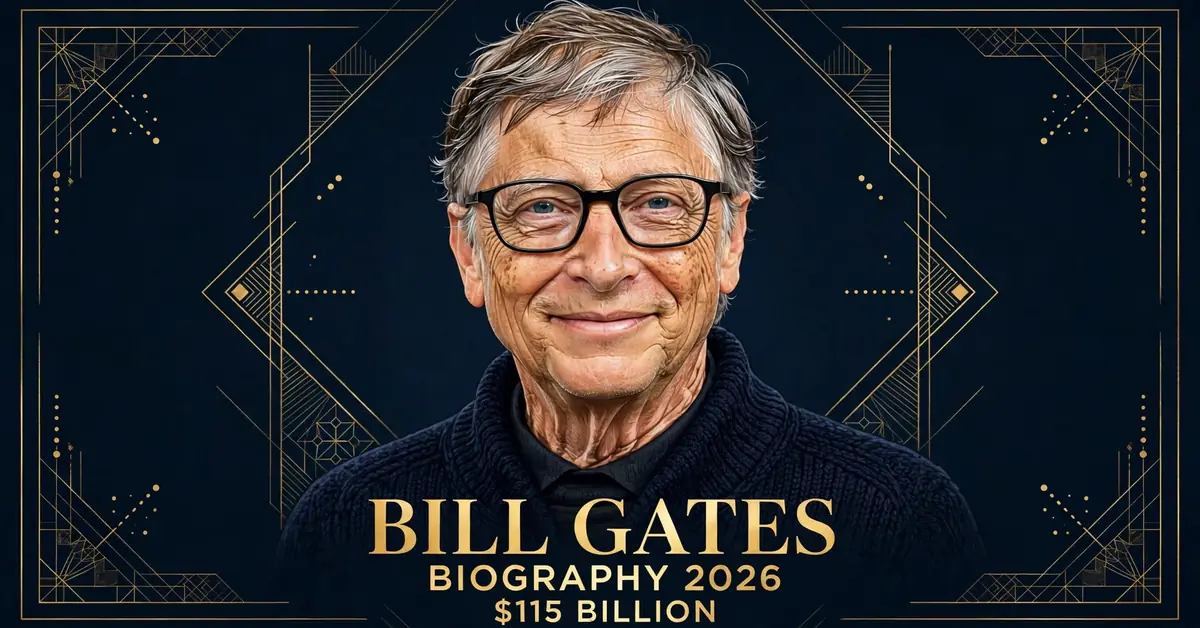
Bill Gates biography 2026: the Microsoft co-founder is 71, worth about $115 billion, and giving 99% away. His life story, from Lakeside to the Gates Foundation.
Last updated: November 14, 2026 · By Nathan Cole
Bill Gates is 71 years old in 2026, worth about $115 billion, and in the middle of giving almost all of it away. The Microsoft co-founder was born William Henry Gates III in Seattle on October 28, 1955, wrote his first computer program at 13, dropped out of Harvard at 19 to start a software company with his childhood friend Paul Allen, and spent the next quarter-century running it. He became the world’s youngest billionaire at 31, the first person ever worth $100 billion, and the richest person on earth for 18 of the 24 years between 1995 and 2017. Then he walked away from the company, built the largest private charitable foundation in history with his wife Melinda, and in May 2025 announced he would give 99% of what remains — roughly $107 billion — before the foundation closes in 2045.
This is the full life story, from the Lakeside School computer room to the Gates Foundation’s Seattle headquarters: the IBM deal that made the fortune, the Windows years, the antitrust trial, the divorce, the three children, the memoir, and the 2026 testimony and AI essay that put him back in the news. Every figure below is dated and sourced, because the numbers around Gates move with Microsoft’s share price and with how much he has given away — and the trackers do not always agree on the total.
Quick Facts
| Full Name | William Henry Gates III |
| Born | October 28, 1955, Seattle, Washington |
| Age | 71 years old in 2026 |
| Height | 5 ft 10 in (177–178 cm) |
| Net Worth | $108–121 billion estimated, anchored at $115 billion (Forbes, 2026) |
| Known For | Co-founding Microsoft (1975) with Paul Allen; chair of the Gates Foundation |
| Microsoft Role | CEO 1975–2000, chairman to 2014, board member to 2020 |
| Foundation | Gates Foundation (founded 2000); $59 billion+ given; closes December 31, 2045 |
| Ex-Wife | Melinda French Gates (married 1994, divorced 2021) |
| Children | Three — Jennifer (1996), Rory (1999), Phoebe (2002) |
| Memoir | Source Code: My Beginnings (February 2025) |
How This Estimate Was Made
Bill Gates’s net worth of $108–121 billion, anchored at $115 billion, is a range built from dated Forbes prints, not a single tracker snapshot. Forbes’ 2026 World’s Billionaires list, priced on March 1, 2026, put him 19th at $108 billion. The magazine’s real-time ranking in late August 2026 showed about $109.7 billion, still 19th. By October 10, 2026, the real-time figure was $114.7 billion and 17th in the world, and on October 15 it read $117 billion. Wikipedia’s November 2026 update, citing Forbes, lists $121.2 billion and 17th place. The range is honest because the fortune is a mark-to-market on a private family-office portfolio — mostly Cascade Investment holdings plus a Microsoft stake under 1% — and because Gates keeps giving shares away, which moves the total between prints. Bloomberg’s July 2025 index briefly carried him at $175 billion, then cut the figure to $124 billion within days after recalculating past donations; that swing shows why this profile anchors on Forbes’ dated prints and treats any single-day tracker as a snapshot, not a balance sheet. Figures already donated to the Gates Foundation are excluded — they are charitable capital, not his money.
+
Who Is Bill Gates in 2026?
Bill Gates is the co-founder of Microsoft and the chair of the Gates Foundation, and at 71 he is in the strangest phase of a very public life: richer than almost anyone who has ever lived, and actively trying to end up with almost none of it. He has not run Microsoft in a generation. He left the board in March 2020, stepped down as chairman in February 2014, and handed the chief executive job to Steve Ballmer in January 2000. What he does now is run a foundation that plans to spend itself out of existence.
The numbers frame the man. Forbes’ 2026 annual list put his fortune at $108 billion in March, 19th in the world. By November 2026 the real-time tracker had him at $121.2 billion and 17th. The anchor this profile uses is $115 billion, the middle of the dated 2026 prints. He was once the richest person alive for 18 of 24 years. In 2026 he sits behind Elon Musk, who led the March 2026 Forbes list at $839 billion, and behind Larry Ellison at $152 billion — and the gap is not because Microsoft faltered. It is because Gates gave the money away. More than $59 billion has gone to the foundation, and in May 2025 he promised 99% of what is left.
He is also, in 2026, a memoirist, a grandfather of two, a divorced man rebuilding a public image, and a witness before Congress. His first memoir, Source Code: My Beginnings, arrived in February 2025. In June 2026 he testified voluntarily before the U.S. House Committee on Oversight and Government Reform about his association with Jeffrey Epstein. In August 2026 he published a nearly 6,000-word essay on his personal website about the risks and benefits of artificial intelligence. The biography below follows the money and the man in order, because with Gates the two have always been the same story.
Bill Gates Net Worth 2026: 108–121 Billion, Anchored at 115 Billion
The short answer is $115 billion, and the long answer is that the date matters as much as the number. Forbes does not publish one Gates fortune. It publishes a chain of them, and the chain moves with Microsoft’s share price and with Gates’s giving. Here is the 2026 chain, print by print.
| Date | Estimate | Rank | Source |
|---|---|---|---|
| March 1, 2026 | $108 billion | 19th | Forbes World’s Billionaires (annual list) |
| Late August 2026 | ~$109.7 billion | 19th | Forbes real-time ranking |
| October 10, 2026 | $114.7 billion | 17th | Forbes real-time (via FourWeekMBA) |
| October 15, 2026 | $117 billion | — | Forbes Real-Time Billionaires (via BillionaireList) |
| November 2026 | $121.2 billion | 17th | Forbes (via Wikipedia) |
Two things stand out in that table. First, the fortune rose about $13 billion between March and November 2026 without Gates doing anything — the market did it. Second, the ranking barely moved. He climbed from 19th to 17th while the total rose, because the people above him were rising too. The March 2026 list counted a record 3,428 billionaires worth a combined $20.1 trillion, and the top of it is crowded with founders who kept their shares. Gates is the exception in that crowd: the founder who sold and gave his shares away.
The Bloomberg figure is the cautionary tale. In July 2025 the Bloomberg Billionaires Index carried Gates at $175 billion, then cut the figure to $124 billion within days after recalculating past donations, as the New York Post reported. A $51 billion correction in a week is not a market move. It is a methodology change — Bloomberg had been counting money Gates had already given away. Forbes never had him above about $108 billion in the same period, because Forbes excludes donated assets from the personal total. This profile follows Forbes for the same reason: once money is gifted to the foundation, it is charitable capital under board governance, not spending money.
For scale, the March 2026 Forbes snapshot had Steve Ballmer — the man who succeeded Gates as Microsoft CEO — at $126 billion and 15th, ahead of his old boss. Ballmer kept more of his Microsoft stock. Gates gave his away. That single difference, repeated over 25 years, is worth tens of billions, and it is the whole story of the second half of this biography.
Early Life: Seattle, Lakeside and the First Program
William Henry Gates III was born on October 28, 1955, in Seattle, Washington, the only son of Bill Gates Sr., a prominent attorney, and Mary Maxwell Gates, a University of Washington regent who served on the boards of First Interstate BancSystem and the United Way of America. He grew up with an older sister, Kristi, and a younger sister, Libby, in a comfortable, civic-minded household where achievement was expected and argued about at the dinner table. His father died in 2020 at 94. His mother died in 1994, the same year Gates married — a loss that shaped the foundation he would build in her name.
The turning point came at Lakeside School, the private Seattle prep school where Gates was enrolled as a boy. Lakeside had something almost no school in America had in 1968: a computer terminal, connected by phone line to a mainframe. Gates wrote his first software program at 13. He and a small group of Lakeside students — including Paul Allen, two years older — spent their free hours on that terminal, learning to code by doing it, breaking the system, and then being hired to fix it.
The group formalized itself as the Lakeside Programmers Group, and their first business was Traf-O-Data, a company that sold traffic-counting systems to local governments. It was a small venture, built by teenagers, and it taught Gates the two lessons that would define his career: software could be sold as a product, and a clever program could turn raw data into money. He was still in high school. The money was modest. The pattern was not.

Harvard, Math 55 and the Dropout
Gates entered Harvard University in 1973 as a prelaw major, but the law was never the point. He took Math 55, the university’s famously demanding freshman mathematics course, and graduate-level computer science classes, and he spent his time in the computer center rather than the lecture hall. Allen had gone to Washington State University, and the two stayed in close contact, talking about the machines that were about to change everything.
The moment came in January 1975. The Altair 8800, the first commercially successful microcomputer, appeared on the cover of Popular Electronics. Gates and Allen saw the machine and understood, before almost anyone else, what it needed: software. They called MITS, the company that made the Altair, and claimed they had a version of the BASIC programming language ready for it. They did not. They wrote it in eight weeks, working around the clock, and Allen flew to Albuquerque to demonstrate it. It worked on the first try.
Gates left Harvard that spring, in his sophomore year, without a degree. Harvard awarded him an honorary doctorate in 2007, thirty-two years later, and he gave the commencement address — the dropout returning as the university’s most famous unfinished student. The decision looks inevitable in hindsight. At the time it was a gamble on a machine most people had never heard of, made by a 19-year-old who had never held a job.
Founding Microsoft: April 4, 1975
Microsoft was founded on April 4, 1975, in Albuquerque, New Mexico, where MITS was based. The name was Micro-Soft at first — microcomputer software — and the company was two people, Gates and Allen, writing code for a machine with 256 bytes of memory. Gates was 19. Allen was 22. The first product was Altair BASIC, the language they had promised MITS, and it sold because every Altair owner needed it.
The company moved to Bellevue, Washington, in 1979, bringing it home to the Pacific Northwest, and then to Redmond, where its campus still stands. Gates served as chief executive for the next 25 years, and as president and chairman of the board when the company was incorporated in 1981. Allen left the company in 1983 because of health concerns — he had been diagnosed with Hodgkin lymphoma — and Gates was left in charge of Microsoft alone. The partnership that built the company lasted eight years. The company Gates built from it lasted fifty.
The early Microsoft was not a gentle place. Gates was famous for driving his programmers hard, for all-night coding sessions, for memorizing license plate numbers in the parking lot to see who was working late. The culture he built was intense and competitive, and it produced software at a speed the industry had never seen. It also produced the first enemies, and the first lawsuits, of a career that would collect both.
The IBM Deal That Made the Fortune
In 1980, IBM — then the biggest computer supplier in the world — came to Microsoft with a problem. It was building its first personal computer and needed an operating system. Gates did not have one. He sent IBM to a small Seattle company, Seattle Computer Products, whose programmer Tim Paterson had written an operating system called 86-DOS. Microsoft then bought 86-DOS for a reported $50,000, hired Paterson, and licensed the system to IBM as MS-DOS.
The deal had one clause that mattered more than the price. Microsoft kept the right to license MS-DOS to other computer makers. When the IBM PC launched in 1981 and rivals began building IBM-compatible machines, every one of them needed an operating system, and Microsoft was the only supplier. The $50,000 purchase became the foundation of the fortune. It is still the most famous bargain in business history: an operating system bought for the price of a car, licensed to the world.
The lesson Gates took from it shaped Microsoft’s strategy for the next two decades. Owning the platform — the software every machine runs — was worth more than owning any single machine. Windows was the next step, and it made the IBM deal look small.
Windows and the Richest Man in the World
Windows 1.0 arrived in November 1985, a graphical layer on top of MS-DOS that most reviewers dismissed. Windows 3.0 followed in May 1990 and sold millions of copies. Windows 95 launched on August 24, 1995, with a marketing campaign that included a midnight launch, a Rolling Stones soundtrack, and lines around the block. By then Microsoft’s software ran on nearly every personal computer sold, and Gates’s share of the company was worth a fortune no individual had ever held.
The milestones stacked up fast. Microsoft went public on March 13, 1986, and Gates became a paper billionaire that year. In 1987, at 31, he became the world’s then-youngest billionaire. In 1999 he became the first centibillionaire, when his net worth briefly passed $100 billion. Between 1995 and 2017 he was the world’s wealthiest person for 18 of 24 years — a run no one else has matched, and one that ended only when he gave too much of the fortune away to stay on top.
The success brought the government. In 1998 the U.S. Department of Justice sued Microsoft, arguing that it had used Windows to crush competition in web browsers. The trial ran for years, a federal judge at one point ordered the company split in two, and the case was settled in 2001 with restrictions on Microsoft’s business practices. Gates has said little about the trial in public since. It cost Microsoft momentum, and it cost Gates his appetite for running a company under a microscope. Within two years of the settlement, he had begun the handover that would take him out of the chief executive’s chair.
Stepping Back: Ballmer, Nadella and the Board
Gates stepped down as Microsoft’s chief executive in January 2000, handing the job to Steve Ballmer, his Harvard classmate and the company’s longtime number two. Gates stayed on as chief software architect, a role he held until June 2006, when Microsoft announced he would leave day-to-day work in 2008 to focus on the foundation full time. He remained chairman until February 2014, when Satya Nadella became chief executive and Gates became a technology advisor. In March 2020 he left the board entirely, ending a 45-year formal association with the company he founded.
The handover worked. Ballmer ran Microsoft through the 2000s, Nadella rebuilt it around cloud computing in the 2010s, and the company’s value rose long after its founder left — which is part of why Gates’s fortune kept growing even as he sold shares. The shares he kept are worth more now than the shares he sold, because Microsoft kept compounding. The irony of the Gates fortune is that he got richer by leaving: the company did better without him in the chair, and the stock he still held did better with him out of the way.
His public role changed with the job. The programmer who once memorized license plates became a reader, a traveler, a blogger at gatesnotes.com, and the public face of the foundation. He has written books on climate change and pandemics, and he appears each year to publish his reading lists and his annual letter. The transition from chief executive to philanthropist took fifteen years, from 2000 to 2015, and it was the slowest decision of his career — and the one that defines him now.
Cascade Investment: Where the Money Sits Now
Most people assume Bill Gates’s fortune is Microsoft stock. It is not, not anymore. The money sits in Cascade Investment, the private family office he established to manage his assets, run since 1994 by Michael Larson. Forbes estimates Gates’s remaining personal Microsoft stake at under 1% of the company, after he donated shares worth billions to the trust behind the foundation in 2022. The Microsoft money is still there, in the sense that Cascade’s capital came from decades of Microsoft share sales. But the portfolio itself is something else: a diversified book of public companies, real estate, and farmland.
Forbes’ September 8, 2023 asset breakdown, the last detailed public split, marked him at about $111 billion: Microsoft at an estimated $33.8 billion, cash and other investments at $26.9 billion, Republic Services at $16.1 billion, Deere at $7.9 billion, Four Seasons Hotels at $6.6 billion, Ecolab at $5.7 billion, plus smaller lines in Givaudan, Berkshire Hathaway, AutoNation, Signature Aviation, farmland, Femsa, Canadian National Railway, Sika and Heineken. The shape is a value investor’s portfolio, not a founder’s: waste management, tractors, hotels, water treatment, railroads. It is the portfolio of a man who hired a professional to manage his money and then left him alone for thirty years.
The farmland is the line that gets the most attention. Forbes’ 2023 breakdown marked landholdings at an estimated $1.2 billion, a small slice of the total, but enough to make Gates the largest private farmland owner in the United States — a fact that has generated more conspiracy theories than any other line on his balance sheet. The reality is duller: Cascade buys farmland the way it buys railroads, as a long-term asset that holds value. The theories are not part of this profile, because no reporting supports them.
One warning belongs here. Cascade files almost nothing in public, which is why Forbes and Bloomberg can show materially different numbers for Gates on the same day. Forbes tracks the assets it can see and prices them on the day. Bloomberg, in July 2025, briefly had him at $175 billion before cutting the figure to $124 billion within days, after recalculating past donations. Neither tracker has the full picture. The $115 billion anchor in this profile is the middle of Forbes’ dated 2026 prints, and it is labeled an estimate because that is what it is.
The Gates Foundation: 59 Billion Given and Counting
The foundation began in 1994 as the William H. Gates Foundation, named for Gates’s father, and became the Bill & Melinda Gates Foundation in 2000. In January 2025 it was renamed the Gates Foundation. It is the world’s largest private charitable organization, and its work is global health and development: vaccines, malaria, polio, sanitation, agricultural development, education in the United States. The first big gift came in November 1999, before the foundation in its current form existed: a five-year, $750 million commitment to vaccine access through the GAVI Alliance.
The scale of the giving is hard to hold in mind. More than $59 billion has gone to the foundation, according to CEO.wiki’s May 2025 reporting. About 41% of the foundation’s funds have come from Warren Buffett, whose own biography runs on a parallel track — Buffett pledged most of his Berkshire Hathaway fortune to the foundation in 2006, and his annual gifts are the reason the foundation’s endowment is as large as it is. In 2010, Gates, Melinda and Buffett founded the Giving Pledge, committing the signatories to donate at least half their wealth to charity.

Then, in May 2025, Gates made the announcement that redefined the foundation’s future. He would donate 99% of his remaining fortune — then valued at about $107 billion — and the foundation would spend itself out of existence, closing on December 31, 2045. On January 14, 2026, the board endorsed the plan in operational terms: an approximately $9 billion annual payout and an additional approximately $200 billion of investment before the planned close. The foundation that was built to last forever will instead last twenty years, and then stop.
The decision has a logic that fits Gates. A foundation that spends down forces choices: which diseases to fight, which programs to fund, which bets to make, and in what order. A foundation that lasts forever can postpone all of them. Gates has always preferred a deadline. He gave his foundation one.
The Divorce: Melinda, 25 Billion and the Split
Gates met Melinda French in 1987, at a Microsoft event. She was 23, a product manager at the company; he was 32, its chief executive. They married on January 1, 1994, in Hawaii, and built the foundation together. On May 3, 2021, after 27 years of marriage, they announced the divorce in a joint statement: “Over the last 27 years, we have raised three incredible children and built a foundation that works all over the world to enable all people to lead healthy, productive lives.” The divorce was finalized on August 2, 2021.
The financial terms were never disclosed in full, but Forbes increased its estimate of the settlement tied to the divorce to roughly $25 billion — the largest divorce settlement on record at the time, and the reason Gates’s fortune fell in the Forbes rankings after 2021. Melinda left the foundation in 2024, after the divorce settlement gave her an independent philanthropic fund, and published her memoir, The Next Day, in April 2025. In it she wrote about the marriage, the divorce, and the middle name of their son Rory — John, after her friend and Microsoft colleague John Neilson.
The divorce also brought new scrutiny of Gates’s personal life, including his association with Jeffrey Epstein, the financier and convicted sex offender. Gates has said the meetings were a mistake and that he regrets them. In June 2026 he testified voluntarily before the U.S. House Committee on Oversight and Government Reform about the association. The testimony is part of the public record, and this profile records it without elaboration, because the record is the fact and the rest is speculation.
The Children: Jennifer, Rory and Phoebe
Bill and Melinda Gates raised three children, and the three have taken three different paths. Jennifer Katharine Gates, born April 26, 1996, is a pediatric resident physician with an MD and an MPH, and a competitive equestrian. She married fellow equestrian Nayel Nassar in October 2021, and the couple have two daughters: Leila, born in March 2023, and Mia, born in October 2024. Gates is a grandfather of two.
Rory John Gates, born May 23, 1999, is the only son, and the most private of the three. He graduated from the University of Chicago, holds a PhD in philosophy, and works as an analyst at the Afghanistan War Commission. He keeps a low public profile, and there is little reporting on his life beyond his education and his job — which is, by all accounts, the way he wants it.
Phoebe Adele Gates, born September 14, 2002, is the youngest, and the most public. She graduated from Stanford University with a degree in human biology, co-founded Phia, a fashion-technology platform, and co-hosts a podcast. In a November 18, 2025, interview with Vogue she spoke about building a career under a famous name, and about the pressure that comes with it.
One detail applies to all three. Each child will reportedly receive only $10 million from their parents — a figure Gates has discussed publicly for years, as part of his belief that children should make their own way. Against a fortune of $115 billion, $10 million each is a rounding error, and that is the point. The money goes to the foundation. The children get an education, a start, and the expectation that they will earn the rest.
Source Code: The 2025 Memoir
In February 2025, Gates released Source Code: My Beginnings, the first of a projected three-part autobiographical series. The book covers his childhood, his high-school years, and his college years — the period before Microsoft, when he was a bright, restless, sometimes difficult kid in Seattle who found computers before computers found the world. It is the most personal thing he has published, and it is frank about the traits that made him hard to live with as a young man: the competitiveness, the impatience, the certainty that he was right.
The memoir matters to the biography because it is the only extended account of those years in Gates’s own voice. The biographies by others — Michael Becraft’s Bill Gates: A Biography (2014) among them — rely on interviews and documents. Source Code relies on memory, and it fills gaps the documents leave: what Lakeside felt like, what his mother was like, how a 13-year-old’s obsession became a 19-year-old’s company. Two more volumes are projected, covering the Microsoft years and the foundation years. No publication dates have been announced for them.
The book also did something the foundation’s annual letters never did: it made Gates a person rather than a portfolio. Readers learned about the boy who read encyclopedias for fun, who argued with his parents, who was sent to a therapist as a teenager because his family worried about him. The reviews noted the same thing: the richest man in the world, writing about a childhood that was, by his own account, ordinary in every way except the computer.
2026: Testimony, AI and the Second Act
The year 2026 has been a busy one for a man who is supposed to be winding down. In June, Gates testified voluntarily before the House Oversight Committee about his association with Jeffrey Epstein, answering questions under oath about meetings that took place years before Epstein’s death. In August, he published a nearly 6,000-word essay on gatesnotes about the risks and potential benefits of artificial intelligence — his longest public statement on the subject, and one of the most widely read things he has written since the memoir.
At the foundation, his current role is chair and board member, a position confirmed in November 2026. The work now is the spend-down: $9 billion a year, $200 billion more before the 2045 close, and the decisions about where it goes. The foundation’s January 2026 release framed the plan as an acceleration, not a retreat — more money, faster, while Gates is alive to direct it. He is 71, and the plan assumes he will be directing it for years to come.
The second act has no single headline, and that is the point. Gates’s first act was a company. His second act is a deadline: give the money away, close the foundation, and be done. The biography is not finished, because the man is still writing it. But the shape of it is now clear, and it is the shape this profile has followed from the first paragraph: a fortune built in twenty-five years, given away in twenty.
Bill Gates in Numbers
| Measure | Figure |
|---|---|
| Net worth (2026) | $108–121 billion, anchored at $115 billion (Forbes) |
| Age in 2026 | 71 (born October 28, 1955) |
| Height | 5 ft 10 in (177–178 cm) |
| Years as Microsoft CEO | 25 (1975–2000) |
| Years as richest person | 18 of 24 (1995–2017) |
| First centibillionaire | 1999 ($100 billion) |
| Given to the foundation | $59 billion+ |
| Pledged to give | 99% of remaining fortune (~$107 billion, May 2025) |
| Foundation closes | December 31, 2045 |
| Marriage | Melinda French Gates, 1994–2021 (27 years) |
| Children | Three (Jennifer 1996, Rory 1999, Phoebe 2002); two grandchildren |
Against the peer group, Gates’s position in 2026 is the strangest of all. Elon Musk led the March 2026 Forbes list at $839 billion. Larry Ellison sat at $152 billion, Warren Buffett at $145 billion, and Steve Ballmer at $126 billion — all ahead of Gates’s $108 billion on the same list. Jeff Bezos, who took the richest-person title from Gates in 2017, has held it or shared it since. Mark Cuban, at $6.8 billion, sits far below them all — and, like Gates, is a founder who sold the company and kept the proceeds in investments rather than in the stock. The difference between Gates and every name above him is not talent or timing. It is the $59 billion he has already given away, and the $107 billion more he has promised. Read the full ranking in the Celebrity Net Worth archive.
Sources & Reporting
Net worth figures: Forbes World’s Billionaires 2026 ($108 billion, March 1, 2026, 19th); Forbes real-time ranking (late August 2026, ~$109.7 billion; October 10, 2026, $114.7 billion, 17th, via FourWeekMBA; October 15, 2026, $117 billion, via BillionaireList); Forbes via Wikipedia (November 2026, $121.2 billion, 17th). Bloomberg July 2025 $175 billion then $124 billion recalculation reported by the New York Post via CompaniesHistory. Forbes September 8, 2023 asset breakdown ($111 billion: Microsoft $33.8 billion, cash/other $26.9 billion, Republic Services $16.1 billion, Deere $7.9 billion, Four Seasons $6.6 billion, Ecolab $5.7 billion) via USAcelebs. Biography: Wikipedia (born October 28, 1955; CEO 25 years; youngest billionaire 1987; first centibillionaire 1999; richest 18 of 24 years 1995–2017); Britannica (updated October 8, 2026; memoir February 2025; Epstein testimony June 2026; AI essay August 2026); CEO.wiki (net worth $115 billion December 2025; $59 billion+ donated; Giving Pledge 2010); EBSCO Research Starters (foundation history, endowment, 2014 chairman step-down). Foundation: Gates Foundation January 14, 2026 release ($9 billion annual payout, ~$200 billion additional investment, close end of 2045); May 2025 give-99% announcement (~$107 billion); Britannica Kids (41% of foundation funds from Buffett; GAVI $750 million, November 1999). Family: Parade (children’s birth years; Jennifer married Nayel Nassar October 2021; Leila March 2023, Mia October 2024; $10 million inheritance each); The List (Jennifer MD/MPH, Rory PhD philosophy and Afghanistan War Commission, Phoebe Phia co-founder, Vogue interview November 18, 2025); Page Six (marriage 1994–2021). Divorce: joint statement May 3, 2021; finalized August 2, 2021; ~$25 billion settlement per Forbes via BrandsOwnedBy. Peer figures: Forbes March 2026 annual list via USAcelebs (Musk $839 billion; Ballmer $126 billion, 15th); Guide Net Worth’s own verified profiles (Ellison $152 billion; Buffett $145 billion; Cuban $6.8 billion). Height: Guide Net Worth’s Bill Gates height profile (5 ft 10 in, 177–178 cm). Reporting window: November 2026. Figures are updated when new reporting emerges — contact us via the About page if you spot an error.
Frequently Asked Questions
How old is Bill Gates in 2026?
Bill Gates is 71 years old in 2026. He was born William Henry Gates III on October 28, 1955, in Seattle, Washington. He co-founded Microsoft at 19, became the world’s youngest billionaire at 31 in 1987, and became the first centibillionaire in 1999, when his net worth passed $100 billion.
What is Bill Gates’s net worth in 2026?
Bill Gates’s net worth in 2026 is estimated at $108–121 billion, anchored at $115 billion. Forbes’ annual list, priced March 1, 2026, put him at $108 billion and 19th in the world; the real-time tracker rose to $114.7 billion by October 10 and $121.2 billion by November 2026. The range exists because the fortune is a mark-to-market on a private family-office portfolio, and because Gates keeps giving shares away.
How did Bill Gates make his money?
Bill Gates made his money by co-founding Microsoft with Paul Allen in 1975 and running it for 25 years. The fortune came from the 1980 IBM deal — Microsoft bought the 86-DOS operating system for a reported $50,000 and licensed it as MS-DOS — and then from Windows, which ran on nearly every personal computer sold. Today the money sits in Cascade Investment, his family office, with his remaining Microsoft stake under 1%.
How much has Bill Gates given away?
Bill Gates has given more than $59 billion to the Gates Foundation, and in May 2025 he announced he would donate 99% of his remaining fortune — then about $107 billion — before the foundation closes on December 31, 2045. He co-founded the Giving Pledge with Warren Buffett and Melinda French Gates in 2010. Money already donated is charitable capital, not his personal wealth, which is why Forbes’ figure for him is lower than Bloomberg’s was in July 2025.
Who is Bill Gates’s wife?
Bill Gates’s ex-wife is Melinda French Gates. They met at a Microsoft event in 1987, married in Hawaii on January 1, 1994, and announced their divorce on May 3, 2021, after 27 years of marriage; it was finalized on August 2, 2021. The settlement was estimated at roughly $25 billion by Forbes. Melinda left the foundation in 2024 and published her memoir, The Next Day, in April 2025.
Who are Bill Gates’s children?
Bill Gates has three children with Melinda French Gates: Jennifer Katharine Gates (born April 26, 1996), a pediatrician married to equestrian Nayel Nassar, with two daughters, Leila and Mia; Rory John Gates (born May 23, 1999), who holds a PhD in philosophy and works as an analyst at the Afghanistan War Commission; and Phoebe Adele Gates (born September 14, 2002), a Stanford graduate who co-founded the fashion-tech platform Phia. Each child will reportedly inherit only $10 million.
How tall is Bill Gates?
Bill Gates is 5 ft 10 in tall (177–178 cm). His full height profile, with the sourcing and the comparisons to other tech founders, is on Guide Net Worth’s Bill Gates height page.
What is Bill Gates’s book Source Code about?
Source Code: My Beginnings, published in February 2025, is Bill Gates’s memoir of his childhood, high-school and college years — the period before Microsoft, from his birth in Seattle through Lakeside School and Harvard. It is the first of a projected three-part autobiographical series; the later volumes, covering the Microsoft and foundation years, have no announced publication dates.
WRITTEN BY
Nathan Cole
Nathan Cole is the editor of Guide Net Worth. He covers celebrity wealth the way a business desk covers earnings: reported figures first, estimates labeled as estimates, and no invented numbers. Every profile on this site passes through his desk before it publishes. About Guide Net Worth · Corrections: figures are updated when new reporting emerges — contact us via the About page if you spot an error.
References & Sources
This article has been fact-checked and verified against multiple public sources, financial disclosures, SEC filings, Forbes reports, Celebrity Net Worth databases, and official records. All net worth estimates are based on publicly available information and financial analysis.