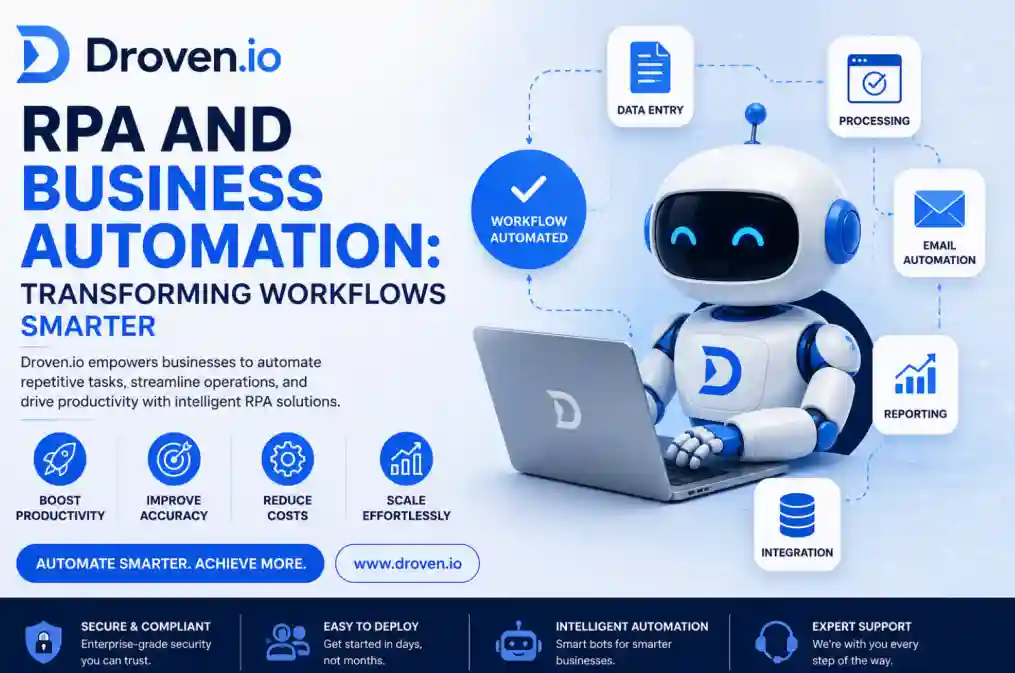
Droven.io RPA and Business Automation is positioned as a modern, no-code automation platform that lets businesses replace repetitive digital work — data entry, invoicing, onboarding, reporting — with software bots. The promise is simple: automate the robot-level tasks so your team can focus on judgment, creativity, and customers. This guide explains how it works, who it serves, how it compares to older RPA tools, and how to start the smart way.
Most companies lose a startling amount of time to work that no human should be doing by hand. Copying numbers between systems, re-typing invoice details, chasing approval emails, exporting the same report every Monday — none of it requires intelligence, yet all of it consumes hours that could go toward strategy or service. Robotic Process Automation (RPA) exists precisely to reclaim those hours, and platforms like Droven.io aim to make that power available to ordinary business teams rather than only to engineers.
The distinction matters because automation has historically been hard. Traditional RPA suites often demanded developers, long deployment cycles, and steep licensing costs. The newer generation — where Droven.io positions itself — leans on visual, drag-and-drop builders and built-in AI so that the people who actually understand a process can automate it themselves. That shift, from “automation as an IT project” to “automation as a business skill,” is the real story of 2026.
What follows is a practical walkthrough: what RPA is, what Droven.io offers, how the platform works step by step, the industries and real tasks it handles, an honest comparison with legacy tools, and the mistakes to avoid. Where specific platform claims should be confirmed on the vendor’s own materials, this guide says so plainly rather than overstating.
+
What Is RPA And Why Does It Matter in 2026?
RPA stands for Robotic Process Automation. It uses software “bots” to carry out the rule-based, repetitive digital tasks that employees normally do by hand — only faster, around the clock, and without typos. Unlike the mechanical robots on a factory line, these bots live inside your software, clicking through the same applications your staff already use.
In practical terms, an RPA bot can:
- Log into web and desktop applications
- Read, copy, and enter data across systems
- Move and rename files between folders
- Fill out forms and update records automatically
- Send emails, alerts, and notifications
- Extract information from websites, PDFs, and documents
Why does this matter so much now? Because the cost of manual processing is no longer competitive. The global RPA market has expanded rapidly as organisations recognise a straightforward equation: automation lowers operating costs, reduces human error, and redirects skilled people toward work that actually needs a human brain. By 2026, automation has moved from a “nice efficiency project” to a baseline expectation — and the businesses still running everything by hand are quietly losing ground to those that don’t.
What Is Droven.io?
Droven.io is described as a cloud-based automation platform built to make RPA and business automation approachable for companies of every size — including those without a dedicated IT team. Its emphasis, according to how it is presented, is on simplicity, speed of setup, and flexibility rather than heavy technical configuration.
The features most associated with the platform include:
- No-code / low-code design — build automated workflows without programming
- Drag-and-drop visual builder — assemble multi-step automations visually
- Cloud-based infrastructure — access and run automations from anywhere
- Pre-built connectors — integrations with common tools such as Salesforce, Microsoft 365, Google Workspace, Slack, and QuickBooks
- AI-enhanced automation — bots that can recognise patterns and handle variability
The underlying goal is to make digital transformation realistic for teams that want measurable results without a months-long implementation. As with any platform, confirm current capabilities, integrations, security posture, and pricing on Droven.io’s official resources before committing.
How Droven.io RPA and Business Automation Actually Works
Seeing the workflow end to end is what makes the value click. A typical automation lifecycle on a modern RPA platform follows five clear stages.
Step 1: Map Your Process
Start by choosing one task to automate and documenting exactly how it happens today — every click, decision, and exception. A good first candidate is something like pulling customer details from inbound emails and entering them into a CRM. Clear mapping is the foundation; a bot can only be as good as the process you describe.
Step 2: Build the Workflow
Using the visual builder, you drag, drop, and connect actions into a sequence. Each step — open app, read field, copy value, paste into target — becomes a block you arrange logically. Because there is no coding, the person who knows the process best can build it directly, rather than handing requirements to a developer and waiting.
Step 3: Test and Refine
Before going live, run the automation in test mode. The platform shows what the bot does at each step, so you can catch missteps — a wrong field, an unhandled pop-up — early and cheaply. This stage is where reliability is earned; thorough testing on sample data prevents costly errors at scale.
Step 4: Deploy and Monitor
Once live, the bot runs on its own while the platform logs every execution, flags errors, and sends alerts when attention is needed. You stay in control through a dashboard rather than doing the work yourself — visibility without manual effort. Monitoring is not optional; it is how you keep automations healthy over time.
Step 5: Scale and Improve
With one win proven, you expand. Add more automations, refine existing ones, and layer in AI features to handle more variable tasks. The strongest automation programmes grow deliberately — each new bot building on the lessons and savings of the last.
Core Features of Droven.io RPA and Business Automation
The platform’s capabilities, as described, map closely to what business teams need from modern automation:
| Feature | What it does | Why it matters |
|---|---|---|
| Visual workflow builder | Drag-and-drop automation design | No coding required |
| AI-powered bots | Bots that adapt to patterns | Handle complex, variable tasks |
| Pre-built templates | Ready-to-use automation flows | Start in minutes, not weeks |
| Multi-app integration | Connects popular business tools | Fits your existing stack |
| Real-time monitoring | Live tracking of bot activity | Instant issue detection |
| Role-based access | Controls who can build or run bots | Protects sensitive data |
| Scheduled automation | Runs bots on a set timetable | Works after hours, unattended |
| Error handling | Detects and manages failures | Reduces downtime |
| Audit logs | Full record of every run | Supports compliance |
| Cloud + on-premise | Choose where data lives | Flexible for regulated sectors |
Industries Using Droven.io RPA and Business Automation
Because the underlying tasks — data entry, reconciliation, document handling — exist everywhere, RPA crosses nearly every sector. The clearest fits:
Finance and Accounting
Finance teams automate invoice processing, account reconciliation, and report generation, and use rule-based checks to flag anomalies for human review. Month-end work that once swallowed weekends compresses into a scheduled, hands-off run.
Healthcare
Clinics and hospitals automate appointment scheduling, insurance verification, and cross-system data entry, reducing administrative load so clinical staff can spend more time on patient care. Given the sensitivity of health data, strong access controls and audit trails matter especially here.
Human Resources
HR uses automation for employee onboarding, leave requests, payroll updates, and records management — removing the manual copy-paste that slows every new hire’s first week.
E-Commerce and Retail
Online retailers automate order tracking, inventory synchronisation, customer notifications, returns, and price monitoring, keeping operations stable even during peak sales events when manual handling breaks down.
Legal Services
Firms cut time spent on document processing, contract intake, case filing, and deadline tracking — freeing fee-earners from low-value administrative work.
Manufacturing and Supply Chain
Manufacturers automate supply-chain updates, quality-control reporting, vendor communication, and production tracking, tightening efficiency across operations.
Real-World Use Cases for Droven.io RPA and Business Automation
Concrete examples make the value tangible. These are common automations businesses build with platforms in this category:
- Invoice processing: a bot downloads invoices, extracts line items, matches them to purchase orders, and files them — turning minutes of manual work per invoice into seconds.
- Employee onboarding: one approval triggers account creation across systems, welcome emails, orientation scheduling, and department notifications.
- Support ticket routing: incoming tickets are read, categorised by keyword and urgency, and assigned to the right team without manual triage.
- Data migration: records move from legacy systems to new software through automated extract, transform, and load steps.
- Compliance reporting: regulatory reports are pulled from multiple sources, formatted, and delivered on schedule, lowering compliance risk.
- CRM updates: after a sales call, notes and outcomes are logged, follow-ups scheduled, and deal stages updated automatically.
Droven.io vs. Traditional Automation Tools
Many teams tried older RPA suites and found them heavy. Here is how a modern, business-user-focused platform like Droven.io is positioned against legacy tools:
| Factor | Traditional RPA tools | Droven.io |
|---|---|---|
| Setup time | Weeks to months | Hours to days |
| Coding required | Usually yes | No (visual builder) |
| Cost model | High licensing fees | Flexible, scalable pricing |
| Scalability | Often limited | Designed to grow |
| AI integration | Frequently an add-on | Built in |
| Primary user | Developers | Business users |
| Deployment | Rarely cloud-native | Cloud-native |
The defining difference is accessibility: putting automation in the hands of the teams who own the processes, not only the IT department. (Pricing and exact capabilities vary — verify specifics directly with the vendor.)
Benefits of Droven.io RPA and Business Automation
Organisations that adopt automation thoughtfully tend to see gains across several dimensions:
- Time savings: repetitive work disappears, and bots run 24/7 without overtime.
- Cost reduction: lower operational expense and fewer costly errors over time.
- Improved accuracy: bots follow rules precisely — no typos, no skipped fields.
- Better employee experience: staff trade drudgery for meaningful work, which supports retention.
- Faster processes: workflows that took days finish in minutes, speeding customer response.
- Compliance and security: every action is logged and traceable, with role-based access protecting sensitive data.
The realistic framing: automation rarely replaces whole jobs outright — it removes the worst parts of many jobs, letting people do the work that actually requires human judgment.
Getting Started With Droven.io RPA and Business Automation
You do not need a long technical runway to begin. A sensible path:
- Identify your best candidate: pick a high-volume, rule-based, time-consuming task — data entry, report generation, or notifications are classic first wins.
- Sign up and explore: create an account and spend time in the dashboard to learn the visual builder.
- Start from a template: customise a relevant pre-built flow instead of building from scratch.
- Test with low-risk data: run the first automation on a small real sample and verify results carefully.
- Train your team: give access to the people who will build and manage bots.
- Measure and expand: track the time and money saved, then use that evidence to justify rolling automation into more departments.
Common Mistakes to Avoid With Business Automation
Even with a capable platform, predictable errors trip teams up. Avoid these:
- Automating a broken process: fix the workflow first — automation amplifies whatever exists, good or bad.
- Starting with the hardest task: begin simple, build confidence, then tackle complexity.
- Ignoring error handling: always configure alerts and fallback actions for when something fails.
- Leaving out end users: the people who do the task daily know its edge cases — involve them in design.
- Forgetting to monitor: bots are not “set and forget”; regular checks keep them reliable.
The Future of Droven.io RPA and Business Automation
Automation is moving from rigid rule-following toward genuine intelligence. The directions shaping the next phase:
- Hyperautomation: combining RPA with AI, machine learning, and process mining to automate even judgment-heavy work.
- Intelligent document processing (IDP): AI that reads and understands unstructured documents — contracts, emails, handwritten notes — and acts on them.
- Conversational automation: bots that take instructions through natural language via chat or voice.
- Predictive automation: systems that analyse data and trigger actions before a human flags the need.
- Deeper AI integration: as models improve, bots handle increasingly nuanced tasks with less oversight.
Final Thoughts
The move toward smart automation is already underway across every industry, and the advantage goes to teams that act early and deliberately. Droven.io RPA and Business Automation is positioned to make that shift practical — giving everyday business users the ability to build, deploy, and manage workflows that once demanded specialist skills and big budgets.
If your team still spends hours on tasks software can finish in seconds, the path forward is clear: map one process, automate it, measure the result, and expand from there. Start small, verify the platform’s specifics for your needs, and let proven savings — not hype — guide how far you take it.
Droven.io RPA and Business Automation FAQs
1. Is Droven.io RPA and Business Automation suitable for small businesses?
Yes. It is designed to scale, so it can fit a small team as well as a large enterprise, with capabilities adapting to your size. Confirm current plans and limits with the vendor for your specific needs.
2. Do I need technical experience to use it?
Generally no. The visual, no-code builder is meant for business users, so most automations can be built without programming. Advanced or custom integrations may benefit from technical support.
3. How long does it take to see results?
Many teams see time savings within the first week of deploying a first automation, with fuller return on investment typically becoming visible over the following one to three months, depending on scope.
4. Can it integrate with the tools we already use?
It is described as supporting pre-built connectors for common business tools — CRMs, accounting, communication, and productivity platforms. Check the current integration list to confirm your specific tools are covered.
5. Is our data safe with the platform?
Security features commonly cited include role-based access controls, audit logs, and encryption, with cloud or on-premise options for regulated industries. Review the platform’s official security and compliance documentation before handling sensitive data.
6. What happens if a bot encounters an error during a task?
Modern RPA platforms include error handling — you can configure alerts, fallback actions, and retry logic so failures are caught and managed without disrupting the wider workflow.
References & Further Reading
For authoritative background on RPA, hyperautomation, and business automation concepts referenced above:
- Gartner — Research and definitions for RPA and hyperautomation. gartner.com
- IBM — Explainers on RPA and intelligent automation. ibm.com
- McKinsey & Company — Research on automation’s impact on work and productivity. mckinsey.com
Last reviewed in 2026. Platform-specific features, integrations, security certifications, and pricing for Droven.io should be confirmed on the company’s official website, as such details change over time.
References & Sources
This article has been fact-checked and verified against multiple public sources, financial disclosures, SEC filings, Forbes reports, Celebrity Net Worth databases, and official records. All net worth estimates are based on publicly available information and financial analysis.