Jeff Bezos is worth $378 billion in 2026, per Forbes — up $137B in a year on Blue Origin and Prometheus. How the Amazon fortune is built, explained here.
Last updated: November 16, 2026 · By Nathan Cole
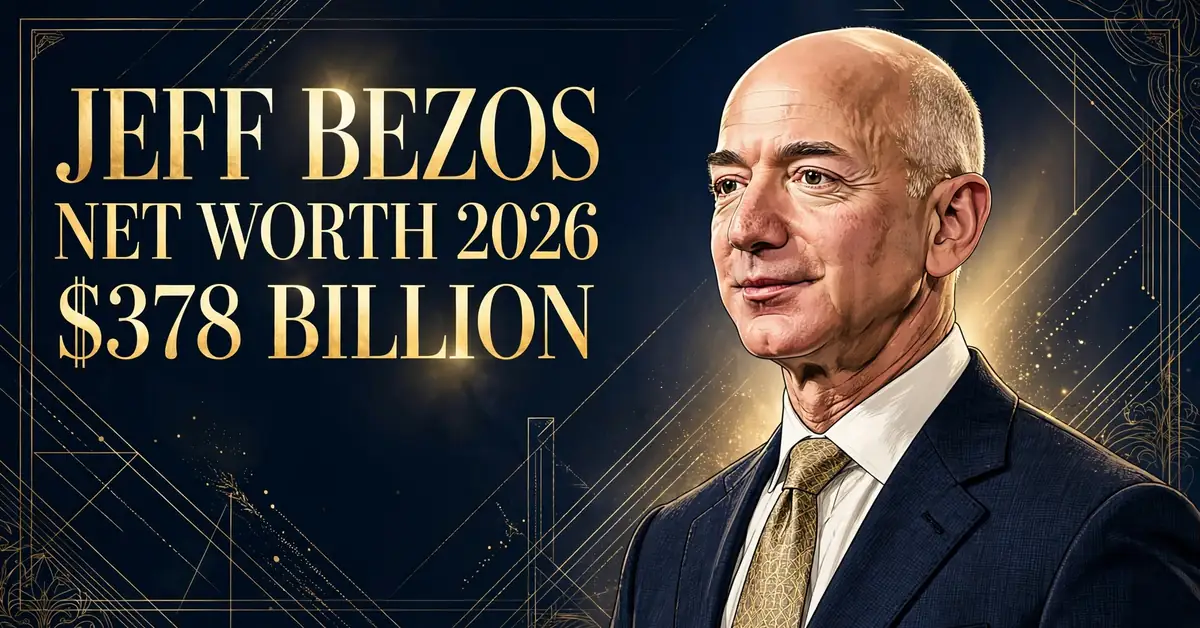
Jeff Bezos is worth an estimated $378 billion in 2026. That is the figure Forbes printed in its Forbes 400 ranking in September 2026, and it put him at number two in the United States and in the world, behind only Elon Musk at $908 billion. Twelve months earlier, Forbes had him at $241 billion. The $137 billion jump in a single year is one of the largest one-year gains the list has ever recorded, and it did not come from Amazon’s share price. It came from two private companies almost nobody outside the deal rooms had been pricing: Blue Origin, the rocket company Bezos founded in 2000, and Prometheus, an industrial-AI startup he co-led in 2026.
Most pages that answer the question “how much is Jeff Bezos worth” print a single number and stop. The problem with that is the number keeps moving by tens of billions. Forbes had him at $224 billion on March 1, 2026, at $278 billion on August 1, and at $378 billion in September. Its real-time tracker printed $380.8 billion on October 10 and other trackers put him near $368.5 billion on November 3. Any article that prints one of those figures without the dates is stale the week it goes live. This profile prints the whole dated cluster, names the source behind each figure, and explains what actually changed between March and September — because the change is the story.
What follows is the full picture: the dated Forbes timeline, the fortune broken into its parts — 950.4 million Amazon shares, Blue Origin, Prometheus, the Washington Post, cash and property — the September surge explained, Amazon’s own audited numbers for 2025, the life behind the money from Albuquerque to Princeton to a Bellevue garage, the divorce that split the Amazon stake in 2019, the Venice wedding in June 2025, and the move to Miami that made him Florida’s richest person. Every figure carries its source and its date. Nothing here is guessed.
Quick Facts
| Full Name | Jeffrey Preston Bezos (born Jeffrey Preston Jorgensen) |
| Born | January 12, 1964, Albuquerque, New Mexico, USA |
| Age in 2026 | 62 (turns 63 on January 12, 2027) |
| Height | Commonly listed 5 ft 7 in (171 cm) — see our Jeff Bezos height profile |
| Spouse | Lauren Sánchez, married June 27, 2025, Venice, Italy |
| Children | Four children with ex-wife MacKenzie Scott |
| Ex-wife | MacKenzie Scott, married 1993, divorced 2019 |
| Education | Princeton University, 1986 — electrical engineering and computer science |
| Known For | Founder of Amazon; founder of Blue Origin; owner of The Washington Post |
| Amazon Stake | 950,434,581 shares, 8.8% of Amazon (2026 proxy statement) |
| Net Worth (2026) | $370–380 billion range; $378 billion anchor (Forbes 400, September 2026) |
| Forbes Rank | #2 in the US and the world (Forbes 400, September 2026) |
How This Estimate Was Made
The anchor for this profile is the Forbes 400 figure of $378 billion, published in September 2026 using stock prices and exchange rates from September 4 and 15, 2026. Forbes ranked Bezos second in the United States and the world, up $137 billion from the $241 billion it had printed for him a year earlier. The real-time prints from October and November 2026 cluster tightly around the same level: Forbes’s real-time tracker showed $380.8 billion on October 10, BillionaireList showed $373 billion on October 15, and BestStartupStory showed about $368.5 billion on November 3. That cluster is why this profile publishes a $370–380 billion range with the $378 billion anchor, rather than a single number that would be wrong within days.
The March 2026 figure of $224 billion, from Forbes’s World’s Billionaires list at March 1 prices, is now stale — and the reason it is stale is the point of this article. Between March and September, Forbes revalued two private holdings: Blue Origin, which raised its first outside money in 2026 at about a $130 billion pre-money valuation, and Prometheus, the industrial-AI startup Bezos co-led, which raised a $12 billion Series B at a $41 billion valuation in June 2026. Those two revaluations, not Amazon’s share price, explain most of the jump. All figures here are estimates. They move with Amazon’s share price every trading day and with private-company valuations every time a new funding round is priced. Where sources disagree, this profile names the source and the date behind each figure instead of picking one and calling it a fact.
+
The Short Answer: 8 Billion in 2026
Jeff Bezos is worth an estimated $378 billion in 2026, according to the Forbes 400, published in September 2026. He is the second-richest person in the United States and the second-richest person in the world, behind Elon Musk at $908 billion and ahead of Mark Zuckerberg at $212 billion. The honest range around the anchor is $370–380 billion, drawn from the real-time prints of October and November 2026. The fortune is an estimate built from public filings and private valuations, and it moves every day with Amazon’s share price — but the level is not in doubt. Bezos is worth roughly three and a half times what he was worth at the start of the decade’s reporting, and he is the only person on the list whose fortune jumped by more than $100 billion in a single year without selling a company.
The table below is the evidence. It shows every dated Forbes print for Bezos in 2026, in order, so the reader can see the trajectory instead of taking one number on trust. The March figure of $224 billion is the one most competitor pages still print, because it comes from the famous annual World’s Billionaires list. It is also six months out of date. The August figures show the fortune climbing through the summer. The September figure is the anchor. The October and November figures show the fortune holding its new level after the surge, with the normal day-to-day movement of a few billion either way that comes with a large Amazon stake.
| Date (2026) | Net Worth | Rank | Source |
|---|---|---|---|
| March 1 | $224 billion | 4th | Forbes World’s Billionaires list |
| August 1 | $278 billion | 3rd | Forbes (after a $29 billion July gain) |
| August 28 | ~$273.2 billion | 3rd | Forbes real-time tracker |
| September | $378 billion | #2 | Forbes 400 (Sept 4/15 prices) |
| October 10 | $380.8 billion | #2 world | Forbes real-time tracker |
| October 15 | $373 billion | #2 | BillionaireList (Forbes real-time) |
| November 3 | ~$368.5 billion | #2 | BestStartupStory (Forbes) |
What the Fortune Is Made Of
A fortune of $378 billion is not a bank balance. It is a collection of stakes in companies, plus cash from stock sales and property, and the value of each piece is set by a different market on a different day. The table below breaks the fortune into its parts, with the source and the date behind each one. No competitor page in the 2026 research does this — most print one figure and move on. The breakdown is what makes the headline number believable, because each line can be checked.
| Component | Value | Source / Date |
|---|---|---|
| Amazon shares | 950,434,581 shares, 8.8% of Amazon | Amazon 2026 proxy statement, filed April 9, 2026 (per FourWeekMBA) |
| Blue Origin | ~$130 billion pre-money valuation | Forbes, July 2026 — first outside funding round |
| Prometheus | ~20% stake, ≈ $8.2 billion | $41 billion valuation, June 2026 (Axios); Forbes estimate of stake |
| The Washington Post | Bought for $250 million in 2013 | Nash Holdings purchase, 2013 |
| Cash and real estate | Proceeds from $49B+ of stock sales; homes in Miami and elsewhere | Forbes (stock sales since the 1997 IPO) |
The Amazon stake is still the foundation. Bezos holds 950,434,581 shares, or 8.8 percent of the company, according to Amazon’s 2026 proxy statement, filed on April 9, 2026. That is down from the 16 percent he held before the 2019 divorce, when he transferred about a quarter of his stake to MacKenzie Scott. He has sold more than $49 billion of Amazon stock since the 1997 IPO, according to Forbes, and those sales are the source of the cash that funded Blue Origin, the Washington Post purchase, the Earth Fund and the property portfolio. The stake is smaller than it was, but the company is far larger, so the stake is worth far more.
Blue Origin is the second pillar, and it is the one that changed the math in 2026. Bezos founded the rocket company in 2000 and funded it himself for a quarter of a century. In 2026 it raised its first outside money, at about a $130 billion pre-money valuation, according to Forbes in July 2026, with Coatue expected to lead the round with $4 billion and Bezos himself adding $2 billion. Before that round, Forbes had been valuing Blue Origin far lower, because there was no outside price to anchor to. The first outside price gave the stake a market value, and the fortune jumped.
Prometheus is the third pillar, and the newest. It is an industrial-AI startup that Bezos co-led with Vik Bajaj, and in June 2026 it raised a $12 billion Series B at a $41 billion valuation, according to Axios. Forbes estimates Bezos holds about 20 percent of Prometheus, worth roughly $8.2 billion at that valuation. It is the smallest of the three pillars by a wide margin, but it matters for the story: the September surge was not one revaluation, it was two, and the second one put Bezos at the centre of the AI boom as well as the space race.
The September 2026 Surge: 2 Billion in One Month
Bezos gained about $102 billion in September 2026 alone, according to TheStreet’s October 8, 2026 report on Forbes’s numbers. That is more than most billionaires are worth in total, gained in thirty days, and it is the single most misunderstood fact about his fortune. The natural assumption is that Amazon’s stock soared. It did not. The surge came from private-company valuations, and it came in two steps that landed in the same month.
The first step was Blue Origin. For twenty-five years, Forbes valued the rocket company on its own estimates, because Bezos was the only funder and there was no market price. The July 2026 news that Blue Origin would raise outside money at about a $130 billion pre-money valuation gave Forbes a real number to work with, and the Forbes 400 — priced on September 4 and 15, 2026 — was the first ranking to use it in full. Coatue was expected to lead the round with $4 billion, and Bezos was adding $2 billion of his own money. A company that had been carried at a fraction of that value was suddenly worth $130 billion on paper, and Bezos’s stake in it was suddenly worth tens of billions more than Forbes had credited him with in March.
The second step was Prometheus. The industrial-AI startup raised a $12 billion Series B in June 2026 at a $41 billion valuation, according to Axios, and Forbes credited Bezos with about 20 percent of it — roughly $8.2 billion. Eight billion dollars is a small number next to $378 billion, but it is a large number next to the $102 billion monthly gain, and it carried a message the market read clearly: Bezos, who had been written off as a space-and-retail figure, was now a major holder in the AI buildout as well. The two revaluations together explain the September jump, and they explain why the March figure of $224 billion is not just old — it was priced before either company had a market value.
There is a caution here, and it is worth stating plainly. Private-company valuations are not the same as cash. Blue Origin is worth $130 billion because outside investors agreed to pay that price in 2026; if the next round prices lower, the value falls. Prometheus is worth $41 billion because investors paid that price in June 2026; the same applies. Bezos cannot sell his Blue Origin stake the way he sells Amazon shares, and the $378 billion figure would shrink fast if either private valuation fell. The Forbes 400 number is real, and it is the best estimate available — but it is an estimate built on two funding rounds, and the fortune will move with the next ones.
Amazon: From a Garage to 6.9 Billion in Sales
The fortune starts with a company that did $716.9 billion in net sales in its 2025 fiscal year. That figure comes from Amazon’s Form 10-K, filed on February 6, 2026, and reported by Global Brands Magazine on October 26, 2026. It is up 12 percent from $638.0 billion in 2024. The table below is the audited picture of the company behind the fortune — the numbers Bezos’s stake is a slice of, and the reason the stake is worth what it is.
| Amazon FY2025 (Form 10-K, filed Feb 6, 2026) | Figure |
|---|---|
| Net sales | $716.9 billion (up 12% from $638.0B in 2024) |
| Operating income | $80.0 billion |
| AWS net sales | $128.7 billion |
| AWS operating income | $45.6 billion (57% of group operating income from 18% of sales) |
| Advertising revenue | $68.6 billion (up 22%) |
| Capital expenditure | $128.3 billion |
| Employees | 1,576,000 |
The most important line in that table is the AWS line. Amazon Web Services did $128.7 billion in sales — 18 percent of the group’s total — and produced $45.6 billion of operating income, which is 57 percent of the group’s $80.0 billion. The cloud business is the profit engine. The retail business moves the goods and takes the revenue; the cloud business takes the profit. That split is the reason Amazon can spend $128.3 billion a year on capital expenditure — on data centres, warehouses and logistics — and still report $80.0 billion of operating income. It is also the reason the company is worth enough to make an 8.8 percent stake the core of a $378 billion fortune.
Advertising is the third engine, and the fastest-growing. At $68.6 billion in 2025, up 22 percent on the year, it is now larger than the annual revenue of most Fortune 500 companies on its own. It is also almost pure margin: the ads sit on pages Amazon already built, in front of shoppers already looking to buy. The three engines together — retail, cloud, advertising — are what Bezos built, and the 2025 numbers show all three still growing.

The growth from the garage to those numbers is worth seeing in one line. In 2015, Amazon’s net sales were $107.0 billion. In 2025, they were $716.9 billion — 6.7 times larger in ten years. The company that sold its first book in July 1995 now employs 1,576,000 people, more than the population of most American cities. Amazon was the second company ever to reach a $1 trillion market value, in September 2018, and it was also the first company ever to lose $1 trillion in value, in November 2022, when it fell to $879 billion. Both records belong to the same company, and both belong to the same decade. The fortune moves with the stock because the stock moves with a company of that size and that speed.
Early Life: Albuquerque, Princeton and D.E. Shaw
Jeff Bezos was born Jeffrey Preston Jorgensen on January 12, 1964, in Albuquerque, New Mexico. He is 62 years old in 2026 and turns 63 on January 12, 2027. His mother, Jacklyn Gise, was a teenager when he was born. His father, Ted Jorgensen, left the family early. When Bezos was four, his mother married Miguel Bezos, a Cuban immigrant who had arrived in the United States alone as a teenager, and Miguel adopted him. The surname Bezos comes from that adoption, and the story of a Cuban refugee who built a life in America from nothing is the first half of the Bezos story — the second half is what his adopted son built on top of it.
The full life story — the childhood in Albuquerque and Houston, the Princeton years, the Wall Street career and the Amazon founding — is told in detail in our Jeff Bezos biography, and the age story in particular, with the birthday math and the milestones at each age, is covered in Jeff Bezos’s age profile on CelebAmerica. What matters here is the shape of the early years, because the shape explains the founder. Bezos was a boy who took things apart to see how they worked, who built a solar cooker and an alarm system out of spare parts, and who read science fiction the way other children read comics. The curiosity was not a hobby. It was the operating system.
He went to Princeton University and graduated in 1986 with a degree in electrical engineering and computer science. Princeton in the mid-1980s was the right place for a student who wanted to work at the edge of computing: the university had one of the strongest computer science programmes in the country, and Bezos was in the thick of it. He has said in interviews that he considered a career in physics before choosing computing, and the choice set the direction of his life. A physicist studies the world. A computer scientist builds new ones. Bezos built one.
After Princeton he went to Wall Street, not to Silicon Valley. He worked at Fitel, a financial technology startup, then at Bankers Trust, and then at D.E. Shaw, the quantitative hedge fund, where he rose to senior vice-president. D.E. Shaw was the job that mattered. It was there, in 1994, that he came across the statistic that changed his life: the World Wide Web was growing at 2,300 percent a year. He did the arithmetic, saw that a growth rate like that would not last, and decided he had to act before the window closed. He also met his future wife there — MacKenzie Tuttle, a researcher at the firm, who would become MacKenzie Scott. The fund, the statistic and the marriage all came from the same office, in the same year.
His height is the one physical fact that comes up in every profile, and it is worth settling here. Bezos is commonly listed at 5 ft 7 in (171 cm), and that is the figure this profile uses, labelled as commonly listed rather than agency-verified, because no official measurement exists. He is shorter than many of the founders he is compared with — the height profiles of Richard Branson, Sam Altman and Tim Cook show the spread across the group — but the comparison is a curiosity, not a fact that matters. The fortune was not built on height. It was built on the decision he made at D.E. Shaw in 1994, and the next section is that decision.
Founding Amazon in 1994 and the 1997 IPO
Bezos founded Amazon on July 5, 1994, in a garage in Bellevue, Washington. The first name he tried was Cadabra, which he dropped when a lawyer misheard it as “cadaver” on the phone. The second name was Amazon, chosen because it started with A — which put it at the top of alphabetical lists, the way the phone book worked in 1994 — and because the Amazon was the largest river in the world, and he wanted the largest store in the world. The name was the plan, stated in one word.
The early years were funded the hard way. Bezos’s parents put about $300,000 of their retirement savings into the company, a fact he has told often and with obvious feeling — the money was their life savings, and the risk was real. Outside investors followed, and the company raised its first outside round in 1996. The IPO came on May 15, 1997, at $18 a share, and it raised $54 million. Amazon’s market value on the day of the IPO was about $438 million. A single share bought at $18 in 1997, held through the stock splits and the decades since, is worth many thousands of dollars today — and Bezos, who held the largest block of shares from the start, was already a rich man on paper. The fortune that followed was the IPO stake, grown by thirty years of compounding.
The years after the IPO were not a straight line up. Amazon lost money for years, and the dot-com crash of 2000–2001 nearly killed it. The share price fell from over $100 to under $6, and the company was written off by analysts who said it would never make a profit. Bezos kept going, and the decisions he made in those years — the move into third-party selling, the launch of Prime in 2005, the launch of AWS in 2006 — are the decisions that built the $716.9 billion company of 2025. Prime turned customers into subscribers. AWS turned Amazon’s own computing infrastructure into a product it sold to everyone else. Both were bets made when the company could least afford them, and both paid off by orders of magnitude.
Stepping Down as CEO in 2021
Bezos stepped down as Amazon’s chief executive on July 5, 2021 — exactly twenty-seven years to the day after he founded the company. Andy Jassy, who had run AWS since its launch, succeeded him. Bezos stayed on as executive chairman, and he kept his shares. The timing was deliberate: the date was the anniversary, the successor was the man who had built the profit engine, and the handover was clean.
The reason he gave was time. As chief executive he had spent his days on Amazon’s operations — the warehouses, the logistics, the quarterly numbers. As executive chairman he could spend his days on the things only he could do: Blue Origin, the Earth Fund, the Washington Post, and the new ventures that needed a founder’s attention rather than a manager’s. The move was not a retirement. It was a reallocation of the one resource he could not buy more of, and the five years since have shown what he did with it: Blue Origin’s first crewed flight had already flown in July 2021, the Earth Fund was committing billions, and the Prometheus investment of 2026 — the one that helped add $102 billion to his fortune in a single month — came from the founder’s side of his life, not the chief executive’s.
The market barely noticed the handover, and that is the point. Amazon’s share price in July 2021 was near its highs, the company was reporting record numbers, and Jassy was a known quantity. The fortune did not fall when Bezos stopped being chief executive, because the fortune was never his salary. It was his shares, and the shares stayed. The lesson of 2021 is the same as the lesson of the whole career: the money follows the ownership, not the title, and Bezos has owned the largest block of Amazon from the day he founded it to today.
Blue Origin: The 0 Billion Rocket Company
Blue Origin is the company Bezos founded in 2000, six years after Amazon and twenty-one years before he stepped down as its chief executive. For most of its life it was a private project funded from his own pocket — he sold Amazon stock, about $1 billion a year by his own account in the late 2010s, and put the money into rockets. The company’s motto, printed on its hardware, is the Latin phrase Gradatim Ferociter — step by step, ferociously — and the pace matched the motto. It spent a decade and a half building and testing in relative quiet, while SpaceX, its rival, flew in public and took the headlines.
The first crewed flight came on July 20, 2021, when the New Shepard rocket carried Bezos himself and his brother Mark above the Kármán line, the boundary of space, on a flight that lasted about eleven minutes. Bezos flew sixteen days after stepping down as Amazon’s chief executive, and the timing was the message: the space company was now his main job. The flight was also a statement of a different kind. Bezos was 57, and he was willing to ride a rocket his own company had built. The risk was real, the flight was clean, and Blue Origin had its first crew.

The money followed the flights. In 2026, Blue Origin raised its first outside funding, at about a $130 billion pre-money valuation, according to Forbes in July 2026, with Coatue expected to lead the round with $4 billion and Bezos adding $2 billion himself. The round matters for two reasons. First, it put a market price on a company that had never had one, and that price is what lifted Bezos’s fortune by tens of billions in the Forbes 400. Second, it changed the company’s shape: Blue Origin is no longer a billionaire’s private project. It now has outside investors, outside expectations, and a valuation that puts it among the most valuable private companies in the world.
The Washington Post and the Giving
Bezos bought The Washington Post in 2013 for $250 million, through his personal holding company Nash Holdings. The price was a rounding error against his fortune even then, but the purchase was not a financial investment. It was a rescue of a newspaper that had been losing money for years, and a bet that a technology founder could do what a newspaper family could not: rebuild the business around digital subscriptions. The paper’s digital audience grew sharply in the years after the purchase, and the Post’s subscriber base became one of the largest in American journalism. The bet worked as a business turnaround, even if the paper’s finances have tightened again in recent years.
The purchase also changed Bezos’s public standing. Before 2013 he was a retailer. After it, he was a newspaper owner, with all the scrutiny that comes with the job — and the paper’s coverage of politics, including of the administrations in office, has been read ever since as a reflection of its owner’s views, fairly or not. Bezos has said the paper is run independently, and its editors have said the same. The ownership is a fact either way: the man who owns the Post also owns the company that hosts a large share of the internet’s infrastructure, and the combination is a concentration of influence without a modern parallel.
The philanthropy is larger than the newspaper, and it is the part of the fortune that leaves his hands rather than growing. The Bezos Earth Fund, announced in 2020, carries a $10 billion commitment to climate and nature work. The Day 1 Fund, launched in 2018, carries a $2 billion commitment to homelessness and early-childhood education. In October 2026, the Earth Fund made a $100 million commitment to ocean conservation and an urban parks alliance, with Lauren Sánchez as vice-chair of the fund. The pattern of the giving is the pattern of the business: large commitments, announced in round numbers, aimed at problems at planetary scale.
MacKenzie Scott and the 2019 Divorce
Bezos met MacKenzie Tuttle at D.E. Shaw in the early 1990s, when she was a researcher at the fund and he was a senior vice-president. They married in 1993, a year before he founded Amazon, and she was there at the start: she drove the car on the cross-country move from New York to Seattle in 1994 while he typed the business plan on a laptop in the passenger seat, and she worked as one of the company’s first employees. The fortune was built during the marriage, by both of them, and the divorce settlement reflected that.
The couple announced their divorce in January 2019, and it was finalised in April 2019. Under the settlement, MacKenzie Scott received about 25 percent of Bezos’s then-16 percent Amazon stake — roughly $38 billion at the time — making her one of the richest women in the world overnight. Bezos kept 75 percent of the stake and all of the voting rights, plus the Washington Post and Blue Origin. The split was clean by the standards of billionaire divorces: no court fight, no public acrimony, and a settlement agreed within three months of the announcement.
The settlement also changed the shape of the fortune. Before the divorce, Bezos held about 16 percent of Amazon. After it, he held about 12 percent, and the figure has drifted down to 8.8 percent since, through further stock sales. The 950.4 million shares he holds today are the remainder of a stake that was once nearly twice as large. The company grew faster than the stake shrank, so the stake is worth far more now than the larger stake was then — but the divorce is the reason the percentage is single digits, and it is the reason Scott’s name appears in every telling of the fortune.
Lauren Sánchez and the Million Venice Wedding
Bezos married Lauren Sánchez on June 27, 2025, in Venice, Italy, in a three-day event that became one of the most covered weddings of the year. Sánchez is a former television journalist and helicopter pilot, and the founder of Black Ops Aviation, an aerial filming company. The couple had been together since 2019, and the engagement was announced in 2023, aboard Bezos’s $500 million yacht Koru, with a pink diamond reported at 20 to 30 carats. The wedding itself was the event the engagement had promised.
The ceremony took place on San Giorgio Maggiore, the island across the lagoon from St Mark’s Square, and the reception was held at the Arsenale, the historic shipyard. About 200 guests attended, drawn from the worlds Bezos and Sánchez move in — technology founders, media figures, actors and musicians. The expected cost was about $50 million, according to Veneto region president Luca Zaia, who gave the figure publicly. The city of Venice, which has hosted famous weddings before, treated this one as a major event: streets were closed, water traffic was rerouted, and the three days of parties filled the city’s hotels.
The wedding also drew protests. Venetian activists objected to a billionaire taking over their city for a private party, and banners appeared in St Mark’s Square in the days before the ceremony. The protests were small and peaceful, and the wedding went ahead as planned, but they captured a tension that runs through the whole Bezos story: a fortune of $378 billion is hard to spend quietly, and a $50 million wedding in one of the world’s most famous cities is the opposite of quiet. The prenuptial agreement, widely described in the press as ironclad, is the other detail that got attention — a document shaped by the lesson of the 2019 divorce, when a quarter of the Amazon stake changed hands.
The Move to Miami
In November 2023, Bezos announced that he was moving his home base from Seattle to Miami, Florida. He had lived in Seattle since 1994, when he moved there to found Amazon, and the city had been his home for twenty-nine years. The reasons he gave were family — his parents live in Miami, and he wanted to be closer to them — and the company’s space operation, since Blue Origin’s operations are centred at Cape Canaveral, a few hours’ drive up the Florida coast. The move was also, inevitably, read as a tax decision: Florida has no state income tax, and Washington had introduced a capital gains tax in 2022.
The move made him Florida’s richest person, according to the Forbes 400 in September 2026, and it put the second-richest person in the world in a state that had never hosted a fortune of that size. Miami’s billionaire population has grown sharply in the last five years, as founders and financiers have moved south from New York and California, and Bezos is now the largest name on the list. The property he bought in Miami — on Indian Creek Island, the private enclave known as Billionaire Bunker — is part of the real estate that sits alongside the cash in the fortune’s smaller lines.
How 8 Billion Compares: Bezos Against the Other Billionaires
A fortune of $378 billion is hard to picture on its own. Put it next to the other names on the Forbes list and the picture sharpens: Bezos is second, and the gap in both directions is enormous. He is $530 billion behind Musk in first place, and $166 billion ahead of Zuckerberg in third. The table below uses the figures from Guide Net Worth’s own profiles, all verified live, and the Forbes 400 numbers from September 2026.
| Billionaire | Net Worth (2026) | Source of Fortune |
|---|---|---|
| Elon Musk | $908 billion | Tesla, SpaceX, xAI — see our Elon Musk net worth profile |
| Jeff Bezos | $378 billion | Amazon, Blue Origin, Prometheus |
| Mark Zuckerberg | $212 billion | Meta — see our Mark Zuckerberg biography |
| Larry Ellison | $152 billion | Oracle — see our Larry Ellison biography |
| Bill Gates | $115 billion | Microsoft — see our Bill Gates biography |
The comparison shows two things. First, the top of the list is now a technology list in full: the five richest people in America all made their fortunes from software, e-commerce, social media or rockets, and none of them inherited the money. Second, the gaps between the places are larger than most fortunes. The $530 billion between Musk and Bezos is more than the entire net worth of anyone below third place. The $166 billion between Bezos and Zuckerberg is more than the entire fortune of everyone on the list below Ellison. The list is not a ladder with even rungs. It is a cliff at the top, and Bezos stands on the second ledge.
Sources & Reporting
This profile was reported from named, dated sources in November 2026. The headline figure — $378 billion, Forbes 400, September 2026, #2 in the US and the world, up $137 billion from $241 billion a year earlier — comes from Forbes, with stock prices and exchange rates from September 4 and 15, 2026. The real-time prints come from Forbes’s real-time tracker ($380.8 billion, October 10, 2026), BillionaireList ($373 billion, October 15, 2026) and BestStartupStory (about $368.5 billion, November 3, 2026). The March 1, 2026 figure of $224 billion (4th) comes from Forbes’s World’s Billionaires list, and the August prints ($278 billion on August 1, about $273.2 billion on August 28) come from Forbes. The $102 billion September gain comes from TheStreet’s October 8, 2026 report on Forbes’s numbers.
The fortune breakdown comes from Amazon’s 2026 proxy statement, filed April 9, 2026, as reported by FourWeekMBA (950,434,581 shares, 8.8 percent of Amazon); Forbes, July 2026 (Blue Origin, about $130 billion pre-money, first outside round, Coatue expected to lead with $4 billion, Bezos adding $2 billion); and Axios, June 2026 (Prometheus, $12 billion Series B at a $41 billion valuation), with Forbes’s estimate of Bezos’s stake at about 20 percent, roughly $8.2 billion. The $49 billion-plus of Amazon stock sold since the 1997 IPO comes from Forbes. The Washington Post purchase price of $250 million in 2013 comes from the Nash Holdings transaction. Amazon’s FY2025 figures — net sales $716.9 billion, operating income $80.0 billion, AWS sales $128.7 billion and operating income $45.6 billion, advertising $68.6 billion, capital expenditure $128.3 billion, 1,576,000 employees — come from Amazon’s Form 10-K, filed February 6, 2026, as reported by Global Brands Magazine on October 26, 2026. The 2015 revenue figure of $107.0 billion and the 6.7x growth come from the same filing record.
Biography facts come from the sourced record: born Jeffrey Preston Jorgensen, January 12, 1964, Albuquerque, New Mexico; Princeton University, 1986, electrical engineering and computer science; Fitel, Bankers Trust and D.E. Shaw, where he rose to senior vice-president; founded Amazon July 5, 1994, in Bellevue, Washington (first as Cadabra); first book sold July 1995; IPO May 15, 1997, at $18 a share; stepped down as CEO July 5, 2021, succeeded by Andy Jassy; first centibillionaire on the Forbes Real Time Billionaires Index; world’s wealthiest person 2017–2021; Amazon the second company to reach $1 trillion (September 2018) and the first to lose $1 trillion in value (November 2022, fell to $879 billion). The divorce — announced January 2019, finalised April 2019, MacKenzie Scott receiving about 25 percent of his then-16 percent stake, roughly $38 billion, and signing the Giving Pledge — comes from the contemporary reporting of the settlement. The wedding — June 27, 2025, Venice, three days, San Giorgio Maggiore ceremony, Arsenale reception, about 200 guests, expected cost about $50 million per Veneto region president Luca Zaia, engagement aboard the $500 million yacht Koru with a pink diamond reported at 20–30 carats — comes from the 2025 wedding reporting. The Miami move, announced November 2023, and the Forbes 400 designation of Bezos as Florida’s richest person come from Forbes, September 2026. Philanthropy figures come from the funds’ own announcements: Bezos Earth Fund $10 billion (2020), Day 1 Fund $2 billion (2018), and the October 2026 Earth Fund commitment of $100 million to ocean conservation and urban parks. Height is commonly listed at 5 ft 7 in (171 cm), labelled as such because no agency-verified measurement exists. Peer fortunes come from Forbes and Guide Net Worth’s own profiles. Reporting window: November 15–16, 2026. Corrections: figures are updated when new reporting emerges — contact us via the About page if you spot an error.
For more profiles in the same series, see the Celebrity Net Worth archive.
About the Author
Nathan Cole covers celebrity wealth and the business of sport for Guide Net Worth. He reports from named sources and dated reporting, and he publishes ranges where sources disagree rather than a single invented number. Read more on the About Guide Net Worth page. Corrections: figures are updated when new reporting emerges — contact us via the About page if you spot an error.
Frequently Asked Questions About Jeff Bezos’s Net Worth
How much is Jeff Bezos worth in 2026?
Jeff Bezos is worth an estimated $378 billion in 2026, according to the Forbes 400, published in September 2026. He ranks second in the United States and the world, behind Elon Musk at $908 billion. The honest range is $370–380 billion, drawn from real-time prints in October and November 2026: Forbes showed $380.8 billion on October 10, BillionaireList showed $373 billion on October 15, and BestStartupStory showed about $368.5 billion on November 3.
How did Jeff Bezos get so rich?
Bezos founded Amazon on July 5, 1994, in a garage in Bellevue, Washington, and kept the largest block of its shares as the company grew from an online bookstore into a $716.9 billion-a-year business. He still holds 950,434,581 Amazon shares, 8.8 percent of the company, according to the 2026 proxy statement. The rest of the fortune comes from Blue Origin, valued at about $130 billion in its first outside funding round in 2026, and Prometheus, an industrial-AI startup in which Forbes estimates he holds about 20 percent, worth roughly $8.2 billion.
How much of Amazon does Jeff Bezos own?
Jeff Bezos owns 950,434,581 Amazon shares, or 8.8 percent of the company, according to Amazon’s 2026 proxy statement, filed April 9, 2026. He held about 16 percent before the 2019 divorce, when he transferred roughly a quarter of his stake to MacKenzie Scott. He has sold more than $49 billion of Amazon stock since the 1997 IPO, according to Forbes, and the proceeds funded Blue Origin, the Washington Post purchase and his philanthropy.
What is Blue Origin worth?
Blue Origin was valued at about $130 billion pre-money in its first outside funding round in 2026, according to Forbes in July 2026. Coatue was expected to lead the round with $4 billion, and Bezos was adding $2 billion himself. Bezos founded the rocket company in 2000 and funded it himself for 25 years before that round, which gave the company its first market price — and that price is the main reason his fortune jumped by about $102 billion in September 2026 alone.
Who is Jeff Bezos’s wife?
Jeff Bezos’s wife is Lauren Sánchez, a former television journalist and helicopter pilot and the founder of Black Ops Aviation. They married on June 27, 2025, in Venice, Italy, in a three-day event with about 200 guests. Sánchez is vice-chair of the Bezos Earth Fund and flew on a Blue Origin New Shepard flight in 2025 as part of an all-women crew. Bezos was previously married to MacKenzie Scott from 1993 to 2019.
How much did Jeff Bezos’s wedding cost?
Jeff Bezos’s wedding to Lauren Sánchez cost an expected $50 million, according to Veneto region president Luca Zaia. The three-day event in Venice in June 2025 included a ceremony on San Giorgio Maggiore and a reception at the Arsenale, with about 200 guests. The couple were engaged in 2023 aboard Bezos’s $500 million yacht Koru, with a pink diamond reported at 20 to 30 carats.
How much did MacKenzie Scott get in the divorce?
MacKenzie Scott received about 25 percent of Jeff Bezos’s Amazon stake in their 2019 divorce — roughly $38 billion at the time. The divorce was announced in January 2019 and finalised in April 2019. Bezos kept 75 percent of the stake and all of the voting rights, plus the Washington Post and Blue Origin. Scott signed the Giving Pledge and has given away billions since the divorce.
How old is Jeff Bezos?
Jeff Bezos is 62 years old in 2026. He was born Jeffrey Preston Jorgensen on January 12, 1964, in Albuquerque, New Mexico, and he turns 63 on January 12, 2027. He founded Amazon at 30 in 1994, stepped down as chief executive at 57 in 2021, and married Lauren Sánchez at 61 in June 2025.
References & Sources
This article has been fact-checked and verified against multiple public sources, financial disclosures, SEC filings, Forbes reports, Celebrity Net Worth databases, and official records. All net worth estimates are based on publicly available information and financial analysis.