Jerry Seinfeld’s biography: the Brooklyn comic born April 29, 1954, turned a sitcom about nothing into a $900M–$1.1B fortune. The full story, sourced.
Last updated: November 19, 2026 · By Nathan Cole
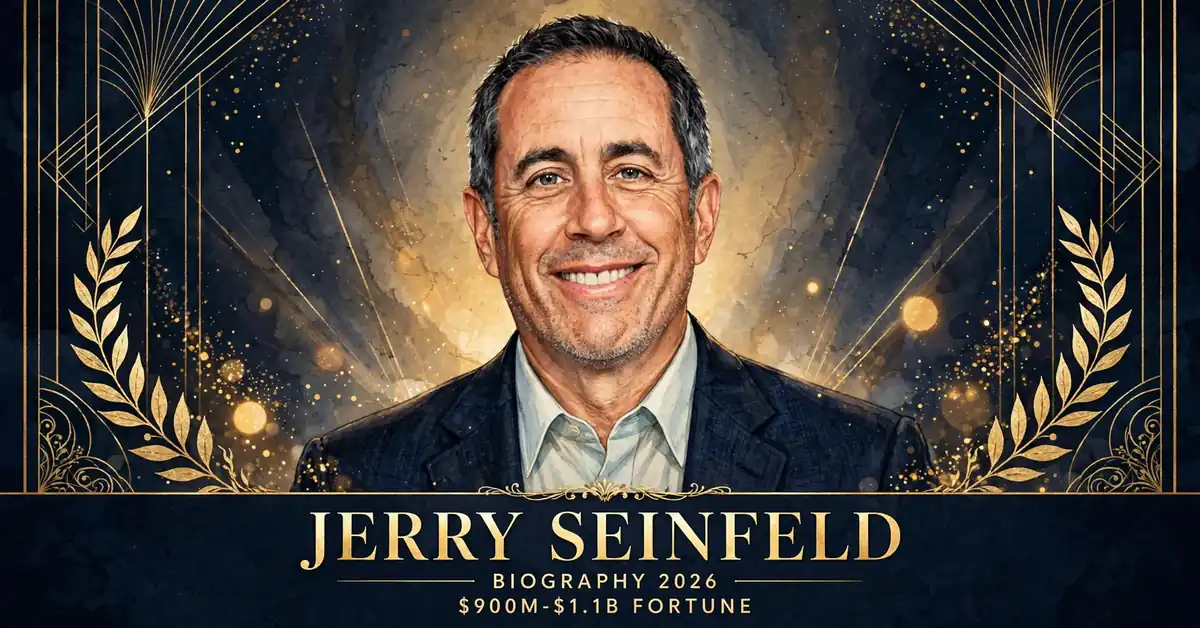
Jerry Seinfeld was born Jerome Allen Seinfeld on April 29, 1954, in Brooklyn, New York — and he is now the richest stand-up comedian in American history. His net worth sits at an estimated $900 million to $1.1 billion as of November 2026, with Forbes listing him at $1.1 billion in its real-time tracking, Bloomberg having first called him a billionaire in March 2024, and Celebrity Net Worth holding at $900 million. The range is the honest answer: his own representative has publicly disputed the billionaire figures, so this biography shows the full spread instead of picking one number and pretending the argument does not exist.
He built it on one sitcom, one voice, and one discipline — writing jokes every single day for fifty years. The show he co-created with Larry David ran for nine seasons on NBC, ended with 76 million people watching the finale, and then kept paying him for decades through syndication and streaming deals that are still among the largest in television history. He turned down a reported $110 million to make a tenth season, walked away at the peak, and somehow got richer after quitting. This is the full story: the Brooklyn childhood, the fifteen anonymous years in clubs, the deal that made him a billionaire, the marriage that has lasted more than a quarter of a century, and what he is doing at 72.
Quick Facts
| Full Name | Jerome Allen Seinfeld |
| Date of Birth | April 29, 1954 (age 72 as of November 2026) |
| Birthplace | Brooklyn, New York City, New York, USA |
| Height | 5 ft 11 in (180 cm) |
| Occupation | Stand-up comedian, actor, writer, producer, director |
| Years Active | 1976–present |
| Estimated Net Worth | $900 million – $1.1 billion (Forbes: $1.1 billion; Bloomberg: over $1 billion; Celebrity Net Worth: $900 million) |
| Spouse | Jessica Seinfeld (married December 25, 1999) |
| Children | Three — daughter Sascha, sons Julian and Shepherd |
| Key Works | Seinfeld (1989–1998), Bee Movie (2007), Comedians in Cars Getting Coffee (2012–2019), Unfrosted (2024) |
| Awards | Emmy Award for Outstanding Comedy Series (1993), Golden Globe for Best Actor (1994) |
How This Estimate Was Made
No one outside Seinfeld’s camp has seen his bank statements, so every published figure is a model, not a fact. This biography uses the three most-reported models and shows the spread: Forbes’ real-time profile at $1.1 billion (September and October 2026), Bloomberg’s Billionaires Index, which first put him past $1 billion in March 2024, and Celebrity Net Worth at $900 million. Forbes and Bloomberg build their numbers from the same visible parts — an assumed roughly 15% backend stake in the sitcom, tour revenue data from Pollstar, real-estate valuations and market-indexed investment returns — and both have been publicly disputed by Seinfeld’s representative, Amy Jacobs, who called the Forbes figure “totally inaccurate” without offering an alternative. The $900 million to $1.1 billion range is therefore the reported truth. Where a single figure is needed in this article, it is labelled as the Forbes figure or the Celebrity Net Worth figure, never presented as settled.
+
Early Life: A Brooklyn Kid Raised on Jokes
Jerome Allen Seinfeld was born on April 29, 1954, in Brooklyn, New York City, to Kálmán Seinfeld, a professional sign maker of Hungarian Jewish descent, and Betty Seinfeld, a homemaker of Syrian Jewish descent. He grew up in Massapequa, a suburb on Long Island, with his older sister Carolyn. The house had a television in his bedroom, and the boy in front of it studied comedy the way other children studied sport: he watched comedians on television day and night, listened to their records, and collected their routines.
His father was part of the training. Kálmán Seinfeld collected jokes as a hobby and told them at home, and by age eight Jerry was putting himself through what Britannica describes as a rigorous comic education — watching television to study the techniques of working comedians. The influences he still names are specific: Jean Shepherd, Mad Magazine, Jonathan Winters, Jerry Lewis, Robert Klein, and Abbott and Costello. None of them did observational comedy about nothing. All of them taught him timing.
He attended Massapequa High School, then the State University of New York at Oswego, and transferred after his second year to Queens College of the City University of New York in Flushing. He graduated in 1976 with a Bachelor of Arts degree in communications and theater. The degree was a backup plan. The real education was already happening at night, in the clubs of Manhattan.
The Club Years: Fifteen Years Before Anyone Knew His Name
Seinfeld took his first open-mic slot at Catch a Rising Star in New York in 1976, while he was still a student at Queens College. The room was small, the pay was nothing, and the audience was mostly other comics. He kept going back. For the next five years he worked the New York club circuit — Catch a Rising Star, the Comic Strip, the Improv — building a five-minute set into ten, then twenty, then an hour, one joke at a time. His rule, the one he still talks about, was to write every day and never break the chain.

The work was slow and deliberately clean. While other comics of the era leaned on shock and profanity, Seinfeld built his act from the ordinary — waiting rooms, airline food, the etiquette of the laundromat — and polished each observation until the wording was exact. It was a style that television could use, and television noticed. He got his first television exposure in the late 1970s on an HBO special hosted by Rodney Dangerfield, and in 1980 he landed his first professional acting job: a recurring role as Frankie, a delivery boy and aspiring stand-up comic, on the ABC sitcom Benson. The part lasted three episodes. He learned he had been fired by reading the script for the next episode and finding his character gone.
The break that mattered came in May 1981, when he appeared on The Tonight Show Starring Johnny Carson. Carson’s approval was the only credential that counted in American comedy, and Seinfeld earned it. The appearance gave him his first national exposure and a touring career that could pay rent. He was 27 years old, five years into stand-up, and still a decade away from the show that would make him rich.
The Tonight Show Break and the Long Road to a Sitcom
After Carson, Seinfeld became a fixture of late-night television and a headliner on the road. He appeared on Late Night with David Letterman, on The Merv Griffin Show, and in comedy specials, and he kept refining the same act: clean, precise, built on the small frictions of daily life. He also kept writing. The discipline that defined him — a joke a day, filed and reworked — turned a club comic into a writer with thousands of finished bits and no wasted words.
That inventory mattered in 1988, when NBC asked him to develop a sitcom. He teamed with Larry David, a fellow comedian he had met at Catch a Rising Star, and the two built a pilot around a fictionalised version of Seinfeld himself: a New York stand-up comic navigating the minutiae of everyday life with three friends. The pilot, originally titled The Seinfeld Chronicles, aired on July 5, 1989. NBC ordered four more episodes. The show was renamed Seinfeld, the neighbour Kessler became Kramer, and Julia Louis-Dreyfus joined the cast as Elaine, Jerry’s ex-girlfriend turned friend. George Costanza, played by Jason Alexander, was drawn from Larry David himself. The show about nothing had its cast.
The Show About Nothing: How Seinfeld Was Built
Seinfeld ran for nine seasons and 180 episodes on NBC, from 1989 to 1998, and it rewrote the rules of the American sitcom while it did it. There was no hugging, no learning — the writers’ own rule, stated openly, was that the characters never grew. Episodes were built from real life: a lost car in a parking garage, a soup stand with too many rules, a contest of willpower, a puffy shirt. The show’s plots were small; its execution was exact. Seinfeld and David wrote and rewrote until every line landed, and the cast — Alexander, Michael Richards as Kramer, Louis-Dreyfus as Elaine — turned precision into chemistry.
The audience found it slowly and then all at once. The first seasons drew modest ratings. By the mid-1990s it was the most-watched comedy in America, and the cast’s salary negotiations became national news: in the final season, Seinfeld himself was paid a reported $1 million per episode. The show won the Emmy for Outstanding Comedy Series in 1993, and Seinfeld won the Golden Globe for Best Actor in a Television Series, Musical or Comedy, in 1994. Larry David left as showrunner after season seven in 1996; Seinfeld took over the show-running duties for the final two seasons himself.
In late 1997, fearing that prolonging the show would lead to creative bankruptcy, Seinfeld announced that the ninth season would be the last. NBC reportedly offered him $110 million to make a tenth season — about $5 million per episode for 22 episodes — and he turned it down. The finale aired on May 14, 1998, and 76.3 million people watched it, one of the largest television audiences in American history. He was 44 years old, at the peak of his fame, and he had just walked away from the most valuable job in television.
Net Worth Breakdown: Where the Fortune Sits
The honest answer to “how much is Jerry Seinfeld worth” is a range, because the three outlets that track him disagree by $200 million. Forbes lists him at $1.1 billion in its real-time tracking as of September and October 2026, and added him to its World’s Billionaires list in 2025. Bloomberg’s Billionaires Index put him past $1 billion in March 2024, in a feature headlined “Get Out! Jerry Seinfeld Is a Billionaire”. Celebrity Net Worth, meanwhile, holds at $900 million and has argued that the billionaire label rests on assumptions about earnings and investment returns that cannot be verified from public records.
| Source | Estimate | Date | Basis |
|---|---|---|---|
| Forbes (real-time) | $1.1 billion | Sep–Oct 2026 | Modelled; on the World’s Billionaires list since 2025 |
| Bloomberg Billionaires Index | Over $1 billion | Mar 2024 | Syndication stake, tour data, real estate, investments |
| Celebrity Net Worth | $900 million | 2026 | Conservative model; disputes the billionaire label |
Either end of the range makes him the richest stand-up comedian alive, by a wide margin. The $200 million gap is not a rounding error; it is a disagreement about how much of the sitcom’s backend he actually owns and how fast his invested earnings have compounded. Nobody outside his camp can settle it, because the key numbers — his exact ownership percentages, his investment portfolio, his current streaming revenues — are not public. What is public is the size of the machine that produced the money, and that machine is the next section.
Why the Billionaire Label Is Disputed
Seinfeld’s own representative, Amy Jacobs, has called Bloomberg’s calculation “inaccurate” and described the Forbes figure as “totally inaccurate” — without offering an alternative number. The dispute matters because it shows what these estimates actually are. Forbes and Bloomberg do not audit Seinfeld’s accounts. They model him. Bloomberg’s methodology, the most transparent of the three, is built on an assumed 15% stake in the sitcom’s backend, tour revenue data from Pollstar, real-estate valuations and market-indexed investment returns. If any one of those assumptions is off — if the backend stake is 12% instead of 15%, if the investment returns ran cooler than the market — the total drops by hundreds of millions.
Forbes estimates that Seinfeld and Larry David negotiated equal 15% shares of the sitcom’s profits and that each has earned well over $400 million from the series. The show-level syndication business is worth $3.1 billion, by Forbes’ count. Those are the numbers the billionaire label rests on, and they are estimates of estimates. Celebrity Net Worth’s $900 million takes the same visible income and applies harsher haircuts for taxes, fees and the unknowable parts of the portfolio. This biography reports all three and calls the range the answer, because that is what the public record supports. A reader who wants a single number can take Forbes’ $1.1 billion and know it is disputed, or Celebrity Net Worth’s $900 million and know it is conservative. Either way, the fortune is real; only the last $200 million is argued over.
The Syndication Machine, Explained
Most sitcom stars get rich from salary. Seinfeld got rich from ownership. When he and Larry David created the show, they negotiated backend participation — a share of the profits the show would earn after its network run, from reruns, cable sales and streaming. Forbes estimates that share at about 15% each. That single decision is worth more than every paycheque of his career combined.
The maths runs like this. Seinfeld has been in syndication since 1995, and the show-level syndication business has generated more than $3.1 billion, according to Forbes. Local stations, cable networks and then streamers paid for the right to air 180 episodes that audiences rewatch endlessly. Bloomberg estimates that Seinfeld’s cut of that machine is worth around $465 million on its own. The streaming era then repriced the asset a second time: in 2019, Netflix paid a reported $500 million-plus for five years of global streaming rights starting in 2021, and in August 2026 Sony renewed the Netflix deal for five more years and the Paramount cable rights for three more, with financial terms undisclosed, according to Variety. The old $500 million price cannot simply be copied onto the renewal — the market has changed, and the terms were not published — but the renewal proves the asset is still paying, 28 years after the finale.
There is a second lesson in the machine. Seinfeld turned down $110 million for a tenth season in 1998. Had he taken it, he would have earned the salary and diluted the asset: a tired tenth season would have weakened the rerun value of the first nine. Walking away protected the back catalogue, and the back catalogue has paid him ever since. It is the cleanest example in entertainment of quitting at the peak being a financial decision, not just an artistic one.
Career Timeline: Fifty Years of Punchlines
| Year | Milestone | Why it matters |
|---|---|---|
| 1954 | Born April 29 in Brooklyn; raised in Massapequa, Long Island | The observational eye starts at home |
| 1976 | First open mic at Catch a Rising Star; BA from Queens College | Stand-up begins; the day-a-joke discipline starts |
| 1981 | The Tonight Show with Johnny Carson | First national exposure; touring career opens |
| 1989 | Seinfeld premieres on NBC (as The Seinfeld Chronicles) | The backend asset is born |
| 1993 | Emmy for Outstanding Comedy Series; SeinLanguage published | Peak prestige; first bestseller |
| 1994 | Golden Globe for Best Actor | Acting recognition to match the writing |
| 1998 | Finale watched by 76.3 million; turns down $110M for season 10 | Walks away at the peak; protects the catalogue |
| 1999 | Marries Jessica Sklar on December 25 | The marriage that outlasted the fame |
| 2007 | Bee Movie — co-wrote, co-produced, voiced Barry B. Benson | ~$293M worldwide box office |
| 2012 | Comedians in Cars Getting Coffee launches | A new format; 84 episodes over seven years |
| 2016 | Beacon Theatre residency begins | 133 shows by May 2026 — a theatre record |
| 2017 | $100M Netflix deal for two specials; Jerry Before Seinfeld | Streaming pays for stand-up directly |
| 2024 | Bloomberg calls him a billionaire; Unfrosted released | The fortune crosses ten figures; directorial debut |
| 2026 | Netflix/Paramount renewals; still touring at 72 | The machine keeps paying |
After Seinfeld: Bee Movie, Books and Cars Getting Coffee
Seinfeld did not retire in 1998; he went back to the clubs. He returned to stand-up full time, toured constantly, and released the special I’m Telling You for the Last Time in 1998. The documentary Comedian (2002) followed him building a brand-new hour from scratch in small clubs, notebook in hand — a portrait of a famous man choosing to be unknown again for the sake of the work. He wrote SeinLanguage in 1993, a best-selling book of humorous observations; a children’s book, Halloween, in 2002; and Is This Anything?, a collection of 45 years of jokes, in 2020.
In 2007 he co-wrote, co-produced and voiced the lead character in the DreamWorks animated film Bee Movie, which took in roughly $293 million worldwide. In 2012 he launched Comedians in Cars Getting Coffee, a web series that paired him with fellow comedians for conversations over coffee and vintage automobiles — a format so simple it looked effortless and so precise it ran for 84 episodes, moving from Crackle to Netflix. In 2017 he signed a reported $100 million Netflix deal for two stand-up specials, Jerry Before Seinfeld (2017) and 23 Hours to Kill (2020), which paid him for the act he had been honing since 1976.
Unfrosted and the Director’s Chair
In 2024 Seinfeld directed his first feature film, Unfrosted: The Pop-Tart Story, for Netflix. He co-wrote it, starred in it, and assembled a cast of comedians to tell a fictionalised version of the 1960s race between Kellogg’s and Post to invent the Pop-Tart. Critics were mixed — the film landed as a broad, silly period comedy rather than the precision instrument his stand-up is — but the debut itself was the point. At 70, after fifty years in front of the camera, he had added directing to a career that already included stand-up, sitcoms, books, animation and a talk show. He has said the film business is “over” as a theatrical proposition, which makes the Netflix home for Unfrosted a fitting one.
The Beacon Theatre Record and the 2026 Tour
Since January 2016 Seinfeld has held a residency at the Beacon Theatre in New York, and by May 2026 he had performed 133 shows there — the most comedy shows in the theatre’s history. The residency is the purest version of his career: no sitcom, no streaming deal, just a man, a microphone and an audience that has been coming back for a decade. His 2026 calendar has included the Beacon dates, an added date at the Just for Laughs festival in Montreal, and shows across North America. He still writes daily. He still tests new material in clubs. The discipline from 1976 never stopped; it just got a bigger room.
That touring is also the most transparent part of his income. Pollstar tour data is one of the inputs Bloomberg uses for its estimate, and a residency that sells out the Beacon again and again is a steady, countable revenue line — unlike the backend, which is modelled. The stand-up money is small next to the syndication money, but it is the money he earns in person, and it is the work he plainly loves most.
Personal Life: Jessica, Three Kids, and Giving Back
Seinfeld met Jessica Sklar in August 1998 at a Reebok Sports Club in New York. She was a public-relations executive for Tommy Hilfiger who had just returned from a three-week honeymoon in Italy with her then-husband, theatrical producer Eric Nederlander. They began dating, Nederlander filed for divorce that October, and Seinfeld and Sklar became engaged in November 1999. They married on December 25, 1999, in a private Christmas-night ceremony in New York. Comedian George Wallace was the best man. The marriage has now lasted more than a quarter of a century.
Jessica Seinfeld, born Nina Danielle Sklar on September 12, 1971, is an author and philanthropist. She has written five cookbooks, including Deceptively Delicious (2007), and in 2001 she founded the GOOD+ Foundation (originally Baby Buggy), a charity that provides essential items to families in need. The couple has three children: daughter Sascha Betty, born November 7, 2000, and sons Julian Kal, born March 1, 2003, and Shepherd Kellen, born August 22, 2005. Sascha and Julian both attended Duke University, and Shepherd began at Duke in August 2024 as part of the Class of 2028. The children keep private lives; none is a public figure in their own right, and this article does not present their father’s wealth as theirs.
The family lives primarily in New York, in a Manhattan townhouse, with a home in the Hamptons and property in Los Angeles. Jessica’s foundation work is the family’s most visible public service, and the Seinfelds appear together at its events. For a man whose comedy is built on noticing the small details of domestic life, the stability of that life is the unglamorous foundation of the fortune: no divorce settlement, no scandal cycle, no interruption to the work.
The Car Collection: About 150 Porsches
Seinfeld’s other famous collection sits in a garage. He owns roughly 150 cars, most of them Porsches, built up over decades of collecting with the same obsessiveness he brings to jokes. The collection includes rare air-cooled 911s and a 1955 Mercedes-Benz 300SL Gullwing, and it is the subject of Comedians in Cars Getting Coffee as much as the conversations are — the cars are the co-stars. He has sold pieces of it at auction over the years, including a group of Porsches that fetched millions, and he has said the collection is a hobby, not an investment strategy. It is also, quietly, an appreciating asset class: the vintage Porsches he bought for tens of thousands of dollars are worth many times that now.

The cars explain something about the man that the money cannot. Seinfeld collects objects with a history and a mechanism he can understand, and he keeps them in working order. It is the same instinct as the joke file: acquire the good ones, maintain them, and never stop adding to the set.
How Seinfeld’s Fortune Compares to Other Comedians
Seinfeld is not just the richest comedian alive; he is richer than the next several combined. The gap is the backend. Every other name on this list earned their money the ordinary way — salary, specials, tours, films — while Seinfeld owns a piece of a show that has paid him for 28 years after it ended.
| Comedian | Estimated net worth | Main source |
|---|---|---|
| Jerry Seinfeld | $900M – $1.1B | Seinfeld backend, syndication, streaming |
| Adam Sandler | $440M – $500M | Films, Netflix deal, production |
| Kevin Hart | $300M | Stand-up tours, films, Hartbeat media |
| Jim Carrey | $180M | Film salaries, art |
| Chris Rock | $60M | Stand-up, Netflix specials, films |
The comparison also shows why Seinfeld’s peers admire him and why younger comics study him. Dave Chappelle, John Mulaney and Bill Burr all built their careers the same way Seinfeld did — clubs, a tight hour, a special — but none of them owns a sitcom that pays forever. Jimmy Fallon, who followed Seinfeld onto late-night television’s throne, built his fortune on a salary, not a backend. The lesson of Seinfeld’s biography is not that he was the funniest comic of his generation, though many would argue he was. It is that he was the one who negotiated ownership.
What Jerry Seinfeld Is Doing in 2026
At 72, Seinfeld is still working the way he has worked since 1976: writing every day, testing material in clubs, and playing the Beacon Theatre residency that has now passed 133 shows. His 2026 calendar has included the Beacon dates, a Just for Laughs date in Montreal, and shows across North America. The August 2026 renewal of the sitcom’s Netflix and Paramount deals means the show that made him will keep paying into the 2030s, and the Forbes real-time profile still lists him at $1.1 billion.
He is also, by now, a grandfather of a particular kind of comedy: the observational style he perfected is the default setting of stand-up, and the “show about nothing” is the template every prestige sitcom since has borrowed from. Our sister site’s Jerry Seinfeld age profile tracks the number year by year, with how old he was at every turn of the career. The biography’s answer is simpler. Fifty years after his first open mic, the kid from Massapequa who studied comedians on television is still doing the same job, in the same city, for the same reason: the joke is not finished until the wording is exact. Browse more profiles in our Celebrity Net Worth section.
Sources & Reporting
This profile was reported from live sources in November 2026. Net worth: Forbes’ real-time Jerry Seinfeld profile ($1.1 billion, September and October 2026; World’s Billionaires list, 2025); Bloomberg’s Billionaires Index (over $1 billion, March 2024, “Get Out! Jerry Seinfeld Is a Billionaire”); Celebrity Net Worth ($900 million, 2026); the representative’s dispute reported by Forbes and Bloomberg (“totally inaccurate” / “inaccurate”, via Amy Jacobs). Syndication and deal figures: Forbes (15% backend estimate; $3.1 billion show-level syndication; $465 million syndication estimate via Bloomberg); Variety (August 2026 Netflix five-year and Paramount three-year renewals, terms undisclosed); the 2019 Netflix deal ($500 million-plus, reported); the 2017 Netflix specials deal ($100 million, reported). Career: Encyclopaedia Britannica (updated November 7, 2026 — birth, education, Tonight Show 1981, Unfrosted 2024); Wikipedia (updated November 2026 — 180 episodes, 76.3 million finale viewers, Emmy 1993, Golden Globe 1994, marriage and children); Disciples of Comedy (Beacon Theatre residency, 133 shows by May 2026, checked November 16, 2026); Box Office Mojo (Bee Movie, ~$293 million worldwide). Personal life: Wikipedia and contemporary CBS reporting (marriage December 25, 1999; children Sascha, Julian and Shepherd, born 2000, 2003 and 2005; GOOD+ Foundation, 2001). Sister site: CelebAmerica’s Jerry Seinfeld age profile (November 2026). Where sources disagreed — the $900 million to $1.1 billion spread, and the 1975 versus 1976 date for the first open mic — this article names the outlier and the reason for the call. Corrections are welcome via the About page.
Frequently Asked Questions
How old is Jerry Seinfeld in 2026?
Jerry Seinfeld is 72 years old as of November 2026. He was born Jerome Allen Seinfeld on April 29, 1954, in Brooklyn, New York, and turned 72 on April 29, 2026.
What is Jerry Seinfeld’s net worth in 2026?
Jerry Seinfeld’s net worth is estimated at $900 million to $1.1 billion as of November 2026. Forbes lists him at $1.1 billion in real-time tracking, Bloomberg first valued him above $1 billion in March 2024, and Celebrity Net Worth holds at $900 million. His representative has called the Forbes figure “totally inaccurate”, so the honest answer is the range.
Is Jerry Seinfeld a billionaire?
Forbes and Bloomberg say yes — Forbes lists him at $1.1 billion and added him to its World’s Billionaires list in 2025, while Bloomberg first called him a billionaire in March 2024. Celebrity Net Worth says $900 million and disputes the label, and Seinfeld’s own representative has called both billionaire calculations inaccurate. He is a billionaire by two of the three major estimates, and not one by the third.
How much did Jerry Seinfeld make from Seinfeld syndication?
Forbes estimates Seinfeld and Larry David each negotiated about a 15% share of the sitcom’s profits and each earned well over $400 million from the series. Bloomberg estimates Seinfeld’s syndication earnings at around $465 million, from a show-level syndication business worth more than $3.1 billion, according to Forbes. The exact stake is modelled, not disclosed.
Who is Jerry Seinfeld’s wife?
Jerry Seinfeld is married to Jessica Seinfeld, an author and philanthropist. They met in August 1998 at a Reebok Sports Club in New York and married on December 25, 1999. Jessica founded the GOOD+ Foundation in 2001 and has written five cookbooks, including Deceptively Delicious (2007).
How many children does Jerry Seinfeld have?
Jerry Seinfeld has three children with Jessica Seinfeld: daughter Sascha Betty, born November 7, 2000, and sons Julian Kal, born March 1, 2003, and Shepherd Kellen, born August 22, 2005. All three attended or attend Duke University.
Why did Seinfeld end after nine seasons?
Seinfeld announced in late 1997 that the ninth season would be the last, saying he feared prolonging the show would lead to creative bankruptcy. NBC reportedly offered him $110 million for a tenth season and he turned it down. The finale aired May 14, 1998, and was watched by 76.3 million people.
What is Jerry Seinfeld doing now in 2026?
At 72, Seinfeld is still touring stand-up, with a residency at New York’s Beacon Theatre that passed 133 shows by May 2026 — the most comedy shows in the theatre’s history. His 2026 calendar includes Beacon dates, a Just for Laughs date in Montreal, and shows across North America. In August 2026 the sitcom’s Netflix deal was renewed for five more years.
Nathan Cole
Nathan Cole is the editor of Guide Net Worth. He covers celebrity wealth the way a business desk covers earnings: reported figures first, estimates labeled as estimates, and no invented numbers. Every profile on this site passes through his desk before it publishes. About Guide Net Worth · Corrections: figures are updated when new reporting emerges — contact us via the About page if you spot an error.
References & Sources
This article has been fact-checked and verified against multiple public sources, financial disclosures, SEC filings, Forbes reports, Celebrity Net Worth databases, and official records. All net worth estimates are based on publicly available information and financial analysis.